Showing posts with label Royal City Rink. Show all posts

Saturday, 28 December 2024

No pickles and no pudding: Merry Xmas 1907, Guelph!

The end of 1907 brought the annual international convention of the Women's Institute to Guelph. Audiences jammed into the lecture hall in Massey Hall on the Ontario Agricultural College (OAC) to hear speakers hold forth on topics of special interest to women. On the morning of 12 December, for example, speakers prescribed proper nourishmen of children, in both mind and body. Miss Aikens of Detroit stated that (Globe, 13 December):
No soothing syrups should be given to babies, and she emphasized the danger of allowing too many people to kiss babies.
This seems like sound advice, especially considering that "soothing syrups" of the era could well contain uncontrolled amounts of narcotics or alcohol. Soothing? Yes. Healthy? Not so much. The prohibition on kissing probably reflects the recent ascendance of the germ theory of disease, on which illnesses were held to be caused by infections of microscopic organisms, a theory that still prevails today.
("Massey Hall and Library, O.A.C.," #173 of the International Stationary Co. series on Guelph, ca. 1910.)

Miss Watson, principal of the Macdonald Institute associated with the OAC, articulated advice particularly a propos of the holiday season:

"Don’t train children to drink tea, coffee, or any other stimulant. Don't teach them to eat highly-seasoned foods, and up to fourteen years anyway forbid pickles and highly-seasoned foods, and forbid rich foods, such as pastry, puddings and cakes.” Miss Watson stated that the time was very opportune for speaking of feeding children, as a great deal of the sickness which followed Christmas among children was due to the stuffing on Christmas day. Instead of giving children plum pudding and mince pie, she suggested that a pretty dessert be prepared, plain, but wholesome, which the children would enjoy.
No soothing syrups, no stimulants, no pickles, no stuffing, no pastries, no cake, and no pie. And no fun.

The Women's Institute was (and remains) an association that advocated for women's issues, founded in 1897 in Stoney Creek by Adelaide Hoodless. Branches quickly spread throughout the Dominion and abroad. Ms. Hoodless was also the prime mover behind the foundation of the Macdonald Institute, which aimed to teach young women skills they would need to run modern households. It was hoped that such training would help to stem the tide of young women leaving rural Canada for its cities, where jobs as bookkeepers, store clerks, telephone operators, and so on, beckoned them away from the farm.

(In fact, it was just at this time that the population of Ontario went from being mostly rural to mostly urban, with more residents living in cities than outside of them.)

Besides domestic issues, the convention included some remarks on the place of women in political life:

Mr. C.C. James ... charged the women to look after the proper training of children, and instead of dabbling in politics, endeavoring to break up men’s meetings or agitating for suffrage, to see that the home life was made as educating as possible.
Ten years later, women gained the right to vote for the first time in Canada.

The postcard craze of the era continued to gain momentum, with many Guelphites sending postcards to touch base during the holiday season. One such card featured a picture of the new Carnegie Library in Guelph, the front of which was featured in an earlier blog post on that structure.

Obviously, this card was not designed to be a holiday card but it could do the job with a suitable message, in this case from "B.P." to Mary in Lifford, Ontario:
The message says:
Guelph Ont, Dec 5th/07 // Dear Mary:— I don’t think I sent you a card like this one before. it is a pretty place both inside and out[.] Wishing you a Merry Xmas and a Happy New Year, B.P
It sounds as though B.P. and Miss Mary Staples of Lifford had been exchanging postcards, a common way for children and adults of the time to see images of places they probably hadn't been and to have fun amassing a collection of their favorite cards. (A hobby that can be carried on today, I should add!)

So, what kind of Xmas did Guelph have in 1907? Was it merry?

From the cooking advice given by Miss Watson, it might seem like the children of the Royal City did not have a good time. However, we learn that some managed to entertain themselves in a time-honored fashion by toboganning down the sidewalk on Neeve street after a big snowfall. Though fun for the participants, the practice did not meet with general approval (Mercury, 17 December):

Naturally some objections were raised, and the boys were asked to keep off the sidewalk, with the result that retorts were made, advising the sojourning of the parties in a land where snow is not known and sleds utterly useless.
Police were summoned and four of the boys appeared before the magistrate, who let them off with a warning and an admonition to have their parents administer justice via a hickory stick. The paper does not record if this was done.

In another sign of times, a group of young women were observed walking through the town in male garb (4 December):

A couple of charming young ladies last night made their debut in that attire, consisting of Christy, trowsers and coat, which is usually conceded to be part of the male make up. The young lady gentlemen were from one of the local hotels and, with their hands in their pockets, curls stuck under Derbys, and chaperoned by a couple of men friends, they made a parade of the main streets to the astonishment of the natives who happened to be abroad and the entertainment of the young men on the street corners. This disguise was not carried so far as to include the wearing of overcoats, and the masqueraders could not have found it pleasant. They were thoroughly chilled.
Presumably, they were not attending the Women's Institute convention. But, although chilly, it does sound somewhat merry.

The weather in December 1907 was generally quite wintery. There was quite a blizzard on the 14th, which blew snow up into high drifts and immobilized the streetcar system for several hours. The street railway prepared and opened up the outdoor rink that it usually operated on Howitt's pond, near the the system's main building. The same site featured change rooms and a toboggan slide.
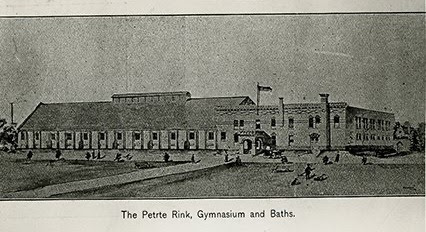
(The Petrie Rink, Gymnasium and Baths; Courtesy of Guelph Civic Museums 2014.84.2.)

The team of the Guelph Hockey Club prepared for a new season. Local players worked on their skating legs on the frozen pond at Goldie's Mill. The Royal City rink, at the intersection of Gordon and Wellington streets, had recently been enlarged and was ready for more games and up to 1,600 spectators. (The rink had begun life as the Petrie Athletic Park in 1897, was turned into a cream separator factory in 1901, and then back into a recreational facility earlier in 1907.)
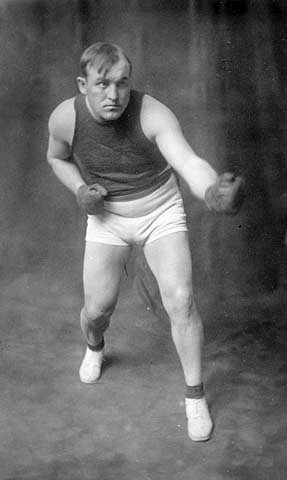
(Tommy Burns, ca. 1912. Courtesy of Library and Archives Canada 3191889.)

Besides winter events, Guelph was also linked, albeit somewhat tenuously, with the world heavyweight title boxing match in London, England, between "Gunner" Moir and Tommy Burns. Burns was born as Noah Brusso in Hannover, Ontario, and became a professional boxer in 1904, adopting the Scottish moniker "Tommy Burns" perhaps for professional reasons. He clearly had a talent for it and became world champion in 1906. On 2 December 1907, he fought British boxer "Gunner" Moir in a title defence. Though Moir was the bigger man with a harder punch, Burns's "ringcraft" served him well and he soundly defeated Moir by a KO in the 10th round.

A film of the whole fight can be seen on YouTube, along with an added commentary track. There is also a video of selected highlights, which is much shorter.

The connection with Guelph? In February, 1907, Burns had been to Guelph to put on an exhibition of boxing at the Royal Opera House with his sparring partner Jimmy Burns of Toronto. Burns was a former resident of Galt, so he was able to drop by there to visit his parents during the outing.

In addition, the Toronto Globe (2 December) reported that Burns sent the following message just before the fight to Alderman Higgins of Guelph, manager of the Royal Opera House: "Am defending the world’s championship against Gunner Moir, and will fight to bring home the money and honors.” So, it seems that Burns retained a connection with the Royal City after his recent visit. No doubt, many Guelphites read the account of his fight with great interest.

("The Bell Organ and Piano Co., Ltd., Factory, Guelph, Ont." published by Valentine & Sons Publishing Co., Ltd., ca. 1905. Courtesy of the Keleher collection. The front of the Royal Hotel can be seen to the right of the factory, facing onto Carden street. Jubilee Park is visible in the foreground, now the site of the VIA station.)

One thing that stands out to anyone reviewing the events of Xmas time in Guelph, 1907, is the number of big fires. On 5 December, a "dangerous" fire broke out in the Royal Hotel, next to the Bell Piano factory on Carden street. The fire started in the cellar and soon seemed to have hold of the entire building. It was said that smoke was soon pouring out every window. Business travelers, with whom the hotel was popular, immediately smashed many of the ground floor windows to eject their trunks and other wares. One man named Tracey had 14 trunks with him, all of which he managed to save in this manner.

A number of women were trapped by the smoke on the third floor. One made ready to throw herself out but was persuaded to wait for a ladder rescue. This was duly accomplished by Assistant Chief John Aitkens of the London fire brigade, who, for whatever reason, happened to be on hand. After the fire was doused, Aitkens went to the cellar to investigate its cause, when he was arrested by a police constable! Happily, he was well known about the town and was quickly released.

Though damage was considerable, no one was seriously hurt.

(The Taylor-Forbes factory, as seen looking northward from the Neeve street bridge, from a real photo postcard dated 1919; courtesy of the Keleher collection. The Guelph standpipe can be seen in the background.)

On 9 December, there was a blaze in a shipping building of the Taylor-Forbes plant on Arthur street. Mr. James Taylor noted smoke pouring from the structure and called it in to the fire department. The fire was quite intense as a pile of seasoned timber in the structure ignited and made for some very dense smoke. It was difficult for the fire fighters to get into the building, so they cut holes in the roof and gable ends to train water on the flames.

The fire was put out in a couple of hours but the company lost quite a bit of finished products, mainly lawn mowers, radiators, and similar items.

Another serious fire occured in St. George's Square in the boot-and-shoe store of "J. Dandeno" on 22 December. Mr. Dandeno had been cleaning up and oiling the floor, a measure taken to keep wooden flooring in good shape. He left a lit lamp on the landing of the stairs when he exited through the rear door. When the door slammed shut, it caused a rush of air that upset the lamp, which tumbled down and set the floor oil on fire. The flames quickly climbed the stairs, threatening to set the whole building—and its neighbors—ablaze.

(East side of St. George's Square, ca. 1910. Joseph Dandeno's shoe store would have been where Alex Stewart's drug store is in this photograph. Courtesy of Guelph Civic Museums, 2009.32.4536.)

Mrs. Dandeno ran up the stairs, through the flames, to rescue the children, which she was able to do through a rear window, with the assistance of some passers-by. She and two children were slightly burned and treated at the hospital.

The fire brigade had the fire out in about 45 minutes, and managed to save the surrounding buildings from much damage. Still, the Dandeno's losses were about $6,400, only half of which was covered by insurance.

This J. Dandeno was very likely Joseph Dandeno, a local boy who had worked as a piano finisher at Bell's Piano factory since about 1889. Only in the 1908 city directory is he listed as associated with a shoe store, suggesting that he had only recently gone into the trade before the fire struck. Evidently, the loss and shock were enough to prompt Dandeno to move to Providence, Rhode Island, the next year, where he lived for the remainder of his life.
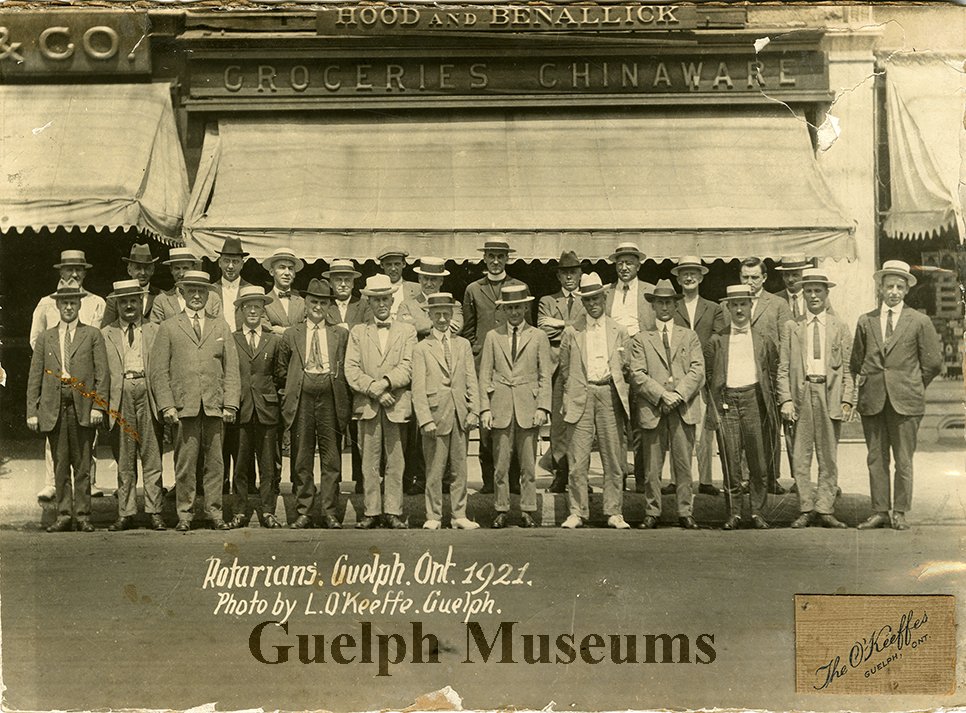
("Photograph, Rotary Club of Guelph, Lionel O'Keeffe, 1921." George Scroggie is standing fifth from the left in the front row. Courtesy of Guelph Civic Museums, 2014.84.282.)

Despite these serious fires, Guelph escaped a general conflagration. However, it was consumed by an unusual scandal that year. It came to light that month that George Scroggie, the City Treasurer, was collecting two rents for one of the residences that he owned in the city. In brief, Scroggie rented out a modest residence on Durham street to a Mrs. Fisher, an elderly black woman who was described as "a well-known character" (Mercury, 20 December). Mrs. Fisher was destitute and relied to a large degree on the generosity of her friends and neighbors. As such, her rent of $4/month was covered by the City's Relief Committee. However, Mrs. Fisher was also staunchly independent and preferred to pay her own way as much as she could manage. As such, she had been paying some rent money to Scroggie, even though the city covered the full amount.

So, it seemed as though Scroggie was collecting rent twice, once from the city and again (in part) from the destitute Mrs. Fisher. Naturally, when this situation came to general notice, it looked bad for Scroggie. The Relief Committee of the city council investigated and learned the particulars. They learned that Mrs. Fisher was perfectly aware that her rent was paid by the committee but was determined to contribute to it as much as possible. They learned from Scroggie that he was saving the money that Mrs. Fisher paid to him in this way with the idea of remitting it to the city at the end of the year.

Was this odd situation even a matter for the city government? After all, rent for the residence was paid by the committee to Scroggie as per their express arrangement. If Mrs. Fisher wanted to pay him further money out of her own pocket, knowing that her rent was fully covered, perhaps that was simply her affair. However, the committee felt it had to do something, as rumors about the situation had been spreading like wildfire.

When the committee offered to pay Mrs. Fisher the money she had given to Scroggie, and which he had remitted to the city, she refused (Mercury, 24 December):

The amount of these payments, about $20, which Mr. Scroggie has stated his willingness to pay, was offered to her, but she refused point blank to accept it. She is a very eccentric old lady, and independently maintains that she will be dependent upon charity no more than she possibly can.
So, the committee arranged for the funds to put in the hands of a trustee to be used on Mrs. Fisher's behalf when the need arose. This arrangement met the approval of the editor of the Mercury, who remarked that she would certainly need the support before the winter was out.
("Winter Fair Buildings, Guelph." Published by Henry Garner Living Picture Postcard Co., Leister England; posted in 1909. Now the site of the Market square; note the old city hall at the left.)

Since its founding in 1827, Guelph was a central point in local agriculture, a role that was enlarged with the founding of the OAC in 1874. In 1889, the Royal City became the permanent site of the Ontario Provincial Winter Fair, in which the finest live stock, poultry, produce, and other agricultural items were displayed and judged. The year 1907 was no exception, with the Winter Fair building on Carden Street (now the site of the Market square) hosting a panoply of meetings and events.

("Sir Adam Beck," Watercolour, gouache, gum arabic, on ivory, by Gerald Sinclair Hayward, 1902. Courtesy of the Royal Ontario Museum, 993.209.1.)

Perhaps the biggest draw was the speech given by the Hon. Adam Beck. Although the meat of his speech was to encourage Ontario agriculturalists to pay more attention to horse breeding (Beck was a enthusiastic amateur breeder), he could not help but mention his support for the plan to connect the region's cities to a single grid, by which electricity generated at Niagara Falls would be distrubted throughout under the auspices of a government corporation. Educated at the nearby Rockwood Academy, Beck had recently been appointed the first chairman of the Hydro-electric Power Commission, dedicated to this purpose. Guelph, like most cities in the region, was about to vote on by-laws that would commit them to the scheme. Government control, Beck argued, would ensure that the resource was developed and made available with the public interest at heart, rather than as a money-making scheme of private providers. The next month, Guelph, along with almost all municipalities in the region, voted resoundingly in favor.

Despite the success of the Winter Fair, the biggest agricultural news that winter in Guelph was the victory of the OAC stocking judging team at the International Livestock Show in Chicago the previous month. A team of students from the OAC won the overall event there for the third year in a row, which entitled them to take permanent possession of the Spoor Trophy, in the form of a bronze bull. The win was considered a national victory, which I have described in a previous post.

The real photo postcard above shows students from the OAC celebrating their triumph by painting the Blacksmith Fountain in red and white, the OAC colors, during a victory parade. The Blacksmith retained his new livery for the holidays, though it was soon removed by a city crew.
("James Gow," ca. 1880. Courtesy of Guelph Civic Museums, M1991.9.1.149.)

Guelph received an item of sad news during Xmas 1907 as well. Mr. James Gow, described by the Mercury (21 December) as "one of the most lovable men who ever lived in Guelph," passed away at his residence in Windsor, Ontario (Mercury, 21 December). Born in 1827 in Glasgow, Scotland, Gow had emigrated to Canada in 1851, settling first in Hamilton but then moving to a farm in Eramosa. In town, he struck up a partnership with Peter Gow (not a relation or, at least, an immediate one), in the form of P. & J. Gow, tanners and leather merchants. In 1866, the partnership was dissolved and Gow had a storehouse built on Huskisson street (now Wyndham street south) to carry on the business in his own name. However, he was then appointed to the office of Collector of the Inland Revenue in Guelph.

Ten years later, he was transferred to the office at Windsor and then made Inspector of the Windsor District and Dominion Inspector of Distilleries, an appointment he held until retirement in 1902. Although he had been away from Guelph for some 30 years, we are told that his inspections brought him regularly to his old haunts and that he kept in close contact with old friends and family members who remained in the Royal City.

On the whole, it seems that Xmas and New Year's in Guelph in 1907 was merry enough, though not remarkably so. It was neither especially memorable but not without notable news and events. Perhaps the season is epitomized by the following item from the Mercury (28 December):

Drank 21 beers

This is the story which is going the rounds today. The employees of a certain factory last night decided to test the drinking capacity of one of their number—a colored gent. Accordingly they hied themselves to the nearest dispensary of warming drink, and then this man of mighty thirst got on the outside of 21 beers—not small beers, or short beers, or ordinary beers, but 21 big pint schooners of lager. He walked home afterwards but was not at work today.
No doubt, speakers with the Women's Institute would not have approved but such were the spirits of Xmas in Guelph in 1907.

Merry Xmas and Happy 2025, Guelph!

Saturday, 17 December 2022

Merry Xmas and Happy New Year, 1914

The postcard shows a lovely, summery scene featuring the Blacksmith Fountain in St. George's Square. The streetcars carry passengers in their summer attire, who are probably happy that the open sides let in cooling breezes. Perhaps the driver of the oncoming car secretly hopes to apply the made-in-Guelph cow-catcher on the front to scoop an errant pedestrian out of the way.
("St. George's Square, Guelph, Canada," ca. 1910. Published by the International Stationary Company, Picton, Ontario.)

Although postcard publishers tended to prefer summer photography, postcards were sent all year round, and this card was actually dispatched from Puslinch to Guelph on 31 December 1914, when the Royal City and its surroundings had be socked in under repeated snowfalls.

Addressed to Mrs. James D. McPherson on York Road in Guelph, the message relates to the holiday season:

Dear Jim & Belle:—
We got the photos and you could not have sent us a better Christmas box. Glad to hear baby is growing so well.
Wishing you all
A Happy New Year
Aunt Flora
Of course, the year 1914 was an unusual one in Guelph. The Great War had begun a few months earlier and Canadians were still unsure what it would amount to. Many young men had left with the Canadian Expeditionary Force and were still in Britain training for combat. Herbert Philp wrote a letter home to his family, which they subsequently published in the Mercury (24 December), under the ironic title "Salisbury mud a wonderful thing." In it, Philp speaks eloquently of the frustration of the contingent:
For, despite the eagerness of practically every man in the contingent to be "over the way," we are still wallowing about in England's mud.
Philp explains that the conditions were fine and dry on their arrival, and they pitched their tents in a "slight valley." Then down came the English rains, leaving their modest dwellings with:
ambitious rivulets flowing either through them or snuggling close to their sides. Not a tent but contained a pool of water.
When the weather let up, the tents were moved up slope but the cookhouse remained down in the valley, meaning that everyone had to line up there three times a day, in whatever weather, to get their food. The result was frequenty cold tea and soup and soggy bread at meal times.
(Detail of "Herbert William Philp," no date; Courtesy of William Ready Division, Archives and Research Collections, McMaster University Library, via The Canadian Encyclopedia.)

Philp finishes his letter thus, "But, so far as excitement and entertainment are concerned, Salisbury Plains still runs a close second to the grave."

(Herbert Philp's many and eloquent letters home throughout the Great War have been collected by Ed Butts in the book, "The Withering Disease of Conflict: A Canadian Soldier's Chronicle of the First World War." It is available from the Guelph Historical Society and I highly recommend it!)

War news was a mixed bag. Accounts of terrible battles were featured, but the general tone conveyed the sense that the Allies had the upper hand and German defeat in the near future was still a possibility, though not by Christmastime.

Rumours of German attacks on or in Canada circulated. For example, a national article printed in the Mercury (1 December) related a scheme set in motion for German forces to take over Quebec City. A concrete structure made the previous year near St. Anne de Beaupré by a German movie crew in 1913 was thought to be a bunker intended as a weapons cache for a surprise attack launched by sea. Luckily, British naval superiority had frustrated this plan, it was thought.

The many Canadians of German descent in the region also caused concern. A letter to the Editor (11 December) attempts to address rumours of a German-Canadian fifth column thus:

Editor of the Mercury.
Dear Sir: Who are the meddlers who have been reporting to Guelph authorities that secret meetings are being held in Morriston by the Germans and German-Canadians?
There are no secret meetings held in Morriston to my knowledge. Perhaps the meddlers had reference to the revival meetings, held in the Evangelical church, which are held annually. These meetings are not secret, but sacred, and people of all nationalities are welcome to attend.
Are such meddlars as these throughout the Dominion interested in uplifting our Canada? No, they are too ignorant to realize the harm they are doing their own village and community, also their own country, Canada.
Yours respectully,
A life-long Mercury reader.
As ever, conflict breeds suspicion and mistrust, well-founded or not. Locally, misplaced suspicion of German- and Catholic Canadians resulted in the Guelph Novitiate Raid of 1918.
("Evangelical Ch., Morriston." Courtesy of Wellington County Museum and Archives A2009.124, ph. 31342.)

Compared to previous years, the Xmas shopping ads in the Mercury seemed subdued. Still, they were far from absent. The D.E. Macdonald & Bros. shop urged Guelphites to "Hurry up! Only two more Saturdays before Christmas" (11 December). Extensive gift suggestions for him, her, and baby were provided, along with an illustration of Santa Claus hauling a prodigious sack of goodies.

Similarly, Moore and Armstrong noted that there were only nine shopping days left (14 December): "If you have not got the Christmas Spirit yet, you will have it in large measure when you get to the White House," that is, their store on Wyndham street.

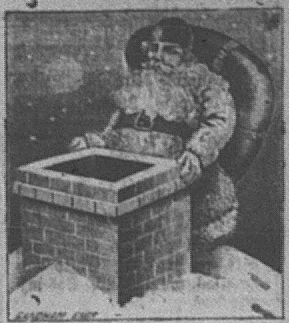
Their illustration also showed Santa Claus carting a super-sized sack of gifts. One can understand the look of relief on the jolly old elf's face at the sight of the very wide chimnney before him!

If nothing else, Santa's message was to go big or go home, or both!

Even Santa Claus was not unaffected by the conflict in Europe. This cartoon shows how low German Kultur had sunk with the war (22 December):

The caption says, "An act of barbarism: Not only are the Germans firing on the Red Cross and flags of truce, but they are rendering the work of Santa Claus difficult and hazardous."

Being magical, Santa had the means to rectify the situation, as shown in a subsequent cartoon (26 December):

Here, Santa deploys what I assume is a stocking full of doorknobs to give Kaiser Bill a jolly good thrashing.

People on the home front carried on. The Guelph Musical Society held a parade downtown on 9 December. The performance was marred somewhat when large bulldog followed the squad down Wyndham street. The drummer found that the dog would bite the drumsticks whenever he raised them to beat the kettle drum. Fearing that he might be "minus a wing" if he provoked the dog further, the drummer ceased drumming and the band had to proceed without their bass.

The animals did not have it all their own way. A bear cub named "Teddy" had been kept as a curiousity at the American Hotel on Wynhdam street for most of the year. Having reached the size of 200 lbs, Teddy was sent Bernard Schario, the butcher, who turned him into roasts and steaks as a holiday feast for the hotel residents (24 December).

The skating season took shape. With the cold weather, Guelphites were soon skating on the pond above Goldie Mill. Skating also began indoors at the Royal City Rink (formerly Petrie's Athletic Park and Rink) at Wellington and Gordon streets.

(Detail of "The Petrie Rink, Gymnasium and Baths," 1898. Courtesy of Guelph Museums 2014.84.2.)

Curiously, the street railway company decided not to open their usual skating rink on Howitt's pond, on the basis that it would not be "a paying proposition" (18 December). In previous years, the rink behind the streetcar barns on Waterloo road had been run as an attraction to get people onto the streetcar system in winter.

Perhaps they had too much competition. The City had decided to fund a rink on the grounds of the Guelph Collegiate Institute on Paisley street. A room in the basement was even made available for people to put on their skates (22 December). Perhaps this level of comfort and style attracted skaters who might have been inclined to travel to the streetcar rink in previous years.

("Collegiate Institute, Guelph, Ont." Postcard printed for Waters Bros., Guelph, ca. 1910. Courtesy of Guelph Museums 2009.20.1.)

The Royal City Rink was also home to Guelph's very first NHL team! Yes, Guelph entered a team in the 1914–15 Northern Hockey League senior series (21 December). Although some of the players trying out for the team were from out of town, lots of local boys turned out to show their stuff, including Allan, Anderson, Stricklerr, Greer, Hayes, Spalding, Ogg, King, Mowat, and Bulgin.

The side lost their first exhibition game against the Dutchmen of Waterloo (26 December). Although the Guelphites mainly acquitted themselves well, the superior size of the Seagramites gave them a distinct advantage, resulting in a 5–2 win for the visitors.

Another tilt against the same team was arranged for the first regular season game. This time, the Royal City skaters were better prepared. The result was a "wild sort of affair," beginning with a dispute over whether one of the Guelph players was a professional—strictly forbidden! The play was very physical and Referee Knell of Berlin (Ontario) "had his hands full."

The police had to be called in to break up a melee after the crowd joined in an on-ice altercation in the second half. Tied at the end of regulation play, the game went ten minutes into overtime before Guelph's centre, McGregor, put the home team up 7–6.

At the Reformatory (or "Prison Farm"), the provincial government announced plans to install an abattoir on site (31 December). The Ontario prison system required 600–700 tons of meat annually in its operations, which was obtained from private butchers. Building an abbatoir at the prison meant that prisoners could be employed to perform the butchering at a lower cost than private butchers, saving the system some $50k a year. In addition, prisoners would learn skills that they could use to obtain regular employment as meat dressers in private industry after release.

("Ontario Reformatory Guelph, Jan. 1915 The Abattoir." Courtesy of Guelph Museums 2014.84.1276, p. 59, ph. 3.)

A final point of interest came with the annual, municipal elections. First, there was some talk of not holding the elections at all, in view of the war situation (17 December). But, the election went ahead as usual.

Besides electing a Mayor, Aldermen (Councilors), and other officials, citizens of Guelph were asked to weigh in on the following by-law, "Are you in favor of municipal votes for married women?" (8 December). The 'Women's Franchise plebisite' was carried by a majority of (male) voters 1140 to 838 (5 January 1915).

Women's groups had long campaigned for women's suffrage in Ontario. In the Edwardian era, efforts tended to focus on municipal voting. In 1914, the Canadian Suffrage Association, led by Dr. Margaret Gordon, had lobbied many Ontario municipalities to hold referenda on extending votes to women. It appears that Guelph was one of 33 municipalities where the effort met with success, albeit for married women only.

Women's role in the Great War led to further support for the cause. In 1917, Ontario women finally gained the right to vote in provincial elections.

In many respects, the holiday season of 1914 was like those of previous years. Even so, as the prospect of the end of the conflict in Europe receded, it was clear that times were changing and that the New Year would bring on many new challenges.

Sunday, 27 September 2020

Petrie's pleasure scheme: Guelph's first indoor swimming pool

On 27 December 1897, the Daily Mercury broke the news breathlessly to Guelphites:
A mammoth scheme.

Mr. Petrie to build a gymnasium, bicycle track, hockey and skating rink.

Mr. A.B. Petrie, with characteristic enterprise, is making a move which will meet with the hearty good will of nearly every one in the city.

The city has long been in need of a well-equipped athletic grounds and this want Mr. Petrie has decided to meet. With this end in view he has purchased from the Jackson estate the property, adjoining Johnson’s boat house, near the Dundas bridge. Here he proposes to build a gymnasium with club rooms, swimming baths, etc., a first-class bicycle track, and a grandstand to seat from 1500 to 2000 people, and a regulation size hockey and skating rink. The green will be fixed up so as to be suitable for lawn tennis, lacrosse, football, bowling, etc.

As I noted in a previous post, Mr. Alexander Bains Petrie (1843–1921) was a prominent Guelphite with several business successes to his credit. Today, he is best known as the druggist who built the Petrie Building, which was recently restored to its former glory after an energetic campaign.
(Mr. A.B. Petrie, owner of Petrie Athletic Park and Rink; Detail of Guelph Civic Museums 1986.17.1.)

However, as this article makes clear, Petrie was also a keen supporter of athletics, especially distance running: He was a founder of the Guelph Road Race Association in 1894. His decision to build such a comprehensive athletic facility is testimony to his desire to bring athletic competition of all sorts to the Royal City.

Although not included in the headline above, Petrie's Athletic Park was to include not only a gymnasium, track, and rink but also swimming baths. Surviving accounts of the Park say almost nothing about this pool but, given the sports focus of the other facilities of the Park, there can be little doubt that the pool was intended for competetive swimming rather than casual bathing of the kind provided earlier at Hazelton's baths. As such, the pool at Petrie's Athletic Park counts as the first indoor swimming pool in the Royal City. No doubt, it was influenced by the pool at the Ontario Agricultural College up the road but that was located outside the city limits at the time.

As the article notes, Petrie's Athletic Park was built in the vicinity of Johnson's Boat House, near the corner of Gordon and Wellington streets today. One image of the facility shows the side facing Gordon Street, with the rink on the left and the gymnasium on the right. (The race track was set in a separate oval structure to the right of this view, about where the Guelph Animal Hospital is now.) The caption confirms that "baths" were among the offerings of the facility. No doubt, the baths were in the basement of the gymnasium component.

(The Petrie Rink, Gymnasium and Baths; Courtesy of Guelph Civic Museums 2014.84.2.)

The approximate position of the Petrie Rink and Gymnasium are shown on the satellite map below (Courtesy of Google Maps).

The Park was soon a popular venue for skating, hockey, lawn tennis and bowling etc. The Second Ontaio Canadian Wheelman's Association bicycle races were held on its track in 1899. However, I have yet to find any explicit mention of activity, competitive or otherwise, in the swimming pool. It seems that the bathing pool just did not capture the attention of Guelphites.

The closest thing that I have seen that might pertain to Petrie's pool is a notice for swimming lessons, found in July editions of the Mercury of 1899:

Swimming taught in one week

My classes are now being formed. Private pupils taken in hand. Special rates where there are more than one from the same family.

If you want your boy to swim, or you wish to learn yourself, address for terms to

H.K. Cockin,
(The Mercury)
References from each pupil of last year.

The instructor is (Eustace) Hereward Kirby Cockin, who was a Guelph literary figure and columnist with the Mercury. He was born in Frizinghall, Yorkshire, England, in 1853 and was well educated and well travelled. He immigrated to Toronto in the early 1880s and eventually became an editor with the city's new Saturday Night magazine.
(Guelph and Ontario Agricultural College Cricket Club, 1913. Courtesy of Guelph Public Library CA ON00126 C6-C6-0-0-0-0-204. H.K. Cockin is the old gentleman in the back row just to the right of center.)

Besides his commercial writing, Cockin was noted for a book of his poetry entitled "Gentleman Dick o' the Greys and other poems" (1889). The title piece is a narrative about British soldiers fighting in the Crimean War, with a twist ending. As might be expected, this piece and others are written in a tenor influenced by Alfred Tenneyson, author of "Charge of the Light Brigade." For example:

But, ere we could re-form our grape shatter'd ranks,
The Vladimir regiment burst on our flanks.
And 'twas hack, cut and slash—little parrying there—
If the Russians were devils what demons we were!
Right nobly our handful disputed the field.
For a Briton can die! tho' he never can yield!
Most poems express a loyal love of Britannia and its imperial projects. Others make use of common racist stereotypes that would make the volume unpublishable today. Cockin does have a comic touch that I appreciate, my favourite being "Lying epitaphs," in which the author wanders through a cemetery admiring the memorials, only to be informed by "an old man" that they are all deceits, for example:
"The tombstones here are neither more, nor less
Than eulogies on byegone wickedness.
For did one pitch in vales of vice his tent,
The grander here that scoundrel's monument."
And ending with the thought that:
And each of our "God's acres"—if 'tis so—
Is nothing save a marble-cutter's show.
And each "Here lies" the good, the great, the wise,
But upright stones of downright chiselled lies.
The obvious moral is against hypocritical shows of piety but I like to think that Cockin, as an author, also recommended a certain scepticism of the written word, even when carved in stone.

Cockin also composed verses for various occasions, such as the return of Guelph's soldiers from the Boer War in 1901, and was popular as an orator for special events. He also published a column in the Mercury under the pen name "The Blacksmith," giving his views of current events.

Although well known for these endeavors, Cockin was also moted for his ardent interest in cricket, which he played at a high level. It seems he took a liking to Guelph's English character while in town from Toronto to play the local cricket club and relocated to the Royal City (Mercury, 23 June 1917) in the early 1890s as a result. His obituary also confirms that cricket was his life-long love:

As an instance of his manly pluck throughout his last trying and hopeless illness, Mr. Cockin remarked to an old friend whom he met on the street,
“I have tried all my life to play cricket, and when the inevitable comes, as it soon must, I hope it may be said of me ‘He played the game.’” And he surely did.

I have seen no records noting that Cockin had any expertise at swimming, so it is a little hard to fathom why he would be offering swimming lessons. However, his keenness for cricket suggests a love of sport, and expertise at swimming was not required to give lessons in that era. Quite likely, his lessons were focussed simply on helping people develop skills to prevent drowning, such as learning to float, skull, and tread water. Lessons might go as far as rudimentary instructions in the breast stroke. Cockin advertised no certification from any swimming association, just the good impression left with his pupils in 1898.

It is the fact that his lessons were offered in 1898–99 that may connect him with Petrie's Athletic Park. Those two years are the first that the pool was available, so it may be that the lessons were intended, in part, to promote the new facility. Or, it may be a coincidence.

All indications are that the Petrie Athletic Park was a hit. Running and cycling competitions were held there in the summers, while hockey and skating events were popular in the winters. New-fangled "moving pictures" were shown there, perhaps for the first time in Guelph.

Festivals and balls were held in the gymnasium, as well as a Canadian Conversative Party convention in September, 1901. The keynote speaker was Sir Charles Tupper, a Father of Confederation and a former Prime Minister who still holds the record for the briefest tenure in that office.

According to the (Liberal) London Advertiser, the whole affair was a disappointment, with Petrie's Rink half-empty and also draughty and unheated. The audienced thinned out continuosly as each successive speaker droned on. According to the (Conservative) Toronto Globe, the rally was a great success and the Rink was half-full despite the unpleasant weather. The speakers thrilled the crowd and the Party rallied behind them in support of enduring Conservative policies such as opposition to free trade.

So, it must have been a shock when the Mercury (27 September 1901) announced that the Petrie Athletic Park was to be closed. A.B. Petrie's son George had joined the Taylor Mfg. Co., which manufactured the Magnet Cream Separator, to form the Petrie-Taylor Mfg. Co. New facilities were needed immediately to ramp up separator production and the only space on hand, by this account, was the Athletic Park.

Guests of the Petrie-Taylor company held a year-end bash in the facility on 27 December 1901, both to close the old place and, in a sense, to open the new one (Mercury, 28 December 1901):

Petrie-Taylor at Home.
Many guests enjoy opening of new factory.

It was difficult to imagine last night that scene of gayety and social activity which the new Petrie-Taylor manufactory presented would so soon be transformed into a work-room of the skilled artisan, when the strains of the orchestra would be replaced by the hum of machinery, and the graceful motions of the dancers by the hurrying hither and thither of the busy workingmen.

No information is given explicitly, but I imagine that the swimming pool was filled in and buried and quickly forgotten. Possibly, traces of it remain under the parking lot of the Wellington Plaza today.

Like the swimming pool under the gymnasium of the OAC, the pool at Petrie's Athletic Park did not find an audience right away. However, it was not in service long enough for interest to grow. As such, it was an indication of the growing profile of swimming as a sport, although interest in it would have to await the construction of other pools. Even so, the Petrie pool had earned the epitaph, "Guelph's first swimming pool."


Given that it closed in 1901, it is no surprise that the Petrie Athletic Park does not appear as such in any Guelph postcards. However, the building did live on.

The cream separator business does not seem to have paid off as anticipated. The Petrie-Taylor Mfg. Co. became the Petrie Mfg. Co. in 1903, and the facility was sold off to the Guelph Carpet Mills in 1906. Then it was bought up by the Guelph Hockey Club and became the Royal City Rink.

So, it was certainly around during the height of the postcard mania of the Edwarian era (and later). However, rinks seem not to have been a popular category of collectable image and no commercial postcard image of it has come to my attention, nor any real-photo card. Indeed, the only picture of the rink of any kind that is readily available is this one taken from the east during the spring flood of 1929:

(Courtesy of Guelph Civic Museums, 1971.6.1.)

Happily, a far-off view of the building can be found in a later aerial view of Guelph, taken and issued by McPhail Air Services Ltd. in the early 1960s. (The card is distinguished by its large size, 6" by 9", and others in the series are labelled as part of the "Giant Post Card" series.) A detail of the card is shown below, with the rink circled:

Thank goodness for postcards with aerial photos!
The Internet Archive provides a full scan of H.K. Cockin's magnum opus, "Gentleman Dick o' the Greys," which you may care to peruse.

Here is the text of his poem, "When the troops came home" (Mercury, 12 January 1901) celebrating the return of the Guelph contingent of British forces sent to fight in the Boer War (led by John McCrae):

Welcome! Soldiers of the Empire! You, who nobly sprang to arms
In the Empire's hour of danger—in the midst of War's alarms;
You, who heard the voice of Duty, when the skies were overcast;
You, who heard Britannia calling, and obeyed her trumpet blast,
You, who bring your honor spotless from South Afric's distant shore;
Welcome Home, brave lads in kakhi! Welcome to our hearts once more!
Spirits of your fallen comrades! Shades of the unconquered slain!
Hear the Royal City's welcome, when her sons come home again.

Calm the Southern Cross is smiling at the Great Bear of the North
(First star gazer on the anguish and the pride that sent you forth)
You, who came from toils and hard ... from the far veldt's lonely track
...
Oh! not on your shields, but with them ye, brave hearts of Christ's saving grace
Live to hear the grand Te Deum—passed the trenches' narrow space.
Welcome! Welcome! Home-bred heroes! Who have stemmed the surging main,
Hear your kith and kin's glad welcome when their own come back again.

You have helped to crush Oppression; you have stayed the Bloody Hand;
You have burst the gyves of Freedom in that far off Southern land!
You with the victorious Living and the unforgotten Dead,
Have re-painted Britain's war-map with another splash of red;
You have dug the blood-gauged road-bed that full soon goes stretching forth
From the sunny slopes of Capetown unto Cairo in the North!
Swazis! Zulus! and Basutos! Boers and Griqnas! hear the strain
Of the Royal City's welcome when the troops come home again.

Heirs of deathless Balaclava and the red Bayuda sands!
Heirs of India's mountain-passes and the fields of many lands!
Stern avengers of Majuba and of Laing's ill-fated Nek!
Spur-welts of the Boers' inspanning to his last and longest trek!
Europe, Africa and Asia—each has heard your martial tread;
Laurels for the living victors, cypress leaves to deck your dead;
Welcome! Valiant Sons of Empire! with you honor free from stain,
Pile your arms—your Guns unlimber—Hi! the Battery's home again.

—The Blacksmith

T.B. Costain, later novelist and editor of the Mercury, provides an interesting character portrait of H.K. Cockin in recalling his first encounter with the latter (Mercury, 20 July 1927):
Recollections of “The Blacksmith”

The other member of the regular staff was Mr. H.K. Cockin, probably the most picturesque citizen that Guelph boasted at the time. I shall never forget my first sight of him. One day, when I was on The Herald, I had passed on the streets a very tall and very dignified man wearing the highest starched collar I had ever seen on a human neck and the plaidest pair of shepherds plaid trousers that any tailor had ever cut. He looked a little aloof and sad and very decidedly out of his setting on solemn Wyndham street. I was very curious about him at the time and it was a surprise, therefore, to walk into the dingy old editorial offices of The Mercury on my first day and discover this imposing and ambassadorial person seated behind a desk there. Mr. Cockin spent his mornings in the office, reading proof and doing some other editorial work, but his main function was the preparation of a column for the Saturday edition under the pen name of “The Blacksmith.” It was, I’m afraid, rather ponderous material, but it had a classic smack to it and people throughout the whole county read it with a great deal of interest. As for “H.K.” himself, he was one of the very finest and most courteous men I have ever been associated with.”

What did Cockin's swimming costume look like, I wonder.