Showing posts with label Illustrated Post Card Co.. Show all posts

Wednesday, 4 December 2019

Guelph postcard producers: The Waters Bros.

The Waters Bros. were regular advertisers in local newspapers like the Guelph Mercury. A typical ad might run like this:
Waters Bros., Guelph
Headquarters for O.A.C.
And School supplies
For
Nature study
Botanical
Entomological
Drawing
Painting

41 Wyndham Street
Phone 350
So, it was likely a surprise to readers when the following ad appeared in the usual space (Acton Free Press, 29 Apr 1915):
No reasonable offer refused

Show cases and equipment
Picture frames, china and glassware, etc.
Everything must be sold

Waters Bros., Guelph.
Suddenly, the Waters Bros., a long-established Guelph enterprise, was going out of business. What happened?

The Waters Bros. was a Picture and Art Supply business founded in Guelph in 1878 by Frederick and Florance Waters. Frederick (b. 1853) and Florance (b. 1854) were sons of Charles and Frances Waters. Charles was a customs official in the southeast of England. In 1877, the two had immigrated to Canada, where Frederick had set up a business in Guelph. When his brother Florance joined him there in 1878, they formed the Water Bros., and placed the following notice in the Daily Mercury (23 April):

Important.
Frederick Waters begs leave to inform the public that he has taken into partnership his brother Florance Waters. The business will be carried on under the style of Waters Bro’s.
The new firm offers a large and varied assortment of oil paintings, chromos, engravings, frames, mouldings, &c., at lowest prices.
Upholstering as usual. Carpets made and laid. Mattresses re-made and made to order.
Parties furnishing will find it advantageous to call and inspect the stock of Waters Bros.
148 Quebec street, Guelph, West of McCrae’s Wood Yard.
The address would be approximately where 33 Quebec St. stands today.


(Quebec street west in 1874, roughly as it appeared when Waters Bros. set up shop there a few years later, about half-way down the south, left-hand side. Courtesy of Guelph Civic Museums 2013.72.94.)

The partnership did not last long. In 1881, the brothers dissolved it and Frederick moved on to Stratford. Florance took over the business but kept the "Waters Bros" name. It seems that Florance was not the brother interested in upholstery and carpets, since these are left out of the description of the business in the "Industries of Canada" (1886):

Waters Bros.—The Picture Gallery, near Post Office; Picture Frames, Oil paintings, steel engravings, mouldings, poles, cornices, and mirrors, well known in Guelph as a reliable house in every respect at which to purchase pictures or get them framed; also artists’ materials, and every article required by amateurs and professionals—established their business eight years ago, on their arrival in this country from England, the land of their nativity. They occupy very neat premises, near the Post Office, which are 25x25 feet in dimensions and two stories in height
The title "The Picture Gallery" remained the slogan of the business in future. Note this title in the ad below, from the 1882 Evans City Directory:


One of the benefits of owning a prosperous business is that Florance could get married. On 12 April 1879, Florance married Fanny Lacy, also an English immigrant, who resided in Palmerston at the time. By 1882, the couple had moved into a lovely house at 94 Liverpool Street (now 86), as shown on Google Street View below.


Charles and Fanny had a large family, Charles Jr. (b. 1880), Florence (a girl, b. 1881), Edith (b. 1883), Caroline (b. 1885), Fanny (b. 1887), George Percy (b. 1889), William (b. 1892), and Arthur (b. 1894) (1901 Census). It seems that the picture and arts supplies trade paid decently enough.

Of course, the future is never certain. By 1884, the Waters Bros. had moved a couple of times and then occupied a space on the south side of Quebec street opposite the Bank of Montreal, facing out on St. George's Square. This spot must have been considered prime real estate for trade. Yet, shortly after noon on 31 May 1887, the block in which their store sat caught fire (Mercury). The blaze imperiled the whole block, from Mr. Copeland's barber shop at the south end, Nunan's book bindery, Hall's tailor shop, Clark & Thompson's carpet store, as well as the Waters Bros.

One advantage of the locale and time was that many people were on hand to pitch in:

Soon a crowd gathered, and when it was discovered that Mr. Copeland and his family had removed, efforts were directed to saving the property of Waters’ Bros, for nothing could be done in the bindery. Willing hands were soon at work, and succeeded in getting out the most valuable portion of the stock in an increditable short space. Those engaged in the work seemed to “keep their heads,” and rescued the contents in such a safe manner as it seldom witnessed now.
The Waters Bros' loss was estimated at $1500, with a $1000 of insurance.

Alderman Hearn, who had recently purchased the block, had insurance and decided to rebuild. However, the Waters Bros. had to vacate their building. They moved temporarily to the store previously occupied by James Nelles (father of Charles Nelles, subject of a previous blog) at 25 Wyndham street to hold a fire sale, "Where they are preparing to sacrifice their tremendous stock."


(25 Wyndham St., currently the location of Wimpy's Diner; courtesy Google Street View)

The Waters Bros remained at this site for a couple of years. However, when the new Hearn Block was ready, they relocated back into the fancy, new digs, with double the space. The announcement was made as follows (Mercury, 25 July 1889):

Going west.—Stock must be reduced. No reasonable offer refused as Waters Bros., will remove in a few days to the double store in Hearn’s block, St. George’s square.
The phrase "Going west" usually applied to people who were moving to western Canada; Florance was using it here to refer jokingly to his move from the east to the west side of Wyndham street.

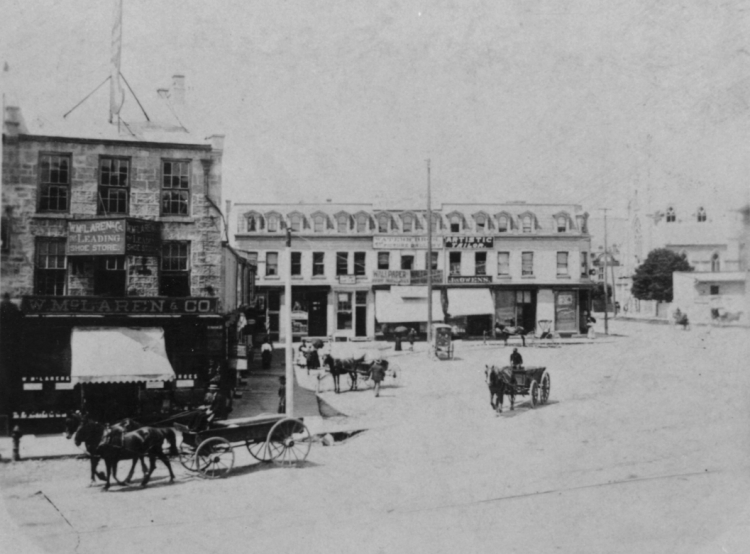
The Waters Bros. store in the Hearn Block, ca. 1895, can be seen in the photo below. It lies in the middle of the block, in the right background of the photo, behind the tall pole.

(Courtesy of Guelph Public Library, F38-0-15-0-0-22.)

The sign below the attic windows reads, "Waters Bros. // The Picture Gallery." A sign over the awning reads, "Wall paper," always a good seller, and other things that are hard to make out.

Apparently, the west did not suit the Waters Bros store for long. In September 1898, the store returned east to 39 Wyndham street, just south of St. George' Square, currently the location of a nightclub. A few years later, they moved one door up the street to 41 Wyndham street, currently the home of Guelph Today.


(41 and 39 Wyndham street, courtesy of Google Street View.)

At around the same time, the Waters family moved from Liverpool street to a substantial stone house at 27 Arthur street (now 86), backing on to the Speed River. It seems that The Picture Gallery had made Florance Waters and his family a picture of prosperity!


(86 Arthur street; Courtesy Google Street View.)

When the picture postcard craze swept the Edwardian era, the Waters Bros was a perfect position to capitalize. The store had always carried souvenir goods for special occasions such as Christmas. This, and their attention to pictures, made postcards and related phenomena a natural extension of their product line.

Postcards bearing the imprimatur of the Waters Bros. seem to come in two groups. The first group have postmarks in the date range 1908–1911 and have the same backs (in brown ink) as those published by the Pugh Mfg. Co. of Toronto (in blue ink), suggesting that both used the same printer. The views on these cards are typical for Guelph postcards of the era. For the most part, the pictures seem to have been borrowed from other producers, although a few may have been taken especially for the Waters Bros. stock.

For example, here is a nice view of Massey Hall at the Ontario Agricultural College, with a gentleman standing outside of it:


This card was addressed in 1909 by Stanley R. Dayton of Little Britain, Ontario to H. Smith of Ingersoll as part of a postcard exchange, a common arrangement of collectors who sent each other postcards of interest. The text sounds like the sort of thing that two enthusiastic, young postcard collectors would ask of each other:
Many thanks for your pretty card. How many cards have you? Do you get many out of the exchange? What do you work at? I am going to school all the time and soon.
The picture is the same as one found in a contemporary Warwick Bro's card, even to the awkward cropping on the right-hand side.

On the back, the card is identified as "Published by Waters Bros, Guelph, Ont."

Another interesting picture shows a view taken from the top of Goldie's Mill, looking down the Speed River, over the Norwich street bridge towards the spire of St. George's Church.


This card was postmarked on 3 September 1908 and was addressed by "Cousin Neil" to Miss Sadie McPherson of Guelph as follows:
Dear Sadie, You will be at school now. Ida & Tina did not get up in the holidays. Maybe they’ll come some Saturday. Our flower Sunday at Sunday School is on Sunday, the 6th Sept. How are Uncle Donald & Aunt Christie & John & all you girls? I had a good time at your place.
This image is the only version I know of issued as a colour lithograph. There is a halftone version with no publisher's mark that may have originated with Charles Nelles.

The second set of Waters Bros. cards are reprints of cards issued by the Illustrated Post Card Co. of Montreal, with postmarks in the 1911–1913 range. For example, here is a view of the then-new Carnegie Library, with a well-dressed couple posing in front:


The postcard was sent from Fergus by Harold to Harry and Florrie Lewar of London, England on 14 June 1913:
Many thanks for letters. so pleased to hear that you are not moving from London. I went washing sheep for Hastings the other day & then took a swim. I will write that character for you Harry before I leave here.
Swimming with sheep sounds like it might be highly therapeutic.

Another nice postcard from this set depicts Gow's Bridge, now often known as the McCrae Bridge, when the mill and other buildings were still present:


The subdued, watery palate of the series shows the river to good effect.

Certainly, the Waters Bros were selling postcards with their own imprimatur in the 1908–1913 period. It is quite possible that they sold postcards from other producers beforehand and even at the same time. In all, it seems likely that postcards formed a nice side line for the business

As with so many other things, the Great War changed all that. Shortly after war was declared, young William Waters volunteered for the British Columbia Horse (Mercury, 11 August 1915). The previous year, he had taken a job with Guelph's Taylor-Forbes foundry, which sent him to their Vancouver office. Finding that horses were too scarce, Waters travelled to the training camp at Valcartier, Quebec, and joined the 5th Battalion, infantry.

His military records reveal that Corporal Waters's service was not long or easy. He suffered a case of the flu in December, followed by bronchitis in January 1915. His regiment was among the first sent to France, where it became involved in the Second Battle of Ypres, where poison gas was first deployed by German forces. At Langemarck, Corporal Waters was reported to be wounded on 25 April and evacuated to a field hospital, which authorities reported to his father, Florance.

Corporal Warron, a friend of Corporal Waters who had been lightly wounded in the same attack, noted that his friend was not to be found and instigated a search. It turned out that the field hospital where Waters lay was overrun by German forces and Waters had become a prisoner of war. In August, German authorities listed Waters as dead, with no details given as to the cause. The Canadian military listed Waters as deceased and informed his family in Guelph on 10 August.

It seems likely that this string of events precipitated the sudden decision to liquidate the Waters Bros. business in April 1915, as noted above. The process was completed in September, shortly after news of William's death reached home. Curiously, advertisements for the liquidation sale are to be found in the Acton Free Press but not in the pages of the Mercury itself. It may be that the news was all over town anyway, so that local advertisements were unnecessary but that is only a guess.

A picture of Corporal William Waters was published in the Mercury on 18 August:


Curiously, for the family of a picture business, this is the only photograph of a family member that I have yet come across. (If anyone has more, let me know!)

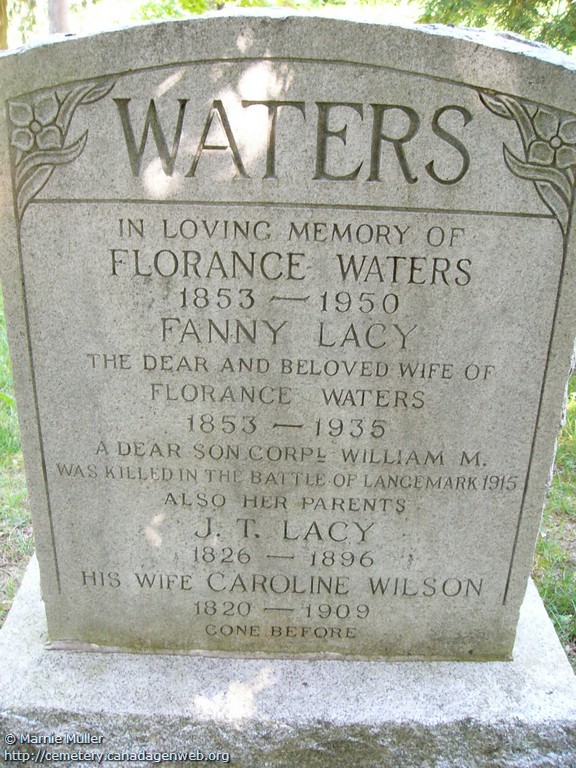
In a few months, Florance and Fanny packed up and moved to Vancouver, for reasons that remain unclear but may be connected to William's residence there. Even at such a large distance, the family was not forgotten in the Royal City. A marker is to be found in Woodlawn Cemetery, commemorating Florance and Fanny, Fanny's parents, and William:

(Courtesy of CanadaGenWeb Cemetery Project.)

Besides this marker, we have their postcards to remind us of the Waters family, their business, and the Guelph that they lived in before the Great War.

Monday, 13 July 2015

In Guelph and in poor health

Postcards are generally noted for their sunny views and sunny messages. Messages on postcards are often confined to mundane expressions about good health, such as "we are all fine" and "hope this post card finds you well." However, that is not always the case. Sometimes, postcards convey messages about ill health, from simply feeling poorly to reports of fatalities. It is interesting to look through the messages found on postcards for these unusual but sometimes telling glimpses into how people experienced illness in the Edwardian era. In this posting, I will share a few messages relating to illness from my collection. For the sake of focus and space, I will restrict the messages to physical illness—thus excluding psychological problems like home sickness—and set aside injuries such as work related accidents (where the distinction is clear).

First of all, illness is often mentioned simply in order to explain or excuse people's manner of writing. A simple example would be the following from a postcard postmarked in 1908:

Was ill on Sunday and have been too busy to write since. Am all right now. G.
Sending a postcard saying that you cannot write may sound like an oxymoron. However, in the Edwardian era, it was usually the case that only a full letter counted as "writing". A mere postcard with a line or two did not qualify. Here, the postcard mentions an illness to excuse the fact that "G" has not written when that might have been expected. Nothing serious.

Besides excusing one's own want of letter writing, postcards describing illness could be used to prompt letters from others. I have the sense that such prompting is partly behind the following message addressed to Master L. Frayer of Galt on 11 April 1907:

Apr. 11/09 // My Dear Lauren // Are you ever going to write to me again[?] have been looking for a letter the last few days. If P. comes up on S. tell him to bring me Mrs. (??) have not been so well the last few days but hope to be well soon. Love ??
Postcards were frequently used to scold tardy letter writers, and the mention of illness might be a kind of passive-aggressive measure to help ensure an appropriate response. After all, every sick person wanted letters of sympathy and well-wishes.

Winter was a particularly bad time for the flu. Postcards mailed in January, February, or March that mention illness often relate to the flu. In my collection, the French term "la grippe" is often used to designate the flu, as in this message from a postcard mailed on 26 January 1906:

... These are real spring days surely, but so much La Grippe am afraid to say I’ve escaped so far, but hope it continues. I believe in preventatives and so far it’s alright. I suppose you’re not looking for anything more or have you been in style[?] I believe you were too. Hope your throat is O.K. by now. ... Jean.
In the era before vaccinations, the annual flu was a risk that was hard to avoid, apart from the use of "preventatives", to which we will return.

Some postcards mention chronic conditions, such as asthma. Here is one example, sent to Mrs. Henry Sanders of Detroit on 25 September 1907, which mentions asthma in conjunction with a number of other ailments:

Guelph, Sept. 25, 1911 // Dear Cousin. // A few lines to let you know we are still living. But Richard is layed [sic] up with the asthma. Hope yours are all well. Did you hear Uncle George burried [sic] his youngest son Eddie and his wife is laying very low[;] waiting for her to go off at anytime. She may be dead by now. I have not wrote to your mother yet but will try & soon write to her. Mother is very poorly. How is Bertha do you hear & her baby. good by with love & best wishes from your loving cousin Bertha. I got your card & book all O.K. Write soon.
Some families seemed to get more than their fair share of troubles!

As a chronic condition, asthma could be quite limiting, as noted in this post card sent to Miss E. M. Wade of Smithville, Ontario:

Dear Eleanor :- Maude & Rob went to Toronto fair to-day so I am taking care of the children. we have just been down town for ice cream. we were going to Riverside Park, but it started to sprinkle so we had to come in. Robert is just so wheezy as can be. It is awful to be so susceptible to cold. ...
The term asthma is not used, but it seems to apply to poor, young Robert.

Serious illnesses seem to have been regarded with more resignation than might be the case today. For example, a half-dozen cases of mumps today is a major concern (and properly so). Old postcards reporting incidents of such diseases of childhood seem to treat it rather matter-of-factly. For example, this line was addressed to "Master Herbert Nelson" of Sarnia in 1909:

How is that “measley” boy coming up? Your Old Aunt.
Herbert was about 10 years old at the time and measles would have been a common ailment for a boy that age. Certainly, his aunt seems unfazed at the news.

Infectious diseases became more ominous during the First World War. Large camps full of soldiers in crowded quarters made for an elevated risk of outbreaks. For example, smallpox and diphtheria were on the rise in Ontario (Globe; 8 Jan. 1915) with a serious smallpox outbreak occurring in the Six Nations Reserve in Brantford. As a result, recruits in central and western Ontario were ordered vaccinated against those illnesses (Globe; 20 Jan. 1915). Perhaps this outbreak explains the following postcard message from Agnes Stewart to Miss Annie McCaig of Sarnia (2 Feb. 1915):

My dear Annie, Did you know that I had come here [Guelph General] as resident nurse? Your Aunt & I are good friends and she wishes to thank you for your letter & all the news you gave her. She did not know about the smallpox. She is well & hopes you will write again to her. Kind regards. Agnes Stewart // Glad you all getting well. Take care of yourself.
It sounds like Annie may have had a case, although a minor one.

Undoubtedly, the gravest epidemic of the period was the Spanish flu. Its origin is contested but the concentration of soldiers in Europe and North America helped it to spread rapidly around the globe. It is estimated to have infected 500 million people and killed at least 50 million, making it one of the deadliest disasters in human history. Some 50,000 Canadians are thought to have died of it. The flu continued to circulate well into the 1920s and was known for striking down people who were otherwise quite healthy, often devastating families. One report of the flu in Wellington County is given in a lengthy postcard (in tiny writing) from "Edith" in Erin to her cousin Susan, Mrs. H. H. Harding, of Guelph on 29 March 1920:

Dear Cousin.. Your card received O.K. Glad to hear from you. But sorry to hear you all have been sick with the flu. But oh how thankful you should be that yous [sic] have come through it safely when so many have died lately. There’s a young boy up the lane died this week, and young married women up at Orangeville I used to go to school with died and left 4 little children - the oldest 6 and baby 8 months[.] she was only 23-years old herself. ...
There must have been many more such sad stories related in the postcards of that time.

Some illnesses were more mysterious and seemingly arbitrary. Postcard descriptions convey a sense of helplessness, as in this example addressed to Miss Bessie Reid of Mobeetie Texas on 1 September 1910:

Guelph Sep 1st // Dear Children // John is sitting up today is feeling pretty well but cannot rise his legs yet at all nor his hands hope he will get better of that love from Mama
Here is a similar example, addressed to Mrs. D. C. Parsons of Davenport, Iowa on 19 November 1910:
Saturday, Mother still keeps growing weaker. face enlarging & discharging very rapidly. Little Sadie is not expected to live with Brain Fever. - has had the fever about 3 days. - E. Jaap
The term "brain fever" is a Victorian one that could refer to any number of illnesses, thought to have been brought on by some severe, emotional distress. Brain fever tended to be a life-threatening ailment.

In the face of these various threats to health, Guelphites of the day responded in various ways, including the use of "preventatives", as mentioned earlier. Some of these prophylactics seem to have been folk remedies, as suggested in this message from a card sent to Mrs. J. N. Babson of Cleveland on 14 November 1906:

... The cold is about all gone - took a proper dose of “onion” yesterday fore-noon - concluded my experimental dose had been insufficient. Met E. Crowe - she says K. is better. L.
L. does not say what a "dose of onion" would be but it sounds like a household cure. Onions are still held to have curative powers.

In her book, How to be a Victorian (pp. 270ff), Ruth Goodman notes that people of the era were the objects of a barrage of drug advertising. Such ads promised good health if only the reader would keep a stock of patent medicines on hand, perhaps taking them regularly or, at least, at the first sign of discomfort. Each advertised physic was said to be able to mitigate or cure a wide variety of ailments. For example, consider the text from an ad for Dr. Wood's Norway Pine Syrup that mixes fear, hyperbole, and neuroticism in its appeal to potential customers (Globe, 31 March 1906):

More terrible than war!

More terrible than war, famine, or pestilence is that awful destroyer, that hydra-headed monster, Consumption, that annually sweeps away more of earth's inhabitants than any other single disease known to man.
"It is only a cold, a trifling cough," say the careless, as the irritation upon the delicate mucous membrane causes them to hack away with an irritable tickling of the throat. When the irritation settles on the mucous surface of the throat, a cough is the result. To prevent Bronchitis of Consumption of the Lungs, do not neglect a cough however slight as the irritation spreading throughout the delicate lining of the sensitive air passages soon leads to fatal results. If on the first appearance of a cough or cold you would take a few doses of Dr. Wood's Norway Pine Syrup you would save yourself a great deal of unnecessary suffering. Dr. Wood's Norway Pine Syrup contains all the life-giving properties of the pine trees of Norway, and for Asthma, Croup, Whooping Cough and all Throat and Lung affections it is a specific. Be sure when you ask for Dr. Wood's Norway Pine Syrup to get it. Don't be humbugged into taking something else. Price 25 cents.
Miss Lena Johnston, Toledo, Ont., writes: "I have used Dr. Wood's Norway Pine Syrup for throat troubles after taking numerous other remedies, and I must say that nothing can take the place of it. I would not be without a bottle of it in the house."
Is it a coincidence that "Pine Syrup" is being sold by a man whose name is "Dr. Wood"? The leading tuberculosis researcher of the day, Robert Koch of Germany, had tried and failed to find an effective treatment for tuberculosis ("consumption"), so it seems all the more like that "Dr. Wood" is a pseudonym and his specific a "humbug".

The ad makes broad claims for the power of this specific, without saying much about the nature of the "life-giving properties of the pine trees of Norway." The contents of such specifics, tonics, and the like were not regulated and could contain a variety of powerful drugs (Goodman 2013, p. 282):

Morphine, opium, cocaine, laudanum, heroin, chloroform, ether, aspirin and cannabis were all purchasable, without any form of medical supervision, and for a very few pence.
As a result, Goodman observes, addiction to these medicines was all too common. Although people sometimes fell ill and even died from these addictions, addiction was not recorded as a cause of death at the time. Thus, anyone, even children, reported to have "wasted away", "died in his sleep" or perished from a "brain fever" may have suffered from a drug overdose.

Scepticism about these tonics had prompted some official investigation. Specifically, governments of the era were concerned with "adulteration", that is, the inclusion of fraudulent ingredients in drugs (or foods). For example, a preliminary investigation by the US Inland Revenue Department found that many over-the-counter drugs contained very little active ingredient and a great deal of alcohol, up to 40% (Globe, 28 Feb. 1906):

These preparations contain so small an amount, if any, of effective drugs or medicines, and so large an amount of alcohol as to make their use as intoxicants not uncommon.
Being so potent, the medicines would have an obvious and immediate impact and at least give the taker the impression that they were taking some effective action to treat themselves. With so much alcohol in common medicines, the Inland Revenue investigators suggested that druggists should require a liquor license to sell them.

Illnesses that did not simply go away or yield to the confections of druggists might result in a visit to the doctor. Once prohibitively expensive for most, visits to a doctor had become more affordable for the Edwardian middle class in Guelph. In that light, there were times when a doctor's attention was definitely what was required, as in the case mentioned in this postcard by "Fred", which was never addressed or sent:

The Dr. lanced my face four or five days ago. it was as big as a tea cup. I think it must be from the poison ivy. I was some sick. all kinds of pain and sick feeling and weak. I could hardly walk. I hope I will be able to come in the Freight. It will be some experience. Coming with the cattle. we might only bring the sixteen cattle we have already bought. I haven’t shaved for a week. I will have some whiskers when I come home. Eddie has had a bad cold. We got lots of warm clothes for him before he starts. Fred
I imagine that Fred's face must have hurt for a while after that experience!

Of course, some ailments demanded a trip to one of Guelph's hospitals. Hospitals and nursing facilities were a point of pride in the Royal City, and were depicted frequently in postcards of the Edwardian era. Many postcard messages also speak of stays in hospital. With some good fortune, the hospital was a place where sick people could recuperate from their illnesses, as mentioned in this postcard to Mrs. H. C. Schumm of Baden, Ontario on 18 June 1912:

G. General Hospital // Dear Alice // I have been perched up on pillows to-day but am down flat again. Come to see me soon as you can. this is my first writing. I am tired so good bye. With love, Luella
Another postcard dated 23 June notes that Luella had left the hospital for Hespeler, so I assume that she had recovered by that time.

Luella gives the General Hospital as her address. Also, the card depicts the hospital itself, as shown below.


The card was published around 1910 by the Illustrated Post Card Co., Montreal. It was evidently taken in the spring before the foliage could completely obscure the building. It may be that the hospital kept a stock of such cards on hand for the use of patients and assisted in getting them into the mail.

The old General Hospital was located roughly where the Medical Health Centre on 75 Delhi St. currently sits (just down the road from the current hospital), which you can see in the Google Street View image below.


The hospital is where operations for various ailments might be performed, as mentioned in this postcard from Lena Martin to Miss Martha Polzen of Berlin (now Kitchener) on 13 June 1910:

Guelph. June 12th/10 // Thought I would let you know that Katie is at the General Hospital at Guelph from an operation for appendiscitis [sic] a week ago. is doing nicely but may have to undergone [sic] another operation soon for internial [sic] trouble. With love, Lena Martin per Katie Bachert
Wasn't it nice of Katie to write this postcard on Lena's behalf? The operation was probably performed in the east wing (right in the postcard), named the Victoria Jubilee Wing after the Queen's Jubilee when its construction began in 1887 (Golden Jubilee: School for Nurses, 1938). That wing contained the first proper operating theatre in the hospital. Happily for Katie, the appendectomy operation had been well advanced by 1910. Before about 1885, most sufferers of appendicitis were expected to die of infection.

Of course, not all operations were expected to succeed, as reported matter-of-factly in this postcard by Susie sent to Mrs. Noah Sunley of Chilliwack on 16 August 1912:

Thur evening Aug 16th // Dear Mother:— I hope you are enjoying yourself. We are all well at present. We throw in with the haying and started harvest. G. Swan went through a very serious operation Tues. Very little hopes for him. We will write a letter in a few days. Dont’ forget to write again as we do enjoy your letters. hoping all is well. Bye Bye. Your daughter, Susie.
With a few exceptions, surgery remained the treatment of last resort for those who were unwell in Guelph.

The messages conveyed in postcards tend to be brief and quotidian. Mentions of health are often confined to "we are well" and "hope you are fine." For such reasons, postcard messages are often overlooked in favour of their pictures. Yet, postcard messages can serve to illustrate the life experiences of their writers, and postcards on the experience of illness seem to bear this out. In messages like the ones above, we get a glimpse through a proverbial keyhole of what it meant when you were not well in the Royal City of about 100 years ago.