Showing posts with label Henry Strange. Show all posts

Sunday, 30 December 2018

Xmas at Tiffany's, 1910

The Xmas season is upon us once again and memories of times past return to mind. Some of these glances back are prompted by ephemera like postcards. Below is picture of an Xmas message printed on a festive greeting card:


In some ways, the card is easy to understand. It conveys a common message, wishes for a Merry Christmas and Happy New Year, accompanied by picture of candles and festive plants in the shape of a wreath. It also gives the names "Mr. and Mrs. Thomas R. Logan," who are presumably the senders of the good wishes, and the address 12 Tiffany St. East in Guelph. Although it is not a postcard nor a folding Christmas card of the common type, it seems straightforward enough.

The location of 12 Tiffany Street East is easy enough to find with Google Street View:


The house is an example of the Queen Anne revival style, built in the late 1800s, likely at about the same time as its two neighbours closer to Woolwich Street.

However, Mr. & Mrs. Thomas R. Logan remain something of an enigma. No Guelph address book that I have consulted lists them, and their name never appears as residents of 12 Tiffany Street East. The card does have the text "$1.00 per dozen" written in the bottom right corner, suggesting that it may be a salesman's sample. Perhaps Mr. & Mrs. Logan were printers and this card is an advertisement.

So, instead of discussing the Logans, we can discuss Tiffany Street. According to Irwin (2008), the street was named after George Tiffany, the man who carried out the first survey of the Guelph town plot in 1827 at the direction of its founder, John Galt.

George Sylvester Tiffany was born in 1805 in Schohaire, New York and moved with his family to Upper Canada in 1812. He studied to become a land surveyor and the job with the Canada Company in Guelph must have been one of his first gigs (Tiffany 1901, pp. 45–46). Apparently not satisfied with this profession, he studied law and became a lawyer and relocated to Ancaster in 1836. During the Upper Canada rebellion of 1837, Tiffany went to Toronto under the command of Sir Allan Napier McNab to put down the revolt. He later became a reeve and then the second mayor of Hamilton.

A.E. Byerly (1935, p. 73) points out that, in 1836, Tiffany married Eliza Ann Strange, daughter of Henry Strange, a former governor of Demerera, West Indies, and who was an important figure in early Guelph history and an occupant of the Priory for a time. He went on to found Strange's Mills, now Rockwood, near Guelph.

Both men were immortalized in Guelph's street names. As with with their namesakes, Tiffany street and Strange street intersected. Strange street was the segment of what is now Dufferin Street, reaching from Kerr Street to Clarence Street, parallel to the river. Tiffany Street East spanned the block from Woolwich to Strange Streets. See the map below.


(The intersection of Tiffany Street East and Strange Street, inside the oval, Wellington County Atlas 1877.)

Both streets have since been changed. As Irwin (2008) notes, street names were not much regulated in Guelph's early years, resulting in some peculiarities. For example, Strange Street continued Mill Street from the south and was itself continued by Dufferin Street to the north, making three streets out of one continuous roadway that spanned only a few blocks. In 1907, the Post Office Department threatened to delay door-to-door delivery until confusing street names and numberings were sorted out. Several streets were rationalized in 1910. At this time, Mary Street, which continued Tiffany Street from Strange Street to the Speed River, was eliminated in favor of more Tiffany Street East.

However, it was not until 1956 that Strange Street was eliminated in favour of Dufferin Street. The name Strange Street can still be seen engraved in the sidewalk at the intersection of Dufferin and Powell Streets.


In view of the extension of Tiffany Street East in 1910, it seemed appropriate to look into what was happening in Guelph during Christmas time of that year.

The year 1910 was an important one for several Guelph institutions. The Armouries on Huskisson Street (now Wyndham Street South) were completed. Construction began on the Ontario Reformatory, then commonly known as the Prison Farm, on York Road just east of town. Today, its is known as the York Lands Green Hub.

However, perhaps the biggest change was the arrival of Niagara power.

Before its adoption, electricity in Ontario was typically provided by small, local outfits, either local utilities or generators purchased by companies to run their factories. However, with the development of large hydropower generating stations such as those at Niagara Falls, there was a considerable push to establish what later became known as "the Grid", that is, a publicly-owned, province-wide system of electricity generation and distribution. This effort was led by Adam Beck, a graduate of Rockwood Academy, who was later knighted for his efforts. The chief advantage of this system was to provide electricity broadly across the province, in abundance, and cheaply.


(Sir Adam Beck, as Mayor of London, 1902; Courtesy London Room Photograph Archives - PG F191.)

Niagara power was first connected to Guelph's electricity grid in September of 1910, and adopted industrially by the Taylor-Forbes plant in November. The transition did not go smoothly at first. On 4 December, a generator at the City's Light and Heat Commission (L&HC) blew out, leaving the residential area of Guelph in darkness. Manager John Heeg explained that the strain of serving the extra demand for lighting at the annual Winter Fair had proved too much for the Commission's ancient generators (Mercury, 5 December). For some years, in anticipation of Niagara power, the City had ceased to upgrade its own equipment and was now paying the piper.

The residential lights went out again the next night as another old generator bit the dust (Mercury, 6 December). Manager Heeg repeated his previous explanation. Also, he promised to expedite work on getting the new power substation up and running, which would allow the city to access enough Niagara power to make up for the shortfall in expired generators.

Of course, this work was tricky, as the substation had to transform electricity transmitted at 2,200 volts to 100 volts and 60 Hz, which was the new standard for domestic use. Furthermore, the new power configuration would mean that many people's old fans and other equipment would no longer function, since they were designed for the 125 Hz power previously provided by the city. Still, some power would be better than no power in mid-December.

Manager Heeg also urged the good citizens of Guelph to moderate their demand for electricity so that the remaining equipment might survive until Niagara power could be brought fully to bear.

Unfortunately, the Royal City's power woes continued to mount. On 8 December, the lights went out again although this time on Wyndham Street and in many of the city's factories. Blackouts continued each evening. On 10 December, the lights went out three times!

Complaints were beginning to mount and Samuel Carter, Commissioner of the L&HC, gave a statement to the press (Mercury, 12 December): The City continued to experience difficulties with its ancient generators. Furthermore, Guelphites had not moderated their demand for electricity. If anything, demand continued to increase.

The LH&C had pressed its new substation into service to meet the emergency. However, the new equipment had not been properly checked out and broken in, and so failed after only a few hours of operation. The LH&C pressed its reserve generators into service. Alas, these also failed to perform. These generators had been exposed to a lot of dust as a result of an earlier fire in the substation and their bearings quickly seized up. Five out of the city's six generators were now out of commission.

Then, for the coup de grâce, the power feed from Niagara failed. The cause of this disconnection was not entirely clear, although speculation was that high winds in the Niagara region were playing havoc with the power lines there (Mercury, 14 December 1910). Adam Beck assured Ontarians that these glitches would be worked out and, after a few days, the juice did seem to flow consistently (Mercury, 19 December 1910). The Royal City's factories continued to hum and its businesses were able to carry out their Christmas trade even after dark.

Many seasonal items were available for the delectation of Guelph shoppers. The D.E. Macdonald store on Macdonnell Street featured "everything in Xmas presents for everybody," especially Christmas furs. C.W. Kelly's music store had a deal on Victor & Berliner's "Victrola" gram-o-phone record players plus many records to play on them. The Bond Hardware store offered a wide selection of sleighs.

Perhaps the best gift notion was proposed by the Gowdy Bros. company on the Market Square, which placed the ad below in the Mercury's Christmas extra issue:


Who wouldn't want a ton of coal for Christmas? In an era when houses were often heated by coal stoves and furnaces, the connotation of receiving Lehigh and Scranton's anthracite from St. Nick would have been different than it is today. (In fact, coal was only just becoming a punitive gift at the time.)

Of course, there remained the problem of what to get for the person who has everything. In this case, the Guelph School of Telegraphy in St. George's Square had the perfect suggestion (Mercury, 21 December 1910):

Give your son or daughter a course in telegraph operating for Xmas. It will be an everlasting reminder and benefit to them.
If the gift card were spelled out in Morse code, the recipient would have to take the course to truly appreciate it.

For provident souls who had done their shopping, Griffin's Opera House on Wyndham street had a special entertainment treat in store (Mercury, 19 December 1910). For a warm up, they had three great reels of moving pictures straight from the Edison, Essanay & Selig factories. After that came the Thaten Duo, featuring real Holland wooden shoe dancing and singing, straight from Rotterdam! For versimilitude, the act featured backdrops of quaint scenes from old Holland, presumably including dykes and windmills.

I like to think that the act looked something like this:


Finally, patrons would be amazed at the Kols Brothers, vaudeville contortionists widely known as the Human Serpents!

As today, turkey featured prominently in plans for the holiday season. Perhaps mindful of what happened to Ebenezer Scrooge in Dickins' "A Christmas Carol," J.W. Lyon, then President of the Board of the Radial Railway (the streetcar) gave each married man among its employees a turkey for Christmas (Mercury, 22 December 1910). The single men each received a box of cigars instead. Clearly, cooking a turkey was more than could be expected of any bachelor.

The Mercury also contained some more surprising, turkey-related news (22 December 1910):

Jarvis, Ont., Dec. 22—The body found in a barrel in Montreal yesterday labelled "turkeys" was that of Matthew Johnston, caretaker of the Presbyterian church here. He was buried November 18th, and when the grave was opened this morning, the body was found missing. The casket had been cut and the corpse dragged out. John McSorley, formerly a medical student and eccentric character, is held here by the police.
Apparently, Mr. McSorley's eccentricities included resurrectionism, that is, digging up fresh corpses to sell to medical schools for doctor training. Montreal was a frequent destination for the proceeds of this practice (Belyea, 2016), although shipping "turkeys" all the way from Jarvis seems exceptional.

What Guelphites of the day or you, dear reader, should make of these two, turkey-related tales I leave for you to determine.

Happy holidays!

Friday, 30 June 2017

The Goldie Mill grounds

A section of Goldie Mill Park was recently closed due to detection of contaminated soil. The trouble started in June 2016 when sinkholes began to open in the vicinity of the great chimney. Environmental testing subsequently detected the presence of hydrocarbons, some due to incomplete incineration, so the area is closed off while the nature and extent of the contamination is further investigated.

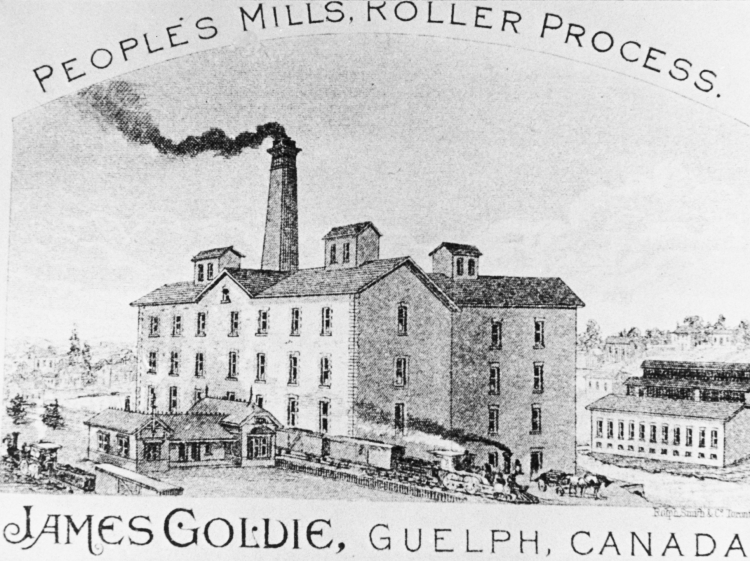
It is strangely appropriate to find that incineration remains an issue at Goldie Mill. Since the founding of Guelph, fire, along with water and stone, were always at hand there. The site has seen many changes over the years, changes that are not always evident today. Happily, old postcards, maps, and photos can help us to envision how Goldie Mill used to be, especially as it was developed by James Goldie himself.

David Allan (1939, pp. 38–39) notes that the story of Goldie's Mill begins at the founding of Guelph in 1827. David Gilkison, a cousin of John Galt, and Gilkison's partner Captain William Leaden bought the site (for a total of 25 acres) after having failed to obtain the site of Allan's Mill next to the Priory. There, they built a dam and a sawmill. However, the business never made money and the pair discontinued operations in 1829.

It was sold to Captain Henry Strange in 1833. It seems that Strange operated the mill with more success but died in 1845. Besides operating the mill, Strange also built a house at Cardigan and Norwich streets, as related by Tatham (1983, pp. 6–7):

About 1837 Captain Henry Strange built a house on the property and operated the sawmill. The house, a long low building with arched windows and doorways in a latticed porch at the centre front, is well remembered in some photographs (usually with a little dark dog on the lawn!) still in existence, and by a painting which was in the possession of “Alex” Goldie and was given to Riverslea by his widow, Mrs. Marjorie Goldie. This house was occupied by James Goldie and his family from 1868 to 1891 (and was torn down about 1925). Thus this house, often called “Captain Strange’s House,” was home for James and Frances Goldie and their children, Thomas, John, James Owen, and later Roswell, born in Guelph on March 26, 1862, and Lincoln, born in Guelph in 1864. Baby Margaret probably never saw this house, because she was born in Guelph on February 26, 1867, and died two weeks later, on March 11th.
Strange Street was named after Captain Strange, comprising the blocks of what is now Dufferin Street from Kerr to Division.

(The "Old Goldie Home" AKA "Captain Strange's House", complete with lawn dog, ca. 1895. Courtesy of Guelph Public Library Archives, item F38-0-14-0-0-126.)

Local potentate and wheeler-dealer Dr. William Clarke, and his partner Dr. Henry Orton, bought the mill from Strange's estate. To the sawmill they added a flour milling operation that they called The Wellington Mill. This frame structure was the first of several structures to occupy the later Goldie Mill site.

Fire destroyed the mill in 1846. Mills of that era were quite prone to fire and burned down with regularity. So, this event was no surprise. However, the blaze may have been more than a simple accident. As Stephen Thorning has explained, Dr. Clarke was an unreconstructed Protestant who had engendered more than a little contempt from local Catholics during the heated religious conflict of the time. As Justice of the Peace, Dr. Clarke could make life difficult for those whose religion he looked down upon. So, the blaze that consumed his mill may have been sparked by the religious friction of the era.

A determined man, Dr. Clarke bought out his partner's share in the mill privilege and built a new mill in 1850, which he called The People's Mill. This time, Dr. Clarke had the building made from stone, at least some of which was quarried on the property itself.

Over the next few years, the property went through a succession of hands, until it was leased to Charles Whitelaw, a successful businessman from Paris who operated several mills in the Grand River valley, among other concerns. Whitelaw, it seemed, had the touch and the mill apparently operated at a profit.

However, fire returned again on 8 June 1864. Although some of the stores and equipment, and the cooperage across the river, were saved, the mill was a total loss. Stephen Thorning noted that suspicion fell on local cooper Bernard Kelly, who had threatened to burn down the mill before because he did not get orders for barrels from Whitelaw. The coroner's inquest found the the blaze was indeed arson but deemed that there was not sufficient evidence to accuse anyone in particular. Even so, Kelly was convicted in the court of public opinion and hastily left town.

On 8 June 1866, the property was bought for $15,000 by James Goldie. In 1860, Goldie had built the Speedvale Mill further upstream, at the current site of the Speedvale Fire Station. He sold his old place of business and undertook rebuilding and expansion of the People's Mill. It would remain in his hands for 46 years and duly become the "Goldie Mill".

(James Goldie, from "Golden Jubilee of Nurses," 1938. Goldie was on the Hospital's Board of Directors.)

A good idea of what the area looked like during Goldie's tenure can be gained from the 1881 Wellington County Atlas. Because of the dam just upstream of the Goldie Mill, the reservoir made the Speed River much wider there than it is today. Here, I have superimposed part of the town map on a portion of the Google map of the area as it is now. I have outlined the banks of the river in solid lines and the bridges in dashed lines.


Bridges are represented by dashed lines. The parallel dashed lines in the center of the picture represent the dam, which was also used as a foot crossing. The black block to its left is the location of the original sawmill. On the west bank, the reservoir covered the wooded slope that exists there today. Note that a "Victoria Street" was on the survey through the middle of what is now Herb Markle Park. Of course, the street was never built. On the east bank, the reservoir covered most of what is now Joseph Wolfond Park East, upstream from the foot of Derry Street.

Four postcards record views of Goldie Mill. The first one (labelled "1" on the map above) was taken on the west bank of the Speed downstream from the mill. Although the caption identifies the subject as "Goldie's bridge", the bridge in view is clearly what is now called the Norwich Street bridge. Goldie Mill, with its ninety-foot chimney, built in 1885 and which still remains, can be seen peeking over the treetops on the left-hand side, a hint of what is to come.

(Courtesy of the John Keleher Collection.)

The building on the right is what was then a storage house of the Canada Ingot Iron Culvert Co. (demolished in 1927). This card is a "bookmark" card, published by Rumsey & Co., Toronto, of a photo taken with a panoramic camera.

The second postcard was taken from the east bank upstream of the Norwich Street bridge (labelled "2" on the map above). The mill buildings can be clearly seen on the left-hand side of the picture. The top of the distinctive chimney is clearly visible behind the other structures. Beneath lies a spit or island separating the Speed on the right from the tail race on the left.


Although the mill is an industrial site, it is presented in the background, framed by water and foliage almost as if it were a picturesque temple discovered on a trek along an Arcadian river.

The third picture (taken from the point labelled "3" on the map above) was taken from beside the tail race and next to the Speed River. It looks northwards to the back of the dam.


There is more tension in this picture. The ground is strewn with chunks of broken limestone, lying around like the remnants of an explosion or quarrying operation. The dam in the background is straining to hold back the waters of the mill pond beyond, without complete success. This card was printed by Warwick Bro’s & Rutter of Toronto.

The fourth picture (taken from the point labelled "4" on the map above) shows the mill pond itself from the north looking southeast. The steeple of St. George's Anglican Church can be seen in the center background. Goldie Mill and its tall chimney can be seen to the right. Today, this spot would be not far south of Riverslea, where the Goldie family then lived, today on the Homewood grounds. The Speed is now much narrower at this point and both banks are thickly wooded.


Near the opposite shore there are two swans in the water. It seems as though they are approaching a man on the bank, who may be moving to feed them. A small boat lies tied up nearby, its stern dragged downstream by the current. This postcard was printed by the Pugh Mfg. Co. of Toronto.

James Goldie acquired two white swans in 1888 to add to his menagerie. His estate was renowned for its gardens. Goldie's father had been a globetrotting botanist and assembled a botanical collection for the Tsar at St. Petersburg. The apple did not fall far from the tree. Goldie Jr.'s gardens contained hundreds of exotic flowers, shrubs, and trees. Visitors came from far and wide to see them.

Goldie's menagerie included many exotic birds, both "preserved" and alive. The latter included Egyptian geese, a Sandhill crane, English, Golden, and Silver pheasants, and the two swans. He also imported English sparrows, some of which he released and some of which he kept in a cage. James Gay, a local man who styled himself the Poet Laureate of Canada, wrote the following poem about them ("Canada's poet" 1884):

On the sparrows
Mr. Goldie’s sparrows, quite a number, returned to James Gay,
He feeds them with small wheat every day,
About eight in the morning, you can see them fly around
To feed on the wheat laid out for them on the ground.
This friend to sparrows, he takes much delight,
To hear their little warblings from morning to night;
All are made welcome as the flowers in May,
Not one shall fall to the ground by the hands of James Gay.
If Mr. Goldie could hear their prattling ways,
He would send them some small wheat every day,
So between the miller and the poet too,
Those little birds are sure to do.
About four they take flight,
If they could speak, they would say thank you and good-night.
Besides swans, youths liked to swim in the mill pond and places nearby in summertime. There was an old quarry pit at the site known as Kate's hole (for reasons unknown to me), as recollected by Fred Dyson (Mercury, 8 May 1948):
Among the real old timers expressing interest in tales of the old town is Fred Dyson, who, at 87, can look back pretty far. Explaining the origin of Kate’s hole down by the spur line at the old Goldie Mill, he said it was the quarrying of stone there for the mill dam that made it a favorite resort for swimmers. The spur line ran right into the mill property.
That swimming there in those days was clothing-optional is confirmed wistfully by another old-timer, James Ritchie (Mercury, 1 May 1948):
Who among Guelph’s real old-timers does not remember Crib’s hole, near Russell Daly’s present home? Or Fraser’s hard by the Sterling Rubber Company’s plant, or the staircase near the old Goldie’s Mill? ... These are among many others inseparable from old swimmin’ hole memories. No swimming in the nude anywhere these days. If the boys try it they will be chased away, no matter how far they are from the city.
O tempora, O mores!

The Speed could be dangerous as well as beautiful and fun. Spring floods often threatened the dam. Indeed, it was swept away by floods in the springtime of 1873 and 1929.

In addition, girls and boys drowned in the pond alarmingly often, e.g., (Northern Advance, 12 June 1890):

Mrs. Henry Ching, of Toronto, who is on a visit to friends in Guelph, lost her five-year-old boy by drowning on the 5th inst. The little fellow fell into the river while throwing stones into the water from the bank. The river is very high with the recent heavy rains, and he was quickly carried over the dam at Goldie’s mill. The body was recovered in a few minutes, but life was extinct.
In the winter, the pond froze over and made for a useful expanse of ice. Guelphites went there for skating and curling. The ice itself was also harvested by Mr. T.P. Carter of Carter's Ice Company, who handled about 2,000 tons of ice annually from his ice houses on Essex Street (Industrial number, 1908). There was also an ice house on the west bank of the Speed upstream of the mill (in the backyard of 165 Cardigan Street today), perhaps for the use of James Goldie himself.

Perhaps the weirdest incident connected with the Goldie Mill pond occurred when it was frozen over. A Mr. Leslie, while walking home at noon hour by the Mill one day, found a green fedora with no band and a worn overcoat lying on the ground beside the ice. In a pocket was a peculiar note (Mercury, 11 Dec 1922):

This seems the only way out. If ‘F’ had been here it might have been different. Good-bye. X.—J.B.
The note suggested a suicide. Yet, there was no hole in the ice nearby. No amount of searching and dragging the river or mill race produced a body. Perhaps the whole thing was a prank. Either way, the identity and fate of J.B. remains a mystery to this day.

Goldie remained by the Mill and its pond. Around 1885, he purchased Rosehurst across the river from Dr. Clarke's estate. This grand house stood on the Delhi hill and had a beautiful view of the pond. James's son Thomas and his family moved in. (There is a lovely photo of Rosehurst taken from across the pond, Tatham 1983, p. 9. However, I cannot locate the source.)

James Goldie built Riverslea for himself in 1890–91. It stood somewhat apart from its setting, being made of brown stone imported from New York State (Tatham 1983). However, it was still sited near the east shore of the mill pond with a good view of the Speed and Goldie's Mill downstream. Like his mill, James Goldie never left the river.

The mill prospered. After he took over, Goldie rebuilt the mill larger than before. He also added a substantial cooperage across the river. A rough wooden bridge connected the two. Storage areas and an elevator were added also. See the map below.


Here, I have superimposed a portion of the Fire Insurance map of 1911 on a Google satellite view of the mill and vicinity. As President of the Wellington Mutual Fire Insurance Company, James Goldie would have been familiar with this map.

Just to the left of the mill, is a building shaped like a sideways "I", labelled "A. Office". As mentioned above, the Great Western Railway built a spur line down the Speed to Cardigan Street to serve the Royal City as a new passenger train station ("Guelph railroads", Keleher 1995, p. 59). It opened for business on 16 February 1882 but proved to be a flop and closed six months later. In 1884, Goldie bought the building and moved it next to his mill, where it appears on the map, to serve as office space.

The building can be seen on the left in the cute drawing below.

("Goldie Mill", courtesy of the Guelph Public Library, item F8-0-4-0-9-3.)

In 1888, the Guelph Junction Railway was built and a siding laid to Goldie's Mill, which is also visible in the map. As a result, wheat and flour at the mill were no longer transported by horse. This change was important since Goldie increasingly had to buy wheat from western Canada in order to keep the mill profitable.

The office was torn down around 1920. Today, the site is the location of the Guelph Youth Music Centre, constructed in 1995–2001, from a storeroom built in place of the office. The spur line was later torn up and became the Spurline Trail.

As more land in its watershed was cleared, the force of the flow of the Speed diminished. As a result, Goldie added a steam engine to pick up the slack. In 1910, electrical engines were furnished instead, supplied by a power substation dedicated to the mill. The electricity was generated at Niagara Falls. So, the mill ran on power from a river over 120km away rather than on power from Speed, which flowed right beneath it.

James Goldie died on 4 Nov 1912. The mill afterwards passed through many hands. In 1918, the mill was bought by F.K. Morrow, investor and owner of the Morrow Cereal Co. In 1926, the Standard Milling company took over, followed by the Pratt Food Company in 1930.

Time and tide chipped away at the mill and its grounds. Milling operations ceased soon after yet another spring flood wrecked the dam in 1929. The mill became a warehouse with its buildings used mainly for storage. On 24 February 1953, fire returned in the form of a spectacular blaze that destroyed the original milling, shipping, and boiler rooms.

The mill was then slated for demolition but the City and the Grand River Conservation Authority intervened. The remaining stone structures were stabilized and were turned into a picturesque folly. Fittingly, the park was named Goldie Mill Park, still bearing the name of the man who had shaped the place more than anyone else, so many decades before.