Showing posts with label Pugh Mfg. Co.. Show all posts

Monday, 21 August 2017

Officer 666 plays in Guelph!

The Edwardian era was the golden age of postcards. Also, as Anthony Vickery (2010) points out, it was the golden age of theatrical touring in North America. From 1896 until the Great War, hit plays produced in New York would tour the United States and also Canada. From Montreal as far west as Windsor and Sault Ste. Marie, plays produced in the Big Apple would tour from city to city while riding the rails.

Vickery explains that there were two ways in which this would transpire. Producers in New York owned or controlled theaters throughout the region and scheduled traveling shows at their convenience. These theaters were mainly sited in larger cities such as Montreal and Toronto.


Theaters in smaller towns were usually locally owned. Tours of these theaters were often negotiated through local entrepreneurs. In the Edwardian period, the local circuit in Ontario was managed by one Ambrose Small of Toronto. New York productions that played in Guelph were typically booked through him.


One such production was "Officer 666". This play was a "melodramatic farce" written by Augustin MacHugh and produced by the noted team George M. Cohan and Sam H. Harris. It played at the Gaiety Theater on Broadway starting in January, 1912, and was a hit. A review in the New York Times (30 Jan 1912) praised it for being comical and absurd:

All of which is carried out in broadest farcical spirit, with plenty of humorous situations, a large number of surprises, and considerable bright dialogue. At the conclusion Helen says to this effect: “I feel as if it couldn’t have happened except in a play,” and Gladwin replies, “It couldn’t.”
Popular and in keeping with the spirit of the times, it was sure to be a hit on the road. Naturally, a touring show was speedily arranged.

Ads for the performance of "Officer 666" in Guelph began with this photograph in the Mercury (5 March 1913):


The caption reads: "'Officer 666' gets himself in many a fix in the play of that name. The accompanying scene occurs in Act III when the now famous sleuth is discovered minus his uniform and other insignia of his office. 'Officer 666' is a melodramatic farce as full of surprises as is the small boy just home from an ice cream festival."


An interesting simile! What could that refer to?


Advances in printing technology meant that newspapers were able to print halftone photographs in any issue; no doubt, an agent of the touring company sent the plates ahead to the local rags in advance of the show. By 1913, it was common for the Mercury to print such pictures to promote upcoming shows. However, "Officer 666" did seem to merit special treatment. A whole half-page ad, featuring another photo, was printed on March 6. Another photo appeared in the top middle of the front page on March 8.


Promotion for the play was not limited to the newspaper. The following postcard was also in circulation:


(Courtesy of Andrew Thomson.)

It was printed by the Dana T. Bennett Co. of New York and likely depicts the New York stage production. The message space on the back identifies the play and is also stamped with the local showtime, "Royal Opera House, Guelph. Monday, March 10." It seems that the play's promoters were going all out!

The Royal Opera House opened in 1894. It was built to supply a notable, cultural landmark for Guelph and to replace the inadequate old City Hall as a venue for dramatic and musical performances. (Sited next to the Grand Trunk Railway tracks, patrons at the City Hall had difficulty hearing performances over the throaty whistles of the G.T.R.'s steam engines.) However, with a capacity of over 1,200 seats, it was a rare night when the theatre was in the black.

It can be seen in the following postcard printed by the Pugh Mfg. Co. of Toronto:


The building was razed in 1953 and today is the site of the less dramatic Guelph Community Health Centre, as can be seen in the Google Street View scene below.


In 1911, the Royal Opera House was sold to the Griffin Amusements Corporation, which brought it solidly into the orbit of the Broadway play touring system.


Finally, the big night arrived and bums filled the seats of the Griffin Theatre. It appears that the full-on advertising campaign worked. The review in the Mercury the next day was entitled, "Packed house greets a clever presentation at Griffin's last night." It praises the wittiness of the writing, the strength of the acting, and the frothiness of the plot:

The blue pencil might do a little effective work on one or two sentences, but otherwise the show is clean, funny, and has the requisite of all successful plays, nowadays, the thing couldn’t happen anywhere outside of the stage or a book.
In a nutshell, the plot concerns a youthful millionaire New York art aficionado named Travers Gladwin. He returns to his old haunt on Fifth Avenue after a trip to Europe to find that he is being impersonated by a slick thief who is in the process of purloining his art collection. The thief has also used his usurped identity to win the affections of Helen Burton, a lovely debutante. Rather than expose the deception, Gladwin impersonates a police officer—Officer 666—with the inducement of a $500 bill. With the help of his friend Whitney Barnes and valet Bataeto, Gladwin cleverly outmaneuvers the thief and wins the hand of the lovely Helen.

If you want to learn more, you can read the whole book at the Gutenberg Project. Or, listen to the audiobook at Youtube!


What I find curious is that the story reminds me of the end of the Odyssey: Odysseus finally returns to Ithaca to find suitors besieging his good wife Penelope. With the aid of his son and his old swineherd, he slays the suitors and wins back his bride. Happily for the cleaning crew at the Griffin Theatre, "Officer 666" ends without bloodshed and the actors instead "slay" the audience.


As was usual for these New York touring shows, the company put on only the one performance, departing the next morning for the next small town along the rails. In their wake, they no doubt left many Guelphites repeating their favorite lines, as well as some promotional postcards as testimony to the Royal City's small part in the gold age of theatrical tours in North America.

(From the book cover for "Officer 666", published by the H.K. Fly Company, New York, 1912/Wikimedia commons.)


Admiration for "Officer 666" outlasted its turn on Broadway and along the American railways. It was adapted as a silent film in Australia in 1916 and in Hollywood in 1920. A still from the Australian version can be found at the Australian National Film and Sound Archive. There is also a short clip to see:


This appears to be how Gladwin gets the uniform of Officer 666 in the film.

Oddly, there also appears to be a tin wind-up toy of Officer 666 which you can see here:


It seems the character was still good for a laugh in the 1930s, long after its appearance in theaters.

Friday, 30 June 2017

The Goldie Mill grounds

A section of Goldie Mill Park was recently closed due to detection of contaminated soil. The trouble started in June 2016 when sinkholes began to open in the vicinity of the great chimney. Environmental testing subsequently detected the presence of hydrocarbons, some due to incomplete incineration, so the area is closed off while the nature and extent of the contamination is further investigated.

It is strangely appropriate to find that incineration remains an issue at Goldie Mill. Since the founding of Guelph, fire, along with water and stone, were always at hand there. The site has seen many changes over the years, changes that are not always evident today. Happily, old postcards, maps, and photos can help us to envision how Goldie Mill used to be, especially as it was developed by James Goldie himself.

David Allan (1939, pp. 38–39) notes that the story of Goldie's Mill begins at the founding of Guelph in 1827. David Gilkison, a cousin of John Galt, and Gilkison's partner Captain William Leaden bought the site (for a total of 25 acres) after having failed to obtain the site of Allan's Mill next to the Priory. There, they built a dam and a sawmill. However, the business never made money and the pair discontinued operations in 1829.

It was sold to Captain Henry Strange in 1833. It seems that Strange operated the mill with more success but died in 1845. Besides operating the mill, Strange also built a house at Cardigan and Norwich streets, as related by Tatham (1983, pp. 6–7):

About 1837 Captain Henry Strange built a house on the property and operated the sawmill. The house, a long low building with arched windows and doorways in a latticed porch at the centre front, is well remembered in some photographs (usually with a little dark dog on the lawn!) still in existence, and by a painting which was in the possession of “Alex” Goldie and was given to Riverslea by his widow, Mrs. Marjorie Goldie. This house was occupied by James Goldie and his family from 1868 to 1891 (and was torn down about 1925). Thus this house, often called “Captain Strange’s House,” was home for James and Frances Goldie and their children, Thomas, John, James Owen, and later Roswell, born in Guelph on March 26, 1862, and Lincoln, born in Guelph in 1864. Baby Margaret probably never saw this house, because she was born in Guelph on February 26, 1867, and died two weeks later, on March 11th.
Strange Street was named after Captain Strange, comprising the blocks of what is now Dufferin Street from Kerr to Division.

(The "Old Goldie Home" AKA "Captain Strange's House", complete with lawn dog, ca. 1895. Courtesy of Guelph Public Library Archives, item F38-0-14-0-0-126.)

Local potentate and wheeler-dealer Dr. William Clarke, and his partner Dr. Henry Orton, bought the mill from Strange's estate. To the sawmill they added a flour milling operation that they called The Wellington Mill. This frame structure was the first of several structures to occupy the later Goldie Mill site.

Fire destroyed the mill in 1846. Mills of that era were quite prone to fire and burned down with regularity. So, this event was no surprise. However, the blaze may have been more than a simple accident. As Stephen Thorning has explained, Dr. Clarke was an unreconstructed Protestant who had engendered more than a little contempt from local Catholics during the heated religious conflict of the time. As Justice of the Peace, Dr. Clarke could make life difficult for those whose religion he looked down upon. So, the blaze that consumed his mill may have been sparked by the religious friction of the era.

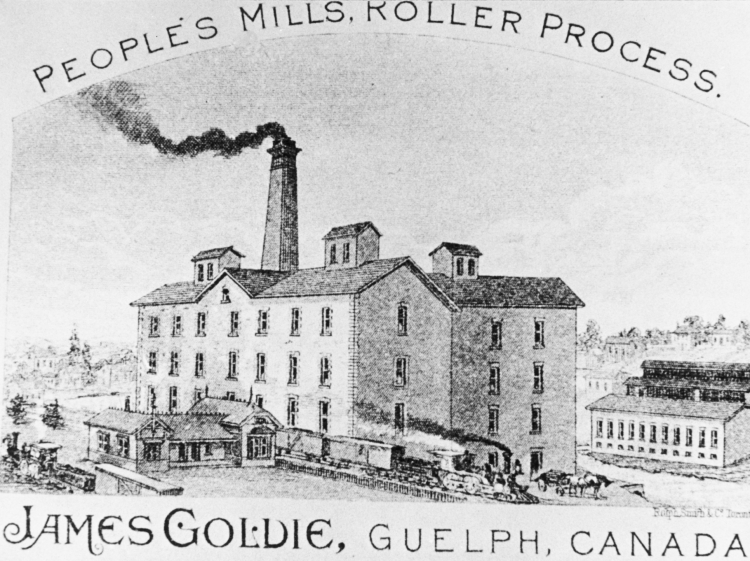
A determined man, Dr. Clarke bought out his partner's share in the mill privilege and built a new mill in 1850, which he called The People's Mill. This time, Dr. Clarke had the building made from stone, at least some of which was quarried on the property itself.

Over the next few years, the property went through a succession of hands, until it was leased to Charles Whitelaw, a successful businessman from Paris who operated several mills in the Grand River valley, among other concerns. Whitelaw, it seemed, had the touch and the mill apparently operated at a profit.

However, fire returned again on 8 June 1864. Although some of the stores and equipment, and the cooperage across the river, were saved, the mill was a total loss. Stephen Thorning noted that suspicion fell on local cooper Bernard Kelly, who had threatened to burn down the mill before because he did not get orders for barrels from Whitelaw. The coroner's inquest found the the blaze was indeed arson but deemed that there was not sufficient evidence to accuse anyone in particular. Even so, Kelly was convicted in the court of public opinion and hastily left town.

On 8 June 1866, the property was bought for $15,000 by James Goldie. In 1860, Goldie had built the Speedvale Mill further upstream, at the current site of the Speedvale Fire Station. He sold his old place of business and undertook rebuilding and expansion of the People's Mill. It would remain in his hands for 46 years and duly become the "Goldie Mill".

(James Goldie, from "Golden Jubilee of Nurses," 1938. Goldie was on the Hospital's Board of Directors.)

A good idea of what the area looked like during Goldie's tenure can be gained from the 1881 Wellington County Atlas. Because of the dam just upstream of the Goldie Mill, the reservoir made the Speed River much wider there than it is today. Here, I have superimposed part of the town map on a portion of the Google map of the area as it is now. I have outlined the banks of the river in solid lines and the bridges in dashed lines.


Bridges are represented by dashed lines. The parallel dashed lines in the center of the picture represent the dam, which was also used as a foot crossing. The black block to its left is the location of the original sawmill. On the west bank, the reservoir covered the wooded slope that exists there today. Note that a "Victoria Street" was on the survey through the middle of what is now Herb Markle Park. Of course, the street was never built. On the east bank, the reservoir covered most of what is now Joseph Wolfond Park East, upstream from the foot of Derry Street.

Four postcards record views of Goldie Mill. The first one (labelled "1" on the map above) was taken on the west bank of the Speed downstream from the mill. Although the caption identifies the subject as "Goldie's bridge", the bridge in view is clearly what is now called the Norwich Street bridge. Goldie Mill, with its ninety-foot chimney, built in 1885 and which still remains, can be seen peeking over the treetops on the left-hand side, a hint of what is to come.

(Courtesy of the John Keleher Collection.)

The building on the right is what was then a storage house of the Canada Ingot Iron Culvert Co. (demolished in 1927). This card is a "bookmark" card, published by Rumsey & Co., Toronto, of a photo taken with a panoramic camera.

The second postcard was taken from the east bank upstream of the Norwich Street bridge (labelled "2" on the map above). The mill buildings can be clearly seen on the left-hand side of the picture. The top of the distinctive chimney is clearly visible behind the other structures. Beneath lies a spit or island separating the Speed on the right from the tail race on the left.


Although the mill is an industrial site, it is presented in the background, framed by water and foliage almost as if it were a picturesque temple discovered on a trek along an Arcadian river.

The third picture (taken from the point labelled "3" on the map above) was taken from beside the tail race and next to the Speed River. It looks northwards to the back of the dam.


There is more tension in this picture. The ground is strewn with chunks of broken limestone, lying around like the remnants of an explosion or quarrying operation. The dam in the background is straining to hold back the waters of the mill pond beyond, without complete success. This card was printed by Warwick Bro’s & Rutter of Toronto.

The fourth picture (taken from the point labelled "4" on the map above) shows the mill pond itself from the north looking southeast. The steeple of St. George's Anglican Church can be seen in the center background. Goldie Mill and its tall chimney can be seen to the right. Today, this spot would be not far south of Riverslea, where the Goldie family then lived, today on the Homewood grounds. The Speed is now much narrower at this point and both banks are thickly wooded.


Near the opposite shore there are two swans in the water. It seems as though they are approaching a man on the bank, who may be moving to feed them. A small boat lies tied up nearby, its stern dragged downstream by the current. This postcard was printed by the Pugh Mfg. Co. of Toronto.

James Goldie acquired two white swans in 1888 to add to his menagerie. His estate was renowned for its gardens. Goldie's father had been a globetrotting botanist and assembled a botanical collection for the Tsar at St. Petersburg. The apple did not fall far from the tree. Goldie Jr.'s gardens contained hundreds of exotic flowers, shrubs, and trees. Visitors came from far and wide to see them.

Goldie's menagerie included many exotic birds, both "preserved" and alive. The latter included Egyptian geese, a Sandhill crane, English, Golden, and Silver pheasants, and the two swans. He also imported English sparrows, some of which he released and some of which he kept in a cage. James Gay, a local man who styled himself the Poet Laureate of Canada, wrote the following poem about them ("Canada's poet" 1884):

On the sparrows
Mr. Goldie’s sparrows, quite a number, returned to James Gay,
He feeds them with small wheat every day,
About eight in the morning, you can see them fly around
To feed on the wheat laid out for them on the ground.
This friend to sparrows, he takes much delight,
To hear their little warblings from morning to night;
All are made welcome as the flowers in May,
Not one shall fall to the ground by the hands of James Gay.
If Mr. Goldie could hear their prattling ways,
He would send them some small wheat every day,
So between the miller and the poet too,
Those little birds are sure to do.
About four they take flight,
If they could speak, they would say thank you and good-night.
Besides swans, youths liked to swim in the mill pond and places nearby in summertime. There was an old quarry pit at the site known as Kate's hole (for reasons unknown to me), as recollected by Fred Dyson (Mercury, 8 May 1948):
Among the real old timers expressing interest in tales of the old town is Fred Dyson, who, at 87, can look back pretty far. Explaining the origin of Kate’s hole down by the spur line at the old Goldie Mill, he said it was the quarrying of stone there for the mill dam that made it a favorite resort for swimmers. The spur line ran right into the mill property.
That swimming there in those days was clothing-optional is confirmed wistfully by another old-timer, James Ritchie (Mercury, 1 May 1948):
Who among Guelph’s real old-timers does not remember Crib’s hole, near Russell Daly’s present home? Or Fraser’s hard by the Sterling Rubber Company’s plant, or the staircase near the old Goldie’s Mill? ... These are among many others inseparable from old swimmin’ hole memories. No swimming in the nude anywhere these days. If the boys try it they will be chased away, no matter how far they are from the city.
O tempora, O mores!

The Speed could be dangerous as well as beautiful and fun. Spring floods often threatened the dam. Indeed, it was swept away by floods in the springtime of 1873 and 1929.

In addition, girls and boys drowned in the pond alarmingly often, e.g., (Northern Advance, 12 June 1890):

Mrs. Henry Ching, of Toronto, who is on a visit to friends in Guelph, lost her five-year-old boy by drowning on the 5th inst. The little fellow fell into the river while throwing stones into the water from the bank. The river is very high with the recent heavy rains, and he was quickly carried over the dam at Goldie’s mill. The body was recovered in a few minutes, but life was extinct.
In the winter, the pond froze over and made for a useful expanse of ice. Guelphites went there for skating and curling. The ice itself was also harvested by Mr. T.P. Carter of Carter's Ice Company, who handled about 2,000 tons of ice annually from his ice houses on Essex Street (Industrial number, 1908). There was also an ice house on the west bank of the Speed upstream of the mill (in the backyard of 165 Cardigan Street today), perhaps for the use of James Goldie himself.

Perhaps the weirdest incident connected with the Goldie Mill pond occurred when it was frozen over. A Mr. Leslie, while walking home at noon hour by the Mill one day, found a green fedora with no band and a worn overcoat lying on the ground beside the ice. In a pocket was a peculiar note (Mercury, 11 Dec 1922):

This seems the only way out. If ‘F’ had been here it might have been different. Good-bye. X.—J.B.
The note suggested a suicide. Yet, there was no hole in the ice nearby. No amount of searching and dragging the river or mill race produced a body. Perhaps the whole thing was a prank. Either way, the identity and fate of J.B. remains a mystery to this day.

Goldie remained by the Mill and its pond. Around 1885, he purchased Rosehurst across the river from Dr. Clarke's estate. This grand house stood on the Delhi hill and had a beautiful view of the pond. James's son Thomas and his family moved in. (There is a lovely photo of Rosehurst taken from across the pond, Tatham 1983, p. 9. However, I cannot locate the source.)

James Goldie built Riverslea for himself in 1890–91. It stood somewhat apart from its setting, being made of brown stone imported from New York State (Tatham 1983). However, it was still sited near the east shore of the mill pond with a good view of the Speed and Goldie's Mill downstream. Like his mill, James Goldie never left the river.

The mill prospered. After he took over, Goldie rebuilt the mill larger than before. He also added a substantial cooperage across the river. A rough wooden bridge connected the two. Storage areas and an elevator were added also. See the map below.


Here, I have superimposed a portion of the Fire Insurance map of 1911 on a Google satellite view of the mill and vicinity. As President of the Wellington Mutual Fire Insurance Company, James Goldie would have been familiar with this map.

Just to the left of the mill, is a building shaped like a sideways "I", labelled "A. Office". As mentioned above, the Great Western Railway built a spur line down the Speed to Cardigan Street to serve the Royal City as a new passenger train station ("Guelph railroads", Keleher 1995, p. 59). It opened for business on 16 February 1882 but proved to be a flop and closed six months later. In 1884, Goldie bought the building and moved it next to his mill, where it appears on the map, to serve as office space.

The building can be seen on the left in the cute drawing below.

("Goldie Mill", courtesy of the Guelph Public Library, item F8-0-4-0-9-3.)

In 1888, the Guelph Junction Railway was built and a siding laid to Goldie's Mill, which is also visible in the map. As a result, wheat and flour at the mill were no longer transported by horse. This change was important since Goldie increasingly had to buy wheat from western Canada in order to keep the mill profitable.

The office was torn down around 1920. Today, the site is the location of the Guelph Youth Music Centre, constructed in 1995–2001, from a storeroom built in place of the office. The spur line was later torn up and became the Spurline Trail.

As more land in its watershed was cleared, the force of the flow of the Speed diminished. As a result, Goldie added a steam engine to pick up the slack. In 1910, electrical engines were furnished instead, supplied by a power substation dedicated to the mill. The electricity was generated at Niagara Falls. So, the mill ran on power from a river over 120km away rather than on power from Speed, which flowed right beneath it.

James Goldie died on 4 Nov 1912. The mill afterwards passed through many hands. In 1918, the mill was bought by F.K. Morrow, investor and owner of the Morrow Cereal Co. In 1926, the Standard Milling company took over, followed by the Pratt Food Company in 1930.

Time and tide chipped away at the mill and its grounds. Milling operations ceased soon after yet another spring flood wrecked the dam in 1929. The mill became a warehouse with its buildings used mainly for storage. On 24 February 1953, fire returned in the form of a spectacular blaze that destroyed the original milling, shipping, and boiler rooms.

The mill was then slated for demolition but the City and the Grand River Conservation Authority intervened. The remaining stone structures were stabilized and were turned into a picturesque folly. Fittingly, the park was named Goldie Mill Park, still bearing the name of the man who had shaped the place more than anyone else, so many decades before.

Wednesday, 29 June 2016

The Priory—a sad ending

In his essential History of Guelph, Leo Johnson remarks that the Priory—the first house in Guelph—came to a sad ending (1977, p. 317). I have outlined the history of the Priory in an earlier post but it is worth revisiting this particular event in some detail: On the eve of the 100th anniversary of the city and the building, how was it that this historic structure was hauled away in pieces, never to be seen again?

The sad ending begins many years earlier, in 1887, when the Priory was sold to the Guelph Junction Railway (GJR). The GJR was a corporation formed in 1887 by local merchants and the city to create a transportation link to Guelph to compete with the Grand Trunk Railway, thus lowering shipping rates and costs for Guelphites and their businesses. The railway built a track from near Campbellville through the city itself. Instead of running the railway themselves, the corporation leased it to the Canadian Pacific Railway (CPR).

There had been some discussion of using the existing Grand Trunk Station downtown as a depot, thus creating a Union Station. However, the GJR instead acquired the Priory, which had been a private residence owned by David Spence. The 99-year lease to the CPR gave them the right to modify the property as necessary for the purpose of operating a station. No thought was given to what would become of the Priory in the event that the CPR no longer wanted it. Although some citizens were concerned about the erosion of links to Guelph's past and its founder, John Galt, there was no sense that preservation of certain structures for posterity was a significant project or something that might be enshrined in the city's contractual relationships, much less public policy. That proved to be fateful for the Priory.

The Priory's previous owners had created quite a park around the structure. The grounds featured a variety of flower and vegetable gardens, with paths in between. In the gardens could be found gooseberries, apples and plums, including the "Glass seedling plum" developed by David Allan's gardener, Alex Glass (Mercury, 5 Feb. 1955). Iris, narcissus and tulips were grown beside the main path, and the greenhouse featured several rare plants, including Spanish grapes.

The Mercury records the suggestion that the grounds be maintained in order to beautify the station and gratify visitors to Guelph (4 July 1888):

The Priory Trees.—The attention of the directors of the Guelph junction might be called to the need of caring for the valuable trees on the Priory lot. Owing to the grove being completely open from the track, but secluded by the clothes fence, from the street, young vandals have taken advantage of this license and have stripped three white birch trees of their bark. No grove perhaps in the city for its size contains more valuable specimens of choice trees there being 15 varieties of evergreens alone. It is a beautiful spot and will make a very comfortable resting place for travelers, and if thrown open for the benefit of the public would give them a nice park also. A fence behind the station along the track, with footpath through and seats round would put it under the protection of every citizen, and all would feel a just pride in preserving the small but valuable park.
In the end, most of the gardens, paths, and other features were removed to accommodate the tracks, platform, and access to Priory Street. Although the CPR was not wantonly destructive, neither was it much interested in the maintenance of gardens or the provision a civic park. As a result, the Priory did not receive "the protection of every citizen."

During the "golden" age of postcards in the early 20th century, the Priory was one of the most popular postcard views of Guelph. One particular image, taken from the east where Macdonell Street meets the Speed, is likely the most common Guelph postcard ever made. Here is the version of this image as produced by the Pugh Manufacturing Co. of Toronto.


This view shows the building as it appeared around 1900. With its contrasting colors, it nicely picks up the details in the building, including the Virginia creeper growing over much of its exterior.

Although the caption on this card says only, "C.P.R. Station, Guelph", captions of many cards from other companies often note that it was also the first house in Guelph and once the home of John Galt. Messages on these cards often mention the Priory, as in the following example from a card printed by the A.L. Merrill Co. of Toronto, sent in 1908:

I know you like historic buildings. This is the first house that was built in Guelph. It is about one hundred years old now. The C.P.R. use it as a station on account of it being the first house. they are not allowed to pull it down. J. M.
(Courtesy of John Parkyn.) It is interesting that Joe Merlihan (J.M.) remarked on the possible demolition of the Priory, since that had already become an issue of much discussion.

Before proceeding with that matter, I want to put up an unusual postcard that shows the Priory from across the Speed. This postcard was printed in the format of a bookmark and thus provides a panoramic view of the building and its surroundings at another point in its career as a CPR station.


This card was published by Rumsey and Co. of Toronto, around 1910. The photo reveals the screen of trees behind the building that still separated it somewhat from the downtown behind it. Note also the locomotive on the tracks to the right.

It would also help to have a bird's eye view of the Priory and its surroundings. No postcard or other such image survives, that I know of. However, one can be concocted by taking a satellite view of the vicinity from Google Maps and overlaying an early survey of the Priory and neighboring lots done by Captain Strange (and copied in 1957 by Mr. Shoemaker, a surveyor; University of Guelph Archives XR1 MS A379094). The outline of the Priory is emphasized by a black box with its porch facing the Speed.


I adjusted the overlay by locating two fixed points: The first is the bend of Woolwich Street immediately east of Thorp Street (Woolwich used to bend south there instead of north); the second is the location of the bridge at Allan's Dam, where the railway bridge was later constructed. The result is a rough-and-ready map of the Priory. The bulk of the Priory's plan is now under Woolwich Street with the porch to the north of the sidewalk, facing the metal canoe in John Galt Park. The map helps to give a sense of the scale of the building and its grounds, the latter comprising all the lots between Priory Street and the Speed River on the map.

Progress soon made the Priory seem obsolete as a railway station. In 1904, the CPR began construction of the Guelph to Goderich Railway, at the behest of the GJR. It was proposed that Priory be razed and replaced by a larger and more modern building as a part of this project (Johnson 1977, p. 318). Although the cost of $40,000 proved prohibitive, the proposal brought the matter to a head. Many residents viewed the Priory as something of a relic, one that seemed increasingly shabby and out-of-place in modern Guelph. Others viewed it as a significant connection with the Royal City's past. Even the Mercury, normally a voice for progress, urged that the old place be preserved (Mercury, 4 June 1904):

And, by the way, now that C.P.R. extension is in the air and a new station is talked of, what is to become of the old Priory? If the citizens of Guelph have any respect at all for, and pride in, the city’s history, they will see that this historical building is preserved intact. Would it not be a good idea to place it on rollers and remove it to the Exhibition grounds, to be used as a museum, containing interesting relics of Guelph, and including such old pictures as are now available.
Since the CPR's lease seemed to give them a free hand, the obvious way to save the Priory was to move it to another site. Buildings were moved around regularly in that era, so the scheme raised no technical problems. However, the notion of a historic park where old buildings might be located was, so far as I know, a novelty. Would it attract much support?

One important supporter of preservation was brewer George Sleeman. In 1905, then-Mayor Sleeman received a letter from one Gilbert Campbell, a Scottish fan of John Galt. In the letter, Mr. Campbell asked for confirmation of a story that had reached his ear to the effect that Guelphites proposed to destroy Galt's old residence. He offered a photo of Galt's birthplace in exchange for a photo (perhaps a postcard?) of the Priory. The Mercury (16 Oct. 1905) printed the letter along with the following observation:

His worship the mayor is one of the many citizens who hope that the old landmark will not be disturbed. He will acquaint to Mr. Campbell of the present situation.
In 1908, the CPR agreed to deputations from Guelph City Council urging them to build a new, better station in the town (Johnson 1977, p. 318). Construction of the new station in Trafalgar Square by the Eramosa Road bridge began in 1910. Their plans for the Priory site no longer included the building. Instead, they had plans to construct a short spur line and some pens and storage sheds at that location.

The crisis point was reached in 1911, upon completion of the new station. A letter from Donald Guthrie, a local lawyer, addressed to the Board of the GJR explains the situation (8 July 1911; UoG Archives XR1 MS A801—box 16, file 10). He explains that, in his opinion, the Priory is the property of the GJR and the CPR's lease does not entitle them to demolish or sell the structure. He reports that Mr. Oborne, Superintendent of the CPR, did not agree and said that, notwithstanding this news, the Company would demolish the building if it were not removed within a week! Mr. Guthrie advised that while the GJR could sue the CPR, it might be more expedient for Sleeman to contact Oborne personally to discuss the matter, as Sleeman was a prominent local customer of theirs.

Sleeman and the other Parks Commissioners explored numerous options. One scheme was to transport the building to Riverside Park. However, the cost estimate of $500 was more than could be mustered without help from either the CPR or the City Council, both unlikely. Besides,the building might not even fit under the streetcar wires on Woolwich Street.

Another scheme was to move the Priory a short distance back into Priory Park (the current location of the Blacksmith Fountain). However, the City Board of Works would not issue a permit to allow the move, a decision that the police promised to enforce (Mercury, 19 July 1911).

The CPR refused another suggestion to allow the building to be moved to the empty southwest corner of their site.

The situation provoked much popular discussion, much of it negative. Consider the following reports in the Mercury (26 July 1911):

All kinds of opinions continue to be expressed regarding the old building. Mr. C.J. Eisle was of the opinion that if its disposition were referred to the people they would 99 out of every hundred vote for its destruction. Six or seven men passed him when the fire bell rang the other day, and for fun he told him the fire was at the old C.P.R. station. In each case they expressed the hope that it was. This was Mr. Eisle’s method of taking a plebiscite. These opinions are in accordance with that of a prominent manufacturer, said if the disposal of the building were left to him he would put a stick of dynamite under it and blow it up.
Another wag suggested that it be taken to St. George's Square, halved in size, and used as a comfort station for streetcar passengers there.

The City's Finance Committee recommended a grant of $500 for removal of the Priory to Riverside Park. However, this proposal was flatly rejected by City Council in a session that featured "fireworks" (Mercury, 19 Aug. 1911):

Ald. Penfold was not a bit backward in stating his objections to any grant, in fact he was very much opposed to it. “The idea,” said the alderman, “of spending that amount of money for the removal of a few rotten logs! Why the idea is preposterous, and not to be thought of at all.”
Others objected that the shabby building would discredit the city and its citizens if displayed prominently in a city park:
Aldermen Calvert came back with a remark that if it was erected on the Priory Park site it would look like a man with a black eye.
Finally, the controversy also revealed a division along class lines. Most of the advocates for relocation of the Priory were wealthy and prominent men. Many citizens found the whole scheme evidence of how misguided and out-of-touch their wealthy patricians could be:
Alderman Howard was decidedly opposed to the removal of the building to Riverside Park. ”It is ridiculous,” said the alderman. ”I have interviewed a great number of the ratepayers, and not a single man has said that he was in favor of the project. The majority of them had said to tear it down. Furthermore, the council has no right to be dictated to by a few people who have a lot of money.”
City Council refused the grant. So, the ball landed squarely in George Sleeman's court. Sleeman had in the meantime purchased the building from the GJR and spent $300 on preparations for its relocation. He now contacted Mr. Oborne again and convinced him to allow the Priory to be relocated at the back of their site. It was relocated behind the Priory Hotel, on a laneway from Woolwich Street (as it was then) to Priory Street, roughly where the Supreme Car Wash stands on Woolwich Street today. The CPR had no immediate plans for that particular part of the site. Their condition on this agreement was that the Priory would be removed within 30 days of the CPR notifying Mr. Sleeman at some future time (2 Sept. 1911; UoG Archives XR1 MS A801—box 16, file 10).

The Mercury heaved a sigh of relief. On 29 Sept. 1911, a headline read, "Fate of the old Priory at last determined." However, the old building had merely been granted a reprieve. Also, dismantling of the structure had begun. Oddly, George Sleeman had the two side wings of the Priory removed and taken to his property on Waterloo Avenue, there erected as an independent structure (Mercury, 28 Aug 1911). Is was only the remainder of the building that was moved to the rear of the CPR grounds. It is unclear why Sleeman made this move. Perhaps it was the only way for the building to fit into the space made available by the CPR. Perhaps, seeing that the Priory was not out of danger, he had removed as much of it as he could afford to. In any event, the signs were not good.

Without anyone to maintain it, the Priory fell into disrepair and increasingly became an eyesore. It acquired the bad habit of catching fire, which it did at least three times in 1922 (Mercury, 27 Sep. 1922). That same year, members the City Parks and Buildings Committee asked the Council for some money to purchase the Priory from Sleeman with a view to moving it to Riverside Park, apparently in connection with a dam to be constructed there to make a swimming pool. Once again, the money was not forthcoming.

In 1923, the Guelph law firm of Guthrie & Kerwin corresponded with the CPR, suggesting that the railway lease the land on which the Priory then sat to the city, so that they could make a small park around it (31 July 1923; UoG Archives XR1 MS A801—box 16, file 10). Although CPR Superintendent Rutter confirmed that the company had no plans for that location, they were not willing to lease it out. The building caught on fire once again (Mercury, 28 Sep. 1923). At that point, the Fire Chief Knighton expressed the view that the ruin had become a fire hazard to the other buildings around it.

In 1924, the City Council consulted with Wellington Thompson of Huntsville, an expert on log cabin construction, for his opinion on whether or not a memorial to the building could be built in Riverside Park with the salvageable logs from the Priory (Toronto Globe; 29 May 1924). He expressed the view that a small model of 18 by 22 feet might be erected. The work was never carried out but the incident shows that the Council had given up on the idea of saving the whole structure.

In 1926, George Scroggie, building inspector for the City's Public Works Committee, was instructed to assess the remains of the Priory (Mercury, 2 March 1926). He reported that it should be condemned:

I have examined the building as requested and found it to be in a very bad repair. The roof has fallen in, adding to the danger of complete collapse, as the pressure on some parts of the log walls is now outward. As there has been considerable talk about the restoring of this structure, I have hesitated up to this time to condemn it, but the time has come when something must be done, and I would urge that it be torn down as soon as possible.
The Mercury published the following photo of the old derelict (16 March 1926):


On 4 May 1926, the Priory was demolished (Toronto Globe, 5 May 1926). Salvaged logs were stored at Robert Stewart's Lumber Company on Cardigan Street (KW Record, 22 Feb. 1958), the idea being to use them to construct a model replica of the Priory in Riverside Park the next year for Guelph's Centennial celebrations (Mercury, 21 Dec. 1926). However, the scheme was not carried out. The Priory was then just a memory.

It is certainly curious that Guelph's oldest building, and one associated so closely with the city's founder, came to such a sad ending. It is especially poignant that it was demolished on the eve of its 100th anniversary, when there was to be a celebration of the city's history. To understand this outcome, it may help to compare the Priory to other buildings that have been preserved.

Consider Zavitz Hall on the University of Guelph campus. When slated for demolition, Zavitz Hall was occupied by the Fine Art Department, for which no other accommodation existed. By contrast, the Priory was an empty shell, and one slated for replacement by the CPR not long after the Railway occupied the building. Also, whereas Zavitz Hall contributed positively to the space of Branion Plaza, the Priory was widely seen as an isolated relic shorn of the gardens of its former residents.

Importantly, supporters of the Priory lost the political battle to save it. Prominent political figures such as George Sleeman worked to preserve the building but were unable to raise sufficient money to carry out their plans. Many of the Aldermen and much of the electorate saw the scheme as the pet project of an elite out of touch with the priorities on the man in the street.

This last point is perhaps crucial. In the case of Zavitz Hall, supporters could articulate a vision for the future of the University in which the building played an important part: in making Branion Plaza a pleasant space, in honoring the significance of Charles Zavitz, and in respecting the achievements of the Fine Art Department. By contrast, would-be saviors of the Priory had difficulty making a similar case for it. The Priory had become a "black eye" that evoked no sympathy. Its association with John Galt was of little moment because, I suspect, most Guelphites knew little of or cared very much for Galt and knew the Priory mainly as an inadequate railway building, recently deprived of even that function.

The concept of using the Priory as museum and a tourist attraction was perhaps ahead of its time. As Guelphites grew tired of the building, some out-of-town newspapers expressed admiration for it and its historical associations, suggesting that the scheme was not hopeless. However, it seemed to make little sense to citizens of the Royal City at the time. Things changed dramatically by the end of World War II, as evidenced by the development of the John McCrae Memorial Garden and house as tourist attractions at that time.

Indeed, the Priory was later resurrected in various ways for this purpose. However, that is a story for another time.


Thanks to the folks at the University of Guelph Archives for help in locating documents for this post!