Showing posts with label electric lighting. Show all posts

Sunday, 17 September 2023

Old Home Week, 1908: Not a week of drinking and debauchery

In his dispatch to The Globe newspaper, a reporter from the Big Smoke summarized the scene in Guelph on August 3, 1908, as follows:
Every point in Canada and the United States where the old girls and boys have settled has been deflated of ex-Guelphites, and they may be found here, for this was the first day of the celebration in honor of former residents. How many thousands of visitors there are here it would not be possible to compute, but Mayor John Newstead said this was the biggest day in Guelph that he could remember. The visitors and citizens ranged at will all over the city and through the civic buildings and homes; in fact, in the Exhibition Park, the chief point of interest, they roamed in such numbers that it was almost impossible for one to make a way through the crowd.
What occasioned this invasion? It was Guelph's Old Home Week, 1908.
(Frank Rollins, Governor of New Hampshire 1899–1901. Courtesy of Wikipedia.org.)

As explained in my previous post about Guelph's Old Home Week 1913, the festival got it's start in New Hampshire in 1899. Governor Frank Rollins instituted a week long, state-wide wing-ding with a number of objectives, the principal ones being to assert the status of northern New England as the essential component of the region, and to stimulate a burgeoning tourist industry there.

Brown (1997) points out that migration of residents away from rural, northern New England for the big cities of Boston, etc., or points west, had left the area somewhat detached from the rest of the region and country, leaving it with a reputation as a backwater. A nostalgic mass return of former resident to the "Old Home" would reconfirm its importance and, more generally, the role of rural life that it exemplified as an antidote to the moral and cultural environment (Rollins would say "decline") associated with city living.

At the same time, Old Home Week would help to establish rural New England as a recreational destination for big city folks and their money. With agricultural productivity in relative decline, a new source of income would be welcome and, Rollins thought, tourism was it.

New Hampshire's 1899 Old Home Week was a smashing success and the idea spread like wildfire throughout neighbouring regions, including the Maritimes, Quebec, and Ontario. Soon, the President of the Canadian Club of Boston wrote a letter to the editor of The Globe (15 June 1901) urging that Canada get in on the act and assuring officials that Ontarians abroad would relish the chance to revisit their old haunts.

The idea of a province-wide (or nation-wide) Old Home Week understandably proved too unwieldy but individual cities soon got in on the act. By 1905 (Evening Mercury, 25 August), locals were writing letters to Guelph newspapers reporting on the Old Home Weeks of nearby towns and cities. Not to be left behind, the powers-that-be in the Royal City kicked the idea around.

(Detail of "Guelph's Old Home Week Executive Committee," from "The Royal City of Canada, Guelph and Her Industries / Souvenir Industrial Number of the Evening Mercury of Guelph, Canada." Courtesy of Guelph Civic Museums 1974.15.7.)

In 1907, talk turned into action. An Old Home Week committee was formed and planning began (Mercury, 14 September). A gaggle of subcommittees were formed to handle the challenging task, including Finance, Transportation, Decoration, Publicity, Sports, Music, Reception, and Parade. Dates were set for the civic holiday week of the next year: August 2, 3, 4, 5, and 6, 1908.

Various postcards were created for residents to send out as invitations. This postcard provides a helpful form with blanks to fill in and even a picture of someone doing so, just to be clear. The invitee is "Old Pal James," who is identified on the back as Jas. Cowan of Grimsby. The message on the back reads:
Oh I wish you were here now. You could work day and night, the electricians are so busy for Old Home Week. How long will you you be down then. I might slide down to see you. However will expect [you] Old Home Week.
Electrians were indeed busy, preparing to light the Royal City up like never before.
This "Welcome Old Boys" cards was another popular publicity item, also demonstrating the male orientation of the event. However, the Old Girls were welcome too, as demonstrated by the message:
Guelph, July 12/08 // Dear Amabel. how are you today and have you completely recovered[?] be sure and come up for old home week and we’ll sleep outside in a tent. We expect to have a great time. Guelph is buying up all the flags and bunting in Ontario[.] Lots of fireworks too. Bye Bye Cousin Helda
Both the above postcards are stamped "Daly's // Guelph, Ont." on the back, likely meaning they were sold at Daly's News and Cigar store on Wyndham street.

One of the early concerns was trying to land a prominent figure to help attract visitors. Initially, it was hoped that the Prince of Wales (later George V) might drop in. HRH would be in the country at the time and he was a Guelphite—well, a member of the house of Guelph after whom the city was named. Alas, it was not to be: The King's secretary politely informed the Committee that the Prince's tour would be confined to Quebec.

("Rear Admiral Charles E. Kingsmill (1855–1935), in naval uniform, ca. 1908." Courtesy of Wellington County Museum and Archives, A2002.54, ph. 16831.)

However, the Committee got a positive reply from another prominent former Guelphite, Admiral Charles Kingsmill. Kingsmill was born and raised in the Royal City but left age the tender age of 14 to join the Royal Navy. To make a long story short, he served in every corner of the British Empire and climbed the ranks right into the senior echelons. In 1906, he was captain of the battleship Dominion, named for the Dominion of Canada and sent there on a tour to show the flag. The ship ran aground during the tour, resulting in a reprimand for Kingsmill. Even so, he was appointed a Rear Admiral in 1908 and was tapped by the Canadian government with the (unenviable) task of organizing a Canadian navy. In brief, Kingsmill was about as well-known and highly-regarded figure as was likely to attend Old Home Week. One can only imagine the joy with which the organizers received his acceptance of their invitation.

Besides having a star attraction, Old Home Week organizers needed to assist thousands of former Guelphites and well-wishers in making their way to the Royal City. Associations of ex-Guelph people were formed in cities throughout Canada and the United States. Negotiations with the railways resulted in special trains that brought people hence to their old haunts. One of the largest such associations was the ex-Guelphites Association of Toronto, which held meetings and publicized the event in the Queen City. This connection was much assisted and cultivated by the Guelph Committee. Other cities where ex-Guelphites formed associations for the event included Edmonton, Calgary, Regina, Winnipeg, Vancouver, Detroit, and Cleveland.

By mid-July, the effort to dress the city up for the event was in full swing. Naturally, there would be banners and bunting of all description on display. Most exciting was the plan to illuminate Wyndham street from end-to-end with electric lights. Since the power grid drawing juice from Niagara Falls did not yet exist, Guelph had to look to the output of its own generators. Representatives of the Light and Power company surveyed local businessess to determine their requirements and to identify whose power could be cut off: Given the system's limitations, bathing downtown in electric light would mean plunging other city sectors into darkness for the duration (Mercury, 18 July 1908).

(The subtitle of this article is a hoot: "Electric fluild to be conserved." Was this really a reference to the already-outdated fluid theory of electricity? Or, was it simply an expression, like "turning on the juice" is today?)
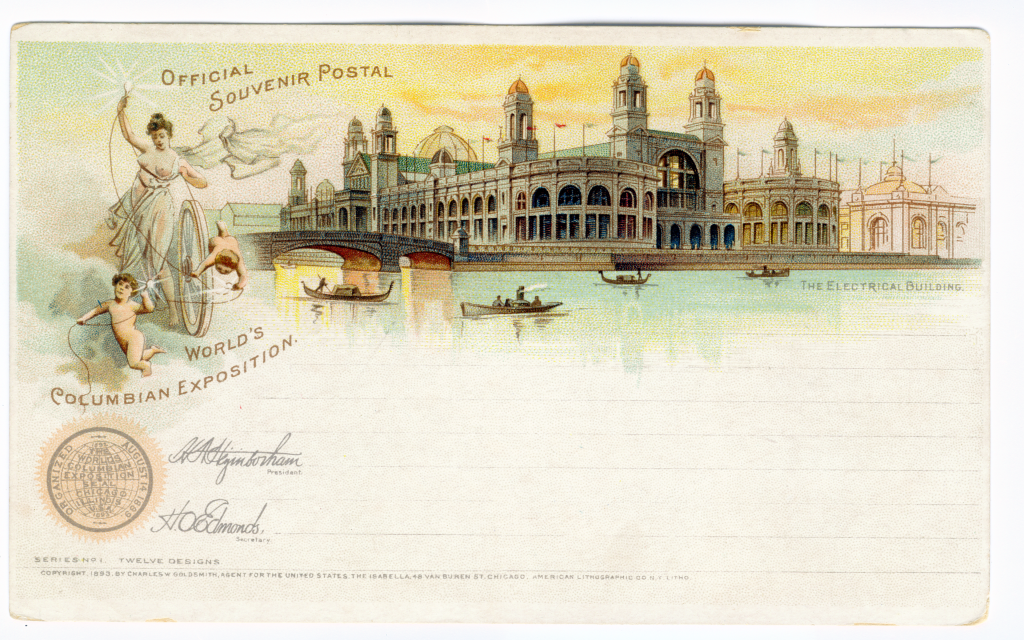
(Souvenir postcard of The Electrical Building, World's Columbian Exposition, Chicago, 1893. Courtesy of the Chicago Postcard Museum.)

Nye (2022) explains that illuminations were very signficant to American cities. In days of yore, torchlight processions and the like were hallmarks of special celebrations and elite occasions. With the advent of gas and then electric lighting, the scope of illuminations to demarcate special places and events increased. For example, The World's Columbian Exposition in Chicago in 1893 was lit up prodigiously with electric lighting and featured a whole Electricity Building dedicated to the technology's bright future.

The delight experienced by Guelphites with their own electric promenade was palpable. The Guelph Musical Society Band was engaged to play a concert on the night of 24 July during the time the illumination was first tested. A large crowd gathered in the street for the final test on 1 August.

Finally, the carnival of Old Home Week commenced. Decorations had been finalized, accommodations found, grand stands, tents, and light stands erected. Trains arrived at the stations, disgorging hundreds of visitors before heading off to bring more.

A typical day during the celebration began with dignitaries meeting trains of special visitors downtown, requiring official greetings along with speeches and music for the VIPs. An afternoon parade would lead celebrants from the (old) City Hall, up Wyndham, Woolwich, and London streets to the Exhibition Park. There would be a program of events centered on a given theme, held in the fields in the northern sector of the Park. Visitors also had the option of enjoying the midway and sideshows featured in southern area. These areas were fenced off and general admission was $1. After the official festivities concluded, another parade led those so inclined back downtown, perhaps to find their lodgings or their trains back home.

(Real photo postcard view of Lower Wyndham street as seen from the old City Hall. Courtesy of Guelph Civic Museums 2014.84.460.)

Naturally, parades featured performances by musical bands. Guelph's Musical Society Band was consistently present but bands from home-comers' cities also took part. For example, on American Day (5 August), the Marine Band of Detroit led the parade, with the stars and stripes out front.

(Real photo postcard view of Lower Wyndham street looking towards St. George's Square. Interestingly, this postcard was sent through the mail in 1915.)

The day of 5 August featured burlesque bands. Perhaps the most memorable was the "Blea Rube Band" of Toronto, which performed a "Kiltie burlesque" (Mercury, 6 August):

Yesterday they appeared in Highland costume very cleverly burlesqued and they used instruments on which they imitated the old Highland bagpipes in a style which would have deceived the best bred Scotsman that ever crossed the pond from the land of the heather. In addition they had painted themselves in the most grotesque manner, with heads and faces on their knees, etc.
The local favorite was by far "Long Joe" ("alias Madam Le Haut"), local man Joe Lawrence, who sported a parasol and fashionable Parisian gown and who stood out at nearly 7 feet tall.
(Real photo postcard of "Long Joe" Lawrence in a white dress with parasol, parading through St. George's Square. Courtesy of Guelph Civic Musuems 2009.3.1. The message on the back states, "This is the only one I have got left of Guelph Old Home week procession[.] it is a man standing seven feet in a lady dress representing a firm from Toronto" )

One special feature of the 3 August parade was the appearance of a number of Guelph old-timers (Globe, 4 August). A yoke of four oxen carrying a load of wheat was driven by Mr. Wm. Healey, "who remembers the earliest days of the Guelph market." The wagon was itself an old relic, built 62 years previously and used by the Gow family of Fergus to move wheat to Guelph market square (Mercury, 1 August).

(Real photo postcard, "Souvenir, Old Home Week, Guelph, 1908. In a similar card, the oxen are identified as Tom and Jerry.)

Naturally, sporting events featured prominently in the afternoons. There were competitions in lawn bowling, lacrosse, horse racing, and track and field. The most anticipated event was the baseball game between Eastern League rivals the Toronto Maple Leafs and the Jersey City Skeeters.

The game itself turned out poorly for the Canadian fans, with the Maple Leafs receiving a drubbing at the bats of the American team (Globe, 5 August):

What the lowly Skeeters did to the champion Maple Leafs here to-day was cruel and almost criminal, and before a crowd of 8,000 Old Home week celebrants at that. The Mosquitoes—for it was an occasion which called for some politeness—thumped, hammered and slugged their way around the bases fourteen times in the seven innings before darkness mercifully put an end to the slaughter.
The final score was 14–1.

On the bright side, the Maple Leaf's one run was a homer off the bat of Jimmie Cockman, a Guelph Old Boy! Cockman had been born and raised in Guelph and excelled in baseball to the extent that he had a solid career with many professional teams. As captain, Cockman led the Milwaukee Creams to the top of the Western League in 1903. In 1905, he was seconded to the New York Yankees by his Newark International League team, making him one of the few Canadians of the era to play in the American major leagues. He retired and returned to Guelph in 1912 but coached the Guelph Maple Leafs in their championship run in 1921.

("James Cockman, Guelph's well-known professional player," The Canadian Century, v. 4, n. 13, 1911.)

At Cockman's first at-bat in the second inning, play was suspended and a brief ceremony held to honor the Royal City's famous son (Mercury, 5 August):

The players of both teams formed a semi-circle around the popular third baseman, while Mr. Downey [local M.P.P.] acted as spokesman. In a few words, Mr. Downey stated that the many admirerers of Jimmie in the city had considered this a suitable time to show their esteem and admiration for that popular and very efficient player. He also referred to the fact that Guelph had been the birthplace of baseball in Canada.
Mr. Morris then presented Mr. Cockman with a diamond ring, and the crowd gave three cheers and a tiger.
(Real photo postcard of St. George's Square from the middle of Lower Wyndham street. This image was the most commonly reproduced postcard of Old Home Week.)
(Real photo postcard view from the Post office/Customs house of a parade marching through St. George's Square. Note Joe Lawrence in a dress in the foreground and a marching band following him. A hand-written message on the front states, "scenes during Old Home week on main street, Guelph".)

Another signal event for Old Home Week was the military tattoo. On the evening of August 5, crowds of people packed into the grandstands in Exhibition park to see the spectacle. The conditions were excellent (Mercury, 6 August):

A dark, still night, not very warm, with a gentle breeze blowing steadily. The colored lights placed along the fence and the edge of the track cast a lurid glow over the track, throwing into relief the soldiers and bandsmen as they marched past, and sillouetting darkly the crowd in the background.
The bands stood poised at the north end of the park. At the signal, the Guelph band marched forth, down the track and past the grand stands, under the baton of Drum-Major Fairburn. The hometown crowd cheered with excitement.
("Captain Walter Clark," ca. 1900, veteran of the Crimean War and drill instructor of the Guelph Cadets. Courtesy of Guelph Civic Museums, Grundy 3.)

Next followed the bands from Preston, Berlin (now Kitchener), and Goderich. Following them were the formations of troops and then the cadets, under the direction of Captain Walter Clark.

Following this was a prodigous fireworks display. At first, sparkling lights produced a portrait of King Edward, accompanied by the national anthem played by bands and three volleys fired by the Wellington Riflemen. Then followed a portrait of Theodore Roosevelt, which prompted an ovation.

The finale comprised an all-in burst of colour and noise that took the crowd's (and the reporter's) breath away:

Every variety of rocket was fired off in rapid succession. The air was literally full with glowing, flashing, rapidly-changing colors. There was a constant succession of glowing lights, bold color breaking into myriad [displays of] many colors, jumping rockets whirled and twisted with eccentric irregularity. “Maxim” or repeating rockets, fiery clouds which seemed charged with shifting rainbows. It was a gorgeous pyrotechnic display of such magnitude that the crowd literally held its breath while it lasted.
The bands followed up with a few more selections and paraded back to downtown, followed by many of the excited specators.
(Real photo postcard scene of an Old Home Week parade in St. George's square, conveying some of the excitement at street level.)

At the south end of the park was a midway, featuring attractions such as a Ferris Wheel, Merry-Go-Round, Electric Theatre, Fairies in the World, Coney Island at Night, Darkness and Dawn, etc. In a tent labelled "The Train Wreckers," one could see moving pictures!

The train wreckers was the title of a hit short film from the Edison Company, 1905. It features one of the few actual cases on film of villians trying to do away with a girl by leaving her on railroad tracks. Watch for the trick photography during the rescue scene!

Naturally, there was a so-called freak show. One freak performer was "Rattlesnake Joe," AKA Mr. J.H. Wilson, who was immune to reptile venom. His act was to handle a menagerie of poisonous snakes, which he allowed to bite him on the arms, chest and even his tongue (Mercury, 6 August)! Amazingly, he seemed none the worse for wear.

Then there were two "fat boys," weighing over 600 lbs between them, who engaged in boxing matches, using gloves. There were also three snakes, of a combined length of more than 100 ft., an untameable ape, and a two-headed fetus preserved in alcohol. The curious could attend lectures on any or all of these subjects.

Special performers were also employed to please the crowd between the main attractions. For example, there was the Dare Devil Dash, in which Professor Zavaro peddled his bicycle madly down a 100 ft. ramp, vaulted a wide chasm, turned around in mid-air and, leaping from his ride, dived into a vat of water. This is a feat beyond most university professors. Was Zavaro on sabbatical?

Perhaps from the same institution came Professor Tardini, the balloonist. His vocation was staging balloon ascensions accompanied by fireworks displays aloft. After this, Tardini would descend back to mother earth using a parachute.

(A real photo postcard featuring a man and woman looking at the camera through a cut-out backdrop of a balloon with gondola. Courtesy of Guelph Civic Museums 1986.18.153. This appears to be an homage to Professor Tardini's balloon. It was likely taken in a photographer's studio in town.)

Tardini's balloon had difficulty in rising to the occasion. The wind was too high in the afternoon of 5 August to permit him to fill his gas bag. However, conditions improved and he was able to ascend and provide an aerial fireworks show that evening. An intriguing aspect of Tardini's setup was that his balloon was filled with "real gas" rather than hot air. If this means hydrogen, then the Professor was even more brave—or more foolish—than he seems at first. I can only think he was not a professor of chemistry.

Most impressive were the performances of the Kishizuna Japanese acrobatic troupe. Their performance is not described in detail but it was praised as "easily the best attraction on the grounds and has proven well worth the money expended by the committee" (Mercury, 6 August).

("Kishizuna Imperial Japanese Troupe," ca. 1910, postcard publisher unknown. Courtesy of "aboveall" via HipPostcard.com")

No detailed account of the Kishizuna act is given but it may have featured elements like those recorded in a short film by "Japanese Acrobats" (1913): ("Japanese Acrobats," 1913. Courtesy of the British Film Institute National Archive, via Friends of the British Film Institute.)

One of the more intriguing aspects of accounts of the 1908 Old Home Week were descriptions of how orderly it was. One might expect a week-long wing-ding to be the occasion of some overzealous revelry. That was not the Police Magistrate's opinion, however. "I am agreeably surprised and pleased with the manner in which the large concourse of people have conducted themselves in the city during the Old Home Week," Justice Saunders remarked (Mercury, 6 August).

There were not infrequent cases of drunkness, of course, but these were handled discretely by police, who put simply put inebriated celebrants in holding cells until they sobered up, at which point they were decanted. So, it seems that good order was kept in part by bending the usual concept of what was considered orderly.

("Ancient Order of Pole Climbers - Old Home Week Ribbon." Courtesy of Guelph Civic Museums 2014.33.20.)

It seems the police were more interested in assaults and thefts, of which there were not many. The only issue on this count was a young man who threatened to shoot someone and was found in possession of a loaded revolver. As this person had no license to carry a firearm in the city, he was fined $8.50 or one month in jail.

Still, the police blotter could hardly convey the experience of being on Wyndham street during the carnival. The account of the Mercury's own reporter must be our guide ("Confusion reinged," 6 August):

Bedlam let loose could not present more madmen than did Wyndham street last night after the return of Ralph Humphries’ “Illustrated” parade from the park. The old town, sober, quiet, old Guelph aroused itself in earnest. Everybody was just crazy with joy, falling over themselves and everybody else in their efforts to have a good time—and they were having it, too. There has never been anything the likes of it before in the old burg, and visitors from afar would last night have had recourse to the old saying that “a thing must be seen to be believed.” To describe anything that happened would be an impossibility. Everything that could happen occurred, and it was occurring all the time. From end to end the street was filled with a joyous, yelling jovial crowd of the best humored people ever gathered together. Anything went with crowd, and everything was taken in the spirit in which it was given with freedom and good spirit.
At ten o’clock the fun was officially commenced, and The Mercury still awaits reports as to when it was concluded. No matter how late or how early it was when people left the town, they had the opinion that they were missing something. At two o’clock this morning the lights were put out, but the fun did not discontinue until a long time after that. Throughout the several hours of fun there was not the least let-up at any time. Everybody appeared to be tireless, and the mob rushed from end to end of the street, howling, yelling, cheering and throwing everything at everybody “without fear or favor.”
Of all the games of the street last night, there was nothing so popular with the mob as the merry go round. To the majority of the readers there is no need to explain the principle of the game. They have experienced it, and know what it is. But it may be explained that the merry go round consists of the old time bull in the ring game. The innocent cause of the trouble, who may be standing on the street with his lady friends, is suddenly surrounded by a bunch of hooting, yelling lunatics and for the next few minutes they have the opinion that they are in the centre of a cyclone. But the storm soon passes to another quarter of the street, and no one is the worse for the experience.
Another popular form of lunacy last night was the flying wedge, which worked on the principle of the rotary snow plow, and had the effect of clearing the street with a rapidity that would have done credit to the Guelph police force. At the ends it worked with the same effect as crack-the-whip and woe to the man who got in the way.
Half a dozen wagon trucks, etc., put in their appearance on the street at different times and were pulled from one end to the other in great style. One of these was put into intentional collision with the wagon of the peanut man, who thereupon decided to make for safer quarters, but the crowd were after him, and before he got half way across the square wagon, charcoal, peanuts and fire were distributed over the square in a very impartial manner.
The fountain on St. George’s Square was the Mecca of many of the hoodlums. More than one was ducked. Some were thrown in bodily, while one unfortunate who was reposing on the stone coping was compelled to turn a graceful back somersault into the tank.
Apparently under the delusion that he was in the holy water of the Ganges, a local tonsorial artist entered the dampened arena, and with the water to his knees commenced a parade in which he was given the undisputed proprietorship of the parade ground. He seemed to enjoy it immensely, and kept not all the pleasure to himself. He had a sponge which he attached to a string and by its aid was very successful in distributing shower baths upon the crowd.
Ald. Humphries, the chairman de parades, was the hero of the night, and his appearance for the midnight parade was the signal for a general ovation. Everybody cheered for Humphries. He was the idol of the hour. On Upper Wyndham street despite considerable damage to his wearing apparel, he was hoisted to the shoulders of some of the enthusiastic ones and carried all the way down the street.
Magistrate Saunders had said that the orderly conduct of citizens during the week "would convince those who had been opposed to the reunion that it was not a week of drinking and debauchery." Were they convinced?

No city could operate under such conditions for very long. By the evening of 7 August, the festivities wound down and Guelph put her sober countenance back on. People flocked to the train stations to catch trains out of town. Decorations were removed and special lighting turned off. A number of people attended the final performance of the Kishizuna Troupe and took in "The streets of Cairo," curious to see a sideshow deemed objectionable by some of their fellow citizens. This piece was a vignette about a young girl on the mean streets of Cairo and had been composed and performed for the Chicago Columbian Exhibition in 1893, where it was a hit. It featured a belly dance known as the hoochie-koochie, which was probably the most objectionable part. The tune remains one of those old melodies widely recognized today but whose origin most have forgotten.

With these last, few performances over, the tents were taken down and the performers departed for their next gigs. Guelph became its old self. As the Mercury (8 August) put it:

Where on the previous night riots reigned where the air was filled with confetti and talcum powder and funny noises, last night reigned the silence and quietude of a quiet city.
Old Home Week 1908 was over. Was it a success? Fiscally, the Reunion Committee expected a small deficit. However, most everyone had had a grand time and were not concerned if the affair did not quite break even.

It is unclear that Guelph had demonstrated the superiority of small town Ontario culture or morals. Nor is it clear that the Royal City had set itself up as a tourist Mecca. Still, citizens could be satisifed that their city had come a long way since its foundation, and that it could put on a blast to compare with those of any of its neighbours.

Already, there was talk of mounting another Old Home Week.

("Guelph Old Home Week souvenir pin." Courtesy Guelph Civic Museums 1978.165.7.)
Works consulted for this post include:

Tuesday, 31 October 2017

The Royal City and the Royal Coronation, 1911

Any year has its beginnings and its endings and 1911 was no exception. In the British Empire, it was perhaps most noted for the beginning of a new era with the return of a King George to the British throne. The previous year had seen the death of King Edward VII and, with it, the end of the brief Edwardian era. Edward was succeeded by his son, King George V, whose coronation was set for 22 June 1911.

Naturally, the loyal city of Guelph was eager to celebrate the new king of the House of Guelph. In 1902, Guelph had sent some dignitaries and military men to England to take part in the coronation of King Edward. So, it was thought fit and proper that the same should be done for the coronation of the new King George.

In the end, 706 Canadian dignitaries and military men were rounded up and shipped across the pond by the Dominion. They went in style aboard the Empress of Ireland, a cruise ship of the Canadian Pacific Steamship Company. This ship was the one that would sink to the bottom of the St. Lawrence on 29 May 1914, taking 1,012 lives with her. However, she sailed from Quebec City on 2 June and arrived in Liverpool without incident.


The SS Empress of Ireland from a contemporary postcard/Courtesy of Wikimedia.

Similar groups arrived in Britain from all over the Empire. The military men bivouacked at the euphonious Colonial Coronation Contingents Camp, Duke of York's School, London.

The contingents were assiduously recorded in photographs that were printed up as postcards. Happily, a postcard probably featuring the visiting Guelphites was sent back from the old country.


The card was printed by Gale & Polden, Ltd., Aldershot, Portsmouth, & Chatham. The caption says, "Canadian Artillery // Colonial Coronation Contingents Camp, Duke of York's School, London. 62."

The message on the back reads simply, "Certainly a fine trip & lots of spare time. // B B Mc." The addressee was "J. Vertigan, Esq // The Armouries" in Guelph.

Here is another beginning, for the Armouries in Guelph had been officially opened only two months earlier! Joseph Vertigan is listed in the city directory as a caretaker there. It seems the postcard was addressed to him by the cryptic Mr. B B Mc.


The Armouries, Guelph, Canada, published by Rumsey & Co., Toronto (as seen from Jubilee Park).

The bad thing is that Guelph newspapers for this event are missing, so our information about the contingent is limited. The good thing is that the passenger manifest of the Empress of Ireland still exists and lists the points of origin of its passengers, including those from Guelph! They are as follows:

Saloon passengers
Mr. Hugh Guthrie, M.P., Mrs. Guthrie
Mr. E. Harvey, Mrs. Harvey.
Artillery
Major D.M. Foster, 16th Battery, C.F.A., Guelph, Ont.
Sergt. A. Anderson, 11th Battery, 1st Brigade, C.F.A.
O.R. Sergt. B. McConkey, 1st Brigade, C.F.A.
Infantry
C.Sergt. O. Wideman, 30th Regiment
Departmental Corps
Sergt.-Major C.T. Lark, C.A.S.C., No. 1 Co.
The saloon passengers were the civilian dignitaries, who, therefore, spent much of the voyage in the saloon.

It was quite an honour to be selected for this event, so it is interesting to find out about the people who were picked.

  • Mr. & Mrs. Hugh Guthrie: Hugh Guthrie was a local boy and a barrister in the city. He was elected M.P. for South Wellington with the Liberals in 1900 and represented the riding federally until 1935. It would be distracting to attempt to summarize his political career; suffice it to say that he held numerous Cabinet posts and was one of the most prominent men of the town for many years. His inclusion in the coronation party was surely a no-brainer.

  • Mr. & Mrs. E. Harvey: Edmund Harvey was born in Galt in 1844 (Mercury, 3 July 1923). His family had the good sense to relocate to Guelph in 1850, where he remained for most of his life. He became a prosperous pharmacist but later turned to oil, real estate and finance, where he made a tidy fortune. He was City Treasurer and Paymaster of the 30th Wellington Battalion of Rifles from 1884 until 1896. His obituary fails to mention that he was charged with embezzlement of at least $12,000 from the City treasury at that time (Globe, 27 Aug. 1896). In the end, he pled guilty to reduced charges and, evidently, remained a respectable town patrician. He later got into lime manufacturing in Rockwood and was still president of E. Harvey, Ltd., when he died suddenly of a heart attack on 29 July 1923. His grave in Woodlawn cemetery is marked by an impressive obelisk.

  • Douglas Mortimer Foster was born in Guelph in 1878 and became a dentist. He served 14 years with the 16th Battery of the Canadian Field Artillery, beginning around 1900. He joined the Canadian Expeditionary Force in Guelph on 13 Dec. 1915, in the Canadian Army Dental Corps with the rank of Captain. He served in France until he came down with a case of appendicitis in 1917. It appears that he travelled to Canada briefly to recover and then returned to France in 1918. Evidently, he remained with the military and was promoted to Major with the Wellington Rifles in 1924. He died on 13 Nov. 1962.

  • Sergt. A. Anderson: I have not found out much about Andrew A. Anderson except that he was born about 1869 somewhere in Ontario to Scottish parents. He worked in the printing business in Guelph. He died 17 Oct. 1933.

  • O.R. Sergt. B. McConkey: Benjamin Bertram McConkey was born in Guelph on 8 Dec. 1890 (Mercury, 3 June 1918). He had served three years with 16th Battery under Major Foster when the coronation beckoned. He graduated from McGill University in 1914, apparently having studied architecture there. He had little time to practice his profession: Upon the outbreak of the Great War, McConkey immediately joined up with the artillery as a Lieutenant. He was later promoted to Captain and won the Military Cross for his performance at the battle of Vimy Ridge in 1917. He died on 29 May 1918 from wounds to his right hand and shoulder. He is buried in Doullens by the Somme in northern France. He is also evidently the sender of the postcard above: "B B Mc"!

  • C. Sergt. O. Wideman: Orrie C. Wideman was born on 7 July 1884, the second son of Louis Conrad Wideman (so, "Orrie C." probably expands to "Orrie Conrad") and Jeannie Wideman. Louis Wideman was an important builder in Guelph in the Victorian era and was a Captain of the 30th Regiment. It seems that the apple did not fall far from the tree: Orrie joined the 30th Regiment as well, rising to the rank of Colour Sergeant in 1906. Around (after?) the coronation, Wideman moved to Toronto to pursue the building trade there. He joined the Canadian Expeditionary Force on 17 Sep. 1915 and served until the end of the war. The 1921 Ontario Census shows him living in Toronto, working as a contractor (with an income of $1400), along with his wife Henrietta and children Lily and George. He died in Toronto on 5 May 1958.

  • Sergt.-Major C.T. Lark: Charles Thomas Lark was born in England in 1879 and immigrated to Guelph in 1907 (Mercury, 19 Oct. 1953). He seems to have felt very comfortable in uniform! He served in London's First Dragoons from about 1895 until 1903. His unit participated in Queen Victoria's Diamond Jubilee in 1897 and fought in the Boer War. After that, Lark joined the London Metropolitan Police until he upped sticks for Canada. His move was precipitated by a desire to join the Royal North-West Mounted Police. It seems, though, that he took an understandable liking to Guelph and remained in the Royal City instead, taking work at the Standard Valves plant and joining the Canadian Army Service Corps (now known as the militia), in which capacity he participated in the coronation. After the coronation, Lark decided on another change, joining the Guelph Police Department, where he rose to the rank of sergeant. During the Great War, Lark joined the Canadian Expeditionary Force on 12 June 1916 as a Lieutenant. For reasons that are not explained in his records, Lark did not depart with his regiment and was demobilized instead in April, 1917. He resumed his role in the Guelph police. In 1921, the restless Lark then became a guard at the Ontario Reformatory ("prison farm"), where he remained, as a sergeant, until 1937. Finally, Lark retired and, naturally, became a night clerk at the Wellington Hotel until 1951. He died on 17 Oct. 1953.
Mayor and Mrs. George Thorp also attended the coronation as part of a European tour they went on. However, they were sent by the Town of Guelph instead of the Dominion, and so did not voyage with the others.

I presume that many or all of the Guelph military party is present in the postcard above. However, I do not presently have any other photos of the people involved, so I am unable to say who is which or which is who. Perhaps some educated guesses could be made by matching people's ranks to the insignia on their uniforms. If you can shed any light on the subject, please do so in the comments section below!

The coronation went off on 22 June without a major hitch. The colonial contingents marched in the procession before the royal couple, assumed positions near Westminster Abby, and stood to attention as the royals entered and later exited.

The coronation ceremony marked a number of firsts. For example, it was the first coronation in which the service within the Abbey was allowed to be photographed.

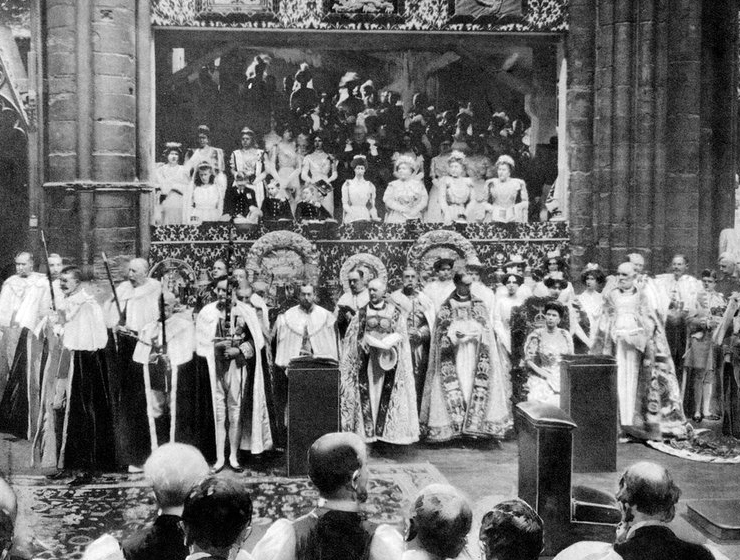
King George V and Queen Mary seated on the Chairs of Estate in front of the royal box at their coronation in 1911. By Benjamin Stone/Wikimedia commons.

The event was also extensively recorded in moving pictures. Coronation Of King George V (1911)/British Pathé.

My favourite technological first for this coronation would have to be how the newly anointed monarch contrived to the lay the cornerstone of the Fisherman's Institute in St. John's, Newfoundland (Globe, 22 June 1911):

In spite of the pressure of the Coronation ceremonies, King George will find time Thursday to participate in the laying of the corner stone of the new Fisherman's Institute to be erected here by Dr. Wilfrid T. Grenfell. It will be at His Majesty's word, sent over the cable, that Governor Ralph Champney Williams, of Newfoundland, will place the stone in position. Arrangements have been completed for special telegraph and cable connection between Buckingham Palace and the site of the structure in St. John's.
Huzzah! What a signal demonstration of the electrical sinews of the Empire!

In the Royal City, the coronation was celebrated in royal style. A series of athletic contests were held in and around Exhibition Park (Globe, 23 June 1911). The Guelph Shamrock lacrosse team was narrowly exceeded by the Brampton Excelsiors, 3–4. A series of races were held, including sprints, races for whippets, boys on ponies, and a five-mile motorcycle race. The Guelph baseball team travelled to Berlin (now Kitchener) and spit a double-header against the Dutchmen.

A first for Guelph was the inauguration of the city's first, incandescent street-lighting system. The Fire, Light and Markets Committee of the City Council teamed up with the Light and Heat Commission to install the system. At 10pm sharp on coronation day, the downtown was lit up as never before (Globe, 23 June 1911):

Wyndham, Carden, Macdonnell, Quebec, Norfolk and Woolwich streets were made as light as day by the fine lights, and, the effect was very pleasing. Citizens generally expressed their entire satisfaction and approval of the new system, which will hereafter be lighted every night and all night.
Thanks to Niagara Power, courtesy of the new Hydro-Electric Power Commission of Ontario set up by Sir Adam Beck, the future of the new era seemed bright indeed.
Since posting this piece, I came across the following information about B.B. McConkey, which clarifies the circumstances of the action that earned him the Military Cross at Vimy Ridge (Mercury, 12 Dec 1918):
Mrs. B.R. McConkey has received the Military Cross awarded to her son, the late Capt. B.B. McConkey, M.C. The statement of the award, which came with it, is as follows: “Lieut. B.B. McConkey, C.F.A. as F.O.O. for his battery with two N.C.O.s this officer laid a telephone line from Lichfield Crater through Volker Tunnel to Thelus Mill, during the operations against Vimy Ridge, on the 9th of April, 1917. Getting ahead of the mopping up Bn. they were held up by a barricade and a machine gun in the tunnel. They overcame this opposition and after handing over 12 prisoners to the infantry, they established an F.O.O. station in Goulot Wood in time for the next attack. When their lines were cut they continued to send back timely information by runner, showing initiative, perseverance and gallantry.”

Friday, 29 November 2013

The Wyndham St. Railway underpass

In its passage through downtown Guelph, Wyndham St. intersects with the Canadian National Railway/VIA Rail line. Rather than meet on-grade, Wyndham Street plunges beneath the tracks, emerging before the Armoury building. Over the last few years, this underpass was closed to traffic so that it could be upgraded to conform to new regulations. After about two years and $8.4 million dollars, renovations to the underpass were recently completed.

Unfortunately, the renovations have not been a complete success in all respects, as a number of trucks have had scrapes with crash beams installed underneath the tracks to protect them. The official clearance is 3.8 meters but the underpass may appear deceptively high, or some drivers may underestimate the height of their trucks. Or, perhaps the underpass is cursed: When the prominent clearance signage was temporarily removed for the 2013 Santa Claus parade, another truck went down the fateful ramp to scrape its way under the crash beams before the signs could be restored.

The Wyndham St. underpass was installed in 1911 in order to avoid scrapes between trains and vehicles on the street. Prior to that time, the intersection between Wyndham St. South—or Huskisson Street, as it was known then—and the Canadian National line—known then as the Grand Trunk Railway—was a level crossing. By the turn of the century, many Guelphites had come to view crossings like this one as an unacceptable hazard. Consider the experience of a Mr. Beaver of Morriston who was approaching the GTR crossing on nearby Gordon St. when his horse startled, apparently at the approach of a train (Guelph Mercury, 8 Nov. 1910). The animal bolted and ran down the tracks, just ahead of the approaching train! At Norfolk St., Mr. Beaver's cart got tangled with guy wires supporting a utility pole. He suffered serious injuries to his face but was able to go home after receiving medical attention. The horse was apparently uninjured. Interactions with trains at level crossings could be painful, or worse.

By 1906, the City and the GTR had reached a tentative agreement. The City would sell Jubilee Park (a small park situated where the current VIA station stands) and perhaps other land to the GTR and, in exchange, the GTR would expand its facilities in the area and construct underpasses—then called subways—to eliminate the level crossings. Unfortunately, the two sides could not agree on the price for Jubilee Park, nor on who would pay for the subways (Globe and Mail, 21 March 1906).

There the situation stood until 1908. The same day as Mr. Beaver's run-in with a train, news broke that the City was filing a lawsuit against the GTR. In part, the indictment denounced the GTR for "maintaining a public nuisance" (Mercury, 11 Nov. 1908). In other words, the GTR had neglected to fulfill its public duty to build safe railway crossings. In fact, the case for the suit was so compelling that the provincial Crown Attorney, Mr. Henry Peterson, filed the case on behalf of the City. Mr. Justice McMahon, clearly also impressed with the case, gave the indictment to a grand jury, explaining the issue to them, in part, as follows:

Another phase of the matter His Worship said was in connection with the dangerous crossings and the need for a subway and he dwelt upon the dangers at the station through the passengers having to pass over tracks to reach their trains as well as the danger of crossing the tracks after leaving the station. It was the duty of the railroad company to protect the public.
The editor of the Mercury was certainly pleased with the news. The entire indictment, with its imposing legal language, was printed on the front page of the paper. I will spare you the full text, but a taste would be appropriate, where the accusation of negligence is made (12 Nov. 1908):
Yet the said corporation [GTR] of the said railway have for many years past and still do neglect to operate and maintain the said line of railway, in and through the said municipality of the City of Guelph and along the line of streets and highways on which their aforesaid line of railway runs and others which they pass and run on with their said engines and passenger and freight cars, with due and proper safety and freedom from danger, as respects the crossings of the said streets and highways, especially as respects the running and operating of the said passenger cars and engines and the safe access thereto and egress therefrom at and in connection with their public passenger station in the said Municipality of the City of Guelph.
What a sentence! Also, I have to include the final sentence of the indictment, which conveys the vexation of the crown at this state of affairs:
The said corporation of the said Grand Trunk Railway by the said acts and neglect and in contravention and in culpable and unlawful neglect of their proper public duty and rights and obligations have committed and continue to commit a common nuisance, endangering and injuriously affecting the lawful safety, comfort and conveniences, privileges, uses and enjoyments, of the said public and His said Majesty's liege subjects in the due and lawful exercise and enjoyment of rights to which they are lawfully entitled, but are now deprived of and interfered with and injured and to the great and general disadvantage and danger and common nuisance of the liege subjects of His Majesty the King, to the evil example of all others in like cases offending, and against the peace of our Lord the King, His Crown and Dignity.
You get the idea.

Although the case was not actually decided at the November assizes, it seems that the indictment moved the GTR, somewhat. By the spring of 1909, the GTR solicitor, Mr. Pope, assured the public that the Railway meant to proceed immediately with a new station and crossings, on certain conditions (22 May 1909, Globe and Mail):

The company ... will install subways at Huskisson and Gordon streets. Neeve street is also to be diverted through a subway [at Huskisson?], the city or the company to pay the cost, according to which had the prior right of way at the crossing. The point has not yet been settled.
It seems that the GTR wanted to build two subways, one each at Huskisson and Gordon Streets. The City, however, wanted only a pedestrian subway at Huskisson St., and full subways at Neeve St. and Gordon St. Naturally, each side thought that the other one should pay most of the cost.

The matter came before the Dominion Railway Commission in October, 1909. The Commission rendered its decision (Mercury, 15 Oct. 1909): The GTR would build two full subways, one each at Huskisson and Gordon Streets. The end of Neeve St. was to be closed off, but Surrey St. was to be extended to relieve any congestion on Neeve. The cost for the Huskisson St. subway was to be split between the City and the GTR. The decision was final.

If you find some of the topography confusing, it may help to look at the map below.


View Larger Map

Of course, when I say that the decision was final, I mean that the dispute merely entered a new phase. Engineers arrived within days to begin surveying and planning the new train station and subways (Mercury, 20 Oct. 1909). Construction began in May 1910. The railway tracks were to be raised from Allan's Bridge (at the Speed) through to Glasgow St. (14 May 1910, Guelph Mercury). At the crossings of Huskisson and Gordon Streets, the tracks would be raised by about six feet. This elevation would help to keep the subways from getting too deep.

At the same time, disputes over plans and money continued. The width for the Huskisson St. subway was set by the Commission at 30 feet. Mayor Hastings suggested that the subway at Huskisson St. should perhaps be widened in order to accommodate a streetcar line that the City wanted to run into St. Patrick's Ward (Mercury, 26 Oct. 1909). The City also continued to press for a subway, if only for pedestrians, at Neeve St. The GTR was amenable, if the City granted it more land and/or concessions on the price of Jubilee Park. The GTR made plans to place switching equipment on City land and to close the end of Freshfield St., whereupon the City ordered the construction stopped (Mercury, 6 July 1910).

This phase of the dispute was not settled until December. After talks with Mr. Fitzhugh, Vice President of the GTR, the two parties settled on a price for the park ($9000) and on the nature of the Huskisson St. subway (9 Dec. 1910):

The subway at Huskisson street will be moved 25 feet further to the east than it is shown to be on the plan and will be built straight instead of with an elbow in the middle of it, as the plans indicate.
I have to say, a straight underpass sounds like the better choice.

Newspapers from early 1911 are not available, but construction seems to have proceeded. For the latter half of the year, the paper carries a series of notices in its "City News" column about the progress of construction. Here are a few examples:

Girders arrive (6 July):
The girders have arrived for the G.T.R. subway at Huskisson street crossing, and will be placed in position as soon as possible. The excavation work is progressing rapidly.

Raising the track (7 July):
Work has been commenced on raising the track between Gordon and Huskisson streets. The G.T.R. Co. have a large gang of men at work. At Huskisson street the tracks have been raised six feet, so that the company has quite a contract ahead of it.

Lavatories closed up (11 July):
Owing to the fact that they were being used by the men employed on the relaying of the G.T.R. tracks, and complaints being made, the Winter Fair lavatories have been closed up, as the Board of Works feel that the men should have one of their own. They will be opened on market days only.

Work on lower end (31 August):
The gang on the Huskisson street subway is to-day at work on the lower end of the subway, laying the storm drain and making the excavations for the retaining wall. Steps will be laid from the road leading to the Armories.

Grand Trunk officials (20 September):
An official of the Grand Trunk passed through the city this morning, staying here for a few minutes while they looked over the subways.
And so on. The subway appears to have been completed and open for the opening of the new train station on 22 November.

At the same time, dispute over the width of the subway continued. In the end, the GTR had agreed to build a subway 32 feet in width, with four feet for a sidewalk and 28 feet for vehicles (4 August 1911). In July, a number of local residents argued to City Council that the Huskisson subway should be widened by eight feet to better accommodate pedestrians (12 July). The City solicitor, Mr. Donald Guthrie [father of local MP Hugh Guthrie?] advised that the GTR was under no obligation to agree to the alteration [nor was it likely to]. After much debate, the city decided to appeal to the Railway Commission to have two pedestrian underpasses ("foot subways") built, one at Huskisson and one at Norfolk Streets (8 September). These were to be eight feet wide and high, which would leave a commodious 32 foot roadway for streetcars and vehicles, and prevent pedestrians and vehicles from having to share a single space. The Council hoped to persuade the Commission to have the GTR share the extra cost. The GTR had no objections to the extra subways (1 September) but declined to pay for them. It seems that the GTR got its way: The City decided to proceed with the two subways at its own expense (26 September). The Huskisson St. foot subway was completed concurrently with the street subway (14 October).

At last, the GTR finished the subways and all was well. Almost. It was the responsibility of the City to pave the roadway in its new subways, but different City departments had different ideas about who was liable for that work. It was expected that the Board of Works would proceed immediately with the paving (23 October). The Board recognized the something must be done about the "troubles" with the unpaved condition of these roadways but thought that the Street Railway was responsible:

Bed roads in subways (12 Dec. 1911):
The Chairman of the Board of Works claims that the Street Railway management is responsible for the keeping of the roads through the subways in condition. Whoever is responsible should do something to improve matters at once as the roads in both subways are in wretched condition.
I am uncertain who, in the end, paved the subways, or when it was done. It is interesting to note that it was the final layer of paving on the Wyndham St. underpass in 2013 that, by raising the level of the roadway, seems to have precipitated the clearance crunch experienced by some truckers downtown.

Printers of the Edwardian era did not celebrate the new subway on a postcard. However, a good image of the subway can be found in this photograph spectators sending off a troop train at the new station in 1915. Although important to the safe conduct of civic affairs, underpasses do not attract the same sort of attention as churches or bridges, perhaps because they plunge into the ground rather than soaring into the air. So, the appearance of the Huskisson Street subway is registered in only the margins of contemporary postcards. Consider the following pair, taken of the old City Hall square. The first card shows the square shortly before the subway was built.

(From the The Valentine & Sons Publishing Co., Ltd. Montreal, Toronto and Winnipeg.)

Now, have a look at this second card, from a photo taken probably around 1915.

(From the Warwick Bro’s & Rutter, Limited, Printers, Toronto; Courtesy of John Parkyn)

Notice the difference? The retaining wall on the west side of the subway is visible in the latter picture, along with the railing for the foot subway closer to the viewer. Overhead is the new hydro wire strung over the tracks following construction.

The arrival of the railways in Guelph brought many opportunities but also many challenges. The railway connected the city to the rest of the province in a way that the contemporary road system could not. However, it also bisected the downtown core, once defined by the open Market Square designated by John Galt. In so doing, it placed a sometimes dangerous obstacle in path of Guelphites. New technologies, especially concrete and electricity (the foot subway was wired for nighttime illumination in February 1912) made it feasible to address this danger with an underpass. Introducing the solution was not simple, however, because of disputes over control of the design and funding of the structure. As recent experience suggests, the adoption of the truck brought new opportunities and challenges, and those have, once more, touched off similar disputes concerning our centenarian subway.

Here is the underpass in its form before recent renovations:


View Larger Map

Tuesday, 6 August 2013

Old Home Week, 1913 - the event

As noted in my previous posting, Guelphites had planned for a big bash at the end of July, 1913. It seems that their wish was granted. Many visitors came by railway, which offered special fares, and by car. The Mercury on July 28 reported on the throngs disgorged into the city by the railways, bringing home the "old boys" and choking the length of Wyndham St. "with a seething mass of humanity."

The paper also compliments the city for its festive accoutrements:

The decorations were beautiful, and when the lights were turned on at 8.30 the vari-colored bulbs, flags, pennants and bunting presented a magnificent vista of color.
A special shout-out goes to the Mahoney's, who had a plumbing business on Quebec St., for their enormous Union Jack studded with coloured lights.

The evening was capped off with a concert from the Guelph Musical Society's Band and the Philharmonic Chorus at Exhibition Park. In addition, there were speeches from numerous important personages, which were entertaining even though perhaps inaudible:

The average speaker has not the sonorous vocal outfit to be a successful outdoor orator, and it may be amusing, although not exactly entertaining, to see the gestures, but hear no words. At any rate, the old boys and girls will now take it for granted that they are welcomed.

The program acquainted the public with the fun on tap:

During the entire week various kinds of attractions and amusements will be provided by the Committee, such as Side Shows, Animal Shows, Electrical Devices, Wax Works, Moving Pictures Shows, Ferris Wheels, Merry-go-Rounds and Galloping Horses, and everything in the amusement line that can be procured, and the Committee wish to assure the public that there will be nothing allowed that could offend the most fastidious.
In addition, there would be plenty of parades, sporting events, and musical performances.

Of course, it would not be a real party if it could not offend the most fastidious. In fact, the Mercury reports some licentious behaviour the very next day:

Many of those who attended the carnival five years ago [Old Home Week 1908] were wise in their generation, and knew what to expect. They wore their old duds. But of the others who did not know what was ahead of them—many of them had their best clothes ruined by talcum powder. The crowd ran riot, and girls and young ladies were openly seized and kissed on the street; hats were knocked off, and kicked about by the swirling crowd, and the air was full of talcum powder and confetti.
An editorial in the paper bemoaned this bacchanal on the Speed, urging police to put a stop to it, and assuring readers of "the chief offenders being the non-English speaking element." The Mercury on August 5 notes that an Italian, George Longo, pled guilty to a charge of "disorderly conduct" on Wyndham St. during Old Home Week. Was he the "non-English speaking element"?

Things seems to settle down by July 31, when the Mercury makes the following report:

There was no throwing of talcum or flour, and very little confetti showered about, the orders in that respect being well observed. "Ticklers" [paper tubes rolled into a coil that unroll and make a horn sound when blown into] were in evidence; and the vendors reaped a rich harvest, disposing of thousands of the "fun makers" as they called them.
However, the air was still thick with sexual tension:
The crowd was out for a big time, and they apparently had it, as the streets resounded with laughter, as arm in arm the boys and girls, young men and young women, promenaded the streets. Cordons were formed, and woe betide the girl that was caught in the charmed circle. Before she got out she was forced to pay toll.
This behaviour seems not to draw any reproach from the Mercury. Perhaps this suggests how the mores of Edwardian Guelph were different than the Victorian city.

Several issues of the Mercury from that week are missing, so it is hard to know which events drew the most notice. However, some items seem to stand out. First, there was a contest for best decoration, to be judged by the Committee. Many decorators, it seems, had incorporated electric lighting as an important component of their displays. The Committee seemed not to have anticipated this approach (July 31):

As the competition was for the best "decorated," not the best "decorated and illuminated" home, the judges could not take into account the electrical effect...
Thus, the Mahoney's, with their oversized and light-studded Union Jack, won only second prize. Today, decorating with lights is the norm, certainly for events such as Halloween and Christmas. In 1913, it seems, electrical decorations were still quite a novelty.

Another event worthy of note was the appearance on July 29 of Carlstrom, the "Swedish Bird Man" and his amazing Blériot aeroplane. This pilot was Victor Carlstrom, a Swedish-American aviator who was on a tour of southwestern Ontario at the time (Globe, July 25, 1913). Both he and his plane arrived in town by train. Carlstrom immediately set out to fly the plane at Exhibition Park. Unfortunately, the engine would not start and the Bird Man remained on the ground.

However, things worked out better on July 30. The Mercury of July 31 gives the following, breathless account:

With wings spread like a soaring eagle, Carlstrom, the bird man, sped over the city yesterday afternoon in his new Bleriot aeroplane. Rising from the ground at Exhibition Park, the daring aviator mounted to an elevation of a quarter of a mile, and swinging in a graceful circle, till he got his bearings, flew in a south-easterly direction.
The machine, propelled by a powerful seventy-five horse power engine, passed over Trafalgar Square, the people being made aware of the gasoline engine, which could be distinctly heard.
As the airship crossed the river and circled to the north, it was so high up that the airman at the wheel, who guided it in its evolutions, could not be seen. As it turned to the south, it dipped, and as it sped on a line, as the crow flies, on the return trip to Exhibition Park, it was much nearer to the house tops, and the aviator could be plainly seen guiding the machine.
It is not clear which Blériot model Carlson was flying, but it might have been the model XI that Blériot flew over the English Channel in 1909.

(Courtesy of Wikimedia commons)

The program states that Carlstrom's flight was the first in the City and, probably, first in the experience of most of its citizens. It must have been thrilling.

Also on the new technology front was the Grand automobile parade from the City Hall to Exhibition Park. The parade was to include "all motor cars belonging to the city of Guelph and those visiting". Unfortunately, no account of the parade survives in the Mercury. However, the idea can be better appreciated if you imagine putting on today a parade of all cars belonging to the city and to every visitor. Clearly, the automobile was still something of a novelty in town.

A couple of incidents also illustrated the problems that cars would bring. On the first evening, a celebrant named Reg Hoile (sp?), an employee of the Herald, was dazzled by a sparkler in the face and stumbled from the sidewalk in front of G. B. Ryan's dry goods store on Wyndham. There he was struck by a passing car and suffered several cuts and a sprained ankle. The August 2 issue of the Mercury wraps up its coverage of Old Home Week by noting another auto accident (among other things). On this occasion, Walter Benjamin, "a colored man", was knocked down by the Wellington Hotel bus as he tried to cross the street in front of the Post Office.

Of course, cars did not cause all the injuries that week. A woman was knocked down by the horse-drawn ambulance, for example, on the opening night. However, these collisions suggest the coming tensions between motorists and other, established users of the roadways.

By the end of the week, the Old Boys and their reunion were winding down. An article in the Mercury (August 2) notes that the crowds were dwindling, as was their enthusiasm. Perhaps the last bit of excitement was a burst pipe (apparently the second) in Exhibition Park the previous day: "... although it made rather a pretty improvised fountain, it did no damage."

On the whole, the event was considered a great success. Postcards sent from attendees of Old Home Week echo the this evaluation. One postcard (featuring the Carnegie Library on the front), gave this report:

Dear Auntie. Received that piece yesterday. You ought to have come to Guelph. We had a great time there. It was awful noisy though. Thank you very much for sending that piece. While we were at Guelph we went all to see the college. Love to all, Georg
It was postmarked on July 31 and sent to Miss E. J. Matheson, then resident in Detroit.

It seems that Old Home Week in Guelph, 1913, had it all: Noise, lights, cars, planes, talcum powder, and stolen kisses. Although the residents may have been looking forward to another one soon, the next Old Home Week would not occur until the city's centenary in 1927.

Tuesday, 19 March 2013

Guelph after dark

This postcard is an unusual one.  Normally, postcards are based on photos of outdoor, daytime scenes.  Except in small spaces, there were few practical ways of illuminating a large, outdoor space in order to take a photograph.  However, this postcard is clearly set after dark.


The postcard was published by Valentine & Sons' Publishing Company of Dundee, Scotland, and was printed in Great Britain.  There is no writing or post mark on the back.  The text in the upper right corner says "Post Office & Wyndham St., Guelph, Ont."  In the lower right corner is the text "102,147 (JV)", perhaps a serial number from the publisher.

Probably, you recognize this scene as St. George's Square, which was introduced in a previous posting.    Recall from that posting that the "Old Post Office" (as it was later known) had a clock installed in its tower in November, 1906.  Since the clock is missing in the picture above, it should be from before then. It also happens that the Old Post Office received its third floor in 1902 (Coulman 1977, n. 147).  So, the photo in the postcard appears to show St. George's Square as it was in about 1905.

Set at nighttime, the picture is of special interest for a number of reasons.  For one, it emphasizes the importance of street lighting to the city.  Note the tall pole in the middle of the image, standing beside the island, to the left of the "Blacksmith fountain".  At the top of the pole is a crossbar from which two lamps are hanging.  Those lamps seem to be radiating a cool, blue light into the warm, dark air above the Square.

In fact, those lamps are arc lights.  Each lamp consists of two small carbon rods separated by a gap.  Light is produced by passing a spark across the gap at high voltage.  Although it is hard to tell from this picture, the lights are suspended from the cross bar by block-and-tackle set that can be accessed near the base of the pole.  That is a good thing as the carbon burns out quickly and must be frequently replaced.  The City would have had some employees whose job it was to maintain the lights.  They would go from pole to pole on a schedule, hauling a cart carrying supplies.  At each post, the employee would loosen the rope from its cleat, lower the lamps, and assess the carbon rods in them, replacing them as required.

David Allan (1939, p. 64) notes that the arc light system first appeared in Guelph on January 11th of 1888, replacing the previous lighting system based on coal gas.  In her book "The history of the Board of Light and Heat Commissioners of the City of Guelph" (2001, p. 10), Elizabeth Thomson notes that the arc lights were themselves replaced in 1912 by a system based on incandescent bulbs.

Beyond these technological changes, the presence of night lighting had some profound effects on how people used the streets.  For example, it changed the night life of the city.  As Paul Moore (2004) explains, city streets were associated with poverty, prostitution, and other unsavoury things, at least after dark.  The advent of street lighting allowed the nighttime streets to be rehabilitated for respectable, middle-class activities such as shopping and movie-going.

Of course, the opening up of city night life did have some unintended and unwelcome (to some) consequences, as becomes clear in this November 30, 1912 Toronto Star article, entitled "Guelph Young People Must Keep off the Streets":
A meeting of the Police Commissioners was held Saturday to consider drafting a by-law to prohibit young people from promenading up and down the streets of the city and in the public parks at all hours of the evening until late at night unless they have with them a chaperon.
Mayor [George] Thorp, one member of the Commission, states that some stringent means must be taken to prevent promiscuous promenading in the city for hours at night, as conditions here during the past year have been shocking.
Why not just turn off the lights?

Thorp's dismay highlights the general anxiety over regulation of night life in the era of street lighting.  With "stringent" control, perhaps with the aid of police, street lights would permit city night life to take on a safe and respectable, middle-class character.

Also, I am intrigued by a comment that David Allan makes about the character of the light shed by the arc lighting of the streets, based on the fact that they are suspended from a pole (1939, p. 64):
The light swayed back and forth with the wind and produced deep, shifting shadows.
Imagine walking through St. George's Square or down one of other old city streets at night with the lamps swaying back and forth in the breeze!

Unfortunately, there is no evidence of this dramatic lighting in the postcard.  Although the moon appears to be casting shadows, the street lights do not.  In fact, this observation suggests that this postcard is not quite what it appears to be: Why is the moon casting shadows but not the street lighting?  The answer is that this postcard scene is taken from a daytime photo of the Square, not one taken at night!  Have a look at the following postcard:


Look familiar?  In fact, this treatment of daylight images is not so unusual.  The trope involved taking a daylight image, darkening the sky and scenery, adding a moon wreathed in wispy clouds, then making other corrections, such as erasing a lady's parasol in this case.  Fiendishly, the colourizer has also erased the town clock, which is clearly visible in the daylight image.  In fact, this picture must date from after November 1906, when the clock in the Old Post Office was installed, but before the island in the middle of the Square was turned into an oval shape later in 1908.

Here is the scene today in Google Streetview:


Although the central island is long gone, the street light at the corner of Quebec and Wyndham streets, near the center middle-ground, is near to the location of the old arc lamp pole.  How many of the City's youth have promiscuously promenaded beneath it, I wonder?