Showing posts with label International Stationary Co.. Show all posts

Saturday, 9 December 2023

An International Stationery Co. tour of Guelph

Yours truly recently gave a talk at a meeting of the Kitchener-Waterloo-Cambridge-Regional-Post-Card Club (KWCRPCC). This was the Club's first meeting since the arrival of the COVID pandemic, so it was an honour to help the group resume operations after a long hiatus.

The venue was the historic First Church of Christ, Scientist in Kitchener. As it happens, the church itself features in some old postcards, such as the following:
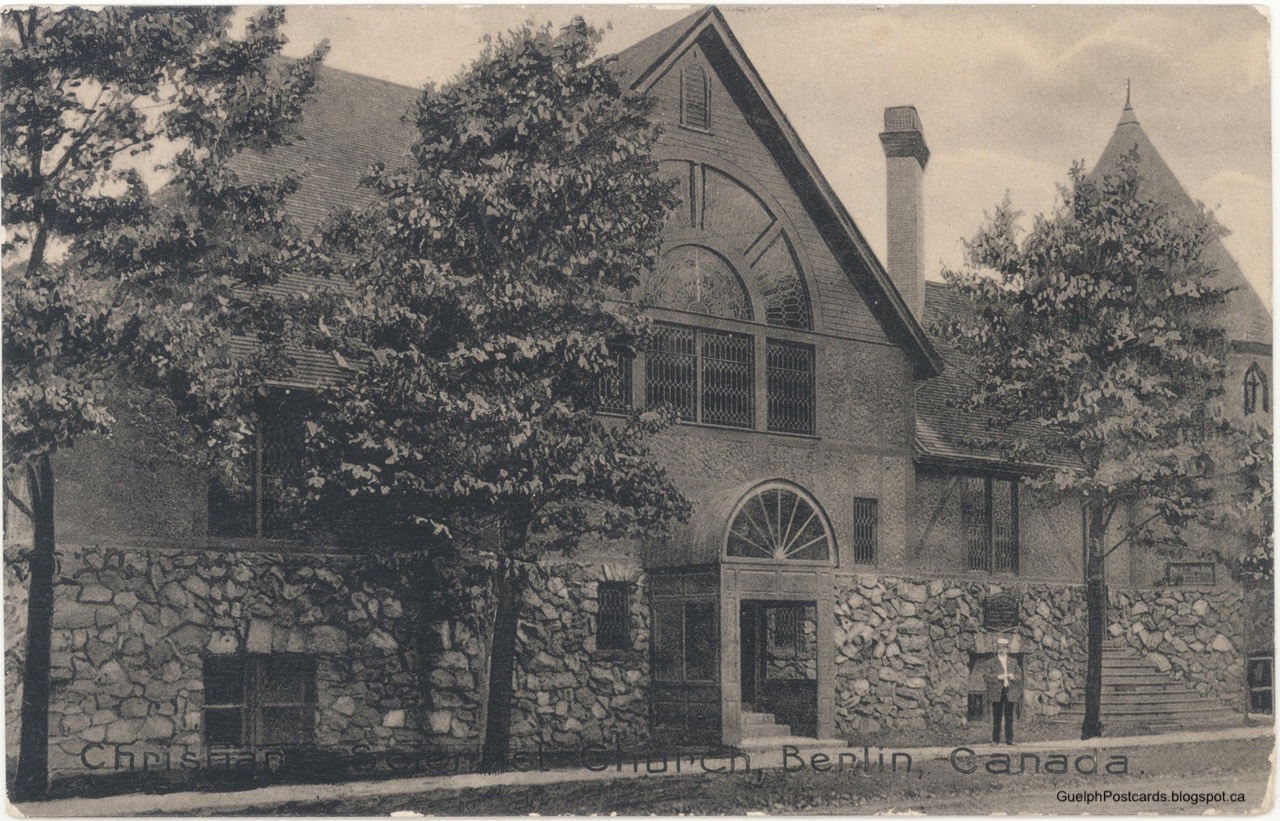
("Christian Scientist Church, Berlin, Canada," ca. 1909. Courtesy of Leigh Hogg.)

(First Church Christ, Scientist; courtesy of Google Maps.)

The subject of the talk was the postcard views of Guelph as provided by the International Stationery Co. (ISC) of Picton, Ontario. In this post, I will give a precis of the talk and show some of the images. The point of the presentation is not to give a history of places shown but to give an impression of the aesthetic quality of the individual postcards as pictures and of the whole set as a curated show of the Royal City as it then existed.

Among Canadian deltiologists, that is, postcard collectors, the ISC is known for its set of fine sepia-toned collotype postcards from the early 20th century. Consider the example below.

("Collegiate," #130.)

This is the predecessor of the current Guelph Collegiate and Vocational Institute, shown from near the corner of Paisley and Arnold streets. For inventory purposes, ISC numbered their cards; this card is number 130. The photo is nicely layered, with paths leading from the foreground into the image, where people can be seen walking under the trees and in front of the pointy buildings. Clouds billow upwards in the sky, drawn there by arists in Germany, where the cards were printed. As will become evident, this composition is typical for cards of Guelph from this set.

The history of the ISC goes back to "The Fair", a kitchen supply and grocery store located in Picton and founded by local boy James Livingstone (1868–1949) in 1895. The Fair was successful and expanded into new locations and goods. As the postcard craze took hold in the Edwardian era, Livingstone got into the act. Postcards turned into a big business for the ISC, which specialized in views from southern Ontario and the Montreal area. It carried on for some decades and left an interesting legacy of topical views.

To judge from postmarks, postcards of Guelph began circulation in 1913 and persisted into the early 1920s. Serial numbers range from 100 to 199, suggesting that there are about 100 views of Guelph in the set—quite a few! ISC expert Ian Robertson reports about 900 cards total in his collection, so the Royal City seems to have enjoyed attention disporportionate to its modest size. What was the charm?

The ISC set includes views of the usual suspects, such as the card below of the Carnegie Public Library. Designed by local boy William Frye-Colwill and erected in 1905, the building was a regular part of postcard sets of Guelph. Images were almost always taken from diagnoally across Norfolk street, which produces this dramatic angle. Even so, the photo appears to have been taken especially for the ISC.

("Carnegie Public Library," no number.)

The Winter Fair Building is another fine card. The building was located on Carden street, in front of the new City Hall, where the splash pad/outdoor rink is now located. It was built to house the agricultural fairs that used to be held downtown. The corner of the old City Hall, now a Provincial Court House, can be seen on the left. As usual, the scene is animated by figures walking hither and thither.
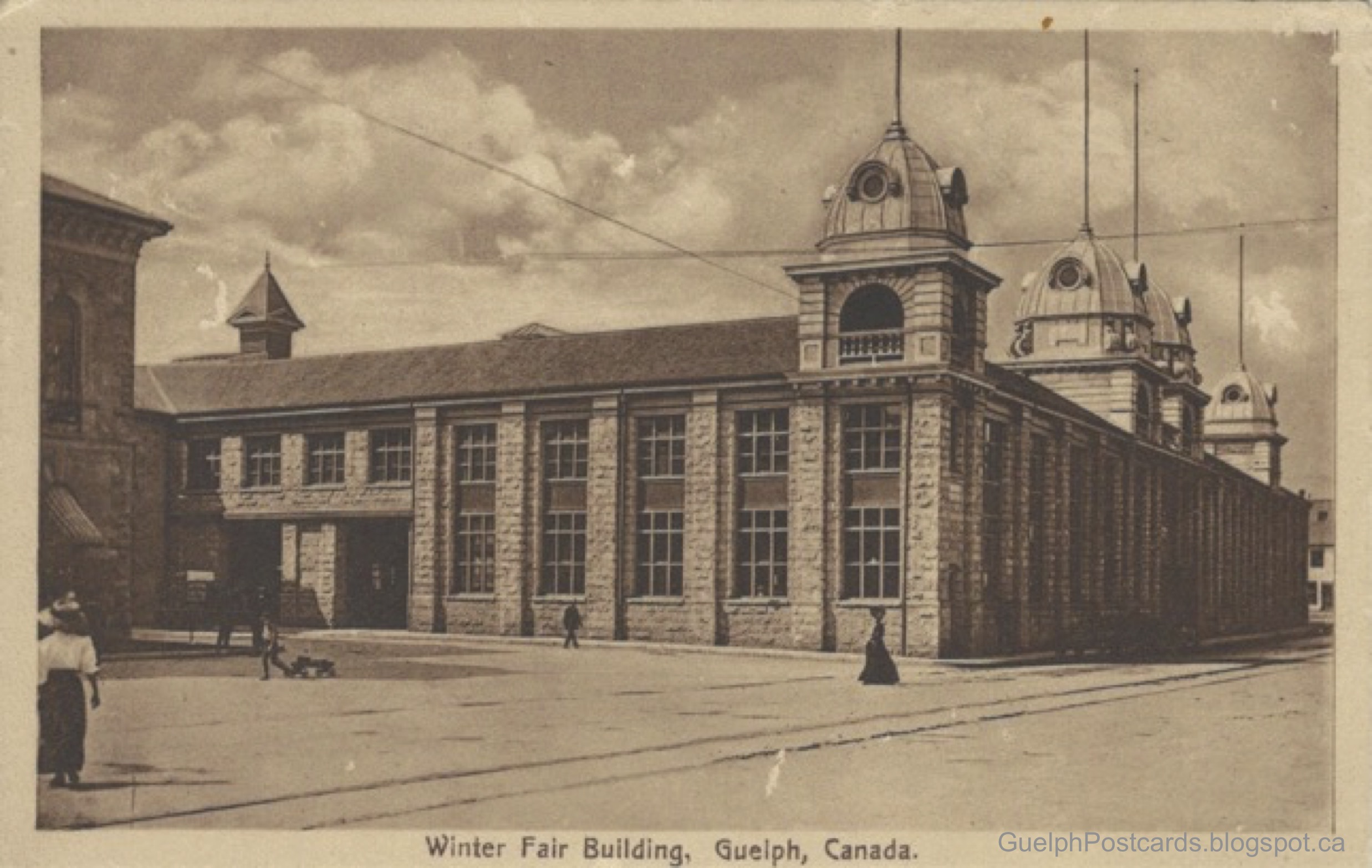
("Winter Fair Building," #110.)

Another good, downtown view is the end of the Bell Piano & Organ factory, seen from the old Grand Trunk train station, today the city bus depot downtown. The photo gives a good impression of the bulk of the building, which was meant to dominate the old market square and train station. Beneath the near facade is the street sprayer, a wagon drawn by two horses and carrying a big barrel of water that was sprayed onto the dirt streets in the summer in order to keep the dust down. To the upper left is the clock tower, perhaps the oldest illuminated clock dial in Canada. Alas, the building burned to the ground in 1945 and the site is now a parking lot for the Royal Inn and Suites.

("Bell Piano and Organ Co.," #122.)

Another interesting view is the one below of the side of the Ontario Reformatory, popularly known in the day as the "Prison farm." The view was taken from the bluff at the back of what used to be the Turfgrass Institute. In the foreground is the Guelph Junction Railway while the three-span concrete bridge over the Eramosa River lies in the middle ground. The bridge was built from limestone from the on-site quarry and using prison labour. The prison buildings themselves lie in the background, making this card one of the few showing the Reformatory that do not feature the buildings themselves up close.

("Prison Farm," #178.)

One of the features of the ISC cards is that there are sometimes multiple views of a given building or site. Such collections of views can provide an impression of a place that would not be possible with a single image—and also would help to sell multiple cards!

One such set in Guelph is of the old Central School. The school lies along the shoulder of the drumlin that is topped by the Church of Our Lady, just one block away. With its prominent site and tall belfry, the old Central School seems to have been intended to leave a strong visual impression on anyone looking around from the downtown, and competing for visual profile with the neighbouring church. The old Central School was demolished in the 1960s and replaced by the current, one-storey structure.

("Central School," #173, looking along what is now Commercial street from Norfolk street.)

("Central School," no number, looking from Cambridge street across Dublin street—the opposite facade to the one above.)

("Guelph Model School," #142, seen from the south along Cambridge street.)

It was certainly an imposing structure!

Naturally, many of the ISC cards feature sites on the Ontario Agricultural College (OAC), now the site of the University of Guelph. For present purposes, I will feature views of Massey Hall & Library. The story has it that OAC President James Mills happened upon Walter Massey, head of the farm implement giant, on a Toronto streetcar and persuaded him to fund construction of a campus library. Thus did this charming structure come into being!

As with many ISC images, the main entrance of Massey Hall & Library can be seen behind a number of trees and elegantly-dressed ladies walking the path from the OAC garden.

("Massey Hall and Library, O.A.C.," #176.)

Below is a view of the Hall from the reverse angle, looking along the entry lane from what is now Gordon street. The MacLaghlan Building is more in the foreground on the right, with the Main Building (where Johnston Hall now stands) behind on the left.

("Massey Hall and Library, O.A.C.," #108.)

The third card with the same caption returns us to the uphill side of the Hall but further down what is now "Winegard Walk". Here, it appears that some sort of open-air lecture is underway, with the audience sitting in rapt attention on the bank of the College reservoir. No photographer on the OAC campus could resist the reflections afforded by this artificial pool!

("Massey Hall and Library, O.A.C.," #173.)

The University of Guelph has produced the following short video relating the story of the Hall:

One of the real treats contained in the ISC set of Guelph are the many pictures from Old Home Week, 1913. Old Home Week, also known as the Old Boys' Reunion, was a city-wide party for residents and former residents. The first installment was the Old Home Week 1908, the second was the Old Home Week 1913, while the third occurred in the Royal City's centennial year, 1927. ISC postcards of the 1913 event are the only images of that installment that I am aware of. The cards are characterized by decorated buildings, people milling about, parades, and events in Exhibition Park. A few selected images will give an appropriate impression.

This card shows a crowd of well-heeled ladies and gentlemen disembarking from a train at the CPR station and making their way through Trafalgar Square towards the downtown. A small omnibus waits by the station's front entrace. It is labelled, "Hotel New Wellington." The actual Hotel New Wellington was only a stone's throw away but the omnibus may have been handy for passengers who arrived with a lot of luggage. The site is today the location of the Trafalgar Square apartments on Cardigan street.

("C.P.R. Station," #136.)

The Grand Trunk railway station (now the VIA station) was also the entry/departure point for many participants in the Old Home Week. In the card below, a train can be seen in the background while people mill about the entrance and the intersection of Wyndham and Carden streets in the foreground. At the front entrance to the station can, once again, be seen the Hotel New Wellington Omnibus. Those must have been busy days for the bus driver! Also doing a good business was the city's peanut vendor, whose cart, I believe, is the focus of attention on the street corner in the centre of the image. Bags of roasted peanuts were a common street snack in those days, and passengers probably arrived with an appetite, not to mention money in their pockets.

("G.T.R. Station," #190.)

The actual Hotel New Wellington itself is featured in the card below. It is suitably dressed up for the occasion. In the foreground is a sandwich board and overhead sign for the Bogardus Pharmacy, which had a storefront facing the corner of Wyndham and Woolwich street in those days.

("Hotel New Wellington," #139.)

There are also many scenes of parades in the set. I include the one below, looking up Wyndham street towards St. George's Square, because the caption actually names the event shown in the image, instead of referring to the places or buildings in the background.

("Old Boy's Home Week at Guelph," #111.)

A number of pictures show crowds in Exhibition Park but the one below is the best (at least of those that I know of at present). At the right is the grandstand, roughly where Hastings Stadium is now, overlooking the track where many racing events and parades were held. To the left are many cars, which were parked in the park for the day. In the background were some of the Exhibition buildings, including the unusual octagonal barn.

("Exhibition Grounds," #127.)

For a final Old Home Week card, I cannot resist one of my Guelph favourites, which shows a woman guiding what I suppose are her young daughters across Woolwich street towards the Hotel New Wellington. Nice outfits! Also, the picture features an interesting composition, with the three figures in the foreground on the right of centre that balance out the dramatic fall and rise of Eramosa road in the background to the left of centre. Very deliberate photography!

("Eramora [sic] Road," #121.)

I will finish by giving a few examples of characteristic street scenes. One of the quirks of the ISC set of Guelph is the photographer's affection for scenes with people walking towards or (more often) away from the camera.

The example below is a card of two gentlemen in fashionable straw boaters striding up Delhi street, which the viewer can see was a dirt road at the time. Their retirement into the middle layer of the composition animates the picture in away that a simple picture of the sidewalk could not.

("Delhi St.," #181)

The locations seems to be near the intersection with Eramosa Road, with the house at address 34 Delhi in view at the left margin. Compare with the Street View image below.

(Delhi street, June 2016; courtesy Google Street View.)

The scene below is Waterloo Avenue, with a woman walking down the sidewalk away from the camera, while a horse & wagon and a streetcar move along the street. Judging from the shadows, the view is looking eastward along the north side of the avenue. It is hard to say which crossroad is in the foreground.

("Waterloo Ave.," #115.)

The penultimate view is of Woolwich street, the main thoroughfare leading north-west out of town. Two well-dressed ladies approach the camera along the sidewalk. A man on horseback rides down the street on the other side.

("Woolwich Street," #145.)

It is difficult to be sure but my sense is that this picture is set just north of the First Baptist Church, looking towards the intersection with London Road in the distance. In that case, the intersection on the left side of the picture is Edwin street. Compare with the Street View image below.

To conclude the tour, have a look at the image below. It shows two ladies and a young man—well turned out, of course—walking across the second Heffernan street footbridge towards Queen street. It seems a fitting image on which to finish.

("Foot bridge," # not known. Courtesy of Guelph Civic Museums, 2004.32.61.)

(As you may have guessed, I do not have a copy of this card in my collection—yet. For the postcard collector, there is always hope.)

Of course, there are many more excellent views in the ISC tour of the burgeois Royal City of 1913. The images are impressively composed and curated and form an appealing tour of the town, all the more poignant as it was, unknowingly, on the verge of the precipice of the Great War, which would change it profoundly.


Works consulted include:
  • Ian Robertson and Barb Henderson (2016) “The International Stationery Company of Picton, Ont.” Card Talk v. 37, n. 2.)

Monday, 22 August 2016

The ghost garden of the O.A.C.

Today, Guelphites and University of Guelph students know Johnston Green as the large and pleasant lawn encountered while traveling to campus from the direction of downtown. Surveyed by the Johnston Hall tower, the green is a favourite spot for seeking verdant relief from the built environment of the campus. However, it has not always been simply trees and grass. Once, it was graced by a large, formal flower garden.

The old flower garden may be viewed in the postcard below, printed by The International Stationary Company of Picton, likely shortly after 1910. The photo was taken from the top of Massey Hall, next to the green.


The sepia hues are the card's original colouration and not due to aging.

The garden layout is formal and geometrical. It is roughly an oval, divided into quarters by gravel paths. In the middle is a round flower bed. Each outside quadrant features four flower beds: three arranged radially and one, triangular bed placed near the long ends of the oval. Each bed appears to feature a single variety of flower or, perhaps, one variety surrounded by another.

On the right-hand side is the north wing of the Main Building, the residence where the O.A.C. students lived during their studies. In the background on the left-hand side is the top of Macdonald Hall, across College Street, where the students of the Macdonald Institute lived during their studies.

Another postcard shows a reverse angle, taken from the Main Building with Massey Hall and the Biological Building (now the MacLachlan Building) in the background. To the right lies the garrison gun known as "Old Jeremiah", sitting in a graveled notch (hidden in the first image), pointing down the Green away from the Main Residence.


This postcard was printed by the Valentine & Sons Publishing Co. around 1910, and gives a more colourful idea of how the garden may have looked.

The placement and form of the flower garden were not the result of some last-minute decorative impulse. Kaars Seipesteijn (1987, pp. 38ff) points out that the garden played a central role in plans for the Green from its inception.

In 1882, well-known American landscape architect Charles H. Miller of Miller & Yeates, Philadelphia, was hired to create a master plan for development of the growing Ontario Agricultural College (O.A.C.). The Ontario Fruit Growers' Association, which had helped to establish a campus Arboretum, prompted the Provincial government to spring for a formal campus plan to be drawn up. Since the O.A.C. had been modeled on US land-grant colleges, it made sense to consult an American designer.

The Main Building had achieved its final form in 1880. So, the central concern of the plan for the Green was how to turn this field, which still bore the marks of Frederick Stone's plow, into a suitable lawn for this building. Miller's solution reflects many ideas of Frederick Law Olmsted, the "father" of American landscape architecture. Olmsted adapted the approach of the English Landscape school of architecture and had designed numerous American college campuses, though he remains best known for his work on Central Park in New York City.

(Frederick Law Olmsted/Courtesy of Wikimedia commons.)

Olmsted's influence is visible in the belt of trees that surround the Green and the semi-circular carriage driveway leading through it from Brock Road (now Gordon Street) past the front of the Main Building. The trees and driveway provide a little drama as the Main Building was "unveiled" only when travelers got quite close to it.

Another important influence on the design of the Green was the other "father" of American landscape architecture, Andrew Jackson Downing. Downing promoted the "gardeneque" style in which, among other things, flower beds were prominently featured. Downing advocated the use of formal flower gardens in the English style. Formal flower gardens could be used to designate important parts of the landscape such as the position of significant structures.

(Andrew Jackson Downing/Courtesy of Wikimedia commons.)

In his Treastise (1841, p. 364), Downing gives an interesting illustration of a set of English gardens along a circular walkway. In the illustration, flower beds are arranged "spottily" along the path and given blob-like shapes. The two exceptions are the beds behind the main structure in the lower left and the conservatory ("b") at the top. The latter beds, particularly, are round and highly regular in shape.


It may be no coincidence that the circular garden beside the conservatory bears a family resemblance to the O.A.C. flower garden. This garden was meant to provide a kind of transition or buffer, separating the relatively informal Green from the significantly formal Main Building. In short, the oval garden at the top of the Green was carefully designed to dignify the Main Building and mark it off from the more haphazard parkland below.

Perhaps Miller had this very illustration in mind when he designed the O.A.C.'s new flower beds.

The resulting layout of the Green can be seen in an aerial photograph apparently taken just after World War I. The caption reads, "Agricultural College, Guelph, Ont., taken from an aeroplane." The copyright notice attributes it to the Canada Post Card Co. of Toronto in 1919. Mills Hall appears to be under construction along the north side of the carriage way. The aeroplane's wing appears on the left edge of the photograph.

(Courtesy of rych mills.)

The significance of the flower garden at the apex of the driveway to the Main Building is readily apparent.

As the postcards above attest, the flower garden persisted through the early twentieth century. However, events finally overtook it. The first event was the adoption of the automobile. As more and more Guelphites drove cars, they demanded more and more pavement on which to drive them and park them.

The second event was the construction of the new Administration Building (now Johnston Hall) in 1931. When the old building was razed and the new one put up in its place, the opportunity was taken to install a paved road flanked with parking spaces, accessed by a lane from Moore Avenue (now College Avenue). The flower beds were torn out and paved over, and the cannon moved away to the south. Asphalt and automobiles—not flowers—now divided the building from the Green, as they continue to do to this day.

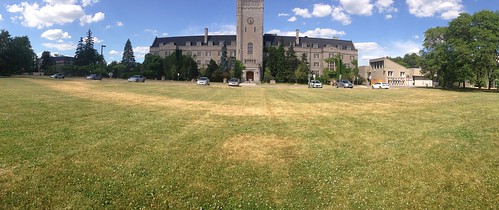
To be more precise, though, the flower garden was only half paved over. The half closest to Gordon Street was simply buried under sod. Thus, the gravel paths that once guided visitors around the beds still lurk under the grass. The result is that, during dry periods, the ghost of the O.A.C.'s flower garden returns to haunt Johnston Green.

In the postcard below, the gravel paths of the western half of the old flower beds are eerily visible as swaths of yellow grass in front of the Administration Building.


This postcard was printed by the Peterborough Post Card Co. around 1960.

These areas of extra-dry grass are known as parch marks. That is, the grass there can become parched quickly during a dry spell because of materials below the surface that prevent root growth or simply do not hold water as well as the surrounding soil. Aerial photographs taken during droughts can sometimes reveal subsurface features of archaeological interest, as they have recently at Stonehenge.

The summer of 2016 has also been a dry one. So, I was interested to see whether or not the paths of the old O.A.C. flower bed would return. Indeed they did, as you can see from this panorama taken on June 30.

(See "Old garden path"/Flickr.com)

The half-arc of the pathway can be seen sweeping to either side of Johnston Hall. In front of the arc is the gravel notch where Old Jeremiah used to sit.

So, if you are observant, and the conditions are right, you can follow in the footsteps of students and faculty from years gone by, walking on the paths of the ghost garden and standing where the cannon once stood guarding the end of the O.A.C. Green.

Saturday, 26 July 2014

The Homewood Retreat grounds

Currently known as the "Homewood Health Centre", Guelph's place of refuge for the afflicted and addicted began as the Homewood Retreat on 18 May 1883. The Retreat was the first wholly, privately owned sanitarium in Canada. The prime movers of its establishment were A. J. W. Langmuir and E. A. Meredith, both of whom were former inspectors of asylums in the Province of Ontario.

They were motivated by both humanitarian and commercial interests. Langmuir thought that a private institution might be able to enact reforms in the care of patients that were not practicable in government institutions (Sanitarium 1983). At the same time, Canadian patients who sought a higher level of comfort and service were traveling to the United States for care. A local institution would keep that revenue in the country and make a profit for the shareholders (Hurd et al., 1917).

Finding a suitable location was crucial to the success of the venture (Sanitarium 1983, p. 1):

[Langmuir] conceived the idea of a private psychiatric hospital, preferably outside of the pressurized life of the big city of Toronto, yet near enough to be accessible by railway or road for horse-drawn vehicles.
Toronto, apparently, was not a good place for people to find rest and recovery. Besides which, land would be more affordable out in the countryside.

However they did it, Langmuir and his associates located an ideal site about one mile north of the centre of Guelph. The 19-acre property epitomized the ideals of the Picturesque. It contained the crest of one of the city's many drumlins, one that commanded an excellent view of the Speed River. In addition, a large and romantic residence sat along the hilltop. This house was "Craiganour", the former home of Donald Guthrie, once the local Member of Parliament, who named it after his birthplace in Scotland.

Craiganour was made of local stone and built in the Italianate idiom then very popular in the country. Notable features include the paired windows with rounded heads, the belvedere in the projecting tower and the broad awning over the porch that stretched around two sides of the structure. The effect was meant to be impressive but, at the same time, inviting. It is a great shame that it was destroyed by an electrical fire in January 1911.

The old building can be seen in the following postcard printed by Rumsey & Co., ca. 1910.


Although the building dominates the photograph, it is the grounds that are the centre of attention. The broad lawn is impressively flat, an observation reinforced by the substantial roller in the middle. Several figures are seen at the edges of the lawn, perhaps preparing to play tennis or croquet. To the left, a stairway can be seen connecting the lawn with the main building.

The site and grounds proved helpful in the rehabilitation of patients. Clearly, outdoor recreation was an important part of the therapy. A report on the facility in the Toronto Globe mentions lawn tennis and quoiting ("The Homewood Retreat at Guelph described," 27 April 1901). The Industrial Number of the Mercury also mentions "cricket creases" (1908). In addition, there are photographs of patients playing bowls on the broad lawns (Sanitarium 1983, p. 18). In fact, a game of bowls on the lawn appears in another postcard, this one published by the International Stationary Co. of Picton also around 1910.


One thing that I enjoy about many of the postcards from this publisher is that people are integral to the photographs. (Look through previous postings to see other examples.) Here, interest in the scene consists of the postures and arrangements of the people in it. Several men sit at their ease in stick furniture while others stand about apparently discussing the play. One lies recumbent on the ground to one side, echoing the posture of the chair in the middle foreground. It is a quiet and even indolent moment.

Besides gaming and sporting possibilities, the grounds offered opportunities for the simple enjoyment of water and greenery. Visitors never failed to notice the beauty of the site and its therapeutic potential. A Globe article on the opening of the institution describes them thus ("The Homewood Retreat", 31 May 1884):

On each [patient's] flat is an alcove with large bay windows facing south, so as to receive the sun for the greater part of the day. From these windows the prospect is a delightful one. The greater part of the twenty-acre park surrounding the building spreads out in front, stretching down to the River Speed, which forms the southern boundary. Glinting patches of the river's surface are seen, changing always as the gently moving leaves close or broaden the view. Dazzled with the brightness, the eye seeks relief and finds it in the sunny or shaded green of the grove, lawn, and meadow.
...
A ramble in the grounds was almost a day's outing. The trees are all strong and beautiful and the grass close and of healthy growth. At the rear of the house are the vegetable garden and orchard, also the stable and stable-yard.
There is one postcard that may capture a view of the Speed near this place. It is labelled simply "River Speed" and was published by Valentine & Son’s sometime around 1905.


The course of the Speed and the shape of the hill opposite are appropriate for a photo taken from the Riverslea estate, built originally by James Goldie and now on the Homewood grounds a little south of the original Homewood. The vista from the belvedere at the Homewood Manor might have been similar.

Another interesting description was given in a letter sent by "Veronica" to a column called "Circle of Young Canada" in the Globe (1 April 1916). In the letter, Veronica describes the scenery where she lives in Guelph:

I'm sure you'd all admire the view from our front windows. I'm not a very good painter of pen-pictures, or any other kind for that matter, but will try to describe it to you. Our house is at the head of a little street that runs down to the River Speed, so we have a clear view of that stream. The other side of the river is closely wooded and the trees were a picture when they were turning all colors. The Homewood Sanitarium is on top of the hill, and every day as the leaves fall we discover new buildings that couldn't be seen before. One of the buildings is called "The Manor" and looks just like an old English home situated in a large park. The scenery all around is beautiful also as there are hills in every direction, either wooded or laid out as farms.
Perhaps Veronica lived near the intersection of Strange (now Dufferin) St. and Clarke St., which affords a decent view of Homewood from across the river.

Besides surveying the Homewood grounds from her window, it may be that Veronica could have explored them readily on foot. A foot bridge had been built across the Speed for the use of patients to get to Homewood from the C.P.R. line on the other side of the river (Sanitarium 1983, p. 8). It was used as such by a special delegation from the Canadian Medical Association in 1910, who were entertained with a buffet luncheon on the lawns.

(This bridge was swept away in the flood of 1912, and it is unclear whether or not it was rebuilt. There is also mention of a foot bridge near Riverslea that existed "within memory of some older Homewood employees" but was removed due to decrepitude; Sanitarium 1983, p. 8).

The Homewood grounds continue to be an important part of the facility and of the greater community. It is, for example, the site of a "horticultural therapy program". Patients learn how to plant and maintain a vegetable garden, which is therapeutic in itself and brings them outside where they can enjoy their surroundings ("Homewood garden part of food production project", Mercury, 16 July 2014):

Currently the garden grows on a roughly 190-square-metre piece of land, surrounded by the centre's beautiful lawns, woods, trails, and historic buildings.

[Program director Tami] Proctor said patients started all of the garden plants from seed and transplanted the seedlings just over a month ago. "It's a true seed-to-table garden," she said.

"This teaches people how to plant a garden," she said. "Some have never planted before, and it gives those with gardening experience the opportunity to really shine and share what they know."

A garden, she said, acts as a "grounding tool," helping patients reconnect with nature, with their senses, and with a sense of inner peace. Digging in the dirt, hearing the surrounding sounds, engaging the sense of smell and taste, is all therapeutic.
The idea is reminiscent of the original idea for the Guelph Correctional Centre, in which prisoners were to be given agricultural tasks to perform in order to detach them from their fondness for alcohol.

Unfortunately, the future of the Homewood grounds may be in question. The current owner, Schlegel Health Care Inc., has applied to the city to sever a number of the lots on the property ("Committee of Adjustment", 12 June 2014). Although no permissions have been granted, it may be that some of the Homewood estate is headed for the auction block. Whether or not that would be a good thing remains unclear, but it would change fundamentally the character of that well-trodden terrain.


26 April 2016:
Schlegel's plans for Homewood portend big changes for the site, or sites. See the Friends of Homewood Grounds website for more information.

Also, see rych mill's Flash from the Past column for more history of the site and institution.

Saturday, 27 July 2013

Old Home Week, 1913 - the preparations

One hundred years ago, one of the biggest occasions for the city of Guelph was Old Home Week. Old Home Week was a celebration in which former residents of Guelph were invited to return to the city to join in festivities arranged in their honour by residents. The custom originated in New England in the late 19th Century when Frank Rollins, a successful entrepreneur in Boston, returned to his native New Hampshire to run for governor. After his election, he decided that many former residents of the state shared his nostalgia for it, and arranged a homecoming for them in 1899. The event was so well received that the idea spread to neighbouring states and provinces, giving rise to many Old Home Weeks and Old Home Days (Daniell 2000, pp. 356-357). Guelph held its first Old Home Week in 1908 and, since it was such a hit, residents decided to do it again in 1913.

In 1913, Old Home Week (also known as "Old Boys Reunion" to some) took place during the last week of July, that is, Sunday July 27 through Saturday August 2. Many of the stationary stores in the city did a brisk business in postcards among other items during that stretch, as visitors wanted to share their experiences with folks who did not attend. One such postcard is shown here:


This postcard was published by The International Stationary Co., Picton, Canada, my favourite source for photos of Edwardian Guelph. It shows three ladies enjoying a leisurely row on the river. I am not sure where the photo was taken, but the growth suggests a more rural area, perhaps even the Eramosa River near Victoria Landing, where there was a boating club.

In any event, the postcard is postmarked on August 1, 1913 and has a special cancellation stamp made up for the occasion, as you can see in the upper right corner on the back of the card.


The cancellation stamp says, "Guelph’s Old Home Week 1913 July 28 Aug 2". According to the Canadian Philatelic Society of Great Britain, these "slogan cancellations" became a popular device in 1912, and remained so for a number of years.

The message on the back of the postcard is of the usual having-a-good-time variety, apparently referring to the celebrations in town:

Well I suppose you are going on your trip. Hope you have a good time. I am just having a great time. Love to all the girls. Nita
Interestingly, I have another postcard addressed to Miss Ida Fissette in my collection, dated in 1908 and addressed to her in Simcoe.

Preparations for the event were extensive and expectations were high. On July 4, the Mercury reported that the executive committee had met and felt enthusiastic about the prospects for the event...

... and expressed the hope that every citizen would take right hold and make the reunion a great advertisement for the city as well as a time of pleasure in the meeting of old friends...
In modern terms, then, the party was not just for old time's sake but to burnish the brand of Guelph in the region. To this end, the committee had made special arrangements at the "Toronto end", which go unexplained. I assume they made a special effort to get former Guelphites from Toronto to make the trip. However, I can find no mention of Guelph's Old Home Week in the Toronto Star or the Globe.

The Mercury also makes special note of the hot weather, which persisted through the month.

Soon, city businesses began to advertise special sales for the event. On July 16, Charles Nelles (who happened to be the treasurer of the executive committee) began to advertise decorations, namely flags and "Chinese lanterns". I suspect the latter term refers to paper lanterns in the form of a ball and illuminated by an electric light. On July 21, George E. B. Grinyer advises his patrons to "Have your electrical decorations done early: We can do your work at once; next week, we'll be busy". Nelles had a stationary and wallpaper store at 101 Wyndham St., while Grinyer had a plumbing, heating, electricians and tinsmith (sheet metal) business at 124-126 Wyndham. It seems that the festivities would be well lit!

On July 24, G. Anderson & Co. advertised "A good supply of flags, tissue paper, pennants, canes, etc." In the daytime, without the benefit of electric lighting, the town spirit would depend upon flags waving and bunting twisting in the winds. Charles Anderson had a book, stationary, china, and fancy goods store at 53 Wyndham (phone 256).

As great as all this sounds, my favourite ads are those of D. E. Macdonald & Bros. The Macdonald family—Donald, Evan, Florence (not a brother, I assume), Norman, and William—had a dry goods, clothing and "mens furnishing" store at 1-9 Wyndham, and were determined to help Guelphites do it in style. Here is their ad from July 21.


That ad emphasizes the decoration needed to prepare properly for the event. The following ad, published in the Mercury during Old Home Week, emphasizes the accoutrements needed to properly enjoy it.


A straw boater and cane, or a parasol, and you're all set!

Some visitors started to arrive early in order to take full advantage. The "City News" column of the Mercury on July 22 notes the following arrival:

For Old Home Week.

Mr. J. M. Ogilvie and Mrs. Ogilvie and family motored up to the "Old Burg" for Mr. Ogilvie's vacation. They will be here for two weeks, for as Mr. Ogilvie says, "We wouldn't miss a Guelph Old Boy's Reunion for anything. That's why I got my holiday right now."
Mr. Ogilvie's arrival raises two issues regarding Old Home Week. The first is the importance of the "motor" or automobile to it. Cars were assuming an ever greater role in personal mobility, especially with the relatively inexpensive Ford Model T on the market since 1908. As we will see, cars also assumed a formal role in Old Home Week itself.

Second, the issue of how the event would affect local businesses was much discussed as July 28 approached. Clearly, goods and services vendors downtown were elated. However, factory owners were not so enthused. On July 24, Mayor Samuel Carter suggested to the city council that the August Civic Holiday—that would fall on the first Monday in August, right after Old Home Week—should be either cancelled or moved earlier to within the Week itself:

[Factory owners] claim that in all probability they will have to close down during Old Home Week, and that they cannot afford to close down again on the Monday following.
The Trades and Labor Council and the Executive Committee of Old Home Week met to discuss the matter and recommended that the Civic Holiday be moved to Tuesday, July 29, during Old Home Week. An editorial in the Mercury (July 25) inveighed against the change for the following reasons:
  • The date of the Civic Holiday was set by a by-law, which probably could not be amended in time;
  • The railways give special rates on that day and would not change the date at the last minute. Thus, Guelphites would be deprived of their chance at affordable train travel for holiday making;
  • Stores in town would have to close on Tuesday, taking away a great deal of business and inconveniencing attendees.
There are no indications that I can find that the Civic Holiday was moved.

With all obstacles removed and preparations made, it was time for the celebrations to begin...

Tuesday, 2 July 2013

Happy (belated) Canada Day!

Although I have missed the date itself, I still would like to honour Canada's birthday with a belated posting.

Here is a postcard featuring what appears to be a Dominion Day parade, ca. 1915. The patriotic bunting is plentiful, and the floats are profusely decorated with flowers. The City Hall (and its clock) are visible in the background. The float in the foreground may be a fire engine, to judge from its shadow. Note the plumes on the horses' heads. Also in the background is are incandescent street lights of the type installed in 1912.

(Courtesy of John Parklyn)

The postcard has a white border, from the post-1915 period, and is done in a sepia-toned halftone process. It is labelled "The Armouries, Guelph, Can." and was printed by The International Stationary Co., Picton, Canada.

It is hard to get an exact match with Google Street View because of construction when the photos were taken, but here is a shot that is approximately the same. It is of Lower Wyndham St., at the intersection with Macdonell, looking towards the Armouries.


View Larger Map

I thought that it would be interesting to see what was happening on Dominion Day in Guelph 100 years ago, when these postcards were so popular. Unfortunately, the issues of the Guelph Evening Mercury from July 1st and 2nd of 1913 are missing from the archives. However, the June 30th edition is available and suggests what was happening in the city at the time.

The headline news that day was the arrival of world-famous opera singer Eddie Johnson. A Guelph native, Johnson had been in Italy for over five years, earning his living and building up his reputation. The piece notes the fame that Johnson had gained in Italy, even being ranked with "the immortal Caruso". In spite of his fame, Johnson displays a properly Canadian modesty:

With that inherent modesty, for which all true British and Canadian artists are noted, he would rather talk about anything else than that wonderful voice of his which has made all Europe proclaim him a second Caruso.
In his success, and his modesty, he displays the spirit of his country. He came with his wife and daughter to visit his parents and to rest his voice for the upcoming season in Italy.

Although Guelphites could choose to stay home and enjoy the Dominion Day parade downtown, they could also travel to distant parts, perhaps to visit their relatives. Both Canadian Pacific and the Grand Trunk Railways offered discount rates on fares for travel within the province.

If the train did not offer enough exercise for some, then there was always the chance to participate in the famous Dunlop Trophy Race. This race was an annual event co-sponsored by the Dunlop Tire & Rubber Goods Co. and CCM. In 1913, the race went from Waterloo to Preston Hill and back for a total of 20 miles.

The churches of Guelph held services on June 30 to prepare the way for the secular Dominion Day celebrations on the morrow. Many services involved themes of progress, change, and movement. The Salvation Army, for example, staged a march near the site depicted in the postcard above:

At the splendid open air service on Wyndham and Carden Streets, the band especially excelled itself. As some one said, "Who could help but march to such music? The word of the cornets was often remarked, it was perfect and always sure."
The Rev. J. D. Fitzpatrick of Norfolk St. Church observed a tension created by the mobility that modern life granted to Canadians. On the one hand, Western civilization in general, and Canada in particular, was characterized by enhanced mobility, represented by the national railways:
It was the church that discovered Japan and China and Africa. It produced the world's knowledge and commerce. Reports from missionaries in the Northwest were the original cause of the building of the Canadian Pacific Northwest Railway across the continent.
Unfortunately, the opportunities presented by the nation's transportation networks also threatened to unravel its moral fabric:
"The great foe of the Dominion," said the reverend speaker, "is materialism." No nation ever perished when she was poor; Egypt, Babylonia, Rome and Israel, were all destroyed when at the height of their material prosperity. The reforms needed in the Dominion will be brought about by the church; the evil of worldliness will be conquered by it.
Although it may be a mixed blessing, mobility is something that Canadians expect and enjoy, as their excursions on Canada Day attest.

Thursday, 11 April 2013

Eramosa Rd.

This postcard presents a view of Eramosa Rd. (incorrectly labelled "Eramora Road") looking northward from the intersection of Eramosa, Woolwich St. and Upper Wyndham.


Text on the back of the card indicates that it was produced by "The International Stationary Co., Picton, Canada". It is one of a series of postcards of Guelph printed by the company, all done in this warm, sepia tone, with a narrow white frame and art-nouveau-font label on the front.

The photo clearly shows incandescent street lamps, directly above the hat of the woman in the foreground, that were introduced to downtown Guelph in 1912. The card is postmarked for June 1st, 1916, so the image can be dated to ca. 1915.

This card is one of my favourites. It is an unusual card in the sense that it is a professional card that has people in the foreground. Most professional cards of Guelph, at least in the Edwardian era, are of notable structures or places, less often of activities or events. Activity cards often feature people but focus on leisure or recreation, e.g., strolling in the park. Here, the ladies crossing Woolwich St. are in the foreground, but are not engaged in a recreation. Indeed, they are dressed in their fancy attire. So, what are they doing?

It is hard to be sure, but the photo offers some clues. Union Jacks and Ensigns are seen flying in the windows above (James) Steele's Wire Works (the building on the corner at the right margin of the photo). A line of Union Jacks and perhaps other flags is suspended across the road from Craven's Furniture to Trafalgar Square, opposite. (Henry Craven is listed as an upholsterer in the 1917 Vernon's City Directory, at 5 Trafalgar Square). In "Guelph: Take a look at us!", Donald Coulman provides a picture of the Dominion Day parade in downtown in 1912, noting that the buildings are covered in patriotic bunting (1977, n. 180). Dominion Day marked the establishment of Canada as a confederation and a British dominion on July 1st, 1867. (It is now known as Canada Day.) It could be that the ladies in the foreground are on their way to a Dominion Day celebration.

The background is also interesting. The Trafalgar Square road continues from the picture's center down to the Eramosa bridge. Eramosa then continues dramatically up and over the crest of Eramosa hill on its way out of town.

Things are happening along the roadway. A car appears to be turning off the road in the middle ground. Is it a Model T? Perhaps it is headed into the garage next to Craven's Furniture. Vernon's directory lists a "Maylor Auto Sales" at 9 Trafalgar Square, which seems likely to be the garage in the picture. The directory lists seven "garages" in total, suggesting that cars were becoming popular in the city, even at this relatively early date.

Further down the road, beside the furniture store, is a passenger rail car, apparently sitting on the Canadian Pacific Railway tracks next to the road. I gather that it is not going to cross the road since the white barrier poles on either side of the tracks are raised to permit traffic to cross.

Then comes the Eramosa bridge, spanning the Speed River. After the bridge, the colouration of the roadway seems to change, suggesting that the pavement ended there and that Eramosa road remained a dirt road at the time.

Although it is necessarily a snapshot, the picture provides an interesting tension. The three figures in the foreground approach the camera, walking with a purpose, even as Eramosa Road seems to lead the eye off in the opposite direction, away from the camera and over the horizon. Also, the different means of mobility, that is, walking, driving, and riding the train, remind the viewer about the places in the area outside of the frame of the picture. Retrospectively, the presence of the cars makes me think about how profoundly automotive traffic is about to change the city and the lives of the people in it.

Here is the current Street View image of the same vantage:


View Larger Map

Many of the details have changed. For example, the roadway has been widened, squeezing Trafalgar Square in order to accommodate more cars on Eramosa. The buildings on the right margin have been replaced by The Matrix Centre. Eramosa Road has replaced the "Trafalgar Square" address and now meets Woolwich St. However, the topology of the streets remains essentially the same.

The postcard was sent through the mail, so the back has some interesting things on it as well. First, it has a two-cent stamp, reflecting the fact that rates for postcards increased from one to two cents in 1915 for North American delivery. The text of the letter reads as follows:

Thurs. a.m.
Dear Margaret: Rec. your card. have the house-cleaning just about done. giving Ida a party on sat. after-noon. if Sid doesn't get off, you had better come up over sunday. Ida would like you to be here for her party.
With love from all
Grace and the boss
The receiving address is: "Mrs. S. Dudley, 88 Indian Grove, Toronto, Ont". I wonder if Margaret made it for the party. Or Sid. And, who was "the boss"?