Showing posts with label warwick brothers and rutter. Show all posts

Sunday, 25 July 2021

Guelph postcard producers: C. Anderson & Co.

The postcard below provides an interesting, though murky, view across St. George's Square, as it appeared around 1910. The caption, "Post Office and section of Wyndham st., Guelph, Canada", draws attention to the city's fancy and recently renovated post office, which appears to the left of Douglas Street.

As always, the Square is busy, with men and women walking around and through it. Horses with carts are coming and going. Someone is running away from the camera up Wyndham street—camera shy? A young man appears to be scooting through the square with his knee on a four-wheeled cart. Streetcar tracks bisect the space diagonally.

The alert viewer may note that the stamp is attached to the front of this postcard instead of the back as usual. It is also notable that the stamp is upside-down. The stamp's rotation may convey a message. In the "Language of stamps," an inverted stamp could be used to ask, "Do you remember me?" In other words, it was a subtle nag to the recipient that a card or letter was expected ASAP.

That this orientation was not an accident seems to be borne out by the message, sent to Miss Mary Elliott of Galt on 7 March 1910:

Dear Mollie. Have you been doing the Rip Van Winkle act lately[?] Haven’t heard for ages, poor Mrs. Fairley has been in the Hospital again this last month. Write soon. Helen Taylor
The postcard was printed by Warwick Bros. & Rutter, Toronto, for C. Anderson & Co., Guelph.

As fortune would have it, the C. Anderson store is visible in the postcard picture. At the right-hand edge lies Joseph Pequegnat's jewelery store. Immediately to its left, at 53 Wyndham street, is the storefront of C. Anderson & Co. The storefront can be better seen in the detail below.

C. Anderson & Co. was a popular bookstore that sold books, stationary, and "fancy goods." It was named after its founder and manager Christian Anderson. Besides being a highly successful Guelph merchant, Christian Anderson has the distinction of being one of the Royal City's few, early woman entrepreneurs.

Christian Anderson was born on 16 July 1855 to Alexander and Christian Anderson, somewhere in the vicinity of Guelph, and, clearly, named after her mother. Her father led a peripatetic life, which may account for the uncertainty of Christian's early whereabouts. He immigrated to Canada from Fyfeshire, Scotland with his parents and siblings around 1834 and settled on a farm in the Paisley Block near Guelph (Mercury, 11 Feb. 1889). As soon as he was able, he went into farming on his own account in "different localities." Then, his wanderings truly began:

Tiring of this he went into partnership with his brother Robert in the lumbering business, at what was known as Stumptown, in Halton Co., near Acton. After the partnership was dissolved he went to Georgetown and embarked in the grocery business which he carried on for a few years. About twenty years ago he removed to Guelph and taught in the public schools for about eight years. Giving this occupation up he went into the manufacture of brushes. He threw this business up also and went to Toronto, where he has since carried on a glassware agency.
He died in Toronto in 1889 but was buried in the Union (now Woodlawn) Cemetery at Guelph.

Ms. Anderson was educated in public schools in Georgetown and, later, Guelph, where the family located in 1868 (Mercury, 1 Oct. 1918). So, perhaps "Stumptown" was her place of birth. She seems not to have shared her father's wanderlust and remained in the Royal City for the rest of her life.

However, Ms. Anderson displayed independence. Upon graduating from public school, she entered the employ of T.J. Day, whose bookstore was a fixture at 29 Wyndham street since 1861. There she remained as a clerk for over 20 years. Evidently, she enjoyed the independence brought by her job and income and never married.

However, in 1898, she decided to set up shop for herself. It is unclear what led her to make this decision; much later, we are informed only that, "Miss Anderson was dissatisfied with working for another, so decided to branch out into business for herself" (Mercury, 28 Feb. 1948). Whatever the full story was, this move seems to speak further of Ms. Anderson's independent spirit. She was soon joined in the venture by her younger sister, Lydia, who also, as it happens, remained a spinster.

The 1908 Industrial number of the Mercury provides a fulsome description of C. Anderson & Co. in its early years:

The premises occupied comprise a large three-story building, located at 53 Wyndham street. On the first floor can be found every description of books, high-class stationary and the office. On the second floor is carried a comprehensive line of china toys and a variety of small articles. The third floor is devoted to stock. The store is thoroughly equipped, and employment is given to seven skilled and painstaking assistants. When we say to our readers, that at C. Anderson & Co’s. store they will one of the most complete and up-to-date establishments of this kind in the country, we have covered the ground. The individual members of the firm are C. Anderson and L. Anderson. C. Anderson, the manager of the concern, has had a wide experience in this line of business, having spent a number of years and thoroughly learned the business in T.J. Day’s store.
A contemporary advertisement for the bookstore, from the OAC Review (1909, v. 21, n. 5) of the nearby Ontario Agricultural College, shows that C. Anderson & Co. did a lot of business by supplying school needs for the College students.

The name "The Central Bookstore" suggested the importance of the shop and also its location in the middle of Guelph's downtown district.

In the Edwardian era, C. Anderson & Co. sold postcards, as did many bookstores. As suggested by the postcard above, they had a line of cards printed especially for them by Warwick Bros. & Rutter of Toronto. Warwick Bros. was one of largest publishers in Toronto and Canada at the time, and described as "The Big Kahuna" of postcard publishers in the nation by postcard researcher Mike Smith. The company was the first in Canada to print colour postcards domestically rather than having the work done in Germany or Britain as was the practise before.

It is quite likely that C. Anderson & Co. had a standing relationship with Warwick Bros. and so having them print up a special line was straightforward. Postmarks of cards in my collection range from 1910 to 1916, although it is likely that the store sold Warwick Bros. cards for some years earlier.

Some of this line of cards were printed in colour with a white bar across the front bottom, as was typical for Warwick Bros. cards of the time. These cards were from the publisher's own line of Guelph cards with the name of C. Anderson & Co. printed beneath the caption, as illustrated by the postcard featuring the old Heffernan street footbridge:

However, the majority of postcards in this line are printed in a murky, sepia tone like that of the first postcard above, probably to keep the cost of production down. What may be the first group in this line consists of postcards with hand-lettered captions. This group includes a series of views of Wyndham street, starting south of St. George's Square:

The Square itself is represented by the card already shown above:

The triptych is then completed with a view of Upper Wyndham Street, to the left of the old Post Office:

Some of the pictures were of scenes away from the downtown core. For example, this very murky view of the General Hospital is also included:

Anyone collecting this series of cards might assume that Guelph had a terrible smog problem!

What may be a later series is characterized by a clearer sepia tone and captions set in type. This group includes views of both of Guelph's new train stations that were opened in 1911. The first is the Grand Trunk (now Canadian National/VIA) station:

The baggage building east of the passenger area (since removed) can be seen at the right-hand end of the station's long roof.

The Canadian Pacific station built to replace the Priory is next:

Taken from the north side of the Speed River looking south over the Guelph Junction Railway tracks, the site is currently occupied by the Trafalgar Square apartments.

In addition to the commercial side of the stationary business, C. Anderson & Co. was involved in its professional organization. When the Booksellers’ and Stationers’ Association of the Province of Ontario was formed in 1907, C. Anderson & Co. was a charter member (Bookseller and stationer, v. 23, n. 2, p. 15). Charles Nelles, the owner of the City Book Store just a few doors down, was president of the Association, so Guelph was well represented in the local profession.

By the time the Company began to sell postcards, Christian and Lydia Anderson had settled into life at 76 Yarmouth Street. The 1911 Ontario Census lists Christian Anderson as the head of the household and describes the occupation of both women as "Stationer." Another woman, Kate Doerson, is listed as a "domestic," that is, a resident housekeeper.

By all indications, Christian and Lydia Anderson had achieved a comfortable, middle-class existence for themselves.

(76 Yarmouth street, courtesy of Google Street View.)

When the Anderson sisters lived there, the building was a single-storey cottage that had been built in the mid 1860s. The second floor was added after 1921.

Their brother Thomas Anderson worked as a press operator for the Kelso Printing Company, while brother Andrew worked for his sisters at the bookstore. A few years later, Andrew joined Thomas at Kelso.

By 1911, the Anderson sisters had set up a phone line for their store, with the three-digit number "256."

In the early morning of 1 October 1918, in her 64th year, Christian Anderson died at her home on Yarmouth street. Her obituary briefly describes her history in the stationary trade and, on a personal note, adds that she "was an active worker, for many years in Knox church, and was, for some time, a member of the choir, and teacher in the Sunday school" (Mercury, 1 Oct. 1918). After her funeral a couple of days later, the Mercury lists the pall bearers at the service (3 Oct. 1918):

The pall bearers were, W. Wood, of Warwick Bros. & Rutter, Toronto; W. Cunningham, of Buntin Gillies Co., Hamilton; F.G. Johnston, of H. Froude Co., Toronto, and R.E. Nelson, W. Macdonald, and A. Scott, of Guelph.
It is surely significant that representatives of three major Ontario publishers were present, including the company, Warwick Bros. & Rutter, that had printed the postcards for C. Anderson & Co. only a few years before.

After Christian's death, Lydia Anderson continued to run the business, apprently in much the same vein as before. An ad from the Mercury's Guelph Centennial edition (20 Jul. 1927) carries on the modest style of presentation from the previous decade—and even mentions postcards!

Lydia died in 1929. The business was run by the estate, probably the Andersons' little brother Andrew, until 1930, when the following announcement appeared in the Mercury (18 June):

We wish to announce the sale of the business of C. Anderson & Co., to Mr. Campbell Lamont, of Orangeville. In thanking our customers for the liberal patronage afforded us, we bespeak the same for Mr. Lamont. The business will be carried on under the same name.

Yours truly,
C. Anderson & Co
Per A.A. Anderson
Campbell Lamont was the husband of Janet Christian (Anderson), the daughter of Thomas, Christian and Lydia's brother. It seems fair to say that the business remained in the family! The Lamonts purchased the business from the estate, where Campbell then worked as manager and Janet as clerk. They moved in with Thomas at his house at 107 Palmer street.

(107 Palmer street; Courtesy of Google Street View.)

Although the business remained essentially the same, some changes were made (Mercury, 28 Feb. 1948):

In 1930 the new proprietors eliminated the counter system of sales, and instituted the self-serve system now in use, and is proving very effective. Under the present setup more goods can be displayed, and the entire floor space is open to the public to see and inspect the wide variety of articles for sale.
That half-century of activity has been a period of steady progress, and today they enjoy the patronage which covers and area, believed far in excess of any Guelph retail store. Besides serving all parts of Wellington County, considerable business is derived from Gray, Bruce, Huron and Dufferin Counties.
C. Anderson & Co. remained in business at the same location until 1958, an impressive 60-year run.

As noted above, women entrepreneurs (business owners) were unusual in Guelph and in Canada in general. It is difficult to say exactly how unusual. Most working women of the era were employees who worked for wages, stereotypically as typists, telephone operators, bookkeepers, and so on. However, the situation of women who owned businesses and derived income from their profits is less well studied.

Aston & Martino (2017) found that women played a significant role as entrepreneurs in Victorian and Edwardian Britain. Although it is usually thought that women were squeezed out of business in this period compared with the pre-industrial era, this seems not to have been the case. English women continued to own and operate businesses successfully in that era. To what extent this is true in Canada generally and Ontario in particular is hard to say. The experience of the Anderson sisters demonstrates that it could be done.

Buddle (2020) has found that a significant number of women owned businesses in comtemporary British Columbia. These tended to be in areas where women might be employed as laborers, such as hotel keeping, food preparation, laundry, and so on. Although not married, the Anderson sisters would seem to fit with this model, as clerking in bookstores was a common occupation for working women. Indeed, their own business careers began as wage earners in the book and stationary trade.

Certainly, it would be interesting to know more about Christian and Lydia Anderson and their experiences as women entrepreneurs in the early 20th century. Also, it would be great to find pictures of them! Although descriptions of Guelph entrepreneurs of the era were often accompanied by drawings or photos, I have yet to find a representaiton of either Christian or Lydia Anderson.


Works consulted for this post include:

Wednesday, 27 December 2017

Xmas at Summerhill, 1904

At Christmas time, it is fun to pick out a postcard with a seasonal message to investigate. This year's card conveys a scene from the campus of the Ontario Agricultural College, ca 1900. Specifically, it shows what is today known as Winegard's walk after William Winegard, the University of Guelph's second president.

(Courtesy of the John W. Keleher collection.)

In the right foreground is Day Hall (then the "Experimental building"), then, to the left of the tree, is the Gymnasium, the Chemistry Building, and the Main Building (all now demolished).

The postcard is of an early type in which the message goes on the front with the picture while the address alone goes on the back (called an "undivided back" card for that reason). The message on the front reads:

Many thanks for Xmas greetings. Wishing you a very happy new year. L.A.Y.
The addressee is Master Hyde Auld, “Summerhill”, Guelph. The card was printed by Warwick Bros. & Rutter and was postmarked on 29 Dec. 1904.

Summerhill was one of Guelph's houses grand enough to merit a special name. Summerhill was becoming quite well-known—even notorious—in the Royal City, so it could readily be used as an address, all by itself.

The history of Summerhill is well summarized in the booklet "Brooklyn and College Hill" (Guelph Arts Council, p. 11–12). It was built in 1840 by James Thompson at the centre of what was then a large estate. In 1865, it was rented to Colonel Thomas Saunders, Wellington County's first magistrate and an important local figure. He was soon to sell his large farm, "Woodlands," which later became Vimy Ridge Farm. He also figures in the Christmas post from 2015 as one of the founders of St. James church in Guelph.

Summerhill became notorious because of two of the Colonel's granddaughters who grew up there: Lucy and Elinor Sutherland. In 1860, their mother Elinor had married Douglas Sutherland, a British engineer who took her to India, South America, and then London, where the girls were born. In 1865, Douglas died of typhoid fever, prompting the widow to journey to Summerhill with her young family (Mercury, 20 July 1927).

Although shorn of its estate, Summerhill still stands at 25 Harcourt Drive and can be seen looking resplendent in the Google Street View picture below.


Even though the old laneway leading to Summerhill from Dundas Road (now Gordon Street) is now gone, the gates can still be seen halfway up College hill, on the west side of the street:


The family remained at Summerhill until 1871, when Elinor married Mr. David Kennedy and removed to his residence on Woolwich Street, next to the new St. George's Church and opposite the Court House (where the Wellington Catholic District School Board building now stands). The Mercury relates a scene from their childhood on the side of the Speed River (perhaps a recollection shared by the ladies during a later visit to town):

Here the children watched with great interest the building of the new St. George's Church, the old one being in St. George's Square, and here with one or two of their young cousins, the Saunders boys, they slid on boards through the basement [of the church], and climbed as far as possible the scaffolding about the tower, then in the process of erection.
In 1874, Mr. Kennedy took his family back to the Old Country.

A brief sketch can hardly do justice to the careers of these two woman, so let the following sketch suffice. Lucy became a dressmaker and then a noted fashion designer. In 1900, she married Sir Cosmo Duff-Gordon and, in 1903, opened "Lucile Limited" in London. Her's was the place the English glitterati got their best clothes for the next 20 years.


(Lucy Christiania, Lady Duff-Gordon (1919)/Wikimedia commons.)

Lucile was later known for surviving the sinking of the Titanic in 1912. She and her husband survived in a life boat that carried only 12 people although it had a capacity of 40. Rumors spread that Duff-Gordon had bribed the crew to leave the ship prematurely. A subsequent inquiry exonerated him.

Anyway, as the website of Lucile and Co. states today, Lucile Duff-Gordon was the "It girl" of the Belle Epoque.

Lucy's sister Elinor married Clayton Louis Glyn in 1892 but the marriage proved unworkable. As a result, Elinor Glyn began a series of affairs with various high-flying British aristocrats. If that were not scandalous enough, she began to publish risqué novels based on her experiences. The best-known is "Three weeks," about a young English nobleman who has a three-week fling with an older woman in Switzerland, and published in 1907 (and based on a true story!).

The book inspired the following bit of popular verse:

Would you like to sin
With Elinor Glyn
On a tiger skin?
Or would you prefer
To err with her
On some other fur?
The book was panned by critics as vulgar, silly, and disreputable and, naturally, sold very well.


(Elinor Glyn/Courtesy of Wikimedia commons.)

Elinor went on to write and produce screenplays for early Hollywood films. Perhaps the most famous of these was "It" (1927), about a spunky young redhead who sets her cap at her wealthy employer. The movie popularized the concept of the "It girl", a woman who possesses "It," defined by Elinor as follows:

With It, you win all men if you are a woman and all women if you are a man. It can be a quality of the mind as well as a physical attraction.
Clara Bow, who played the heroine in the movie, was thus the first official It girl.


(Poster for "It"/Courtesy Wikimedia commons.)

So, when our postcard arrived at the Guelph post office in 1904, "Summerhill" was already known as the former residence of the Sutherland girls, each making a name for herself in the Old Country.

As luck would have it, the postcard's recipient, Master Hyde Auld, was also destined to make a name for himself and the Royal City but in his own way.

James Hyde Auld was born in Guelph on 27 June 1891. He was the third child of Charles and Jessie Auld. Charles Auld was in the carriage goods business, having worked as a traveling salesman for the Guelph Carriage Goods Co. (Mercury, 20 July 1927). In 1887, Auld and his partner Augustus Woodyatt took over the Guelph Sewing Machine and Novelty Works on Nelson Crescent (now the site of a parking lot at 8 Paisley Street) and began to manufacture lawn mowers there. The business expanded quickly and was moved to the former McCrae Woolen Co. mill lands (now on Arthur Street South, below the railway bridge). By 1902, the business became part of the Taylor-Forbes Co. Besides lawnmowers, it produced steam boilers, general hardware, metal castings and, later, auto parts.

Jessie Auld, née Forbes, was a daughter of Robert Forbes, who was half of Taylor-Forbes Co. and who had bought Summerhill in 1874. Although her husband Charles is usually listed as living in the downtown area, it seems that Jessie remained at Summerhill, at least much of the time. So it was that her son James Hyde could be found there in 1904 when our postcard was dropped in the mail.

James Hyde, who went by "Hyde," signed up for the Canadian Expeditionary Force at Woodstock in November, 1915. The fact that he did so in Woodstock instead of Guelph suggests that he might not have had his mother's approval.

His profession is given as "salesman," suggesting that he had followed his father, probably at Taylor-Forbes. For reasons unknown, he was not assigned to overseas duty and signed up a second time in Toronto in June, 1916. His record notes that he suffered and attack of diphtheria in March, 1917 and so was not sent overseas until October of that year. He then seems to have suffered at attack of chicken pox in Britain, which further delayed his deployment to France until May, 1918.

There, he joined the 78th Battalion (Winnipeg Grenadiers) as a Lieutenant. On 2 Sep 1918, he was shot through the right leg just above the knee. The location near Dury and the date suggests that he was taking part in the Battle of the Hindenberg line, the Allied offensive that eventually brought about the defeat of the German army.

He was evacuated to London for treatment and rehabilitation. The wound was quite profound, and he was returned to Canada only in September, 1919. There, he was fitted with a knee brace but continued to have significant difficulty walking, which, I imagine, persisted for the rest of his life.

By the time that Hyde returned to Canada, his mother and sister had relocated to 123 Glasgow Street (north), where he and other family members remained for the rest of his life. The house remains there today, a classic Royal City residence made from local stone (dormers are a recent addition):


Hyde evidently decided on a change of career. Instead of resuming his job in sales, which may have been difficult, given his injury, he pursued a career in music. Specifically, Hyde joined the Presto music club of Guelph and began training and performing as a baritone. A short survey of his ambitious training is given in the Toronto Globe (15 Sep 1927):

His many friends will be interested to learn that Hyde Auld, Canadian baritone, is now studying in Paris with Jean Perier of the Opera Comique. During the past season Mr. Auld has been much in demand in and around New York for private musicales and soirees, and in November will make his European debut in Paris. Arriving home in December, Mr. Auld will be available for engagements in January, February and March. He then returns to Paris, going later to Italy.
His first performance that I have found is in Toronto under the tutelage of James Campbell-McInnes of that city in December, 1921. It seems that he wasted little time upon his return to Canada.

Hyde performed both classical works and folk songs. For example, he sang "Duna" and "The old road" at the grand re-opening of the Guelph Collegiate and Vocational Institute (Mercury, 8 Nov 1923). A notion of what this performance sounded like may be gained from the singing of "Duna" by the baritone Thomas L. Thomas in 1956:


(Courtesy of Youtube.)

On 8 May 1929, Hyde performed on a broadcast of the Imperial Oil hour on CKGW Toronto, a radio station based at the King Edward Hotel (Globe). While the Imperial Oil Symphony Orchestra played, Hyde sang "Ich liebe dich" by Grieg. (How many oil companies have symphony orchestras today?) Hyde was one of several performers on the program.

That he sang in German suggests that Hyde did not hold a grudge. This attitude seems to be confirmed by the fact that Hyde later visited Munich, Germany for advanced study in his field (Globe, 6 July 1935). One wonders what he thought of the Nazis then in power there.

Besides being a well-known Canadian baritone, Hyde took an interest in teaching. He had become a member of the Ontario Educational Association by 1939, when he is listed as a sponsor of the seventh annual concert of music students of Ontario, given in Massey Hall in Toronto (Globe, 12 April 1939). Later records give his profession variously as musician, vocalist, and music teacher. By 1957, he is listed as "retired."

James Hyde Auld died on 6 November 1981 at the age of 90 years. Although not as well-known as the Royal City's most famous tenor, Edward Johnson, Auld deserves to be remembered for his achievements in the national and international music scenes, all accomplished in the face of significant adversity.

Of course, the Xmas tableau would not be complete without mention of some significant events of the season in 1904.

On Dec 5, Mr. John Gordon of Nassagaweya lost his left leg below the knee after being run over by a train at the C.P.R. station (that is, the Priory). The Mercury explains that the event occurred on the passenger platform as Mr. Gordon jumped on and off the train as it pulled in (5 Dec). He slipped and his leg went under a wheel. The loss of his services, the article notes, would be a "serious drawback" to his wife and six children and their work on the farm.

The Street Railway (that is, the streetcar) provided free trips on Dec 13 to celebrate the installation of its battery system. The purpose of the system was to provide for more efficient use of power in driving the streetcars, as explained by Mr. Rufus N. Chamberlain, of the Gould Storage Battery Co. of Depew N.Y.:

The surplus power produced by the steam driven generator when the cars are in operation or at a standstill, as they all are at the ends of the line, or on St. George's Square, is stored, and when extra power is required for pulling cars, freight and passengers from the C.P.R. station or up the Brock Road (now Gordon Street) hill to the Agricultural College, it is drawn from the storage battery.
The principle is much the same as in hybrid engines today. Curious passengers could tour the giant battery jars in the power house behind the streetcar barns at the end of the Waterloo Avenue.

My favourite Xmas gift advertisement is for a new-fangled, Bissell carpet sweeper as available from G.B. Morris's hardware store, located at 22 Lower Wyndham Street (now the site of Lutherwood Employment Centre). Morris had opened the store in 1889 and sold it in 1906 when he became manager of the Royal Bank.


What wife wouldn't appreciate the gift of a modern carpet sweeper?

As usual, pupils in each school were allowed to show off their accomplishments. For example, pupils in Miss Rose's drawing and woodworking class in Alexandra School (next to Central School) displayed their handicrafts (Mercury, 22 Dec):

On the blackboard was the suggestive quotation from Michael Angels: "Trifles make perfection but perfection is no trifle." The motto for the term was: "Not good enough but as good as you can do." This was suggested to Miss Rose by the pupils asking frequently in connection with their work, "Is that good enough?"
...
The pupils in the senior fourth classes were restricted to key racks, match scratchers and calendar backs, and marvelous as well as beautiful were the results, some combining all three purposes in one model.
Good enough!

The usual winter recreational opportunities were open, including skating at the Street Railway rink (behind the car barns on Waterloo Avenue) and on the Speed Open Air Rink, that is, the Goldie Mill pond, with the entrance off Perth Street (now Arthur Street North).

On Dec 31, the Elliott Home was officially opened by the Lieutenant-Governor of Ontario, Mr. William Mortimer Clark. The institution was funded by the estate of Mr. George Elliott as shelter for the poor, old and infirm. The original plan was to call it by the customary name, "The Home for the Friendless." However, as the Mercury noted, such a dreary name seemed out of keeping with the times. It suggested "Fairview," a sunnier name that reflected the building's high perch in the middle of Delhi Street, which then overlooked an array of bucolic farms to the north. In the end, "The Elliott Home" stuck.

Unfortunately, the old Elliott Home was demolished in 1965 to make way for an expansion of the General Hospital, but that is a tale for another time.

Guelphites in general, and young Master Auld in particular, looked forward to a happy new year, as desired for him by his nice, new postcard.

Friday, 30 June 2017

The Goldie Mill grounds

A section of Goldie Mill Park was recently closed due to detection of contaminated soil. The trouble started in June 2016 when sinkholes began to open in the vicinity of the great chimney. Environmental testing subsequently detected the presence of hydrocarbons, some due to incomplete incineration, so the area is closed off while the nature and extent of the contamination is further investigated.

It is strangely appropriate to find that incineration remains an issue at Goldie Mill. Since the founding of Guelph, fire, along with water and stone, were always at hand there. The site has seen many changes over the years, changes that are not always evident today. Happily, old postcards, maps, and photos can help us to envision how Goldie Mill used to be, especially as it was developed by James Goldie himself.

David Allan (1939, pp. 38–39) notes that the story of Goldie's Mill begins at the founding of Guelph in 1827. David Gilkison, a cousin of John Galt, and Gilkison's partner Captain William Leaden bought the site (for a total of 25 acres) after having failed to obtain the site of Allan's Mill next to the Priory. There, they built a dam and a sawmill. However, the business never made money and the pair discontinued operations in 1829.

It was sold to Captain Henry Strange in 1833. It seems that Strange operated the mill with more success but died in 1845. Besides operating the mill, Strange also built a house at Cardigan and Norwich streets, as related by Tatham (1983, pp. 6–7):

About 1837 Captain Henry Strange built a house on the property and operated the sawmill. The house, a long low building with arched windows and doorways in a latticed porch at the centre front, is well remembered in some photographs (usually with a little dark dog on the lawn!) still in existence, and by a painting which was in the possession of “Alex” Goldie and was given to Riverslea by his widow, Mrs. Marjorie Goldie. This house was occupied by James Goldie and his family from 1868 to 1891 (and was torn down about 1925). Thus this house, often called “Captain Strange’s House,” was home for James and Frances Goldie and their children, Thomas, John, James Owen, and later Roswell, born in Guelph on March 26, 1862, and Lincoln, born in Guelph in 1864. Baby Margaret probably never saw this house, because she was born in Guelph on February 26, 1867, and died two weeks later, on March 11th.
Strange Street was named after Captain Strange, comprising the blocks of what is now Dufferin Street from Kerr to Division.

(The "Old Goldie Home" AKA "Captain Strange's House", complete with lawn dog, ca. 1895. Courtesy of Guelph Public Library Archives, item F38-0-14-0-0-126.)

Local potentate and wheeler-dealer Dr. William Clarke, and his partner Dr. Henry Orton, bought the mill from Strange's estate. To the sawmill they added a flour milling operation that they called The Wellington Mill. This frame structure was the first of several structures to occupy the later Goldie Mill site.

Fire destroyed the mill in 1846. Mills of that era were quite prone to fire and burned down with regularity. So, this event was no surprise. However, the blaze may have been more than a simple accident. As Stephen Thorning has explained, Dr. Clarke was an unreconstructed Protestant who had engendered more than a little contempt from local Catholics during the heated religious conflict of the time. As Justice of the Peace, Dr. Clarke could make life difficult for those whose religion he looked down upon. So, the blaze that consumed his mill may have been sparked by the religious friction of the era.

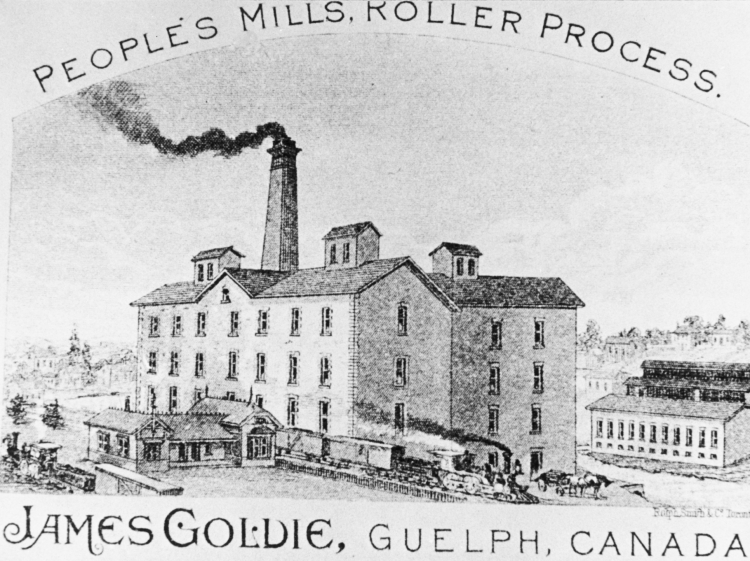
A determined man, Dr. Clarke bought out his partner's share in the mill privilege and built a new mill in 1850, which he called The People's Mill. This time, Dr. Clarke had the building made from stone, at least some of which was quarried on the property itself.

Over the next few years, the property went through a succession of hands, until it was leased to Charles Whitelaw, a successful businessman from Paris who operated several mills in the Grand River valley, among other concerns. Whitelaw, it seemed, had the touch and the mill apparently operated at a profit.

However, fire returned again on 8 June 1864. Although some of the stores and equipment, and the cooperage across the river, were saved, the mill was a total loss. Stephen Thorning noted that suspicion fell on local cooper Bernard Kelly, who had threatened to burn down the mill before because he did not get orders for barrels from Whitelaw. The coroner's inquest found the the blaze was indeed arson but deemed that there was not sufficient evidence to accuse anyone in particular. Even so, Kelly was convicted in the court of public opinion and hastily left town.

On 8 June 1866, the property was bought for $15,000 by James Goldie. In 1860, Goldie had built the Speedvale Mill further upstream, at the current site of the Speedvale Fire Station. He sold his old place of business and undertook rebuilding and expansion of the People's Mill. It would remain in his hands for 46 years and duly become the "Goldie Mill".

(James Goldie, from "Golden Jubilee of Nurses," 1938. Goldie was on the Hospital's Board of Directors.)

A good idea of what the area looked like during Goldie's tenure can be gained from the 1881 Wellington County Atlas. Because of the dam just upstream of the Goldie Mill, the reservoir made the Speed River much wider there than it is today. Here, I have superimposed part of the town map on a portion of the Google map of the area as it is now. I have outlined the banks of the river in solid lines and the bridges in dashed lines.


Bridges are represented by dashed lines. The parallel dashed lines in the center of the picture represent the dam, which was also used as a foot crossing. The black block to its left is the location of the original sawmill. On the west bank, the reservoir covered the wooded slope that exists there today. Note that a "Victoria Street" was on the survey through the middle of what is now Herb Markle Park. Of course, the street was never built. On the east bank, the reservoir covered most of what is now Joseph Wolfond Park East, upstream from the foot of Derry Street.

Four postcards record views of Goldie Mill. The first one (labelled "1" on the map above) was taken on the west bank of the Speed downstream from the mill. Although the caption identifies the subject as "Goldie's bridge", the bridge in view is clearly what is now called the Norwich Street bridge. Goldie Mill, with its ninety-foot chimney, built in 1885 and which still remains, can be seen peeking over the treetops on the left-hand side, a hint of what is to come.

(Courtesy of the John Keleher Collection.)

The building on the right is what was then a storage house of the Canada Ingot Iron Culvert Co. (demolished in 1927). This card is a "bookmark" card, published by Rumsey & Co., Toronto, of a photo taken with a panoramic camera.

The second postcard was taken from the east bank upstream of the Norwich Street bridge (labelled "2" on the map above). The mill buildings can be clearly seen on the left-hand side of the picture. The top of the distinctive chimney is clearly visible behind the other structures. Beneath lies a spit or island separating the Speed on the right from the tail race on the left.


Although the mill is an industrial site, it is presented in the background, framed by water and foliage almost as if it were a picturesque temple discovered on a trek along an Arcadian river.

The third picture (taken from the point labelled "3" on the map above) was taken from beside the tail race and next to the Speed River. It looks northwards to the back of the dam.


There is more tension in this picture. The ground is strewn with chunks of broken limestone, lying around like the remnants of an explosion or quarrying operation. The dam in the background is straining to hold back the waters of the mill pond beyond, without complete success. This card was printed by Warwick Bro’s & Rutter of Toronto.

The fourth picture (taken from the point labelled "4" on the map above) shows the mill pond itself from the north looking southeast. The steeple of St. George's Anglican Church can be seen in the center background. Goldie Mill and its tall chimney can be seen to the right. Today, this spot would be not far south of Riverslea, where the Goldie family then lived, today on the Homewood grounds. The Speed is now much narrower at this point and both banks are thickly wooded.


Near the opposite shore there are two swans in the water. It seems as though they are approaching a man on the bank, who may be moving to feed them. A small boat lies tied up nearby, its stern dragged downstream by the current. This postcard was printed by the Pugh Mfg. Co. of Toronto.

James Goldie acquired two white swans in 1888 to add to his menagerie. His estate was renowned for its gardens. Goldie's father had been a globetrotting botanist and assembled a botanical collection for the Tsar at St. Petersburg. The apple did not fall far from the tree. Goldie Jr.'s gardens contained hundreds of exotic flowers, shrubs, and trees. Visitors came from far and wide to see them.

Goldie's menagerie included many exotic birds, both "preserved" and alive. The latter included Egyptian geese, a Sandhill crane, English, Golden, and Silver pheasants, and the two swans. He also imported English sparrows, some of which he released and some of which he kept in a cage. James Gay, a local man who styled himself the Poet Laureate of Canada, wrote the following poem about them ("Canada's poet" 1884):

On the sparrows
Mr. Goldie’s sparrows, quite a number, returned to James Gay,
He feeds them with small wheat every day,
About eight in the morning, you can see them fly around
To feed on the wheat laid out for them on the ground.
This friend to sparrows, he takes much delight,
To hear their little warblings from morning to night;
All are made welcome as the flowers in May,
Not one shall fall to the ground by the hands of James Gay.
If Mr. Goldie could hear their prattling ways,
He would send them some small wheat every day,
So between the miller and the poet too,
Those little birds are sure to do.
About four they take flight,
If they could speak, they would say thank you and good-night.
Besides swans, youths liked to swim in the mill pond and places nearby in summertime. There was an old quarry pit at the site known as Kate's hole (for reasons unknown to me), as recollected by Fred Dyson (Mercury, 8 May 1948):
Among the real old timers expressing interest in tales of the old town is Fred Dyson, who, at 87, can look back pretty far. Explaining the origin of Kate’s hole down by the spur line at the old Goldie Mill, he said it was the quarrying of stone there for the mill dam that made it a favorite resort for swimmers. The spur line ran right into the mill property.
That swimming there in those days was clothing-optional is confirmed wistfully by another old-timer, James Ritchie (Mercury, 1 May 1948):
Who among Guelph’s real old-timers does not remember Crib’s hole, near Russell Daly’s present home? Or Fraser’s hard by the Sterling Rubber Company’s plant, or the staircase near the old Goldie’s Mill? ... These are among many others inseparable from old swimmin’ hole memories. No swimming in the nude anywhere these days. If the boys try it they will be chased away, no matter how far they are from the city.
O tempora, O mores!

The Speed could be dangerous as well as beautiful and fun. Spring floods often threatened the dam. Indeed, it was swept away by floods in the springtime of 1873 and 1929.

In addition, girls and boys drowned in the pond alarmingly often, e.g., (Northern Advance, 12 June 1890):

Mrs. Henry Ching, of Toronto, who is on a visit to friends in Guelph, lost her five-year-old boy by drowning on the 5th inst. The little fellow fell into the river while throwing stones into the water from the bank. The river is very high with the recent heavy rains, and he was quickly carried over the dam at Goldie’s mill. The body was recovered in a few minutes, but life was extinct.
In the winter, the pond froze over and made for a useful expanse of ice. Guelphites went there for skating and curling. The ice itself was also harvested by Mr. T.P. Carter of Carter's Ice Company, who handled about 2,000 tons of ice annually from his ice houses on Essex Street (Industrial number, 1908). There was also an ice house on the west bank of the Speed upstream of the mill (in the backyard of 165 Cardigan Street today), perhaps for the use of James Goldie himself.

Perhaps the weirdest incident connected with the Goldie Mill pond occurred when it was frozen over. A Mr. Leslie, while walking home at noon hour by the Mill one day, found a green fedora with no band and a worn overcoat lying on the ground beside the ice. In a pocket was a peculiar note (Mercury, 11 Dec 1922):

This seems the only way out. If ‘F’ had been here it might have been different. Good-bye. X.—J.B.
The note suggested a suicide. Yet, there was no hole in the ice nearby. No amount of searching and dragging the river or mill race produced a body. Perhaps the whole thing was a prank. Either way, the identity and fate of J.B. remains a mystery to this day.

Goldie remained by the Mill and its pond. Around 1885, he purchased Rosehurst across the river from Dr. Clarke's estate. This grand house stood on the Delhi hill and had a beautiful view of the pond. James's son Thomas and his family moved in. (There is a lovely photo of Rosehurst taken from across the pond, Tatham 1983, p. 9. However, I cannot locate the source.)

James Goldie built Riverslea for himself in 1890–91. It stood somewhat apart from its setting, being made of brown stone imported from New York State (Tatham 1983). However, it was still sited near the east shore of the mill pond with a good view of the Speed and Goldie's Mill downstream. Like his mill, James Goldie never left the river.

The mill prospered. After he took over, Goldie rebuilt the mill larger than before. He also added a substantial cooperage across the river. A rough wooden bridge connected the two. Storage areas and an elevator were added also. See the map below.


Here, I have superimposed a portion of the Fire Insurance map of 1911 on a Google satellite view of the mill and vicinity. As President of the Wellington Mutual Fire Insurance Company, James Goldie would have been familiar with this map.

Just to the left of the mill, is a building shaped like a sideways "I", labelled "A. Office". As mentioned above, the Great Western Railway built a spur line down the Speed to Cardigan Street to serve the Royal City as a new passenger train station ("Guelph railroads", Keleher 1995, p. 59). It opened for business on 16 February 1882 but proved to be a flop and closed six months later. In 1884, Goldie bought the building and moved it next to his mill, where it appears on the map, to serve as office space.

The building can be seen on the left in the cute drawing below.

("Goldie Mill", courtesy of the Guelph Public Library, item F8-0-4-0-9-3.)

In 1888, the Guelph Junction Railway was built and a siding laid to Goldie's Mill, which is also visible in the map. As a result, wheat and flour at the mill were no longer transported by horse. This change was important since Goldie increasingly had to buy wheat from western Canada in order to keep the mill profitable.

The office was torn down around 1920. Today, the site is the location of the Guelph Youth Music Centre, constructed in 1995–2001, from a storeroom built in place of the office. The spur line was later torn up and became the Spurline Trail.

As more land in its watershed was cleared, the force of the flow of the Speed diminished. As a result, Goldie added a steam engine to pick up the slack. In 1910, electrical engines were furnished instead, supplied by a power substation dedicated to the mill. The electricity was generated at Niagara Falls. So, the mill ran on power from a river over 120km away rather than on power from Speed, which flowed right beneath it.

James Goldie died on 4 Nov 1912. The mill afterwards passed through many hands. In 1918, the mill was bought by F.K. Morrow, investor and owner of the Morrow Cereal Co. In 1926, the Standard Milling company took over, followed by the Pratt Food Company in 1930.

Time and tide chipped away at the mill and its grounds. Milling operations ceased soon after yet another spring flood wrecked the dam in 1929. The mill became a warehouse with its buildings used mainly for storage. On 24 February 1953, fire returned in the form of a spectacular blaze that destroyed the original milling, shipping, and boiler rooms.

The mill was then slated for demolition but the City and the Grand River Conservation Authority intervened. The remaining stone structures were stabilized and were turned into a picturesque folly. Fittingly, the park was named Goldie Mill Park, still bearing the name of the man who had shaped the place more than anyone else, so many decades before.

Wednesday, 21 December 2016

Merry Xmas Tokyo, 1908!

The picture side of this postcard is common enough, providing a view of the Priory, the "First House in Guelph, now CPR Station" printed by Warwick Bro’s & Rutter, Limited of Toronto.


However, the reverse side is more interesting, for two reasons.

First, it conveys Xmas greetings from Guelph to an unusual destination, that is, Tokyo Japan:

Xmas 1908 // Dear Miss Blackmore, As you are so ancient I suppose you will remember dates prior to the building of this house. I thought that you would be interested in old things. Merry Xmas. Hope you got my other message. Sincerely Yours, Margaret E. A.
The postcard was postmarked in Guelph on 30 November 1908 and in Tokyo on 26 December 1908.

The reverse side also has an interesting Japanese postmark and some Japanese writing on it.


Perhaps the Japanese writing provides a more specific address. If anyone can read it, please let us know what it says in the comments below!

I am not sure who the sender is. There was a Margaret E A Griffin, matron of the House of Industry and Refuge near Fergus. That would fit the signature "Margaret E. A." but that's about it.

Oddly, I have a better idea about the addressee, Miss Blackmore. I believe that she is Miss Isabell Slade Blackmore of North River district, Colchester County, Nova Scotia. Born in 1863, the third daughter of Richard and Margaret Blackmore, a Truro area farm family, Isabell had become a local school teacher. At age 19, she had joined the Methodist Church and began thinking about missionary work.

By her own account, the calling to spread the gospel overseas became urgent and she applied to join the Canadian Methodist Women's Missionary Society (WMS), noting in her application ("A sensitive independence", Gagan 1992, p. 26):

[T]he conviction that help such as I could give was needed in the Lord's Vineyards abroad, became so strong that I could no longer put it aside ... All I have and am I wish to belong to Christ. Gladly will I work in His service in any way or anywhere, if I may but know I am doing His will. As to how soon I can go, I feel I am given but one answer. When the Master has need of me.
Evidently, the WMS was impressed and sent Miss Blackmore to Tokyo in 1889, where she remained (with occasional furloughs back to Canada) until 1924.

Japan was an exciting place to be a missionary in that time. With the Meiji Restoration of 1868 and the establishment of the Meiji constitution in 1889, Japan became open to western influence. The WMS seized the opportunity to set the Japanese people on the right path amidst the resulting cultural tumult ("Missionary leaflet," February 1892, v. 8, no. 2, p. 7):

Great changes, due to contact with the West, are in progress, some of an alarming nature. We refer to Rationalism, Unitarianism, and the New Theology, which has filled the minds of some of young Japan’s travellers to the West. It is encouraging, however, for us to know that those missionaries, whose sole aim is to lead men to Christ and to build them up in holiness, have very little trouble with the new “isms” among their converts. The missionary, political and commercial atmosphere of Japan is now electrified as never before. The land lies before us, and shall we not “go up and possess it?” Pray that the God of all wisdom may guide this intelligent and energetic people in this transition period of their country’s history.
The missionaries set up schools, concentrating on the Christian education of Japanese children. Apparently, these institutions were popular and successful.

Of course, along with Japanese receptivity to western ideas came military friction with western powers, as everyone jostled for influence in East Asia. In the Russo-Japanese War of 1904–1905, for example, the Japanese navy decisively defeated the Russian navy, thus giving Japan hegemony over Korea and Manchuria.

Japanese expansion put it on a collision course with the United States, which was moving into the Philippines and Guam. Realizing the the US Navy was not up to a fight with Japan, President Theodore Roosevelt had ordered the construction of 11 new battleships. In 1908, in a sort of pivot to Asia, Roosevelt sent the newly beefed-up Atlantic fleet on a world tour, which included a call on Yokohama in October. Known as the "Great White Fleet" for its white paint job, the visit sent a not-very-subtle message that American power in the Pacific was not to be taken lightly.

The event was recorded in many postcards, which may be viewed online at the Old Tokyo Vintage Japanese Postcard Museum and at The Peaceful Sea. Perhaps the oddest souvenir of the visit is this ashtray with a commemorative postcard embedded in the bottom!

By Naval History & Heritage Command from Washington, DC, USA (76-172-I Ashtray, Souvenir, Great White Fleet) [CC BY 2.0], via Wikimedia Commons.

The postcard shows a picture of the USS Kansas and what I assume is her commander, Captain Charles E. Vreeland.

Although the missionaries of the WMS seemingly paid little attention to world events, they must have wondered what this visit portended.

Shortly thereafter, Miss Blackmore received a postcard from Margaret E A from Guelph. Isabell and Margaret may have met in Guelph before. Miss Blackmore had visited the Royal City during the week of 22 October 1901 on furlough, during the annual meeting of the Board of Managers of the WMS, that year in Dublin Street Methodist (now United) Church (Globe, 23 Oct. 1901).


(Dublin Street United Church, Guelph. Courtesy of Google Street View.)

Isabell expressed optimism about the work of the WMS in Japan:

Miss Blackmore, home on furlough from Japan, spoke on the revival there. She was sure the work would be permanent. The Japanese had shown a great deal of activity during the revival, in their giving and in their work. Results could be traced directly to past work, and the Japanese Christians had learned to delight in the work.
It may be that Isabell and Margaret met and struck up a correspondence then.

The United Church of Canada Archives have some pictures of Isabell (called "Isabella Blackmore"). Here is a small detail of one taken in 1910 ("A sensitive independence", Gagan 1992, p. 23):


In her other message to Isabell, Margaret may have spoken about recent events in Guelph. It had been a significant year in the Royal City. Guelph's first Old Home Week, a prolonged bash for Guelphites past and present, was held in early August. Harry Peer had skated 186 miles in ten hours at the Victoria roller rink. A new bridge across the Speed at been built on Eramosa Road.

On the police blotter, six prisoners attempted to escape from the County Jail by scratching a hole through the wall of their cell with iron parts harvested from their beds (Globe, 10 March 1908). However, the ring leader, John Cox, was caught scaling the wall and, after being "hauled over the coals", ratted out the whole scheme.

In addition, Inspector Oakes expressed concern over some "blind pigs" operating in St. Patrick's Ward (Mercury, 11 December 1908):

That the liquor traffic carried on in St. Patrick’s Ward amongst the Italians has reached very serious proportions, is the conviction of Inspector Oakes, who is still working on the case.
A "blind pig" was originally a drinking establishment that charged people to see oddities, like blind pigs, but provided alcoholic beverages "free of charge", thus circumventing laws against sales of liquor. Supposedly, the term "blind pig" was reserved for lower-class establishments, such as those of recent immigrants like Guelph's Italian community. More respectable, British, illegal drinking establishments would have been called "speakeasies."

Perhaps my favorite law-and-order item concerned efforts to keep people off the grass around the Blacksmith Fountain in the middle of St. George's Square (Mercury, 3 Nov. 1908):

At the Council meeting last night, Ald. Carter asked if the Parks and Shades Committee could not do something to keep the general public off the grass plot in the centre of St. George’s Square. Everybody seemed to want to walk on it, he said, or throw peanut shells all over it, and even the street railway employees made it a resting place.
Carter thought that some "Keep off the grass" signs would do the trick. Eventually, a fence was placed around whole installation.

Xmas in Guelph in 1908 was congenial (Mercury, 26 Dec. 1908). The weather was mild but winds were "raw", and the ice in the Victoria Rink (behind Knox Church) was too soft for skating. Even so, people enjoyed skating and tobogganing in the Open Air park (now Howitt Park), where the toboggan run had recently been improved.

Perhaps the weather was too good. Rev. Caleb Buckland of St. James's Church, evidently miffed at how many of his parishioners had voted with their feet, "took occasion to comment on the fact that Christmas day was looked upon by too many as a day of pleasure instead of one of worship."

Services at the Church of Our Lady were well attended. People may have been curious to see the results of the extensive interior renovations recently untaken there. However, many wanted to hear Rev. Dr. Drummond, a visiting priest widely known for his oratorical eloquence. Apparently, they were not disappointed.

Choral performances were put on in the city's hospitals, the Elliot Home, and the Homewood Sanitarium.

On the downside, 20 gallons of milk were spilled on the road at Quebec and Woolwich Streets (now beside the Cooperators Building) from a delivery sleigh after the horse pulling it took fright for some reason (Mercury, 24 Dec. 1908). The report neglects to say whether anyone cried over the spilled milk or not.

Guelphites took little notice of Japan that Xmas. However, the Ontario Agricultural College Review (v. 21, no. 3, p. 166) noted that December that some Japanese students were studying there. It published a picture of the main building surrounded by the coats of arms of some of its international students. The symbol of the rising sun can be seen among them.


Miss Blackmore remained in Japan until 1924. Her return to Nova Scotia was likely prompted by the great Tokyo-Yokohama earthquake of 1923. The powerful earthquake, followed by fire storms and tsunami, nearly obliterated Yokohama and likely swept away the institutions built by the WMS.

The event was also seized upon by Japanese nationalists as an excuse to remove foreign and liberal elements from Japan. It may have helped to set Japan on a militaristic course:

Though they may dispute its effects, historians agree that the destruction of two great population centers gave voice to those in Japan who believed that the embrace of Western decadence had invited divine retribution. Or, as philosopher and social critic Fukasaku Yasubumi declared at the time: “God cracked down a great hammer” on the Japanese nation.
The Japanese navy attacked Pearl Harbor on 7 December 1941, an act that put Canada and Japan at war with one another. One wonders what Isabell Blackmore thought of that development. She died 26 days later, on 2 January 1942 and was buried in the Crossroads Cemetery, Valley, in her birthplace of Colchester County, Nova Scotia.

Wednesday, 27 April 2016

Generic postcards of Guelph

Imagine that you wandered into A.B. Petrie's drugstore on Wyndham Street about 100 years ago, looking for a postcard. What would you expect to see? You would probably expect a rack of cards with pictures of Guelph looking back at you. These "view cards" depicted the city's prominent places or notable beauty spots. You might pick one up to send to a friend who collected such images, perhaps of bridges or post offices. Or, you might simply want to communicate that you had had the good fortune to be in the Royal City.

However, you would also find many postcards without local views printed on them. Instead, these generic postcards would have a stock image printed on the front. Stock images might include pictures of some random building or other scene, a drawing, or just text. So that these cards could still pass as souvenirs of the Royal City, the word "Guelph" would appear somewhere in the image as well.

Let us see what sorts of generic postcards you might find in that rack.

One of the most common sets of generic postcards of the city can be seen in the triptych below. These cards were evidently printed up on behalf of the Bell Piano and Organ Company.


My guess is that none of these lovely ladies were residents of or visitors to the Royal City. Instead, they were models whose pictures were in a file of stock photos in some faraway cabinet. The printer is not named on the card, so it is hard to say exactly where they came from. Perhaps that is appropriate for a generic card: They are from nowhere.

These cards have been localized by the addition of printed text that sings the praises of Bell pianos and organs. Their pictures also contain little drawings of twin bells with the caption "Bell Pianos" underneath. It is not clear why pictures of these décolleté women were a propos for the sale of pianos. Perhaps it was merely a case of "sex sells." Or, perhaps a pun was intended: Belles to sell Bells. We may never know for sure.

At any rate, these cards are among the most common generic Guelph cards that I have seen. In addition, besides being from nowhere, they went nowhere: I have yet to see one that has been written on or mailed. Perhaps they were simply passed out as trade cards with the purchase of a Bell piano rather than being for sale in local stores.

A common form of generic card 100 years ago was the fill-in-the-blank card. These cards were usually conveyed with both a stock image and a stock phrase in which a space was left for the name of the locality in which it was to be sold. Fill-in-the-blank cards were advantageous for vendors because they cost less than cards with photographs on them and could be ordered quickly and in bulk for special occasions or just to fill holes in inventory.

Very often, fill-in-the-blank cards were humorous. Perhaps humor was used in order to make up for the otherwise nonspecific nature of the card. If recipients did not get to see a bit of Guelph, then at least they could enjoy a laugh. A couple of examples will give a good idea of the type.

(Image courtesy of rych mills.)

Here, the generic message "I am stuck in ..." is filled out with "Guelph". The message also shows that the image, which seems very serious in its own right, is part of a gag, with "stuck" substituted for "beaten and imprisoned for trying to rob a jewelry store". The publisher was the Rotograph Co. of New York.

Gags like this were available in rural as well as urban settings. Consider the following tall-tale postcard purporting to show turnips harvested in Guelph.


Good for a laugh, especially as the use of photographic manipulation is obvious enough. If that were not sufficient, then the text written on the image in front of the car, stating "Corpr. 1911 // By A.S. Johnson Jr. // Waupun Wis" certainly gives the game away. Mr. Johnson just could not resist the chance to sign his handiwork!

A particular species of the fill-in-the-blank card is the pennant postcard. In pennant cards, the blank occurred inside a triangular space in the shape of a little flag. Sometimes, the pennant was presented in the form of a little piece of felt actually glued onto the card. Here is a typical example.


This pennant card is also an example of the "Dutch kid" genre of postcard. These cards typically had a picture of one or two Dutch children, signified by their stereotypical, Dutch peasant clothing. The kids do something cute and say something childish in a Dutch accent, rendered by phonetic spelling. Dutch kid cards were a popular "meme" through the 1910s, for reasons obscure to me. The card was printed by the Bergman Company of New York, which apparently specialized in comic cards.

In the generic cards above, stock images reside in the foreground while the local name, "Guelph", is in the background. However, Petrie's rack probably also had cards where the arrangement was the other way around. That is, the name "Guelph" featured prominently while the stock image was somewhat less emphasized. Consider the following example.


On this greeting card, the caption "Greetings from Guelph" was written by hand using a special, sparkly ink. These cards were typically made in Germany, this one being from "PFB", which is Paul Finkenrath in Berlin. The big hand-written lettering and fancy ink help to draw attention away from the generic flower image in the other corner of the card.

Like the pennant cards, these floral cards might even have decorations glued to them. Consider this example.


This card has a sheaf of wheat with a sickle glued somewhat incongruously next to the usual bouquet. Although it was published by the Stedman Bros. of Brantford, it seems likely that it was a stock card imported from Germany and then customized by the Ontario firm.

A final type of generic card that likely adorned Petrie's store was one where the local name was emphasized within the stock image itself. What would you think when you found the following card?


Generic "Greetings from <insert town here>" with a bunch of cut flowers lying around was a common setting. This example came from the Rotary Photographic Co. of London, so named for its use of rotary presses. Although Petrie's customers might have felt patriotic buying British name-and-flower cards instead of German ones, the Rotary Company was actually a subsidiary of Neue Photographische Gesellschaft of Germany! The postcard business was truly an international one.

Whose job was it, I wonder, to arrange and photograph oversized letters to spell out the names of half the towns in the British Empire to be immortalized in postcards? Today, it would be done by an unpaid intern, I'm sure.

A similar type of card spelled out town names using faces. Here is an example printed by Warwick Bros. and Rutter Ltd., Publishers, of Toronto.


Patriotic maple leaves adorn the corners. The faces in the collage were probably those of Edwardian actors and actresses whose pictures might have been printed elsewhere on their own postcards. Buyers might have had fun trying to make them all out. Unfortunately, I do not recognize any of them. However, if you do, then please note them in the comments!

Many customers went into Petrie's store, and others like it, looking for Guelph cards that depicted its prominent places and beauty spots. However, some would have been looking for Guelph cards that were localized simply by having the word "Guelph" printed somewhere on the front. Petrie might have favored generic cards because they were cheaper than the other sort or because they allowed him to quickly make up numbers during times of high demand. For customers, generic cards may have been preferable if they were looking to send a message rather than a souvenir.

So, as you pick through Petrie's offerings, you might find that a generic Guelph card suits your purpose just fine. Don't forget the stamp!


Of course, Guelphites also would have found completely generic cards in their stores, that is, cards with no localizing detail at all. I leave these cards for other occasions.

In addition, just to prove that every classification scheme has exceptions, I should note that some generic cards also conveyed local views. Here is a good example.


This hybrid card is a generic, pennant card with a smaller postcard image—complete with its own minute caption— embedded at the top. Evidently, this card was for customers who wanted everything or who simply could not make up their minds. Mr. Petrie had something for everyone!