Showing posts with label Photogelatine Engraving Co.. Show all posts

Friday, 20 July 2018

Isabella Preston and the Creelman lillies of the OAC

The postcard below, mailed in 1937, conveys a pleasant view of the Administration Building (now Johnston Hall), constructed only a few years earlier, with reflecting pond and the canon, Old Jeremiah, in the foreground.


The card was published by the Photogelatine Engraving Company of Ottawa, a prolific source of Guelph postcards in that era. (From the John Keleher collection.)

However, the most interesting feature of this postcard is the message on the back, sent by "M" to Mrs. Gerald Badke of Kitchener, Ontario:

55 Dundas Rd. Guelph // July 19/37 // Dear Sister.—Before I go to bed I want to write this to tell you that the Creelman Lilies are just out in perfection now and in case any of you wish to see them come this week. They are beautiful. I counted 1st on one stem with the buds to-day. I am tired to-night. We try Field Husbandry to-morrow. Love. M.
The "Creelman Lilies" refers to both one of the great success stories of the Ontario Agricultural College (OAC) and one of its longest-standing mysteries.

As luck would have it, there is a photograph of the very lilies that M. was writing about:


This picture was published in the OAC Review (1937, v. 49, n. 8, p. 479), so very likely shows the bed of Creelman lilies—very plainly labelled—planted that year beside Zavitz Hall. (Courtesy of University of Guelph Library McLaughlin Archives, RE3 OAC A005037.) I hope that "M"s family went to see them.

First, to the success story. The "Creelman lily" (officially Lilium princeps x "George C. Creelman") was a hybrid of two lilies from southern China, L. regale and L. sargentiae. The crossing was made by Isabella Preston, a young horticulturalist working in the OAC greenhouses. In her book "Garden lilies" (1929, p. 110), she described the process as follows:

On July 20th, 1916, when I was attached to Mr. Crow’s Department at the Ontario Agricultural College, Guelph, Ont., I pollenized L. sargentiae (growing in the greenhouse) with L. regale. Three seedpods formed, the seed was sown in pots in the greenhouse and the seedlings began to germinate on January 15th, 1917. These were transplanted to a cold frame and bloomed well in 1919. It was named G.C. Creelman [the OAC President] by the Guelph Department in 1923.
Isabella Preston (1881–1965) herself was a crossing, a young English woman who had emigrated to Canada with her sister Margaret after their mother's death in 1912. She was determined to work in horticulture and the prior lack of professional, female horticulturalists did not dissuade her. Upon her arrival in Guelph, she immediately enrolled in the subject at the OAC.
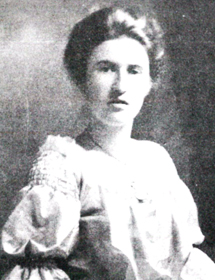

(Isabella Preston. Courtesy of the Ontario Agricultural College.)

After a year's study, Miss Preston entered a self-study course and took up work full-time in the greenhouse headed by Professor James W. Crow. There she was introduced to the art and science of hybridization. Apparently enthralled, she read "all the books in the library" on the subject and began to experiment, with special attention to lilies. Both her talent and her hard work paid off handsomely.

The Creelman lily won immediate and universal praise. In 1939, Howard L. Hutt, Emeritus Professor of Horticulture at the OAC, recalled his initial response to the appearance of the lily (quoted in von Baeyer, 1987, p. 131):

I can well remember seeing their first bloom, four and five immense white flowers on sturdy stems about three feet tall. And I thought well here is a worth while new lily. But when I happened to be at the College a week later and saw two or three of the original plants at least five feet high and bearing fifteen blooms I felt like taking off my hat, even if I did not throw it up in the air.
In 1923, after four years of trials, the new Creelman lily was put on the market. It was a smash hit and eventually spread around the country and even overseas.

Like her new lily, Isabella Preston's career began to bloom. In 1920, she left the OAC for the Botanic Garden at the Central Experimental Farm at Ottawa. There, she developed many new botanic hybrids but remained best known for her work with lilies. As testimony to her reputation, von Baeyer (1987, p. 125) relates the following anecdote:

After World War II, a Japanese admiral was brought to the United States as part of a friendship promotion program. He was asked if there was any special attraction he would like to see—Niagara Falls perhaps? The admiral thanked his hosts very politely and then answered (in rough translation), "I would really like to travel to Canada to meet Miss Isabella Preston." He was a lily enthusiast.
In 1946, at age 65, Preston had retired from her long and productive official career. She spent a year in England but found that, like her flowers, she was no longer adapted to that climate. So, she returned to Canada and settled in Georgetown, Ontario where she kept a large garden in which Creelman lilies were likely a prominent feature.


Isabella Preston, 1957. Courtesy of the Isabella Preston Collection, Royal Botanical Gardens Archives.


Now, to the mystery. Creelman lilies remained a popular choice for gardens and special occasions for many years. Of course, there is the large bed on the OAC campus in 1937, shown above. In addition, news items from the Guelph region mention the flower in various connections. For example, it was used to decorate a home in Georgetown for a wedding that same year (Georgetown Herald, 11 August 1937):

Miss Ruth Evelyn Giffen, daughter of the late Mr. and Mrs. John Giffen, of Ashgrove, became the bride of Howard C. Wrigglesworth, son of Mr. and Mrs. Fred Wrigglesworth, Ashgrove, at the home of her sister, Mrs. Elmer May, Hornby, on Saturday afternoon. Rev. B. Eyre, of Ashgrove United Church officiated. The home was decorated with pink and white gladiolus, white Creelman lilies and fern.
Then, there was the wedding of Muriel Ricketts, married at her parents' house on Grove Street in Guelph, in which Creelman lilies also featured prominently (Acton Free Press, 30 July 1942):
The house decorations were in pink and white, harmonizing prettily with the gowns of the bride and bridesmaid. Bouquets of Creelman lilies, roses and baby’s breath added to the charm of the home, while the wedding cake was attractively placed on the festive table with tall white tapers.
Creelman lilies continued to be grown by enthusiasts in the region. Special mention must be made of Mr. & Mrs. Arthur K. Thomas of Rockwood, who were well-known for their dedication to Creelman lilies throughout the 1950s. Indeed, the Acton Free Press gives a full report of his entry in the North American Lily Show in 1958 (24 July 1958):
Rockwood flower gardens specialize in Creelman lilies

Enthusiastic flower lovers, Mr. and Mrs. A.K. Thomas, Guelph St., Rockwood, took a special joy in their garden this past week for their George C. Creelman lilies, despite cool weather, began to bloom in time for the North American lily show, held in Hart House, Toronto.
The beautiful lilies thrive in the Thomas garden and many lily growers visit the spot, envious of the beautiful blooms. There are a dozen other lily varieties there as well as the Creelman but none are half as lovely as these splendid blooms.

25 years ago
Mr. Thomas bought his first clump over 25 years ago from William Harris. The great mass of thousands of fragrant flowers in the garden today have grown from that one plant.
Mr. Thomas recalls paying three dollars for it and thinking at the time that the price was somewhat high. Today, however, he feels it was very little to pay.
The lily was developed at the O.A.C. by Miss Isabella Preston and named after Dr. George C. Creelman.

Blooms specially packed
New at entering flowers in a show, Mr. and Mrs. Thomas found the idea exciting and full of interest. The blooms had to be packed with cotton to keep the petals clean.
The spikes cut for the show had to be chosen carefully. A tinge of frost bite on the leaves was one item that had to be watched for.
As Miss Preston and the Thomases frequented the same, local flower shows, it seems a safe bet that they were well known to one another. I imagine that Miss Preston was flattered.

However, mention of the Creelman lily falls away by the 1960s. The reason is obscure but is hinted at in Miss Preston's obituary in the Georgetown Herald (6 January 1966):

She continued working at the Ontario Agricultural College in Guelph, crossing various strains of lilies. The well known George C. Creelman is an ancestor of most of the white tubular lilies that are so popular now. Crow’s Triumph is the other and was more favoured by florists.
It seems that the fashion in flowers moved on and the Creelman lily, like many a reigning monarch, was finally supplanted by its offspring.

Though the plant itself apparently vanished, knowledge of it did not fade entirely. In 2007, Alex Henderson, curator of living collections at the Royal Botanical Gardens (RBG) in Burlington, Ontario, received a napkin with the words "George C. Creelman," "Isabella Preston," and "Allan Goddard" scrawled on it. The item was given to him by a colleague who had encountered Allan Goddard, Creelman's great-grandson, at a bar (Giaimo 2017). Henderson knew of the flower by reputation and looked for it in the archives but came up empty-handed. “We didn’t have it, but I went into our plant records, and we used to have it,” he said. On inquiring further, a similar story emerged from other nurseries both near and far. Though once extremely popular, specimens of the lily had not been kept anywhere.

Alex Henderson continued his search. In 2009, Rodger Tschanz from the University of Guelph thought he had some and gave Mr. Henderson some bulbs. These were duly grown and the flowers examined by expert botanists, who Mr. Henderson locked in a room with the plants for two hours. The determination rests on how well the flowers match written descriptions made by Isabella Preston and some early, hand-colored photographs. Their verdict: Close but not quite. The flowers may be near relatives of the Creelman but just not the same.

However, the story may yet have a happy ending. In July 2017, a caller phoned into the CBC Radio talk show Ontario Today ("CSI of horticulture," 24 July 2017) to solicit information from master gardener Ed Lawrence. Cynthia Culp phoned in from Bancroft to ask: How rare were her Creelman lilies? She explained that her grandmother had obtained them from a neighbour who worked at the University of Guelph and had purchased them at a University plant sale around 1950. Ms. Culp's grandmother grew them until she moved house in the 1990s, at which point Ms. Culp's mother brought them home, mentioning that the variety was "Creelman". In 2014, Cynthia Culp rescued the plants from her brother, who planned to sod over the garden.

As the lilies took hold in her garden, Ms. Culp searched on the Internet for current information on the variety. Frustrated in her search, she phoned in to the CBC's gardening show. She was advised that there was someone at the RBG who would be most anxious to hear from her. Alex Henderson politely asked her if she would share some of the plant material with the Royal Botanical Gardens. The answer was "yes."

These materials were duly transplanted and have been grown in pots at the RBG this year. This May, the lilies flowered with the results shown in the following, beautiful photographs:


(Courtesy of Dr. David A. Galbraith/Royal Botanical Gardens, Burlington, Ontario.)

The verdict? So far, so good. Alex Henderson holds the conclusion that these are Creelman lilies to be "tentatively correct." The final verdict will have to wait for at least another year, so that the plants can be grown outside and their normal habit of growth observed. He is cautiously optimistic that another season will put any doubts to bed.

So, it seems that Mr. Henderson's improbable search has borne fruit and Miss Preston's legacy is secured for future generations. I hope that, some day soon, the Creelman lily will grace the gardens of the University of Guelph and beyond once again!


Thanks to Alex Henderson and Dr. David A. Galbraith of the RBG for their kind responses to my queries about the status of the Creelman lily. Keep up the good work!

Sunday, 30 October 2016

R.C.A.F. Wireless School No. 4

The postcard shown below portrays Upper Wyndham Street as it appeared in the early 1940s, in a somewhat hallucinogenic color scheme. The Dominion Public Building is quite recognizable on the right and the street is full of period cars.


This card was printed by the Photogelatine Engraving Co., Limited, Ottawa.

More important than the picture, though, is the message on the other side, which reads:

Hey. What’s the matter with everyone. I’ve sent a letter home and also to Esther and I haven’t had a [sic] answer yet.
What’s the matter.
K274563.AC2 Guigues W.W.
MPO105 R.C.A.F.
Guelph Ont.
The postcard was addressed to Mr. & Mrs. W.C. Guigues at 206 Devonshire Pl., Ottawa, and is postmarked at MPO 105 ("Military Post Office 105") on 23 October 1943.

The message is fun to read for two reasons. First, it is scolding its recipient for being remiss in sending a letter, a function that postcards were often used to fulfill. Second, it identifies Mr. William Guigues as a trainee at the Royal Canadian Air Force (RCAF) Wireless Training School Number 4, Guelph.

The RCAF Wireless School Number 4 at Guelph began in July, 1941 with the task of training wireless operators to be part of airplane crews that might fly bombing raids over Europe or submarine patrols over the oceans. The history of the Wireless School is well documented on its Wikipedia Page, an article, "U of G's military history" (The Portico, 2008), and a story by Ed Butts (Mercury, 17 August 2015). So, I will provide only a short outline here but try to fill in some items that illustrate the life of trainees at the School.

At first, the Government of Ontario's plan was to close the Ontario Agricultural College (OAC), the Macdonald Institute, and the Ontario Veterinary College (OVC) and turn the entire campus over to the RCAF for their School. This plan met with strong objections from the local population. The RCAF surveyed the campus and determined that only a part was necessary for the needs of the School. So, only the Macdonald Institute was completely shut down during the Second World War.

A five-foot high fence featuring three strands of barbed wire was erected around the School's campus. Buildings within this campus included Johnston, Blackwood, Drew, Watson, Creelman, Mills, Maids, War Memorial and Macdonald Halls. The Macdonald and Trent Institutes, Mechanics Building, Bursar Hall, and Gymnasium were also enclosed.

A notion of the School campus can be gained from the photograph below, taken at its opening on 9 August 1941.

RCAF Guelph Official Opening Johnston Hall.jpg
By Unknown - University of Guelph, McLaughlin Library, Archives and Special Collections, Public Domain, Link.


Training for wireless operators ran for about 6 or 7 months. Several cohorts, or "entries", underwent training at any given time. Academic training included radio theory, Morse code and mathematics, and was taught by OAC faculty. Additional training included swimming and how to right a capsized dingy after a water landing, in the swimming pool. Flight training was provided at Burtch Airfield south of Brantford. Naturally, marching and fitness were emphasized too.

The daily schedule was intensive:

The day started at 6 a.m. with two hours of physical training and drill. Classes began at 8 a.m. and went until 5 p.m., with a break at noon for lunch. There were more classes after supper.
The trainees lodged in Johnston Hall and ate in Creelman Hall.

The No. 4 Wireless School Association held reunions in 1987 and 1988, and the local papers featured many interesting reminiscences of the School's graduates.

Mr. Eddy "Link" Traynor recalls how noisy life in Johnston Hall could be (Tribune, 22 June):

Everybody had a radio. With all the different tastes in programming, it made quite a cacophony in the halls, especially in the mornings when we were getting dressed and shaved.
Most of the trainees were new to Guelph, Eddy also notes:
Before I came, the only thing I knew about Guelph was that we had a stove at home in Montreal with "Guelph" on it.
Perhaps his stove was made by the Guelph Stove Company.

Frank Russell recalls a brainstorm that one squadron leader had to help the trainees learn Morse code in their sleep (Mercury, 29 June 1987):

He had us string electric light bulbs in the alcove behind Johnston Hall, so the light shone in the guys' barracks windows.
When the guys were trying to sleep, this bright light would be flashing in Morse code. That lasted two weeks before they were told to get it out.
Discipline was fairly strict. Trainees had to maintain a high level of dress and deportment, and some of the instructors could be harsh. As a result, not everyone passed the course. Failure could be a serious issue since trainees who did not pass were often trained to be tail gunners in bomber crews, a highly dangerous position.

Eddy found that the Royal City had some agreeable entertainments to offer.

The Ritz [now Van Gogh's Ear] had a dance hall upstairs with a juke box. It was quite a hangout for Air Force types.
There was another dance hall on Wyndham above Ryan's [now the Wyndham Building]. They had pretty good bands with a big band style. I remember Willis Tipping had about ten guys who were really good musicians with a Glen Miller sound.
Evidently, Eddy and many other trainees managed to get in many visits despite the 10pm curfew imposed by the School, although that was relaxed on Saturday nights.


(Van Gogh's Ear today—formerly The Ritz. The second floor held a dance hall with a juke box.)


(The Wyndham Building today—formerly the Ryan. Its second floor served as a dance hall.)

The extent to which trainees might go to get out on the town is illustrated by graduate Robert Allen, who wrote (OAC RE1 OAC A0670):

Would you believe we fooled the RCAF brass for 6 months—convinced them we were "Bush Baptists" (Religion); they couldn't find a minister to suit—hence we missed out on Sunday Church parades. We all got 10 days C.B. [Confinement to Base] when they found out, but the tunnel system under the sidewalks into Guelph was quite handy. I don't think they ever found out how we disappeared.
I would love to know what tunnel system he is talking about! At any rate, the story illustrates one of the downsides of relying on security fences.

Naturally, a big part of the attraction of the downtown hangouts was that they were also frequented by local girls. Eddy Traynor notes that many of the women in town were involved in war-related industries, such as making uniforms. Frank Russell recalls that the Knights of Columbus used to put on dances for the troops where they could meet some local girls, although they were "well chaperoned" and no drinking was allowed. That would be at former Knights of Columbus Hall on Dublin Street just north of Waterloo Avenue, currently the site of the Boarding House Gallery.


(The Boarding House Art Gallery today—formerly the Knights of Columbus Hall, where well-chaperoned and alcohol free dances were held.)

In any event, boys met girls. For example, Eddy Traynor met, courted and married Guelph native Elma Delaney, all within his six-month stay at the school!

I was not able to find any records in the University of Guelph archives specifically about our postcard writer, Mr. William Guigues. Records on Ancestry.ca show that he was born in 1925, married Helen Victoria Lord in 1945, and later settled in Ottawa, where his parents (Mr. & Mrs. W.C. Guigues) lived.

Fortunately, William's daughter-in-law Deborah has kindly provided a few more details. Perhaps most interesting is the following photo of William and Esther—whom he mentions in his postcard—in his parents' backyard in Ottawa.


They look happy! Given that Esther is still "in the picture", it seems likely that this picture was taken around the time that William was at the Wireless School. Deborah says that William was involved with radar. This tidbit suggests that William may have been in training as a "radio mechanic", as radar technicians were then known. The job of these technicians was to install and maintain radar equipment, and many such technicians were trained at the Wireless School in Guelph.

Another photo shows William at a railway station in Ottawa. This photo must be somewhat later since William has an Aircraftsman wing and Sargent's chevrons on his uniform.


The usual posting for a radar technician in that period would be to an airbase in Britain. However, William instead went to Summerside, Prince Edward Island. Perhaps he underwent navigation and spotting training at No. 1 General Reconnaissance School there. Among the things he spotted in town was his future wife, Helen.

Following the war, William worked in retail for a couple of years before rejoining the Air Force with the occupation of air traffic controller. This job took him to many military airports in Canada and also Germany. Finally, he retired and worked as an air traffic controller for a number of years at the Ottawa International Airport. He died in Ottawa in 2006.

Wireless School No. 4 closed on 12 January 1945 as the war was headed towards its conclusion. By that time, some 5000 to 5800 young men like William Guigues has passed through its gates. The campus, the city, and the nation began to return to their peacetime state.

Perhaps the most distinguished graduate of the School was Lincoln Alexander, later an M.P. and Lieutenant-Governor of Ontario. Of his time at the School, he said: "I remember the friendship and the fun. It made me a man. It taught me what authority was all about. It taught me to respect others. I'm proud of my service."


Thank you to Deborah Guigues for information and pictures of her father-in-law!

Thank you also to the staff of the University of Guelph Archives for help in locating the appropriate documents.

Saturday, 23 May 2015

The John McCrae Memorial Garden

May 2015 marks the 100th anniversary of the writing of "In Flanders Fields", the poem for which John McCrae is famous. Although McCrae lived long enough to enjoy some of the admiration of his work, his life was cut short by pneumonia in 1918.

However, regard for his poem continued to live and grow even after the end of the Great War. Testimony to this fact resides in the many memorials and monuments dedicated to McCrae and his work. For example, a brass plaque eulogizing McCrae was presented to Guelph Collegiate (now Guelph Collegiate and Vocational Institute), his alma mater, on 13 November 1919. Many other memorials of various kinds have been dedicated to him over the years since, for example (Guelph Mercury, 30 April 2015):

Stained glass windows are erected to his memory at McGill University, Royal Victoria Hospital in Montreal and at the University of Toronto and here in Guelph at St. Andrew's Church. Four schools have been named after him: John McCrae Public School here in Guelph, John McCrae Senior Public School in Scarborough, John McCrae Public School in Markham and John McCrae Secondary School in Nepean which opened in 1999.
And, of course, the McCrae House, where McCrae was born and raised, became a national historic site in 1966 and a public museum in 1968. It is now part of the Guelph Civic Museum.

Next to the McCrae house stands the John McCrae Memorial Garden. The basic layout of the Garden can be seen in this postcard printed by the Photogelatine Engraving Co., Ltd., Toronto, in Kodachrome in the early 1950s.


The photo looks into the Garden diagonally from the intersection of Water St. and McCrae Boulevard. Notable in this photo are the low stone walls and gateway formed by pillars on either side. Through the iron gate is a path that leads through flower plantings to the John McCrae shrine. A look at the site through Google Street View shows how little the memorial has changed and how much the trees have grown:


The shrine itself is more closely featured in the card below, also printed by the Photogelatine Engraving Co., Ltd., Toronto but from a photo taken in 1946 (cf. "The Torch" 1946, p. 32):


The shrine sits on a raised, dais and features a limestone block with the words "Lest we forget" carved on it. On top of the block is an open, bronze book with the verses of "In Flanders Fields" inscribed. At the back of the dais is a low wall featuring urns at either side. In the center is a memorial surrounded by carved torches and featuring an alcove with an inscription in memory of John McCrae and an illuminated, bronze torch in the center. Around the shrine are beds of flowers in which poppies are usually prominent. (A close-up photo of the monument can be found in the Guelph Public Library archive.)

The Garden and the House are well integrated and visitors move easily from one to the other. It is thus easy to forget that the Memorial Garden was established as a public monument some 20 years before the House. Considering the obvious association between McCrae and his birthplace, how then did the first monument to him in Guelph happen to arrive in the form of a garden next door?

The answer begins with the early history of Brooklyn, the area of Guelph just south of the Speed. By the early 1850s, a large block of the area belonged to Henry William Peterson Jr., a prominent citizen and local politician. The estate and its grand house were known officially as Ulmenwald ("Elmwood") and locally as "Peterson's Grove" (see "Ulmenwald"; Piper 2008). Its address was 122 Water St. and it included the land on which the Memorial Garden now stands as well as much more to the south.

The Peterson family sold the property to Thomas Joseph Bedford in 1924. Bedford was a farmer in Guelph Township who moved to town with his wife and several children. Bedford was born in Guelph Township in 1857 and married Mary Jane Hockett in 1885. The 1901 and 1911 Ontario Census reveals that the Bedford clan was a large one: Thomas Sr. (b. 1857), wife Mary (b. 1859), with children Elenor (b. 1886), Florence (b. 1887), Francis (b. 1890), Thomas Jr. (b. 1892), Mary (b. 1894), Eva (b. 1895), John (b. 1899), Melba (b. 1901), Frederick (b. 1904), Charles (b. 1905) and Lucy (b. 1908)! It also notes that the family was Catholic.

(Thomas Joseph Bedford, Courtesy of the Guelph Daily Mercury, 28 May 1947.)

In 1913, Bedford sold a farm in Guelph Township to the Jesuit Fathers, who began the St. Stanislaus Novitiate there. Bedford was an active man (Mercury, 28 May 1947):

He served at one time as councilor in Puslinch township, and was a firm Conservative in politics. He maintained a keen interest in livestock and for many years was a land valuator for the Guelph Trust Company. In the latter category, he travelled widely throughout the western part of Canada.
According to Vernon's City Directory for Guelph, the family lived in several locations in town before settling at Ulmenwald in 1928. In 1932, they relocated around the corner to 49 Mary St.

It is not clear why the Bedfords moved into town but the family farm may have been insufficient to support the whole clan. In any event, many members found jobs in Guelph. In 1926, Bedford Motor Sales appeared on Quebec St. East (now in the Quebec St. Mall), selling Dodge cars. A photo of Thomas Bedford Jr. (misidentified as "I. J. Bedford") appears along with siblings Fred and John in a photo in the Guelph Civic Museum Archive.

As with Thomas McCloskey's garage, Bedford Motor Sales was hit hard by the Depression. By 1932, Bedford Motor Sales was no more and the brothers worked at other businesses or at casual labor. By 1940, Bedford had retired and the family may have been considering disposing of the Ulmenwald property.

By 1943, the national government was beginning to plan for the end of the Second World War. In particular, it was concerned about providing enough housing to meet the pent-up demand of soldiers who were to return from the conflict. Housing development had become a national and a local priority. So, Bedford was looking to sell the property at 122 Water St. and developers were looking to buy it.

At around the same time, the notion of memorializing John McCrae was raised. In the 1943 edition of The Torch (p. 21), the yearbook of the Col. John McCrae Memorial Branch of the Legion in Guelph, H. G. Hewitt talks about a suggestion made in a column of the Guelph Mercury:

Some months ago, an article appeared in the Guelph Mercury written about the names of the streets in Guelph. In that article, it was suggested that it would be nice if a street was named after John McCrae. The McCrae Legion has acted on that suggestion ...
The article Hewitt seems to have in mind is 3 March 1943, which talks about the development of new streets in Guelph and how they should be named:
If new streets in Guelph are to be opened or old ones renamed, the names chosen should carry on, as long as that street lasts, some worthwhile association. This is the suggestion made to the Guelph Daily Mercury by one of Guelph's citizens. He suggested that the name might be that of an important battle or engagement in which Canadians participated or will participate in the present war.
The article mentions Inkerman and Crimea streets, named after places from the Crimean War, as well as Vimy Ridge Road just outside the city boundaries. (The latter is now Laird Road and was the site of the Vimy Ridge Training Farm after the Great War and, by coincidence, was also the same road where Bedford owned other lots.) The article makes no mention of John McCrae.

Perhaps Bedford had read the same article and considered the matter. In any event, he approached the local Legion with the object of donating some property for a John McCrae memorial (Mercury, 1 Aug. 1946):

Creation of the Colonel John McCrae Memorial Garden ... began when the executive of the Colonel John McCrae Memorial Branch Number 257 of the Canadian Legion, British Empire Service League was advised that Thomas Bedford had donated to the branch a lot near the cottage where Colonel McCrae was born.
The Legion officially took on the project at a meeting in May, 1943 (Mercury, 10 May 1943).

No one seems to have asked Bedford what gave him the idea or why he made the donation, so we can only guess at his reasons. Thomas J. Bedford Jr. had volunteered for the Canadian Expeditionary Force in 1916. There is a recruitment record for "Thomas Joseph Bedford", a resident of Guelph Township, birthday 7 October 1892, on 4 March 1916. No prior military experience is noted. Clearly, the recruiting officer mixed up Bedford Jr.'s name with his father's and mis-recorded Bedford Jr.'s birthday, which was 7 October 1891.

Curiously, there is a conscription record for "Thomas James Bedford", a resident of Guelph Township, birthday 7 October 1891, on 15 October 1917. On it, Thomas is recorded to have served 3 months with the 55th Battery. The 55th Battery was an artillery unit formed in Guelph in the spring of 1916, trained at Camp Petawawa over the summer, and sent overseas in September of that year. Apparently, Bedford Jr. trained with this unit in 1916 but did not depart with them. Perhaps he was needed back home to help run the family farm. Given the farm labour shortages of the time, farm work was considered as a reason for young men to remain home and support the war effort through growing food.

In any event, it appears that the Bedford family supported the war effort. In addition, the family name "Bedford, —" appears on the Honor Roll of the Order of Service for the dedication of the Guelph Cenotaph in 1927. This notation appears to signify that the Bedford family had helped to fund that monument. Whatever the details of his military service, this record suggests that Thomas Bedford also supported the construction of public memorials to Guelph's soldiers.

In any event, in 1943, Bedford donated a parcel of land for the Memorial Garden. The McCrae Branch of the Legion then proceeded with fundraising and planning efforts under the direction of Ivan Glover. The plans quickly outgrew the donated lot. Joseph Wolfond, to whom Bedford had sold the neighbouring property, agreed to donate another lot, enlarging the Garden's size from 140 x 50 feet to 140 x 100, the frontage on Water St. and the new McCrae Boulevard respectively (Mercury, 17 Sep. 1943). The enlargement suggests that the Legion was already thinking about integrating the Garden with the McCrae home next door (Mercury, 17 May 1944), then owned by Elizabeth Mowat Nind.

The work took time, not surprisingly considering that the country was at war. Architect A. C. Burnett Nicol of Toronto was retained to design the shrine itself and the Sharp Brothers Cut Stone Co., of Hamilton to build it. William Parker of Guelph received the contract to build the surrounding wall. The land was cleared, leveled and the wall built by the end of 1944 ("The Torch" 1944). Limestone for the shrine would not arrive from Indiana and Queenston for nearly another two years.

The Guelph Horticultural Society helped with preparation and planting of the grounds. The Legion set out to raise $10,000 to cover the costs. The effort began to attract wider attention. For example, the Toronto Star ran a piece about it (1 Aug 1945), noting that blacksmith Al Smith had made the wrought-iron gates for the entrance and showing a photo of Legion Branch president Charles Vince beside one of the entrance posts.

Finally, the shrine and garden were complete and opened officially on 6 August 1946, described in detail in the Mercury. A parade led by veterans proceeded from St. George's Square to the memorial site, where a ceremony of dedication took place:

Following the opening hymn, "Land of Hope and Glory," J. Creighton Sanders, president of McCrae Branch, gave a short address, explaining development of the shrine and gardens. Scripture reading was followed by dedication prayers, with Major the Rev. E. Brillinger, rector of St. James' Anglican Church, officiating.
Other dignitaries in attendance included Ian Mackenzie, Federal Veterans' Affairs Minister, and Mayor Gordon Rife.

Many postcards of the memorial have been printed since then. My own favourite is the following, imaginatively coloured picture taken in the late 1940s and published by Valentine-Black Co. Ltd., of Toronto.


By framing the shrine and its flanking torches in the background between the two, spiky gate posts, the picture suggests that the posts themselves take the form of torches, though of a less formal sort. It is a kind of "rhyme" that I imagine John McCrae would have appreciated.

The garden and shrine continue to do good service, pleasing the eyes of visitors and dignifying the memory of John McCrae. I imagine that Thomas Bedford was pleased also. He died 27 May 1947 and is buried in Marymount Cemetery.


PS. Thanks to Kathleen Wall of the Guelph Civic Museum for help searching the Museum's archives.

Wednesday, 7 May 2014

The island in the Square

The City of Guelph is contemplating some further changes to its downtown spaces. One of the changes under consideration is the construction of a large roundabout in St. George's Square. The main aim of the proposal is to establish a convivial public plaza in the large space that the new design would create there. A mock-up of the new design appears in the draft Streetscape Manual produced recently by the city:


The report on downtown Guelph prepared by the Project for Public Spaces notes that:

Throughout history, St. George’s Square has always been a Central Square for the City of Guelph. During the past half century however, the Square’s more ceremonial and iconic elements gave way to more functional elements that were needed to support a growing city, namely transit service and a growing street network. Until very recently, St. George’s Square was the central bus transfer hub for downtown Guelph.
The proposed redesign would, among other things, return the Square to its earlier role.

Of course, the history of St. George's Square, and the space in its centre, is more complicated than that. It has been the site both of much traffic and of much controversy. A little of the story of St. George's Square appears in this earlier blog entry. However, since the Square has been of perennial interest to postcard makers, its history can be explored in this blog more thoroughly. For the present, I will outline this history and save more detailed accounts for later postings.

The Square began as a spot dedicated by John Galt to the Anglican Church. The first St. George's Church, a wood frame structure, was built in the middle of the space in 1833. Thus, it was the first island in the Square. Its location in the middle of Wyndham St. made it "one of the most conspicuous objects in the town..." in the opinion of a British visitor (Johnson 1977, p. 114). By 1851, the growth of the congregation required a larger church, and a stone building was constructed in the same location. As soon as 1859, however, prominent parishioners were seeking a new site for the church, one that was bigger still and removed from the commercial centre of the City (Johnson 1977, p. 223). By 1873, Dr. William Clarke had arranged for a new site (the current one) and the sale of the old site to the town. The second church was razed and the new one built at that time. After the rubble was removed, the Square stood empty for almost the first time.

The removal of the Church seems to imply that the townsfolk did not appreciate the detour that it necessitated. However, it did not take them long to seek out a new landmark to put down in the same place. In 1884, the citizens decided that the middle of the Square would be a good place for a fountain. The City Council collected donations, including a bronze statue of a blacksmith from local manufacturer J. B. Armstrong. The statue was placed atop a marble fountain and surrounded by a little garden, the whole becoming known as "The Blacksmith Fountain" (Couling 1996, p. 6).

The Blacksmith Fountain was octagonal in shape, framed by a small stretch of grass, and surrounded in turn by a short fence. It was joined by an arc-light on a pole for illumination. And thus, St. George's Square had its island back. A photo of the Square featuring the Blacksmith Fountain can been seen here.

The first major change to the island was the arrival of the Guelph Street Railway system in 1894. George Sleeman, the brewer, entered into what we would call a public-private partnership with the City to build a streetcar system (Johnson 1977, p. 285). As the tracks were laid up Wyndham St., they passed on either side of the Blacksmith Fountain. The Fountain then became an important stop along the streetcar's route. This confluence of uses proved fateful.

A good view of the Fountain as it then appeared can be seen on the postcard below. It was printed by Warwick Bros. & Rutter of Toronto.


The photo was taken in 1907. The presence of the clock face in the Post Office tower dates the photo to no earlier than 1907 and the Fountain was altered in 1908, as we shall see.

The photo provides an excellent view of the Fountain and its immediate surroundings. The plantings around it are rendered in green by the lithographer, and the streetcar tracks on either sign are quite visible. Also visible is the base of the arc-light pole on the Upper Wyndham side. Interestingly, serrations are also apparent on the top of the fence rails around the Fountain. It seems clear that the designers of the garden wanted to let no casual intruders near the structure. It was for viewing only!

In 1908, Guelph celebrated its first Old Home Week. Photos of St. George's Square during parades through the city (like this one) show that the island had been renovated. The Fountain appears unchanged but the garden around it has been enlarged and changed to an oval shape, with the long axis along Wyndham St. The oval neatly fills in the lines of the streetcar tracks around the Fountain. Also, the arc-light pole has been replaced by a flag pole.

Photos of Old Home Week that year tend to obscure the island (although this photo shows people sitting in it while enjoying a parade.) However, postcards from roughly the same time more clearly show the island after this renovation. The card below, for example, shows the island along with its new fence. Keep off the grass! Also, note that the arc light is now mounted on a wire strung across the Square.


This card was also printed by Warwick Bros. and Rutter of Toronto, although in halftone (now yellowed). In addition to the features already mentioned, you can see benches placed at the end of the island facing Upper Wyndham for people to sit on as they kill time or await the next streetcar.

One aspect of street life that stands out in those older pictures is that people, streetcars, and horse-drawn conveyances tend to mingle freely on the street. In those days, streets were regarded as public places. Thus, everybody had a right to be in them. Standing in the middle of the street talking or waiting for a streetcar, for example, were perfectly acceptable things to do. All that changed in the era of the automobile.

By the 1920s, people were committed to the automobile as their main means of personal transportation. As a result, other street users were pressured to change their ways. Streetcars struggled to compete for ridership, while people on foot were increasingly confined to the sidewalks. These trends are certainly evident in the changing fortunes of the island in the Square.

In 1921, the Guelph streetcar system was purchased by Ontario Hydro, which set about rationalizing its service. One of their first moves was to make changes in the layout of the island. The Blacksmith Fountain was removed and relocated to its new home in Priory Square, where it remains today. New streetcar tracks were run directly through the centre of the Square, while two half-oval gardens were planted on either side. In effect, the island was split in two. Its inside edges provided boarding platforms for the streetcars while benches were placed on its outside edges for people to sit in the street.

This configuration can be seen in the postcard below. It was printed by The Valentine & Sons United Publishing Co., Ltd., Toronto, from a photo taken ca. 1925. (It is postmarked on 1 April, 1931.)


The picture suggests how many cars were commonly on the street at that time. With increasing car traffic in the Square, the presence of a transit depot in its centre island seemed bound to create conflict. And it did! However, remarkably perhaps, the island in the Square persisted for quite a while yet. Among other factors, the Great Depression and the Second World War delayed any major changes in infrastructure.

One change that did occur in that time, however, was the replacement of the streetcars by busses. The streetcar system proved to be a money-loser for Ontario Hydro, which attempted to sell the system back to the City in 1926. No sale! Finally, the streetcars were replaced entirely by busses in 1937, which continued to use the island as a central depot.

The island of this era, now going by the name of "The Circle", can be viewed in this postcard from 1942 (Coulman, 1977, n. 211). It was published by the Photogelatine Engraving Co., Ltd., Toronto and was postmarked in 1953.


The Circle remains much as before, although it now plays host to buses, and there are no benches to allow people to sit in the street. Still, pedestrians are clearly expected to cross through traffic in order to get to the bus stop, a maneuver that grew increasingly dangerous as time went on.

After the Second World War, the economy picked up steam and car ownership resumed its climb. As such, the Circle had to go. In 1953, in the midst of much controversy, the City altered the island again. It increased the middle space from two lanes to four and placed concrete barriers along each side. The barriers discouraged pedestrians from walking through the middle of the Square to catch a bus.

This setup can be seen in the following postcard, taken on Dominion Day in 1954 (Coulman, 1977, n. 212). (Note the patriotic bunting hanging over the roadway.) It was published by the Photogelatine Engraving Co., Ltd., Toronto ca. 1955.


Not long after this photo was taken, the island was removed entirely. Bus stops were moved off to the sides of the Square. Now cars could pass along Wyndham Street straight through the middle of the Square without impediment.

The Street View scene roughly equivalent to the previous postcard would be the one below. No island there!


View Larger Map

The fate of the island illustrates the impact that automobile adoption had on many streets in older cities. Designed originally for foot and horse traffic, these streets were redesigned to more closely resemble highways, by widening and straightening. The island in the Square resisted this treatment for a long time, out of its centrality to public transit and perhaps the attachment of older citizens to the Royal City's established ways. These are themes that can be explored in further postings.

Setting aside any practical considerations, I find it intriguing to imagine being on foot on an island in the middle of the Square, having traffic pass around me like the spokes on a wheel turning about its hub. It is hard to imagine, though, since I am used either to fleeing across it on foot or to wheeling through it in my car. If the notion of putting an island back in St. George's Square is to succeed, it will have to capture the imaginations of Guelphites, who will now find it alien and unfamiliar.

Thursday, 20 February 2014

Guelph Correctional Centre

If asked about long-standing institutions in the Royal City, you might think first of the Ontario Agricultural College. That would be perfectly understandable. However, Guelph is also the site of another historical, Provincial institution, lately known as the Guelph Correctional Centre. For about 90 years, Guelph was the site of a provincial jail. How did it get there?

The answer involves changes in provincial politics and attitudes towards crime ("Joseph P. Downey and prison reform", W. J. Waines, Historic Guelph 16, 1977). In 1902, Joseph Downey was elected the first conservative member of the Legislative Assembly of Ontario from Wellington South. In 1905, Downey was re-elected and became part of the first Conservative government of the province under James Whitney. Downey, it seems, had a special interest in prison reform and was appointed chair of the Special Committee on Prison Labour in 1907.

The Committee was given a mandate to inquire into the issue of how prison labour might comport with "free" labour in the province. At the time, prisoners were not normally given opportunities to work while incarcerated, while those who did laboured under what we would call sweatshop conditions. Downey had the idea that work under normal conditions would be beneficial for prisoners–who would acquire employable skills–and for society because employable ex-prisoners would be less likely to re-offend.

The Committee members visited prison facilities in the Central Prison in Toronto, and also reform facilities in Europe, Australia, and New Zealand. In their report to the Legislature in 1908, the Committee recommended that the Province should set up a reformatory, where first-time prisoners guilty of minor offenses could be rehabilitated through employment. In particular, the Committee singled out agricultural work as most suited to the purpose of reform:

How does employment in the open air, especially farm work, meet these
requirements? It is productive, for nature is generous in her return for
labor expended on the soil. It is remunerative because the produce of the
field can immediately be used not only by the Institution itself but by other
Institutions under Government control, thereby saving materially the cost
of maintaining the Institutions. It is labor which offers the least compe-
tition to free labor.
In addition to its productivity, agricultural work is especially good for the character of people prone to criminality (note the connection with the temperance movement of the era):
Crime, in a large majority of cases is traceable to alcoholism and its consequences.
Work in the open air with well regulated diet is without doubt the best means of curing the drunkard, and this is especially so if the reformatory can detain him until cured. ... Outside labor improves the health of the prisoner, and in improving the physical condition, lays the foundation for moral improvement. The great diversity of occupations which may be carried on in an Agricultural Reformatory permits a constant change of work which is in itself a great help towards a prisoner's reformation. Labor on the farm is educational because of the many different kinds of occupation offered, and the opportunities for intensive agriculture. The interest the prisoner takes in his task when he sees the product of his labor growing and bearing fruit may be in many cases regarded as the measure of his reclamation. The constant surveillance of a prison is largely done away with, and the relative freedom enjoyed reconciles the prisoner to his surroundings, and thus helps on the work of reformation.
Just as the prisoner's efforts bear edible fruit, so does the province's efforts to cultivate law-abiding citizens!

The report won the support of W. J. Hanna, the Provincial Secretary, and the project was a "go"!

Given the emphasis on agriculture in the project and the chairmanship of Mr. Downey, it seemed natural that Guelph was selected as the site of the new "prison farm", as it was then often referred to. In 1908, 800 acres east of Guelph were purchased. In 1910, prisoners were transferred from Central Prison in Toronto to the new site to begin preparing the land and erecting the new facilities. (They were apparently housed in the existing farm structures left over from the previous owners of the lands.)

Architect John McIntosh Lyle was hired, also in 1910, to design the facility. Trained in the Beaux Arts style, Lyle chose a restrained classical form for the main building. However, Secretary Hanna ultimately found Lyle's fees too dear and gave most of the design work to James Govan, an architect in the Secretary's own Department. So, the gatehouse, outbuildings, and layout of the grounds are largely the work of Govan and his collaborators.

In 1915, the work was complete enough that the remaining prisoners at the Central Prison in Toronto were transferred to the new facility. Although the site became a military hospital from 1917 to 1921, it remained in use as a "prison farm" for most of the time until the late 1970s. Indeed, it was well known for its orchards, its cattle herds, and its abattoir. In addition, the prisoners did a great deal of work on the grounds, quarrying stone at a nearby site and using the stone to landscape the grounds into the early 1930s.

Eventually, however, the province could no longer see the relevance of the agricultural rehabilitation offered by the Correctional Centre. Farming skills were no longer so much in demand, or were increasingly provided by machinery or migrant labour. Finally, the facility was closed in 2001 and the Province began to seek new uses for the property.

This process continues today. The Province and the City of Guelph are soliciting ideas for the development of what they call the "Guelph Innovation District". Plans would include some mixture of residential and commercial development, along with a college campus, perhaps.

A group called the Yorklands Green Hub advocates the establishment of

a demonstration and educational centre in Guelph where residents, business persons, schools, community groups of all ages and cultures can see, learn and practice appropriate technologies for water, energy and resource conservation, urban farming and people powered transportation.
All parties also wish to protect the historic structures on the site, as well as the significant features on the grounds. Not doubt, this will be quite a challenge!

In the 1930s, the Reformatory attracted attention from postcard makers. Both the Photogelatine Engraving Company (PECO) of Ottawa and Valentine-Black (VB) of Toronto produced a series of cards displaying its main building and grounds. Let's start with the main building itself. Here is a view of the front elevation taken from the west near the York Rd. entrance.


It was made by PECO and has a caption that says, "Ontario Reformatory, Guelph, Ontario, Canada. - 32". The picture provides a good view of the the layout of the building, with its classical orderliness and sprawling wings. Also, it displays the emphasis placed on the bucolic setting of the structure. It was set into large, open grounds that were meant to provide a feeling of verdure and openness, in contrast with the massive and confined design of typical prisons.

Here is another frontal view of the main building, this time by VB. The caption here says, "Administration Building, Jail Farm, Guelph, Ont., Canada."


This card gives a better view of the details of the building. However, the facade is colourized to resemble white limestone instead of its actual buff stone, making it look a little "off" (or perhaps too classical). Clearly, the colourizer had not seen the building or a colour reproduction of it.

VB also includes a photo of the grounds that includes a picture of the gatehouse by the entranceway to the main building. Here it is, with the caption, "Scene by the Highway, near Guelph, Ontario, Canada".


The scene shows one of the ponds constructed by the prisoners, with the bridge and gatehouse as incidental accoutrements in the background. The caption does not even mention the "Jail farm" but only the nearby Highway 7 (York Rd.), which was outside the city limits at the time. This postcard was actually mailed in 1937, confirming that the photos in this series were taken before that time (likely around 1935).

The water features on the grounds appear in many more postcards. Here is a good example from PECO. The caption reads "A corner of the lake, Ontario Reformatory, Guelph, Ontario. - 28."


Interest in the Reformatory seemed not to survive World War Two, at least among postcard makers. However, PECO (now in Toronto) did produce a Kodachrome card of the same old pond in the 1950s. The caption on the back read, "Ontario Reformatory, Guelph, Ontario, Canada - 9."


In this picture, the greenery hides the bridge and gatehouse behind, throwing all the emphasis on the pond and stream in the foreground.

Not unusually, the postcards display an interest in the buildings and grounds of the jail farm, but no interest in the prisoners or even their orchards, fields, or herds.

Of course, it is difficult to match these pictures exactly since the grounds have changed somewhat. Also, Google Street View provides shots only from the roadway. (You can take a recent photo tour of the buildings here.) Having said that, this image is close to the one above. If not a perfect match, it is the kind of scene that postcard markers of the era would have appreciated as a "beauty spot".


View Larger Map

The City of Guelph continues to grow and now the old prison farm will be incorporated into its fabric. How that will happen remains to be seen. I suppose it would be fitting if the site could become a centre for urban farming, reforming urbanites with agriculture has it did convicts many years ago.

Update (23 April 2014): This posting is mentioned in a Mercury article by Andrew Vowles on Guelph's visioning process downtown.

Wednesday, 1 May 2013

Laura Lemon

This postcard shows a view across the Speed River in downtown Guelph. As the label says, the house in the photo is the "Birthplace of Laura Lemon, Author of 'My Ain Folk', Guelph, Ontario, Canada 9."


The postcard was made by the Photogelatine Engraving Co., Limited, Ottawa, denoted by the acronym "PECO" in a maple leaf, as printed on the back of the card. I do not have much information about this company, but they produced many Canadian postcards, seemingly between 1920 and 1940. The picture also appears in a Valentine & Sons postcard, so it may have been taken in the Edwardian era.

A brief article in the "Historic Guelph" (vol. 2, no. 5) provides some interesting information. The house in the card was known as "Mavis Bank", and Laura was born there on Oct. 15, 1866. (Here is a photo of her.) In 1871, the family moved to a house called "Ashcote" on Queen St., where they entertained the Marquis of Dufferin, then Governor General of Canada, in 1874.

Clearly, the Lemons were a prominent family in the city. Her father was Andrew Lemon, Queen's Council, and a partner in the law firm "Lemon and Patterson". Her mother was Laura Armstrong, after whom she was evidently named. In 1873, Lemon St. on Eramosa Hill was named after Mr. Lemon (Irwin, 2008, p. 47). Unfortunately, he appears to have speculated in some railway venture and lost, prompting the family to move to Winnipeg in 1881.

Laura must have displayed musical talent early, as she travelled to London to study at the Royal Academy of Music in 1890. The article has this to say about her abilities:

Laura was a fine musician and her piano playing was really magnificent. She is said to have had the ability to make the piano sing. While many of her compositions are Scottish in theme or title, she never set foot in Scotland.
Laura seems to have enjoyed a successful career. Her big hit was "My Ain Folk" in 1904 (music here), along with "Slumber Songs" (1895), and "Three Moravian dances" (1910). Although she never returned to Canada, she did write patriotic songs about her home country, e.g., "Canada Ever!" (1907), "Mighty Dominion" (1910), and "Canadian Song Cycle" (1911).

The continuing popularity of "My Ain Folk" is apparent from a YouTube search, which turns up over 7,500 hits. Here is my favorite rendition:


Laura Lemon passed away on August 18, 1924, which may have prompted PECO to reproduce the card. It shows the Speed in summertime, with Mavis Bank in its verdant setting on the river's edge. Of special note are the trellis posts of the verandah, characteristic of Picturesque architecture in the second quarter of the nineteenth century. Today, the site lies across from the River Run Centre, so there is no Street View image that matches the photo. However, a similar view can be had from the Royal Recreation Trail along the riverside, as you can see here:


This photo was shot in April, 2013, with a lower water level. The greenery is not yet out, but the house and verandah are more visible that way.

Mavis Bank is now part of a three-residence complex, at 72–78 Arthur St., the front of which you can see in the Street View image below.


View Larger Map

Note the treillage on the verandah posts at the right, which maintains the type found on the structure when the postcard photo was taken and when Laura Lemon lived there.

Laura's songs were aimed at contemporary tastes and so have since faded from attention. However, the third Moravian Dance, "No. 3 Mazurka", has been included in a recent collection of Canadian works, Romance: Early Canadian chamber music (iTunes). So, enjoy! and think of Laura Lemon, one of the many Canadian musicians who left her old haunts and went abroad to make good on her career.