Postcards of Guelph, Ontario, Canada, from my collection, spanning the early 20th century to the present. Click on postcard images to see them enlarged, and on Street View images (where given; copyright to Google) to compare with the present-day city. Also, check out my Flash from the Past columns with the Waterloo Record.
About 12:30 in the morning of 6 November 1968, Harry Johnston, proprietor of the Rockhaven Motel, answered the doorbell to find two young men with their backs to him. The fact that they had silk stockings over their heads immediately suggested they were up to no good. The account from the Kitchener-Waterloo Record continues:
One of the two men turned around and put a switch blade knife against Mr. Johnston’s chest and mumbled something about giving them money.
The proprietor backed his way out of a kitchen and managed to lock the two inside where they ransacked the premises but could not find a cash drawer.
They then fled from the unlocked entrance to the kitchen and disappeared shortly after 4 o’clock.
Johnston called the police, who soon located John Prochownik, 17, of RR 4, St. Catherines, and Peter Donald Holmes, 18, of Toronto, and charged them with attempted armed robbery and other crimes.
The Rockhaven Motel stood on at 780 York Road, on the north side, just opposite the driveway entrance to the Ontario Reformatory, in Guelph Township just outside of the Royal City. The armed robbery attempt by Prochownik and Holmes was possibly the most exciting or newsworthy event that happened there. Otherwise, the motel seems to have garnered little in the way of press attention.
(Ad for the Rockhaven Motel from the Bell Yellow Pages, 1981, early in the tenure of Jack and Margaret Randall. The motel had many of the usual attractions, including a heated swimming pool. Not every motel could offer a nice fishing hole in the ponds of the Reformatory across the road!)
Local phone books and city directories provide some basic information. The "Rockhaven Motor Court" first appears in the 1949 phone book, with W.H. Beacom listed as proprietor. It's name changes to Rockhaven Motel in 1956. Beacom's tenure seems to last throughout the 1950s, when Gladys Hill is given as proprietor in 1963. Harry Johnston takes over in 1964 and endures the armed robbery attempt four years later. In 1971, John and Alma Cimerman succeed Johnston and are followed in turn by Jack and Margaret Randall in 1980. In the 1988/89 city guide, the motel is listed as belonging to Trans Cities Realty, followed by Clarence Close in 1989/90 and 1990/91.
(Matchbook for Rockhaven Motel. Like postcards, these were also common promotional items for motels. Smoke 'em if you got 'em was the rule in motels in that era. From this matchbook, we also learn that Harry Johnston's wife was Jean. Note the two-letter + 5-number telephone number, TA 4-7500, which was in use ca. 1960. The matchbook appears to date from W.H. Beacom's proprietorship.)
In the 1991/92 directory, the address 780 York Road appears to be the private address of M Lajeunesse. Rockhaven Motel, it seems, had seen its final curtain and was shortly replaced by Yorkhaven Place. Yet, it deserves to be remembered. The fact that it is the only "motor court" listed in 1949 directory suggests that it was Guelph's first example of that up-and-coming means of motorist accommodation, the motel.
(Another matchbook for the Rockhaven Motel. The motel had not only a pool but a dining room! Courtesy of the Wellington Museum and Archives, 2018.8.23.)
The first motel of record seems to be the Milestone Mo-Tel, opened by Arthur and Alfred Heineman on 12 December 1925 in San Luis Obispo. The location was significant because SLO was half-way along the highway between Los Angeles and San Francisco and thus a convenient stop-over for folks travelling between California's best-known cities in that increasingly popular means of personal transportation, the automobile.
Until that point, auto travellers had two choices. One was to drive into town and stay at a regular inn or hotel. But, that option was becoming increasingly inconvenient given increasing levels of congestion in big cities. Also, downtown locations were often relatively expensive. Another option was to stay at an "auto camp," a road-side camp ground where travellers could pitch a tent and start a camp fire, and then enjoy the communal facilities. Cheap but not convenient or comfortable.
The mo-tel (a portmanteau of "motor" and "hotel"), located on the outskirts of town, offered a respite from city traffic and prices, combined with the convenience of an auto-camp but featured private rooms and facilities. Plus, guests could drive right up to their room doors! What's not to like?
The motel business prospered in spite of the Great Depression. After the Second World War, car production resumed, the economy boomed, and motels began to spring up along roadsides near every major (and not so major) city across North America.
Readers may have fond memories of stays in motels during road trips. Motels invested in more and more amenities to compete. A land line telephone in every room! A swimming pool! Colour TV! And, of course, postcards. While postcards had faded as a means of communication or civic display, motel postcards flourished as advertising for businesses and as a way of recording or sharing a record of one's exotic travels.
The Rockhaven Motor Court was no exception. In the motel's early days, the proprietors invested in an inexpensive postcard, as shown below.
("Rockhaven Motor Court—One mile east of Guelph on No. 7 Highway.")
Three people appear to be standing outside the motel office to the left, while three vehicles demonstrate that guests could indeed drive right up to their room doors. The ridge looming in the background is the raised rail bed of the Canadian National Railway track. Decorative rocks add a touch of class to the entrance and the foundation of the building.
No printer is listed on the card but text on the back does extol the amenities of the establishment: "A Restful Motor Court—Good Food, Centrally Heated—Open the Year Round." Nice!
Fortunately, a copy of this postcard from the Keleher collection was sent through the mail, 27 August 1951, suggesting that the postcard records the motel as it appeared in its earliest days. Furthermore, the postcard was sent by the proprietor himself:
Hello Gordon
This is a picture of our motor court. Hope you are real to all. We are very busy here.
Wm. & E. Beacom
It seems business was good.
From this postcard, we also learn that W.H. Beacom's first name was William and his wife's first initial was E. Beyond that, I have not been able to find out anything about the Rockhaven Motel's founders. In fact, information about the other proprietors is not plentiful either. Harry Johnston, John & Alma Cimmerman, and Clarence Close are largely cyphers.
(From the "Survey and Mapping Branch, Department of Energy, Mines and Resources, 1965." Courtesy of Brian Skerrett. Note the label "Motel" next to Rockhaven, opposite the entry drive to the Ontario Reformatory.)
Some things can be found about Jack and Margaret Randall, who owned the motel from 1979 through 1989. Jack married Margaret Schmidt on 7 December 1956 in Waterloo. It's not clear how they got into the motel business but they remained in it after leaving Guelph. They are given as owners of the Cedarcourt Motel in Southampton in 1998.
There is an interesting photo of Jack Randall in the Kitchener-Waterloo Record (1 December 1982):
("Aerial acrobot: Jack Randall, proprietor of the Rockhaven Motel on York Road, Guelph, balances precariously on a metal bar while he secures a sign that was being loosened by strong winds. Record photo by Rick Kotze."
At present, the reasons why the motel went out of business can only be guessed at. Perhaps increasing competition from big chains played a role. Also, the importance of York Road as a convenient route for motorists to reach Guelph likely dwindled with completion of the Hanlon Expressway in 1975, connecting the city to Highway 401 to the south.
(From the 1960 Guelph Fire Insurance Map. Courtesy of Brian Skerrett.)
In any event, if you happen to drive along York Road opposite the Reformatory east of Guelph, spare a glance at the former motel and imagine pulling in and driving right up to your door at the Royal City's first motor court!
(The former site of the Rockhaven Motel, now Yorkhaven Place. Courtesy, Google Street View.)
It would be great to learn more about the Rockhaven Motel and its former owners. If you have some information to share, please leave a comment in this post!
Works consulted include:
Yours truly recently gave a talk at a meeting of the Kitchener-Waterloo-Cambridge-Regional-Post-Card Club (KWCRPCC). This was the Club's first meeting since the arrival of the COVID pandemic, so it was an honour to help the group resume operations after a long hiatus.
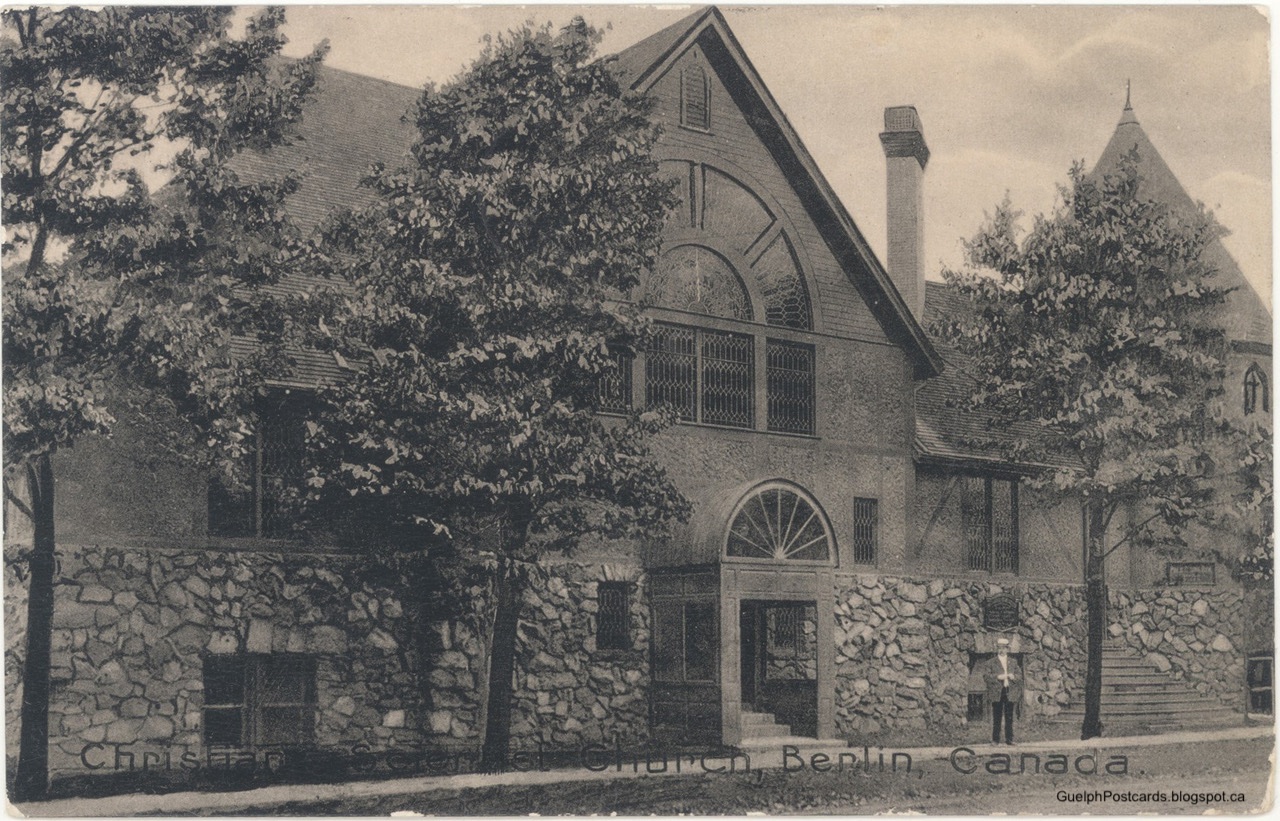
("Christian Scientist Church, Berlin, Canada," ca. 1909. Courtesy of Leigh Hogg.)
(First Church Christ, Scientist; courtesy of Google Maps.)
The subject of the talk was the postcard views of Guelph as provided by the International Stationery Co. (ISC) of Picton, Ontario. In this post, I will give a precis of the talk and show some of the images. The point of the presentation is not to give a history of places shown but to give an impression of the aesthetic quality of the individual postcards as pictures and of the whole set as a curated show of the Royal City as it then existed.
Among Canadian deltiologists, that is, postcard collectors, the ISC is known for its set of fine sepia-toned collotype postcards from the early 20th century. Consider the example below.
("Collegiate," #130.)
This is the predecessor of the current Guelph Collegiate and Vocational Institute, shown from near the corner of Paisley and Arnold streets. For inventory purposes, ISC numbered their cards; this card is number 130. The photo is nicely layered, with paths leading from the foreground into the image, where people can be seen walking under the trees and in front of the pointy buildings. Clouds billow upwards in the sky, drawn there by arists in Germany, where the cards were printed. As will become evident, this composition is typical for cards of Guelph from this set.
The history of the ISC goes back to "The Fair", a kitchen supply and grocery store located in Picton and founded by local boy James Livingstone (1868–1949) in 1895. The Fair was successful and expanded into new locations and goods. As the postcard craze took hold in the Edwardian era, Livingstone got into the act. Postcards turned into a big business for the ISC, which specialized in views from southern Ontario and the Montreal area. It carried on for some decades and left an interesting legacy of topical views.
To judge from postmarks, postcards of Guelph began circulation in 1913 and persisted into the early 1920s. Serial numbers range from 100 to 199, suggesting that there are about 100 views of Guelph in the set—quite a few! ISC expert Ian Robertson reports about 900 cards total in his collection, so the Royal City seems to have enjoyed attention disporportionate to its modest size. What was the charm?
The ISC set includes views of the usual suspects, such as the card below of the Carnegie Public Library. Designed by local boy William Frye-Colwill and erected in 1905, the building was a regular part of postcard sets of Guelph. Images were almost always taken from diagnoally across Norfolk street, which produces this dramatic angle. Even so, the photo appears to have been taken especially for the ISC.
("Carnegie Public Library," no number.)
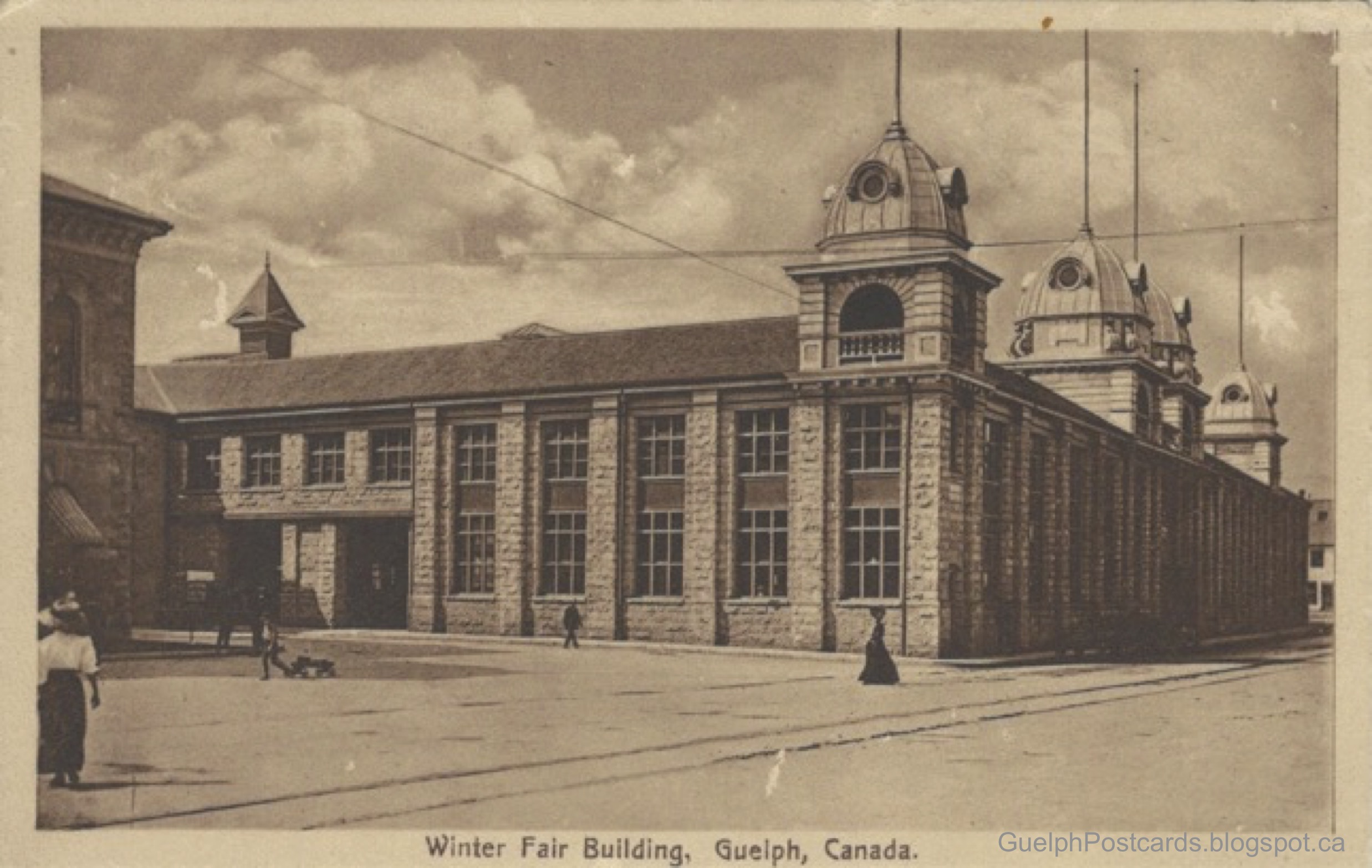
The Winter Fair Building is another fine card. The building was located on Carden street, in front of the new City Hall, where the splash pad/outdoor rink is now located. It was built to house the agricultural fairs that used to be held downtown. The corner of the old City Hall, now a Provincial Court House, can be seen on the left. As usual, the scene is animated by figures walking hither and thither.
("Winter Fair Building," #110.)
Another good, downtown view is the end of the Bell Piano & Organ factory, seen from the old Grand Trunk train station, today the city bus depot downtown. The photo gives a good impression of the bulk of the building, which was meant to dominate the old market square and train station. Beneath the near facade is the street sprayer, a wagon drawn by two horses and carrying a big barrel of water that was sprayed onto the dirt streets in the summer in order to keep the dust down. To the upper left is the clock tower, perhaps the oldest illuminated clock dial in Canada. Alas, the building burned to the ground in 1945 and the site is now a parking lot for the Royal Inn and Suites.
("Bell Piano and Organ Co.," #122.)
Another interesting view is the one below of the side of the Ontario Reformatory, popularly known in the day as the "Prison farm." The view was taken from the bluff at the back of what used to be the Turfgrass Institute. In the foreground is the Guelph Junction Railway while the three-span concrete bridge over the Eramosa River lies in the middle ground. The bridge was built from limestone from the on-site quarry and using prison labour. The prison buildings themselves lie in the background, making this card one of the few showing the Reformatory that do not feature the buildings themselves up close.
("Prison Farm," #178.)
One of the features of the ISC cards is that there are sometimes multiple views of a given building or site. Such collections of views can provide an impression of a place that would not be possible with a single image—and also would help to sell multiple cards!
One such set in Guelph is of the old Central School. The school lies along the shoulder of the drumlin that is topped by the Church of Our Lady, just one block away. With its prominent site and tall belfry, the old Central School seems to have been intended to leave a strong visual impression on anyone looking around from the downtown, and competing for visual profile with the neighbouring church. The old Central School was demolished in the 1960s and replaced by the current, one-storey structure.
("Central School," #173, looking along what is now Commercial street from Norfolk street.)
("Central School," no number, looking from Cambridge street across Dublin street—the opposite facade to the one above.)
("Guelph Model School," #142, seen from the south along Cambridge street.)
It was certainly an imposing structure!
Naturally, many of the ISC cards feature sites on the Ontario Agricultural College (OAC), now the site of the University of Guelph. For present purposes, I will feature views of Massey Hall & Library. The story has it that OAC President James Mills happened upon Walter Massey, head of the farm implement giant, on a Toronto streetcar and persuaded him to fund construction of a campus library. Thus did this charming structure come into being!
As with many ISC images, the main entrance of Massey Hall & Library can be seen behind a number of trees and elegantly-dressed ladies walking the path from the OAC garden.
("Massey Hall and Library, O.A.C.," #176.)
Below is a view of the Hall from the reverse angle, looking along the entry lane from what is now Gordon street. The MacLaghlan Building is more in the foreground on the right, with the Main Building (where Johnston Hall now stands) behind on the left.
("Massey Hall and Library, O.A.C.," #108.)
The third card with the same caption returns us to the uphill side of the Hall but further down what is now "Winegard Walk". Here, it appears that some sort of open-air lecture is underway, with the audience sitting in rapt attention on the bank of the College reservoir. No photographer on the OAC campus could resist the reflections afforded by this artificial pool!
("Massey Hall and Library, O.A.C.," #173.)
The University of Guelph has produced the following short video relating the story of the Hall:
One of the real treats contained in the ISC set of Guelph are the many pictures from Old Home Week, 1913. Old Home Week, also known as the Old Boys' Reunion, was a city-wide party for residents and former residents. The first installment was the Old Home Week 1908, the second was the Old Home Week 1913, while the third occurred in the Royal City's centennial year, 1927. ISC postcards of the 1913 event are the only images of that installment that I am aware of. The cards are characterized by decorated buildings, people milling about, parades, and events in Exhibition Park. A few selected images will give an appropriate impression.
This card shows a crowd of well-heeled ladies and gentlemen disembarking from a train at the CPR station and making their way through Trafalgar Square towards the downtown. A small omnibus waits by the station's front entrace. It is labelled, "Hotel New Wellington." The actual Hotel New Wellington was only a stone's throw away but the omnibus may have been handy for passengers who arrived with a lot of luggage. The site is today the location of the Trafalgar Square apartments on Cardigan street.
("C.P.R. Station," #136.)
The Grand Trunk railway station (now the VIA station) was also the entry/departure point for many participants in the Old Home Week. In the card below, a train can be seen in the background while people mill about the entrance and the intersection of Wyndham and Carden streets in the foreground. At the front entrance to the station can, once again, be seen the Hotel New Wellington Omnibus. Those must have been busy days for the bus driver! Also doing a good business was the city's peanut vendor, whose cart, I believe, is the focus of attention on the street corner in the centre of the image. Bags of roasted peanuts were a common street snack in those days, and passengers probably arrived with an appetite, not to mention money in their pockets.
("G.T.R. Station," #190.)
The actual Hotel New Wellington itself is featured in the card below. It is suitably dressed up for the occasion. In the foreground is a sandwich board and overhead sign for the Bogardus Pharmacy, which had a storefront facing the corner of Wyndham and Woolwich street in those days.
("Hotel New Wellington," #139.)
There are also many scenes of parades in the set. I include the one below, looking up Wyndham street towards St. George's Square, because the caption actually names the event shown in the image, instead of referring to the places or buildings in the background.
("Old Boy's Home Week at Guelph," #111.)
A number of pictures show crowds in Exhibition Park but the one below is the best (at least of those that I know of at present). At the right is the grandstand, roughly where Hastings Stadium is now, overlooking the track where many racing events and parades were held. To the left are many cars, which were parked in the park for the day. In the background were some of the Exhibition buildings, including the unusual octagonal barn.
("Exhibition Grounds," #127.)
For a final Old Home Week card, I cannot resist one of my Guelph favourites, which shows a woman guiding what I suppose are her young daughters across Woolwich street towards the Hotel New Wellington. Nice outfits! Also, the picture features an interesting composition, with the three figures in the foreground on the right of centre that balance out the dramatic fall and rise of Eramosa road in the background to the left of centre. Very deliberate photography!
("Eramora [sic] Road," #121.)
I will finish by giving a few examples of characteristic street scenes. One of the quirks of the ISC set of Guelph is the photographer's affection for scenes with people walking towards or (more often) away from the camera.
The example below is a card of two gentlemen in fashionable straw boaters striding up Delhi street, which the viewer can see was a dirt road at the time. Their retirement into the middle layer of the composition animates the picture in away that a simple picture of the sidewalk could not.
("Delhi St.," #181)
The locations seems to be near the intersection with Eramosa Road, with the house at address 34 Delhi in view at the left margin. Compare with the Street View image below.
(Delhi street, June 2016; courtesy Google Street View.)
The scene below is Waterloo Avenue, with a woman walking down the sidewalk away from the camera, while a horse & wagon and a streetcar move along the street. Judging from the shadows, the view is looking eastward along the north side of the avenue. It is hard to say which crossroad is in the foreground.
("Waterloo Ave.," #115.)
The penultimate view is of Woolwich street, the main thoroughfare leading north-west out of town. Two well-dressed ladies approach the camera along the sidewalk. A man on horseback rides down the street on the other side.
("Woolwich Street," #145.)
It is difficult to be sure but my sense is that this picture is set just north of the First Baptist Church, looking towards the intersection with London Road in the distance. In that case, the intersection on the left side of the picture is Edwin street. Compare with the Street View image below.
To conclude the tour, have a look at the image below. It shows two ladies and a young man—well turned out, of course—walking across the second Heffernan street footbridge towards Queen street. It seems a fitting image on which to finish.
("Foot bridge," # not known. Courtesy of Guelph Civic Museums, 2004.32.61.)
(As you may have guessed, I do not have a copy of this card in my collection—yet. For the postcard collector, there is always hope.)
Of course, there are many more excellent views in the ISC tour of the burgeois Royal City of 1913. The images are impressively composed and curated and form an appealing tour of the town, all the more poignant as it was, unknowingly, on the verge of the precipice of the Great War, which would change it profoundly.
Works consulted include:
Ian Robertson and Barb Henderson (2016) “The International Stationery Company of Picton, Ont.” Card Talk v. 37, n. 2.)
The postcard shows a lovely, summery scene featuring the Blacksmith Fountain in St. George's Square. The streetcars carry passengers in their summer attire, who are probably happy that the open sides let in cooling breezes. Perhaps the driver of the oncoming car secretly hopes to apply the made-in-Guelph cow-catcher on the front to scoop an errant pedestrian out of the way.
("St. George's Square, Guelph, Canada," ca. 1910. Published by the International Stationary Company, Picton, Ontario.)
Although postcard publishers tended to prefer summer photography, postcards were sent all year round, and this card was actually dispatched from Puslinch to Guelph on 31 December 1914, when the Royal City and its surroundings had be socked in under repeated snowfalls.
Addressed to Mrs. James D. McPherson on York Road in Guelph, the message relates to the holiday season:
Dear Jim & Belle:—
We got the photos and you could not have sent us a better Christmas box. Glad to hear baby is growing so well.
Wishing you all
A Happy New Year
Aunt Flora
Of course, the year 1914 was an unusual one in Guelph. The Great War had begun a few months earlier and Canadians were still unsure what it would amount to. Many young men had left with the Canadian Expeditionary Force and were still in Britain training for combat. Herbert Philp wrote a letter home to his family, which they subsequently published in the Mercury (24 December), under the ironic title "Salisbury mud a wonderful thing." In it, Philp speaks eloquently of the frustration of the contingent:
For, despite the eagerness of practically every man in the contingent to be "over the way," we are still wallowing about in England's mud.
Philp explains that the conditions were fine and dry on their arrival, and they pitched their tents in a "slight valley." Then down came the English rains, leaving their modest dwellings with:
ambitious rivulets flowing either through them or snuggling close to their sides. Not a tent but contained a pool of water.
When the weather let up, the tents were moved up slope but the cookhouse remained down in the valley, meaning that everyone had to line up there three times a day, in whatever weather, to get their food. The result was frequenty cold tea and soup and soggy bread at meal times.
Philp finishes his letter thus, "But, so far as excitement and entertainment are concerned, Salisbury Plains still runs a close second to the grave."
(Herbert Philp's many and eloquent letters home throughout the Great War have been collected by Ed Butts in the book, "The Withering Disease of Conflict: A Canadian Soldier's Chronicle of the First World War." It is available from the Guelph Historical Society and I highly recommend it!)
War news was a mixed bag. Accounts of terrible battles were featured, but the general tone conveyed the sense that the Allies had the upper hand and German defeat in the near future was still a possibility, though not by Christmastime.
Rumours of German attacks on or in Canada circulated. For example, a national article printed in the Mercury (1 December) related a scheme set in motion for German forces to take over Quebec City. A concrete structure made the previous year near St. Anne de Beaupré by a German movie crew in 1913 was thought to be a bunker intended as a weapons cache for a surprise attack launched by sea. Luckily, British naval superiority had frustrated this plan, it was thought.
The many Canadians of German descent in the region also caused concern. A letter to the Editor (11 December) attempts to address rumours of a German-Canadian fifth column thus:
Editor of the Mercury.
Dear Sir: Who are the meddlers who have been reporting to Guelph authorities that secret meetings are being held in Morriston by the Germans and German-Canadians?
There are no secret meetings held in Morriston to my knowledge. Perhaps the meddlers had reference to the revival meetings, held in the Evangelical church, which are held annually. These meetings are not secret, but sacred, and people of all nationalities are welcome to attend.
Are such meddlars as these throughout the Dominion interested in uplifting our Canada? No, they are too ignorant to realize the harm they are doing their own village and community, also their own country, Canada.
Yours respectully,
A life-long Mercury reader.
As ever, conflict breeds suspicion and mistrust, well-founded or not. Locally, misplaced suspicion of German- and Catholic Canadians resulted in the Guelph Novitiate Raid of 1918.
("Evangelical Ch., Morriston." Courtesy of Wellington County Museum and Archives A2009.124, ph. 31342.)
Compared to previous years, the Xmas shopping ads in the Mercury seemed subdued. Still, they were far from absent. The D.E. Macdonald & Bros. shop urged Guelphites to "Hurry up! Only two more Saturdays before Christmas" (11 December). Extensive gift suggestions for him, her, and baby were provided, along with an illustration of Santa Claus hauling a prodigious sack of goodies.
Similarly, Moore and Armstrong noted that there were only nine shopping days left (14 December): "If you have not got the Christmas Spirit yet, you will have it in large measure when you get to the White House," that is, their store on Wyndham street.
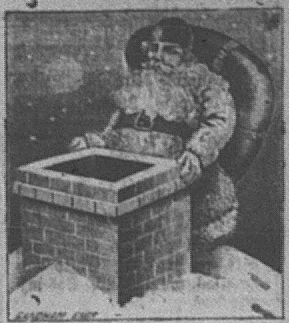
Their illustration also showed Santa Claus carting a super-sized sack of gifts. One can understand the look of relief on the jolly old elf's face at the sight of the very wide chimnney before him!
If nothing else, Santa's message was to go big or go home, or both!
Even Santa Claus was not unaffected by the conflict in Europe. This cartoon shows how low German Kultur had sunk with the war (22 December):
The caption says, "An act of barbarism: Not only are the Germans firing on the Red Cross and flags of truce, but they are rendering the work of Santa Claus difficult and hazardous."
Being magical, Santa had the means to rectify the situation, as shown in a subsequent cartoon (26 December):
Here, Santa deploys what I assume is a stocking full of doorknobs to give Kaiser Bill a jolly good thrashing.
People on the home front carried on. The Guelph Musical Society held a parade downtown on 9 December. The performance was marred somewhat when large bulldog followed the squad down Wyndham street. The drummer found that the dog would bite the drumsticks whenever he raised them to beat the kettle drum. Fearing that he might be "minus a wing" if he provoked the dog further, the drummer ceased drumming and the band had to proceed without their bass.
The animals did not have it all their own way. A bear cub named "Teddy" had been kept as a curiousity at the American Hotel on Wynhdam street for most of the year. Having reached the size of 200 lbs, Teddy was sent Bernard Schario, the butcher, who turned him into roasts and steaks as a holiday feast for the hotel residents (24 December).
The skating season took shape. With the cold weather, Guelphites were soon skating on the pond above Goldie Mill. Skating also began indoors at the Royal City Rink (formerly Petrie's Athletic Park and Rink) at Wellington and Gordon streets.
(Detail of "The Petrie Rink, Gymnasium and Baths," 1898. Courtesy of Guelph Museums 2014.84.2.)
Curiously, the street railway company decided not to open their usual skating rink on Howitt's pond, on the basis that it would not be "a paying proposition" (18 December). In previous years, the rink behind the streetcar barns on Waterloo road had been run as an attraction to get people onto the streetcar system in winter.
Perhaps they had too much competition. The City had decided to fund a rink on the grounds of the Guelph Collegiate Institute on Paisley street. A room in the basement was even made available for people to put on their skates (22 December). Perhaps this level of comfort and style attracted skaters who might have been inclined to travel to the streetcar rink in previous years.
("Collegiate Institute, Guelph, Ont." Postcard printed for Waters Bros., Guelph, ca. 1910. Courtesy of Guelph Museums 2009.20.1.)
The Royal City Rink was also home to Guelph's very first NHL team! Yes, Guelph entered a team in the 1914–15 Northern Hockey League senior series (21 December). Although some of the players trying out for the team were from out of town, lots of local boys turned out to show their stuff, including Allan, Anderson, Stricklerr, Greer, Hayes, Spalding, Ogg, King, Mowat, and Bulgin.
The side lost their first exhibition game against the Dutchmen of Waterloo (26 December). Although the Guelphites mainly acquitted themselves well, the superior size of the Seagramites gave them a distinct advantage, resulting in a 5–2 win for the visitors.
Another tilt against the same team was arranged for the first regular season game. This time, the Royal City skaters were better prepared. The result was a "wild sort of affair," beginning with a dispute over whether one of the Guelph players was a professional—strictly forbidden! The play was very physical and Referee Knell of Berlin (Ontario) "had his hands full."
The police had to be called in to break up a melee after the crowd joined in an on-ice altercation in the second half. Tied at the end of regulation play, the game went ten minutes into overtime before Guelph's centre, McGregor, put the home team up 7–6.
At the Reformatory (or "Prison Farm"), the provincial government announced plans to install an abattoir on site (31 December). The Ontario prison system required 600–700 tons of meat annually in its operations, which was obtained from private butchers. Building an abbatoir at the prison meant that prisoners could be employed to perform the butchering at a lower cost than private butchers, saving the system some $50k a year. In addition, prisoners would learn skills that they could use to obtain regular employment as meat dressers in private industry after release.
("Ontario Reformatory Guelph, Jan. 1915 The Abattoir." Courtesy of Guelph Museums 2014.84.1276, p. 59, ph. 3.)
A final point of interest came with the annual, municipal elections. First, there was some talk of not holding the elections at all, in view of the war situation (17 December). But, the election went ahead as usual.
Besides electing a Mayor, Aldermen (Councilors), and other officials, citizens of Guelph were asked to weigh in on the following by-law, "Are you in favor of municipal votes for married women?" (8 December). The 'Women's Franchise plebisite' was carried by a majority of (male) voters 1140 to 838 (5 January 1915).
Women's groups had long campaigned for women's suffrage in Ontario. In the Edwardian era, efforts tended to focus on municipal voting. In 1914, the Canadian Suffrage Association, led by Dr. Margaret Gordon, had lobbied many Ontario municipalities to hold referenda on extending votes to women. It appears that Guelph was one of 33 municipalities where the effort met with success, albeit for married women only.
Women's role in the Great War led to further support for the cause. In 1917, Ontario women finally gained the right to vote in provincial elections.
In many respects, the holiday season of 1914 was like those of previous years. Even so, as the prospect of the end of the conflict in Europe receded, it was clear that times were changing and that the New Year would bring on many new challenges.
In the chilly afternoon of 8 November 1920, a group of people crossed over the Eramosa River on the sturdy, concrete bridge to the Canadian Pacific platform at the Speedwell station. They were the last patients and staff of the Speedwell Military Convalescent Hospital, commonly known as the Speedwell Hospital. They consisted of 45 walking patients, 9 "stretcher cases," 2 doctors, 7 nursing sisters, 3 vocational aides, and 9 orderlies. They boarded the 3:40pm train for Toronto, bound for Christie Street Hospital. The Speedwell Hospital was now closed.
(View of the Prison Farm from near the Speedwell train stop. Printed by International Stationary Co., Picton. Although the card is from ca. 1912, the note on the back says, "This is present Speedwell Hospital.")
The story of Speedwell Hospital begins in 1915. It had become clear that the conflict in Europe was going to be a long and grinding affair. Many personnel sent off to war were coming home badly wounded and in need of substantial care, and many more would do so in future. In June of that year, the Canadian government set up the Military Hospitals Commission (MHC) to acquire and operate a system of hospitals and other facilities to see to the needs of returning veterans. Given the pressing nature of the situation, the MHC was on the look-out for existing facilities that it could adapt for its purposes. The Ontario Reformatory at Guelph, still often known as the Prison Farm, was a good candidate. It could certainly serve the medical needs of wounded veterans but, more to the point, its farm and machine operations could provide employment and vocational training for veterans as they re-integrated into civilian life.
The choice of the Prison Farm was telling in some ways. The Prison Farm had been designed to turn young men from lives of petty crime or dissolution to lives as productive and upright citizens, learned through agricultural work or tradecraft. Although the Speedwell Hospital was to function as a medical facility, it too had a broader social function. Like the Prison Farm, it was intended to turn young men from soldiers into civilians through experience with agricultural work or useful trades.
Soldiering was generally viewed as heroic and not criminal, yet the fundamentally undemocratic operation of the military and the dependency of its rank and file on the organization were regarded as problematic for civilian life. Thus, Speedwell would be a place where returned soldiers would be honoured and healed but also helped to begin lives as the heads and breadwinners of the nation's future families.
Unfortunately, Speedwell did not succeed in this mission.
On 19 October 1917, the first 50 returned soldiers were brought to Speedwell from the London Military Hospital (Evening Mercury). The Prison Farm had been thoroughly renovated in preparation for their arrival. Of course, bars and screens had been removed from windows and iron doors replaced with curtains. Painters, carpenters, and other tradesmen from Guelph had been busy for months making the place more welcoming and less confining.
(Military Hospital, with a new dormitory wing visible on the right. Printed by the Heliotype Co. of Ottawa, ca. 1920.)
In addition, two new wings had been built as dormitories. Each was two storeys high and could accommodate 74 beds on each floor, for a total of 296. In addition, a large theatre had been constructed behind the Main Building, with a capacity of about 600. Here, soldiers could put on entertainments for each other, for visitors, or be entertained by special guests. A recreation room featuring billiard and pool tables as well as pianos was provided. A library was also fitted up, and a call for book donations put out. A canteen was constructed in the basement where patients could eat cafeteria style, if they could.
(Soldiers playing billiards at Speedwell. Courtesy of Guelph Civic Museums 1978.6.4.)
(Soldiers at a Speedwell cafeteria. Courtesy of Guelph Civic Museums 1978.6.1.)
Vocational training was also organized. Patients could get training in the trades, such as carpentry and auto mechanics. Remedial schooling was also available.
(Soldiers making furniture in a carpentry shop at Speedwell. Courtesy of Guelph Civic Museums 1978.6.5.)
As part of the deal between the Department of Soldiers' Civil Re-establishment (DSCR—successor to the MHC), command of the hospital remained with the military, headed by Lieutenant Colonel T.G. Delamere, a veteran of the first Canadian contingent to France who was wounded in action and returned to Canada. Even so, many of the staff of the facility would continue to be civilians, many remaining from the Prison Farm days.
(Real photo postcard of Speedwell, taken from the north with a Farm side road in the foreground.)
In some respects, Speedwell Hospital served its patients reasonably well. Opportunities for playing billiards, reading books, and writing letters and postcards were likely agreeable. Many special entertainments were mounted also. For example, sporting events were brought in. On 14 April 1919, for example, a boxing program was put on featuring "Irish" Kennedy versus "Battling" Ray of Syracuse (Globe). Although scheduled for 10 rounds, Kennedy knocked out Ray with two telling blows to the jaw in round 5. A wrestling match between Finnemore of Milton and Hays of Galt went nearly 25 mintues, when Hays made the second fall of the bout. The Eustis Bros. of Toronto delighted the assembled with their excellent acrobatic display. Three boxing matches between returned soldiers were well fought and ended in draws.
In 1919, amateur baseball returned to Guelph, and the Speedwell Hospital entered a team. The experience seems to have been a success as Speedwell went on to enter a team in 1920 as well.
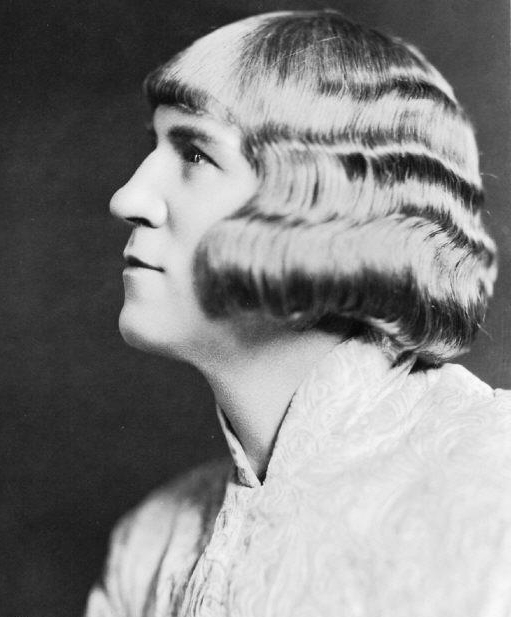
Edward Johnson, local boy who was already an international singing sensation, put on a show to a packed audience at the Speedwell theatre on 10 September 1920 (London Free Press, 11 Sep.).
(Edward Johnson as Pelléas in Claude Debussy's Pelléas et Mélisande at the Metropolitan Opera in New York in 1925. Courtesy of Wikimedia Commons.)
Soldiers at the the Hospital also organized their own entertainments, which were sometimes made available for the community. For example, the Speedwell Hospital Minstrels put on a minstrel show in the old Guelph City Hall (Evening Mercury, 19 Feb. 1920). Minstrel shows were variety shows in which white men wore blackface and capered, sang, and played instruments in the manner they imagined southern African Americans did. The form had been largely superseded by Vaudville style shows but persisted as an informal kind of amusement. The Speedwell Minstrels' performance was liked well enough that they were invited to repeat it in Elora.
Ties between the returned soldiers and the community seem to have been positive. Reports suggest that many soldiers remained in Guelph after their time at Speedwell, though I have not found accounts of exactly who they were or how numerous. Connections with town were facilitated by the Toronto Suburban Railway stop at Speedwell station, across the Eramosa River from the institution. The Guelph Radial Railway (streetcar) opened a regular service to Speedwell (Evening Mercury, 15 Jan. 1920). Business on this route was so good that two extra daily trips were put on, which were filled to capacity.
(Storage building at Speedwell; Construction v. 13., n. 3, p. 97, March 1920.)
Various aid organizations, many run by women, took a great interest in the well-being of the soldiers, for example (Globe, 19 Dec. 1919):
The Speedwell Hospital Visiting Committee of the Red Cross Society at Guelph yesterday prepared the personal property bags and packages which are to be distributed to all the patients of the hospital. The committee received many generous donations for these packages, which will contain raisins, chocolates, smokes, socks, handkerchiefs, apples, and other articles. In each there is also a Christmas card and a Red Cross card. The distribution of gifts will be made on Thursday afternoon.
Soldier's Comfort Committees in many communities made goods and campaigned for funds to provide soldiers with domestic comforts. For example, the Women's Institute of Ospringe made and donated an "autograph quilt" to the Speedwell Hospital in 1919.
At the provincial level, Mrs. Arthur VanKoughnet of the DSCR coordinated a funding drive with impressive results (Globe, 7 Oct. 1919):
Oakville Woman’s Patriotic League, $200.00; Seaforth Canadian Red Cross Society, $125.00; St. Cyprian’s Carry on Club, $130.50; Riverdale Woman’s Patriotic League, $225.00; Woman’s Volunteer Corps. $125.00; Grey County Woman’s Institute, Ayton, $202.00; Ioco Good Cheer Club, $66.00; Gorrie Woman’s Institute, $54.50; Annan Woman’s Institute, $30.00, and others from individuals. Donations of comforts of various kinds were received from Sherbourne Street Methodist Church, Jarvis Street Patriotic Society, Navy League of the United States, York Rangers’ Chapter I.O.D.E., Sir Thos. Cheton Chapter, I.O.D.E., Hastings; W.I. Roseneath, Cobourg Ladies, 169th Regt., St. Alban’s Red Cross Society, North Toronto Red Cross Society and Soldiers’ Comforts, D.S.C.R., 71 King street west.
Some of the soldiers applied themselves to the domestic arts, perhaps those who were unable to work in the abbatoir or carpentry workshop. Some of the fruits of their labour, from Speedwell and other facilities, were put on display in the Women's Building of the Toronto Exhibition (Globe, 26 Aug. 1919):
There are beautiful scarves and hat bands woven on hand looms, beaded necklets and watch fobs of fine color and design; examples of metal work, hammered brass and copper; cushion covers and centerpieces in embroidery and cross stitch; excellent carpentry and cabinet work; beautifully carved and inlaid trays; hand-painted China and other things almost beyond his number.
Above all, the author heaped praise on the fine baskets that the men had made.
The author also took pains to maintain the dignity of the soldiers. Although this work was of a traditionally feminine character, it "may frequently set an example of the beauty of usefulness and simplicity to the women who exhibit their achievements in the adjoining rooms." In other words, the soldiers' scarves, embroidery, and baskets were safely masculine, and admirably so.
Of course, some items were decidedly military, such as a belt made of war trophies, a kind of art practiced in the trenches in France:
A unique contribution to the collection is a belt made from captured German regimental badges, and clasped with the regulation German brass buckle bearing a crown and the words “Gott Mit Uns.”
In spite of these efforts and the benefits they conferred, returned soldiers experienced significant troubles at Speedwell.
Some troubles were consequences of the war. For example, George William Moyser of the 71st Battery of Toronto, died as a result of ill-health caused by a gas attack suffered in France (Globe, 28 May 1919). Others were due to misadventure. Fred Tucker died as a result of falling off the top of the quarry pit at the back of the Hospital (Daily Star, 11 Aug. 1919).
Many soldiers were killed as a result of the Spanish Flu epidemic. For example, Lavelle Germain of St. Marys was taking a vocational course at Speedwell but staying in Guelph. He returned to his room at the King Edward Hotel complaining that he felt unwell. He later called for a doctor, who arrived to find Germain all but dead (Evening Mercury, 3 Feb. 1920). A whole ward of Speedwell was converted into a ward for flu victims, and several ill students from the O.A.C. were moved in (London Advertiser, 10 Feb. 1920).
Of course, the Spanish flu affected everyone. Nursing Sister Miss Geraldine McGinnis of London died of pneumonia resulting from the flu (London Advertiser, 12 Feb. 1920). She must have been very dedicated to her vocation as she had served two tours in France during the war and was in her second stint as a nurse at Speedwell.
Physically, Speedwell itself was not well suited to work as a hospital. Among the many problems was the damp. The stone walls of the institution seemed to encourage condensation, making the rooms continually uncomfortable. Dampness was a particular problem for the "lungers," that is, the many tuberculosis patients housed at Speedwell. Patients complained bitterly to a Mercury reporter who went to investigate (Evening Mercury, 8 July 1920):
Vincent is a British naval veteran, in with bronchitis. “The floors here are like the decks of a battle ship,” he said. “I had some experiences in the navy, was mined twice, but the experience I have had here are worse than the former ones.”
...
“It has to be a pretty wet place before I’ll complain of it,” said “Pick” McRae, “but you can tell ‘em all it’s too wet here for me.” McRae is a lung patient in cell number 9. Water was dripping from the walls of his cell.
As the word "cell" suggests, Speedwell retained the look and feel of a prison, in spite of the renovations and amenities. Naturally, the patients found this quality disheartening.
Speedwell had significant institutional problems as well. The DSCR's contract with the Ontario government meant that civilians staffed many of the Hospital's operations, such as the farm. Veterans felt that they should have preference for work at Speedwell and resented limitations on their opportunities there.
Budget limitations also led to conflicts among the staff. Nurses at Speedwell, who belonged to the military organization, complained that their medical duties did not allow them time to deliver and supervise patients' meals, as expected by the institution's dietitians, who belonged to the civilian authority. The dietitians complained that there was not enough money available to hire civilian staff to carry out that duty.
("Portion of the spotlessly clean kitchen at Speedwell, wherein cooking is a ?? and diet a study. No dish is used whereon one germ exists and frequent tests keep up this desirable condition." The London Advertiser, 20 Dec. 1919.)
In 1920, the situation came to a head. One hundred and fifty patients signed a petition demanding a sharp improvement in hospital conditions. They and the Great War Veterans Association (GWVA) called for the resignation of the Hospital administrators and for jobs at Speedwell to be given to veterans before civilians. Many of the nurses walked off the job in protest at conditions in the Hospital. A provincial inquiry found that want of money had led to filthy conditions falling well below the standards of a military hospital.
In the face of these problems, the DSCR decided that the situation at Speedwell was irretrievable and that the facility would be closed down. Military staff were re-assigned, civilians were laid off, and patients were moved to other facilities. The local Soldiers' Comfort Committee paid a final visit, bringing fruit and other gifts and holding a farewell dance (Evening Mercury, 4 Nov. 1920).
The Ontario government contemplated other uses for Speedwell, such as an insane asylum or merger with the OAC. In the end, they decided to return it to its former use as a prison. Local contractors were hired to put bars in the cell windows and make other preparations (Evening Mercury, 22 Nov. 1920). The theatre, which had served as a focal point for the amusement of returned soldiers, burned down in a mysterious fire during renovations (Globe, 28 Nov. 1921). The Speedwell Military Convalescent Hospital experiment was truly at an end.
Information about Speedwell and its institutional problems comes mainly from:
Durham, B. (2017). “The place is a prison, and you can’t change it”: Rehabilitation, Retraining, and Soldiers’ Re-Establishment at Speedwell Military Hospital, Guelph. 1911-1921. Ontario History, 109 (2), 184–212. https://doi.org/10.7202/1041284ar










#/media/File:Edward_Johnson_in_Debussy's_Pelléas_et_Mélsande_1925.jpg)