Showing posts with label cars. Show all posts

Sunday, 30 May 2021

The early days of Eden Mills

Eden Mills, a short distance up the Eramosa River from Guelph, has a reputation as a quiet and picturesque rural village. But, it wasn't always so. When Aaron and Daniel Kribs arrived the site on 14 April 1842, it had a good water supply but not much else to recommend it (Mercury, 20 July 1927):
Finding that there was sufficient fall in the bed of the river to raise about eight feet head of water at that place, they proceeded, after building each a shanty, to clear the ground for the mill dam. This required a good deal of courage, for a more dreary or unsightly looking place could not be found in the whole township, than it was at that date.
Despite the rough nature of the terrain, the availability of water and timber, plus the determination of the brothers, made them press on:
However, the Messrs. Kribs pushed ahead, and by the 1st of October of the same year, had the dam completed, the saw mill running, and a good one it was too, for an old fashioned water mill. Having a good lot of pine trees convenient to the mill, they set to work sawing lumber, and very soon the people found a way to get it out from the place. Although they had only a miserable apology for a road, yet the lumber was taken away as fast as cut, and they did very well that fall and winter.
(Postcard of "Mill pond, Eden Mills," ca. 1955.)

Daniel Kribs was born near Hamilton in 1816 and moved with his family to Eramosa in 1826 (Globe, 6 December 1898). The new mill was evidently the Kribs brothers' chance to make a name for themselves. So, they called their new locale "Kribs Mills" (sometimes spelled "Cribbs Mills").

("Grist Mill," ca. 1923; Courtesy of Guelph Public Library F38-0-15-0-0-340. These stone buildings replaced the frame mills built by the Kribs.)

Flushed with success, the Kribs brothers added an oatmeal and a grist mill to their enterprise. Unfortunately, this addition proved their undoing. The millwright they hired to construct it did a poor job, resulting in an underpowered mechanism that could grind only a fraction of the capacity required to run at a profit.

The brothers persevered but could not make good their debts.

In the spring of 1846, Adam Lind Argo came to the town and saw an opportunity. He offered the Kribs $5000 for their operation and lands and, although it was only half their investment, they accepted and washed their hands of the operation. Daniel Kribs later moved to Guelph, where he became a court bailiff and a respected member of the community.

Adam Argo was born about 1809 in Foveran, Aberdeenshire, Scotland, and immigrated to Canada in 1836. He gained milling experiece in Bridgeport and Preston before striking out on his own. Thanks to his experience and acumen, he was able to remodel the Kribs's mills and keep them running in the black.

Unsurprisingly, Adam chose to rename Kribs Mills and selected "Eden Mills" instead. Various stories are told about his reason for this choice. One story is that the name "Eden" was adopted to help attract interest in the otherwise unappealing locale, rather as Erik the Red choose the name "Greenland" for the icy North Atlantic island he was trying to sell back in frosty Iceland. Another story is that the name "Eden" had a Biblical provenance: Just as the original Adam came from Eden, so this new Adam would return there, in a manner of speaking. Another possibility is that Mr. Argo choose "Eden" in memory of his homeland, where there are a number of places featuring that name, such as Eden Castle in Aberdeenshire.

(Postcard of street scene of Eden Mills, 1905; Courtesy of Wellington County Museum & Archives A1989.101.)

Whatever the reason, Eden Mills ultimately proved attractive. The Mitchell’s Canada gazeteer of 1864 gives the following description and list of village enterprises, suggesting a thriving community:

Eden Mills, C.W.—A village, situated on the river Speed, in the township of Eramosa, count of Wellington, containing a good female school, three churches and Mechanics’ Institute library with 460 volumes. Distant from Rockwood, a station on the Grand Trunk Railway, 3 miles; Guelph 7 miles. Daily mail. Population 250.
Antony, Jacksonshoemaker
Bardswell, Meshackretired
Boyle, Andrewblacksmith and wagon maker
Burrows, Wm.shoemaker
Cook, Charlescabinet maker
Cook, Frederickcabinet maker
Davidson, John A.carpenter and builder
Davisdon, John A.collector, land agent, issuer of marriage licenses, commissioner in B.R. conveyancer, &c.
Dowrie, Davidcarpenter
Esson, Johnbuilder
Fielding, Davidgrocer
Frain, Jameswagon maker
Harmston & Hendersonbuilders
Harris, Johnhotel keeper
Hay, Johnshoemaker
Hortop, Henryflour mill
Jackson, Anthonygeneral merchant
Krase, Greorgecabinet maker
Little, Jamesmiller
Malcolm, Mrs.female school
Meadows, Sam’lpostmaster, general merchant, sewing machine agent, and potash manufacturer
McDonald, Alextailor
McDonald, Johncooper
Richardson, Ralphwagon maker
Ritchie, Williambuilder
Stewart, Alexanderbuilder
Sullivan, Timothyblacksmith
Watson, Wm.mail stage proprietor
White, Jamesconstable and lime burner
White, Thomasretired
Wilson, JamesJ.P., and oatmeal mill
Wilson, Peterwoollen manufacturer
Zouart, Johnretired
The sharp-eyed reader will note that Mr. Argo had sold the mill by this time (1850), and relocated to Fergus.

Despite being largely cleared, local trees continued to play a significant role in the village. In 1872, some local men performing statute labour nearby discovered a human skeleton in an advanced state of decay with a flagstone laid across its breast (Mercury, 19 June 1872). They supposed that it was an Indian burial, as it was found under the roots of an old pine tree and must have predated the arrival of settlers. It crumbled to dust on removal.

In 1890, Mrs. William Geddes of Eden Mills was killed in an unfortunate accident involving a tree near the village (Mercury, 31 July 1890). She and her children had gone berrypicking with some friends in Mr. Anstee's swamp. The two parties had just gone their separate ways towards home when the children ran back saying that their mother had been struck by a tree. Her friends hurried to the spot to find that Mrs. Geddes had been killed outright and was lying next to the tree that had felled her.

In 1912, Eden Mills was hooked up to the electrical grid, like many towns in southwestern Ontario, to receive power generated a Niagara Falls. Construction of the Hydro corridors resulted in the felling of many trees, which met with some protest, reflecting a rise in interest in forest conservation advocated by people like Edmund Zavtiz of the Ontario Agricultural College (OAC). In a letter to the editor of the Globe (12 June 1918), J.E. Carter complained of "the great destruction of our beautiful shade trees along our highways by linemen who butcher them." He drew particular attention to "a fine row [of rock maples] near Eden Mills" that had recently suffered this fate. Carter noted that the Ontario Tree-Planting Act limited the powers of linemen to trim roadside trees and urged rural residents to exercise their rights to defend them.

(Postcard of Eden Mills showing General Store and post office, mill, and building located south of mill, 1912; Courtesy of Wellington Museum & Archives, A1989.66.)

Besides trees, water was a crucial part of Eden Mills early history. Of course, it powered the mills themselves but it also provided opportunities for recreation. In 1843, a party of young men were working on construction of Kribs's grist mill and decided to take a little break from the hot weather in the mill pond. Two of the party, Gerow and Duffield, got in over their heads and disappeared under the water. Daniel Kribs came upon the scene and managed to pull them out. Duffield appeared to be dead but local resident Stephen Ramage applied some "resuscitation techniques" and restored him to life.

Despite this close call, the mill pond continued to be a popular local swimming hole.

(Postcard, "Mill stream, Eden Mills, Ont.," ca. 1955.)

Of course, the mill pond and Eramosa River were popular places for locals to go fishing. So, it was the setting of many fish stories, such as (Globe, 20 July 1886):

An ex-student of the Agricultural College, now employed near Eden Mills, made loud professions of his abilities as a fisherman. Some persons, however, had so little faith in his attainments in this line that they made a wager that a young lady of the neighbourhood could outfish him, he however, to catch six to her one. The result was the young woman caught nine fish, one of which was a trout weighing a pound and a half, while the ex-student caught six shiners [minnows].
Grrl power! It would interesting to know who these fisher folk were. The young man whose angling pretensions were so ignominiously punctured may have been R.A. Ramsay, a local lad who had graduated from the OAC four years earlier.

In the great tradition of the pasttime, local anglers' exploits were always open to question, for example (Mercury, 17 June 1887):

The Rev. J.C. Smith, B.D., and Mr. Geo. Sandilands, manager of the Central Bank, were trout fishing in Eden Mills yesterday. Mr. Sandilands told a glowing story about trout, and trout fishing. The reporter would at any time take Mr. Sandilands’ word for $20,000, but when it comes down to veracity on a fishing expedition it is another matter. Mr. Smith was not seen on the streets to-day, and thus the promised one true fish story of the season is knocked on the head. It is privately whispered, however, that the catch was beautifully small.
Doubtless, more than a few whoppers were fished from the Eramosa at Eden Mills.

As it happens, more than water flowed through Eden Mills. In 1886, following a tip, police officers raided Johnston's Hotel there looking for violations of the Province's new Scott Act (Mercury, 24 December 1886):

Edward Johnston, who keeps a hotel there, was the suspected party. His premises were searched, and underneath the bar in the cellar was found a small still in full working order. The still was erected on the top of a common wood stove, with worm in a cold water tub near by. A considerable quantity of wort in different stages of fermentation was also found, together with distilled spirits. The whole was seized and the wort destroyed. The still and fermenting tuns were brought to Guelph.
Having been caught red-handed, Johnston pleaded guilty and was fined $50.
(Stone hotel building in Eden Mills, 1973; Courtesy of Wellington County Museum & Archives A1985.110.)

It seems that Johnston learned his lesson. A short time later, we learn of thirsty patrons being turned from the doors of his hotel (Mercury, 4 February 1888):

On Wednesday afternoon, it seems Mr. Arch. Robertson, living near Eden Mills, went home from Guelph with enough liquor to make him quarrelsome. Being refused entrance to Johnston’s hotel in the village, he ran foul of Mr. David Shannon, and in the encounter received a black eye. In the evening he returned with the assistance of James Rouse and William Hillis and visited Shannon’s house. Shannon was called to the door and assaulted by the trio, and had his window and sash broken. Shannon swore out an information and on the three parties appearing before Squire Strange they were fined $20 each, $5 costs each, $3 for the damage done, and bound over to keep the peace for 3 years. The villagers were much annoyed by the unseemly row, and trust that the result of this case may prove a warning to others disorderly disposed.
Unfortunately, it seems that later proprietors of the hotel were not so scrupulous. Joseph Zinger, who kept the hotel in the 1890s, was found guilty of illegally selling liquor on several occasions.

Matters came to a head in 1904 when the Prohibition League of Guelph complained to authorities about lax enforcement by W.S. Cowan, the license inspector for South Wellington. The Inspector, they said, took no action despite numerous complaints made by the League against establishments in Everton and Eden Mills. Indeed, his superiors were unimpressed with Cowan's defence (Globe, 27 February 1904):

The department wrote to him twice about the matter, and he replied that he had made an inspection, and at Eden Mills had confiscated so much liquor as to necessitate a team to take it away. The department decided that he should have known of the open violation long before, and that after such glaring evidence of incapacity there was no alternative but to ask for his resignation. He declined to resign, and the department removed him.
What did the neighbourhood think of a village where the license inspector hauls away a wagonload of illicit liquor and his bosses figure that he isn't trying hard enough?
(Postcard of Eden Mills showing General Store and post office, mill, and buildings located west and south of mill, 1912; Courtesy of Wellington County Museum & Archives A1989.66.)

Besides wood, flour, and whiskey, Eden Mills was once set to become a petro-town. Apparently, enough oil had been dug up in the vicinity to prompt villagers to form the Oil Company of Eden Mills (Globe, 19 January 1866). Directors were appointed and capital not less that $4,000 was sought. At the inaugural meeting, it was resolved that

the shareholders, owning land at a distance not greater than three miles from Eden Mills, agree to bond their land for oil digging purposes at a royalty of one-eighth of the proceeds of the well, or wells sunk by the Company—said shareholders binding themselves, at the time of taking stock, to hold their lands open for three years for the company for that purpose, and said contract, when executed, to extend to 99 years.
The village was said to be in "a fever of excitement." Test wells were dug and samples sent to Toronto for analysis. Yet, after a year or so, Eden Mills' search for black gold did not pan out and the village never did become the Calgary of South Wellington.
(A forest of oil derricks in Los Angeles, Toluca Street, ca.1895-1901. This failed to materialize in Eden Mills. Courtesy of Wikimedia Commons.)

One of the challenges for residents of the village was its relative isolation. When the Grand Trunk Railway from Toronto to Guelph was built in 1856, it went through nearby rival Rockwood instead of Eden Mills. So, when the Guelph Junction Railway was proposed in 1886, to connect Guelph to the Canadian Pacific Railway (CPR) line at Campbellville, residents saw a chance to catch up. After a village conference, Messrs. Laing and Nicol were sent to a meeting of the directors of the new railway to urge them to adopt a route through the village (Mercury, 6 April 1887). They acknowledeged that a route through Eden Mills would be a little longer than the one proposed near Arkell but argued that it would have compensating advantages. Eden Mills was home to many gravel pits that could supply building materials cheaply. It's grist, oatmeal, and shingle mills produced much material that could be shipped from a station in the village, not to mention the plenteous turnips! The directors promised to relay the proposal to Mr. Jennings, the CPR Engineer, though they were not optimistic for its prospects.

As residents contemplated this gloomy news, things suddenly looked up. A navvy, that is, a civil engineering construction worker, soon appeared in the village, equipped with boots, shovel, and spade. Residents inferred that the Junction railway was to grace their village after all! Alas, it was not so and the people of Eden Mills had to deal manfully with their disappoinment (Mercury, 19 April 1887):

The new arrival was received with open arms, but when he avowed, on being questioned, that he knew nothing about the Guelph Junction, he was treated to the cold shoulder, and plainly made to understand that his [ab]sence would be a relief, and if he did not go he would be assisted.
In the end, the CPR decided on the shorter route and Eden Mills was bypassed again.

However, the patience of villagers was finally rewarded when the Toronto Suburban Railway (TSR) was built between Toronto and Guelph in 1913–1917. This was made possible by the extension of Hydro power to Eden Mills in 1912. When it became operational in 1917, the TSR enabled residents to ship and receive goods from their local station. In addition, visitors could readily arrive by train to enjoy events such as dances put on in Edgewood Park (later Camp Edgewood). Residents could get to larger centres for their amusement and convenience.
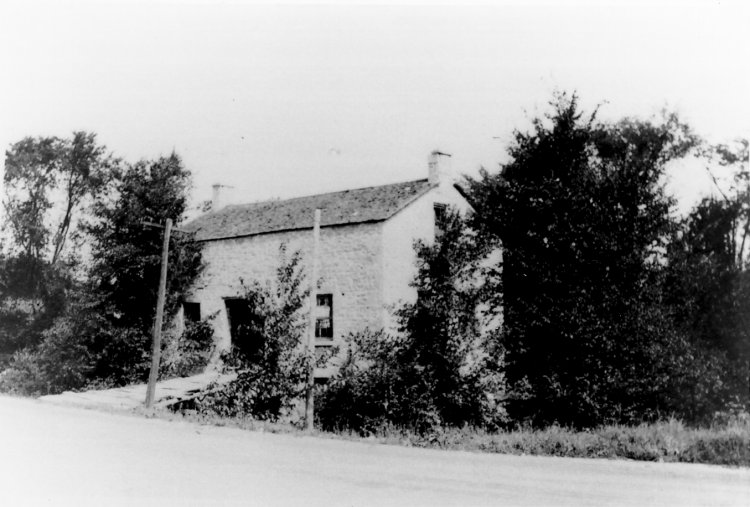
(Oatmeal mill, Eden Mills, ca. 1923; Courtesy of Guelph Public Library F38-0-15-0-0-341.)

However, by the time the TSR arrived in town, a rival mode of transportation was taking hold, that is, the automobile. At first, cars were largely expensive summer amusements for wealthy urbanites. Early car owners from town would take their vehicles for joyrides through the countryside, spooking the horses and annoying rural residents.

Some residents occasionally lashed out against these urban elites by setting traps for them in the roadways. On one occasion, Mr. Walter Harland Smith, Liberal candidate in Halton County, met with just such an improvised obstacle (Globe, 12 September 1911). He had finished addressing a meeting at Eden Mills and was driving to Campbellville for another when, just near the top of a hill near Brookville, his car crashed into a barricade of logs and stones thrown over the road. He and his two companions were ejected from their auto and badly shaken up, though not seriously injured. However, their car was completely wrecked.

It may be that this attack was directed specifically at Mr. Smith as a form of politial opposition. If so, it nonetheless employed a tactic that was also directed indiscriminately against car operators in rural areas of Ontario, and elsewhere, at the time.

(Map of Eden Mills, 1906; Courtesy of Wellington County Museum & Archives A1985.110.)

However, by the end of the Great War, car ownership had become more common, including among rural residents. One news story about an unfortunate incident following a wedding in 1919 shows that there were at least two automobiles in Eden Mills by that time (Globe, 24 October 1919):

Death came quite suddenly to-day to Frank Ramshaw, a highly-respected citizen of Eden Mills. In company with Geo. Gordon, he was returning home in a motor car from a wedding.
In another car just behind him were his son and several others, and when about three or four miles from Rockwood this car overturned and went into the ditch. The car ahead stopped, and Mr. Ramshaw got out and went to a nearby farmhouse to secure assistance. He came back only to find that everything was all right and no person hurt.
While he stood there, however, he suddenly fell forward, and almost before anyone could reach him he expired. Death was no doubt due to heart failure brought on by the excitement due to the accident. Mr. Ramshaw was about sixty-five years of age, and was well known. He leaves a wife and several children.
Increasing popularity of private automobiles decreased interest in the TSR, which ran mostly at a deficit and ceased operations in 1931. Sections of it are now operated as trails by the Guelph Hiking Club, including in the vicinity of Eden Mills. (Mill pond, Eden Mills; Courtesy of Google Street View.)

Of course, there is much more to the history of Eden Mills, which is perhaps best known today for the Eden Mills Writers Festival. Suffice it to say that, despite initial appearances and a few challenges, Eden Mills did become an attractive and lively locale.


The following works were consulted for this post:

Monday, 21 December 2020

We had a decent Xmas, 1916

The end of the year is often a good time to look back and take stock, and so it is with postcards. Consider the rather watery postcard below, received in Guelph on 22 January 1917:
The naval theme of the picture is reinforced by the information on the back, which looks like this:
To start with, the "A.S.M" publisher's mark in the centre bottom shows that the card is Italian, published by A. Scrocchi of Milan. The postmarks reveal that this card passed through London (England) on 8 January 1917, Toronto on 21 January, and arrived in Guelph the next day. The large blue circle stamp near the bottom centre says, "Passed by censor," revealing tha the card had a military origin. Military personnel sent billions of pieces of mail home from the First World War, most of which had to be cleared by military authories to ensure that they contained no information that was of strategic significance or that would injure "morale."

A look at the message on the card confirms the judgement of the censor:

Dear Sister
Just a card to let you know I am quite well. I hope you are all the same. We had a decent Xmas. Hope to hear from you soon.
Your Loving Brother
Chris
Mess 5.
The addressee was Mrs. G. Bowles whose P.O. Box was in Guelph.

A little genealogical sleuthing reveals that the addressee was Mrs. George Bowles (née Lydia Wilkins), resident of Guelph Township. Lydia was born in Great Missenden, Buckinghamshire, England in November 1888. Her father John was a platelayer, that is, a man who maintained industrial rail lines. On 6 December 1909, she married George Bowles, in St Marylebone, Westminster.

George Bowles was born in Mile End, Essex, England, in 1889. On his marriage to Lydia, his occupation was listed as footman, that is, a domestic servant. However, it seems that a life of service did not appeal to the new couple, who immigrated to Canada in 1911, settling in Guelph.

The 1911 Census lists George and Lydia as residents of 46 Nottingham street and gives George's occupation as "driller" in the employ of the Standard Valve [and Fittings] Co. The city directory suggests that the couple soon relocated to a stone cottage at 64 Albert street, before moving to Guelph Township around 1915. That is likely where they lived when Lydia received this postcard from her brother Chris. (64 Albert Street; Courtesy of Google Street View.)

The writer, Christopher Wilkins, was born in Great Missenden in 1898. Like his older sister, he was not satisfied with his fortunes there—his occupation in the 1911 census is listed as "paper boy"—and so he enlisted in the Royal Navy in 1913. His first assignments were to training vessels such as the Ganges, where his trade is give as "Boy Tel[egrapher]."

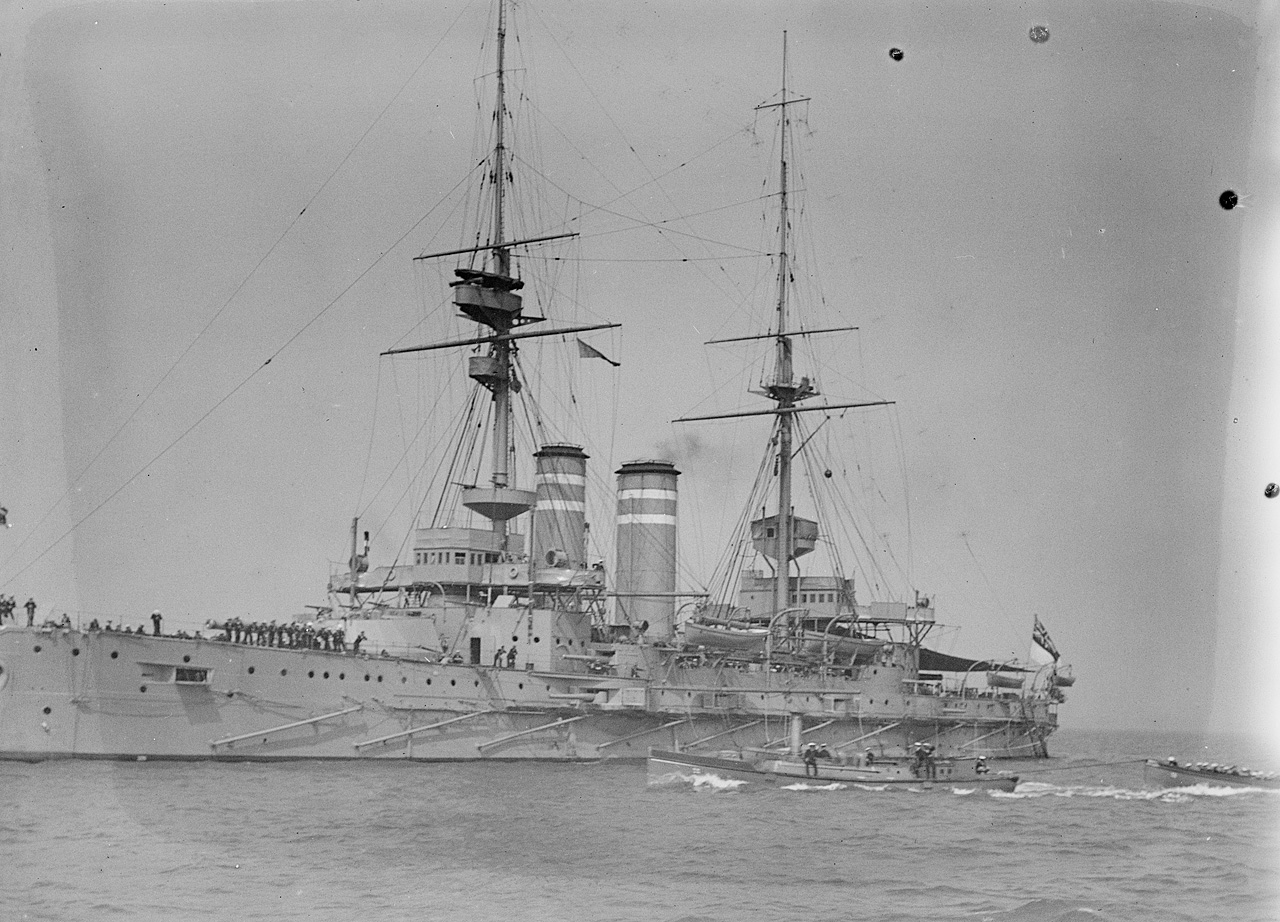
Things got more serious in 1915 when Chris was assigned to the Queen, a pre-Dreadnought battleship that participated in the Dardanelles campaign, including the Gallipoli landings.

(HMS Queen, ca. 1909; Courtesy of Wikimedia Commons.)

In August, 1915, Chris was promoted to Ordinary Telegrapher. The Queen was assigned to support the Italian navy, which explains why he was in Italy for Xmas 1916. He was promoted to Leading Telegrapher by the time he demobilized in March, 1920.

Christopher Wilkins wasted no time in seeking his fortunes abroad. He emigrated to Canada in May, 1920, headed to Toronto to join his brother Stanley, who had made the trip around 1914, intending to work as a telegraph operator. What become of him after that, I am not sure.

In Guelph, Xmas 1916 was a difficult one, as you would expect. On 5 December, the Mercury reported that seven Guelph soldiers had been reported killed in action. Privates Henry Emeny, Austin Henry Thomas, Robert S. O'Drowsky, William Macoll, Charles S. Lawrence, Frederick Willis, and Corporal George Thomas Ryder were reported either killed in action or dead as a result of wounds received in action. It was, said the headline, the "hardest blow the city has received since the outbreak of war."

An article from 9 December notes the availability of foodstuffs for Xmas cooking and compares that with the previous year. Regrettably, dates had gone up in price from 10¢/lb to 15¢/lb and gone down in quality. Something similar applied to currants, which were then imported from Australia rather than Greece, and were dearer but not as juicy. British lemon, orange, and citron peel had almost doubled in price and lard was almost impossible to get, likely because hog fat was considered a strategic good. On the up side, there had been a bumper crop of oranges, which were of good quality and cheaper than in 1915. No doubt, many young Guelphites received oranges in their Xmas stockings that year.

On 19 December came the news that George Sleeman was retiring from public life. He was well-known as a prominent, local business mogul and also for his keen interest in civic life. He was elected councillor for the South Ward in 1876 and was elected the first mayor of the City (no longer town) of Guelph in 1880. He was mayor of the city for six years in total, the last time in 1906. He was elected to the Light and Heat Commission and appointed to the Parks and Shades Commission, where he continued to serve until ill health motivated his present resignation.

(George Sleeman; Courtesy of Guelph Civic Museums 2009.32.951.)

On the bright side, Santa Claus continued to move with the times. Advertisements in the Mercury show St. Nick making use of all the modern conveniences while going about his job. For example, Bell Telepone noted on 5 December that the jolly old elf highly recommends telephones, including a second telephone in order to save running upstairs to answer the first one!

Another plus appears to be that Santa does not need a red-nosed reindeer, at least where the team can just follow the prolific telephone wires.

Another ad for G.B. Ryan & Co. from 7 December shows Santa ditching the reindeer altogether for another modern convenience, the automobile!

This is not to say that Santa had dispensed with all his magic. Early cars (and many late models) were notoriously hard to operate in the cold and snow, so that motorists tended to put them away in winter and operate sleighs instead in 1916. So, driving a car so readily over the snowy streets of the Royal City would have benefited from Santa's magic touch.

In addition, there continued to be a nostalgia for sleigh rides during the holiday season. On Xmas day, every cutter in the city was rented out so that Guelphites with some money to spare could promenade through town in proper style, with horses nodding and sleigh bells ringing (26 December).

One enterprising Guelphite took the obvious step of combining cars and sleighs. An article in the Mercury (30 December) notes:

An addition to a Ford car, which caused comment and interest yesterday afternoon, was the use of runners in place of the two font wheels. This facilitated the running of the car through the snow, and the driver was quite proud of himself.
Santa take note! I wonder if this innovative automobile looked like this:
("A Model T Souped-Up for Snow, 1920." Courtesy of Plainfield Public Libray, Photo #VV60207.)

The same day came the news that the "Prison Farm" just outside of town might be re-purposed as a recuperation and training facility for returned soldiers. In due course, the Reformatory did indeed become the Speedwell Military Hospital.

George Bowles died on 3 March 1952 and was buried in Woodlawn Cemetery. His obituary dwelled mainly on his involvement with the local chapter of the Independent Order of Odd Fellows (IOOF), of which he was elected Chief Patriarch and District Deputy Grand Patriarch in 1932.

Lydia died on 13 February 1961 and was buried next to George.

Monday, 28 March 2016

Easter in Guelph, 1920

Easter has traditionally been an important time of year in Guelph, both for religious and secular reasons. Part of its significance is that it marks the change of seasons from winter to spring. Appropriately, people often chose to get in touch with one another at this time, perhaps hoping to get together. Postcard makers issued special cards with Easter motifs to help people honor the occasion.

The card below exemplifies this tradition. It features a drawing of a cute little girl feeding a couple of bunnies with a special dropper, with the message "A Happy Easter" to make the intent completely clear. The logo in the lower-left corner identifies the printer as the Stecher Lithographic Company of Rochester, New York.


Writing on the back identifies the addressee as Miss Grace Benham of Rockwood. The message is of the typical how-are-you sort:

Dear Grace: How is all the folks at your place. hoping every one is fine. I wish you & George will come in some Saturday & spend the day. wishing you all a happy Easter. from Agnes Bennett
The cancellation mark is from Guelph on 3 April 1920. Unfortunately, there is no listing for Agnes Bennett in the contemporary Guelph city directory, so it is unclear who she is.

Easter 1920 must have been especially significant for Guelphites. The trauma of the Great War was still present but people clearly hoped for better in the coming decade.

One continuing difficulty regarding the Great War was how to put it in perspective. For its part, the Ontario Agricultural College began a funding drive to raise $100,000 to construct a building to memorialize Canadian soldiers who fought and died in the conflict (Mercury, 6 Jan.). The result was the War Memorial Hall built on the campus in 1924. The Hall commemorates Canadians who lost their lives in both World Wars. However, it is often used for happier events, including conferences and convocation.

An unpleasant reminder of the war came as a recurrence of the Spanish flu that first appeared in 1918. The strain was infamous for its lethality and the fact that it seemed especially dangerous for young and healthy people. One article in the Mercury (3 Feb.) remarked on the number of young and well-known Guelphites who had been carried off in only the previous 24 hours. These included Walter Iveson, Mrs. Frank O'Drowsky, Emma Reinhart (daughter of Rudolf and Lena Reinhart, owners of the Fountain House hotel), William McArthur, Mamie Olive Guild of Rockwood, Douglas Pettipiece, Alice Kelly, and Lavelle Germain. The latter was a Great War veteran who was in Guelph to take a vocational course at the Speedwell Hospital. Some of the things Germain had welded during his training were exhibited to the Prince of Wales on his visit to the Royal City in the previous year. Germain, who was staying at the King Edward Hotel, complained one evening that he felt unwell and asked to see a doctor. The doctor arrived to find the man only a few hours away from death.

In addition, Guelphites read with alarm stories in the Mercury about current events in Europe. In Germany, for example, the Versailles Treaty came into effect. The new Weimar Republic, which had replaced the German Empire, was required to demobilize large parts of its armed forces. Rather than submit, German marines staged a coup under Wolfgang Kapp. On 13 March, marines marched into Berlin, ominously bearing swastikas emblazoned on their helmets. The German military was largely in favor of the so-called Kapp Putsch and the Republican government fled the city.

However, resistance to the coup arose in the form of a national strike led by German labor unions. Millions of Germans left work and protested in the streets, effectively paralyzing the country. Finding their situation untenable, Kapp and the generals resigned and left Berlin and, ultimately, the country.

Feeling that their time had come, socialist and communist strikers in the German industrial heartland of the Ruhr turned their resistance into a coup of their own. The so-called Ruhr Uprising attempted to install a "dictatorship of the proletariat", supported by the self-organized Red Ruhr Army. In April, the uprising was brutally suppressed by the German army and paramilitary forces. As the presence of the German army was against the Versailles Treaty, French and British forces occupied several western German cities. Happily, German troops backed off and no shots were fired between them.

The situation in Eastern Europe was even more chaotic. Nationalist and communist forces fought for control of territories in the former Austrian and Russian empires. Guelphites were likely concerned about the advances of the Soviet Red Army against the White Russian forces in the Ukraine during the Russian Civil War and were glad that the Canadian Siberian Expeditionary Force had returned from Vladivostok the previous year.

However, the international news was not all grim. For example, the League of Nations was brought into being on 16 January 1920 as a part of the Versailles Treaty. The League consisted of a General Assembly, a Council of the great powers, a Permanent Court of Justice, and the International Labor Organization (which still exists). One of the main aims of the League was to establish an effective alternative to warfare in international relations, in the hope of preventing another world conflict. Over the years, it met with some success in resolving border disputes but, of course, failed to prevent the occurrence of a second World War.

Locally, Guelph was still finding its way to a new normal for peacetime. In his inaugural speech to the City Council, Mayor Henry Westoby described his plans for the Royal City in 1920 (Mercury, 20 Jan.). They included renovation of the water supply system and storm sewers, renewed street paving to smooth the path for the city's increasing population of cars, support for the proposal to allow the Ontario Hydro utility to take over the city's streetcar system (accomplished in 1922), adoption of Daylight Saving Time, and construction of a public swimming pool.

Although no pool was built that year, a new ice rink was opened on 7 February (Mercury, 9 Feb.). The rink stood at the corner of Cambridge (now Commercial) Street and Norfolk, where the Royal Plaza now stands. Over a thousand people lined up to enjoy the opening ceremonies and events, which were filmed for a "moving picture" show. The opening event was a game between two teams of women's "hockeyists", one from the Guelph Collegiate Institute and the other from "White's," perhaps referring the Colonial Whitewear Company on Northumberland Street, which had many female employees. The reporter praised the teams for their vigorous play, which included many "stiff" bodychecks. The crowd was also amused at how the women, who were used to playing broom ball, handled their hockey sticks. The game was very competitive and the final result, after two periods of play, was a 3–1 victory for the GCI girls.

The women's game was followed by two matches between men's teams. In the first game, a team from the Guelph Carpet Mills Co. on Neeve Street played to a 0–0 tie with a team from the Partridge Rubber Co. on Clark Street (now Ferguson). In the second match, a junior all-star team from Toronto edged a junior all-star team from Guelph by a score of 6–5. The Mercury reporter thought that the events of the new arena's first evening augured a bright future for the facility.

The Priory, the first building constructed in the city, continued to fall into disrepair after it had been decommissioned as the city's C.P.R. train station in 1911. During a visit to the Royal City, eminent horticulturalist Dr. F.C. Bennett (any relation to Agnes Bennett?) was shocked to discover that such a historic structure had been left to fall into ruin (4 March):

Mr. Bennett was astonished to think that such a land mark of the city was being left to go to waste, and at a meeting of the Horticultural Society held last evening he proposed that the Society take the building over and fit it up as a permanent home for the local horticulturalists. His idea was to leave the old building on the property where it now stands, and put it in a good state of repair, and also that a great deal be gone to the grounds surrounding by planting flowers, shrubs and other improvements that would add to the general appearance of a picturesque home.
George Sleeman, former Mayor and the building's owner, was in favor of the plan. Unfortunately, it never bore fruit.

At the end of March it was learned that Canadian actress, and "America's sweetheart", Mary Pickford had married Hollywood heartthrob Douglas Fairbanks (Mercury, 1 April). She and Fairbanks, along with Charlie Chaplin, had just formed the independent production company United Artists. Pollyanna, her first movie with the new company, was a big hit in early 1920. It established Pickford's popular "little girl" persona and also the term "Pollyanna" for someone who is naively optimistic about life, based on "The Glad Game" portrayed in the movie in which players must describe things they are grateful for, even though they may be miserable.

You can get sense of the movie from this scene between Pollyanna and her dying father at its outset:


If you are intrigued, then feel free to watch the whole thing (courtesy of Wikimedia Commons)!


Pickford was undoubtedly grateful for the divorce from her first husband, Owen Moore, who had became an abusive alcoholic. She must have been keen on a new beginning since she acquiesced to Owen's demand for a $100,000 settlement. Pickford's marriage to Fairbanks probably caused tongues to wag in the Royal City, coming as it did only days after the divorce.

Guelph also began to deal with implications of the ascent of the automobile, renewed with vigor since the end of the war. The Mercury's editor (25 May) noted that there were a number of incidents in which cars hit children who were crossing or playing in the streets. Streets had always been used as places to play by young Guelphites but the increasing number and velocity of cars meant that this practice was becoming rather dangerous. The editor blamed parents of the children in question, arguing that it was not fair to motorists that naive children should be allowed to play in the streets and retard traffic. He suggested that the city should construct more playgrounds and that parents should see to it that children restrict their fun to designated play areas.

As Easter approached, store owners urged customers to impress their lady friends with—what else?—chocolate! Here is an ad in the Mercury from the pharmacy of Bogardus and Barton (5 April).


Easter itself fell on 4 April in 1920. The Mercury noted that the weather was uninviting, featuring a cold east wind and "sharp cutting snow" (5 April). Nevertheless, Guelph's churches were ready:

All the churches of the city were ready for the occasion with a profusion of flowers adorning chancel, pulpit and platform, all being significant of the new life that marks the passing of the winter of death, ushering in a season of joy and gladness and a hope for the good and the beautiful in life.
The article duly summarized the service in each of the City's main churches. All featured hymns, Easter lillies and recounting of the resurrection story. Reverend George Little of Chalmers Church (now Royal City Church) also took issue with doubters who looked to science or spiritualism for the truth about the afterlife. At Norfolk Street Methodist (now Lakeside Downtown), Mrs. Cook gave a talk entitled "Mission work in Japan." The Mercury reported that, despite the adverse weather, services in morning, afternoon, and evening were well attended.

In view of daunting events in recent history, it may be that Guelphites were looking extra hard for some Easter optimism as the 1920s began.

Monday, 30 November 2015

St. George's Square centre gets split in half

On 28 March 1922, the citizens of Guelph voted to make a significant change at the centre of town. The garden (or "island") that had stood in the middle of St. George's Square was to be split in half. The Blacksmith Fountain had stood in the centre of the Square, surrounded by a small patch of grass and flowers, since 1885. The people of Guelph had been keen to make a splashy gesture in the heart of town, and the fountain filled the bill. The original streetcar tracks diverted to either side of it when they were first installed in 1895. The garden area had even been enlarged for the Old Home Week celebration held in 1908.

Here is a postcard view of St. George's Square as seen from the south, from a photo taken around 1913. It was printed by The Valentine & Sons Publishing Co., Ltd. Montreal and Toronto. Note the new, larger "Prairie" cars on either side the Fountain, with the older open car in the back. It must have been a nice day since the open cars were then used only during good weather.


Amid the bustle of downtown Guelph, the fountain and its garden had been a fixed point, a focus around which all business of the central city revolved. Now that was set to change. What happened?

Impetus for the change in the centre of the Royal City came from Hydro. The City sold the Guelph Radial Railway (the streetcar) to the Ontario Hydro Commission in 1921 for $150,000 and kicked in a debenture of $300,000 for its repair ("Streetcars in Guelph", Thorning 1982). For most of its history, the streetcar had run at a loss. Inflation during the Great War had put upward pressure on salaries while fares were kept low to facilitate ridership. In addition, the system suffered from many years of deferred maintenance. The rails and rail beds were too light for new models of streetcars, and its electrical system was not organized efficiently. Breakdowns and even minor derailments were becoming problematic. Although the service was popular, it was becoming a political albatross for City Council. Selling it off became a political necessity.

Two suitors came calling. The Canadian Pacific Railway offered to purchase and upgrade the lines as an addition to its own holdings. The Ontario Hydro Commission also wanted to purchase the system and add it to a proposed network of intercity trains (rather like the later GO Transit system) in Southern Ontario. In the end, the citizens of Guelph voted down a sale to the C.P.R., leaving Hydro in possession of the prize.

As soon as the sale was complete, Hydro officials and engineers came to the Royal City to plan a total overhaul of the network. One of their recommendations was to have the tracks run straight through the centre of St. George's Square. This measure would simplify reconstruction of the system downtown, making it cheaper to build and run.

Guelphites seemed generally happy to let Hydro revamp the system and improve service. Yet, digging up the garden in St. George's Square proved to be a sticking point. Initially, the Railways and Manufacturers Committee of City Council recommended the change. However, resistance appeared when the matter was raised in a full Council meeting on 16 January 1922 (Evening Mercury, 17 Jan. 1922). For one thing, legal eagles differed over whether or not the city had the power to allow such a usage for the land. The issue was laid out in a letter to Council written by Mr. Patrick Kerwin (of the law firm Guthrie and Kerwin, and future Chief of the Supreme Court of Canada). In the letter, published in the Evening Mercury, Kerwin notes that the City bought the land in question from Dr. William Clarke in 1873. One condition of sale went as follows:

Whereas the said William Clarke has agreed to sell and the said Corporation of the Town of Guelph to purchase, the lands and premises hereinafter described for the purpose of a public garden in the said Town of Guelph, and for the improvement of Wyndham and Quebec streets in the said Town.
The bylaw (No. 230) by which the City officially acquired the land also stipulated a garden in its first clause:
That a freehold estate be acquired for the Corporation of the Town of Guelph in the County of Wellington in the said lands for the purpose of a public garden and for the improvement of Wyndham and Quebec streets in the Town of Guelph.
Few would consider a set of streetcar tracks a public garden, so Hydro's proposal would seem to be in violation of the bylaw and the City's undertaking when it bought the land.

However, Kerwin pointed out, the City's agreement with Hydro gave the Power Commission the right to run tracks through any city property on streets already serviced by the streetcar system. Kerwin argued that the City could simply pass a bylaw that closed the garden and added it to the roadway, thus making it fall under the agreement with Hydro.

Mr. Charles Dunbar, a local barrister and solicitor, wrote a letter to Council, also published in the Mercury, giving a different view. He simply warned that the City had no power to allow a different use for the garden and that unnamed citizens had instructed him to sue the City in the event that it should try to do so.

Naturally, a spirited debate ensued in the Council Chamber. Alderman Mahoney suggested that the City take no action. Then, if Hydro chose to tear down the garden and install trackage, they would face the legal consequences instead of the City facing them.

Opponents of the change pointed out that the citizens of Guelph had just voted against installing a war memorial in the middle of St. George's Square, preferring Exhibition Park for its location. (It was finally built in 1927 in Trafalgar Square.) Alderman Drew interpreted this vote to mean that the citizenry would also oppose running the streetcar through the middle of the Square. Aldermen Oakes and Yeates argued that the Square would remain a "beauty spot" only if it retained the garden in the middle.

Alderman McElroy, a proponent of the Hydro plan, raised the estimate from the Hydro engineers that laying tracks through the centre of the Square instead of around it would save $25,000, a substantial amount. Alderman Barlow added that he thought that the aesthetics of the Square would be enhanced if the streetcar ran through its centre. (The Hydro plan included green space on either side of the tracks.) He also said that voters had rejected the site for the war memorial precisely in order to give Hydro the opportunity to use it for the railway. Alderman Penfold reported a figure from the Hydro engineers saying that running the streetcar through the middle of the Square instead of around it would save $500 per month in operating costs. Alderman Baldwin replied that, since the report of the Railways and Manufacturers Committee lacked specific figures and calculations, the financial aspects of the scheme were rather indefinite.

In the end, the Council voted to send the report back to the Railways and Manufacturers Committee for reconsideration. On 2 February, the Committee met and made the same recommendation as before, namely that Hydro should run its tracks through the middle of the Square, with the City's blessing (3 Feb. 1922; Evening Mercury). The matter therefore returned to Council on 6 February. There followed a spirited discussion covering essentially the same ground and proving equally conclusive (7 Feb. 1922; Evening Mercury). In the end, the Council voted 9 to 7 to send the matter to a plebiscite.

On 28 March 1922, the plebiscite was held on the following question (28 March 1922; Evening Mercury):

Are you in favor of the Council permitting the Hydro Power Commission of Ontario to construct the tracks of the Guelph Radial Railway Company through St. George’s Square, and to re-arrange the said Square in accordance with Hydro Plan 502-71?
The vote went "Yes...873" and "No...484", a decisive majority (though a low turnout for an electorate of 5,035). Mayor Howard declared himself pleased with the result, saying that it was "a step in the right direction" for Guelph. Ex-Mayor Carter said that, although he was opposed to the plan, he was satisfied that the electorate had spoken and so the plan should go ahead.

The work began on 5 September with the removal of the electric lighting from the Square's centre (6 Sep. 1922; Evening Mercury). A few days later, the Blacksmith Fountain was removed and set aside with the intention of placing it in one of the grass plots to be installed on either side of the new tracks (9 Sep. 1922; Evening Mercury). Then, the Parks and Buildings Committee of City Council recommended that the Fountain be moved to a new location, preferably Priory Park (28 Sep. 1922; Evening Mercury). The reason for this recommendation was not noted but it was reported the next day that the Hydro crew had suggested that the grass plots in the Square be made smaller than planned. Perhaps removal of the Fountain was intended to support this suggestion. In any event, City Council agreed to the relocation of the Fountain but insisted that the grass plots in the Square remain at the size specified in plan 502-71 (4 Oct. 1922; Evening Mercury). The next evening, the streetcars began to move over the new tracks in the middle of the Square.

The unexpected removal of the Blacksmith Fountain occasioned some regret (5 Oct. 1922; Acton Free Press):

In a rather pathetic editorial the Guelph Herald referred in feeling terms last Saturday to the removal of the iron figure of the sturdy blacksmith which surmounted the fountain on St. George’s Square. This splendid figure, presented to the city by the Armstrong Carriage Company in their palmy days, has occupied the prominent site in the centre of St. George’s Square nearly ever since the old church was removed—forty years or more ago. The demand for a straight street car line through the Square necessitated the removal of this landmark. It will be missed by many who are not residents of the Royal City.
In place of the symbol of industry, Guelph had a central transit station.

The transformation of the Square did not end without a little more drama. Some local motorists evidently objected to the extent of the gardens planned for either side of the central tracks. Hydro workers, who had ripped up the area under the gardens in order to lay concrete beds for them downed tools until the matter was resolved (1 Nov. 1922; Evening Mercury). The next Council meeting featured a long and passionate argument among Aldermen as to whether or not the garden plots should be shrunk according to Hydro's wishes. The Council debated the following resolution:

That this Council approve of the Hydro-Electric Commission reducing the open space now existing at St. George’s Square by ten feet on each side.
On the "no" side, Alderman Burgess said that the Council would look like "a lot of school boys" if they reversed their earlier decision in spite of the situation not having changed. He also maintained that the Council had no right to alter the plan since it had been approved in a plebiscite. Alderman Drew argued that Council should leave the situation alone since it could be easily changed later if that seemed advisable. If no alteration were needed, then the Council would have saved itself the difference in construction costs.

On the "yes" side, Alderman Jaffray argued that the large gardens would be an undue danger to traffic. The argument is not spelled out but the idea seems to have been that the large gardens would squeeze traffic into smaller space in the Square, thus increasing congestion. Assuming that congestion is dangerous, then large gardens would increase risk of collisions for drivers. On the matter of cost, Alderman Evans said that the extra construction cost arising from reducing the gardens would be well worth the saving of danger to life and limb.

The resolution finally came to a vote. The Alderman tied 8–8, so Mayor Howard cast the deciding vote in favor: The gardens would each be 10 feet (3m) narrower. Interestingly, Alderman Wing later told the Council that he had been confused during the vote: voting for the resolution when he meant to vote against it (11 Nov. 1922; Evening Mercury). He wanted to revisit the resolution during the next Council meeting. Hydro officials did not wait for another possible reversal of policy. On 11 November, workmen began tearing out the old curbs and pouring cement for the new ones for the smaller design (13 Nov. 1922; Evening Mercury). The new layout became a cement accompli and was not revisited by Council.

Sod was laid for the new, smaller gardens and flower bulbs planted to rise the next year (1 Dec. 1922; Evening Mercury). Work was completed by 7 December, all but for paving of the bare roadbed left by removal of the surface torn up to shrink the gardens. After much debate, Guelph had its new island in the Square.

The new setup can be seen the postcard below, printed by The Valentine & Sons United Publishing Co., Ltd., Toronto, from a photo taken around 1925. Note that, in spite of the increased presence of cars on the street, Guelphites still walked and sat in the roadway.


Despite missing the Blacksmith Fountain, Guelphites seemed pleased with new setup. The new, rationalized street railway represented progress although it did not, in the end, save the city from the cost of running it at a loss. Portentously, a number of motor busses were hired to "help out" with the people-moving duties while the street car system was under renovation (1 Apr. 1922; Evening Mercury):

Two of three busses owned by Messrs. McElroy and Daly, were very kindly loaned to Manager House of the local street railway this morning, when it became known that the suspension of Hydro power would be indefinite. The busses were immediately put into commission as “Street Cars”, and are being operated today on the Elora Road–York Road and O.A.C.–Suffolk street lines.
Busses were run as "street cars" on each line as it was rebuilt. Even as the day of the new street railway system dawned, its eclipse began.


The redesign of the centre of St. George's Square suggests a number of things about how Guelphites of the day viewed their city. Sale of the streetcar to Hydro over the C.P.R. suggests that citizens viewed the service more like a utility than a private enterprise. Its sale to a public utility may also explain the broad willingness to let Hydro lay tracks through middle of the Square. Although some people saw the move as an abuse of a public space, many evidently saw the new use as compatible with the established understanding of it.

The change in St. George's Square also illustrates how Guelph faced challenges brought on by the increasing presence of automobiles on the streets of the Royal City. Although only a minority of Guelph families had cars at the time, owning a car was becoming a common aspiration. Many residents looked forward to the day when they could breeze through the city in their cars and wanted a streetscape that reflected that aspiration. This may explain the successful pressure that some citizens brought to bear on Council to shrink the garden plots in the new layout.

Besides the redesign of the Square, there was a proposal to turn the middle of Macdonnell Street into a parking lot in order to augment curbside parking (8 Nov. 1922; Evening Mercury). The scheme was not adopted but it suggests the enthusiasm for cars among Guelphites and a brewing conflict over how best to use the downtown streets.

The time is fast approaching when St. George's Square may be redesigned again. A new proposal includes a traffic circle, reminiscent of its old configuration. It will be interesting to see how the process and results today compare with those of the past.

Tuesday, 6 August 2013

Old Home Week, 1913 - the event

As noted in my previous posting, Guelphites had planned for a big bash at the end of July, 1913. It seems that their wish was granted. Many visitors came by railway, which offered special fares, and by car. The Mercury on July 28 reported on the throngs disgorged into the city by the railways, bringing home the "old boys" and choking the length of Wyndham St. "with a seething mass of humanity."

The paper also compliments the city for its festive accoutrements:

The decorations were beautiful, and when the lights were turned on at 8.30 the vari-colored bulbs, flags, pennants and bunting presented a magnificent vista of color.
A special shout-out goes to the Mahoney's, who had a plumbing business on Quebec St., for their enormous Union Jack studded with coloured lights.

The evening was capped off with a concert from the Guelph Musical Society's Band and the Philharmonic Chorus at Exhibition Park. In addition, there were speeches from numerous important personages, which were entertaining even though perhaps inaudible:

The average speaker has not the sonorous vocal outfit to be a successful outdoor orator, and it may be amusing, although not exactly entertaining, to see the gestures, but hear no words. At any rate, the old boys and girls will now take it for granted that they are welcomed.

The program acquainted the public with the fun on tap:

During the entire week various kinds of attractions and amusements will be provided by the Committee, such as Side Shows, Animal Shows, Electrical Devices, Wax Works, Moving Pictures Shows, Ferris Wheels, Merry-go-Rounds and Galloping Horses, and everything in the amusement line that can be procured, and the Committee wish to assure the public that there will be nothing allowed that could offend the most fastidious.
In addition, there would be plenty of parades, sporting events, and musical performances.

Of course, it would not be a real party if it could not offend the most fastidious. In fact, the Mercury reports some licentious behaviour the very next day:

Many of those who attended the carnival five years ago [Old Home Week 1908] were wise in their generation, and knew what to expect. They wore their old duds. But of the others who did not know what was ahead of them—many of them had their best clothes ruined by talcum powder. The crowd ran riot, and girls and young ladies were openly seized and kissed on the street; hats were knocked off, and kicked about by the swirling crowd, and the air was full of talcum powder and confetti.
An editorial in the paper bemoaned this bacchanal on the Speed, urging police to put a stop to it, and assuring readers of "the chief offenders being the non-English speaking element." The Mercury on August 5 notes that an Italian, George Longo, pled guilty to a charge of "disorderly conduct" on Wyndham St. during Old Home Week. Was he the "non-English speaking element"?

Things seems to settle down by July 31, when the Mercury makes the following report:

There was no throwing of talcum or flour, and very little confetti showered about, the orders in that respect being well observed. "Ticklers" [paper tubes rolled into a coil that unroll and make a horn sound when blown into] were in evidence; and the vendors reaped a rich harvest, disposing of thousands of the "fun makers" as they called them.
However, the air was still thick with sexual tension:
The crowd was out for a big time, and they apparently had it, as the streets resounded with laughter, as arm in arm the boys and girls, young men and young women, promenaded the streets. Cordons were formed, and woe betide the girl that was caught in the charmed circle. Before she got out she was forced to pay toll.
This behaviour seems not to draw any reproach from the Mercury. Perhaps this suggests how the mores of Edwardian Guelph were different than the Victorian city.

Several issues of the Mercury from that week are missing, so it is hard to know which events drew the most notice. However, some items seem to stand out. First, there was a contest for best decoration, to be judged by the Committee. Many decorators, it seems, had incorporated electric lighting as an important component of their displays. The Committee seemed not to have anticipated this approach (July 31):

As the competition was for the best "decorated," not the best "decorated and illuminated" home, the judges could not take into account the electrical effect...
Thus, the Mahoney's, with their oversized and light-studded Union Jack, won only second prize. Today, decorating with lights is the norm, certainly for events such as Halloween and Christmas. In 1913, it seems, electrical decorations were still quite a novelty.

Another event worthy of note was the appearance on July 29 of Carlstrom, the "Swedish Bird Man" and his amazing Blériot aeroplane. This pilot was Victor Carlstrom, a Swedish-American aviator who was on a tour of southwestern Ontario at the time (Globe, July 25, 1913). Both he and his plane arrived in town by train. Carlstrom immediately set out to fly the plane at Exhibition Park. Unfortunately, the engine would not start and the Bird Man remained on the ground.

However, things worked out better on July 30. The Mercury of July 31 gives the following, breathless account:

With wings spread like a soaring eagle, Carlstrom, the bird man, sped over the city yesterday afternoon in his new Bleriot aeroplane. Rising from the ground at Exhibition Park, the daring aviator mounted to an elevation of a quarter of a mile, and swinging in a graceful circle, till he got his bearings, flew in a south-easterly direction.
The machine, propelled by a powerful seventy-five horse power engine, passed over Trafalgar Square, the people being made aware of the gasoline engine, which could be distinctly heard.
As the airship crossed the river and circled to the north, it was so high up that the airman at the wheel, who guided it in its evolutions, could not be seen. As it turned to the south, it dipped, and as it sped on a line, as the crow flies, on the return trip to Exhibition Park, it was much nearer to the house tops, and the aviator could be plainly seen guiding the machine.
It is not clear which Blériot model Carlson was flying, but it might have been the model XI that Blériot flew over the English Channel in 1909.

(Courtesy of Wikimedia commons)

The program states that Carlstrom's flight was the first in the City and, probably, first in the experience of most of its citizens. It must have been thrilling.

Also on the new technology front was the Grand automobile parade from the City Hall to Exhibition Park. The parade was to include "all motor cars belonging to the city of Guelph and those visiting". Unfortunately, no account of the parade survives in the Mercury. However, the idea can be better appreciated if you imagine putting on today a parade of all cars belonging to the city and to every visitor. Clearly, the automobile was still something of a novelty in town.

A couple of incidents also illustrated the problems that cars would bring. On the first evening, a celebrant named Reg Hoile (sp?), an employee of the Herald, was dazzled by a sparkler in the face and stumbled from the sidewalk in front of G. B. Ryan's dry goods store on Wyndham. There he was struck by a passing car and suffered several cuts and a sprained ankle. The August 2 issue of the Mercury wraps up its coverage of Old Home Week by noting another auto accident (among other things). On this occasion, Walter Benjamin, "a colored man", was knocked down by the Wellington Hotel bus as he tried to cross the street in front of the Post Office.

Of course, cars did not cause all the injuries that week. A woman was knocked down by the horse-drawn ambulance, for example, on the opening night. However, these collisions suggest the coming tensions between motorists and other, established users of the roadways.

By the end of the week, the Old Boys and their reunion were winding down. An article in the Mercury (August 2) notes that the crowds were dwindling, as was their enthusiasm. Perhaps the last bit of excitement was a burst pipe (apparently the second) in Exhibition Park the previous day: "... although it made rather a pretty improvised fountain, it did no damage."

On the whole, the event was considered a great success. Postcards sent from attendees of Old Home Week echo the this evaluation. One postcard (featuring the Carnegie Library on the front), gave this report:

Dear Auntie. Received that piece yesterday. You ought to have come to Guelph. We had a great time there. It was awful noisy though. Thank you very much for sending that piece. While we were at Guelph we went all to see the college. Love to all, Georg
It was postmarked on July 31 and sent to Miss E. J. Matheson, then resident in Detroit.

It seems that Old Home Week in Guelph, 1913, had it all: Noise, lights, cars, planes, talcum powder, and stolen kisses. Although the residents may have been looking forward to another one soon, the next Old Home Week would not occur until the city's centenary in 1927.