Showing posts with label Hugh Guthrie. Show all posts

Monday, 29 August 2022

A church off the old block: The origin of Chalmers Church

From the perspective of postcard collecting, the main issue relating to Chalmers Church in Guelph (now the Royal City Mission Church) is the rarity of postcards featuring views of it. The card below is the only one that I have yet come across.
("Chalmers Church, Guelph." Courtesy of the John Keleher collection. Publisher unknown.)

Comparison with a recent Google Streetview image shows that the exterior of the church has not changed a great deal since the postcard picture was taken sometime in the early 20th century.
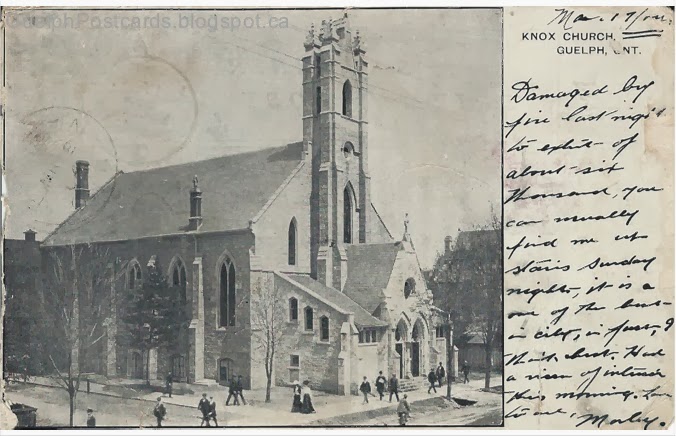
Stone churches were a highly collectable category of picture postcard back in the day and the Chalmers Church was no slouch in the aesthetics department. Furthermore, the Knox Church just down the block was represented on a number of postcards.
(From "Knox Church fire of 1904.")

Like Knox, Chalmers was also a Presbyterian Church, a mainstream denomination that any city like Guelph would boast of. So, why Knox would be prominently featured while Chalmers was the Royal City's secret remains a head-scratcher.

Interestingly, Chalmers Church owes its existence to Knox Church. The first Knox Church edifice on Yarmouth Street was sold to the Raymond Sewing Machine company when it expanded its shop along that street. The congregation built itself a smart new home around the corner on Quebec Street, where the cornerstone was laid in October, 1868.

(The first Knox Presbyterian church on Yarmouth Street, to the right of the Raymond Sewing Machine factory, ca. 1870. Courtesy of Guelph Civic Museums, Grundy 249.)

By the early months of the following year, a sizeable portion of the congregation was looking to break away! Official histories are somewhat mum on the reason. C.A. Burrows (1877), in his Annals of the Town of Guelph, says only that there was an "unhappy divison" within the congregation, while Smith (1955, p. 96) says that some members were "at variance" with the minister, W.S. Ball.

(Rev. W.S. Ball, ca. 1880. Courtesy of Guelph Civic Museums 1997.21.2.)

Perhaps my favourite perspective is that of George B. Anderson, who reminisced about the incident, which occured when he was a boy (Mercury, 20 July 1927):

About the time I came to Guelph to live we all went to Knox Church. Knox Church was a barn-like structure on Yarmouth Street, a diagonal street running from Norfolk Street to Woolwich. There is, or was, a sewing machine factory on the site of the church. But two factions sprung up, over some question I could never quite understand what it was all about. However, the Chalmers Church faction broke away and worshipped in the Court House for some time, until the present church was built.
Luckily, issues of the Evening Mercury from 1868 survive and provide some details. As noted by Smith, the matter turned on some acrimony regarding Rev. Ball, to whom some parishoners took great exception (17 April):
Knox’s church, Guelph.—The Presbyterial investigation of charges preferred against the Rev. W.S. Ball by members of his congregation, which began on Tuesday evening, closed on Thursday afternoon. The decision of the Presbytery will be read to the congregation on Sunday first by the Rev. Mr. Smellie, of Fergus, who has been appointed to preach on that day.
The resolution adopted by the Presbytery as a result of their investigation was printed subsequently (Mercury, 20 April). To make a long story short, the resolution focusses on a few specifics. It notes that Rev. Ball continued to enjoy the support of many members of the church. However, some members had impugned his "pulpit abilities" and his spread gossip about his "moral character." Access to Sabbath School and pew rentals also seem to have underwhelmed some congregants. In fairness, the Presbytery found that Rev. Ball had addressed the situation using "imprudent language," thus feeding the fire afflicting the congregation.

It is hard to know exactly what to make of these points. However, the mention of pew rents is interesting. It was a custom brought from the old country that pews were rented to congregants. The best pews were at the very front and were rented to the wealthiest and most prominent families. Rents got cheaper the closer to the back they sat, while some at the very back were freely available to strangers and indigents.

Rents were not very expensive but were an important source of income for churches. Collecting pew rents, which were frequently in arrears, was a regular headache for the pastors of churches where rents were applied.

Of course, since the location of a family's pews was a signficant signal of social status, they could also be a source of social dispute. Since the Knox congregation had recently moved into a new building and thus had to negotiate pew rentals for everyone, it may well be that some members of the congregation took exception to their new arrangement, to which Rev. Ball may have responded with impatience.

Doubtless, the situation was complicated and particular to local circumstances. As Tolstoy wrote, “All happy families are alike; each unhappy family is unhappy in its own way.”

In any event, attempts at reconciliataion proved fruitless and a segment of the Knox Congregation applied to the Presbytery to form its own group named Chalmers Church, in honour of Thomas Chalmers, a luminary of the Free Church of Scotland. This petition was granted and the group began to hold services in the city Court House while making plans to establish its own place of worship.

(An ad from the Guelph Mercury, 24 July 1868, for the first meeting of the Chalmers church in the Court House.)

The founders' plans went well. In September of 1869, Rev. Thomas Wardrope of Knox Church, Ottawa, agreed to become minister of the new church. The cornerstone of the new building was officially laid by Rev. D.H. MacVicar, Principal of Montreal College, on 22 June 1870, and services began there in December of the following year.

("Laying Cornerstone—Chalmers United Church 1870." Courtesy of Guelph Civic Museums 1970.39.17. In the background on St. George's Square, note the original Wellington Hotel on the left, the old Bank of Montreal building in the centre, and the rear of the second St. George's Anglican church on the right.)

Leaders of the new church spared no expense in setting themselves up. They hired Toronto architect Henry Langley, "the undisputed dean of ecclesiastical architecture in Ontario during the last half of the 19th century." The Board of Managers were quite specific that they wanted a church in the latest taste, modeled on the Knox Church of Montreal, though on a smaller scale. Langley certainly delivered! The church cost a total of $25,000, a considerable amount for a new congregation.

(Henry Langley. Courtesty Wikipedia.)

Gilbert Stelter (1989) makes the following point about the relation of Chalmers Church to Knox Church down the block:

The choice of a site for the new church seems almost provocative, for it was almost next door on the same downtown street (Quebec) as Knox Church, from which they had split. And the use of a relatively sophisticated Gothic design must have been calculated to look more impressive than the very simple Gothic of Knox's new building, designed by James Smith of Toronto a year earlier. Knox Church was essentially a rectangular box ornamented only with plain pointed windows. Chalmers, however, was described as "the best constructed and the most elegantly furnished church in town" when it opened for services in 1871.
The building was also distinguished by the fact that it constructed of imported gray limestone rather than the plentiful, warm local material. No doubt, this measure also serveed to distinguish the church from Knox church.
("Knox Presbyterian Church, 1871." Courtesy of Guelph Civic Museums, Grundy 63.)

The congregtation grew during the Victorian era and the church was altered and expanded to meet additional demands for space. A substantial renovation was completed in 1896. Designed by the original architect, Henry Langley, the shingles on the roof were replaced by slate and a series of dormer windows were added as well. Each row on either side of the roof could be opened at once with a hand crank. The ventilation thus achieved served as an early form of air conditioning.

A new gallery was added around the main auditorium, which could seat 320 people, bringing the total capacity to 850 persons. In a pinch, partitions between the vestibule and the auditorium could be lowered mechanically and 200 seats added to the vestibule also, meaning that the church could hold over 1,000 souls.

A point of particular pride was that the lighting of the church was converted to electricity. A review in the Mercury (23 September 1896) speaks most highly of the two main electroliers suspended in the auditorium. (In fact, many of the fixtures were hybrids that combined incandescent lighting with gas, as a precaution in case the power went out, which was not so unusual in that era.)

The total cost of these renovations was $6,050, a considerable outlay.

Perhaps the most interesting alteration in that era was the purchase and installation of a pipe organ in 1890. Today, organ music and singing in church services is de rigeur but it was not so when Chalmers Church was founded. Until 1873, singing in Prebyterian church was "lined", that is, a leader or "precentor" read a line from a Psalm and the congregation sang it back. A tuning fork was sometimes deployed to assist everyone in hitting the appropriate pitch.

In 1867, just before Chalmers Church was founded, Knox Presbyterian Church in Montreal created a brouhaha by including organ music in its services. The issue of whether or not instrumental music was kosher for its churches was referred to the national Synod. This body made no decision, thus effectively leaving the matter to each Presbytery to decide for itself.

An "interesting discussion" was held on the matter in the Guelph Presbytery (Mercury, 15 January 1868), which voted down the idea. Even so, services gradually became more musical. Chalmers' first choir was formed in 1871. Hymn singing was introduced to service a few years following. The organ question was revisited again in 1884 and rejected in a vote of the congregation.

Finally, installation and use of an organ was approved in 1890. It may have helped that Knox Church had approved the use of an organ in 1887. True to form, the new organ was a top-of-the-line instrument featuring 900 pipes in all, powered hydraulically by connection with the city waterworks. Considerable renovations were required to accommodate it (Mercury, 8 September 1890).

("Chalmers Church, ca. 1890." Courtesy of Guelph Civic Museums, 1975.21.21.)

While Chalmers and Knox churches remained social rivals the actual division between their congregations was neither profound nor long-lasting. At the time Chalmers Church was formed, there were four different Presbyterian groups in Canada. These had been engaged in negotiations for a union for some time, a project that resulted in the amalgamation of all four into the Presbyterian Church in Canada in 1875. Thus, Chalmers and Knox congregations became equal members of a single, national body.

Chalmers Church became Chalmers United Church when the the United Church of Canada was formed in 1925.

In his reminiscences, Geo. B. Anderson notes that many of the great and good of the Royal City were members of Chalmers Church in its early days:

  • Peter Gow, who ran a tannery business where Gow's bridge now lies, was twice Mayor, Guelph's first M.P.P. after confederation, and held the post of Provincial Secretary. He assumed the office of County Sheriff upon his retirement in 1876.
  • David Stirton, who owned a farm in Puslinch near town, was elected as the Member for the Legislative Assembly of the Province of Canada (1858–1867) and then Member of Parliament (1867–1876), after which point he retired to Guelph and assumed the office of Postmaster.
  • Donald Guthrie, a local lawyer, succeeded Stirton as M.P. for Wellington South (1876–1882), and then served as M.P.P. in the same area (1886–1894).
  • James Innes was for 36 years an editor and publisher of the Guelph Mercury.
  • Hugh Guthrie, son of Donald Guthrie, was also a local lawyer who had a long and eminent career as M.P. for Wellington South (1900–1935) during which time he held many high offices.
So, whatever it lacked in postcard representations, Chalmers Church was an eniment fixture in the culture and landscape of Victorian Guelph and, happily, continues to adorn Quebec street to this day.
Works consulted include:

Friday, 4 May 2018

Religion, conscription and interdiction: The Guelph Novitiate Raid of 1918

At about 9:30pm on Friday, 7 June 1918, late visitors knocked on the door of Saint Stanislaus Jesuit Novitiate, situated a short distance north of Guelph. It was not a social call—the callers were a squad of military police led by Captain A.C. Macaulay, all dressed in civilian clothes. They had arrived on serious business, to look for young men evading conscription amongst the students. They meant to arrest all suspected "slackers" and take them into custody.

Thus began the notorious "Guelph Novitiate raid."


The Novitiate was a Jesuit school that had been founded only a few years before when the Jesuit Society purchased a 300-acre farm north of Guelph from Thomas Bedford (later a prime mover behind the John McCrae Memorial Garden in town.) Young men studied there to join the priesthood.


The Society built a generous structure to house the school. Happily, photographs of the Novitiate are preserved in a couple of postcards. The first is a real-photo postcard, that is, a photograph printed on postcard stock, by Lionel O'Keeffe, a Guelph photographer, ca. 1920.


The building is an impressive one, looking much like a fancy hotel, to my eye. Certainly, it must have looked commanding at the brow of the hill from the Elora Road. I wonder if Macaulay felt any trepidation when approaching it.

The second postcard shows the other side of the building. The fieldstone walls of the first and second floors were left from "Langholm", the name that an earlier owner, Charles Mickle, had given to his stone farmhouse on which the Novitiate was later built. A subsequent owner, Maurice O'Connor, called the property Mount St. Patrick and had a large portrait of the saint under the gables of his house. Perhaps it was only natural that it became the site of St. Stanislaus Novitiate later on (Mercury, 20 June 1927).


This postcard was printed by the J.J. Pinsonnault Co. of St. Jean Quebec, probably also around 1920. Together, the postcards leave an impression of a substantial building, designed to impress.

The story of the raid has been told in detail in several venues (see below). Relying on these sources, I will outline the events presently but want to set the scene first, framing the raid in the context of the Conscription Crisis of 1917 that gave rise to it.


The Great War was not going as hoped. In 1917, the situation on the western front looked grim. Germany was certainly winning the conflict in the east, where the Russian revolutions seemed destined to knock that country out of the war. In that event, the German army would be able to deploy many more forces to the western front in 1918 to launch an all-out assault. In spite of American entry into the war, prospects for victory were far from bright.


This was the situation as presented to Canada's Prime Minister Robert Borden as he attended the Imperial War Conference in London in March–April 1917. Even though Canada had contributed mightily to the war effort, and had just won a famous victory at Vimy Ridge, the ultimate outcome remained in grave doubt.


Borden-sm.jpg

Robert Borden (Miesianiacal - Library and Archives Canada (PA 028128)/Wikimedia Commons)

The Imperial War Cabinet wanted Canada to do yet more, mainly to supply more soldiers. Perhaps to sweeten the deal, the Cabinet adopted Resolution IX, which offered (nearly) full autonomy to the British Dominions, including Canada. Borden determined to act. He decided that the only effective response to the situation would be to introduce conscription. Although he had previously maintained that compulsory military service would not be necessary, Borden now saw things differently. The result was the Conscription Crisis of 1917.


A federal election was due late in 1917. At that point, Borden's Conservative Party had uncertain prospects of returning to power. However, the conscription issue enjoyed broad support in English Canada. So, running on a pro-conscription policy would substantially improve his chances of success. At the same time, conscription was less popular in French Canada and rural Ontario. French Canadians were more likely to view the conflict as an imperial, British affair instead of a Canadian matter. Also, many were unhappy about government policies that they viewed as anti-French, such as Ontario's Regulation 17, which severely curtailed French-language schools in the province. Farmers in rural Ontario also tended to oppose the policy, fearing that removing their young sons from the farms would threaten their livelihoods.


As a result, a policy of conscription was sure to cause upheaval along existing, social fault lines.


Borden undertook several measures to improve his odds of success. Knowing that many English Liberals supported conscription, he formed a Unionist coalition in which Conservatives and pro-conscription Liberals could both join. Hugh Guthrie, formerly a Liberal MP for Wellington South, joined this coalition.


Hugh_Guthrie_(cropped).png

Hugh Guthrie (Library and Archives Canada (PA 027564)/Wikimedia Commons)

The Conservative government also passed acts to swing the electorate in their favor. The Wartime Elections Act enfranchised women in federal elections for the first time but only those with close relatives serving in the military. It also disenfranchised Canadian citizens who came from "enemy-alien" countries, that is, Germany and Austria, and were naturalized after 1902. The Military Voters Act enfranchised all soldiers in the Canadian Expeditionary Force, even those who were recent British immigrants. Military voters could vote simply for the "Government" or "Opposition", in which case the government itself would choose which riding to allocate the ballot to.


These measures were calculated to boost votes for the Unionist government and suppress votes against it.


To quell unrest in rural Ontario, Major-General Mewburn, the Minister of Militia and Defence, pledged that conscription would not be applied to farmers' sons. Mewburn's pledge was made official by an Order-in-Council.


Sydney_Chilton_Mewburn.jpg

Major-General Sydney Mewburn (Canadian Annual Review, 1923/Wikimedia Commons)

After perhaps the bitterest and most divisive election in Canadian history, the Unionists were elected by a large majority and conscription was duly enacted. The election drove a wedge between various social groups, especially English vs. French, and Protestant vs. Catholic. It is in this context that the significance of the Guelph Novitiate Raid of 1918 should be viewed.


In English Canada, opposition to conscription among French (and therefore mainly Catholic) Canadians was regarded as unfair and perhaps treasonous. By 1918, the view that the war represented a clash between civilization, in the body of the British Empire particularly, and barbarism, in the guise of Germany especially, was well established. Thus, the very survival of Canada as a civilized country was at stake. Conscription was seen as necessary for victory, so opposition to it was viewed as tantamount to Kaiserism. Furthermore, enlistment in French Canada trailed that of English Canada, so that it appeared that French Canada was reaping the benefits of resistance to the Huns without making a fair contribution to it.


In Guelph, suspicion began to fall on the Novitiate. In no small part, this suspicion originated in a provision of the Military Service Act that exempted clergy from conscription. Among Protestants, young men studying for ordination were not regarded as clergy. Thus, they were subject to conscription. Among Catholics such as the Jesuits, on the contrary, young men studying for ordination were considered bona fide clergy. Thus, they were exempt from conscription. Not a few Protestants saw this situation as unfair. In addition, rumour had it that the Novitiate might be hiding "slackers" from elsewhere. The neighbouring riding of Waterloo North had voted Liberal, which some Guelphites thought was out of sympathy with Germany. Perhaps Hun sympathizers from Waterloo were abroad in the region, where they would, it was thought, find aid and comfort for their treasonous schemes at St. Stanislaus.


Jesuit authorities had taken measures to head off problems. In September 1917, the Bishop of Hamilton visited the Novitiate to tonsure the students, that is, to officially induct them into the Jesuit order as clergy. Also, Father Henri Bourque, the Rector, arranged for official documents to be drawn up for each student at the Novitiate, confirming their status as clergy. Students were instructed to carry these documents with them at all times when off the Novitiate grounds.


Yet, increasing pressure was put on military authorities to do something. Members of the Guelph Ministerial Association complained publicly about that the Novitiate students were in violation of the Act. Rumors began to circulate that the Jesuits had dug tunnels to keep slackers or the sons of wealthy Catholics out of the trenches. It was also speculated that the Jesuits had acquired a cannon and were stockpiling ammunition for some sort of uprising.


Henry Westoby, city alderman and registrar and secretary-treasurer of the local enlistment league, complained to military officials of Father Borque's repeated refusals to register the students for conscription. He reiterated some of the rumours in circulation and said that there was going to be an "explosion" unless military officials took action. Local Unionist MP Hugh Guthrie passed on to Major-General Mewburn the names of three men reported to be hiding out at the Novitiate. Taking this information at face value, Mewburn issued a communique to his staff to follow up, which was passed on to military police in London, Ontario, with an ambiguous note to "clear out" or "clean out" the Novitiate. (A later search failed to find the note, so its wording remains unclear.)


Captain Macaulay and nine men were duly assigned the job and arrived in Guelph, in plain clothes so as to be discrete. Macaulay and several men searched the buildings while others covered the grounds, in case any slackers or subversives tried to flee. To make a long story short, no such people were found, neither were there any tunnels or ammunition stockpiles. Of the three young men on Mewburn's list, only George Nunan was actually there, although he was in compliance with the Act.


The situation quickly became heated. Macaulay began to interrogate members of the Novitiate. As it happened, these included the Reverend Father William Power, then head of the Jesuit Order of Canada and described as "a formidable character," and Father William Hingston, an army chaplain just returned from a tour of duty in France, who appeared in his Captain's uniform. In addition, Father Bourque had got on the phone and alerted a number of people including Patrick Kerwin, their lawyer, Thomas Bedford, then Justice of the Peace, and Judge Hayes of the County Court. Judge Hayes advised Father Bourque to allow Macaulay to inspect the grounds and interrogate members of the Novitiate. This Bourque did, under protest.


Macaulay proceeded to interrogate students while making no effort to ascertain their status under the Act. That is, he did not ask for proof of their membership in the clergy, although their documentation was on hand. As it happened, one of the students was Marcus Doherty, son of Charles Doherty, the Justice Minister of the Unionist government. The younger Doherty was able to reach his father on the phone, who then contacted the Adjutant for Canada, Major-General Ashton. Ashton was put on the phone to Macaulay and told him to return to town without making any arrests. Macaulay had identified 36 people he considered suspicious and was about to take three away with him. Given the situation, he removed himself and his squad from the grounds.


Charles_Joseph_Doherty.jpg

Charles Joseph Doherty (A history of Quebec: its resources and people, 1908/Wikimedia Commons)

In the end, only one person at the Novitiate could not be immediately accounted for. In fact, he turned out to be a demobilized soldier, Private O'Leary, with a distinguished service record. Father Bourque made a written complaint to General Mewburn, who replied with an official apology and blamed the affair on Macaulay. A later inquiry endorsed this view and Macaulay was reassigned to Winnipeg.


At this point, the story moves away from the Novitiate itself. Naturally, the raid was the talk of the town and beyond. The government invoked a press ban, so discussion was either informal or conveyed by clergy from their pulpits. There remained a great deal of resentment about what was seen as special treatment of Catholics in general. The Minister of Justice was seen as particularly responsible, as an Irish Catholic from Montreal who had a son of military age at the Novitiate itself. (It is worth noting that Marcus Doherty had already been declared unfit for military service by Army doctors.) Others argued that judgement should be reserved until the facts were in.


The press ban collapsed on 19 June when the Toronto Star broke the story, after which it became a cause of much discussion nationally. Press reports in the Guelph papers tended towards conciliation, as accounts of the raid came in and it was realized that the whole affair was casting the Royal City in a rather scandalous light.


After a few weeks, the press of outside events drew attention away from the raid. It was later played down. For example, no mention of it appears in the Centennial edition of the Guelph Mercury in 1927, which contained a lengthy history of the city's first century. Although the divisive issues that played a role in the raid simmered on, the raid itself was perhaps seen as part of the unpleasantness of wartime that was best left unrecalled.


The old Novitiate building soldiered on until it burned down in 1954. It was afterwards succeeded by the Ignatius Jesuit Centre, which remains on the top of old Mount St. Patrick today.


The account above is taken from the following sources:


Although largely forgotten today, the Conscription Crisis and its aftermath remain, arguably, the ugliest political upheaval in Canadian history. English and French Canadians felt unfairly treated by the other. Feelings surrounding the Guelph Novitiate Raid relate significantly to French Canadian enlistment or the apparent lack of it. French enlistment was lower than in English Canada, a point that vexed many Guelphites. However, it is worth remembering some further points. About half of all Canadians in the Canadian Corps were British born. Enlistment among Canadian born men was never equal to their proportion of the population in either French or English Canada. In no small part, this situation was a result of a massive wave of immigration of single, young men from Britain in the Edwardian era, a wave that bypassed French Canada. So, the supply of unattached young men available for service in English Canada was much higher than in French Canada, both numerically and proportionally. Details like this were largely overlooked in the heat of the moment.


Sunday, 25 February 2018

"A national victory": The OAC triumphs in stock judging, 1907

A cold but ebullient crowd of students presses around the Blacksmith Fountain in St. George's Square. Two of their number stand atop the fountain, handling the Blacksmith while the rest cheer them on. Bystanders gather around the margins of the Square, taking in the spectacle. A placard held by the students reads "National Victory". A spectator on the second floor of the Bank of Commerce, on the east side of the Square, grabs a nearby camera and takes a snap. This great day for the Ontario Agricultural College (OAC), Guelph and, apparently, Canada, is duly immortalized.

Later, the photo was turned into a postcard featuring the caption "O.A.C. National Victory Celebration." It can still be seen today, courtesy of the John Keleher collection:


This photo appears to capture a moment in celebrations of the OAC's third victory in competition for the Spoor Trophy, a prize awarded for achievement in stock judging. John A. Spoor was an American business man with particular interest in the livestock trade. In 1900, he became President of the International Livestock Exposition in Chicago and instituted a livestock judging competition for agricultural students. At the end of November, students from around North America converged on the Chicago exhibition to show their judging chops.

Spoor commissioned a bronze trophy for the occasion, in the form of a large bull. The OAC took an interest in the competition and began to send teams of students to take part.

The OAC offered a variety of degree programs focussed on agriculture. Students who majored in the Agriculture Option studied a number of subjects including Animal Husbandry. This included study of the principle breeds of cattle, sheep, pigs, and horses and their preferred characteristics, along with practical work in judging these on inspection. The point of this study was to enable students to continue improvements to animal breeds that they might raise on their own farms. Improvement could be measured in the financial returns that farmers realized from their stock (OAC Review, v. 25, no. 9, pp. 431–433):

... every breeder, if he expects to accomplish results as an improver of his live stock, must know the conformation consistent with each animal's utility and the type which will yield him the largest returns.
The utility of an animal depended crucially on the condition of its tissues and internal organs. These could not be viewed directly in a live animal, so the trick for students was to learn to judge these matters from an external inspection.

At the Guelph campus, judging practice often took place in the Judging Pavilion, now known appropriately as the Bullring, and shown in the Valentine & Sons postcard, ca. 1905, below:


In their Senior year, the best students in the Agriculture Option were selected and trained for the competition. At the appointed time, similar teams from agricultural colleges across North America would converge on Chicago for the ultimate test of their mettle. The contest is described in detail in the OAC Review (1910, v. 23, n. 2, pp. 67–68):
On the day of the contest they meet in the great arena and are divided into four sections. Four different classes of live stock are brought in the ring and a section goes to each class and has eighteen minutes to place the animals and write notes. After the eighteen minutes they are moved to another class of stock and twice again, until the four rings are judged. Then the boys are marshalled in four sections and take turns in going before the judges. There are four sets of judges, one set for each class of live stock. Each boy has from one to two minutes to state his reasons for his placing of the class. After giving his reasons he retires to his section and remains until all have given reasons, then the section moves along to a second set of judges, and so twice more until reasons are given on the four classes of stock. This completes one-third of the work. Again four classes of stock are brought in and the same course pursued, and yet once more. Owing to tedious delays, the contest is not usually over until ten p.m. The boys come out from giving their last reasons a wearied, jaded crowd, despondent if they discover many mistakes in placings, awfully weary, but knowing that another contest would find them better prepared in every way.
In a nutshell, each student is rated according to how well his judgment accords with that of the experts. The Spoor Trophy went to the team with the best overall score in the various categories.

Student teams from the OAC won the trophy in 1905 and 1906, so the 1907 team went south with great expectations, and their efforts were crowned with success! Because the 1907 victory was the College's third in a row, it was judged not merely a victory for the institution but for the whole nation. The Toronto Globe proclaimed, "No international prize ever brought to Canada was better won or more beneficently significant than this trophy" (Mercury, 4 Dec 1907).

The OAC Review (Jan 1908, v. 20, n. 4, pp. 179–183) contained photos of the winning teams, the Spoor Trophy, and a breathless account of the victory celebrations. Here is the winning team:


As the leading man in training the team, Professor Day gets the special, central and rectangular treatment.

Then there is the trophy itself:


This fine specimen was created by August Nicolas Cain, a French sculptor known for his portrayals of animals in bronze.

Then there is the hometown celebration, leading up to the event in St. George's Square, as related by the OAC Review:

Monday, December 2nd, 1907, will long be remembered in the annals of the college as the day on which we concentrated all the means at our disposal to celebrate the great national victory gained by our stock-judging team at Chicago. As President Creelman had granted us a half-holiday, accordingly about 2 p.m., the students, over two hundred strong, assembled in front of the dormitory. The bronze bull, mounted on a wagon decorated with red and blue, headed the procession, and with flags, pennons and streamers flying, with horns blowing and college yells filling the air, this truly great demonstration of patriotic spirit and enthusiasm filed down the college hill. Accompanied by a number of Macdonald girls in a carryall, we arrived in the city, and proceeded to make things lively. The residences of some of the various professors were visited, and the usual cheers given. The procession, then headed by J. Hugo Reed on horseback, marched back to St. George's Square and surrounded the statue while two of the students gave it a much-needed protection against the weather in the form of a liberal application of red and blue paint.
Red and blue were the College colors.

Of course, this treatment of the poor Blacksmith is reminiscent of the current practice of University of Guelph students who occasionally paint the cannon Old Jeremiah on campus today. This observation invites the question: Why didn't the OAC students paint something on campus—even Old Jeremiah itself, which sat on Johnston Green—instead of the Blacksmith in the middle of town?

I suspect that the answer is that this "national victory" called for a more prominent, public acknowledgment. Since the Blacksmith Fountain sat in the centre of Guelph, in the midst of its main thoroughfare, it was the most "national" of objects available for decorative commemoration.

This idea is confirmed by subsequent events. After the students finished with the Blacksmith, they repaired to the City Hall (now the "Old City Hall") to receive congratulations from every available public official. The students were eulogized by Mayor Newstead, M.P.P. J.P. Downey, and M.P. Hugh Guthrie. Even Police Chief Randall was roped into making a congratulatory speech. (Did he know his audience had just painted a public monument?) The Mercury (3 Dec 1907) describes the scene):

The boys in the burlesque costumes lined up on either side of the steps and gave vent to their feelings at each appreciative sally of the speakers in cheers loud and continuous. They rallied round the bull and each speaker was given three hearty cheers led by the man on the wagon.
It also records Hugh Guthrie's affirmation of the significance of their achievement:
"The judging team of the Ontario Agricultural College are a credit not only to the Institution they represent, the city of Guelph, and the Province of Ontario, but to the whole Dominion of Canada."
Glowing with this lavish praise, the crowd carried on back up Wyndham Street to the Kandy Kitchen, where they gorged themselves on treats. Then, sated and elated, they dragged themselves and their trophy back to campus perhaps for more merriment.

According to the rules of the competition, any institution that won a trophy three times in a row got to "retire" it. Accordingly, the OAC kept theirs. (Since Iowa State won the first trophy in 1901, 1902, and 1903, that version remains there.) Evidently, the trophy remains with the OAC even today.

So, we have both the trophy and the postcard to remind us of the time when, in the stockyards of Chicago, the OAC won a great victory for themselves, for Guelph, Ontario, and for their grateful nation. Perhaps the Blacksmith also remembers the event but maybe not so fondly.


Identification of this postcard with the OAC celebration on 2 Dec 1907 rests on three points:
  1. Real-photo postcards of this type became popular locally around 1905, so the image is not earlier than that year. Also, the octagonal garden around the Blacksmith Fountain was changed to a long oval in the summer of 1908, in preparation for Old Home Week that year. So, the image is not later than that year.
  2. The scene in the image matches descriptions of the celebration. It occurs in winter, involves a large crowd focussed on the Blacksmith Fountain, two of whom are handling the Blacksmith itself in a way that is consistent with painting.
  3. The OAC Review describes the 1907 win in particular as a "national victory", probably because it brought permanent possession of the Spoor Trophy to the OAC. The congratulations offered to students by Guelph's dignitaries confirms this signification. This gibes with expression "national victory" as found on a placard in the photo as well as the postcard's caption itself.
Maybe students from the OAC could be persuaded to re-stage the celebration someday, just for old-time's sake, minus the paint, of course.

Tuesday, 31 October 2017

The Royal City and the Royal Coronation, 1911

Any year has its beginnings and its endings and 1911 was no exception. In the British Empire, it was perhaps most noted for the beginning of a new era with the return of a King George to the British throne. The previous year had seen the death of King Edward VII and, with it, the end of the brief Edwardian era. Edward was succeeded by his son, King George V, whose coronation was set for 22 June 1911.

Naturally, the loyal city of Guelph was eager to celebrate the new king of the House of Guelph. In 1902, Guelph had sent some dignitaries and military men to England to take part in the coronation of King Edward. So, it was thought fit and proper that the same should be done for the coronation of the new King George.

In the end, 706 Canadian dignitaries and military men were rounded up and shipped across the pond by the Dominion. They went in style aboard the Empress of Ireland, a cruise ship of the Canadian Pacific Steamship Company. This ship was the one that would sink to the bottom of the St. Lawrence on 29 May 1914, taking 1,012 lives with her. However, she sailed from Quebec City on 2 June and arrived in Liverpool without incident.


The SS Empress of Ireland from a contemporary postcard/Courtesy of Wikimedia.

Similar groups arrived in Britain from all over the Empire. The military men bivouacked at the euphonious Colonial Coronation Contingents Camp, Duke of York's School, London.

The contingents were assiduously recorded in photographs that were printed up as postcards. Happily, a postcard probably featuring the visiting Guelphites was sent back from the old country.


The card was printed by Gale & Polden, Ltd., Aldershot, Portsmouth, & Chatham. The caption says, "Canadian Artillery // Colonial Coronation Contingents Camp, Duke of York's School, London. 62."

The message on the back reads simply, "Certainly a fine trip & lots of spare time. // B B Mc." The addressee was "J. Vertigan, Esq // The Armouries" in Guelph.

Here is another beginning, for the Armouries in Guelph had been officially opened only two months earlier! Joseph Vertigan is listed in the city directory as a caretaker there. It seems the postcard was addressed to him by the cryptic Mr. B B Mc.


The Armouries, Guelph, Canada, published by Rumsey & Co., Toronto (as seen from Jubilee Park).

The bad thing is that Guelph newspapers for this event are missing, so our information about the contingent is limited. The good thing is that the passenger manifest of the Empress of Ireland still exists and lists the points of origin of its passengers, including those from Guelph! They are as follows:

Saloon passengers
Mr. Hugh Guthrie, M.P., Mrs. Guthrie
Mr. E. Harvey, Mrs. Harvey.
Artillery
Major D.M. Foster, 16th Battery, C.F.A., Guelph, Ont.
Sergt. A. Anderson, 11th Battery, 1st Brigade, C.F.A.
O.R. Sergt. B. McConkey, 1st Brigade, C.F.A.
Infantry
C.Sergt. O. Wideman, 30th Regiment
Departmental Corps
Sergt.-Major C.T. Lark, C.A.S.C., No. 1 Co.
The saloon passengers were the civilian dignitaries, who, therefore, spent much of the voyage in the saloon.

It was quite an honour to be selected for this event, so it is interesting to find out about the people who were picked.

  • Mr. & Mrs. Hugh Guthrie: Hugh Guthrie was a local boy and a barrister in the city. He was elected M.P. for South Wellington with the Liberals in 1900 and represented the riding federally until 1935. It would be distracting to attempt to summarize his political career; suffice it to say that he held numerous Cabinet posts and was one of the most prominent men of the town for many years. His inclusion in the coronation party was surely a no-brainer.

  • Mr. & Mrs. E. Harvey: Edmund Harvey was born in Galt in 1844 (Mercury, 3 July 1923). His family had the good sense to relocate to Guelph in 1850, where he remained for most of his life. He became a prosperous pharmacist but later turned to oil, real estate and finance, where he made a tidy fortune. He was City Treasurer and Paymaster of the 30th Wellington Battalion of Rifles from 1884 until 1896. His obituary fails to mention that he was charged with embezzlement of at least $12,000 from the City treasury at that time (Globe, 27 Aug. 1896). In the end, he pled guilty to reduced charges and, evidently, remained a respectable town patrician. He later got into lime manufacturing in Rockwood and was still president of E. Harvey, Ltd., when he died suddenly of a heart attack on 29 July 1923. His grave in Woodlawn cemetery is marked by an impressive obelisk.

  • Douglas Mortimer Foster was born in Guelph in 1878 and became a dentist. He served 14 years with the 16th Battery of the Canadian Field Artillery, beginning around 1900. He joined the Canadian Expeditionary Force in Guelph on 13 Dec. 1915, in the Canadian Army Dental Corps with the rank of Captain. He served in France until he came down with a case of appendicitis in 1917. It appears that he travelled to Canada briefly to recover and then returned to France in 1918. Evidently, he remained with the military and was promoted to Major with the Wellington Rifles in 1924. He died on 13 Nov. 1962.

  • Sergt. A. Anderson: I have not found out much about Andrew A. Anderson except that he was born about 1869 somewhere in Ontario to Scottish parents. He worked in the printing business in Guelph. He died 17 Oct. 1933.

  • O.R. Sergt. B. McConkey: Benjamin Bertram McConkey was born in Guelph on 8 Dec. 1890 (Mercury, 3 June 1918). He had served three years with 16th Battery under Major Foster when the coronation beckoned. He graduated from McGill University in 1914, apparently having studied architecture there. He had little time to practice his profession: Upon the outbreak of the Great War, McConkey immediately joined up with the artillery as a Lieutenant. He was later promoted to Captain and won the Military Cross for his performance at the battle of Vimy Ridge in 1917. He died on 29 May 1918 from wounds to his right hand and shoulder. He is buried in Doullens by the Somme in northern France. He is also evidently the sender of the postcard above: "B B Mc"!

  • C. Sergt. O. Wideman: Orrie C. Wideman was born on 7 July 1884, the second son of Louis Conrad Wideman (so, "Orrie C." probably expands to "Orrie Conrad") and Jeannie Wideman. Louis Wideman was an important builder in Guelph in the Victorian era and was a Captain of the 30th Regiment. It seems that the apple did not fall far from the tree: Orrie joined the 30th Regiment as well, rising to the rank of Colour Sergeant in 1906. Around (after?) the coronation, Wideman moved to Toronto to pursue the building trade there. He joined the Canadian Expeditionary Force on 17 Sep. 1915 and served until the end of the war. The 1921 Ontario Census shows him living in Toronto, working as a contractor (with an income of $1400), along with his wife Henrietta and children Lily and George. He died in Toronto on 5 May 1958.

  • Sergt.-Major C.T. Lark: Charles Thomas Lark was born in England in 1879 and immigrated to Guelph in 1907 (Mercury, 19 Oct. 1953). He seems to have felt very comfortable in uniform! He served in London's First Dragoons from about 1895 until 1903. His unit participated in Queen Victoria's Diamond Jubilee in 1897 and fought in the Boer War. After that, Lark joined the London Metropolitan Police until he upped sticks for Canada. His move was precipitated by a desire to join the Royal North-West Mounted Police. It seems, though, that he took an understandable liking to Guelph and remained in the Royal City instead, taking work at the Standard Valves plant and joining the Canadian Army Service Corps (now known as the militia), in which capacity he participated in the coronation. After the coronation, Lark decided on another change, joining the Guelph Police Department, where he rose to the rank of sergeant. During the Great War, Lark joined the Canadian Expeditionary Force on 12 June 1916 as a Lieutenant. For reasons that are not explained in his records, Lark did not depart with his regiment and was demobilized instead in April, 1917. He resumed his role in the Guelph police. In 1921, the restless Lark then became a guard at the Ontario Reformatory ("prison farm"), where he remained, as a sergeant, until 1937. Finally, Lark retired and, naturally, became a night clerk at the Wellington Hotel until 1951. He died on 17 Oct. 1953.
Mayor and Mrs. George Thorp also attended the coronation as part of a European tour they went on. However, they were sent by the Town of Guelph instead of the Dominion, and so did not voyage with the others.

I presume that many or all of the Guelph military party is present in the postcard above. However, I do not presently have any other photos of the people involved, so I am unable to say who is which or which is who. Perhaps some educated guesses could be made by matching people's ranks to the insignia on their uniforms. If you can shed any light on the subject, please do so in the comments section below!

The coronation went off on 22 June without a major hitch. The colonial contingents marched in the procession before the royal couple, assumed positions near Westminster Abby, and stood to attention as the royals entered and later exited.

The coronation ceremony marked a number of firsts. For example, it was the first coronation in which the service within the Abbey was allowed to be photographed.

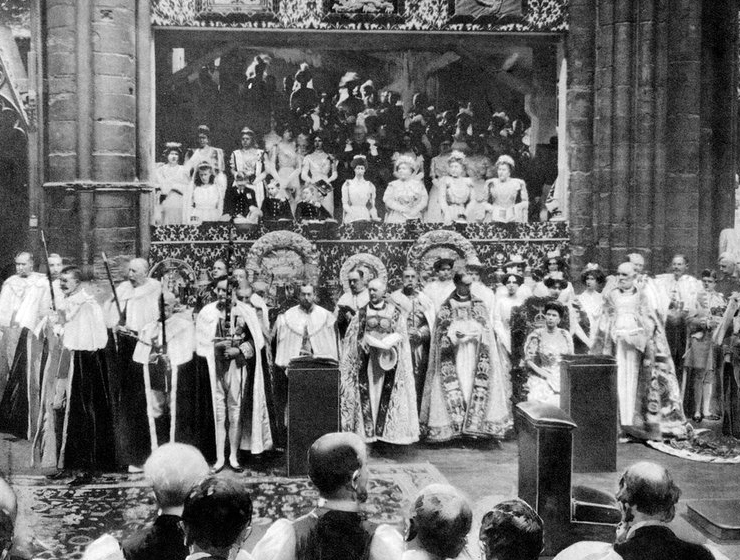
King George V and Queen Mary seated on the Chairs of Estate in front of the royal box at their coronation in 1911. By Benjamin Stone/Wikimedia commons.

The event was also extensively recorded in moving pictures. Coronation Of King George V (1911)/British Pathé.

My favourite technological first for this coronation would have to be how the newly anointed monarch contrived to the lay the cornerstone of the Fisherman's Institute in St. John's, Newfoundland (Globe, 22 June 1911):

In spite of the pressure of the Coronation ceremonies, King George will find time Thursday to participate in the laying of the corner stone of the new Fisherman's Institute to be erected here by Dr. Wilfrid T. Grenfell. It will be at His Majesty's word, sent over the cable, that Governor Ralph Champney Williams, of Newfoundland, will place the stone in position. Arrangements have been completed for special telegraph and cable connection between Buckingham Palace and the site of the structure in St. John's.
Huzzah! What a signal demonstration of the electrical sinews of the Empire!

In the Royal City, the coronation was celebrated in royal style. A series of athletic contests were held in and around Exhibition Park (Globe, 23 June 1911). The Guelph Shamrock lacrosse team was narrowly exceeded by the Brampton Excelsiors, 3–4. A series of races were held, including sprints, races for whippets, boys on ponies, and a five-mile motorcycle race. The Guelph baseball team travelled to Berlin (now Kitchener) and spit a double-header against the Dutchmen.

A first for Guelph was the inauguration of the city's first, incandescent street-lighting system. The Fire, Light and Markets Committee of the City Council teamed up with the Light and Heat Commission to install the system. At 10pm sharp on coronation day, the downtown was lit up as never before (Globe, 23 June 1911):

Wyndham, Carden, Macdonnell, Quebec, Norfolk and Woolwich streets were made as light as day by the fine lights, and, the effect was very pleasing. Citizens generally expressed their entire satisfaction and approval of the new system, which will hereafter be lighted every night and all night.
Thanks to Niagara Power, courtesy of the new Hydro-Electric Power Commission of Ontario set up by Sir Adam Beck, the future of the new era seemed bright indeed.
Since posting this piece, I came across the following information about B.B. McConkey, which clarifies the circumstances of the action that earned him the Military Cross at Vimy Ridge (Mercury, 12 Dec 1918):
Mrs. B.R. McConkey has received the Military Cross awarded to her son, the late Capt. B.B. McConkey, M.C. The statement of the award, which came with it, is as follows: “Lieut. B.B. McConkey, C.F.A. as F.O.O. for his battery with two N.C.O.s this officer laid a telephone line from Lichfield Crater through Volker Tunnel to Thelus Mill, during the operations against Vimy Ridge, on the 9th of April, 1917. Getting ahead of the mopping up Bn. they were held up by a barricade and a machine gun in the tunnel. They overcame this opposition and after handing over 12 prisoners to the infantry, they established an F.O.O. station in Goulot Wood in time for the next attack. When their lines were cut they continued to send back timely information by runner, showing initiative, perseverance and gallantry.”

Sunday, 21 June 2015

Riverside Park's 110th anniversary

On 24 May 1905 (Victoria Day), thousands of Guelphites headed up Woolwich St. to their new playground, a park by the side of the river Speed. Many took the handy streetcar, which stopped by the entrance to the park. Only a year before, the place had been a private farm belonging to Alfred Lace. However, the city had managed to purchase the property with a view to turning it into a park. The citizens of Guelph were on their way to experience it and render their verdict.

According to the Mercury the next day, Guelphites were impressed by what they found. The park was not complete. Trees and undergrowth had been cleared but many of the planned amenities were not yet in place. However, the beauty and potential of the site were widely appreciated:

The promise is that when in shape it will prove a very popular resort for citizens, will aid in increasing the number of excursionists who visit Guelph, and will prove profitable to the city, aside from the additional earnings it will make for the street railway. Invariably yesterday’s visitors expressed themselves as pleased with the park and its promise as a pleasure resort.
The people were happy and receipts for the street railway were up. Indeed, the Mercury reported, the street railway carried 1109 more passengers than on Victoria Day the previous year.

What led the Royal City to buy the grounds and construct the park? Why had it bought land in that location, then north of the city limits, and not elsewhere? The answer is complex but centers on the prominent Guelph businessman J. W. Lyon.

According to the The Canadian Album (1891, p. 230), James Walter Lyon was born in Uniondale, Susquehanna Co., Pa., in 1848. He found his calling in business early on:

At age nineteen he left home to canvass for books in Michigan, and at twenty-two he had made and saved ten thousand dollars. He was then taken into partnership by his employer, O. A. Browning, of Toledo, Ohio, and in 1872 they opened a branch of the business in Canada, which proved a great success.
The Canadian office was sited in Guelph. According to the Historical Atlas of the County of Wellington (1906), Lyon liked what he saw in Canada and in the Royal City. In 1874, he sold off his interest in the US company and bought out his partner's interest in the Canadian branch, renaming it the "World Publishing Company". The new name was well chosen: The World Publishing Company became a global success with branches in Australia, South Africa, East and West Indies, and South America. Although book printing was carried out in Toronto, the head office, and J. W. Lyon, as he was always known, stayed in Guelph.

(J. W. Lyon, Historical Atlas of the County of Wellington, 1906)

Besides his publishing empire, Lyon became a highly successful real estate developer. He bought and sold land throughout the US and Canada. Partridge (1992) notes that Lyon bought about 400 acres in the area of York and Victoria roads in Guelph and donated the sites to manufacturers for development. He bought and upgraded John Hogg's old pile at 67 Queen Street, which he named "Wyoming" after the Wyoming Valley in Pennsylvania where he grew up. All his enterprises were blessed with success and he became Guelph's first millionaire. The stretch of Queen Street where he lived was sometimes known as "Millionaires' Row".

Lyon was also Commissioner of the Guelph Radial Railway Company (the streetcar) and keen on its development. Built originally by the brewer George Sleeman, the streetcar system was running well but had not yet become a money-maker. Lyon realized that part of the problem was the limitation of its clientele. The streetcars helped Guelphites commute to work and got students up College hill to the O.A.C. and back. To make money, the streetcar needed to attract new ridership and also to increase business on its northern route, which ended at the Woodlawn Cemetery, hardly a big draw although, of course, people were dying to go there. Besides, it needed more ridership during down times like evenings and weekends.

Lyon saw an opportunity and announced it in a letter to the editor of the Mercury (14 Oct. 1904):

New Park
Scheme for obtaining one proposed by Mr. Lyon


To the editor of the Mercury:
Dear Sir, —Myself and my Directors are extremely anxious to make the Guelph Radial Railway a success, financially as well as the means to recreation for the people of Guelph. ... The trouble with our line, however, is that it starts nowhere and goes nowhere, or, as it is said with a smile, “from the brewery to the cemetery.” The College end is satisfactory, and we desire to make the opposite end, up the Elora Road, equally satisfactory and profitable. With that in view, we have obtained an option on the Alfred Lace property—two properties, five acres and nine and a half acres. By acquiring this we would have a splendid outside park, excellently adapted for Sunday school and other picnics, well timbered, fronting about a quarter of a mile on the river Speed, and the dam for Pipe’s Mill furnishing boating and bathing, an ideal ground for all sports, games, amusements and band stand, an added attraction being an excellent spring of water.
...
A park would address both issues at once: It would create an attraction on an underperforming route and lure picnickers, especially Sunday school children, as passengers into the system. The new park could help put the streetcar in the black.

The problem, as Lyon realized, was that the development would cost a fair amount of money. The option obtained by the directors put the price of the land at $3,200. That would be a large sum for the city and would be seen as extravagant by some ratepayers. He raised a number of arguments to make his case.

  • The first point, of course, was that it would make the streetcar profitable. In 1903, the city had bought the streetcar system from investors for $30,000 and assumed liability for its debt of $48,000 (Mills 2010, p. 185). So, the sooner it made money, the better it would be for the taxpayers.
  • Lyon noted that the city was losing its park land downtown. Guelph had recently sold part of the Market grounds to the Canadian government for the construction of the Armory. Also, the Grand Trunk Railway was in the process of expropriating Jubilee Park, a public park where the VIA station now stands. There was a need for new park land and it seemed only fair, argued Lyon, that the money from these sales should go to the establishment of a new park.
In a second letter to the editor of the Mercury (30 Dec. 1904), Lyon made further points in answer to his critics.
  • For example, he argued that the new park would put Guelph ahead of its regional rivals, especially Berlin (now Kitchener):
    In my opinion the natural features are superior to those of the celebrated park in Berlin. The Berlin people talk of the money they make out of the Guelph people. Let us make some money out of Berlin and other towns, and get a double fare out of the June excursionists; when they have seen the College, then take them to the park.
    The park that he does not dignify with a name is likely Riverside Park in Bridgeport, built in 1902 as an attraction for patrons of the Berlin and Bridgeport Street Railway.
  • Lyon also noted that the park would be serviced by the existing streetcar system. This would save the city the thousands of dollars it would cost to build a new route to some other destination and provide more cars and employees to run it.
  • He also rejected the argument that the city should wait until it could buy build a park at Puslinch Lake. The city of Guelph was very interested in developing a recreational park at the Lake, and businessmen like Lyon and George Sleeman had bought property there. However, Lyon noted that it would take a great deal more money, and many more years, for such a project to materialize. (It never did.) The new park on the Lace property could be opened in a few months.
Besides, Lyon reiterated the beauty and allure of the site.

In the end, Lyon took matters into his own hands. With the option to buy the Lace property nearing its end, and the City council waiting to hold a referendum on the matter, Lyon simply bought it (21 Nov. 1904). If the city supported its purchase, they could have it at cost. Otherwise, he could sell it to other interested parties, of whom there were several by then. The bylaw to purchase the property was passed and the city bought it from Lyon. Lyon was made the Chairman of the parks board and put in charge of the park's development.

On Victoria Day, 1905, the park opened and was another success for Lyon. The postcard below, published shortly after the opening of the Park for A. B. Petrie, shows its main entrance off the Elora Road (now the northern section of Woolwich St.).

Note the small signs on either side of the main "Riverside Park" marquee. They say, "No driving allowed." It was decided that people could not drive their own vehicles (horse- or motor-powered) into the park (Mercury, 13 June 1905). Perhaps Lyon wanted to spare patrons the need to dodge horses or their droppings. Or, perhaps this was his way of encouraging them to take the streetcar.

Lyon proceeded with the planned improvements. The first improvement was a box of monkeys. That was evidently Mayor Sleeman's idea (Mercury, 13 June 1905):

Swings and other facilities will be pushed forward and, as a special treat for the children, Chairman Lyon was empowered to purchase a cage of monkeys. No restrictions as to color, breed, or behavior were laid upon the chairman. The Mayor spoke of his experience when he had a monkey: it was a trade winner from the word go.
Six monkeys—four ringtails and two rhesus monkeys—arrived from New York on 22 June. They were to be fed bread, fruits and nuts but no meat. They were kept in their shipping box until their cage was completed. The monkeys were the beginning of the zoo that featured in the park for many years.

In an early instance of crowdsourcing, the board decided to hold a contest to find an official name for the new park. The Mercury had been calling it the "New Park", the "Street Railway Park" and "Riverside Park" but nothing had been made official. The Mercury announced the contest on 23 June, soliciting entries especially from school children and offering a book of streetcar tickets as a prize. The contest drew an enthusiastic response and the Mercury printed many of the suggestions received by Mr. Hackney, the manager of the streetcar system (16, 17, 19, & 22 June). The suggestions revealed many ideas about how to name the place:

  • Honor (or flattery): Lyon Park, Lyon's Park, Lyondale, Lyonhead, Lyonville, Lyon Valley, Lyon Hurst, Lyon Lane, Lyoneese, Lyon's Cliff, Car Lyon, and Hackneydale.
  • Scenery: Speedview Park, Speedvale Park, Speedside, Speed River, Ferndale, River View, Lakeview, Cedar, Elmdale, Forest Nook, Woodlawn, Woodview, Woodland, Springdale, Cedarvale, Pipe's Dam, Edgewater, Bush, and, of course, Riverside.
  • Loyalty: King Edward Park, Royal City Park, The King's Park, Alexandra, Hanover, Park Royal, Commonwealth, Gotha, Princess, Balmoral, Sandringham, Kensington, and Maple Leaf.
  • Romance: Inverlea Park, Saltaire Park, Wausakasene ("by the side of the river"), Kill Kare, Gretna Green, Lover's Rest, and Restormal.
  • Whimsical: Eureka Park, Ideal Park, Madeline Square Garden, Sans Souci, Mikado, Spurliner's, Line Rhine, Uneeda Rest, Minnetonka, and Togo.
The selection was announced in the Mercury (11 July) with a brief note: "'Riverside Park' is the name selected for the street railway park." With so many other Ontario cities like Berlin establishing a "Riverside Park", it seems that Guelph would not be left out.

(The date 11 July is sometimes given as the official opening of the Park. The Mercury contains only a brief mention of the naming and nothing else. Perhaps we could say that this date was its christening.)

The Park proved quite popular. On 6 July, "practically" the first concert was given by the Guelph Musical Society in the new bandstand (Mercury, 7 July 1905). Over 2,000 people were on hand, and the streetcars were packed. Mr. Hackney estimated that one-third more people wanted to use the streetcars but could not due to limited capacity. Lyon and the other directors must have been smiling.

Riverside Park was meant not only for the comfort of Guelphites but also to impress out-of-towners. This it seemed to do. The Mercury (25 Aug. 1905) printed an except from a letter by Rev. J. B. Mullan of Fergus to the Fergus News-Record giving his assessment in a suitably ministerial tenor. The account tells us about the Park's facilities, both present and lacking, as people of the time saw them:

The Riverside Park will yet be an ideal one. The Radial Company, who own it, are determined to make it the most attractive of all the parks in neighboring towns and villages, such as Stanley at Erin, or Idlewyld in Hespeler, or the still more famous one in Berlin. There are fifteen acres in it, and the Company are about to add as many more to it, most of which is composed of rock and hill, and dell and stream and river, and wood and spring—features of natural scenery which will yet make it, with the help of taste and money, an ideal park. Already there is a large refreshment of ice-cream building, a splendid band stand, a never failing spring, a museum, a number of swings, and many fine rustic seats. Bathers, too, of both sexes, who have their suits, find good bathing there. The caretaker also gives lessons in swimming. There is a large stretch of water, too, above the dam, for boating, but the Company have not yet supplied the boats. There are one or two features of the Park which I do not care about. The merry-go-round and the shooting gallery should not be there, as the children and young people are tempted to spend too much of their money. One of the attractions of Idlwyld, Hespeler, is that they have all the dishes you need for a large picnic, and you can have the use of them for a few cents; but at Riverside there are no dishes, and no place round where you can borrow any. We had all the trouble of bringing them from the city. These defects will be supplied through time. Rome was not built in a day, neither can you make a Park in a year. It is a slow growth like the oak. We met, however, with such kindness and consideration at the hands of all the officials of the G.T.R., the trolley, and the Park, that we feel that if spared, we would like to go back with all the Sabbath schools—a big union picnic next year. In conclusion, permit me in kindness to any who are about to visit the Park, to utter this warning—Beware of the wasps.
Note that the Reverend also declines to name the park in Berlin! Did non-Berliners have to spit on the ground if they said it?

Below is a postcard published ca. 1910 by the Valentine & Sons Publishing company. It shows several youngsters enjoying a swim in the Speed at the park. (Or, are they fleeing the wasps?) The photo may have been taken from on top of the dam of the Speedvale Mill.

It looks very refreshing, an impression helped by the watery palate chosen by the colourizer.

Besides the facilities of 1905, we gain an insight into the activities of well-heeled picnickers in Riverside Park from a detailed article in the Mercury (28 Aug. 1905) describing the First Annual Picnic of the Commercial Travellers' Association, that is, men who travelled frequently in pursuit of their business. The group was well connected, as Mayor Sleeman, M.P.P. J. P. Downey, and M.P. Hugh Guthrie were all in attendance.

The picnic was highly organized by the Association's picnic committees, and nearly every member and his family attended, making nearly three hundred in all. The affair began with a series of games and athletic contests:

The proceedings commenced shortly after three o’clock, when the married men essayed to down the single men at baseball, but the job was too much for them and they gave it up after three innings. The score resulted 6-4 in favor of the single men.
In defense of married men, I should point out that single men tend to be younger.

Next came the foot races, with separate events for boys under 10, girls under 10, boys under 16, girls under 16, young women, single men, married men, and fat men. The victory of "Jock" Smith in the fat men's race is described in some detail.

After a men's and a ladies' egg race, the events became more gender specific. The men ran a backward race and a sack race. The ladies ran a "soap race" and a "tack and hammer race". A soap race at a Toronto Retail Grocers' picnic in 1896 is described as follows:

There were 22 entries for the soap race, ranging in age from girls of 17 to women of 50. The conditions of the race were that each woman was to run 100 yards, picking up a bar of soap every 10 yards, and carrying all her soap in an apron to the finish. The stumbling and falling of the women in their attempts to pick up the soap as they ran, was indeed funny "for the spectators."
In the tack and hammer race, the women had to hammer sixteen nails into a box.

Then came the "thread and needle race". This race was mixed gender and probably similar to the following event held on a British steamship in 1902:

... the thread & needle is good fun. The gentlemen race from one end of the ship with a needle in one hand to a lady with thread & she must thread the needle for him with one hand before he can start back again - they get so excited they cannot hold the needle still & the lady keeps missing the eye & all scream & laugh together.
To make it more interesting, the Association appears to have reversed the gender roles with the ladies running and the men trying to thread the needles.

At six o'clock, everyone sat down in the Pavilion for a "sumptuous tea" provided by the Kandy Kitchen, followed by several speeches. The speakers praised the Association, its members, their families, and the British Empire for furnishing them with so many possibilities for travel and business. Some remarks made by Hugh Guthrie, the M.P., would sound a little peculiar today:

They were the great channel of distribution of home and foreign made goods, and Mr. Guthrie paid high tribute to the colonizing power of Great Britain, whose trade followed the flag. Especially in newer Canada did the commercial men make trade bound forward; they were all proud of the commercial standing of Canada. To a marked degree, the commercial travellers were “the men behind the gun.” The present age would hardly permit of the simple, quiet life; it was more nearly a case of the survival of the fittest, and Canada and Canada’s travellers, employers, and capitalists were no laggards.
He wished them all "health, happiness, and contentment—and higher emoluments", which they met with applause. After more teasing and eulogizing, the evening wrapped up with an auction of wheelbarrows and boxes from the wheelbarrow race ("in which the contestants had to wheel home a box which persisted in slipping off"). Each box contained "some useful article", including an "all day sucker", from the Kandy Kitchen, I assume. Exhausted and amused, the picnickers then headed for the streetcars.

The next day, 29 August, a fireworks display was held (Mercury, 30 Aug. 1905). Somewhere between 2,500 and 3,000 people attended. It lasted from 8 o'clock to past nine and brought the summer park season to a close with a bang.

As J. W. Lyon had predicted, the park helped the streetcar finally to turn a profit. The net take for the 1905 financial year was $1,915.71, much better than the net loss of $2,378.80 the previous year (Mercury, 7 Nov. 1905). Receipts were up 30% over the previous year, which Mr. Hackney put down to the opening of the park. Lyon's gamble, if that's what it was, had paid off.

Riverside Park continues to be a fixture in the social life of Guelph. Its continued popularity is a legacy of several aspects of the Edwardian city. First, it is a monument of sorts to the long-vanished streetcar system. Streetcar technology had made it possible to move large enough numbers of people to and from this location outside of town cheaply and efficiently. Second, it testifies to the prosperity and growth of the city. Guelph now had enough citizens with sufficient income and leisure time to support a park built especially for their amusement. Third, Riverside Park is the legacy of J. W. Lyon, whose business acumen and civic boosterism made it possible.


I have yet to find a map of the interior of Riverside Park in its early days. However, its initial boundaries are included in the Historical Atlas of the County of Wellington (1906). See the detail below.

The entrance was evidently in about the same location as today, at the south end of the lot on Woolwich. The solid black square above the word "Riverside" is the location of the Lace house, which remains in that place today as a park office.

Compare the detail above with the satellite image below, from Google Earth, with the original park boundaries marked by white lines.