Showing posts with label Peter Gow. Show all posts

Friday, 11 August 2023

Gow's bridge

We tend to think of bridges as keeping people dry when they cross over rivers. For the most part, this is true but not always. At its inception, what Guelphites call Gow's bridge today reminded its makers of this fact (Mercury, 1 Sep 1897):
Got a ducking.

City Engineer Hutcheon was inspecting the new stone bridge at Gow’s dam yesterday. Mr. D. Keleher, the contractor, and Mr. J.K. Weeks were along with him. They got on to a rather rickety scaffold. It gave way, and the three men were plunged into six feet of water. Then there was a scramble for the shore. Keleher, it is said, floated on one of the broken planks until it struck on an obstruction and saved him from being floated over the dam. The trio got a good ducking, but nevertheless went on with the inspection of the bridge, if not with the same eagerness, with far more carefulness.
The scaffolding was intended to help laborers to build the bridge. In the absence of safety regulations, these structures could be rather unsound, as the inspector was here reminded.

Gow's bridge is perhaps Guelph's most noted and picturesque bridge (though the Heffernan street bridge is also in the running for that title). For this reason, no doubt, postcards of the bridge were quite popular in the Edwardian era.

("Gow's bridge, Guelph, Canada," published by Waters Bros., Guelph, ca. 1910.)

Technology scholar Langdon Winner is noted for arguing that technology can be "political" in the sense that it can enforce political goals. His most famous example is a set of bridges built by urban planner Robert Moses over some Long Island parkways. These bridges were designed with low clearances, which had the effect of impeding the passage of buses beneath them. Moses's critics argued that this arrangement suited Moses, who didn't want busses to use the parkway because they were the main means that poorer New Yorkers, especially black ones, would use to reach public beaches up the coast from New York City, something that Moses viewed with disfavor. The veracity of this argument has been disputed but it illustrates how the design of technologies, such as bridges, might further particular political preferences.

(A print of the photograph from which the postcard above was made. It is labeled, "Gow's bridge, Guelph, ca. 1875." Of course, this date cannot be correct as the stone bridge was not built until 1897, as noted above. Courtesy of Guelph Public Library, C6-0-0-0-0-1168.)

Gow's bridge was also "political," not because of its design but because of its location. As Johnson (1977, pp. 95–100) explains, Dundas Road (now Gordon street), the only main road leading south from Guelph, was operated by a Commission that charged tolls in order to recoup the costs of its construction and maintenance. In 1852, the Commission raised its toll charges substantially in order to stay in the black.

Of course, higher charges substantially raised the costs for Guelph businesses to ship their goods south to market.

To say that Guelphites reacted negatively to this development would be to put it mildly. Citizens attacked the integrity of the Commission in print and physically attacked the toll gate south of town. In order to break the monopoly that the Commission held in southward routes, the Town Council set out to build more bridges over the Speed River, so that teamsters transporting goods to the south could circumvent the Dundas Road bridge. Its first effort focussed on the foot of Wellington Street, which, at the time, was at the Gow property a little west of the Dundas Road.

("Hon. Peter Gow, Member of the Ontario Legislative Assembly for S. Wellington," ca. 1870; courtesy Library and Archives Canada/MIKAN 3216191.)

Peter Gow (1818–1886), owner of that property, had immigrated to Canada from Scotland in 1842 and arrived in Guelph two years later. Following his father's profession, Gow set up a boot and shoe store in town. He went into partnership with his cousin James on the latter's arrival in 1851.

Ever the go-getter, Gow built a tannery, a woolen mill, an oatmeal mill, and a quarry on property he purchased on the shore of the Speed. (The property had a propitious history: In 1830, it was the site of a distillery built by one Andrew McVenn.) A dam was built to provide power for the mills, which became known as Gow's dam. The convenience of this site to the centre of Guelph, along with the presence of the mills and dam, probably explain why the Gow property was chosen as the site for Guelph's new, Commission-busting bridge.

(Detail of the map of Guelph from the 1877 Atlas showing Gow's bridge and properties where the west end of Wellington street intersected the Speed River. This section is today part of McCrae Boulevard.)

By the end of October, 1852, a bridge apparently sporting stone abutments and piers with a wooden superstructure spanned the Speed River, connecting Wellington street to the mean streets of Brooklyn, the section of Guelph on the river's south bank.

It seems that the new bridge, which was inevitably known as Gow's bridge (though sometimes called the Wellington street bridge), was a success.

Exposed to the elements as they are, particularly ice and floods, bridges tend to wear out and require periodic repair. When the maintenance bills come due is when we see how attached people are to their bridges (or other structures).

By 1872, Gow's bridge was in a "dangerous and dilapidated state" (Mercury, 4 June) and there were calls for its replacement. Helpfully, Wellington County chipped in $500 towards the project, evidently considering the structure an important regional asset. Plans were drawn up and tenders sought. However, at $1400, the lowest bid involved more money than the Town of Guelph wished to spend. Pivoting to Plan B, the town simply had the existing piers raised by a foot and a new wooden deck built. This project cost only about $650, which was much more to the council's liking.

A significant, though unintended, consequence of the presence of Gow's bridge was that it facilitated the practice of swimming or "bathing" in the river. There was a bylaw that prohibited bathing in the river near bridges, so the papers occasionally related stories of people who were caught in the act by authorities.

The perspective of the authorities is nicely conveyed in an article in the Mercury (5 August 1887), which lodges a complaint against the practice in general:

Bathing at Gow’s bridge.

Numerous are the complaints that are made about young men and boys bathing at Gow’s bridge in broad daylight and in the evening. They run around the bridge, and dive from the parapet as naked as the day they were born and the language they use is most offensive beyond imagination. Ladies living on the other side of the river, and whose direct road home is over this bridge, are compelled to walk around by Dundas bridge.
Of course, to the perpetrators, what was shocking about this scenario was the behaviour of the police attempting to catch them in the act. This perspective is nicely conveyed by John D. Higinbotham in a reminiscence of his childhood in Guelph in the 1870s (Higinbotham 1933, p. 21):
An excellent exemplification of the fact that "conscience makes cowards of us all" was seen in the terror of the very name of "Kelly" inspired in the hearts of the small boy. The town police force consisted of Chief Jonathan B. Kelly, and Sergeant Dooley. The former was a small man with dark piercing eyes; yet at the very sight of him every urchin sought cover. The principal duty of the Sergeant during the summer months seemed to be to parade the waterfront from Goldie's Mill to Gow's bridge and apprehend all small boys who, in violation of the town ordinances, insisted on bathing in nature's attire. Occasionally the boys outwitted him by throwing their clothes into an empty barrel and swimming with it to the opposite shore.
Which party was finally in the wrong is left for you, dear reader, to decide.

This second version of the bridge continued to serve the community for another couple of decades. By 1893, wear and tear had brought it to condition of being "unfit for traffic" (Mercury, 7 September) and calls for a new bridge were made once again.

In 1896, the City Council took action. In August of that year, the water had been drained from in front of Gow's dam, meaning that the riverbanks and bed were more than usually accessible, and at no extra cost! The council decided to have abutments built immediately and have a deck designed and built later on (Mercury, 18 August 1896). The tender of Dundas & Cape was accepted and masonry abutments, 22 inches higher than the previous ones, were constructed.

Of course, the superstructure then had to be built. The council could not decide on a type and solicted tenders for a stone structure, an iron one, or a wooden deck (Mercury, 8 March 1897). The stone option won the day, over the strong protests of Alderman Clarke, who favored the cheaper option and called the stone structure, "that costly stone bridge" (Mercury, 16 March 1897). He was certainly correct about the difference in price, with the bid for the stone bridge by D. Keleher coming in at $2197, while the bid by Richard Boyle for the wooden structure would come in under $500.

("Gow's bridge, Guelph, Canada." Postcard in bookmark format printed by Rumsey & Co., Toronto, ca. 1915; courtesy of the Guelph Civic Musemus 2004.32.17.)

Construction began on 16 July and the inspection, complete with the immersion of the inspectors, took place on 1 September. Guelph then had the romantic stone bridge that it continues to enjoy today!

Gow's bridge continued to be a favoured site for bathing but many other things, not always pleasant, occurred there as well. For example, the bank of the Speed at the bridge was a good place to pasture the Royal City's urban cows, a procedure that could occasionally be risky (Globe, 26 July 1916):

Frenzied cow gores woman attendant
Heat and flies madden animal and Mrs. Walker of Guelph is injured.

Guelph, July 25.—Frenzied with the heat and flies, a cow tossed and gored Mrs. William Walker, Birmingham street, this city, while she was endeavoring to drive the animal through the gate of a pasture field near Gow’s Bridge. Had two young men not hastened to her rescue it is altogether likely that Mrs. Walker would have been killed.
("Gow's bridge and mill, watercolour, 1910," by Effie Smith of Guelph. Courtesy of Wellington County Museum and Archives A1985.110, ph. 11243.)

Sadly, like many bridges, Gow's bridge was also the site of drownings and other unfortunate encounters with the Speed. Consider the example of Richard Hulme, a recent immigrant to Canada at the time of his death (Globe, 23 September 1924):

Depressed by lack of work young man takes his life

Guelph, Sept. 22.—Depressed and discouraged owing to the fact that he was unable to obtain employment, Richard Hulme, an English man, 30 years old, drowned himself in the Speed River. He is believed to have been mentally deranged. Before committing the rash act, Hulme placed his sweater coat and hat in a neat pile on the abutment at Gow’s Bridge, and then it is supposed waded into the water. A little girl in passing noticed the man’s clothing and on further investigation discovered the body in about 4 feet of water. Hulme had been out of work for over a month, and had been unable to secure a job. He leaves a wife and two children in Leigh, England.

Gow's bridge was designated a historic site in 1990 and noted as, "the only surviving example of several stone bridges which once crossed Guelph’s rivers."


There are intriguing mentions of a second bridge at the site of Gow's bridge around 1900. Consider this notice in the Mercury (15 July 1904):
Bad Bridge.

Residents in Brooklyn and farmers generally, who are in the habit of crossing Gow’s bridge, are complaining about the state of the wooden bridge adjoining the stone one. It was washed away last spring, and remained in an impassible condition for some weeks, when finally a plank footpath was erected. The fence on the righthand side from the city, between the two bridges, is also down. People who have to do business at the Grundy factory, at Cartledge’s woolen mills, and general delivery men are compelled to go by the Dundas or Wells’ bridges, considerably out of their way.
It sounds as though this wooden bridge connected the stone bridge to Wellington street, so that people crossing the river had to pass over both structures in sequence.

The Mercury (2 September 1904) later notes that this second bridge was replaced by another, "principally of cement".

("Gow's bridge from boathouse, July 1902 // July 10th, 1902 // Oil by Fanny Colwill Calvert;" courtesy of the Art Gallery of Guelph.)

An oil painting made by Fanny Colwill Calvert in 1902 shows not the stone bridge but one with a wooden deck. Could this be the adjoining bridge that was washed out in 1903?

("Gow's bridge, Guelph, Canada," printed by Rumsey & Co., Toronto, ca. 1910. Note the stone bridge on the left-hand side and another structure on the right. Courtesy of the John Keleher collection.)

It may be that this second, "adjoining" bridge stood on the section of Wellington street just north of the stone bridge, effectively connecting it to Wellington. A postcard of that period appears to show such a structure in that location. This structure is not wooden and so may be the one "principally of cement" built after Ms. Colwill Calvert's painting was executed.

The area between Gow's bridge and Wellington street was considerably altered in subsequent decades. The low-lying north shore was filled in with refuse and the buildings at the bridge were removed, making way for what is now Royal City Park. In place of an adjoining bridge, a third span was added to Gow's bridge and the Speed River was lined with stone walls, as part of a Depression-era works project.

("Speed River, from Gordon Street Bridge, Guelph, Ontario, Canada.—8;" postcard printed by Photogelatine Engraving Co., Ltd. and mailed in 1938.)
Works consulted include:

Monday, 29 August 2022

A church off the old block: The origin of Chalmers Church

From the perspective of postcard collecting, the main issue relating to Chalmers Church in Guelph (now the Royal City Mission Church) is the rarity of postcards featuring views of it. The card below is the only one that I have yet come across.
("Chalmers Church, Guelph." Courtesy of the John Keleher collection. Publisher unknown.)

Comparison with a recent Google Streetview image shows that the exterior of the church has not changed a great deal since the postcard picture was taken sometime in the early 20th century.

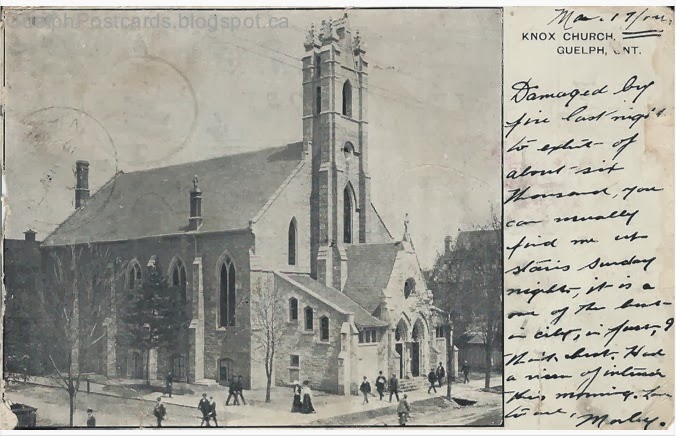
Stone churches were a highly collectable category of picture postcard back in the day and the Chalmers Church was no slouch in the aesthetics department. Furthermore, the Knox Church just down the block was represented on a number of postcards.
(From "Knox Church fire of 1904.")

Like Knox, Chalmers was also a Presbyterian Church, a mainstream denomination that any city like Guelph would boast of. So, why Knox would be prominently featured while Chalmers was the Royal City's secret remains a head-scratcher.

Interestingly, Chalmers Church owes its existence to Knox Church. The first Knox Church edifice on Yarmouth Street was sold to the Raymond Sewing Machine company when it expanded its shop along that street. The congregation built itself a smart new home around the corner on Quebec Street, where the cornerstone was laid in October, 1868.

(The first Knox Presbyterian church on Yarmouth Street, to the right of the Raymond Sewing Machine factory, ca. 1870. Courtesy of Guelph Civic Museums, Grundy 249.)

By the early months of the following year, a sizeable portion of the congregation was looking to break away! Official histories are somewhat mum on the reason. C.A. Burrows (1877), in his Annals of the Town of Guelph, says only that there was an "unhappy divison" within the congregation, while Smith (1955, p. 96) says that some members were "at variance" with the minister, W.S. Ball.

(Rev. W.S. Ball, ca. 1880. Courtesy of Guelph Civic Museums 1997.21.2.)

Perhaps my favourite perspective is that of George B. Anderson, who reminisced about the incident, which occured when he was a boy (Mercury, 20 July 1927):

About the time I came to Guelph to live we all went to Knox Church. Knox Church was a barn-like structure on Yarmouth Street, a diagonal street running from Norfolk Street to Woolwich. There is, or was, a sewing machine factory on the site of the church. But two factions sprung up, over some question I could never quite understand what it was all about. However, the Chalmers Church faction broke away and worshipped in the Court House for some time, until the present church was built.
Luckily, issues of the Evening Mercury from 1868 survive and provide some details. As noted by Smith, the matter turned on some acrimony regarding Rev. Ball, to whom some parishoners took great exception (17 April):
Knox’s church, Guelph.—The Presbyterial investigation of charges preferred against the Rev. W.S. Ball by members of his congregation, which began on Tuesday evening, closed on Thursday afternoon. The decision of the Presbytery will be read to the congregation on Sunday first by the Rev. Mr. Smellie, of Fergus, who has been appointed to preach on that day.
The resolution adopted by the Presbytery as a result of their investigation was printed subsequently (Mercury, 20 April). To make a long story short, the resolution focusses on a few specifics. It notes that Rev. Ball continued to enjoy the support of many members of the church. However, some members had impugned his "pulpit abilities" and his spread gossip about his "moral character." Access to Sabbath School and pew rentals also seem to have underwhelmed some congregants. In fairness, the Presbytery found that Rev. Ball had addressed the situation using "imprudent language," thus feeding the fire afflicting the congregation.

It is hard to know exactly what to make of these points. However, the mention of pew rents is interesting. It was a custom brought from the old country that pews were rented to congregants. The best pews were at the very front and were rented to the wealthiest and most prominent families. Rents got cheaper the closer to the back they sat, while some at the very back were freely available to strangers and indigents.

Rents were not very expensive but were an important source of income for churches. Collecting pew rents, which were frequently in arrears, was a regular headache for the pastors of churches where rents were applied.

Of course, since the location of a family's pews was a signficant signal of social status, they could also be a source of social dispute. Since the Knox congregation had recently moved into a new building and thus had to negotiate pew rentals for everyone, it may well be that some members of the congregation took exception to their new arrangement, to which Rev. Ball may have responded with impatience.

Doubtless, the situation was complicated and particular to local circumstances. As Tolstoy wrote, “All happy families are alike; each unhappy family is unhappy in its own way.”

In any event, attempts at reconciliataion proved fruitless and a segment of the Knox Congregation applied to the Presbytery to form its own group named Chalmers Church, in honour of Thomas Chalmers, a luminary of the Free Church of Scotland. This petition was granted and the group began to hold services in the city Court House while making plans to establish its own place of worship.

(An ad from the Guelph Mercury, 24 July 1868, for the first meeting of the Chalmers church in the Court House.)

The founders' plans went well. In September of 1869, Rev. Thomas Wardrope of Knox Church, Ottawa, agreed to become minister of the new church. The cornerstone of the new building was officially laid by Rev. D.H. MacVicar, Principal of Montreal College, on 22 June 1870, and services began there in December of the following year.

("Laying Cornerstone—Chalmers United Church 1870." Courtesy of Guelph Civic Museums 1970.39.17. In the background on St. George's Square, note the original Wellington Hotel on the left, the old Bank of Montreal building in the centre, and the rear of the second St. George's Anglican church on the right.)

Leaders of the new church spared no expense in setting themselves up. They hired Toronto architect Henry Langley, "the undisputed dean of ecclesiastical architecture in Ontario during the last half of the 19th century." The Board of Managers were quite specific that they wanted a church in the latest taste, modeled on the Knox Church of Montreal, though on a smaller scale. Langley certainly delivered! The church cost a total of $25,000, a considerable amount for a new congregation.

(Henry Langley. Courtesty Wikipedia.)

Gilbert Stelter (1989) makes the following point about the relation of Chalmers Church to Knox Church down the block:

The choice of a site for the new church seems almost provocative, for it was almost next door on the same downtown street (Quebec) as Knox Church, from which they had split. And the use of a relatively sophisticated Gothic design must have been calculated to look more impressive than the very simple Gothic of Knox's new building, designed by James Smith of Toronto a year earlier. Knox Church was essentially a rectangular box ornamented only with plain pointed windows. Chalmers, however, was described as "the best constructed and the most elegantly furnished church in town" when it opened for services in 1871.
The building was also distinguished by the fact that it constructed of imported gray limestone rather than the plentiful, warm local material. No doubt, this measure also serveed to distinguish the church from Knox church.
("Knox Presbyterian Church, 1871." Courtesy of Guelph Civic Museums, Grundy 63.)

The congregtation grew during the Victorian era and the church was altered and expanded to meet additional demands for space. A substantial renovation was completed in 1896. Designed by the original architect, Henry Langley, the shingles on the roof were replaced by slate and a series of dormer windows were added as well. Each row on either side of the roof could be opened at once with a hand crank. The ventilation thus achieved served as an early form of air conditioning.

A new gallery was added around the main auditorium, which could seat 320 people, bringing the total capacity to 850 persons. In a pinch, partitions between the vestibule and the auditorium could be lowered mechanically and 200 seats added to the vestibule also, meaning that the church could hold over 1,000 souls.

A point of particular pride was that the lighting of the church was converted to electricity. A review in the Mercury (23 September 1896) speaks most highly of the two main electroliers suspended in the auditorium. (In fact, many of the fixtures were hybrids that combined incandescent lighting with gas, as a precaution in case the power went out, which was not so unusual in that era.)

The total cost of these renovations was $6,050, a considerable outlay.

Perhaps the most interesting alteration in that era was the purchase and installation of a pipe organ in 1890. Today, organ music and singing in church services is de rigeur but it was not so when Chalmers Church was founded. Until 1873, singing in Prebyterian church was "lined", that is, a leader or "precentor" read a line from a Psalm and the congregation sang it back. A tuning fork was sometimes deployed to assist everyone in hitting the appropriate pitch.

In 1867, just before Chalmers Church was founded, Knox Presbyterian Church in Montreal created a brouhaha by including organ music in its services. The issue of whether or not instrumental music was kosher for its churches was referred to the national Synod. This body made no decision, thus effectively leaving the matter to each Presbytery to decide for itself.

An "interesting discussion" was held on the matter in the Guelph Presbytery (Mercury, 15 January 1868), which voted down the idea. Even so, services gradually became more musical. Chalmers' first choir was formed in 1871. Hymn singing was introduced to service a few years following. The organ question was revisited again in 1884 and rejected in a vote of the congregation.

Finally, installation and use of an organ was approved in 1890. It may have helped that Knox Church had approved the use of an organ in 1887. True to form, the new organ was a top-of-the-line instrument featuring 900 pipes in all, powered hydraulically by connection with the city waterworks. Considerable renovations were required to accommodate it (Mercury, 8 September 1890).

("Chalmers Church, ca. 1890." Courtesy of Guelph Civic Museums, 1975.21.21.)

While Chalmers and Knox churches remained social rivals the actual division between their congregations was neither profound nor long-lasting. At the time Chalmers Church was formed, there were four different Presbyterian groups in Canada. These had been engaged in negotiations for a union for some time, a project that resulted in the amalgamation of all four into the Presbyterian Church in Canada in 1875. Thus, Chalmers and Knox congregations became equal members of a single, national body.

Chalmers Church became Chalmers United Church when the the United Church of Canada was formed in 1925.

In his reminiscences, Geo. B. Anderson notes that many of the great and good of the Royal City were members of Chalmers Church in its early days:

  • Peter Gow, who ran a tannery business where Gow's bridge now lies, was twice Mayor, Guelph's first M.P.P. after confederation, and held the post of Provincial Secretary. He assumed the office of County Sheriff upon his retirement in 1876.
  • David Stirton, who owned a farm in Puslinch near town, was elected as the Member for the Legislative Assembly of the Province of Canada (1858–1867) and then Member of Parliament (1867–1876), after which point he retired to Guelph and assumed the office of Postmaster.
  • Donald Guthrie, a local lawyer, succeeded Stirton as M.P. for Wellington South (1876–1882), and then served as M.P.P. in the same area (1886–1894).
  • James Innes was for 36 years an editor and publisher of the Guelph Mercury.
  • Hugh Guthrie, son of Donald Guthrie, was also a local lawyer who had a long and eminent career as M.P. for Wellington South (1900–1935) during which time he held many high offices.
So, whatever it lacked in postcard representations, Chalmers Church was an eniment fixture in the culture and landscape of Victorian Guelph and, happily, continues to adorn Quebec street to this day.
Works consulted include: