Showing posts with label J.W. Lyon. Show all posts

Sunday, 6 December 2020

Puslinch Lake, Guelph's first resort

Though situated at the confluence of the Speed and Eramosa rivers, which have always provided ample bathing and boating opportunities, Guelph's citizens looked from early times to Puslinch Lake as a desirable retreat. For many years, Guelphites seemed bent on almost annexing the Lake to the Royal City. Despite this close connection between the two places, and the best efforts of Guelph's patricians, this effort eventually failed to bear fruit.

The connection began early on in the history of the settlement of the district. One story had it that a Father Cassidy, founder of a Catholic mission in the village of Guelph, caused a church to be built on the Big Island in Puslinch Lake in 1837. Stones were hauled to the site over the frozen lake that winter and a flat-bottomed scow was built to ferry local parishoners to and from the site.

Another account is that a church was built on the Big Island by Father Simon Sanderl, who ministered to the faithful in St. Bartholemew's Church in Guelph, predecessor of the Church of Our Lady on Guelph's "Catholic Hill," from 1846 to 1850. It seems that construction of the church on the Big Island was a pet project of his. One account says that Sanderl retreated to the church in 1850 after a dispute with a parishoner who balked at paying the Father's dues before burial of his dead child. (Sanderl was, apparently, very forward in collecting dues due to the expense of finishing St. Bartholemew's.) Rather than render the pre-payment, the man buried the child himself, whereupon the good Father ordered the corpse to be exhumed and "as some would say, sold to the doctor."

(St. Bartholomew's Church, ca. 1879. Courtesy of Guelph Civic Museums, Grundy 68.)

On this account, Father Sanderl fled to the Island church to escape the public's opprobrium. In 1852, he relocated to the Gethsemane Monastary in Kentucky and became a Trappist monk.

In any event, Sanderl's modest stone church on the Big Island was abandoned in the 1850s as it was simply too difficult to reach on a regular basis for services. It was then acquired by two men who turned it into a summer hotel but it could not attract enough custom to remain solvent. The church/hotel burned down in 1865.

Even so, the existence of the old ruins added to the romance of Puslinch Lake and fostered legends that a monastery had once existed there on the Island, whose monks had buried their treasure hoard in fear of Indian raids. Later treasure hunting expeditions failed to turn up any gold chalices but the allure of the Lake only continued to grow.

In its early years, people in the area took a predominantly utilitarian view of the Lake. Locals saw it as a place to draw water, wash sheep, shoot ducks, and catch fish. Experience made them apprehensive of its waters. The Lamont family were the area's first permanent settlers, having arrived in 1831. In 1833, their youngest, 17-year-old son drowned in the Lake after falling out of a canoe while duck hunting. Many neighbors believed that his spirit haunted the place, which dampened their enthusiasm for its waters for a couple of generations.

By the 1860s, efforts of hoteliers to popularize Puslinch Lake as a resort began to pay off. Increases in population and income, not to mention improvements to local roads, began to make the Lake a popluar destination. Initially, these hotels were somewhat seedy, served alcohol illegally, and attracted some unsavory elements.

One early mention of the Lake as a honeymoon resort occurred in the Guelph Advertiser (per the Mitchell Advocate, 1 September 1865). It concerned one George Coleman, proprietor of the "Oyster Bay Saloon," a notorious "groggery and gambling hell" in the West Market Square in Guelph. Coleman had married the respectable daughter of one Mr. Hugh McGinnis, of Puslinch, and honeymooned with her by Puslinch Lake (perhaps at the former church-hotel on the Island that was also run by a "Mr. Coleman"). Subsequently claiming to be called away on business to his family in Rochester, New York, Coleman departed but did not return or write to his bride. Communication with his family revealed that Coleman was a scoundrel with several wives in many states, all subsequently abandoned. The author condoled with the poor girl and helpfully added that the tale should serve as a warning to other young ladies to be careful about whom they marry.

Increasing enforcement of liquor laws tended to tidy up the clientele. In July 1867, for example, the Lake played host to a decidedly proper picnic laid on for the Guelph Artillery Company:

Wives and sweethearts are to accompany them, and should the weather be propitious the chivalrous artillery-men will enjoy, what we wish them to the fullest extent—a very pleasant time luxuriating on love and the dainties that are generally considered the indispensable requisites of a pic-nic.
The contrast with Coleman's endeavor could hardly be clearer.

In the 1870s, daytrips to the Lake from Guelph became a commonplace and water sports like rowing were featured attractions, For example (Mercury, 17 July 1874):

The Butchers’ picnic.—The picnic to Puslinch Lake yesterday was, as we anticipated, a most enjoyable affair. Altogether about two hundred persons were present. The spread was, as may be imagined, bountiful; so extensive, in fact, that a quantity of refreshments were brought home again. The best of order prevailed all day. Quoiting, base-ball, boating, dancing on the green, and similar diversions occupied the happy hours. A rowing match, we believe, was one of the features of the occasion, and Mr. George Hood claims the palm as the champion oarsman. The company returned home about dusk, arriving here between eight and nine o’clock.
The increasing popularity of Puslinch Lake with Guelph's well-heeled and well-to-do attracted the attention of the Royal City's patricians. George Sleeman, Mayor of Guelph, owner of the famous brewery, and promoter of the renowned Guelph Maple Leafs baseball club, took a serious interest in recreational development of Puslinch Lake. In 1879, Sleeman bought an eight acre parcel on the north side of the Lake, added 22 acres in 1882, and another 25 acres in 1884. He and his initial partner John Davidson spruced up recreational facilities on the Island.
(Portrait of George Sleeman. Courtesy of Guelph Civic Musuems 2009.32.951.)

In 1882, Sleeman bought out Davidson and turned the hotel on the north shore of the Lake into a full-featured resort.

(Photograph of a picnic at the Puslinch Lake Hotel, owner, George Sleeman, ca. 1905. Courtesy Guelph Civic Museums, 2014.84.1075.1.)

To shuttle people from the shore to the Island facility, in 1880, Sleeman purchased a steamboat signifcantly named the "City of Guelph." Built in Barrie, the boat was a side-wheeler with a 41 foot keel, a 9 foot beam, and was 13 feet tall. With two 4 hp. engines, it could speed 50 persons back and forth at speeds of up to 8 knots. On busy days, up to 100 people jostled cheek by jowl on her deck while she towed a large scow to accommodate even more.

Guelphites and others swarmed to Puslinch Lake on holidays to admire its views and enjoy its recreational opportunties. For example, The Mercury describes the celebrations of Victoria Day in 1881:

The turn-out at this pretty spot numbered about 600. They spent a quiet, enjoyable day with nothing to mar their amusements. The accommodation at the hotel is first class in every respect both for man and beast. The steamer was kept busy.... The small boats, croquet, quoits, and bowling alley were in constant demand and the dancing floor although 30x40 feet in size was none too large. Dancing was a species of amusement and was carried on to the music of a concertina—the boys without coat or vest and hoeing it down to the best of their ability. There were a great number of little family picnics all of whom declare it is the nicest and cheapest place to spend a holiday. The last of the visitors left about 9 p.m.
The wear and tear on the City of Guelph seemed too great and she ceased service after the 1883 season. Visitors to the Big Island could make their way in a small fleet of manually-powered craft provided for the purpose.
("Puslinch Lake near Hespeler, Ont." published by Chas. P. Grill., postmarked in 1910.)

New visitors to the resort also made the acquaintance of another of its legends, the Puslinch Lake Serpent. The Mercury describes one sighting as follows (6 Sep. 1884):

While rowing from the island to the mainland at Puslinch lake on Thursday two Galt gentlemen saw a huge serpent rise fully four feet out of the water. The reptile headed towards their boat and only ceased following them when shallow water was reached. The serpent is described as being fully 14 feet in length with a large flat-topped head. An old farmer who lives across the lake says the same serpent was seen twelve years ago.
Sightings of the serpent continued for some years but the creature was never captured for close study. Perhaps put off by the increasing crowds of visitors, it may have slithered to a more secluded residence.
("A view of Puslinch Lake near Galt," published by F. H. Chapple, Galt., postmarked 1908.)

However that may be, the increasing popularity of Puslinch Lake with Guelphites and others pleased Sleeman. In 1901, he approached City Council with the idea of extending the Royal City's streetcar system to its shore. This system was owned by Sleeman and inaugurated in 1895. Although popular enough, the system was not making money. In addition, there were several proposals to establish an electric railway between Hamilton and Guelph, all of which would include a stop at Puslinch Lake. Convinced that a connection to Puslinch Lake would be profitable, and wanting to fend off competition, Sleeman convinced the provincial government to amend his company's charter to allow the extension.

The Bank of Montreal and the Traders Bank loaned Sleeman money to pursue the scheme but required a mortgage on the streetcar system and Sleeman's property at Puslinch Lake as security. In 1902, Sleeman was unable to make the loan payments and trustees for the banks took over the properties. These were then purchased by the city of Guelph in 1903.

("Puslinch Lake—near Preston Springs Hotel," real-photo postcard, postmarked in 1926.)

The city took a hands-off approach to the properties, leasing them to proprietors who ran them at a profit. In 1916, to make up for continuing losses from the streetcar system, the City subdivided some of its holdings into 42 cottage lots and sold them off. J.W. Lyon, a Guelph magnate who had purchased 35 acres at the Lake in conjunction with Sleeman's project, subdivided his holdings and sold them off for cottages as well.

The city of Guelph maintained ownership of the resort into the 1930s. In addition, various new schemes were proposed to build railways connecting Guelph to the Lake. For example, the Grand River Railway, a Canadian Pacific Railway subsidiary, proposed to take over the Royal City's streetcar system and extend it to Hespeler, including a spur line to the Puslinch Lake resort. This scheme was opposed by Sir Adam Beck, boss of the forerunner of Ontario Hydro, who sought to build an inter-city railway service run by the utility. Guelphites voted down the proposal and thus scotched the idea for good.

In any event, the conception of Puslinch Lake as the site of a public resort was slowly fading. One reason was that construction of cottages there was turning its shores into private property. Increasing prosperity in Ontario allowed or even prompted its residents to purchase vacation properties rather than renting accommodtions or using shared facilties. Puslinch Lake was very much an instance of this development.

("Aerial view, private section, Barber’s Beach, Puslinch Lake, R.R. 2, Hespeler, Ont.," real-photo postcard, postmarked in 1948.)

Another reason was increasing adoption of automobiles. As the province's middle classes took to their cars more and more to enjoy the countryside, and as governments spent large sums to improve roads, enthusiasm for railway connections waned. Rather than have a relatively small number of railways transport holiday makers to a small set of resorts, people increasingly expected to drive anywhere in the province they had a yen to visit. Although automobile adoption widened the potential audience for recreation at Puslinch Lake, it also increased competition for motorists' attention.

After World War Two, cottage and residential development tended to dominate at the Lake.

("At Puslinch Lake," real-photo postcard, ca. 1910.)

Perhaps the swan song of Guelph's direct involvement with Puslinch Lake came on 1 July 1928, when George Young, the Canadian swimmer who had first conquered the channel from Catalina Island to mainland California the previous year, came to swim at the Lake. (Young had visited Guelph itself previous year.) Andrew Aitcheson of Puslinch had arranged for the noted natator and some colleagues to go to Puslinch Lake to show off their strokes and have a friendly 1-mile contest with local marathon swimmer Stanley Hodkinson (Toronto Star, 3 July 1928).

(Ad in the Evening Mercury, 29 June 1928.)

Unfortunately, this plan ran afoul of the Lord's Day Act of 1906, which expressly forbade any sporting competitions on Sundays. As a result, Young's contribution to the proceedings was somewhat underwelming:

Provincial Police Inspector Grey made this point quite clear. Young could swim but he could not race. The result was that, almost unheralded, the conqueror of the Catalina channel stepped into the water, showed a few of the strokes that carried him to victory, and then stepped out.
As a result, only a few of the 6000 people, who had driven to the Lake in at least 2000 automobiles, actually witnessed Young's performance.

No matter. Besides Young's brief appearance, the event was to include a huge bash featuring music and dancing. To avoid conflict with the Lord's Day, the music was slated to start after midnight—thus on Monday morning rather than Sunday night. This nice distinction had drawn protest to City Council from the Royal City's religious leaders but the city fathers decided that the affair could proceed as long as Aitcheson undertook never to organize another such slippery celebration again.

After eight hours of enjoying the Lake's paths and rustic benches, or simply canoedeling in their cars, the assembled took to the dance floor after midnight when the band began to play. The result was apparently quite a bash:

Parked cars were emptied and rustic benches deserted as the young people answered the call of the dance music. But the desertion was not for long. It was impossible for all to dance at one time. Many watched the dawn come from the dance hall floor, but just as many saw it come through the windshield of an automobile and from the sheltered nooks along the water’s edge.
Guelph's possessive embrace of Puslinch Lake soon slackened. Despite George Sleeman's best efforts to haul it in, like the legendary serpent, Puslinch Lake will always be the one that got away from the Royal City.
Works consulted for this post include:
Puslinch Lake also has the honour one of the many places described as the location of this scene:
("On Puslinch Lake, near Preston, Canada," published by Stedman Bros, Brantford, Canada, ca. 1910.)

In fact, this is a picture of Florence Sallows paddling a canoe in the vicinity of Goderich, Ontario. Her father, Reuben Sallows, was a noted Canadian photographer who was the source of thousands of beautiful postcard images of Canada. As Mike Smith explains, "I discovered that the crafty Goderich photographer repeatedly conscripted his daughter when he needed a female model. Flo Sallows was certainly an excellent choice—she was very attractive and undoubtedly saved her father a bundle on modelling fees."

Smith's book, "The Reuben R. Sallows picture postcard handbook," lists no fewer than 24 different postcards featuring this image but captioned variously as "Black Creek, Port Dover, Ont." to "River Lynn, Simcoe, Ont."

This little item confirms that collectors have to remember that picture postcards, like any images, are not always what they seem.

Sunday, 19 July 2020

"Bathers of both sexes find good bathing there": Guelphites get a decent bath in Riverside Park

In his praise of the brand-new Riverside Park in 1905, the Rev. J.B. Mullen of Fergus remarked on one of its attractions:
Bathers, too, of both sexes, who have their suits, find good bathing there.  The caretaker also gives lessons in swimming.
Today, this observation seems unremarkable.  Yet, the presence of boys and girls bathing together in the Speed River was a novelty, and represents a significant change from old ways of public bathing.

As explained previously, bathing in Victorian Guelph followed an established pattern.  In the open air, bathing was enjoyed mainly by groups of young (and some older) men at any number of "swimming holes" along the rivers and creeks of the city.  In the days before indoor plumbing and air conditioning, a skinny dip in the river was a favored way to cool off and have fun with friends.  

Although this way of bathing was widely regarded as natural and healthy, it was also seen as decidedly not decent.  The nakedness of the bathers, and their vulgar language, marked them for exclusion from public view by city by-laws.  Restrictions requiring bathers to wear neck-to-knee costumes and stay away from public bridges and roadways were routinely, evenly gleefully ignored.

A more genteel form of bathing was practiced in commercial bathing houses.  In Guelph, James Hazelton's bathing house on the Speed River near the Eramosa road bridge provided baths, showers and a small pool, along with river access, in a discrete structure.  Unlike river bathing, Hazelton's bath house provided facilities for both men and women under one roof and ensured proper attire.  Although such bathing was decidedly decent, it was too expensive and meagre to lure many Guelphites away from the city's many freely available swimming holes.

Into this situation came Riverside Park in 1905.  It was founded, in part, to get more people on Guelph's streetcar system (which went right past the Park entrance) and to compensate for the lack of park space downtown (due to construction on large sections of the Market Square).  


Riverside Park was an immediate success.  In part, this was because it catered well to the leisure culture of the day, which was focussed on picnicking and related recreational activities, like strolling and boating.  Previously, these pursuits had been in the purview of private parks, like Paradise or Victoria Park on the Eramosa river. 

Unlike those private parks, Riverside Park determinedly constructed a space suitable for both men and women.  Most especially, that meant no naked bathing.  

On the face of it, this restriction should have been a challenge.  The Park had a perfect site for a conventional "swimming hole" in the form of the dam serving Simpson's Mill across the river from the Park.

Owned by J.L. Simpson, the mill stood where the Speedvale Fire Station now stands, just east of the Guelph Junction Railway tracks near Woolwich Street.  It had a dam, sited about where the current dam and bridge in Riverside Park now stand.  Upstream, the dam provided an excellent pond for casual boating.  Downstream, the dam provided a most attractive, splashy site for swimming.

Several postcards show bathers enjoying the site.

(From the Valentine & Sons Publishing Co., ca. 1910.  Note what appear to be bath houses, or changing rooms, on the shore to the left.)

(From Charles Nelles, ca. 1905.)

(From Rumsey & Co, ca. 1905.  Both postcards above show how swimmers became part of the spectacle to visitors at the Park.  Courtesy of the John Keleher collection.)

To my knowledge, postcards of Riverside Park are the only commercial postcards of Guelph that show bathers.  No doubt, this is because pictures of other public bathing sites would feature naked men and boys, which would have narrowed the market for them, not to mention being more daring than most postcard makers were prepared for.

So, although Riverside Park provided a tempting swimming hole of the old school variety, bathing was enjoyed only by those "who have their suits," in the words of Rev. Mullen.  How did this come about?

Formally, the city appointed a caretaker to look after and police the Park.  Charles Easton, who was an employee of the Radial Railway (the city streetcar) was the first person given the position.  Rev. Mullen noted that Easton gave swimming lessons at the park, suggesting that he was quite involved with the running and supervision of the swimming hole.  In that case, he could have taken pains to ensure that the dress code was observed by the swimmers.

Culturally, Riverside Park also reflects a change in bathing practices over previous generations.  Bathing had become an integral activity to late Victorian amusement parks, such as Coney Island in New York, where mixed-sex bathing became normalized.  This form of amusement ground spread to Canada through places like Hanlan's Point Beach on Toronto Island, founded by celebrity rower Ned Hanlan in the 1880s.

As such, Riverside Park was aggressively marketed to community groups.  One of the points J.W. Lyon used to sell the idea of developing the park in the first place was that it would appeal to Sunday School picnickers, for example.  Rev. Mullen of Fergus was at the park for just such an occasion.  Such groups would hardly tolerate nude bathing on the premises.

In addition, amusement grounds like Riverside Park had to be female-friendly because they were expected to draw courting couples.  Amenities such as boating, food, and a "Lovers' Lane" were made available so that women would have socially acceptable reasons to visit the park and spend money there.

(From Rumsey & Co., ca. 1905.  Curiously bereft of lovers, Lovers' Lane does feature one young man seated at a bench, perhaps wishing he was in the water.)

Indeed, the swimming hole would form yet another spectacle that courting couples, and other park visitors, could take in as a part of the experience on offer for consumption.  Postcards of the swimmers were part of, and further testimony to, this function of the bathing facility.

Again, this would be the case only if bathing suits were not optional.

As usual, written records and postcards of the swimming hole represent the views of the men involved in running them.  It is harder to find out what the women who made use of the Park thought of its bathing facilities.  However, its popularity with the fairer sex is suggested by the following item from the Mercury (24 July 1917):

Want bathing house.


A large number of the young ladies of the city are patronizing the swimming grounds at Riverside Park this season, and are anxious that there should be more accommodation in the line of dressing rooms.  At present there are only two very small and very cramped rooms, quite insufficient to take care of the large number of bathers.  The local mermaids have made several appeals to the street railway for dressing rooms, but so far without response.  One of the bathers stated to the Mercury today that between one hundred and one hundred and fifty were on hand last night, and great inconvenience was caused because there was not sufficient bathing house accommodation.

Though not ideal, it seems that the bathing place at Riverside Park was popular with the ladies.

As such, Riverside Park's swimming hole marks a turning point for recreation in Guelph.  It did not signify the immediate end of skinny dipping by groups of young men in the city.  However, it did show that a suitably provisioned and policed public facility could provide a viable alternative.  The change did take hold in time.  As noted in my previous post, by 1948, naked swimming in the rivers of the Royal City was but a fond memory for its male old-timers.


Sunday, 2 February 2020

Guelph's first automobiles

Marjorie Armour sent this postcard to her brother J.C. in Allan's Mills, Ontario on Easter Sunday of 1913. In it, she assigns her sibling a bit of holiday work:
Suppose you are having great time in your holidays. Would you get a flat box with earth in it ready for us to plant our slips in when we go home as we intent to take our little plants home.
The postcard is a promotional, generic type known as a "banner card" for the obvious reason that it has a banner in which the name of the promoted town is printed—Guelph, in this case.


The card was printed by the Samson Brothers, prolific printers of generic postcards from New York City.

The card is interesting here because it depicts an automobile and because it was sent in 1913. By all accounts, that year was the one in which car ownership took off in the Royal City. Up until that point, automobiles were regarded primarily as amusements for the well-to-do, good only for larks in the countryside during the summer months when roads were dry and (mostly) passable. Afterwards, cars came to be regarded as a reasonable means for personal mobility, perferable to streetcars and horses.

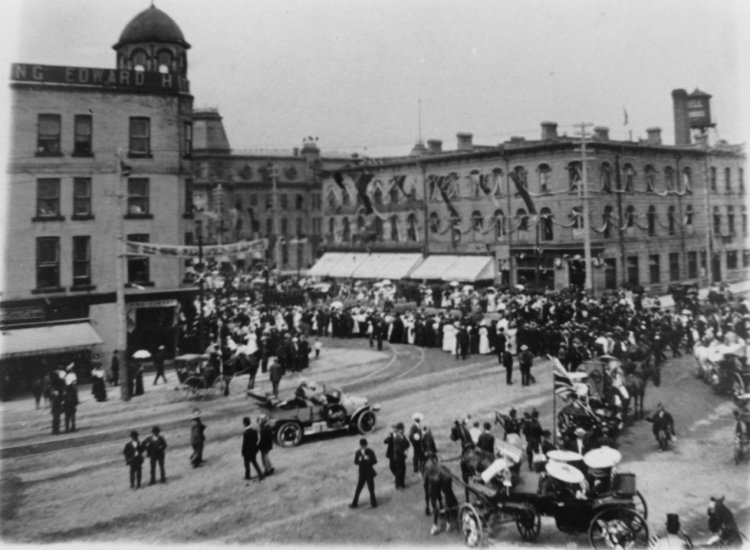
The parade of automobiles during the Old Home Week of 1913 perhaps helped to push this transition in Guelphites' thinking. Indeed, automobiles can be seen lurking in postcard views of the occasion, such as the three below.


There is a nice photo of Russell Daly, a newsseller and tobaccanist in St. George's Square, with his new Studebaker in 1913.


(Courtesy of Guelph Public Library; F38-0-10-0-0-5.)

Daly later operated the Pioneer Bus Line with routes as far as Mount Forest.

Earlier photos of automobiles in Guelph are more difficult to come by. A picture of Carden street during the Old Home Week of 1908 shows a car involved in the proceedings in front of the old City Hall.


(Courtesy of Guelph Public Library; F38-0-15-0-0-459.)

Going further back, there are a few contenders for the earliest car owned by a Royal City resident. Provincial automobile registration records for 1903 (when registration was first required) identify the following Guelphites as car owners:

Name Make License No. Address Occupation
Geo. Williams Cadillac runabout 121 107 Wyndham Baker
John McHardy Autocar (4 seats) 144 96 Glasgow Butcher
L.C. Wideman Conrad (4 seats) 177 16 Arthur Architect

George Williams's claim is supported by the photograph below of a woman in what may be a driving cap seated behind the wheel of a car.


(Courtesy of the J.W. Kelleher collection.)

The back of the photo has the following annotation:

Cadillac, Ada Walker at the wheel; first car in Guelph. // 1902 Cadillac Ada Walker at the wheel of the first car in Guelph. // From E. Hart
The car does appear to be a Cadillac Model A, sporting head- and side-lamps, although it is clearly a four-seater and not a runabout and was first available in 1903. The Evening Mercury (28 Apr 1923) says that George Williams and George Walker got a car between them, so it may well be that Mrs. Walker drove the car too. Mrs. Walker's given name was Ida, so the name on the annotation may represent a slight confusion. (The Walkers had a 10-year-old daughter named Agnes, often known as Ada, which may explain this issue.)

John McHardy's claim to the distinction of first car-owner of Guelph is backed up in the Evening Mercury (20 Jun 1921). It says that, in 1901, Mr. McHardy, a former alderman and co-owner of a pork-packing business, had a garage built especially to house his new toy. The Autocar was the first shaft-driven automobile, had a two-cylinder motor, and was steered by a crank handle on the left-hand side of the car.


(Courtesy of the American Museum of National History.)

However, the Evening Mercury (28 Apr 1923) identifies Major Louis Wideman as the first car owner of Guelph. Wideman was a prolific builder responsible for many structures still standing in the Royal City, as well as an officer in the local militia. The car was described as a "one cylinder affair, of the crude touring body type then in vogue" while the registration records describe it as a Conrad four-seater. Altogether, it sounds as though the car may have been a Conrad Touring Car. The Conrad Motor Carriage Company, of Buffalo, originally produced steam-powered cars but began producing gas-powered ones in 1903, including the Touring Car.


(Courtesy of Grace's Guide to British Industrial History.)

Of John McHardy, the 1923 articles describes him as, "another early motorist, and from the first an enthusiast." The paper goes on to repeat an interesting story about his early experiences, with the proviso that it may be apocryphal:

Whether true or not, it is said that on one occasion, while driving along the Brock Road (Gordon street), he was about to overtake a wagon, in which there were a man and his wife. The team stopped and the woman climbed down from the high seat and ran to the side of the road. Mr. McHardy pulled up his car and one of the party got out and went ahead to hold the horses. The farmer was not at all alarmed about them though, and jocularly remarked, “I think I can hold the horses if you will hold my wife.”
The 1921 article relates another story about the attitude of local farmers to McHardy's vehicle, though of a different tenor:
Mr. McHardy informed the Mercury today that at the time he purchased his first car, the farmers in the vicinity of Guelph were so anxious to see the wonderful invention, that they often ‘phoned to him from miles around wanting to know in which direction he was traveling with his bus on the following Sunday.
Perhaps McHardy was exaggerating or did not fully comprehend why local farmers were concerned about his travel plans. In any event, it is unclear how literally we should take his claim to be absolutely the first car owner of Guelph.

Clearly, though, early automobile ownership was not easy or straightforward. For example, the 1923 article relates a tale about J.W. Lyon, another early car enthusiast, and his encounter with a farmer who did not look kindly upon his contraption:

On one occasion when he was on his way home with a party late at night they got lost. The country roads were not then known so well to drivers as they are now. They stopped at a farmer’s house to ask directions, but the farmer obstinately refused to give these, and they had to get the necessary information elsewhere.
As this anecdote suggests, many Ontarians, rural or urban, viewed automobiles as playthings of a wealthy elite, whose only effect on them was to run them down or frighten horses unnecessarily during heedless jaunts down country lanes.

Early news about horseless carriages could be unpleasant. On 8 Aug 1902, the Mercury carried the news that Mrs. Annie Merlihan, a long-time Guelphite who had relocated to Chicago, had been killed rescuing her daughter Genevieve from being run down by an automobile (Globe, 9 Aug 1902). After pulling her daughter out of the vehicle's path, she was herself run down and her skull crushed under the hooves of a horse that the car had just frightened. The occupants of the car did not stop, perhaps unaware of the carnage in their wake.

Complaints about dangers from automobile use became a regular feature in the Mercury, such as the following letter to the Editor (14 Nov 1904):

Dear Sir—As I was driving home from church to-day, Sunday, the 12th inst., I very near had a serious runaway accident by an automobile driven by some citizen of Guelph. In all justice and Christianity they should have waited until people attending church could get home. There should be a law prohibiting the horrid and dangerous nuisance from the public highways. An elderly lady in Guelph had her arm broken by the same nuisance causing her horse to run away.
There were occasional attempts to sabotage automobile travel in the township, as when a log was thrown across the road at night in Eramosa, apparently with the intention of causing a wreck (Evening Mercury, 13 Sep 1912).

Of course, the situation changed as more people drove cars and government efforts to pave the roadways made travel by automobile easier and more reliable. As noted above, registration of automobiles surged around 1913. In 1922, the Guelph Motor Club was formed, which lobbied for road signage, paving, and construction of intercity highways. As the automotive age began, Guelphites took a last look back at the time when horseless carriages were an oddity whose future was far from certain.


For more information on the early history of automobiles in Guelph and Ontario, see:

Wednesday, 30 October 2019

T.J. Hannigan: Power and politics—and postcards

Thomas Joseph Hannigan was a runner: He ran in road races, he ran businesses, he ran lobby and special interest groups, and he ran for office. He was an important figure in Guelph in the first four decades of the twentieth century. Plus, he sold a few postcards along the way.

Thomas Joseph (very often abbreviated to "T.J.") Hannigan was born on 6 Nov 1869 in Campbellford, Ontario, to John and Ellen. The family moved to Guelph in 1888 (Mercury, 27 June 1940). The 1889 city directory lists John as a tinsmith and young Thomas as a "finisher". The 1891 directory specifies Thomas's place of work as the Bell Organ factory, where he likely finished the organ cabinets.

Hannigan was a joiner in more sense than his work in carpentry. He quickly became involved in various community organizations. In 1891, he is noted as a participant in a minstrel show put on by the Guelph Catholic Union (Mercury, 30 Jan. 1891). He performed in a number called "Africans Bluebeard" described as a musical burlesque. (It's quite possible the performance was in blackface, which would be a liability for a future politician today but was unremarkable for people like Hannigan in that era.)

In 1892 and 1895, Hannigan is listed as an officer of the Canadian Order of Foresters, Court Wellington, No. 180.

In spite of his growing involvement in the social life of the Royal City, sometime in the mid 1890s, Hannigan moved to Plattsville, where he became a hotelkeeper. No doubt this move was a step up the ladder of success, working for himself rather than an employer.

In spite of the move, the connection with Guelph was not severed. In 1895, Hannigan returned to the Royal City to wed local girl Mary Tait in the Church of Our Lady (Mercury, 3 July 1895). The next year, Hannigan's father John died in Plattsville and was buried in Guelph. By 1901, Thomas and his new family had returned to the Royal City.

It seems that Hannigan was a fan of the sport of running. Once back in Guelph, he helped to found the Guelph Cross Country Run and Road Race Association (Mercury, 27 June 1940). With a time-out during the Great War, this association organized running competitions in Guelph, focussed on a set of road races on Thanksgiving Day. Hannigan's interest seems never to have wavered:

He has served as president, General manager and treasurer of this association on numerous occasions. Last year [1939] he was president again. Mr. Hannigan was also president of the Guelph Track Club.
From 1902, city directories list T.J. as the manager of a billiard hall, situated at 1 Wyndham Street, apparently on the second floor of what was the southern half of the Macdonald Block. From its windows, gentlemen at leisure would have had a splendid view of Jubilee Park, old City Hall, and the marketplace.


It appears that T.J. remained in this business until about 1910. It was during this time that he dabbled in the contemporary postcard craze. I am aware of two postcards marked "Published by T.J. Hannigan" on the back, one of St. George's Square and the other of the Church of Our Lady, where he was married. Note the distinctive handwriting featured in the captions below.


Neither card provides a printers name and neither image is unique to T.J. Hannigan. The image of the Post Office in St. George's Square can be dated to about 1904, as the third storey was added to the building in 1903, and the clock added to the empty portal in the tower in 1905. Neither postcard has been postally marked. One card, not in my possession, bears a postmark 16 Jan. 1906.

Further postcards featuring similar captions also exist. All of these have a generic "Private Post Card" logo on the back. Three cards, featuring views of the Court House, Speed River, and Macdonald Institute, have no publisher's or printer's marks. Another six cards are marked "W.G. MacFarlane," a Toronto publisher of the era. These cards feature views of St. George's Church, the Carnegie library, the General Hospital, and the Ontario Agricultural College (OAC). Cards in this set have postmarks from 3 November 1905 through 20 September 1906.

Here is a card of a man canoeing on the Speed River, probably north of the dam in Riverside Park. It has no publisher's or printer's mark.


Here is a card of the barns at the OAC. They were situated where Rozanski Hall lies today, as seen looking down Trent Lane from the north. Cards like this one are marked "W.G. MacFarlane" on the back.


Indexes on the back of these cards are marked A.103, A.105–108, and A.110, suggesting that A.104 and A.109, at least, are still to be found.

It may be that Hannigan decided to sell some postcards in his billiards hall as a side hustle, not an unusual arrangement at the time. He obtained them from W.G. MacFarlane and made them available from late 1905 and into 1906. Perhaps he saw the MacFarlane cards for sale in other businesses and ordered a few specially made for him. Alternatively, he may have sold cards from MacFarlane and perhaps others, not bothering to personalize them except for one small run.

It is hard to know for sure. It seems likely, though, that Hannigan took only a brief interest in the trade. He had other matters on his mind.

Hannigan was also involved in the organization of the Old Home Week festivities in 1908. In particular, he produced the official, souvenir program for the event, which featured views from his postcards and a lovely photo of himself.


(T.J. Hannigan, from the 1908 Old Home Week Souvenir booklet. Courtesy of Guelph Civic Museums, 1973.23.26)

The caption notes that the booklet was a sample of Hannigan's advertising. Presumably, this reference is to a business in which he was involved, although I am not yet sure what that was. It may be that his interest in postcards and in advertising at that time were somehow related. It was just as well that he was branching out.

On 17 Dec. 1909, a fire gutted the Norrish block on the Market Square (now Carden St. west), including Hannigan's pool room on the third floor (where it had been recently relocated). It was time to put the billiard business behind him. Hannigan began a new business venture, running "McDougall & Hannigan," a real estate and insurance company. In 1913, the partnership was dissolved and Hannigan operated the business on his own account. He remained in this line of work for the remainder of his life.


(Advertisement for MacDougall & Hannigan, "The men who sell real estate" from the Christmas edition of the Mercury, 1910. The address "just around the corner" seems cryptic; the city directory gives the address 89 Quebec Street East—now part of the Quebec Street Mall. Also, is it just me or does it appear that the photos are mixed up?)

Hannigan's interests in real estate in the Royal City seem to have been widespread. Irwin (1998) notes that he was involved in the disposition of properties such as Wheeler Avenue in the Ward, and Chester and Stanley streets near Exhibition Park. Plans in the University of Guelph archives associate him with developments near St. James's Church and Crimea Street.


(Ad for Hannigan's real estate business, "He knows." From the Industrial edition, 1915.)

The property that Hannigan was most involved with was Wellington Place (or Boulevard, later renamed Riverview Drive and Waverley Drive), on the east side of Riverside Park. The city directory gives his address as Wellington Place starting in 1922. There, he named his house "Athlone," presumably after the town in central Ireland where, it may be, that the Hannigan family originated.

His tenure there was not untroubled. On 7 May 1928, Hannigan was awakened at an early hour to find that his house was on fire and his bedroom filled with smoke (Mercury):

When the pungent, penetrating fumes of smoldering wood aroused him, Mr. Hannigan, clad only in his pyjames, hastened to the upper portion of the back verandah, and climbed down a post to the ground. Securing a ladder, he placed it against an upstairs window, and re-entering the smoke-filled room, assisted Mrs. Hannigan, who was dazed from the fumes, to the outside of the house.
Although there was considerable damage, Hannigan probably had the house insured. Evidently, it was repaired and he remained there for the rest of his life. Hannigan's special fondness for flowers is apparent in the remark in the article that "many valuable bulbs stored in the cellar were ruined."

Hannigan became politically active. He was elected an alderman for St. John's ward in 1913 and 1914, and in 1919 and 1920. He joined the local Conservative Party and took on a leading role. In 1937, he opposed the nomination of local boy (and future Ontario Premier) George Drew for the South Wellington seat. Rumors swirled that Hannigan would run as an Independent Conservative or that he had already prepared cards listing him as a Farmer-Labor candidate (Globe, 29 Sep. 1937). Hannigan stated that he could neither confirm nor deny the rumors, although he did not run in the end.


(George A. Drew; courtesy Wikimedia Commons)

Hannigan also threw his hat into the ring as Conservative nominee for the 1939 federal election, although he was superseded by Lieut.-Col. C.D. Crowe (Globe, 16 Aug. 1939). He put his name forward again as a National Government candidate in 1940 but again was unsuccessful (Globe, 23 Feb. 1940). At the age of 70 years, he clearly had not lost his enthusiasm for the political life!

During his life, Hannigan was best-known for his role in the development of Hydro power. In the late 19th Century, cities in southern Ontario, including Guelph, had adopted electricity for illumination, powering factories, and private use. Electricity was generated locally, near where it was consumed. In the early 20th Century, power stations were built at Niagara that could generate enough power to run many cities. Distribution of Niagara power constituted the beginning of the electrical grid that we know today.

One important matter concerned ownership of the grid. Would Niagara power be owned and distributed by private companies or a public utility? The campaign for public ownership was led by London M.P.P. Adam Beck, later knighted for his efforts. Organizations including the Hydro Electric Railway Association of Ontario and the Ontario Municipal Electric Association were quickly formed to push the program forward.


(Sir Adam Beck, ca. 1902 as Mayor of London; courtesy of London Public Library)

In Guelph, the public option was broadly preferred. As Stephen Thorning pointed out (2000), the Royal City was pleased with its own track record with its city-owned power utility and the Guelph Junction Railway. Prominent Guelphites organized to support the public option, led by millionaire publisher and civic booster J.W. Lyon, who became president of both Railway and Electric associations.


(J.W. Lyon; Men of Canada (1891, p. 230).)

Hannigan joined both efforts in top positions, such as secretary, treasurer, or both. He took over leadership from Lyon after the latter retired from the fray in the mid-1920s. He continued to promote public ownership of utility for the rest of his life, defending it against encroachments on its turf. He was successful in maintaining public ownership of the grid, although efforts to electrify the inter-city railway system did not bear fruit.

Hannigan's tenure in the Ontario Municipal Electric Association was not without controversy. Liberal leader and Premier Mitchell Hepburn accused the Association of being a "slush fund" used by Hannigan to oppose the government and conduct shady insurance deals (Globe, 13 Aug. 1934). Certainly, Hannigan was a staunch Conservative. However, such allegations were never substantiated, so far as I am aware.


(Mitchell Hepburn; courtesy of Wikimedia Commons.)

No account of T.J. Hannigan's life would be complete without some mention of his passion for flowers. He was president of the Guelph Horticultural Society for many years, and also the Ontario Horticultural Association (Mercury, 27 June 1940). He was a particular authority on gladioli and entered his blooms in many competitions.

For example, Hannigan won many awards in the second annual exhibition of the Ontario Gladioli Society, held at the Ontario Agricultural College in Guelph and attended by gladioli gurus from across the continent (London Free Press, 23 Aug. 1923). Hannigan triumphed in the categories of Best six spikes Pink Perfection, Best three spikes smokey, Best six spikes yellow, Best six spikes pink; and second place in Best 12 spikes Le Marechal Foch (Holland variety), Best three spikes variegated, Best six spikes blue, Best three varieties three spikes each, and Best 12 spikes golden.

Hannigan also became Secretary-Treasurer of the Simcoe Tobacco Plantation Ltd. in 1930 and director of the Ontario Flue-Cured Tobacco Marketing Board. It seems that he was Catholic not only in religion but in botany as well.

T.J. Hannigan died in 1940 and was buried in Marymount Cemetery (Mercury, 27 June 1940). The Guelph Cross Country Run and Road Race Association decided to name its one-mile Thanksgiving Day race the "T.J. Hannigan special race" in his honour (Mercury, 24 Sep. 1940). Certainly, it was a fitting tribute for a man who enjoyed running so much.


(Guelph Cross Country & Road Association Annual Meet, 1909. Hannigan is seated in the front row, extreme left. Courtesy of Guelph Civic Museums 1981.212.1.)