Showing posts with label David Allan. Show all posts

Saturday, 6 June 2026

The early days of Guelph's county courthouse

A courthouse is both a practical and symbolic structure all at once. This is certainly true of Guelph's historic courthouse. Not long after the building's completion in 1843, Major Thornton, a visitor to town, made the following observations relating to it:
Aug. 16th. [1849]—Visited the Court-house where the sessions are held, and where the Sheriff and the Treasurer (Col. Hewat) have their offices. It is a solid stone building, with a district prison behind it. How do prisons proclaim the general depravity of human nature! Go where you will, you find prisons. Walked about the town of Guelph; the locality is diversified and intermixed with verdure and trees, and surrounded at the distance of half a mile and with the wild native forest, with cultivated clearings here and there. From the eminence opposite to the Court-house, the prospect is delightful, and Guelph truly appears “beautiful for situation.”
The Courthouse, and jail, are testimony both to the assertion of the law as established by government and to the tragic failure of the citizenry to live up to their legal obligations. (The justice of the law itself the Major sets aside in his remarks.)

Major Thornton says little about the appearance of courthouse but notes that it is well-situated. Anyone overlooking Guelph from "the eminence opposite" ("Grange Hill" today) would note the centrality of the courthouse on the town site. It's placement on rising ground across Woolwich Street from the Speed River gave it physical prominence in keeping with its social significance. Added to this significance is the neighbouring jail, speaking to the potential stakes involved in judicial proceedings, not excluding the administration of capital punishment.

It was not inevitable that Guelph should have a grand courthouse at all. In the eyes of the British administration, the Guelph region was initially part of the teutonic-sounding District of Hesse, created in the wake of the American Revolution. Court proceedings for the expansive district were held in Detroit, until that was handed over to the United States in 1794.

(The Gore District, detail of "A map of the province of Upper Canada describing all the settlements and townships &c. with the countries adjacent from Quebec to Lake Huron," 1818. Courtesy of Toronto Public Library 912-713-S51-21.)

When Guelph was founded in 1827 by John Galt, it was considered part of the Gore District (founded in 1816, named after Francis Gore, then the Lieutenant Governor of Upper Canada) with its seat in Hamilton. Some Guelph worthies were appointed as Commissioners of the Peace (think "Justice of the Peace"), namely William "Tiger" Dunlop, Col. Lampray, and Messrs. Pryor, Brewster, Hodgert, and Strange, who were empowered to handle minor criminal matter locally, either individually or in panels in the Court of Quarter-Sessions. Minor civils suits were adjudicated locally by the Court of Requests.

No special building was required for these matters. Indeed, legal proceedings were held at the British Coffee House initially. This arrangement was not unusual in Upper Canada: the convenience of holding court proceedings in a tavern buliding need not be elaborated.

However, major legal proceedings were undertaken in Hamilton, the district centre. For example, trials of people accused of aiding and abetting William Lyon Mackenzie during the Upper Canada Rebellion of 1837 were held there. Difficulties experienced in arranging for prisoners and witnesses from Guelph to attend proceedings in Hamilton over poor roads, in bad winter weather, and with lacklustre accommodations illustrated the deficiences of the District's legal arrangements.

(Detail of "Canada West formerly Upper Canada," 1841. Courtesy of Toronto Public Library Digital Archives 912-713-M39-SMALL.)

In 1840, the government shuffled the cards again. Guelph became part of the new District of Wellington, which included not only today's Wellington County but also much of today's Grey, Bruce, and Waterloo counties. The new district would require a courthouse in keeping with its role as the regional seat of justice. Supporters of Berlin (Kitchener), Fergus, Guelph, Preston and Waterloo argued for their towns to be declared the district capital. In the end, Guelph won and the Act stipulated that it should be the judicial seat of the new district as soon as a suitable courthouse could be inaugurated.

Perhaps, in keeping with Major Thornton's concerns about the depravity of humanity, a jail was built first, starting in 1839 and being completed the following year. In terms of design, it is notable as one of Guelph's few octagonal structures, later joined by the "Palace" in Exhibition Park.

("Detail of the Court House and circular jail from "Guelph, Canada West 1853." Ink and pencil on paper by D.J. Kennedy, 1853." Note the octagonal jail to the left of the courthouse. Courtesy of Wellington County Museum and Archives A2009.42, ph. 30416.)

Construction of a new courthouse did not commence right away. Court proceedings were held at the Suffolk Hotel (corner of Gordon and Fountain Streets), where rooms upstairs were converted for use as a court room, judge's chambers, etc. After this hotel burned down, it was replaced by the Red Lion Hotel (later Fountain House, which survives to this day). The fire may have persuaded the building committee to get on with construction of a new, more dignified and less combustable structure. Construction was set in motion in 1842 and the edifice completed in 1844.

There is some ambiguity as to who designed the structure. James Innes (Mercury, 8 March 1866) implies that the designer was Thomas Young, the Toronto architect who is known to have designed the jail. However, as Ken Seiling (1980) points out, no firsthand record explicitly identifies the architect of the courthouse in particular. It seems likely, though, that the building committee in charge of both structures bought the plans for the jail and courthouse from Young at the same time.

Having said that, some local reports name local builder and architect David Allan as the designer. Guelph notable John Higinbotham (1933) relates the following:

David Allan studied architecture with Sir David Bryce, but did not practise it as a profession, although he designed and superintended the erection of the Court House, Saint Andrew’s Church and his own mills in Guelph, all of them monuments of stability and most graceful in their lines.
David Allan was Higinbotham's grandfather. Perhaps the intervening years enlarged his grandfather's role in the matter of the courthouse.

Other records name a few individuals who, along with David Allan, were involved in construction of the courthouse. The Wellington County Historical Atlas (1906) notes that John Black "assisted to build" both the jail and the courthouse. Arthur McQuillan, a noted local builder, recalled that his father James the stone mason had a hand in building the courthouse along with many of Guelph's other early, stone buildings (Mercury, 28 April 1923). Also, Thomas McBride, resident of Guelph since 1828, worked on the courthouse in his capacity as a carpenter (Mercury, 20 July 1927).

("Sketch of Guelph looking west towards Wellington County Court House, ca. 1850." This image provides a nice view of the courthouse in its early context (just above and right of the centre of the image). Courtesy of Wellington County Museum and Archives A1985.13, ph. 6854.)

The style of the architecture has been described as "Regency—Romantic stream" (MacRae 1983), meaning that it has a symmetric facade (more or less classical in inspiration) but incorporates a number of gothic elements, including battlements, corner towers, and stone construction. In terms of the motivation of this style, MacRae (1983, p. 259) states that it "could produce an expression of modern sophistication and yet imply dungeons," which does seem to fit. As such, Guelph's courthouse was only the second courthouse in Ontario designed in this style, the first being the London District (now Middlesex County) courthouse in London, Ontario.

MacRae (1983, pp. 104—105) provides a nice description of the new building's configuration:

Young designed the second Upper Canadian castellated courthouse around its ceremonial heart, the courtroom. Externally, he expressed this by buttressing the centre with four protective towers, the northern pair serving as stair towers and having matching entrance doorways in their bases. The central space above the courtroom was designated for the sittings of the grand jury, still a large and important body in 1837. All windows in the north facade of the Guelph building were large, their transoms and French casements glazed with leaded, diamond-shaped panes. Both the judges and the magistrates were comforted by fireplaces, as were the sheriff and court officials in the rooms overhead. The second floor office of the district treasurer contained the only provision planned in 1837 for the safe-keeping of documents or money: a shallow recess in the thick stone partition wall, fitted with an iron door. The south-east tower housed the constables on the ground floor, near the door in the courtroom leading to the jail. They shared their space for a time with the "court housekeeper," or janitor, one of whose duties was to see that the courtroom floor was thickly strewn with fresh sawdust during the Assizes—an oblique comment both on the state of the District roadways and on the prevalence of tobacco chewing among the spectators.
The accompanying figure gives a basic overview of the building's elevation and plan:
Note that the courthouse was also octagonal in plan, which would be easy to miss when looking at the building from outside.

Readers familiar with the courthouse today will note that it now appears considerably different. Indeed, repairs and renovations began when the structure was only a few years old. These are discussed in detail by Seiling (1983). Major renovations and additions were undertaken in 1850, 1873, 1953, 1955, 1963, and 1982.

("The Court House, Guelph, Ont." Illustrated Canadian News, 21 February 1874, p. 124. Courtesy of Guelph Civic Museums 1981.304.3.)

The horse-head hitching posts that appear in front of the courthouse in many older illustrations were installed in 1877.

("Court House, Guelph, Ontario," ca. 1900, from a set that may have been prepared by Guelph postcard pioneer Oran Turbnull.)

The postcard above provides a typical view of the courthouse from down Woolwich Street. The jail is visible to the left, and three men can be made out standing at the front entrace. The hitching posts are still evident by the roadside. The national flag flies from a pole on the roof. The postcard has the older, undivided back format with a message written on the front: "The compliments of the season to Mr. and Mrs. Church. // John Simpson" The card was sent to Mrs. Church of Victoria, BC, on 24 December 1904. If it were not for the date, the postcard could be understood as an ironic notification of the launch of a lawsuit, "compliments" of the sender. Instead, the card serves to remind us that people often paid little attention to images on the postcards that they sent for correspondence.

("Court House, Guelph, Ont." ca. 1910. Published by the Valentine & Sons Co., Toronto.)

The postcard above provides a similar view, although it has been colourized and the jail behind the courthouse seems to have been removed from view. What appears to be a curious sort of large faucet is visible in the centre foreground by the side of the street. Was this fixture some sort of hydrant? Horse-watering convenience? The postcard was sent on 7 September 1909 to a Miss A.E. Scott in Tasmania with the message: "Many thanks for pretty postal[.] hope you like this one. I have been away on my holidays or you would have got an answer sooner. ans soon [sic] Reg" The message suggests that this image was chosen deliberately. Perhaps Miss Scott collected postcards of courthouses. It seems likely that she was a stamp collector too—putting the stamps on the front would allow them to be visible if the postcard were pasted into an album, as many were.

("Court House, Guelph, Canada." ca. 1910, published by Charles Nelles, a notable purveyor of postcards of the Royal City.)

The postcard above provides a view of the courthouse from up Woolwich Street. One prominent feature in this postcard is the substantial mast planted in front of the courthouse. Although we cannot see the top, it may have been put there in lieu of the flagpole that was evident on top of the courthouse in earlier images but now seems to be missing. A standard fire hydrant can be glimpsed behind a horse-head hitching post in the lower, centre foreground. A group of four young men can be seen sitting about the courthouse's front door. Hopefully, they were not planning anything that would get them into trouble.

The courthouse had a near death experience in the late 1970s when Wellington County considered doing away with it as part of plans to modernize their operations. Happily, the Local Architectural Conservation Advisory Committee was able to persuade the County to "recycle" the building and request that the City of Guelph give it a heritage designation, which was accomplished in 1980.

("Court House, Guelph, Can." published by the International Stationary Co., ca. 1915.)

This image was probably taken at the time of the Old Home Week Guelph in 1913. Note the people in good clothes heading up Woolwich Street. The street also sports a new lighting system and the stairs connecting the street to the sidewalk in front of the Court House. The card was mailed on 23 September 1914 and conveys some sad news: "My dear[,] just a line to tell you our barn was burnt down last night[.] all we could save was the horse and buggie and pigs[.] it was struck with lightning and was burnt down in about 15 minutes. Clara" This incident is what lawyers would call an Act of God.

Naturally, the courthouse was the site of many trials and other legal proceedings. The most discussed of these were the ones that involved capital punishment. The first of these was the trial of Charles Coghlin in 1847, who was accused of the murder of Richard Oliver in the course of a fight. Coghlin was found guilty and hanged from a gallows erected for the purpose outside of the courthouse. This and later examples are discussed by Irwin (2002).

While the primary function of the courthouse was to serve as the locus for regional legal proceedings, the courthouse made itself available for a variety of civic functions. One such function was as a place of worship. In 1851, for example, the Parochial Association of St. George's Church was held in the courthouse, apparently to the satisfaction of all concerned.

("Herbert Purdy as a Baby, circa 1925." Was Herbert marked from an early age for a life of crime? A career in law? Note the street cleaning cart in the background. Courtesy of Guelph Civic Museums 1982.98.46.)

After the original St. Andrew's church on the Market Square was purchased by the town fathers to make way for the (old) city hall (now the site of the Ontario Court of Justice!) in 1856, the Presbyterian congregation met in the courthouse until their new building on Norfolk Street was completed two years later.

As noted in my earlier post on the origin of Chalmers Church, the congregation of Knox Church split up in 1869, apparently due to division regarding the behavior of their minister, the Reverend Ball. The breakway faction, no longer willing to congregate under the same roof, undertook to build their own, which became Chalmers Church, only a few doors down Quebec Street. Of course, churches cannot be built at the snap of a finger, so the rebel faction met for worship in the courthouse until 1871, when their new edifice was complete.

Besides providing space for religious observance, the courthouse served several other important functions. For example, it provided chambers for the Guelph and County councils until those bodies arranged to build dedicated structures of their own.

(Mouse pad showing the Wellington County Administration building, formerly the courthouse, ca. 2005. Courtesy of Wellington County Museum and Archives 2014.7.1.)

As the first "monumental" government structure raised in Guelph, the courthouse was the place to hold or to bless important events. For example, when the first train to visit Guelph arrived on the new Grand Trunk Railway tracks downtown on 30 January 1856, the party of dignitaries, including the Governor General, that arrived aboard her was escorted to the courthouse for a celebratory round of speeches. After that, the party retired to the British Hotel for libations.

On 18 September 1856, when the cornerstone of the (old) city hall was laid, the Town Council, contractors, and various well-wishers assembled at the courthouse and, led by the band of the rifle corps, marched in procession to the site of the new building. It seems that the glamour of the old building was needed to add to the dignity of the new one, something that was best conveyed physically by a procession.

In his history of Guelph, A.E. Byerly (1935, p. 95) notes that some concerts were held the courthouse, for example:

In 1857 efforts were started to build a rectory for the Catholic clergy and James G. Moylan advertised a Bazaar and Concert for Easter evening, April 14, 1857, at the Court House, to raise funds for the building.
Did the conductor use the judge's gavel?

Finally, the Centennial issue of the Mercury (20 July 1927) notes that the courthouse had a lawn bowling team!

While the Guelph Bowling Club is the oldest organization and boasts the largest membership, other flourishing bowling bodies are the Court House, Hillcrest, Reformatory and Homewood. These clubs are all fortunate in having excellent greens, and inter-club matches which are arranged from time to time always create considerable interest.
Did the courthouse team have an advantage? Imagine disputing calls with a teams of judges. (The courthouse, now the Wellington County Administration building, today. Courtesy of Google Street View.)

Things have changed a great deal for the courthouse since Major Thornton's visit in 1849. It has perhaps become less noticeable as its environs have filled in with other structures. It is now an office building that plays a less obvious role in the civic life of the county than it did as a courthouse. It hasn't featured on a Guelph postcard for quite some time. Still, unlike other old Guelph buildings, such as its former neighbour the Priory, it has adapted and survived and invites us to recollect its role in the judicial history of the Royal City.


Works consulted include:
  • Allinson, C.L.C. (1967). "Courts and Court-buidings at Guelph."
  • Burrows, C.A. (1877). "The annals of the town of Guelph."
  • Byerly, A.E. (1935). "The beginning of things in Wellington and Waterloo Counties."
  • Higinbotham, J.D. (1933). "When the west was won."
  • Irwin, R. (2002). "Capital punishment in Wellington County." Wellington County History 15:31–44.
  • Seiling, K. (1983). "Wellington County Courthouse: A link with the past." [Wellington County Museum and Archives A2008.112]

Sunday, 30 January 2022

You would enjoy this sport: The Snow Shoe Club of Guelph

A propos of the winter season, this postcard was sent by A.N.B. from Guelph to Kathleen Tate of Bedford, Pennsylvania, on 21 December 1911.
A.N.B. writes cheerfully, "You would enjoy this sport. Hope you have a very merry Xmas and a Happy New Year." As the caption notes, the sport depicted is snowshoeing.

The card was printed by the large British publisher Raphael Tuck and Sons beginning in 1908. It was not a Guelph scene. In fact, it was adapted from a photograph taken by noted Montreal photographers William Notman & Son (Courtesy of the McCord Museum of Montreal, VIEW-3613). It was made to resemble an oil painting; thus the descriptor "Oilette" in the bottom-right corner.

The photo's title is, "A snowshoe tramp on the river ice, Montreal, QC, 1903." No doubt, it depicts members of one of the many Montreal snowshoe clubs out for one of their regular outings.

Snowshoeing, of course, was nothing new in Canada. French soldiers, farmers, coureurs de bois and voyageurs all learned to use snowshoes from the Indigenous peoples they encountered. Members of the NorthWest Company learned it from them. In their day, using snowshoes was a necessity for getting around in wintertime.

("Indiens voyageant en raquettes avec un traƮneau," Cornelius Kreighoff, ca. 1856. Courtesy of Library and Archives Canada, C-013458.)

As the nineteenth century wore on, the need for snowshoes declined. Lower and Upper Canada were becoming increasingly settled so that road networks and sleighs, then railways, tended to sideline snowshoeing as a form of winter travel. So, it was in 1840 that the Montreal Snow Shoe Club (MSSC) was formed to promote snowshoing as a sport and leisure activity.

Enthusiasm for the sport increased and reached a peak in the 1880s, when there were about 25 clubs in Montreal alone and dozens more throughout the country. Guelphites fell into line and the Guelph Snow Shoe Club was formed in 1882.

The Club kept to a regular schedule. One night each week of winter, club members would convene at a conveient site, often the Wellington Hotel, and set out for a "tramp," often to the house of someone who had invited them for the purpose.

For example, the Mercury (6 January 1883) describes a first-season tramp in some detail. Club members mustered at the residence of J.D. Williamson, across London Road from what is now Exhibition Park. At about 8pm, they tramped about 2.5 miles due west then "circled" to the south and called at the residence of Mrs. Armstrong, who was "delighted at the visit" and well prepared:

She extended the club the most cordial hospitality, and correctly perceived the preference of her company in the way of refreshments, when she set before them such a quantity of milk as would have seemed enormous in the eyes of men with ordinary appetites, but which so quickly disappeared before the sharpened appetites of the snow shoeists that one of their number was led to remark, it must have reminded the lady of calves in the spring-time.
The men departed and returned to the city at about 11pm, having covered about 5 miles in all.

The trip relates many of the attractions of snowshoeing as it was then practiced. The physical activity was cold but invigorating, which increased the snoeshoeists' relish for their pit-stop refreshments all the more. Navigating in the dark had its pitfalls:

Rough fields, with a snow drift here and a bare spot there, a hill in one place and a hollow in another, are not the most easy places traversed in the darkness, even with a pair of snow shoes as a means of locomotion. This was verified by numerous falls, and one of the tourists was unfortunate enough to tumble into a gravel pit, half filled with soft snow, in which he was almost buried out of sight.
Enduring these little setbacks was all part of the fun.

Of course, snowshoeing provided some enjoyable social opportunities. Besides being entertained by hosts, club members often entertained each other with song and competition. Consider one evening spent at the popular camp site called The Rocks (now the quarry site on the Reformatory lands; Mercury 30 January 1885):

About twenty-five members of the Guelph Snow Shoe Club went for a tramp last night. The snow was in splendid condition and the boys enjoyed themselves immensely. Taking a cut across the fields they struck the river at the Water Works and followed it up to the Rocks. There they lit a fire, and after enjoying themselves smoking and listening to some excellent songs by the Captain and others, they marked off a hundred yard track and had some exciting and closely contested snow shoe races.
Although certainly boisterous, Club events could be quite civilized. For example, a social event was held at "Springfield" (the farm of James Anderson, to the southwest of town) to raise money for the purchase of an organ for St. Andrew's church. The chief feature of this soirée was a musical programme including instrumentalists, soloists, and an ensemble of the choir. Although late, due to have gotten lost, the Snow Shoe Club arrived to play its part (Mercury, 13 February 1885):
The Snow Shoe Club which tramped out during the evening added a very interesting part to the programme. They signalled their arrival by singing the well known glee “There is a letter in the candle.” Their singing was heartily enjoyed and they presented a very pretty appearance as they stood around together with their blanket coats and tuques.
"There is a letter in the candle" seems like a charming tune. I cannot locate a recording but there is sheet music if you'd care to try it out.

The passage also mentions part of the snowshoeist's uniform: Blanket coats and tuques. In full, the dress consisted of a white blanket coat tied with a sash, tuque, leggings and moccasins.

("Snowshoer running, Montreal, QC, about 1875." Photograph by William Notman. Courtesy of McCord Museum VIEW-1018.1)

Different clubs often distinguished their uniforms with particular colours of hats, sashes and leggings, as well as special epaulettes and badges. Happily, David Allan jr., who was a member of the Club, later drew a picture of a member of the Guelph club (1936/2012, p. 97):

The figure wears a dark blue tuque, sash, and leggings, along with red epaulettes and trim on his coat, suggesting that these were perhaps the Club markings.

Besides uniforms, showshoe clubs adopted other aspects of military organization. In addition to presidents and board members, clubs had Captains, Lieutenants, and Whippers-in, whose job it was to direct the other members during tramps. The Whipper-in job was take up the rear of the column and ensure that no one got lost or left behind.

Also, snowshoe clubs were predominantly male. Board members and officers of the Guelph Club were all men, which seems to be typical. There is no mention of women joining the tramps, although women certainly did go snowshoeing. In some clubs, women would go for shorter excursions or join the men for part of theirs.

("Snowshoe group, Mount Royal, Montreal, QC, about 1901." N.M. Hinshelwood. Courtesty of McCord Museum, MP-1985.31.182.)

Also like military units, the Club also held occasional marches. Perhaps the biggest one occurred in February 1886, when the Club marched around the downtown core and then led the way to the great toboggan hill on Evan Macdonald's farm (now the Cutten Club) (Mercury, 5 February 1886):

Last evening the members of the Guelph Snow Shoe and Toboggan Club assembled on the Market Square in front of the office of Mr. John Davidson, President, and formed a torch light procession. There were close on fifty members bearing torches, and about a score more without. The President took the lead, having his toboggan attractively decorated with Chinese lanterns. The route taken was along Macdonell to Norfolk Street to the junction with Woolwich, thence along that street to Wyndham. On coming along this street in single file, serpentine fashion, and occasionally shooting off rockets as they proceeded, the effect was very good and the appearance attractive. On reaching St. George’s Square the procession filed around the fountain and discharged a number of rockets, after which they proceeded down Wyndham and Macdonell streets turning at Bell’s factory, and proceeding along Market Square and the Dundas Road to the slide on Macdonald’s hill, where they enjoyed themselves until ten o’clock.
In the days before winter street plowing, a pair of snowshoes may have made parading down the city streets quite a bit easier.

Besides recreation, snowshoeing was also done competitively. As noted above, casual events occurred during club outings. However, national competitions were held at the annual Winter Carnival in Montreal. Members of the Guelph Club did not compete at this level, although one entrant with Guelph connections did well: G.M. "Dooty" Watt, who won the 200-yard race (Mercury, 26 January 1883), was a former student at the Ontario Agricultural College.

("Hurdle race on snowshoes, Montreal, QC, 1892," William Notman & Son. Courtesy of McCord Museum, VIEW-3147.0.)

Given the popularity of the sport, it wasn't long before photographers began to offer snowshoe-related backdrops in their photography studios. In winter of 1885, Guelph photographer William Marshall advertised that he had a "snow shoe scene" available, which must have appealed to club members and their hangers-on. Unfortunately, no photographs of the Guelph Club have yet come to light, although we can get a sense of what was on offer from portraits of showshoeists from other Clubs.

("Miss R. Hamilton and snowshoe, Montreal, QC, 1886." William Notman & Son, II-80085.1.)

The Mercury (12 April 1883) also mentions "a very fine" sketch of the members of the Club, excuted by Mr. Hetherington. Twenty-seven men were depicted and the work was "the best of the kind that has yet been produced in Guelph" and many photographs of it were taken. This work seems not to have survived but many Clubs of the era had similar portraits done.

("Toronto Snowshoe Club, in front of fountain, Queen's Park, at head of University Avenue," ca. 1884. Courtesy of Toronto Public Library, PICTURES-R-5289.)

Mentions of the Club seem to end after the 1887–1888 season. It's not clear why. Poulter (2003) argues that the sport enjoyed a vogue, in part, because its associations with Indigenous and French Canadian culture distinguished it from British sports like curling and American sports like baseball (much like lacrosse). Perhaps the continuing rise of ice hockey took some of the wind from snowshoeing's sails in this connection.

In any event, Guelphites and other Canadians continued to enjoy snowshoeing, as our postcard suggests. Of course, it continues to be a popular winter activity to this day. If you are a snowshoer, then please enjoy your next tramp! If not, then consider trying it out.


Works consulted include:

Friday, 30 June 2017

The Goldie Mill grounds

A section of Goldie Mill Park was recently closed due to detection of contaminated soil. The trouble started in June 2016 when sinkholes began to open in the vicinity of the great chimney. Environmental testing subsequently detected the presence of hydrocarbons, some due to incomplete incineration, so the area is closed off while the nature and extent of the contamination is further investigated.

It is strangely appropriate to find that incineration remains an issue at Goldie Mill. Since the founding of Guelph, fire, along with water and stone, were always at hand there. The site has seen many changes over the years, changes that are not always evident today. Happily, old postcards, maps, and photos can help us to envision how Goldie Mill used to be, especially as it was developed by James Goldie himself.

David Allan (1939, pp. 38–39) notes that the story of Goldie's Mill begins at the founding of Guelph in 1827. David Gilkison, a cousin of John Galt, and Gilkison's partner Captain William Leaden bought the site (for a total of 25 acres) after having failed to obtain the site of Allan's Mill next to the Priory. There, they built a dam and a sawmill. However, the business never made money and the pair discontinued operations in 1829.

It was sold to Captain Henry Strange in 1833. It seems that Strange operated the mill with more success but died in 1845. Besides operating the mill, Strange also built a house at Cardigan and Norwich streets, as related by Tatham (1983, pp. 6–7):

About 1837 Captain Henry Strange built a house on the property and operated the sawmill. The house, a long low building with arched windows and doorways in a latticed porch at the centre front, is well remembered in some photographs (usually with a little dark dog on the lawn!) still in existence, and by a painting which was in the possession of “Alex” Goldie and was given to Riverslea by his widow, Mrs. Marjorie Goldie. This house was occupied by James Goldie and his family from 1868 to 1891 (and was torn down about 1925). Thus this house, often called “Captain Strange’s House,” was home for James and Frances Goldie and their children, Thomas, John, James Owen, and later Roswell, born in Guelph on March 26, 1862, and Lincoln, born in Guelph in 1864. Baby Margaret probably never saw this house, because she was born in Guelph on February 26, 1867, and died two weeks later, on March 11th.
Strange Street was named after Captain Strange, comprising the blocks of what is now Dufferin Street from Kerr to Division.

(The "Old Goldie Home" AKA "Captain Strange's House", complete with lawn dog, ca. 1895. Courtesy of Guelph Public Library Archives, item F38-0-14-0-0-126.)

Local potentate and wheeler-dealer Dr. William Clarke, and his partner Dr. Henry Orton, bought the mill from Strange's estate. To the sawmill they added a flour milling operation that they called The Wellington Mill. This frame structure was the first of several structures to occupy the later Goldie Mill site.

Fire destroyed the mill in 1846. Mills of that era were quite prone to fire and burned down with regularity. So, this event was no surprise. However, the blaze may have been more than a simple accident. As Stephen Thorning has explained, Dr. Clarke was an unreconstructed Protestant who had engendered more than a little contempt from local Catholics during the heated religious conflict of the time. As Justice of the Peace, Dr. Clarke could make life difficult for those whose religion he looked down upon. So, the blaze that consumed his mill may have been sparked by the religious friction of the era.

A determined man, Dr. Clarke bought out his partner's share in the mill privilege and built a new mill in 1850, which he called The People's Mill. This time, Dr. Clarke had the building made from stone, at least some of which was quarried on the property itself.

Over the next few years, the property went through a succession of hands, until it was leased to Charles Whitelaw, a successful businessman from Paris who operated several mills in the Grand River valley, among other concerns. Whitelaw, it seemed, had the touch and the mill apparently operated at a profit.

However, fire returned again on 8 June 1864. Although some of the stores and equipment, and the cooperage across the river, were saved, the mill was a total loss. Stephen Thorning noted that suspicion fell on local cooper Bernard Kelly, who had threatened to burn down the mill before because he did not get orders for barrels from Whitelaw. The coroner's inquest found the the blaze was indeed arson but deemed that there was not sufficient evidence to accuse anyone in particular. Even so, Kelly was convicted in the court of public opinion and hastily left town.

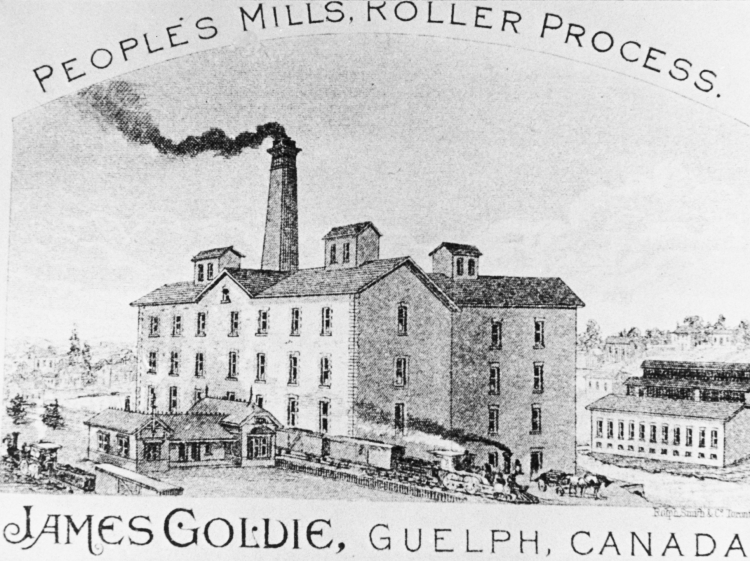
On 8 June 1866, the property was bought for $15,000 by James Goldie. In 1860, Goldie had built the Speedvale Mill further upstream, at the current site of the Speedvale Fire Station. He sold his old place of business and undertook rebuilding and expansion of the People's Mill. It would remain in his hands for 46 years and duly become the "Goldie Mill".

(James Goldie, from "Golden Jubilee of Nurses," 1938. Goldie was on the Hospital's Board of Directors.)

A good idea of what the area looked like during Goldie's tenure can be gained from the 1881 Wellington County Atlas. Because of the dam just upstream of the Goldie Mill, the reservoir made the Speed River much wider there than it is today. Here, I have superimposed part of the town map on a portion of the Google map of the area as it is now. I have outlined the banks of the river in solid lines and the bridges in dashed lines.


Bridges are represented by dashed lines. The parallel dashed lines in the center of the picture represent the dam, which was also used as a foot crossing. The black block to its left is the location of the original sawmill. On the west bank, the reservoir covered the wooded slope that exists there today. Note that a "Victoria Street" was on the survey through the middle of what is now Herb Markle Park. Of course, the street was never built. On the east bank, the reservoir covered most of what is now Joseph Wolfond Park East, upstream from the foot of Derry Street.

Four postcards record views of Goldie Mill. The first one (labelled "1" on the map above) was taken on the west bank of the Speed downstream from the mill. Although the caption identifies the subject as "Goldie's bridge", the bridge in view is clearly what is now called the Norwich Street bridge. Goldie Mill, with its ninety-foot chimney, built in 1885 and which still remains, can be seen peeking over the treetops on the left-hand side, a hint of what is to come.

(Courtesy of the John Keleher Collection.)

The building on the right is what was then a storage house of the Canada Ingot Iron Culvert Co. (demolished in 1927). This card is a "bookmark" card, published by Rumsey & Co., Toronto, of a photo taken with a panoramic camera.

The second postcard was taken from the east bank upstream of the Norwich Street bridge (labelled "2" on the map above). The mill buildings can be clearly seen on the left-hand side of the picture. The top of the distinctive chimney is clearly visible behind the other structures. Beneath lies a spit or island separating the Speed on the right from the tail race on the left.


Although the mill is an industrial site, it is presented in the background, framed by water and foliage almost as if it were a picturesque temple discovered on a trek along an Arcadian river.

The third picture (taken from the point labelled "3" on the map above) was taken from beside the tail race and next to the Speed River. It looks northwards to the back of the dam.


There is more tension in this picture. The ground is strewn with chunks of broken limestone, lying around like the remnants of an explosion or quarrying operation. The dam in the background is straining to hold back the waters of the mill pond beyond, without complete success. This card was printed by Warwick Bro’s & Rutter of Toronto.

The fourth picture (taken from the point labelled "4" on the map above) shows the mill pond itself from the north looking southeast. The steeple of St. George's Anglican Church can be seen in the center background. Goldie Mill and its tall chimney can be seen to the right. Today, this spot would be not far south of Riverslea, where the Goldie family then lived, today on the Homewood grounds. The Speed is now much narrower at this point and both banks are thickly wooded.


Near the opposite shore there are two swans in the water. It seems as though they are approaching a man on the bank, who may be moving to feed them. A small boat lies tied up nearby, its stern dragged downstream by the current. This postcard was printed by the Pugh Mfg. Co. of Toronto.

James Goldie acquired two white swans in 1888 to add to his menagerie. His estate was renowned for its gardens. Goldie's father had been a globetrotting botanist and assembled a botanical collection for the Tsar at St. Petersburg. The apple did not fall far from the tree. Goldie Jr.'s gardens contained hundreds of exotic flowers, shrubs, and trees. Visitors came from far and wide to see them.

Goldie's menagerie included many exotic birds, both "preserved" and alive. The latter included Egyptian geese, a Sandhill crane, English, Golden, and Silver pheasants, and the two swans. He also imported English sparrows, some of which he released and some of which he kept in a cage. James Gay, a local man who styled himself the Poet Laureate of Canada, wrote the following poem about them ("Canada's poet" 1884):

On the sparrows
Mr. Goldie’s sparrows, quite a number, returned to James Gay,
He feeds them with small wheat every day,
About eight in the morning, you can see them fly around
To feed on the wheat laid out for them on the ground.
This friend to sparrows, he takes much delight,
To hear their little warblings from morning to night;
All are made welcome as the flowers in May,
Not one shall fall to the ground by the hands of James Gay.
If Mr. Goldie could hear their prattling ways,
He would send them some small wheat every day,
So between the miller and the poet too,
Those little birds are sure to do.
About four they take flight,
If they could speak, they would say thank you and good-night.
Besides swans, youths liked to swim in the mill pond and places nearby in summertime. There was an old quarry pit at the site known as Kate's hole (for reasons unknown to me), as recollected by Fred Dyson (Mercury, 8 May 1948):
Among the real old timers expressing interest in tales of the old town is Fred Dyson, who, at 87, can look back pretty far. Explaining the origin of Kate’s hole down by the spur line at the old Goldie Mill, he said it was the quarrying of stone there for the mill dam that made it a favorite resort for swimmers. The spur line ran right into the mill property.
That swimming there in those days was clothing-optional is confirmed wistfully by another old-timer, James Ritchie (Mercury, 1 May 1948):
Who among Guelph’s real old-timers does not remember Crib’s hole, near Russell Daly’s present home? Or Fraser’s hard by the Sterling Rubber Company’s plant, or the staircase near the old Goldie’s Mill? ... These are among many others inseparable from old swimmin’ hole memories. No swimming in the nude anywhere these days. If the boys try it they will be chased away, no matter how far they are from the city.
O tempora, O mores!

The Speed could be dangerous as well as beautiful and fun. Spring floods often threatened the dam. Indeed, it was swept away by floods in the springtime of 1873 and 1929.

In addition, girls and boys drowned in the pond alarmingly often, e.g., (Northern Advance, 12 June 1890):

Mrs. Henry Ching, of Toronto, who is on a visit to friends in Guelph, lost her five-year-old boy by drowning on the 5th inst. The little fellow fell into the river while throwing stones into the water from the bank. The river is very high with the recent heavy rains, and he was quickly carried over the dam at Goldie’s mill. The body was recovered in a few minutes, but life was extinct.
In the winter, the pond froze over and made for a useful expanse of ice. Guelphites went there for skating and curling. The ice itself was also harvested by Mr. T.P. Carter of Carter's Ice Company, who handled about 2,000 tons of ice annually from his ice houses on Essex Street (Industrial number, 1908). There was also an ice house on the west bank of the Speed upstream of the mill (in the backyard of 165 Cardigan Street today), perhaps for the use of James Goldie himself.

Perhaps the weirdest incident connected with the Goldie Mill pond occurred when it was frozen over. A Mr. Leslie, while walking home at noon hour by the Mill one day, found a green fedora with no band and a worn overcoat lying on the ground beside the ice. In a pocket was a peculiar note (Mercury, 11 Dec 1922):

This seems the only way out. If ‘F’ had been here it might have been different. Good-bye. X.—J.B.
The note suggested a suicide. Yet, there was no hole in the ice nearby. No amount of searching and dragging the river or mill race produced a body. Perhaps the whole thing was a prank. Either way, the identity and fate of J.B. remains a mystery to this day.

Goldie remained by the Mill and its pond. Around 1885, he purchased Rosehurst across the river from Dr. Clarke's estate. This grand house stood on the Delhi hill and had a beautiful view of the pond. James's son Thomas and his family moved in. (There is a lovely photo of Rosehurst taken from across the pond, Tatham 1983, p. 9. However, I cannot locate the source.)

James Goldie built Riverslea for himself in 1890–91. It stood somewhat apart from its setting, being made of brown stone imported from New York State (Tatham 1983). However, it was still sited near the east shore of the mill pond with a good view of the Speed and Goldie's Mill downstream. Like his mill, James Goldie never left the river.

The mill prospered. After he took over, Goldie rebuilt the mill larger than before. He also added a substantial cooperage across the river. A rough wooden bridge connected the two. Storage areas and an elevator were added also. See the map below.


Here, I have superimposed a portion of the Fire Insurance map of 1911 on a Google satellite view of the mill and vicinity. As President of the Wellington Mutual Fire Insurance Company, James Goldie would have been familiar with this map.

Just to the left of the mill, is a building shaped like a sideways "I", labelled "A. Office". As mentioned above, the Great Western Railway built a spur line down the Speed to Cardigan Street to serve the Royal City as a new passenger train station ("Guelph railroads", Keleher 1995, p. 59). It opened for business on 16 February 1882 but proved to be a flop and closed six months later. In 1884, Goldie bought the building and moved it next to his mill, where it appears on the map, to serve as office space.

The building can be seen on the left in the cute drawing below.

("Goldie Mill", courtesy of the Guelph Public Library, item F8-0-4-0-9-3.)

In 1888, the Guelph Junction Railway was built and a siding laid to Goldie's Mill, which is also visible in the map. As a result, wheat and flour at the mill were no longer transported by horse. This change was important since Goldie increasingly had to buy wheat from western Canada in order to keep the mill profitable.

The office was torn down around 1920. Today, the site is the location of the Guelph Youth Music Centre, constructed in 1995–2001, from a storeroom built in place of the office. The spur line was later torn up and became the Spurline Trail.

As more land in its watershed was cleared, the force of the flow of the Speed diminished. As a result, Goldie added a steam engine to pick up the slack. In 1910, electrical engines were furnished instead, supplied by a power substation dedicated to the mill. The electricity was generated at Niagara Falls. So, the mill ran on power from a river over 120km away rather than on power from Speed, which flowed right beneath it.

James Goldie died on 4 Nov 1912. The mill afterwards passed through many hands. In 1918, the mill was bought by F.K. Morrow, investor and owner of the Morrow Cereal Co. In 1926, the Standard Milling company took over, followed by the Pratt Food Company in 1930.

Time and tide chipped away at the mill and its grounds. Milling operations ceased soon after yet another spring flood wrecked the dam in 1929. The mill became a warehouse with its buildings used mainly for storage. On 24 February 1953, fire returned in the form of a spectacular blaze that destroyed the original milling, shipping, and boiler rooms.

The mill was then slated for demolition but the City and the Grand River Conservation Authority intervened. The remaining stone structures were stabilized and were turned into a picturesque folly. Fittingly, the park was named Goldie Mill Park, still bearing the name of the man who had shaped the place more than anyone else, so many decades before.

Tuesday, 19 March 2013

Guelph after dark

This postcard is an unusual one.  Normally, postcards are based on photos of outdoor, daytime scenes.  Except in small spaces, there were few practical ways of illuminating a large, outdoor space in order to take a photograph.  However, this postcard is clearly set after dark.


The postcard was published by Valentine & Sons' Publishing Company of Dundee, Scotland, and was printed in Great Britain.  There is no writing or post mark on the back.  The text in the upper right corner says "Post Office & Wyndham St., Guelph, Ont."  In the lower right corner is the text "102,147 (JV)", perhaps a serial number from the publisher.

Probably, you recognize this scene as St. George's Square, which was introduced in a previous posting.    Recall from that posting that the "Old Post Office" (as it was later known) had a clock installed in its tower in November, 1906.  Since the clock is missing in the picture above, it should be from before then. It also happens that the Old Post Office received its third floor in 1902 (Coulman 1977, n. 147).  So, the photo in the postcard appears to show St. George's Square as it was in about 1905.

Set at nighttime, the picture is of special interest for a number of reasons.  For one, it emphasizes the importance of street lighting to the city.  Note the tall pole in the middle of the image, standing beside the island, to the left of the "Blacksmith fountain".  At the top of the pole is a crossbar from which two lamps are hanging.  Those lamps seem to be radiating a cool, blue light into the warm, dark air above the Square.

In fact, those lamps are arc lights.  Each lamp consists of two small carbon rods separated by a gap.  Light is produced by passing a spark across the gap at high voltage.  Although it is hard to tell from this picture, the lights are suspended from the cross bar by block-and-tackle set that can be accessed near the base of the pole.  That is a good thing as the carbon burns out quickly and must be frequently replaced.  The City would have had some employees whose job it was to maintain the lights.  They would go from pole to pole on a schedule, hauling a cart carrying supplies.  At each post, the employee would loosen the rope from its cleat, lower the lamps, and assess the carbon rods in them, replacing them as required.

David Allan (1939, p. 64) notes that the arc light system first appeared in Guelph on January 11th of 1888, replacing the previous lighting system based on coal gas.  In her book "The history of the Board of Light and Heat Commissioners of the City of Guelph" (2001, p. 10), Elizabeth Thomson notes that the arc lights were themselves replaced in 1912 by a system based on incandescent bulbs.

Beyond these technological changes, the presence of night lighting had some profound effects on how people used the streets.  For example, it changed the night life of the city.  As Paul Moore (2004) explains, city streets were associated with poverty, prostitution, and other unsavoury things, at least after dark.  The advent of street lighting allowed the nighttime streets to be rehabilitated for respectable, middle-class activities such as shopping and movie-going.

Of course, the opening up of city night life did have some unintended and unwelcome (to some) consequences, as becomes clear in this November 30, 1912 Toronto Star article, entitled "Guelph Young People Must Keep off the Streets":
A meeting of the Police Commissioners was held Saturday to consider drafting a by-law to prohibit young people from promenading up and down the streets of the city and in the public parks at all hours of the evening until late at night unless they have with them a chaperon.
Mayor [George] Thorp, one member of the Commission, states that some stringent means must be taken to prevent promiscuous promenading in the city for hours at night, as conditions here during the past year have been shocking.
Why not just turn off the lights?

Thorp's dismay highlights the general anxiety over regulation of night life in the era of street lighting.  With "stringent" control, perhaps with the aid of police, street lights would permit city night life to take on a safe and respectable, middle-class character.

Also, I am intrigued by a comment that David Allan makes about the character of the light shed by the arc lighting of the streets, based on the fact that they are suspended from a pole (1939, p. 64):
The light swayed back and forth with the wind and produced deep, shifting shadows.
Imagine walking through St. George's Square or down one of other old city streets at night with the lamps swaying back and forth in the breeze!

Unfortunately, there is no evidence of this dramatic lighting in the postcard.  Although the moon appears to be casting shadows, the street lights do not.  In fact, this observation suggests that this postcard is not quite what it appears to be: Why is the moon casting shadows but not the street lighting?  The answer is that this postcard scene is taken from a daytime photo of the Square, not one taken at night!  Have a look at the following postcard:


Look familiar?  In fact, this treatment of daylight images is not so unusual.  The trope involved taking a daylight image, darkening the sky and scenery, adding a moon wreathed in wispy clouds, then making other corrections, such as erasing a lady's parasol in this case.  Fiendishly, the colourizer has also erased the town clock, which is clearly visible in the daylight image.  In fact, this picture must date from after November 1906, when the clock in the Old Post Office was installed, but before the island in the middle of the Square was turned into an oval shape later in 1908.

Here is the scene today in Google Streetview:


Although the central island is long gone, the street light at the corner of Quebec and Wyndham streets, near the center middle-ground, is near to the location of the old arc lamp pole.  How many of the City's youth have promiscuously promenaded beneath it, I wonder?

Wednesday, 6 March 2013

The Priory

Here is a postcard of what is arguably Guelph's most historic structure, namely "The Priory".  Also, it seems to have been Guelph's most popular early postcard subject, to judge from the number of different printers that used this photo and colourized it in different ways (more on that topic another time).


The back of the card has the title "Private Post Card" but no maker is listed.  The text in the lower, left-hand corner says, "First house in Guelph (now C.P.R. station), Guelph, Ontario."

The Priory was the first permanent structure built in Guelph, after its founding on St. George's Day, April 23rd, 1827.  The structure got its name from its builder, Charles Prior, who was one of the party that accompanied John Galt, the founder, to the site where the city was to be located.  It was intended to be the residence of the Canada Company officers in the district, and so had to be of a dignified appearance.  Thus, Galt saw to its design and construction himself, as noted by Charles Burrows in Annals of the town of Guelph, 1827-1877 (p. 6):
The house, which is beautifully situated on the south bank of the river Speed, was built of squared logs, was large and commodious, and with the rustic porch, presents a very fine appearance, though somewhat rough, imitation of Ionic architecture, and stands to this day as a witness of the practical skill and artistic taste of Mr. Galt, who drew the plans and superintended the work.
Given the lack of buildings in Guelph's early days, it is not surprising to learn that the Priory served a number of purposes.  For example, the south wing, the lean-to structure on the closest side of the building in the picture, served as a tavern and a post office, even as it was being finished.

The Priory also had a variety of owners.  In 1838, for example, it was bought by William Allan, builder of Allan's Mill nearby on the Speed river.  On his retirement in 1847, the building passed in to the possession of his son, David Allan, until 1876 (Allan 1939, p. 29).  David Allan was the architect of some of noteworthy local structures, such as the distinctive Court House and St. Andrew's Church (Coulman, n. 10).  The Priory was then owned by David Spence until 1887, after which it became the  local Canadian Pacific Railway (CPR) station, which it remained until 1911 (Coulman 1976, n. 11).

As you can see from this picture, the Priory initially had a beautiful view of the Speed river.  It was also conveniently located next to Allan's Mill (far left in the picture) and Allan's bridge over the Speed.  When it became the CPR station, that connection seems to have remained palpable, according to message written on the back of the postcard:
This is the first place we came to in Guelph and the first house that was was [sic] built in Guelph; it was so pretty it was all green and the river is on the other side of the line.
The postcard is not addressed or postmarked, suggesting that it was used not as a message to someone else but as a kind of aide memoire for the author when passing through the city.

According to Stewart (Vol. 1, p. 48), the photo in this postcard shows the station as it appeared around 1910.  (You can view the original photo here.)  Note the two ladders that appear in the scene.  On the far left is a short ladder placed up against a lamp stand.  I would guess that the lamp ran on coal gas and needed to be lit by a lamplighter each evening.  (I should have more to say about lighting in a later blog.)

Near the middle of the picture is a taller ladder leaning against the roof of the Priory.  Like the smaller ladder, this one is not present by chance.  Note that the ladder rests on a special pad in front of the railing and is secured to the roof by a bar.  Beside the top of the ladder is a pole that projects past the eve of the roof.  From the end of the pole is suspended a metal disk with two holes through it.  It appears to be a railway switch (or signal?)!  That is, it must be rotated in one direction to connect track A with track B, and in the opposite direction to connect track A with track C.

Have a look at the photo below.  It shows the Priory with a train in front of it but with no switch on the roof.  Instead, the switch is at the south end of the platform, in front of the camera, where the three tracks meet (courtesy of the Guelph Historical Railway Association).


It appears that the original switch (note: also accessed by a ladder) was later moved to the roof of the Priory.  Why would anyone move a switch to the roof of the building?  It seems horribly inconvenient to have to climb a tall ladder to change a switch!  The only reason that I can think of is that the location on the roof is easier for the train engineer to see than the location further away and lower down at the crossing in front of Allan's bridge.  Was there an accident that prompted the change?  (A search of the city newspapers might turn that up at some point.)

The new switch installation appears to have evolved over time.  This photo in the Guelph Public Library collection (ca. 1905) shows a ladder that is secured by simply being stuck on the ground and then having its top wedged under the eves.  (Also, the vines have been trimmed back, the gas lamp is present, and the railing in front of the station is of a simpler design.)  Hardly a robust setup!  Even though the ladder bottom appears to be painted, being wooden, it would eventually rot from moisture absorbed from the ground, and the whole thing would probably topple from time to time.  No wonder it was later shortened, placed on a stone pad and clamped to the roof.

You may be curious to know what the Priory looks like today.  Here is a Google Streetview picture, taken from roughly the same perspective as the photo in the postcard.


View Larger Map

The Priory would be on the other side of the railway tracks, in the vicinity of the tall utility pole that stands beside Woolwich St. in the middle background.  What happened?

Sadly, after 1911, the Priory fell into ruin and its carcass was dispersed.  Johnson (1977, pp. 317-321) relates the story in some detail, which I will summarize here.  At the urging of the City Council and Board of Trade, the CPR decided to construct a new railway station in the city.  This was completed and then opened in November of 1911.  After that, the Priory stood vacant.

George Sleeman, the brewer and former Mayor of Guelph, purchased the building and had it moved further away from the river to a vacant lot while trying to muster support for a preservation scheme.  However, there was not enough support from the community and the building deteriorated and was condemned by the City building inspector in 1926.

Sleeman moved the two lean-to sections to his own property.  (Why not the whole thing?) They were apparently donated to the Doon Heritage Village in Kitchener in 1957 (Stewart 1976, p. 48), a move that was described in the Guelph Mercury as "high-handed" and a "disappearance".  For all I know, they remain there still, like the Avro Arrow, crated up and waiting for the time of their return.  The logs of the main section were stored for a time and then dumped in Riverside Park in the 1930s, where they were cut up and used for firewood.

The final blow fell in the late 1970s, when Woolwich St. was moved east toward the river, so as to connect with Wellington St.  In the process, the site of the Priory was partially regraded and paved.

However, not all memory of the Priory has been lost.  Two models of the structure were made by Mr. W. A. Cowan from measurements of the original (Allan 1939, p. 32, n. 5).  A large one was stationed in Riverside Park, where it can still be seen (suitably restored).   A smaller model was given to the Guelph Civic Museum, where it still resides.  If you are in the neighbourhood sometime, you can drop in and have a look.

It is too bad that the Priory did not survive longer but 99 years is a long time for most structures.  If it were around today, it would likely be a central part of the Civic Museum, perhaps a National Historic Site and interpretive center.  In any event, its history serves as a reminder of how Guelph got its start, and how it adapted to changes in times and technology over the years.

Update (12 March 2013): In looking through my collection, I see that I have a postcard featuring the same picture of the Priory above with a post mark of 9 Oct. 1905.  Thus, the dating of the picture to ca. 1910 is too late.  The photo probably dates to ca. 1900.  In that case, this photo dated to ca. 1905 should probably also be dated back, to ca. 1895.

Update (20 March 2013): Ron Brown's book "The train doesn't stop here anymore" clarifies the nature of the disk hanging from the pole on the Priory roof.  It is an "order board"!  Here is how it worked (pp. 11-12):
They gave the locomotive engineer his instructions on whether to stop or to proceed without stopping.

Originally, there were no train order boards. Engineers were required to stop at each station and sign for their orders. ...

Oval in shape, the boards pivoted on a spindle and were controlled by a chain that was attached to a lever inside the agent's office.  When the board was parallel to the track, it was a "clear board" and the engineer could proceed without stopping.  When the board was perpendicular to the track, the engineer must stop. ...

With the introduction of the order board, the engineer no longer had to stop the train and enter the station to receive his orders.  Instead, he simply slowed the engine while the agent handed them up on the end of a long hoop or fork.
It would appear that the mechanism on the Priory roof is a (crude) version of this device.