Showing posts with label Gilnockie. Show all posts

Sunday, 31 October 2021

A model of industry: J.B. Armstrong, postcards, and the carriage trade

In 1884, the City of Guelph was offered a statue of a blacksmith to place in the recently vacated centre of St. George's Square. The project gained support and the Blacksmith Fountain was officially dedicated on Victoria Day in 1885. On its base was engraved, "Presented by J.B. Armstrong, 1884."
(A real-photo postcard of the Blacksmith Fountain, ca. 1910. Courtesy of the John Keleher collection.)

Born in Guelph in 1838, John Belmer (J.B.) Armstrong was the eldest son of Robert and Janet Armstrong, recent immigrants from Scotland. Robert was a blacksmith who had set up a smithy on Macdonell street east in 1834, where he specialized in making wagons and axes. John later boasted that his father had made the first axe in Ontario (Globe, 10 Sep 1886), though this claim may be open to dispute.

Disaster struck when Robert died in 1848, after which his widow ran the business (Mercury, 12 Dec 1892). Adding to the family's woes, the smithy burned down the next year. However, it was rebuilt and leased to Mr. Thomas Anderson, who resumed the manufacture of carriages. It was under Mr. Anderson's tutelage that young John learned the blacksmith's trade.

Subsequently, J.B. decided to seek his fortune south of the border, working for a time in New Jersey and then in Eddyville, Kentucky. There, when the American Civil War broke out in 1861, the carriage trade was disrupted and J.B. returned to his hometown.

Back in Guelph, J.B. entered into a partnership with his brother William at the family factory, going under the name of The Armstrong Bros. The business seems to have gone under a number of names in subsquent years. By 1866, the smithy was styled the "Excelsior Works," then apparently a common name for a foundry looking to gin up a reputation for excellence. By around 1870, the business was also known as the Guelph Carriage Company or J.B. Armstrong & Co. In 1876, J.B. entered into partnership with Thomas Scarff (William having left some years previously), to form the J.B. Armstrong Manufacturing Company, which finally stuck.

The new company had some impressive new digs. In 1875, J.B. had a new structure erected where his foundry stood at what is now 92–98 Macdonell street, named the "Armstrong Block" in his honour. The new edifice was described fulsomely in the Mercury (21 July 1917):

... J.B. Armstrong has erected a block of stone stores three storeys in height, which are second to none in the town for elegance of design and substantial appearance. The stores have a frontage of 70 feet. The most westerly has a depth of 70 feet and the other part is 40 feet in depth. Besides this the old shop fronting on the street has been raised. Two thirds of the ground floor of the new building is to be used as a show room. The additional accommodation in the two flats above the old shop is to be used for trimming room, etc. Entrance to the yards and shops in rear is obtained through an archway between the new building and the shop.
Although much altered inside by the Cooperators in the 1990s (which added an attic storey), the facade constructed by renowned Guelph masons Matthew Bell & Son was kept and graces the streetscape to this day, as can be seen in the image below:
(Courtesy of Google Street View. Zoom in to see the carved plaque "Armstrong Block. A.D. 1875." on the second floor wall.)

J.B.'s plans for his works were ambitious. Besides making carriages and other vehicles, the company began to make carriage parts to sell to other manufacturers. Among the most sought out was the patented Armstrong Carriage Spring, sold across North America and the United Kingdom, as described breathlessly in the Guelph Herald (22 May 1878):

The principle of tempering adopted in this establishment is in use by no other manufacturer in the Dominion, and is the result of many years close study and observation by Mr. Armstrong. Suffice it to say that the process is patented in Canada, the United States and Great Britain, and the effect of its working is such as to command the admiration of those competent to judge such matters.
Another section of the works produced some of the toughest buggy seats then to be found on Earth:
As an instance of the great strength of the patent iron seats for buggies it is only necessary to say that though their weight is no more than if made of wood they are so strong that a two hundred pound biped recently stood with a foot on each end of the seat, and though he exerted his whole strength was unable to warp it out of shape.
Beyond carriage parts, the company also diversified into parts for agricultural implements, such as rake teeth, cultivator springs, harrow teeth, and so on (Globe, 6 Aug 1892).

One of the ways that J.B. decided to advertise his wares was by postcard. These cards from the early 1880s were very similar to the earliest ones adopted in Canada, which featured an address on the front and a message on the back, without any picture.

Compare this card sent to J. Sheldrick of Hagersville on 8 July 1882 with the postcard sent by Guelph lawyer William Merritt ten years earlier:

The only notable difference is that the address of the British American Bank Note Co. is now simply "Montreal" instead of "Montreal & Ottawa."

However, the back of this card is quite different. Instead of a hand-written message, it contains a pre-printed advertisement for the wares of the Guelph Carriage Goods Co.

The carriage step depicted look as though it could support the weight of a very substantial biped!

The back of this card is reminiscent of the trade cards that were then popular with stores that sold consumer goods. Concerns such as the Bell Organ & Piano Co. would distribute cards with pictures on one side and advertisements on the other for giving away to potential consumers. Stores would give cards to people who walked in the door, hoping to increase their chances of a sale.

In this case, the Guelph Carriage Goods Company has used an illustrated postcard to entice another business to purchase their carriage parts. Mr. Sheldrick must have been a likely prospect, as he was sent several similar cards in the weeks following the one above:

This card is a little less interesting as it does not depict the Adze eye nail hammers on offer.

In any event, Mr. Sheldrick was favored with at least two more advertising postcards:

At this point, you may be wondering if Mr. Sheldrick was "sold." As it happens, a later postcard appears to confirm that he was.
This sort of card is known as the "scroll style" for the obvious reason that the "Canada Post Card" label is now contained within a fancy scroll. (The "stamp" has also been changed to have an oval frame.) The scroll style was introduced in 1882, and Mr. Sheldrick was sent this card on March 5 of the next year.

The back of the card contains a hand-written message recorded within a form for business correspondence:

The message on the back reads:
Mar 5th, 1883 // J. Sheldrick Esq // Hagersville // Dear Sir // In reply to your favor of 2 inst[ant]. // we will carry out your instructions // about orders but have received none // from you since our Traveller was // with you[.] // Yours truly // Guelph Carriage Goods Co.
So, it appears that Mr. Sheldrick's interest was piqued by the advertising cards, to which he responded, prompting a visit by a traveling representative of the Guelph Carriage Goods Co., as was standard practice. Follow-up postcards, in the new style, were sent the following year.

J.B. Armstrong & Co. continued to send interesting pictures through the mail. Below, for example, is the back of another scroll-style postcard sent to Messrs M.A. Stephens & Sons of Glencairn, Ontario in 1894. It contains both a form letter acknowledging receipt of an order and a lovely drawing of the Armstrong "Peerless" road wagon:

Along with many other going concerns, the Company also had drawings of its factories printed on its letterhead. Here is an example sent to a potential supplier in 1900:
J.B. Amstrong & Co. are the picture of prosperity, showing off its works in Guelph (upper left) and in Flint, Michigan, (right, established in 1889). Information on the right-hand side indicates that the Company had offices in Great Britain and Australia as well.

The prowess of the Company had not gone unnoticed and was the subject of a glowing review in the Toronto Globe (6 Aug 1892). Besides relating the breadth and reach of the company's lineup, the article provided some interesting pictures. The first was a (somewhat murky) photograph of the works taken from the Bell Organ Co. building across Macdonell street:

(Courtesy of Wellington County Museum and Archives, A1985.110.)

The second was a nice drawing of the man himself:

(Courtesy of Wellington County Museum and Archives, A1985.110.)

The last was a picture of J.B.'s bolt hole at 85 Queen street, built by his brother-in-law James Massie, which J.B. named "Gilnockie" after the residence of a Scottish ancestor:

Gilnockie can still be glimpsed from Queen street.
(Courtesy of Google Street View.)

The extent of the Guelph Carriage Works can be seen in the map below, in which the plan of the Works from the Fire Insurance Map of 1892 is superimposed on a Google Maps satellite image of the north side of Macdonell street.

As noted in the Mercury, the Works extended all the way from the Armstrong Block on Macdonell street to Quebec street at the rear (upper right corner of the inset), now covered by the Quebec Street Mall.

Just as J.B. Amstrong had ascended to the pinnacle of success in the vehicle trade, he was carried away by death (as was a common expresison at the time), dying on 11 December 1892, at the age of 54, following a period of ill health. He was buried in what is now the Woodlawn Cemetery.

The J.B. Armstrong Manufacturing Company continued the trade for a number of years but was wound up in 1913.

J.B. Armstrong was a model of the industrialization of Guelph in the Victorian period and left behind a substantial legacy. The Armstrong Block remains in place along Macdonell street and the Blacksmith Fountain is now located in Priory Square, next to the former Guelph Carriage Works.
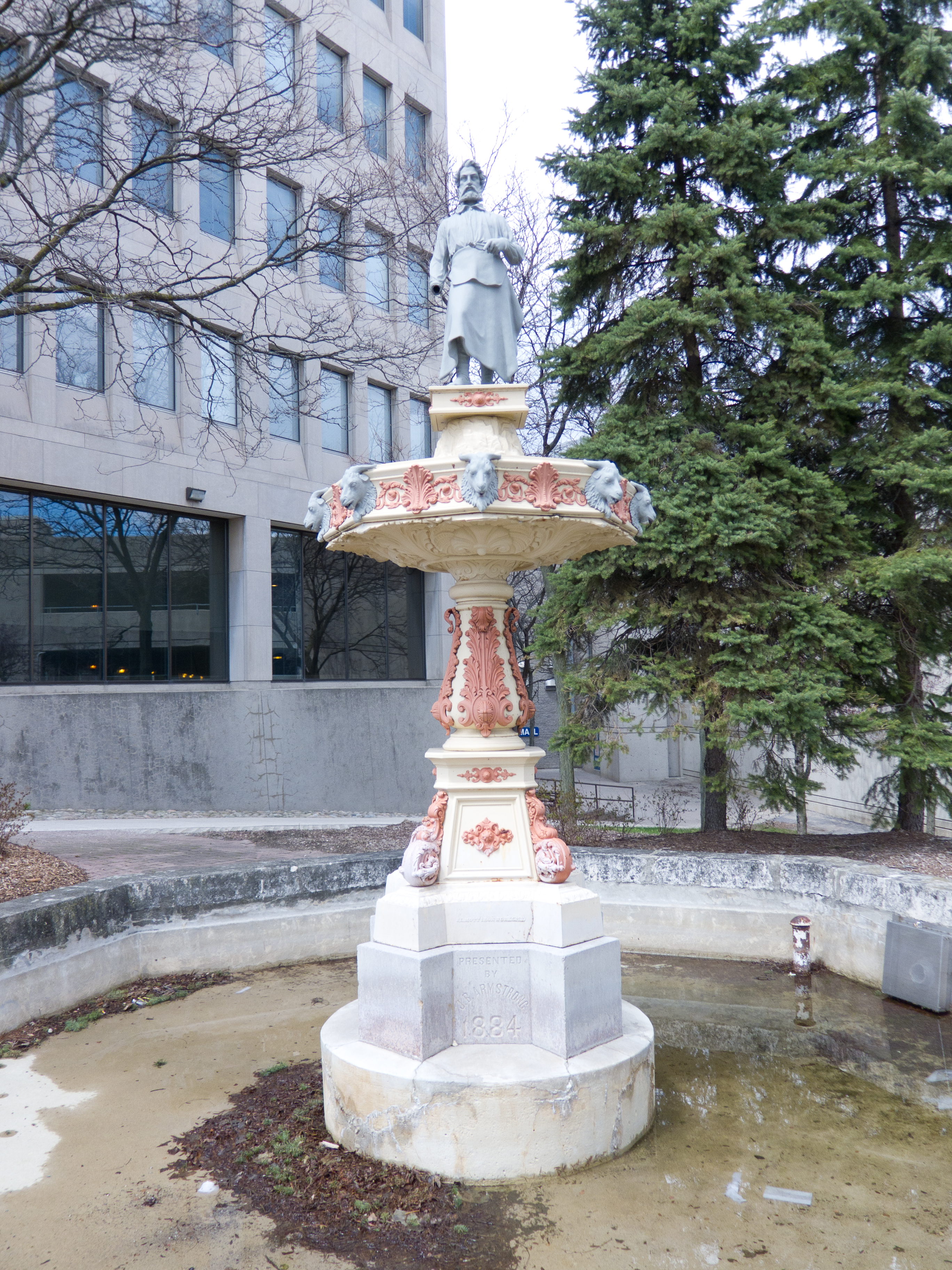
(The Blacksmith Fountain in Priory Square, courtesy of Wikimedia Commons.)

J.B.'s personal legacy is also suggestive. The importance that he attached to the trade, and to control of it, is indicated by some of the terms of his will:

... in his will in 1888, he stipulated that his son, Bertie, would not receive his full inheritance, at age 25, if he had not proved himself to be industrious and frugal or if his mother did not approve of his marriage.
How Bertie felt about these terms, I don't know.

In addition, although the postcards sent by the Guelph Carriage Goods company are ephemeral, they provide us with an instructive reminder of the conditions in which J.B. did business. When I, for one, think about horse-drawn buggies and sleighs, my impression is of the quaintness of the Victorian era and how romantic it might have been to travel the streets of the Royal City in them.

This may have been the case but the cards also remind us of the centrality of horse-drawn transportation to contemporary life. As Tarr (1971) points out, cities depended on horsepower not only for personal transportation but for shipping. Adoption of steam railways meant that tons of goods from long distances could be delivered to cities in a short period. These arrived at centralized locations, such as warehouses at the edge of town, and were then delivered by horse-drawn vehicles. The expansion of railway networks reinforced this trend.

As a result, the working horse population in the United States became quite substantial:

[In 1900,] Chicago had 83,330, Detroit 12,000, and Columbus 5,000. Overall, there were probably between three and three and a half million horses in American cities as the century opened, compared with about seventeen million living in more bucolic environments.
The situation was similar in Canada.

To be put to work, millions of carriages and carriage parts were needed, which the Guelph Carriage Goods Company helped to supply. For the business to work, reliable and affordable communciations were needed to coordinate activity, which the postcards shown above helped to provide. (Not coincidentally, J.B. was one of the first Guelphites to have a private telephone line installed in his house in 1879.) For J.B. Armstrong and his contemporaries, there was nothing quaint about the carriage trade or the means of carrying it out.


For fun, here are some representations of the vehicles made by the Guelph Carriage Goods Company as depicted in their ads.
(Evening Mercury, 25 July 1869.)
(Toronto Globe, 27 November 1886.)
(Guelph City Directory, 1892.)
("The Armstrong Standard Buggy," ca. 1896. Courtesy of Guelph Civic Musems, 2002.88.2.)

Friday, 30 September 2016

James Massie builder of the Alma Block

On the morning of December 15, 1867, we may imagine the scene as James Massie looked over the charred remains of the Alma Block on Upper Wyndham Street. The blaze began as a dropped match ignited the oil-soaked floor of Mulholland's hardware store. Flames spread quickly to Massie's grocery, crockery, and liquor stores in the same building. The fire destroyed a total of $150,000 worth of stock and structure (Promoli 1988, p. 9). Like William Dyson when the Suffolk House Hotel had burned down, Massie faced the question: Should he rebuild?

The answer was "yes." Massie had become a successful and prominent businessman in the Royal City, much interested and involved in its continuing development. Rather than move shop, or even leave town, Massie decided right away to replace the old building with a smart new one in the latest style. Architect James Smith, Toronto, was hired to design the structure, local contractors Kennedy & Pike were hired to do the masonry, Mr. James Barclay the carpentry, and Messrs Hamilton & Sons, Toronto, the iron work (Mercury, 8 Apr 1868).

The result, Gordon Couling notes (Couling 1996, p. 19), is "one of the most attractive examples of commercial architecture in Ontario from the 1860 decade." It is late Italianate in style, with masonry cut from local limestone. It is distinguished by a dentilated cornice featuring an elaborate parapet, carved stone window heads (still remaining on the second and third floors), tooled sill courses, and rusticated pilasters. The front windows on the ground floor were an impressive twelve feet high and glazed with thick pane glass.

That Massie was proud of his new establishment is confirmed by a professional drawing that he had made of it by the Ralph Smith Co. of Toronto. This picture is found at the top of an invoice issued by Massie, Paterson & Co. on 6 Dec. 1875.


The drawing focuses on the fine facade of the building and somewhat exaggerates its size by imaginatively placing a large group of diminutive men, horses, and wagons engaged in a whirlwind of business in front of it. The drawing also very clearly identifies the occupants of the building as James Massie; J.A. Wood; Massie, Paterson & Co.; and Henry Clearihue & Co.

Perhaps the classy drawing on the invoice helped to soften the blow when the amount cited was a large one.

Compare the drawing with the Google Street view image of roughly the same scene today.


(Before you point it out: I realize that a drawing on a statement is not a postcard but I am bending the rules here to include this mass-produced image that was, after all, sent through the mail.)

Not much has been written about Massie and his place in Guelph history, so this image provides an excuse to shed some light on him and his role in the development of the Royal City.

James Massie was born on 20 October 1833 to Mr. James Massie Sr. and Mrs. Elizabeth Jane Massie (née Masson) in Lumphanan, Aberdeenshire, Scotland. Massie Sr. was a prominent local merchant and the apple evidently did not fall far from the tree. However, it did fall across the Atlantic. For reasons unknown, James Massie Jr. emigrated to Canada in 1854 and settled in Guelph ("Commemorative biographical record" 1907, pp. 190–192).

The biography provides the following details of Massie's business ventures:

James Massie came to Canada in 1854, locating at Guelph, where he engaged with the firm of Brown & Robinson for some two years, then with Mr. Rutherford and later on formed a partnership with W.J. Brown & Co., which continued for six years. At the expiry of this time Mr. Massie took over the entire business, which he continued until 1867, being burned out in that year. Shortly after Mr. Massie built the Alma Block and the “Wellington Hotel” at Guelph. In 1871 he retired from business, but resumed in 1873, and continued until 1878.
Further details are provided by Joyce Blyth ("Jugs & crocks of the Guelph merchants" 1982, p. 45):
According to an advertisement dated 1861 for the W. J. Brown & Co. store it is apparent that James Massie was in partnership with Brown at his store in the Alma Block; both names appear at the bottom of the advertisement. In 1863 James Massie opened his own business in the Alma Block at lot 45. Then in July 1864 there was a notice in the newspaper announcing that in order to accommodate those residing in the lower end of town they had opened a store in Day's Block at part lot 114. The store in Alma Block was burned out in 1867 but reopened when the new Alma Block was built the following year, 1868.

James Massie & Co. was an importer, wholesale and retail general grocery store. Massie sold the retail grocery and liquor shop to John A. Wood [a clerk in Massie & Co.] in 1869 and in 1871 he took William J. Paterson into partnership in the wholesale grocery part of the business under the name of Massie, Paterson & Co. James Massie retained a part of the building in which he dealt in wholesale confectionery and crockery until the year 1879.
Interestingly, the special edition of Guelph's Daily Herald (1 Nov. 1877) mentions only yet another of Massie's many businesses, that is, Massie, Weir & Bryce, the confectionary. The reporter evidently had a sweet tooth and speaks in glowing terms of the company's biscuits and bonbons, and its regional success. Everywhere in Wellington County and beyond, the confections of Massie, Weir & Bryce were held in the highest regard!

The reporter's story is backed up by the fact that the company employed 35 to 40 people on a regular basis, and up to 50 near Christmas time. Curiously, Massie was no longer involved when the article was printed. He had purchased the enterprise in 1872 from a Mr. Henry Berry and taken on a Mr. Campbell as partner in 1875. In 1877, he sold the company to Adam Weir and James Bryce, who decided, nevertheless, to retain Massie's name. I suppose that speaks to the lustre attached to Massie's business acumen by that time.

It is worth noting that not everything that Massie touched turned to gold. In 1877, Massie & Co. went bankrupt, apparently having assets of $212,000 but liabilities of $252,000 (Globe, 16 Aug 1877). By October, the company had been purchased by Hill, McIntosh & Innes, presumably at a considerable write-down.

Even so, Massie built himself a substantial house in 1873–75 at 85 Queen Street, some of it with stone salvaged from the second St. George's Church that stood in St. George's Square ("Slopes of the Speed", Partridge & Seto 1992, p. 9). It has had a storied life!

Built in a picturesque version of Gothic Revival style, Gilnockie has been the setting for at least two movies. In 1979, for An American Christmas Carol, it represented an orphanage, and, more recently, for the thriller The Incubus, it was a haunted house! For this latter movie, some ornamentation was added to the house, including the finials on the gables, which, although they appear to be made of painted wood, are in fact plastic.
Massie later sold the house to his brother-in-law, J.B. Armstrong (one of the prime movers behind the Blacksmith Fountain). Armstrong named it "Gilnockie" (sometimes "Gilnochie") after an ancestor's pile in Scotland.

(Gilnockie, ca. 1910. Item F38-0-14-0-0-188, courtesy of the Guelph Public Library Archive. See also photos A1985.110 at the Wellington County Historical Museum Archives.)

Besides his own companies, Massie sat on the Guelph's Board of Trade, which had been founded in 1862. The purpose of the Board was to enhance the Royal City's business scene and promote its regional dominance. In conjunction with this position, Massie sat on the boards of innumerable Guelph businesses that were started up at the time.

For example, Massie was a director of the Wellington Hotel Co., which built the Wellington Hotel on the corner of Wyndham and Woolwich Streets in 1877. This seems all the more fitting since the property on which the hotel was built belonged to James Massie himself. At that time, it was an undeveloped lot known as the "Salt Works".

In addition to real estate, Massie was keen on the development of railways. For example, he was instrumental in the construction of the Wellington, Grey & Bruce Railway (Mercury, 4 May 1904). This railway had been incorporated in 1864 to join the port of Southampton on Lake Huron to Guelph. Progress was slow due to competition with the Toronto, Grey & Bruce Railway, which was intended to cover a similar territory. Apparently, Massie and other businessmen from Guelph met with delegates from townships along the route in 1870 and overcame this difficulty (Burrows 1877, pp. 145–146). Construction began and the first leg from Guelph to Harriston opened in 1871.

The new railway worked out for Massie. It was at around that time that he sold off his retail grocery interests to concentrate on the wholesale trade in regions covered by the new lines.

Massie also had an active and successful political career. He had been elected an alderman for the North Ward from 1865–1868, and then Deputy Reeve and then Reeve (1872). He must have been well liked as a politician: In October 1876, Massie was acclaimed the M.P.P. for South Wellington, the position just then vacated by Peter Gow. Massie stood as a candidate for the Reform Party under Oliver Mowatt. Evidently, the Conservative Party was in such disrepute at the time that no Conservative candidate was even nominated in the contest! As a result, Massie became the M.P.P. for Wellington South on a platform of devolution of power to the provinces and promotion of the temperance movement (Globe, 14 Oct. 1876).

Although Massie appears to have been active as an M.P.P., his tenure at Queen's Park was not noted for any particular achievement. Indeed, he resigned his seat in June 1879 to take up the position of Registrar for South Wellington. One year later, he left that job in order to become the Warden of the Central Prison in Toronto, the job for which he is most remembered. His removal from Guelph to the Queen City must have been quite the send off. It was reported that he was given a purse of gold as a thank-you for his services to the Royal City!

The Central Prison in Toronto had been opened in 1874 ("'A terror to evil-doers'", Oliver 1988). It was built at the behest of J.W. Langmuir (the same J.W. Langmuir who went on to found Homewood in Guelph in 1883), inspector of prisons and advocate of prison reform. Impetus for the project came from the problem posed by prisoners who were given sentences that were more than a few weeks but less than two years. Criminals given short sentences could simply be held in county jails and then released. Prisoners given sentences over two years could be held in federal jails. The Central Prison was built to accommodate those who did not fall into either of the other categories.

The problem was that local jails did not have the means to hold many prisoners for long periods, and they could provide little for their prisoners to do. Ontarians had become very concerned about such prisoners: They were provided with room and board at taxpayers' expense and produced nothing in return. Furthermore, their cushy treatment might make a criminal career seem all the more attractive to them and, by being gathered together in idleness, prisoners might simply school each other in criminal behavior.

So, the purpose of the Central Prison was to extract some labor from prisoners and to terrorize them into shunning a criminal career out of fear of re-incarceration. The prison was located near King and Strachan streets in Toronto, near the railway lines so that products made by the inmates, including rail cars for the Canada Car Company, could be shipped readily. From the start, wardens of the prison established a punitive routine that could include a bread-and-water diet, solitary confinement, hanging in irons, and floggings.

This policy was apparently continued by Massie. Something of his attitude can be gained from his remarks following the flogging of a child molester named Dr. Whiting (Globe, 21 July 1888):

When all was over Warden Massie asked the press reporters present to accompany him into his office. He then made the following sensible remarks:— he had as much sympathy for the criminals under his charge is any man could have; but experience over the civilized world proved that for a certain class of criminals the lash was the only deterrent. Assaults and crimes of an indecent description were on the increase, and the class of men who committed them fear the lash and little else. A maudlin sentimentality had arisen, especially in the United States, and a few weak-minded women made heroes of murderers, sending them flowers in prison. They (the reporters) had just seen Whiting flogged for an offense for which the lash was really the only remedy, and the only punishment men of his class feared. When the last flogging at the Central Prison was administered, The News and Telegram gave sensational accounts of it. It was a mistake to do so. Those accounts were sometimes read by country J.P.’s, magistrates and judges, and when criminals of Whiting’s description were brought before them in the offense proved, they modified the sentence simply because they believed, from reading such reports, that flogging was a cruel and brutal punishment. It was severe, but not more so than the crime called for, and was the only punishment men guilty of such crimes really fear.

The reporters thanked the Warden for his remarks and withdrew. So far as Whiting’s punishment was concerned there was nothing cruel about it. He was lashed to the triangle in a humane and gentle manner. He was taken down with similar kindness, and the flogging might have been far more severe than it was. That the wretch howled as he did only showed his coward heart.
There is no mention that the flogging was part of Whiting's sentence; it seems rather to have been Massie's own idea.

Massie remained warden of the Central Prison until 1896. The prison had been investigated in 1885 for cruelty and ill-treatment, particularly of Irish Catholic prisoners (Oliver 1988, pp. 233–235). However, the investigation, headed by J.W. Langmuir, exonerated Massie and the prison management. If anything, the commission of investigation concluded, the prisoners' treatment should have been even more rigorous.

In any event, the prison came under increasing scrutiny because its manufacturing operations were mostly money-losers. There were various reasons for this issue. A significant one was that prisoners were typically not skilled at their jobs and, because their sentences usually ran to only a few months, they could not be trained to the point of proficiency. Langmuir and others tried to encourage judges and J.P.s to issue longer sentences but they proved to be resistant, as the above news article notes.

In 1895, Massie clashed with prison inspector James Noxon over the appointment of one Walter Scott as foreman of the prison's carpentry shop (Globe, 5 Nov. 1885). Massie had promoted a prison guard named Reid as foreman but Noxon considered him unqualified and incompetent, and appointed Scott in his place. Massie charged Scott with theft and cooking the books to make Reid and Massie look bad. Evidence for these charges was weak and perhaps even fabricated, with the final result that Massie himself was charged with insubordination by an investigative council.

The fracas was settled when Massie resigned from his position and was appointed to the job of Registrar of East and West York (Globe, 23 Jan. 1886). Dr. J.T. Gilmour, the sitting Registrar, took over the job of Warden. Massie retained this position for the rest of his life.

In Toronto, Massie held positions in many benevolent and social organizations. These included the Children's Aid Society, the House of Industry Board, Treasurer of the Caledonian Society, Treasurer of the Associated Charities Board, St. Andrew's Society, and elder of St. Andrew's Church. He also gave many lectures and testimonials in favor of temperance, noting that alcoholism was a significant contributor to criminal behavior.

Massie died suddenly on 1 May 1904 in his house at 68 Bloor Street West (Mercury, 2 May 1904). He had returned to his residence from work seemingly in no difficulties. He was found unconscious in his room at dinner time and died two days later. He was survived by his widow, Mary Ann (née Armstrong); two sons, Dr. James Massie of Santa Fe, New Mexico and Robert Massie of Toronto; and two spinster daughters, Jessie and Elizabeth.

The Guelph Mercury published the following sketch of Massie with his obituary.


On 3 May, Massie's body was taken to Guelph by train and buried in the family plot in Woodlawn Cemetery. A memorial remains over the spot, concealed by shrubbery.


Thanks to Peter Burian for pointing out my earlier error misattributing the name "Gilnockie" to James Massie instead of J.B. Armstrong.

For the curious, here is the trailer for "The Incubus." Gilnockie appears briefly at second 11.