Showing posts with label Eden Mills. Show all posts

Saturday, 18 February 2023

Edgewood Park: Eden Mills summer camp

The local papers printed a number of accounts of an interesting new facility in Eden Mills. For example, the 10 September 1924 edition of the Acton Free Press notes that Mr. and Mrs. Nodwell and family of Toronto recently left for Hogtown after spending the summer at their cottage in Edgewood Park, Eden Mills.

In a previous post, I noted that Eden Mills was known early on mostly as a rural village featuring several mills and a modest hotel. However, things had recently changed and the village had become something of a regional destination. At least, it now sported a popular park and summer homes for out-of-towners.

The history of Edgewood Park really begins with the arrival of the Toronto Suburban Railway (TSR) in the village in 1917. Bypassed earlier by the Grand Trunk and the Guelph Junction Railways, the inclusion of a TSR station at Eden Mills promised to lower shipping costs for the produce of the village's mills and the region's farmers.

Of course, the TSR could also bring passengers into town. This meant that people from nearby towns like Guelph, Acton, and Georgetown could easily make day trips to Eden Mills, as could anyone from Toronto who might desire to do so. The commercial potential of this connection was not lost on towns along the route. For example, a fun facility called El Dorado Park was set up at a TSR stop in what is now Brampton. A Ferris Wheel, a Merry-go-round, and other attractions were added to entice daytrippers to buy tickets on the railway.

In 1924 or perhaps early 1925, a group of Eden Mills residents led by Duncan McDougall got together and built a park next to the Eden Mills station. Land was cleared, a picnic area and baseball diamond laid out, and cottages built. In addition, a dance hall was constructed, where acts from Toronto and beyond could drop in by rail and perform for the delight of locals and courting couples.

One of my favourite early ads for the dance venue featured George Wade and his "Corn Huskers", featuring Sid Jackson, the piano accordian expert (Acton Free Press, 18 July 1929):

McDougall added a swimming pool in 1928. Children simply could have swum in the Eramosa river, but a swimming pool was more family friendly. As explained in my post on Riverside Park in Guelph, parks promoted co-ed swimming by building special swimming facilities where boys could be prevented from swimming au natural, as was their wont.

Schools and social groups soon began to hold picnics at Edgewood. The Acton Free Press of 10 September 1924 mentions that, "The Union Sunday School pic-nic was held at Edgewood Park on Monday afternoon, an enjoyable time being spent."

The venue also became an annual host to Labor Day festivities. This holiday was established in Canada in 1894 as part of the movement to celebrate industrial labour and provide workers with more time off the job. The 1925 Labor Day celebration at Edgewood Park as quite a shindig:

The celebration here on Labor Day was a fine success and well attended considering the threatening weather that prevailed. The affair was started off with a Calithumpian parade, headed by Acton Citizens’ Band from the village to Edgewood Park. The hard time prize outfits were won by W. Mino and R. Argo and E. Reid. The first ball game was between Arkell and Eden Mills, and was won by Arkell, and in the second game York Road won from Brookville. The third game was won by the picked team against the W.S. Progress Lodge, of Guelph.
Not to mention the numerous races and horseshoe throwing contest!

Perhaps the most memorable blowouts at Edgewood Park were the company picnics. The Acton Free Press (6 January 1971) makes special note of the Beardmore & Co. picnics. Beardmore & Co. were a leather tannery in Acton, said to be the largest in the British Empire around 1900. Ontarians of a certain vintage will associate Acton with the Olde Hide House, a large leather goods store and a successor to Beardmore, which made it "worth the drive to Acton."
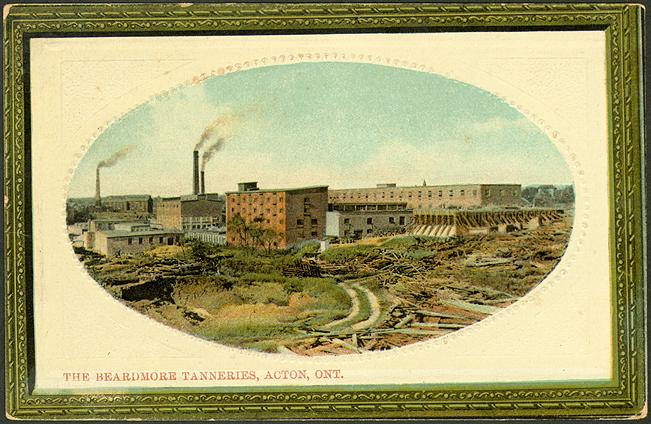
("The Beardmore Tanneries, Acton, Ont," ca. 1910. Postcard courtesy of the Toronto Public Library, PCR-6.)

The 1938 event, held on July 28, was attended by about 500 company employees, their families, and well-wishers. All the usual picnic pleasers were held, including swimming and races for the children, an egg race for the ladies, a fat man's race, and a performance by the Acton Citizens Band. Naturally, the main event was a copious picnic supper.

A special feature of the 1938 edition was the taking of a panoramic picture of the attendees. This was reproduced in the 1971 newspaper thus:

(If anyone knows where a better copy is available, let me know.)

This was not the first panoramic photo taken at Edgewood Park. A photo of the "Nth Erin & Gara. picnic at Edgewood Park, Eden Mills," 1930, is available at a better resolution:

(Courtesy of Wellington County Museum and Archives, A2018.4 ph. 51164.)

Look carefully and you may see that a man near the middle of the picture appears to have a teacup upside down on his head. Why, we may never know.

Attendance at the 1938 Beardmore & Co. picnic was made possible by the use of "nearly all the motor vehicle transportation available" in Acton at the time. This note reminds us that the TSR was no longer operating when the picnic took place. The Railway was in financial difficulty since its inception, since it was hard to compete with private automobiles and hefty, government road building programs. In 1931, the TSR ceased operations and its assets were sold off. However, its downfall seems not to have clipped the wings of Edgewood Park, which remained an established place for regional recreation.

Even so, change did come to Edgewood Park. In 1944, the Park was purchased by the Lutheran Church of the Canada Synod as a location for their annual summer youth camps. The Church had run a Lutheran Boys Camp at Fishers Glen on Lake Erie since 1936. (A Girl's camp was started in 1940.) However, the camp had outgrown the facility there and the Church went looking for a larger one, which led it to Edgewood Park. Around 1,000 people attended the official opening service on 30 July!

Camp Edgewood, as it came to be known (later Edgewood Camp and Conference Centre), provided camping facilities for various youth organizations, not to mention adult and family retreats, Luther League and Synodical Brotherhood meetings, and Salvation Army events. For example, the Guelph YMCA held its annual camp there until 1951, when they moved on to Camp Nagiwa.

In so doing, Camp Edgewood became part of a significant cultural phenomenon: The Ontario Summer Camp. As Sharon Wall (2009) explains, summer camps for city children had become increasingly popular destinations for young Canadians, particularly in Ontario, especially after the Great War and picking up pace after World War II.

Some camps emphasized a 'wilderness' ideal, in which children were taught how to 'rough it' by swimming, canoeing, woodcraft, and sleeping under canvas. These sorts of camps were typically private, sited in more northern areas of the province (as far as Temagami), and catered to the scions of well-to-do city dwellers.

So-called 'Fresh Air' camps were sited near the big cities and were operated by charities. Their clientele were typically children of low-income families who otherwise would have no respite from the noxious fumes of Ontario's major urban centres like the Big Smoke. (The Toronto Star's Fresh Air Fund began in 1901 as a charity to help urban children escape their overheated urban slums.)

In between were 'agency' campus run by organizations like the YMCA that catered to the middle-class and so funded their operations mainly through fees. Like Fresh Air camps, they lay near the big cities and featured less a wilderness experience than a chance to escape urban hothouses for rural idylls and what be called nature literacy. Camp Edgewood fell into this category.

An article in the 12 June 1952 Toronto Globe & Mail provides an insight into the sort of expeience that campers at Edgewood would have:

Enjoy bedtime snack of hot dogs, crawl in creek to find crayfish
By Eldon Stonehouse
Guelph, June 11.—The little red school house was never like this.

Pupils in Guelph have moved out doors for this week to get their lessons under the open sky. So far the idea has been working well, and the pupils, at least, wouldn’t mind if teacher Ron Campbell never took them back under the school house roof.

The children, aged 9 to 13, are camped at Edgewood Lutheran Camp at Eden Mills, a few miles from Guelph. And, while some subject such as arithmetic may be slightly neglected during the week in the open air, other subjects such as art, marine life, birds agriculture and water safety are getting more attention than they have since last September.

Teacher Campbell, who was once a swimming instructor, has 36 young students under his care at the wood-fringed camp. And, while they have been as quiet as they ever were in classroom during the first couple of days, the children are enjoying their lessons more than they did during the first part of the year. (Hot dogs for bedtime snacks have helped.)

The open air schoolhouse is something new for Ontario, although it has been tried in various sections of the United States. So far, the Department of Education is keeping a watchful eye on the camp from Toronto and saying practically nothing. Guelph’s school board hopes that when the department does make its comment, it will be favorable.

The Guelph department launched the idea and put up the first $150. Parents of the Grade 5 children added $1 per day for the period the pupils will spend at the camp. The Home and School Association will pick up what’s left of the cheque after the pupils come back to town.

The children moved into the camp on Monday night, and, after getting accustomed to their new surroundings, were hard at work (hah!) by Tuesday. Monday, of course, was a holiday.

On Tuesday, and each succeeding day, the class was divided into groups, each for a different type of outdoor classroom work. Teacher Campbell took the class in first-aid, and also in water safety at the swimming pool.

Supervisors gave the regular teacher a helping hand with various other types of study. Helen Marr taught art in the dining hall, and Ray Mulford each day took a separate group to a nearby bird sanctuary and on a compass hike through the woods.

The Ontario Lands and Forests Department, although not directly involved, lent a hand too. Representatives just happened to drop into the camp to take the youngsters into the woods and teach them how to identify various trees. This lesson caught on about as fast as any, with the possible exception of Bill Hawley’s historical hikes and marine life studies. He had the children in the near-by creek in the water up to their knees capturing crayfish and underwater creatures for identification.

Keith Barber took another group to near-by farms to let them see what life was like in the rural areas. And, lest there be some need for added physical education, Ernie Berner from the Guelph YMCA was on hand to give the boys and girls some pointers on muscle development.

By the end of the first day at the Lutheran Camp, Ron Campbell had decided the outdoor school was a great idea.

“I wouldn’t mind,” he said, “teaching like this for 10 months of the year.”

Bob Noel, 9-year-old pupil, added his approval. “Gee,” he said, “This is keen.”

But if it rains during the week, it’s back to the books on arithmetic and you know what in the buildings on the camp grounds.
The "Shoebox memories: Edgewood Park" column of the North Halton Compass (2 July 2004) provides a two-page spread of very interesting pictures spanning Edgewood Park's history, which I will insert below. The pictures run from the earliest on page 8 to the later ones on page 9. Page 8:
Page 9:
The Edgewood totem pole reminds us that 'Playing Indian' was a common feature of summer camp programming in that era. As the ersatz totem pole suggests, the point was not mainly to provide education about Ontario's indigenous peoples but to allow modern children to indulge in a confabulated 'primitive' play-acting, which was held to be a kind of theraputic relief from the ails of modernity they faced in city living.

Postcards of Edgewood reveal an interesting dichtomy in its depiction.

The first postcard shows the entrance to Edgewood Park, ca. 1940, featured on page 8 of the Shoebox memories article above:
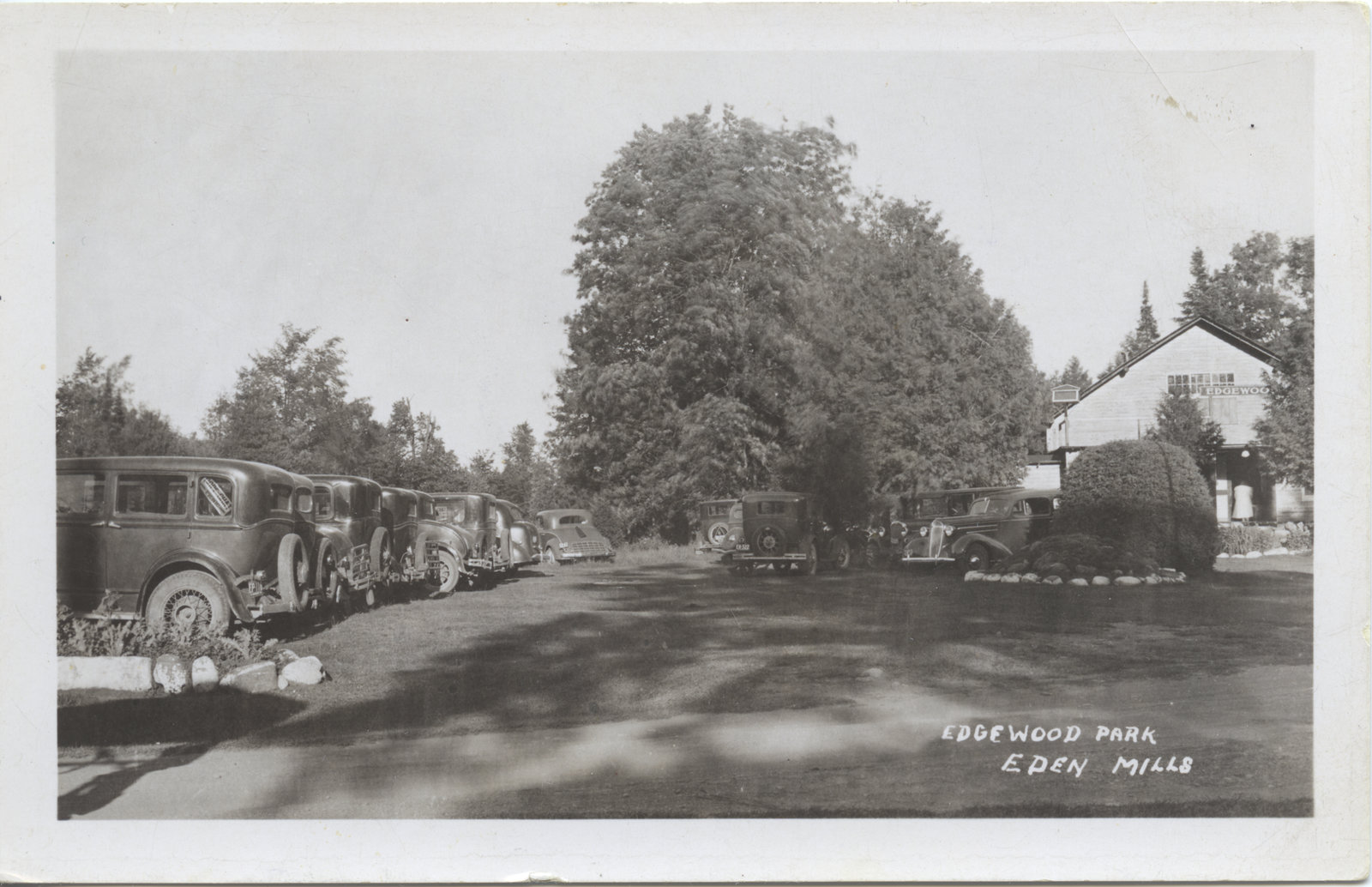
("Edgewood Park, Eden Mills." Real photo postcard; courtesy of Wifrid Laurier University Archives.)

While the picture does not show any people, their presence is revealed by the semi-orderly arrangement of parked cars near the office inside the camp entrance, whose shadow is visible in the lower-left corner.

The postcard below shows the entrance to Camp Edgewood, ca. 1950.
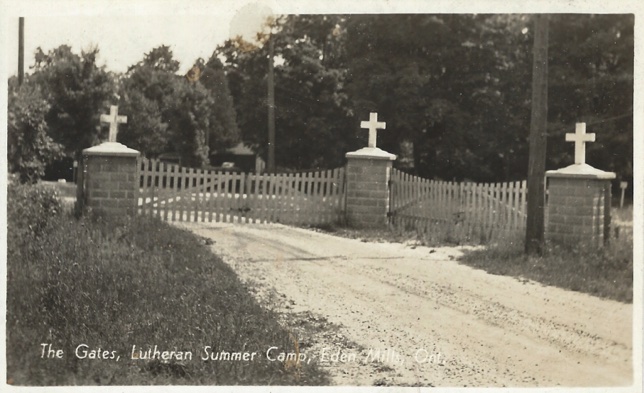
("The Gates, Lutheran Summer Camp, Eden Mills." From the author's collection.)

This image omits any suggestion of people and instead determinedly shows the camp's gate firmly closed and its religious orientation displayed. The impression it leaves on the viewer is that of a locale under the decided control of its managers and focussed on its sectarian mission. Wall (2009) points out that one of the main concerns of parents sending their kids to camps was the safety, both physical, spiritual, and otherwise, of the facility and its management. The image above seems designed to assure them Camp Edgewood is a secure place.

Another postcard of similar vintage is designed to leave a similar impression:
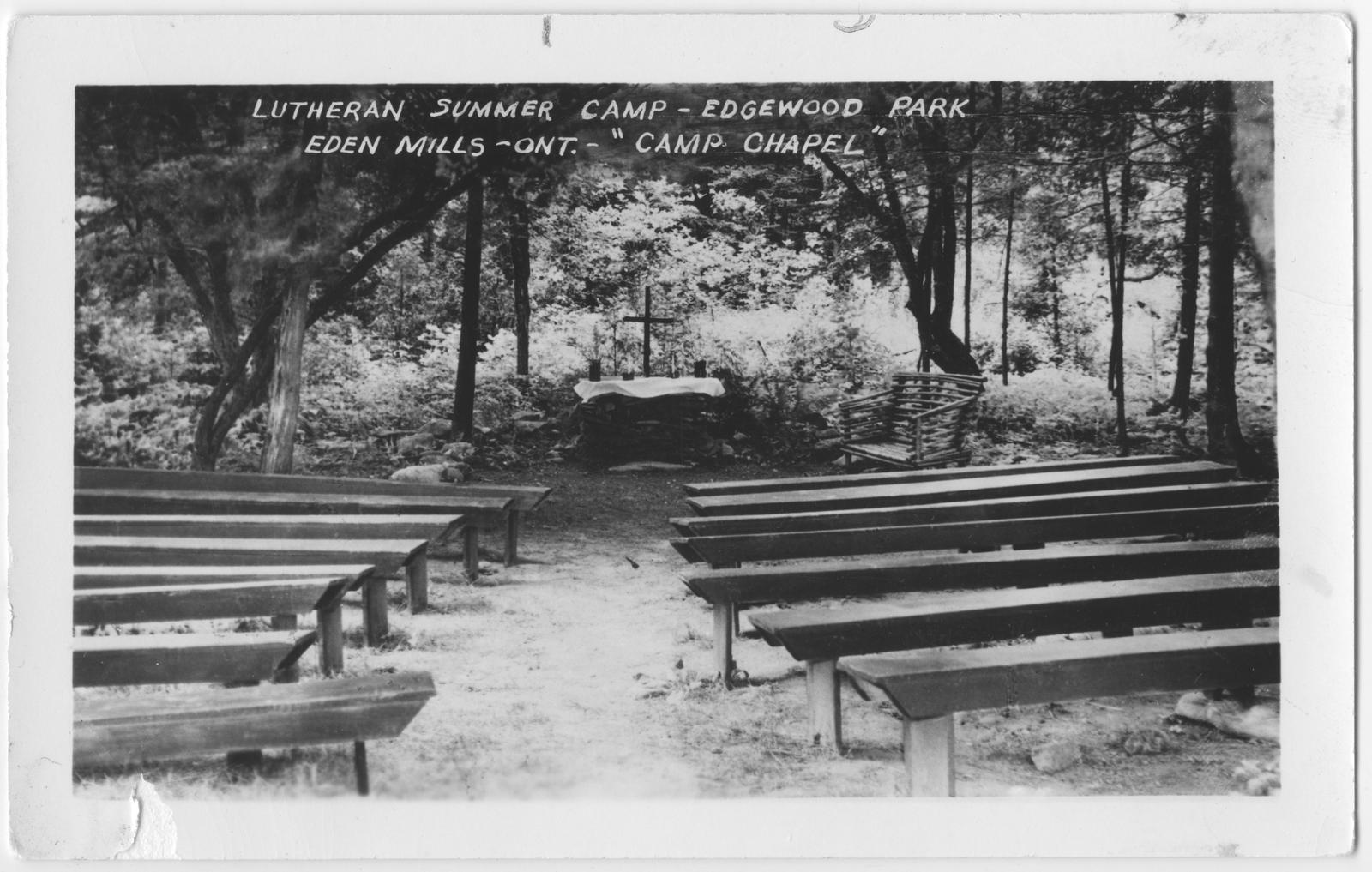
("Lutheran Summer Camp—Edgewood Park. Eden Mills, Ont.—'Camp chapel'," ca. 1950. Courtesy of Wilfrid Laurier University Archives.)

Again, no people are shown. Instead, the outdoor chapel is featured, with its religous symbols and orderly rows of seating. Though rustic, the impression remains one of order and security.

A futher card in the series shows one of the natural attractions of the Camp:

("Lutheran Summer Camp—Edgewood Park. Eden Mills, Ont.—'Camp stream'," ca. 1950. Courtesy of Wellington County Museum and Archives, A2015.1.3, ph. 45682.)

This card was sent to Mrs. Dundas, Waterloo, Ont. on 7 August 1951, from Betty, who reports

I am having a very nice holiday and I am hoping you are too.

A final view from the same series shows the scene inside the entrance of Camp Edgewood:

("Lutheran Summer Camp—Edgewood Park. Eden Mills, Ont.—'Inside of camp entrance'," ca. 1950. From the author's collection.)

As expected, no one is present but the orderliness of camp is dipslayed in the form of the prominent flagpole, the carefully trimmed lawn and greenery, and the park office looking out from behind it.

This postcard was actually sent through the mail and is postmarked on 10 July 1951. The message states:

Dear Frank [??]

Monday evening and still Hanging on. The sun was shining swell to-day. Can’t get Bill to go in swimming. Love to you all

Wes
It's good to know that people were having a swell time at the Camp!

Camp Edgewood was renovated and continued in operation until 2017. It was sold to the Eden Mills Eramosa River Conservation Association (EMERCA), who are incorporating it, under the name Edgewood Trails, into a naturalized area.
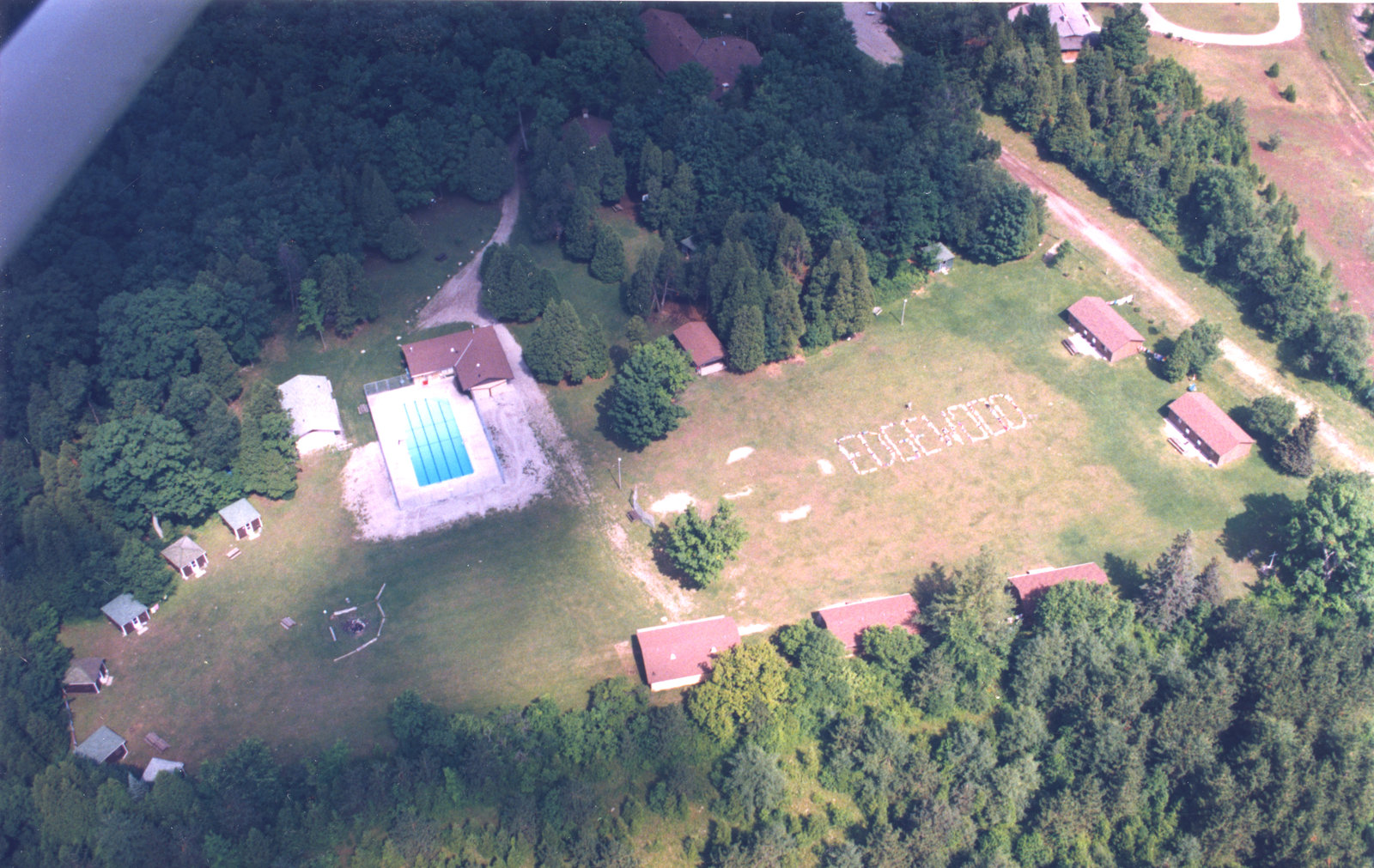
(Aerial photo of Edgewood Camp and Conference Centre, 16 July 1996. Courtesy of Wilfred Laurier University Archives.)
Works consulted for this post include: Wilfrid Laurier University Archives also has an extensive collection of Camp Edgewood materials.

Sunday, 30 May 2021

The early days of Eden Mills

Eden Mills, a short distance up the Eramosa River from Guelph, has a reputation as a quiet and picturesque rural village. But, it wasn't always so. When Aaron and Daniel Kribs arrived the site on 14 April 1842, it had a good water supply but not much else to recommend it (Mercury, 20 July 1927):
Finding that there was sufficient fall in the bed of the river to raise about eight feet head of water at that place, they proceeded, after building each a shanty, to clear the ground for the mill dam. This required a good deal of courage, for a more dreary or unsightly looking place could not be found in the whole township, than it was at that date.
Despite the rough nature of the terrain, the availability of water and timber, plus the determination of the brothers, made them press on:
However, the Messrs. Kribs pushed ahead, and by the 1st of October of the same year, had the dam completed, the saw mill running, and a good one it was too, for an old fashioned water mill. Having a good lot of pine trees convenient to the mill, they set to work sawing lumber, and very soon the people found a way to get it out from the place. Although they had only a miserable apology for a road, yet the lumber was taken away as fast as cut, and they did very well that fall and winter.
(Postcard of "Mill pond, Eden Mills," ca. 1955.)

Daniel Kribs was born near Hamilton in 1816 and moved with his family to Eramosa in 1826 (Globe, 6 December 1898). The new mill was evidently the Kribs brothers' chance to make a name for themselves. So, they called their new locale "Kribs Mills" (sometimes spelled "Cribbs Mills").

("Grist Mill," ca. 1923; Courtesy of Guelph Public Library F38-0-15-0-0-340. These stone buildings replaced the frame mills built by the Kribs.)

Flushed with success, the Kribs brothers added an oatmeal and a grist mill to their enterprise. Unfortunately, this addition proved their undoing. The millwright they hired to construct it did a poor job, resulting in an underpowered mechanism that could grind only a fraction of the capacity required to run at a profit.

The brothers persevered but could not make good their debts.

In the spring of 1846, Adam Lind Argo came to the town and saw an opportunity. He offered the Kribs $5000 for their operation and lands and, although it was only half their investment, they accepted and washed their hands of the operation. Daniel Kribs later moved to Guelph, where he became a court bailiff and a respected member of the community.

Adam Argo was born about 1809 in Foveran, Aberdeenshire, Scotland, and immigrated to Canada in 1836. He gained milling experiece in Bridgeport and Preston before striking out on his own. Thanks to his experience and acumen, he was able to remodel the Kribs's mills and keep them running in the black.

Unsurprisingly, Adam chose to rename Kribs Mills and selected "Eden Mills" instead. Various stories are told about his reason for this choice. One story is that the name "Eden" was adopted to help attract interest in the otherwise unappealing locale, rather as Erik the Red choose the name "Greenland" for the icy North Atlantic island he was trying to sell back in frosty Iceland. Another story is that the name "Eden" had a Biblical provenance: Just as the original Adam came from Eden, so this new Adam would return there, in a manner of speaking. Another possibility is that Mr. Argo choose "Eden" in memory of his homeland, where there are a number of places featuring that name, such as Eden Castle in Aberdeenshire.

(Postcard of street scene of Eden Mills, 1905; Courtesy of Wellington County Museum & Archives A1989.101.)

Whatever the reason, Eden Mills ultimately proved attractive. The Mitchell’s Canada gazeteer of 1864 gives the following description and list of village enterprises, suggesting a thriving community:

Eden Mills, C.W.—A village, situated on the river Speed, in the township of Eramosa, count of Wellington, containing a good female school, three churches and Mechanics’ Institute library with 460 volumes. Distant from Rockwood, a station on the Grand Trunk Railway, 3 miles; Guelph 7 miles. Daily mail. Population 250.
Antony, Jacksonshoemaker
Bardswell, Meshackretired
Boyle, Andrewblacksmith and wagon maker
Burrows, Wm.shoemaker
Cook, Charlescabinet maker
Cook, Frederickcabinet maker
Davidson, John A.carpenter and builder
Davisdon, John A.collector, land agent, issuer of marriage licenses, commissioner in B.R. conveyancer, &c.
Dowrie, Davidcarpenter
Esson, Johnbuilder
Fielding, Davidgrocer
Frain, Jameswagon maker
Harmston & Hendersonbuilders
Harris, Johnhotel keeper
Hay, Johnshoemaker
Hortop, Henryflour mill
Jackson, Anthonygeneral merchant
Krase, Greorgecabinet maker
Little, Jamesmiller
Malcolm, Mrs.female school
Meadows, Sam’lpostmaster, general merchant, sewing machine agent, and potash manufacturer
McDonald, Alextailor
McDonald, Johncooper
Richardson, Ralphwagon maker
Ritchie, Williambuilder
Stewart, Alexanderbuilder
Sullivan, Timothyblacksmith
Watson, Wm.mail stage proprietor
White, Jamesconstable and lime burner
White, Thomasretired
Wilson, JamesJ.P., and oatmeal mill
Wilson, Peterwoollen manufacturer
Zouart, Johnretired
The sharp-eyed reader will note that Mr. Argo had sold the mill by this time (1850), and relocated to Fergus.

Despite being largely cleared, local trees continued to play a significant role in the village. In 1872, some local men performing statute labour nearby discovered a human skeleton in an advanced state of decay with a flagstone laid across its breast (Mercury, 19 June 1872). They supposed that it was an Indian burial, as it was found under the roots of an old pine tree and must have predated the arrival of settlers. It crumbled to dust on removal.

In 1890, Mrs. William Geddes of Eden Mills was killed in an unfortunate accident involving a tree near the village (Mercury, 31 July 1890). She and her children had gone berrypicking with some friends in Mr. Anstee's swamp. The two parties had just gone their separate ways towards home when the children ran back saying that their mother had been struck by a tree. Her friends hurried to the spot to find that Mrs. Geddes had been killed outright and was lying next to the tree that had felled her.

In 1912, Eden Mills was hooked up to the electrical grid, like many towns in southwestern Ontario, to receive power generated a Niagara Falls. Construction of the Hydro corridors resulted in the felling of many trees, which met with some protest, reflecting a rise in interest in forest conservation advocated by people like Edmund Zavtiz of the Ontario Agricultural College (OAC). In a letter to the editor of the Globe (12 June 1918), J.E. Carter complained of "the great destruction of our beautiful shade trees along our highways by linemen who butcher them." He drew particular attention to "a fine row [of rock maples] near Eden Mills" that had recently suffered this fate. Carter noted that the Ontario Tree-Planting Act limited the powers of linemen to trim roadside trees and urged rural residents to exercise their rights to defend them.

(Postcard of Eden Mills showing General Store and post office, mill, and building located south of mill, 1912; Courtesy of Wellington Museum & Archives, A1989.66.)

Besides trees, water was a crucial part of Eden Mills early history. Of course, it powered the mills themselves but it also provided opportunities for recreation. In 1843, a party of young men were working on construction of Kribs's grist mill and decided to take a little break from the hot weather in the mill pond. Two of the party, Gerow and Duffield, got in over their heads and disappeared under the water. Daniel Kribs came upon the scene and managed to pull them out. Duffield appeared to be dead but local resident Stephen Ramage applied some "resuscitation techniques" and restored him to life.

Despite this close call, the mill pond continued to be a popular local swimming hole.

(Postcard, "Mill stream, Eden Mills, Ont.," ca. 1955.)

Of course, the mill pond and Eramosa River were popular places for locals to go fishing. So, it was the setting of many fish stories, such as (Globe, 20 July 1886):

An ex-student of the Agricultural College, now employed near Eden Mills, made loud professions of his abilities as a fisherman. Some persons, however, had so little faith in his attainments in this line that they made a wager that a young lady of the neighbourhood could outfish him, he however, to catch six to her one. The result was the young woman caught nine fish, one of which was a trout weighing a pound and a half, while the ex-student caught six shiners [minnows].
Grrl power! It would interesting to know who these fisher folk were. The young man whose angling pretensions were so ignominiously punctured may have been R.A. Ramsay, a local lad who had graduated from the OAC four years earlier.

In the great tradition of the pasttime, local anglers' exploits were always open to question, for example (Mercury, 17 June 1887):

The Rev. J.C. Smith, B.D., and Mr. Geo. Sandilands, manager of the Central Bank, were trout fishing in Eden Mills yesterday. Mr. Sandilands told a glowing story about trout, and trout fishing. The reporter would at any time take Mr. Sandilands’ word for $20,000, but when it comes down to veracity on a fishing expedition it is another matter. Mr. Smith was not seen on the streets to-day, and thus the promised one true fish story of the season is knocked on the head. It is privately whispered, however, that the catch was beautifully small.
Doubtless, more than a few whoppers were fished from the Eramosa at Eden Mills.

As it happens, more than water flowed through Eden Mills. In 1886, following a tip, police officers raided Johnston's Hotel there looking for violations of the Province's new Scott Act (Mercury, 24 December 1886):

Edward Johnston, who keeps a hotel there, was the suspected party. His premises were searched, and underneath the bar in the cellar was found a small still in full working order. The still was erected on the top of a common wood stove, with worm in a cold water tub near by. A considerable quantity of wort in different stages of fermentation was also found, together with distilled spirits. The whole was seized and the wort destroyed. The still and fermenting tuns were brought to Guelph.
Having been caught red-handed, Johnston pleaded guilty and was fined $50.
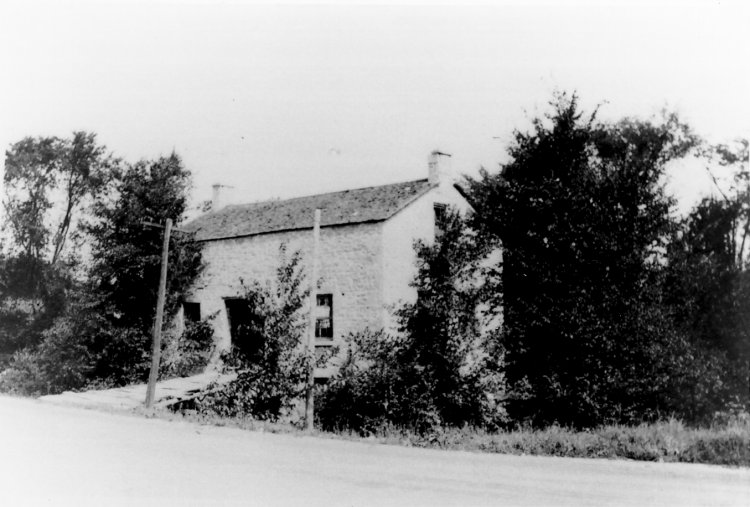
(Stone hotel building in Eden Mills, 1973; Courtesy of Wellington County Museum & Archives A1985.110.)

It seems that Johnston learned his lesson. A short time later, we learn of thirsty patrons being turned from the doors of his hotel (Mercury, 4 February 1888):

On Wednesday afternoon, it seems Mr. Arch. Robertson, living near Eden Mills, went home from Guelph with enough liquor to make him quarrelsome. Being refused entrance to Johnston’s hotel in the village, he ran foul of Mr. David Shannon, and in the encounter received a black eye. In the evening he returned with the assistance of James Rouse and William Hillis and visited Shannon’s house. Shannon was called to the door and assaulted by the trio, and had his window and sash broken. Shannon swore out an information and on the three parties appearing before Squire Strange they were fined $20 each, $5 costs each, $3 for the damage done, and bound over to keep the peace for 3 years. The villagers were much annoyed by the unseemly row, and trust that the result of this case may prove a warning to others disorderly disposed.
Unfortunately, it seems that later proprietors of the hotel were not so scrupulous. Joseph Zinger, who kept the hotel in the 1890s, was found guilty of illegally selling liquor on several occasions.

Matters came to a head in 1904 when the Prohibition League of Guelph complained to authorities about lax enforcement by W.S. Cowan, the license inspector for South Wellington. The Inspector, they said, took no action despite numerous complaints made by the League against establishments in Everton and Eden Mills. Indeed, his superiors were unimpressed with Cowan's defence (Globe, 27 February 1904):

The department wrote to him twice about the matter, and he replied that he had made an inspection, and at Eden Mills had confiscated so much liquor as to necessitate a team to take it away. The department decided that he should have known of the open violation long before, and that after such glaring evidence of incapacity there was no alternative but to ask for his resignation. He declined to resign, and the department removed him.
What did the neighbourhood think of a village where the license inspector hauls away a wagonload of illicit liquor and his bosses figure that he isn't trying hard enough?
(Postcard of Eden Mills showing General Store and post office, mill, and buildings located west and south of mill, 1912; Courtesy of Wellington County Museum & Archives A1989.66.)

Besides wood, flour, and whiskey, Eden Mills was once set to become a petro-town. Apparently, enough oil had been dug up in the vicinity to prompt villagers to form the Oil Company of Eden Mills (Globe, 19 January 1866). Directors were appointed and capital not less that $4,000 was sought. At the inaugural meeting, it was resolved that

the shareholders, owning land at a distance not greater than three miles from Eden Mills, agree to bond their land for oil digging purposes at a royalty of one-eighth of the proceeds of the well, or wells sunk by the Company—said shareholders binding themselves, at the time of taking stock, to hold their lands open for three years for the company for that purpose, and said contract, when executed, to extend to 99 years.
The village was said to be in "a fever of excitement." Test wells were dug and samples sent to Toronto for analysis. Yet, after a year or so, Eden Mills' search for black gold did not pan out and the village never did become the Calgary of South Wellington.
(A forest of oil derricks in Los Angeles, Toluca Street, ca.1895-1901. This failed to materialize in Eden Mills. Courtesy of Wikimedia Commons.)

One of the challenges for residents of the village was its relative isolation. When the Grand Trunk Railway from Toronto to Guelph was built in 1856, it went through nearby rival Rockwood instead of Eden Mills. So, when the Guelph Junction Railway was proposed in 1886, to connect Guelph to the Canadian Pacific Railway (CPR) line at Campbellville, residents saw a chance to catch up. After a village conference, Messrs. Laing and Nicol were sent to a meeting of the directors of the new railway to urge them to adopt a route through the village (Mercury, 6 April 1887). They acknowledeged that a route through Eden Mills would be a little longer than the one proposed near Arkell but argued that it would have compensating advantages. Eden Mills was home to many gravel pits that could supply building materials cheaply. It's grist, oatmeal, and shingle mills produced much material that could be shipped from a station in the village, not to mention the plenteous turnips! The directors promised to relay the proposal to Mr. Jennings, the CPR Engineer, though they were not optimistic for its prospects.

As residents contemplated this gloomy news, things suddenly looked up. A navvy, that is, a civil engineering construction worker, soon appeared in the village, equipped with boots, shovel, and spade. Residents inferred that the Junction railway was to grace their village after all! Alas, it was not so and the people of Eden Mills had to deal manfully with their disappoinment (Mercury, 19 April 1887):

The new arrival was received with open arms, but when he avowed, on being questioned, that he knew nothing about the Guelph Junction, he was treated to the cold shoulder, and plainly made to understand that his [ab]sence would be a relief, and if he did not go he would be assisted.
In the end, the CPR decided on the shorter route and Eden Mills was bypassed again.

However, the patience of villagers was finally rewarded when the Toronto Suburban Railway (TSR) was built between Toronto and Guelph in 1913–1917. This was made possible by the extension of Hydro power to Eden Mills in 1912. When it became operational in 1917, the TSR enabled residents to ship and receive goods from their local station. In addition, visitors could readily arrive by train to enjoy events such as dances put on in Edgewood Park (later Camp Edgewood). Residents could get to larger centres for their amusement and convenience.

(Oatmeal mill, Eden Mills, ca. 1923; Courtesy of Guelph Public Library F38-0-15-0-0-341.)

However, by the time the TSR arrived in town, a rival mode of transportation was taking hold, that is, the automobile. At first, cars were largely expensive summer amusements for wealthy urbanites. Early car owners from town would take their vehicles for joyrides through the countryside, spooking the horses and annoying rural residents.

Some residents occasionally lashed out against these urban elites by setting traps for them in the roadways. On one occasion, Mr. Walter Harland Smith, Liberal candidate in Halton County, met with just such an improvised obstacle (Globe, 12 September 1911). He had finished addressing a meeting at Eden Mills and was driving to Campbellville for another when, just near the top of a hill near Brookville, his car crashed into a barricade of logs and stones thrown over the road. He and his two companions were ejected from their auto and badly shaken up, though not seriously injured. However, their car was completely wrecked.

It may be that this attack was directed specifically at Mr. Smith as a form of politial opposition. If so, it nonetheless employed a tactic that was also directed indiscriminately against car operators in rural areas of Ontario, and elsewhere, at the time.

(Map of Eden Mills, 1906; Courtesy of Wellington County Museum & Archives A1985.110.)

However, by the end of the Great War, car ownership had become more common, including among rural residents. One news story about an unfortunate incident following a wedding in 1919 shows that there were at least two automobiles in Eden Mills by that time (Globe, 24 October 1919):

Death came quite suddenly to-day to Frank Ramshaw, a highly-respected citizen of Eden Mills. In company with Geo. Gordon, he was returning home in a motor car from a wedding.
In another car just behind him were his son and several others, and when about three or four miles from Rockwood this car overturned and went into the ditch. The car ahead stopped, and Mr. Ramshaw got out and went to a nearby farmhouse to secure assistance. He came back only to find that everything was all right and no person hurt.
While he stood there, however, he suddenly fell forward, and almost before anyone could reach him he expired. Death was no doubt due to heart failure brought on by the excitement due to the accident. Mr. Ramshaw was about sixty-five years of age, and was well known. He leaves a wife and several children.
Increasing popularity of private automobiles decreased interest in the TSR, which ran mostly at a deficit and ceased operations in 1931. Sections of it are now operated as trails by the Guelph Hiking Club, including in the vicinity of Eden Mills. (Mill pond, Eden Mills; Courtesy of Google Street View.)

Of course, there is much more to the history of Eden Mills, which is perhaps best known today for the Eden Mills Writers Festival. Suffice it to say that, despite initial appearances and a few challenges, Eden Mills did become an attractive and lively locale.


The following works were consulted for this post: