Showing posts with label Guelph Junction Railway. Show all posts

Sunday, 26 September 2021

Before they had pictures: Wm. Stevenson gets one of Guelph's earliest postcards

When you think "postcard," you likely of a small paper rectangle with a picture on one side and some writing and maybe a stamp on the other. This postcard form has been almost ubiquitous since about 1900 and remains so today. Yet, the first postcards were in circulation decades earlier and did not usually feature pictures at all, apart from a small portrait of the Queen.

What might be called the "pre-history" of the postcard was recently outlined by Andrew Cunningham in Cardtalk (2021, v. 42, n. 2) the newsletter of the Toronto Postcard Club (of which I am a member). He explains that the idea of postcards as a specific and regulated piece of mail was introduced in Austria in 1869. Postcards could be sent through the mail just like letters but at a lesser rate (often half-price), the downside being that they could convey only short messages and afforded less privacy than regular mail.

The idea proved immediately popular and was soon copied elsewhere. In 1871, the Canadian government adopted rules allowing postcards in domestic mail. As abroad, "post cards" or "postals" were soon adopted by Canadians. Unlike later practice, postcards were then used chiefly for business correspondence, to request prices of goods or acknowledge receipt of payments, for example.

Here is an example of this type of card, sent to "Wm. Stephenson Esq." of Guelph on 25 Sep. 1872:

A brief inspection reveals that this item was indeed a novel form of mail, since it has strict instructions printed on it: "The address only to be written on this side." No chit-chat here! In place of a stamp, it has a portrait of Queen Victoria printed in the upper-right corner. This portrait assured the post office that the fee for mailing the card—one cent—had indeed been paid as part of the purchase price of the card. Since the right to print this "stamp" lay solely with the government, they were the only printers of these cards. Some very small type at the bottom of the card reveals that the printer contracted for the job was the "British American Bank Note Co., Montreal & Ottawa."

The back of the card could hardly be plainer: It was a complete blank—write whatever you like. This may sound potentially exciting but most messages are disappointinly uninspired. Here is the back of the card sent to the Mr. Stephenson:

The message says:
Deeds to you & Fleming duly executed. When will you & he be in to complete the purchase. W.M. Merrit // Sept. 25/72
Short and to the point—businesslike. Indeed, the point of the card is apparently to further a real estate transaction. Let's see who was in on the deal.

Mr. Wm. M. Merritt was a Guelph lawyer. He studied law in Toronto and was called to the bar in 1868, at which point he took up practice in Guelph in the firm Dunbar & Merritt (Globe, 1 Apr 1898). He specialized in commercial law, so handling the deed in a real estate transaction was right up his alley. So, it appears that this postcard was sent from a Guelph address to another one—a short trip!

The year after he sent this postcard, Mr. Merritt moved back to Toronto, where he remained for the rest of his life. Even so, Guelph seems to have made an impression. He returned briefly in 1876 to marry local girl Miss Elizabeth Robertson, in what the Mercury (23 Feb) described as a notably fashionable wedding.

The "Fleming" mentioned in the postcard was likely Mr. George Fleming, a recently retired farmer. Mr. Fleming was an early settler of Guelph, having emigrated from Paisley, Scotland around 1836, when the former was still mostly a set of modest, log buildings (Mercury, 6 Dec 1876). For 32 years, he farmed a 100-acre lot a short distance east of town and then relocated to a residence on Berlin st. (now Foster Ave.) upon retirement.

It seems that shortly after his arrival, Mr. Fleming was the victim of disrobement (Mercury, 12 Aug 1868):

Guelph Police Court.

James Fitzgerald was charged with the theft of a shirt from Geo. Fleming. He took it off the clothes line and put it on, and when the Chief Constable caught him he became pugnacious. At first we was for having the case tried at the County Court, but after the witnesses were examined he thought better of it, pleaded guilty, and consented to its being disposed of summarily. He was sent to gaol for a month at hard labour.
Perhaps this incident could be taken as a compliment to Mr. Fleming's good taste in shirts.

The recipient of the postcard was Mr. Wm. Stevenson, an important figure in Guelph's early days. Mr. Stevenson was born in 1817 near Thrumpton Hall, Nottinghamshire and immigrated to Guelph at the age of 20, at about the same time as Mr. Fleming. In religion, he was an active Methodist. He and James Hough were the prime movers behind the organization of the Norfolk Street Methodist Church in 1836, and he served as a preacher there from 1841.

(Norfolk Methodist Church, Guelph, ca. 1910., printed by the International Stationary Co.)

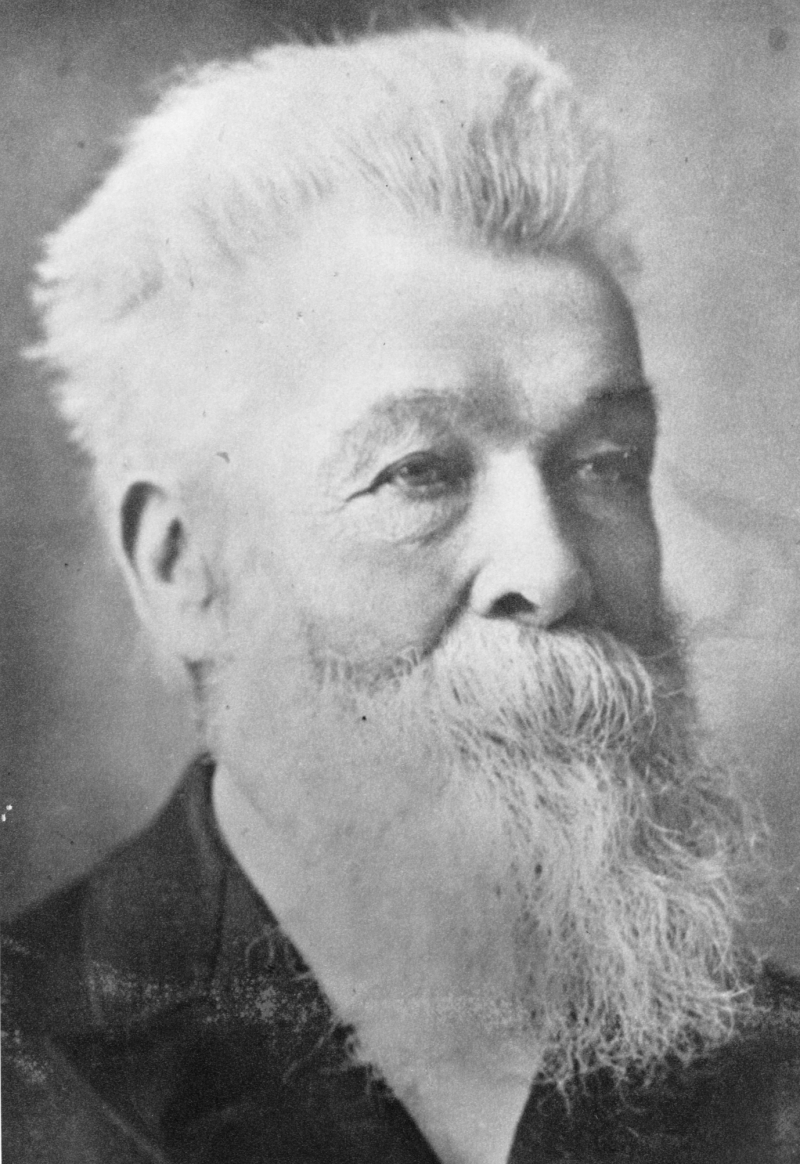
Wm. Stevenson took quite an active part in the governance of the city. He was a Town Councilor in 1851 when Guelph became an incorporated town, separate from the surrounding township. He also served as town alderman (Councilor) in 1854, 1872, 1879, and 1880–1884. In 1885 and 1886, he was Mayor of the Royal City. One of his accomplishments in that time was organizing the Guelph Junction Railway, which connected the city with the Canadian Pacific Railway, thus providing some competition with the Grand Trunk Railway. While this connection helped the commercial interests of the city, its adoption of the Priory as a station set that building on the road to ruin, an outcome that Mr. Stevenson certainly did not anticipate nor would have approved.

("William Stevenson," perhaps at the time he served as Mayor; Courtesy of Guelph Public Library Archives, F38-0-4-0-0-4.)

Apparently a fan of reading and education, Mr. Stevenson also served on the Board of Education and took an active part in the founding of the Central School which competed with the Church of Our Lady for attention on Guelph's downtown skyline from 1876 until its replacement with a more modest structure in 1968.

("Central School, Guelph," printed by A.L:. Merrill, Toronto, ca. 1910.)

Did I mention that Mr. Stevenson had a day job? He was a "nurseryman," that is, he grew and provided plants and trees to order. An ad from the Mercury (13 May 1874) gives an idea of what was on offer:

In 1872, when the postcard above was sent, Mr. Stevenson made a number of entries in Guelph's Central Exhibition, which was his usual practice. The Mercury (4 Oct) records that he won prizes in a number of categories, including Gravenstein apples, pears (variety and Bartlett), grapes (Adirondac, "ereveling," Hartford), and melons (scarlet flesh), not to mention his first prize showing in floral design.

All of this work was carried out at his ample residence of "Maple Bank," at the corner of Grange and what is now Stevenson Street (yes, named after Wm. Stevenson).

(The location of Wm. Stevenson's nursery and Maple Bank in Wellington County Atlas, 1877.)

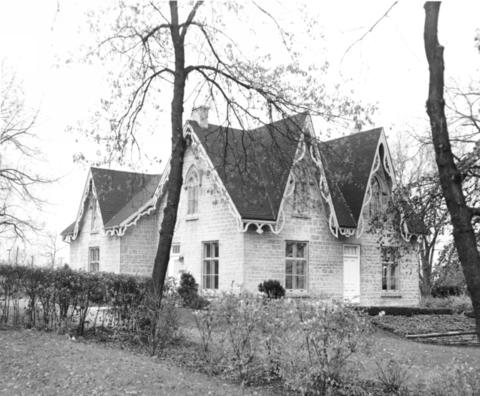
The house itself was built sometime in the 1850s and is quite a nifty example of the Gothic Revival style in Ontario.

("Maple Bank," ca. 1960; Courtesy of Guelph Public Library Archives C6-0-0-0-0-466.)

Happily, Maple Bank survives today and can be glimpsed from Grange street, as in this Google Street view scene:

Here is a picture of the Stevenson family, posed at Maple Bank, ca. 1860:

("Stevenson family," ca. 1860; Courtesy of Guelph Public Library Archives, F38-0-14-0-0-473.)

In the back row stand Wm. Stevenson next to his second wife, Isabella, with Ephraim in behind. The girls are probably Miriam, Laura, Belvedera, Caroline, and Clara (ages, 10, 8, 6, 5, and 1, respectively, in the 1861 census). Given that Clara appears to be about 4–5 years old in the photo, it was likely taken around 1865.

Among Guelph history buffs, Mr. Stevenson is also remembered for the brief reminiscences he delivered in a speech in 1877. It follows the usual form of dates, names, and brief recollections, which the reader would like to know more about. For example, here is his brief recollection for 1854:

In October of 1854, about a dozen of the best stores on Wyndham and Macdonell Streets were burned down, causing a loss of many thousand dollars. About this time the town limits were enlarged, much to the disgust of those parties included in the new limits.
Why were the new Guelphites so disgusted, and what form did their distaste take? It would certainly have been nice to know more of Mr. Stevenson's thoughts on the matter, particularly since he was a town Councilor at the time.

In any event, our humble postcard serves to remind us of one of the influential figures of Victorian Guelph.

Wm. Stevenson died on 6 June 1899 at the age of 81 and is buried at the Woodlawn Cemetery.


It would be remiss of me not to mention that some of the Stevenson children became noted figures in town. Ephraim Stevenson was a member of the Guelph Maple Leafs baseball club that held the semi-professional world championship in the early 1870s.

In a reminiscence about his early years in Guelph, Frank Coffee describes his memory of the team in these words (Mercury, 26 Oct 1918):

The original Maple Leafs had won a Canadian championship; Jim Nichols, Bill Sunley, Eph. Stevenson, Johnnie Colson, Tommy and Billie Smith, Jack Goldie, Kenneth Maclean, Harry Steele, were names to conjure with, as in successive seasons they held, against all comers, the championship emblem—the first silver ball.
I have yet to find a labelled photo of Ephraim in his Maple Leafs uniform but I think that this photo from a collage assembled in 1871 is a good match for the young man posed on the porch of Maple Bank above:
(Detail from "Maple Leaf Baseball Team, 1871." Courtesy of Guelph Civic Museums, 1979X.00.762.)

Despite his prowess at baseball, Ephraim's calling was to be a Methodist clergyman.

William and Isabella's youngest daughter, Maud, achieved fame as a singer. A paragraph from a short biography provides some details of interest:

The Toronto Globe of November 4, 1899, carries an account of Miss Stevenson and mentions that she is known from coast to coast across Canada for her concert work. Also in London, England, she received flattering comments on the tone and quality of her voice as well as the keen dramatic instinct she possessed. She was, it said, able to sing with equal ease, the most difficult classical selections and Scottish ballads. Her soprano voice had a magnificent range and sweetness. She was called "Guelph's sweet-voiced singer."
There is a portrait of her from ca. 1880 in a Notman photograph in a dark outfit and looking rather severe:
She is identified by her married name of Maud Stevenson Pentelow. (Courtesy of Guelph Civic Museums, 2014.84.1066.)

Maud's older sister Clara was also an excellent singer, though she did not enjoy an international reputation. Nonetheless, she is commemorated in the name of Clara Street in the St. George's Park neighbourhood. The reason is not clear to me, although it may not be a coincidence that Clara was the second wife of local mover-and-shaker J.W. Lyon. Anyone who knows the story is invited to fill it in in the comments below.

A portrait of the children of William and Isabella Stevenson, taken ca. 1925, is shown below:

(Courtesy of Guelph Civic Museums, Grundy 12.)

From left to right, the figures are Belvedera, Clara, Carolina, Minnie (Miriam?), Maude, Rev. Ephriam, and Laura.


Sources consulted for this post include:
  • Sudbury, H. "Stevenson, William." Publication of the Guelph Historical Society 1965. 5,9: 1–2.

Sunday, 30 May 2021

The early days of Eden Mills

Eden Mills, a short distance up the Eramosa River from Guelph, has a reputation as a quiet and picturesque rural village. But, it wasn't always so. When Aaron and Daniel Kribs arrived the site on 14 April 1842, it had a good water supply but not much else to recommend it (Mercury, 20 July 1927):
Finding that there was sufficient fall in the bed of the river to raise about eight feet head of water at that place, they proceeded, after building each a shanty, to clear the ground for the mill dam. This required a good deal of courage, for a more dreary or unsightly looking place could not be found in the whole township, than it was at that date.
Despite the rough nature of the terrain, the availability of water and timber, plus the determination of the brothers, made them press on:
However, the Messrs. Kribs pushed ahead, and by the 1st of October of the same year, had the dam completed, the saw mill running, and a good one it was too, for an old fashioned water mill. Having a good lot of pine trees convenient to the mill, they set to work sawing lumber, and very soon the people found a way to get it out from the place. Although they had only a miserable apology for a road, yet the lumber was taken away as fast as cut, and they did very well that fall and winter.
(Postcard of "Mill pond, Eden Mills," ca. 1955.)

Daniel Kribs was born near Hamilton in 1816 and moved with his family to Eramosa in 1826 (Globe, 6 December 1898). The new mill was evidently the Kribs brothers' chance to make a name for themselves. So, they called their new locale "Kribs Mills" (sometimes spelled "Cribbs Mills").

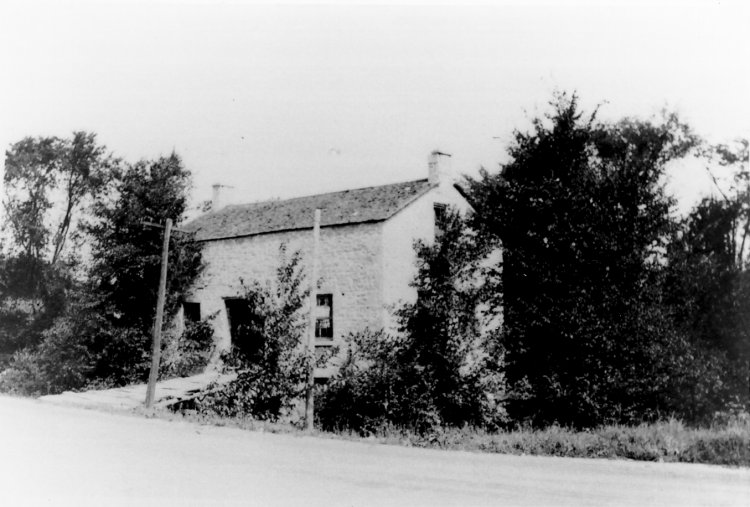
("Grist Mill," ca. 1923; Courtesy of Guelph Public Library F38-0-15-0-0-340. These stone buildings replaced the frame mills built by the Kribs.)

Flushed with success, the Kribs brothers added an oatmeal and a grist mill to their enterprise. Unfortunately, this addition proved their undoing. The millwright they hired to construct it did a poor job, resulting in an underpowered mechanism that could grind only a fraction of the capacity required to run at a profit.

The brothers persevered but could not make good their debts.

In the spring of 1846, Adam Lind Argo came to the town and saw an opportunity. He offered the Kribs $5000 for their operation and lands and, although it was only half their investment, they accepted and washed their hands of the operation. Daniel Kribs later moved to Guelph, where he became a court bailiff and a respected member of the community.

Adam Argo was born about 1809 in Foveran, Aberdeenshire, Scotland, and immigrated to Canada in 1836. He gained milling experiece in Bridgeport and Preston before striking out on his own. Thanks to his experience and acumen, he was able to remodel the Kribs's mills and keep them running in the black.

Unsurprisingly, Adam chose to rename Kribs Mills and selected "Eden Mills" instead. Various stories are told about his reason for this choice. One story is that the name "Eden" was adopted to help attract interest in the otherwise unappealing locale, rather as Erik the Red choose the name "Greenland" for the icy North Atlantic island he was trying to sell back in frosty Iceland. Another story is that the name "Eden" had a Biblical provenance: Just as the original Adam came from Eden, so this new Adam would return there, in a manner of speaking. Another possibility is that Mr. Argo choose "Eden" in memory of his homeland, where there are a number of places featuring that name, such as Eden Castle in Aberdeenshire.

(Postcard of street scene of Eden Mills, 1905; Courtesy of Wellington County Museum & Archives A1989.101.)

Whatever the reason, Eden Mills ultimately proved attractive. The Mitchell’s Canada gazeteer of 1864 gives the following description and list of village enterprises, suggesting a thriving community:

Eden Mills, C.W.—A village, situated on the river Speed, in the township of Eramosa, count of Wellington, containing a good female school, three churches and Mechanics’ Institute library with 460 volumes. Distant from Rockwood, a station on the Grand Trunk Railway, 3 miles; Guelph 7 miles. Daily mail. Population 250.
Antony, Jacksonshoemaker
Bardswell, Meshackretired
Boyle, Andrewblacksmith and wagon maker
Burrows, Wm.shoemaker
Cook, Charlescabinet maker
Cook, Frederickcabinet maker
Davidson, John A.carpenter and builder
Davisdon, John A.collector, land agent, issuer of marriage licenses, commissioner in B.R. conveyancer, &c.
Dowrie, Davidcarpenter
Esson, Johnbuilder
Fielding, Davidgrocer
Frain, Jameswagon maker
Harmston & Hendersonbuilders
Harris, Johnhotel keeper
Hay, Johnshoemaker
Hortop, Henryflour mill
Jackson, Anthonygeneral merchant
Krase, Greorgecabinet maker
Little, Jamesmiller
Malcolm, Mrs.female school
Meadows, Sam’lpostmaster, general merchant, sewing machine agent, and potash manufacturer
McDonald, Alextailor
McDonald, Johncooper
Richardson, Ralphwagon maker
Ritchie, Williambuilder
Stewart, Alexanderbuilder
Sullivan, Timothyblacksmith
Watson, Wm.mail stage proprietor
White, Jamesconstable and lime burner
White, Thomasretired
Wilson, JamesJ.P., and oatmeal mill
Wilson, Peterwoollen manufacturer
Zouart, Johnretired
The sharp-eyed reader will note that Mr. Argo had sold the mill by this time (1850), and relocated to Fergus.

Despite being largely cleared, local trees continued to play a significant role in the village. In 1872, some local men performing statute labour nearby discovered a human skeleton in an advanced state of decay with a flagstone laid across its breast (Mercury, 19 June 1872). They supposed that it was an Indian burial, as it was found under the roots of an old pine tree and must have predated the arrival of settlers. It crumbled to dust on removal.

In 1890, Mrs. William Geddes of Eden Mills was killed in an unfortunate accident involving a tree near the village (Mercury, 31 July 1890). She and her children had gone berrypicking with some friends in Mr. Anstee's swamp. The two parties had just gone their separate ways towards home when the children ran back saying that their mother had been struck by a tree. Her friends hurried to the spot to find that Mrs. Geddes had been killed outright and was lying next to the tree that had felled her.

In 1912, Eden Mills was hooked up to the electrical grid, like many towns in southwestern Ontario, to receive power generated a Niagara Falls. Construction of the Hydro corridors resulted in the felling of many trees, which met with some protest, reflecting a rise in interest in forest conservation advocated by people like Edmund Zavtiz of the Ontario Agricultural College (OAC). In a letter to the editor of the Globe (12 June 1918), J.E. Carter complained of "the great destruction of our beautiful shade trees along our highways by linemen who butcher them." He drew particular attention to "a fine row [of rock maples] near Eden Mills" that had recently suffered this fate. Carter noted that the Ontario Tree-Planting Act limited the powers of linemen to trim roadside trees and urged rural residents to exercise their rights to defend them.

(Postcard of Eden Mills showing General Store and post office, mill, and building located south of mill, 1912; Courtesy of Wellington Museum & Archives, A1989.66.)

Besides trees, water was a crucial part of Eden Mills early history. Of course, it powered the mills themselves but it also provided opportunities for recreation. In 1843, a party of young men were working on construction of Kribs's grist mill and decided to take a little break from the hot weather in the mill pond. Two of the party, Gerow and Duffield, got in over their heads and disappeared under the water. Daniel Kribs came upon the scene and managed to pull them out. Duffield appeared to be dead but local resident Stephen Ramage applied some "resuscitation techniques" and restored him to life.

Despite this close call, the mill pond continued to be a popular local swimming hole.

(Postcard, "Mill stream, Eden Mills, Ont.," ca. 1955.)

Of course, the mill pond and Eramosa River were popular places for locals to go fishing. So, it was the setting of many fish stories, such as (Globe, 20 July 1886):

An ex-student of the Agricultural College, now employed near Eden Mills, made loud professions of his abilities as a fisherman. Some persons, however, had so little faith in his attainments in this line that they made a wager that a young lady of the neighbourhood could outfish him, he however, to catch six to her one. The result was the young woman caught nine fish, one of which was a trout weighing a pound and a half, while the ex-student caught six shiners [minnows].
Grrl power! It would interesting to know who these fisher folk were. The young man whose angling pretensions were so ignominiously punctured may have been R.A. Ramsay, a local lad who had graduated from the OAC four years earlier.

In the great tradition of the pasttime, local anglers' exploits were always open to question, for example (Mercury, 17 June 1887):

The Rev. J.C. Smith, B.D., and Mr. Geo. Sandilands, manager of the Central Bank, were trout fishing in Eden Mills yesterday. Mr. Sandilands told a glowing story about trout, and trout fishing. The reporter would at any time take Mr. Sandilands’ word for $20,000, but when it comes down to veracity on a fishing expedition it is another matter. Mr. Smith was not seen on the streets to-day, and thus the promised one true fish story of the season is knocked on the head. It is privately whispered, however, that the catch was beautifully small.
Doubtless, more than a few whoppers were fished from the Eramosa at Eden Mills.

As it happens, more than water flowed through Eden Mills. In 1886, following a tip, police officers raided Johnston's Hotel there looking for violations of the Province's new Scott Act (Mercury, 24 December 1886):

Edward Johnston, who keeps a hotel there, was the suspected party. His premises were searched, and underneath the bar in the cellar was found a small still in full working order. The still was erected on the top of a common wood stove, with worm in a cold water tub near by. A considerable quantity of wort in different stages of fermentation was also found, together with distilled spirits. The whole was seized and the wort destroyed. The still and fermenting tuns were brought to Guelph.
Having been caught red-handed, Johnston pleaded guilty and was fined $50.
(Stone hotel building in Eden Mills, 1973; Courtesy of Wellington County Museum & Archives A1985.110.)

It seems that Johnston learned his lesson. A short time later, we learn of thirsty patrons being turned from the doors of his hotel (Mercury, 4 February 1888):

On Wednesday afternoon, it seems Mr. Arch. Robertson, living near Eden Mills, went home from Guelph with enough liquor to make him quarrelsome. Being refused entrance to Johnston’s hotel in the village, he ran foul of Mr. David Shannon, and in the encounter received a black eye. In the evening he returned with the assistance of James Rouse and William Hillis and visited Shannon’s house. Shannon was called to the door and assaulted by the trio, and had his window and sash broken. Shannon swore out an information and on the three parties appearing before Squire Strange they were fined $20 each, $5 costs each, $3 for the damage done, and bound over to keep the peace for 3 years. The villagers were much annoyed by the unseemly row, and trust that the result of this case may prove a warning to others disorderly disposed.
Unfortunately, it seems that later proprietors of the hotel were not so scrupulous. Joseph Zinger, who kept the hotel in the 1890s, was found guilty of illegally selling liquor on several occasions.

Matters came to a head in 1904 when the Prohibition League of Guelph complained to authorities about lax enforcement by W.S. Cowan, the license inspector for South Wellington. The Inspector, they said, took no action despite numerous complaints made by the League against establishments in Everton and Eden Mills. Indeed, his superiors were unimpressed with Cowan's defence (Globe, 27 February 1904):

The department wrote to him twice about the matter, and he replied that he had made an inspection, and at Eden Mills had confiscated so much liquor as to necessitate a team to take it away. The department decided that he should have known of the open violation long before, and that after such glaring evidence of incapacity there was no alternative but to ask for his resignation. He declined to resign, and the department removed him.
What did the neighbourhood think of a village where the license inspector hauls away a wagonload of illicit liquor and his bosses figure that he isn't trying hard enough?
(Postcard of Eden Mills showing General Store and post office, mill, and buildings located west and south of mill, 1912; Courtesy of Wellington County Museum & Archives A1989.66.)

Besides wood, flour, and whiskey, Eden Mills was once set to become a petro-town. Apparently, enough oil had been dug up in the vicinity to prompt villagers to form the Oil Company of Eden Mills (Globe, 19 January 1866). Directors were appointed and capital not less that $4,000 was sought. At the inaugural meeting, it was resolved that

the shareholders, owning land at a distance not greater than three miles from Eden Mills, agree to bond their land for oil digging purposes at a royalty of one-eighth of the proceeds of the well, or wells sunk by the Company—said shareholders binding themselves, at the time of taking stock, to hold their lands open for three years for the company for that purpose, and said contract, when executed, to extend to 99 years.
The village was said to be in "a fever of excitement." Test wells were dug and samples sent to Toronto for analysis. Yet, after a year or so, Eden Mills' search for black gold did not pan out and the village never did become the Calgary of South Wellington.
(A forest of oil derricks in Los Angeles, Toluca Street, ca.1895-1901. This failed to materialize in Eden Mills. Courtesy of Wikimedia Commons.)

One of the challenges for residents of the village was its relative isolation. When the Grand Trunk Railway from Toronto to Guelph was built in 1856, it went through nearby rival Rockwood instead of Eden Mills. So, when the Guelph Junction Railway was proposed in 1886, to connect Guelph to the Canadian Pacific Railway (CPR) line at Campbellville, residents saw a chance to catch up. After a village conference, Messrs. Laing and Nicol were sent to a meeting of the directors of the new railway to urge them to adopt a route through the village (Mercury, 6 April 1887). They acknowledeged that a route through Eden Mills would be a little longer than the one proposed near Arkell but argued that it would have compensating advantages. Eden Mills was home to many gravel pits that could supply building materials cheaply. It's grist, oatmeal, and shingle mills produced much material that could be shipped from a station in the village, not to mention the plenteous turnips! The directors promised to relay the proposal to Mr. Jennings, the CPR Engineer, though they were not optimistic for its prospects.

As residents contemplated this gloomy news, things suddenly looked up. A navvy, that is, a civil engineering construction worker, soon appeared in the village, equipped with boots, shovel, and spade. Residents inferred that the Junction railway was to grace their village after all! Alas, it was not so and the people of Eden Mills had to deal manfully with their disappoinment (Mercury, 19 April 1887):

The new arrival was received with open arms, but when he avowed, on being questioned, that he knew nothing about the Guelph Junction, he was treated to the cold shoulder, and plainly made to understand that his [ab]sence would be a relief, and if he did not go he would be assisted.
In the end, the CPR decided on the shorter route and Eden Mills was bypassed again.

However, the patience of villagers was finally rewarded when the Toronto Suburban Railway (TSR) was built between Toronto and Guelph in 1913–1917. This was made possible by the extension of Hydro power to Eden Mills in 1912. When it became operational in 1917, the TSR enabled residents to ship and receive goods from their local station. In addition, visitors could readily arrive by train to enjoy events such as dances put on in Edgewood Park (later Camp Edgewood). Residents could get to larger centres for their amusement and convenience.

(Oatmeal mill, Eden Mills, ca. 1923; Courtesy of Guelph Public Library F38-0-15-0-0-341.)

However, by the time the TSR arrived in town, a rival mode of transportation was taking hold, that is, the automobile. At first, cars were largely expensive summer amusements for wealthy urbanites. Early car owners from town would take their vehicles for joyrides through the countryside, spooking the horses and annoying rural residents.

Some residents occasionally lashed out against these urban elites by setting traps for them in the roadways. On one occasion, Mr. Walter Harland Smith, Liberal candidate in Halton County, met with just such an improvised obstacle (Globe, 12 September 1911). He had finished addressing a meeting at Eden Mills and was driving to Campbellville for another when, just near the top of a hill near Brookville, his car crashed into a barricade of logs and stones thrown over the road. He and his two companions were ejected from their auto and badly shaken up, though not seriously injured. However, their car was completely wrecked.

It may be that this attack was directed specifically at Mr. Smith as a form of politial opposition. If so, it nonetheless employed a tactic that was also directed indiscriminately against car operators in rural areas of Ontario, and elsewhere, at the time.

(Map of Eden Mills, 1906; Courtesy of Wellington County Museum & Archives A1985.110.)

However, by the end of the Great War, car ownership had become more common, including among rural residents. One news story about an unfortunate incident following a wedding in 1919 shows that there were at least two automobiles in Eden Mills by that time (Globe, 24 October 1919):

Death came quite suddenly to-day to Frank Ramshaw, a highly-respected citizen of Eden Mills. In company with Geo. Gordon, he was returning home in a motor car from a wedding.
In another car just behind him were his son and several others, and when about three or four miles from Rockwood this car overturned and went into the ditch. The car ahead stopped, and Mr. Ramshaw got out and went to a nearby farmhouse to secure assistance. He came back only to find that everything was all right and no person hurt.
While he stood there, however, he suddenly fell forward, and almost before anyone could reach him he expired. Death was no doubt due to heart failure brought on by the excitement due to the accident. Mr. Ramshaw was about sixty-five years of age, and was well known. He leaves a wife and several children.
Increasing popularity of private automobiles decreased interest in the TSR, which ran mostly at a deficit and ceased operations in 1931. Sections of it are now operated as trails by the Guelph Hiking Club, including in the vicinity of Eden Mills. (Mill pond, Eden Mills; Courtesy of Google Street View.)

Of course, there is much more to the history of Eden Mills, which is perhaps best known today for the Eden Mills Writers Festival. Suffice it to say that, despite initial appearances and a few challenges, Eden Mills did become an attractive and lively locale.


The following works were consulted for this post:

Saturday, 18 May 2019

Boating on the Eramosa

The Speed and Eramosa rivers have always been central to life in Guelph. John Galt chose a site by the Speed so that the swift current of the river could provide water power for mills that would process grain and lumber harvested from the surrounding region. As a result, mills shaped the early geography of the Speed, as occurred at Goldie's Mill.

Unlike the Speed, the Eramosa river keeps a languid pace, making it less attractive for milling. In the town's early days, the Eramosa (often known as the Eramosa branch of the Speed) was remembered for its use by an immense flock of passenger pigeons for a rookery in 1835. Of course, it was also used as a source of water for people and animals.

As far as the citizens of Guelph were concerned, the Eramosa came into its own later in the 19th century as a place for recreational boating. Increasing incomes allowed for some leisure time and extra cash to spend on boating gear. The usually docile current also rewarded the rowers' or paddlers' efforts more easily than did the Speed.


(Stereograph of rowers at Victoria Park on the Eramosa River. Note the Victoria Road bridge in the background. Courtesy of Guelph Civic Museums 2014.84.73.)

At the same time, around Confederation, rowing began to gain nationwide attention as a sport. In 1867, Robert Fulton, George Price, Elijah Ross, and Samuel Hilton, of St. John, New Brunswick, crossed the Pond to compete in regattas against top European Crews. The arrival of these "colonists" was greeted with some derision but the sneers vanished as the team left their competitors in their wake. They won the Paris Exposition regatta, becoming famous thereafter as the "Paris Crew." In England, they beat the cream of the Oxford University, London, and Leanders clubs—all this in an old-fashioned boat 100 pounds heavier than their rivals'. They returned to Canada to a tumultuous welcome.


(Courtesy Heritage Canada.)

The success of the Paris Crew was followed by that of Edward "Ned" Hanlan of Toronto Island. Ned Hanlan developed a local reputation competing in single sculls events in the early 1870s. He won the national championship in 1877 over a five-mile course in Toronto Bay.

From 1878 until 1884, Ned Hanlan covered himself in glory. He won the American championship in Pittsburgh in 1878, the English championship in 1879 on the Tyne, and the world championship in 1880 on the Thames in London before a crowd of 100,000 spectators. This victory made Hanlan Canada's first world champion in an individual event and an instant hero throughout English Canada.

Besides being a superb rower, Hanlan knew how to work the crowds:

Hanlan's popularity, celebrity even, resulted as much from his showmanship as from his rowing. He often toyed with opponents, slowing down, taunting them, blowing kisses at spectators, faking collapse or rowing in zigzags. (The English press lectured him sternly for his flamboyance.) He was easily Canada's "first national sporting hero," at least in English Canada. After his first English triumph he was met back home by a flotilla 5 kilometres long. In New South Wales a town was renamed Toronto in his honour. He endeared himself to Torontonians by stressing his Canadian identity. He actively took part, like any celebrity today, in numerous promotions, particularly in whistle-stop autograph tours on the eve of races. He organized his own touring shows, raced local heroes, and indulged in showboating, performing tricks such as rowing in a straight line with only one oar.


(Courtesy of CanadaSports150.)

Rowing fever quickly spread to Guelph. In April 1870, the first Guelph Boating Club was organized, accounting for about 35 members (Hacking 1873). The focus of the club was on boating for pleasure and they took some trouble to clear the river of obstructions so that it could be more easily navigated.

Indeed, it seems likely that boaters set out the local geography of the Eramosa River that remained so familiar to Guelphites for about the next fifty years. Hacking's city directory (1873, pp. 18–19) makes mention of several locales along the river connected with boating:

The Eramosa branch is specially admired by pleasure-seekers. Some distance up is an island known as “Rice Island,” and, higher yet, a spot that from its beauty has been christened “Paradise.” The approach to this spot is very fine, especially within half-a-mile of Victoria Bridge, where the long straight watery avenue, thickly clad with shrubs, and the bridge seen in the distance has a really artistic effect. Another place of resort is “The Rocks,” where good duck-shooting is to be had. Here commence a series of shallows, beyond which boating is impracticable.
Several now unfamiliar names occur here. At the time, there was only one island in Eramosa River near Guelph, a small island near the foot of Bell Avenue. Presumably, this place is Rice Island. There is no explanation given for the name but it may be that wild rice was observed to grow there. On Google Maps, the island has been dubbed "Goose island," presumably for the favor it has found with some Canada Geese. (See map below.)


Paradise refers to the area where the Eramosa bends southward about a half-mile east of the Victoria Road bridge. Today, this area is occupied by the Royal City Jaycees Park and the neighboring land subsequently turned into lakes by prisoners of the Reformatory in the 1920s–30s. Paradise was known as a beauty spot and a picnic ground. For example, the Daily Mercury (23 June 1879) relates that:

Chalmers’ Church Bible class boated to Paradise on Friday last and pic-nicked in the beautiful shade to be found there. It was a pleasant party.
Apparently, amenities such as swings and seats were provided. In 1880, the locale is described as "Bradley & Craig’s pleasure grounds," Bradley and Craig being the proprietors of the brand new boat house erected near the Dundas Bridge (and the site of today's Boat House and Tea Room). This note implies that Bradley and Craig had built up an integrated business: renting out boats in the town and arranging a pleasant destination in the township for customers to make for.


(Bend of the Eramosa River at Paradise, 2017. Author's photo.)

In addition to such feminine pursuits as swinging and picnicking, Paradise offered more manly forms of amusement (Daily Mercury, 9 June 1880):

Take care.—Pleasure parties going up the river to Bradley & Craig’s pleasure grounds at “Paradise” yesterday, report random shooting at the range while boats were passing up and down, and no red flag shown. The whistling of a bullet and report as it strikes the target may suit the ears of men and growing boys, but when ladies and children are on pleasure, it will be well for the marker and marksmen to have a care. It will be well, too, for passing navigators to stop and give some kind of alarm when in sight of the target, and then pull by as quickly as possible when the red flag is hoisted.
Today, Guelph rowers must find other incentives for pulling hard on their oars than dodging bullets.

The directory also mentions "The Rocks." The location of this feature is cleared up in the reminiscences of David Allan (1939, p. 98) where he recalls that The Rocks had later become a quarry used by the Reformatory. This locates The Rocks on the north bank of the Eramosa close to Stone Road.


(The Rocks, after quarrying by prisoners of the Ontario Reformatory, 2017. Author's photo.)

The Rocks are part of a series of rocky prominences along the Eramosa River, which were given the name the Eramosa formation in its honour. Geologically, these "Guelph dolomites" take the form of compressed layers of bituminous shales and may be as old as 425 million years.

Speaking of The Rocks in particular, Williams (1915, p. 2) notes that:

South of the prison farm near the Eramosa river, a coral reef rises through Eramosa beds which have been eroded from its top but still flank its sides. The reef is 35 yards wide by 85 yards long and rises about 20 feet at the centre.
It is interesting to think that the banks of the Eramosa River were once the site of a coral reef.

Besides their interesting geology, The Rocks were known as a good place to find wild food. Ducks for shooting have already been mentioned. In the summer, wild berries could also be found there (Mercury, 25 July 1904):

A party of berrypickers, on the dairy farm at the Rocks, of which there are quite a number, had a fright on Friday. One of the ladies nearly tramped on a snake about three feet long. They thought that it was a rattle snake by the sound that it made in its flight. It was a question of whether the ladies or the snake were more scared. Apparently the snake went for its cover, but it is certain that the ladies left the berry patch for home.
As Guelph grew, the geography of the Eramosa sustained more alterations. On 25 June 1886, another private park took shape on the south bank of the Eramosa just west of Victoria Road. The Park was named Victoria Park, after both the nearby road and, of course, the British Queen. The Boating Club made arrangements to rent the land from its owner, Mrs. Evan MacDonald, cleared it up, added tables, chairs, and other amenities suitable for picnics and camping. A sturdy dock was installed on the riverbank, along with stairs carved into the Eramosa rock for the convenience of those arriving by boat or from the nearby road.

A lovely description of Victoria Park is provided in a letter sent as an advertisement to the Acton Free Press to entice customers from further afield to enjoy the Park's offerings (22 July 1886):

... the banks are replete with natural beauty; green hedges dotted with flowers, and interspersed with vines that mount in tangled profusion to the tops of the trees in some places, and fringed at the water’s edge are ferns reflected in the clear mirror of the river, and you row along in a fairy land of nature’s own. You land at a broad wharf when you reach Victoria Park, and a sidewalk of strong planks winds away inland through ferns and tangled brushwood, and mounts on a strong stairway, with romantic seats here and there, the face of the precipice. Or, if you wish a glimpse of moss-grown boulders and lovely lovers’ walks, leave the plank walk and follow the path round the foot of the rocks which tower high over your heads, where you will find much to interest you, especially if you have with you the one person of all the world to you, to help you enjoy it.
If you mount the steep stairway you will find a high dry open space, with grand trees here and there, seats are placed round some, swings are hanging from others, and there is plenty of scope for the largest party to have the best of all good times.
The dock, seats, and swings are now gone, but the place where Victoria Park used to stand can still be accessed from the Guelph Radial Line trail or the easternmost hole of the Cutten Fields golf course.


(Victoria Park Landing, Guelph, ca. 1910, published by W.G. Macfarlane, Toronto. Author's collection.)

Later reminiscences cast a rosy glow over the pleasures of Victoria Park. During the warmer weather, people would often paddle out every Friday to camp there for the weekend. The most determined clients would camp there all summer, paddling downriver for work each morning and returning each evening.

Boating together was considered a highly romantic activity and it was said that, "Many a prominent business man in Guelph today can look back and thank the old canoe excursions for the helpmate who has been his life partner since those days of carefree companionship" (Mercury, 20 July 1927).

During its heyday in 1895–1900, boating to Victoria Park was a focus of leisure activity for many Guelphites. Campers would enjoy musical entertainments including the singing of a young Eddie Johnson (later a world-famous tenor) and the piccolo playing of Arthur Wheatley. At midnight, boaters would return to town en masse, still singing:

All the way, the river valley would echo and re-echo to the noisy choruses which were shouted lustily all the way down. Hands and arms would be made into grappling irons and the great armada of frail craft would be welded together on the return trip. Only those in the rear would paddle, and that just enough energy would be expended to keep the fleet in motion.
Another landmark arrived on the Eramosa River in 1888 in the form of a bridge to service the new Guelph Junction Railway, which initially ran from the Priory to the Canadian Pacific Railway (CPR) line at Campbellville. As the railway is operated by the CPR, the bridge is often referred to simply as the CPR bridge.


(The River Speed—Guelph, Ontario. Publisher unknown. Note the CPR bridge in the background. Author's collection.)

Although viewed with great fondness, the Eramosa River, like the Caney Fork River, is a taker and a giver. A number of boaters drowned in its waters and accounts of these events relate more of its geography to us.

The most noted drowning in the Eramosa in that era was of Hector Cooper and Eugene Gagnon on 24 May 1905. Cooper was then finishing his third year at the Ontario Agricultural College (OAC) while Gagnon, of Quebec, was taking commercial and English training at the Central School in preparation for studies at the OAC (Evening Mercury, 25 May 1904). The boys had become good friends and had decided to go for a paddle up the Eramosa at 4 o'clock that afternoon. They rented a canoe at the Boat House and set out.

A half-hour later, their canoe and a coat were found floating on Hood's bay by other boaters. Upon being informed, Mr. Johnson, owner of the Boat House, suspected that the boys had tipped over and set out for home to dry out, leaving the canoe for him to bring in. This sort of occurrence was not an uncommon one. Nevertheless, finding some of Cooper's letters in the coat pocket, Johnson sent word to the OAC to locate the boys. When Cooper was not to be found, a search party set out along the river. Cooper's body was found a few yards west from the corner turning into Macdonald’s spring. Gagnon's body was found a few hours later about fifty yards further downstream.

Both boys were fit and Hooper was said to be an excellent swimmer, so the cause of their drownings remained a mystery.

The term "Hood's bay" likely refers to George Hood, a butcher who had lived on a property on the York Road at the intersection with the eponymous Hood Street, still bearing that name today. His property backed onto the Eramosa river near where it changes from a westerly to a northerly heading. At a guess, then, Hood's bay may refer to a stretch of the river that widens out northwest of this bend, behind the location of St. Mary's Ukrainian Church today.


(Hood's bay, 2018. Photo by author.)

The feature referred to as Macdonald's spring must then be what local cartographer Jeremey Shute calls Whiteley's Creek, which rises on the University of Guelph campus and flows down through the Cutten Fields, emptying into the Eramosa River just east of Hood's bay. The Macdonalds owned the property on the south bank of the Eramosa in town and their home and other buildings lay near this stream.

Last, but not least, among the familiar places in the landscape of Eramosa boating was the Waterworks. The city Waterworks were built at the foot of Ontario street on the banks of the Eramosa in 1879. Since the waterworks were public property, the location was treated as a public park and boaters with their own craft would use it as a launching point.

Unfortunately, the accessibility of the waterworks also made it a hangout for idle young men. Sometimes, these "loafers" amused themselves at the expense of boaters (Mercury, 14 June 1887):

Bad boys—there is a fine opportunity for the police to nab the number of bad boys who congregate lightly on the Rivers edge in the bushes behind the water works. They sit there, and as every boat goes past, most vulgar and unbecoming remarks are made about the occupants, which are most revolting to the ears of the lady occupants as well as the gentleman. The employees of the water works, although having nothing to do in the matter, for the sake of decency chase them away whenever they can, but the young scamps are so wide-awake that whenever they see them approach they scamper off among the bushes and hide, only to return again when all danger is passed. A policeman in plain clothes would have no difficulty in nabbing the whole gang.
Whether or not these miscreants were ever caught I do not know.

As postcards of the Edwardian era attest, boating on the Eramosa remained a popular pastime. However, the Guelph Boating Club of 1895 came to grief in 1900. An attempt to form a new club was made in 1927 but did not succeed. With the adoption of automobiles, people took drives out in the country to have their picnics. There was talk of paving parkways along the Speed so that it could be enjoyed by car (Mercury, 28 September 1918), though the money to do so was lacking.


(Scene on the river Speed, Guelph, Canada. Published by the International Stationary Company, Picton, Ontario, ca. 1910. Author's collection.)

In addition, the geography of the Eramosa was the subject of more changes, for example, with the arrival of the Ontario Reformatory. However, that is a matter for another time.

Wednesday, 29 June 2016

The Priory—a sad ending

In his essential History of Guelph, Leo Johnson remarks that the Priory—the first house in Guelph—came to a sad ending (1977, p. 317). I have outlined the history of the Priory in an earlier post but it is worth revisiting this particular event in some detail: On the eve of the 100th anniversary of the city and the building, how was it that this historic structure was hauled away in pieces, never to be seen again?

The sad ending begins many years earlier, in 1887, when the Priory was sold to the Guelph Junction Railway (GJR). The GJR was a corporation formed in 1887 by local merchants and the city to create a transportation link to Guelph to compete with the Grand Trunk Railway, thus lowering shipping rates and costs for Guelphites and their businesses. The railway built a track from near Campbellville through the city itself. Instead of running the railway themselves, the corporation leased it to the Canadian Pacific Railway (CPR).

There had been some discussion of using the existing Grand Trunk Station downtown as a depot, thus creating a Union Station. However, the GJR instead acquired the Priory, which had been a private residence owned by David Spence. The 99-year lease to the CPR gave them the right to modify the property as necessary for the purpose of operating a station. No thought was given to what would become of the Priory in the event that the CPR no longer wanted it. Although some citizens were concerned about the erosion of links to Guelph's past and its founder, John Galt, there was no sense that preservation of certain structures for posterity was a significant project or something that might be enshrined in the city's contractual relationships, much less public policy. That proved to be fateful for the Priory.

The Priory's previous owners had created quite a park around the structure. The grounds featured a variety of flower and vegetable gardens, with paths in between. In the gardens could be found gooseberries, apples and plums, including the "Glass seedling plum" developed by David Allan's gardener, Alex Glass (Mercury, 5 Feb. 1955). Iris, narcissus and tulips were grown beside the main path, and the greenhouse featured several rare plants, including Spanish grapes.

The Mercury records the suggestion that the grounds be maintained in order to beautify the station and gratify visitors to Guelph (4 July 1888):

The Priory Trees.—The attention of the directors of the Guelph junction might be called to the need of caring for the valuable trees on the Priory lot. Owing to the grove being completely open from the track, but secluded by the clothes fence, from the street, young vandals have taken advantage of this license and have stripped three white birch trees of their bark. No grove perhaps in the city for its size contains more valuable specimens of choice trees there being 15 varieties of evergreens alone. It is a beautiful spot and will make a very comfortable resting place for travelers, and if thrown open for the benefit of the public would give them a nice park also. A fence behind the station along the track, with footpath through and seats round would put it under the protection of every citizen, and all would feel a just pride in preserving the small but valuable park.
In the end, most of the gardens, paths, and other features were removed to accommodate the tracks, platform, and access to Priory Street. Although the CPR was not wantonly destructive, neither was it much interested in the maintenance of gardens or the provision a civic park. As a result, the Priory did not receive "the protection of every citizen."

During the "golden" age of postcards in the early 20th century, the Priory was one of the most popular postcard views of Guelph. One particular image, taken from the east where Macdonell Street meets the Speed, is likely the most common Guelph postcard ever made. Here is the version of this image as produced by the Pugh Manufacturing Co. of Toronto.


This view shows the building as it appeared around 1900. With its contrasting colors, it nicely picks up the details in the building, including the Virginia creeper growing over much of its exterior.

Although the caption on this card says only, "C.P.R. Station, Guelph", captions of many cards from other companies often note that it was also the first house in Guelph and once the home of John Galt. Messages on these cards often mention the Priory, as in the following example from a card printed by the A.L. Merrill Co. of Toronto, sent in 1908:

I know you like historic buildings. This is the first house that was built in Guelph. It is about one hundred years old now. The C.P.R. use it as a station on account of it being the first house. they are not allowed to pull it down. J. M.
(Courtesy of John Parkyn.) It is interesting that Joe Merlihan (J.M.) remarked on the possible demolition of the Priory, since that had already become an issue of much discussion.

Before proceeding with that matter, I want to put up an unusual postcard that shows the Priory from across the Speed. This postcard was printed in the format of a bookmark and thus provides a panoramic view of the building and its surroundings at another point in its career as a CPR station.


This card was published by Rumsey and Co. of Toronto, around 1910. The photo reveals the screen of trees behind the building that still separated it somewhat from the downtown behind it. Note also the locomotive on the tracks to the right.

It would also help to have a bird's eye view of the Priory and its surroundings. No postcard or other such image survives, that I know of. However, one can be concocted by taking a satellite view of the vicinity from Google Maps and overlaying an early survey of the Priory and neighboring lots done by Captain Strange (and copied in 1957 by Mr. Shoemaker, a surveyor; University of Guelph Archives XR1 MS A379094). The outline of the Priory is emphasized by a black box with its porch facing the Speed.


I adjusted the overlay by locating two fixed points: The first is the bend of Woolwich Street immediately east of Thorp Street (Woolwich used to bend south there instead of north); the second is the location of the bridge at Allan's Dam, where the railway bridge was later constructed. The result is a rough-and-ready map of the Priory. The bulk of the Priory's plan is now under Woolwich Street with the porch to the north of the sidewalk, facing the metal canoe in John Galt Park. The map helps to give a sense of the scale of the building and its grounds, the latter comprising all the lots between Priory Street and the Speed River on the map.

Progress soon made the Priory seem obsolete as a railway station. In 1904, the CPR began construction of the Guelph to Goderich Railway, at the behest of the GJR. It was proposed that Priory be razed and replaced by a larger and more modern building as a part of this project (Johnson 1977, p. 318). Although the cost of $40,000 proved prohibitive, the proposal brought the matter to a head. Many residents viewed the Priory as something of a relic, one that seemed increasingly shabby and out-of-place in modern Guelph. Others viewed it as a significant connection with the Royal City's past. Even the Mercury, normally a voice for progress, urged that the old place be preserved (Mercury, 4 June 1904):

And, by the way, now that C.P.R. extension is in the air and a new station is talked of, what is to become of the old Priory? If the citizens of Guelph have any respect at all for, and pride in, the city’s history, they will see that this historical building is preserved intact. Would it not be a good idea to place it on rollers and remove it to the Exhibition grounds, to be used as a museum, containing interesting relics of Guelph, and including such old pictures as are now available.
Since the CPR's lease seemed to give them a free hand, the obvious way to save the Priory was to move it to another site. Buildings were moved around regularly in that era, so the scheme raised no technical problems. However, the notion of a historic park where old buildings might be located was, so far as I know, a novelty. Would it attract much support?

One important supporter of preservation was brewer George Sleeman. In 1905, then-Mayor Sleeman received a letter from one Gilbert Campbell, a Scottish fan of John Galt. In the letter, Mr. Campbell asked for confirmation of a story that had reached his ear to the effect that Guelphites proposed to destroy Galt's old residence. He offered a photo of Galt's birthplace in exchange for a photo (perhaps a postcard?) of the Priory. The Mercury (16 Oct. 1905) printed the letter along with the following observation:

His worship the mayor is one of the many citizens who hope that the old landmark will not be disturbed. He will acquaint to Mr. Campbell of the present situation.
In 1908, the CPR agreed to deputations from Guelph City Council urging them to build a new, better station in the town (Johnson 1977, p. 318). Construction of the new station in Trafalgar Square by the Eramosa Road bridge began in 1910. Their plans for the Priory site no longer included the building. Instead, they had plans to construct a short spur line and some pens and storage sheds at that location.

The crisis point was reached in 1911, upon completion of the new station. A letter from Donald Guthrie, a local lawyer, addressed to the Board of the GJR explains the situation (8 July 1911; UoG Archives XR1 MS A801—box 16, file 10). He explains that, in his opinion, the Priory is the property of the GJR and the CPR's lease does not entitle them to demolish or sell the structure. He reports that Mr. Oborne, Superintendent of the CPR, did not agree and said that, notwithstanding this news, the Company would demolish the building if it were not removed within a week! Mr. Guthrie advised that while the GJR could sue the CPR, it might be more expedient for Sleeman to contact Oborne personally to discuss the matter, as Sleeman was a prominent local customer of theirs.

Sleeman and the other Parks Commissioners explored numerous options. One scheme was to transport the building to Riverside Park. However, the cost estimate of $500 was more than could be mustered without help from either the CPR or the City Council, both unlikely. Besides,the building might not even fit under the streetcar wires on Woolwich Street.

Another scheme was to move the Priory a short distance back into Priory Park (the current location of the Blacksmith Fountain). However, the City Board of Works would not issue a permit to allow the move, a decision that the police promised to enforce (Mercury, 19 July 1911).

The CPR refused another suggestion to allow the building to be moved to the empty southwest corner of their site.

The situation provoked much popular discussion, much of it negative. Consider the following reports in the Mercury (26 July 1911):

All kinds of opinions continue to be expressed regarding the old building. Mr. C.J. Eisle was of the opinion that if its disposition were referred to the people they would 99 out of every hundred vote for its destruction. Six or seven men passed him when the fire bell rang the other day, and for fun he told him the fire was at the old C.P.R. station. In each case they expressed the hope that it was. This was Mr. Eisle’s method of taking a plebiscite. These opinions are in accordance with that of a prominent manufacturer, said if the disposal of the building were left to him he would put a stick of dynamite under it and blow it up.
Another wag suggested that it be taken to St. George's Square, halved in size, and used as a comfort station for streetcar passengers there.

The City's Finance Committee recommended a grant of $500 for removal of the Priory to Riverside Park. However, this proposal was flatly rejected by City Council in a session that featured "fireworks" (Mercury, 19 Aug. 1911):

Ald. Penfold was not a bit backward in stating his objections to any grant, in fact he was very much opposed to it. “The idea,” said the alderman, “of spending that amount of money for the removal of a few rotten logs! Why the idea is preposterous, and not to be thought of at all.”
Others objected that the shabby building would discredit the city and its citizens if displayed prominently in a city park:
Aldermen Calvert came back with a remark that if it was erected on the Priory Park site it would look like a man with a black eye.
Finally, the controversy also revealed a division along class lines. Most of the advocates for relocation of the Priory were wealthy and prominent men. Many citizens found the whole scheme evidence of how misguided and out-of-touch their wealthy patricians could be:
Alderman Howard was decidedly opposed to the removal of the building to Riverside Park. ”It is ridiculous,” said the alderman. ”I have interviewed a great number of the ratepayers, and not a single man has said that he was in favor of the project. The majority of them had said to tear it down. Furthermore, the council has no right to be dictated to by a few people who have a lot of money.”
City Council refused the grant. So, the ball landed squarely in George Sleeman's court. Sleeman had in the meantime purchased the building from the GJR and spent $300 on preparations for its relocation. He now contacted Mr. Oborne again and convinced him to allow the Priory to be relocated at the back of their site. It was relocated behind the Priory Hotel, on a laneway from Woolwich Street (as it was then) to Priory Street, roughly where the Supreme Car Wash stands on Woolwich Street today. The CPR had no immediate plans for that particular part of the site. Their condition on this agreement was that the Priory would be removed within 30 days of the CPR notifying Mr. Sleeman at some future time (2 Sept. 1911; UoG Archives XR1 MS A801—box 16, file 10).

The Mercury heaved a sigh of relief. On 29 Sept. 1911, a headline read, "Fate of the old Priory at last determined." However, the old building had merely been granted a reprieve. Also, dismantling of the structure had begun. Oddly, George Sleeman had the two side wings of the Priory removed and taken to his property on Waterloo Avenue, there erected as an independent structure (Mercury, 28 Aug 1911). Is was only the remainder of the building that was moved to the rear of the CPR grounds. It is unclear why Sleeman made this move. Perhaps it was the only way for the building to fit into the space made available by the CPR. Perhaps, seeing that the Priory was not out of danger, he had removed as much of it as he could afford to. In any event, the signs were not good.

Without anyone to maintain it, the Priory fell into disrepair and increasingly became an eyesore. It acquired the bad habit of catching fire, which it did at least three times in 1922 (Mercury, 27 Sep. 1922). That same year, members the City Parks and Buildings Committee asked the Council for some money to purchase the Priory from Sleeman with a view to moving it to Riverside Park, apparently in connection with a dam to be constructed there to make a swimming pool. Once again, the money was not forthcoming.

In 1923, the Guelph law firm of Guthrie & Kerwin corresponded with the CPR, suggesting that the railway lease the land on which the Priory then sat to the city, so that they could make a small park around it (31 July 1923; UoG Archives XR1 MS A801—box 16, file 10). Although CPR Superintendent Rutter confirmed that the company had no plans for that location, they were not willing to lease it out. The building caught on fire once again (Mercury, 28 Sep. 1923). At that point, the Fire Chief Knighton expressed the view that the ruin had become a fire hazard to the other buildings around it.

In 1924, the City Council consulted with Wellington Thompson of Huntsville, an expert on log cabin construction, for his opinion on whether or not a memorial to the building could be built in Riverside Park with the salvageable logs from the Priory (Toronto Globe; 29 May 1924). He expressed the view that a small model of 18 by 22 feet might be erected. The work was never carried out but the incident shows that the Council had given up on the idea of saving the whole structure.

In 1926, George Scroggie, building inspector for the City's Public Works Committee, was instructed to assess the remains of the Priory (Mercury, 2 March 1926). He reported that it should be condemned:

I have examined the building as requested and found it to be in a very bad repair. The roof has fallen in, adding to the danger of complete collapse, as the pressure on some parts of the log walls is now outward. As there has been considerable talk about the restoring of this structure, I have hesitated up to this time to condemn it, but the time has come when something must be done, and I would urge that it be torn down as soon as possible.
The Mercury published the following photo of the old derelict (16 March 1926):


On 4 May 1926, the Priory was demolished (Toronto Globe, 5 May 1926). Salvaged logs were stored at Robert Stewart's Lumber Company on Cardigan Street (KW Record, 22 Feb. 1958), the idea being to use them to construct a model replica of the Priory in Riverside Park the next year for Guelph's Centennial celebrations (Mercury, 21 Dec. 1926). However, the scheme was not carried out. The Priory was then just a memory.

It is certainly curious that Guelph's oldest building, and one associated so closely with the city's founder, came to such a sad ending. It is especially poignant that it was demolished on the eve of its 100th anniversary, when there was to be a celebration of the city's history. To understand this outcome, it may help to compare the Priory to other buildings that have been preserved.

Consider Zavitz Hall on the University of Guelph campus. When slated for demolition, Zavitz Hall was occupied by the Fine Art Department, for which no other accommodation existed. By contrast, the Priory was an empty shell, and one slated for replacement by the CPR not long after the Railway occupied the building. Also, whereas Zavitz Hall contributed positively to the space of Branion Plaza, the Priory was widely seen as an isolated relic shorn of the gardens of its former residents.

Importantly, supporters of the Priory lost the political battle to save it. Prominent political figures such as George Sleeman worked to preserve the building but were unable to raise sufficient money to carry out their plans. Many of the Aldermen and much of the electorate saw the scheme as the pet project of an elite out of touch with the priorities on the man in the street.

This last point is perhaps crucial. In the case of Zavitz Hall, supporters could articulate a vision for the future of the University in which the building played an important part: in making Branion Plaza a pleasant space, in honoring the significance of Charles Zavitz, and in respecting the achievements of the Fine Art Department. By contrast, would-be saviors of the Priory had difficulty making a similar case for it. The Priory had become a "black eye" that evoked no sympathy. Its association with John Galt was of little moment because, I suspect, most Guelphites knew little of or cared very much for Galt and knew the Priory mainly as an inadequate railway building, recently deprived of even that function.

The concept of using the Priory as museum and a tourist attraction was perhaps ahead of its time. As Guelphites grew tired of the building, some out-of-town newspapers expressed admiration for it and its historical associations, suggesting that the scheme was not hopeless. However, it seemed to make little sense to citizens of the Royal City at the time. Things changed dramatically by the end of World War II, as evidenced by the development of the John McCrae Memorial Garden and house as tourist attractions at that time.

Indeed, the Priory was later resurrected in various ways for this purpose. However, that is a story for another time.


Thanks to the folks at the University of Guelph Archives for help in locating documents for this post!