Showing posts with label Old Home Week. Show all posts

Monday, 10 November 2025

Old Home Week, 1927 was 100 years in the making

Guelph's third Old Home Week took place from August 1 through 8, 1927, and it took a lot of effort! One of the people who worked in a booth on the occasion wrote about it on a postcard to her aunt as follows:
Dear Aunt and all—Just a card to let you know I arrived here safely. I haven’t time to write a letter for I am working day and night. This is the old Boys reunion here this week and I am busy all day and at night[.] we have a booth and I have to show the guests over our building. I am so tired I can hardly wiggle but it is only for a week & it means extra dollars for me. Don’t write until you hear from me for the O.A.C. office is closed this week. Bye Bye Love Edith. // I was for a ride in an airplane on Sunday.
The card was addressed to Mrs. Melvin Wolfe of Straffordville, Ontario, in care of Frank Wolfe, and was postmarked on 3 August. (Mailed and delivered on the same day!)
("Main Building, O.A.C., Guelph, Ont., Canada," published by Valentine & Sons United Publishing Co., Toronto, ca. 1925. Postmarked 3 August 1927.)

The card was published by the Valentine & Sons United Company of Toronto, one of Canada's biggest postcard producers. The image on the front was a view of the Main Building (replaced by Johnston Hall in 1931). Perhaps Edith selected the card in honour of her association with the Ontario Agricultural College (O.A.C.), which she mentions in her missive.

(Reverse of the card above. Note the special Guelph Old Home Week cancellation logo in the upper right corner.)

Another sign of the importance of the Old Home Week (also known as the Old Boys' Reunion) was that the postcard displayed a special logo in the cancellation mark, which says, "Guelph Centennial Old Home Week Aug 1–8." The post office would apply these special marks to celebrate events of particular significance, of which the Week was one.

The idea of an Old Home Week was for a town to put on a big bash and invite former residents to party in their old haunts and reconnect with old friends, while spending freely to support the local economy. Guelph had had its's first Old Home Week in 1908 and its second in 1913. Understandably, plans for a third were postponed in the wake of the Great War. But, with Guelph's Centennial year of 1927 approaching, authorities and citizens decided it was time to stage another.

The accustomed format of Old Home Week in Guelph was daily parades and themed events in Exhibition Park. The 1927 edition repeated this format. Each afternoon, a parade led from the (old) city hall to the park, led by musicians such as the Guelph Musical Society band.

("Guelph Centennial Old Home Week, 1 August 1927." The view overlooks the parade making its way through St. George's Square, with the central arch visible on the right of the picture. The float in the foreground appears to be the Guelph Mercury, float number 87, signed "Weekly Pioneer Printing Office." The Post Office float, float number 91, approaches in the background. Local photographer Lionel O'Keeffe published a series of photographs of the "Mammoth Centennial Historical Street Parade." Courtesy of Guelph Civic Museums, 2022.42.31.)

However, a special "Mammoth Centennial Historical Street Parade" with 112 floats was mounted in the morning of 1 August. The floats formed queues off Gordon Street along Wellington, Surrey, Fountain, Nottingham, and Essex Streets. From there, they paraded along Carden Street past the (old) city hall, up Wyndham Street to Woolwich and thence to London Road, then along London Road, down Dublin Street, along Suffolk to Norfolk Street, and thence to Quebec Street and the finishing point in St. George's Square (Mercury, 28 July 1927).

("Guelph Centennial Old Home Week, Aug. 1, 1927. O'Keeffe Photo Guelph." This photo shows the Colonial Whitewear float, float number 41, probably waiting on a side street to join the parade.)

Most of the floats were sponsored by local businesses, ranging from old standbys like the Robert Stewart Lumber Company and the Bell Piano & Organ Company, to more recent arrivals like the Northern Rubber Company and Biltmore Hats. Organizations like the Fire Brigade, the Model Dairy, and the YMCA were also represented. Naturally, entertainment was provided by outfits like the Guelph Musical Society, the Toronto regimental pipe band, and—appropriately for the Jazz Age—a jazz band. Entertainers such as the Toonerville Trolley (inspired by a popular comic strip called The Toonerville Folks), and several comics kept the merriment going.

(Postcard showing "The Centennial Arch in St. George's Square during Centennial Celebrations, 1927." Light bulbs are visible on the arch and its supports, suggesting how it would have appeared at night. Courtesy of Guelph Civic Museums, 2000.21.7.)

The Royal City dressed up for the occasion. Flags and bunting were flown over streets and strewn across facades. Special illumination was provided with electric lighting. Over 25,000 feet of wiring was used to position 10,000 vari-colored light bulbs throughout the main streets and nearby dwellings. The new stone towers of the Church of Our Lady were lit up by the powerful rays of flood lights, to shine like twin beacons in the night sky. St. George's Church, the (old) City Hall, the Post Office, and the recently completed Cenotaph all got similar treatment. It may have become difficult to tell night from day in the old town!

(The centennial arch across St. George's Square can be seen across the streetcar tracks with the old Post Office in the background in this real photo postcard. On the bacck, Ms Vera S. informs Elenor Klepd of Cleveland, Ohio, that "Having a fine time in the old home town. This is a picture of some of the decorations at the Post Office." Postmarked 8 August 1927.)

Especially notable among the town's decorations were the centennial arches. Numbering 10 in all, large archways bestrode several routes into town as well as across Wyndham street by the (old) city hall and in the middle of St. George's Square. The latter two were of special magnificence being among the city sights illuminated for the celebration.

("Wyndham St., Guelph, Ont." published by Rumsey & Co. ca. 1930. Courtesy of the Keleher Collection. This is the only regular-production postcard featuring an Old Home Week 1927 image that I am aware of.)

The arch spanning lower Wyndham street had the words "The Royal City extends you 1000 welcomes." In addition, one side bore text denoting "Guelph Centennial" while each displayed the auspicious dates, "1827" and "1927."

The arch in St. George's Square spanned the streetcar tracks that yet ran down the middle of the street, while each supporting arm was itself another arch. The main arch was topped with a crown and the "Guelph Centennial" logo, while each supporting arch repeated "Centennial," the dates "1827" and "1927," as well as the reminder that the event was "Old Home Week, Aug. 1–6."

("Castle Centennial Archway, 1927." This arch stood just east of the entryway to the Ontario Reformatory on York Road. Courtesy of Guelph Civic Museums, 2000.12.4.)

A third arch was placed across York Road near the entrace to the Reformatory. This arch was distinguished by a castellated top featuring a maple leaf and the sign "Welcome," as well as the thematic "Guelph Centennial" and "1827" and "1927." Signs on the pillars bore the familiar "Old Home Week, Aug. 1–6." It is notable that this arch was placed at the entrance to the Reformatory even though that institution was outside the city limits of the day, which went only as far east as Victoria road. It seems the Royal City looked upon the Reformatory as being part of Guelph, culturally if not formally.

Photos place other arches at the Ontario Agricultural College (Dundas Road, now Gordon Street), Riverside Park (Elora road, now Woolwich Street), Eramosa Road, Dundas Road bridge (now Gordon Street), and Waterloo Avenue. I would guess the two remaining arches were across Paisley Road and the Kitchener road (now Speevale Avenue west).

("Ontario Agriculture College, Centennial Celebrations Arch." Dundas Road (now Gordon street) looking north. Johnston Green is visible on the right and the Ontario Veterinary College on the left. Courtesy of Guelph Civic Museums, 2009.52.30.)

All these celebratory arches must have assured visitors that the Royal City was to give them the royal welcome!

("Arch entering city, 1927." This arch spans the Elora road (now Woolwich Street) at the entrance to Riverside Park. The entranceway to the park is visible on the left and streetcar tracks can be seen beside the road on the right. I assume that the arch features greenery and logs tied around its supports to suggest the rustic fittings of the park next door. Courtesy of Guelph Civic Museums, 2000.12.3.)

The headline event held in Exhibition Park was no doubt the Great Historical Pageant. At 8:15pm on 1 August, a cast of 500 performers, along with a chorus of 200 singers, staged a pageant in front of the grandstand that rehearsed the story of Guelph. Although the Guelph Mercury for August 1927 is sadly missing, the script of the pageant is amply described in a program for the Old Home Week. The event kicks off with the arrival of Miss Guelph (Miss Roberta Armstrong) to a fanfare of trumpets. Accompanied by her attendants, Patriotism, Courage, Achievement, Liberty, Pride, Stability, Honor, Beauty, Health, and Peace, she addressed the multitude:

Fellow citizens of the province of Ontario, and the Dominion of Canada, in the name of the goodly inhabitants of this city and in honor of our celebration this evening, I bid you a most cordial welcome. ...
Anon, Miss Canada (Miss Claire Little) delivers her reply:
Miss Guelph, in the name of Canada and her Fair Provinces. I acknowledge this your welcome. With pride we recognize in Guelph one of the brightest gems in the crown of our Canadian Achievement. We are happy tonight to receive your welcome to this great assemblage in honor of those sturdy men and courageous women who here began a march of progress, the direction of which has ever been forward.
("First Wedding Float Guelph Centennial Parade, 1927." A buggy driven by well-dressed footmen, conveys a small party, perhaps the bridge and groom, shaded by parasols, pulled by a horse and donkey, no doubt signfying the happy state of matriomny. The float is moving past Waterloo Avenue up Wilson Street. A note on the back of the photograph states, "A burlesque of the first wedding, one of many comics." Courtesy of Guelph Civic Museums, 2009.52.4.)

With this, Misses Canada and Guelph turn to view the company before them unfold the march of progress that was the history of Guelph. For the sake of brevity, I will simply list the episodes here: (1) The dawn of creation, wherein the land, sky, flowers, and water are shaped and moulded, (2) The Indian, wherein "the primitive life of the Indian" is imaginatively depicted by performers in costume, (3) the founding of Guelph, wherein John Galt and company felled an elm tree and dedicated the site to the royal family, (4) the heroic advancement of Pioneer Manhood and Pioneer Womanhood in the face of Fever, Famine, and Death, (5) the first school, wherein pioneer children were taught by an American named Davis though, regretably, "Davis' intellectual acquirements did not go much beyond the 'three Rs' and he was soon released," (6) the first railroad, wherein the first train steamed in to Guelph and MPPs played a little joke on the locals by presenting the MPP for Lanark as the Governor-General, resulting in "considerable agitation," and (7) the first wedding, wherein Kitty Kelly was pressured into marrying Christopher Keough earlier than she had planned in August 1827. Last came a Masque of Nations.

("Eramosa Road arch." This leafy-looking arch says "WELCOME" in big letters and seems to span the road near Queen street. Courtesy of Guelph Civic Museums, 2009.32.40.)

Of course, Exhibition Park was the site of many more events. For example, a packed program of track and field events was held. The headline event was probably the men's five-mile run, which was won by Harold Webster of the Hamilton Olympic Club. A number of women's events were included as well, an indication of the increasing regard in which women's sport was held at the time. In particular, there were competitions for women in the 100-yard dash and the quarter-mile relay, not to mention softball.

("Guelph Centennial arch on Gordon Bridge." This bridge was installed in 1892 and was the third span built at this location. Courtesy of Guelph Civic Museums, 2009.32.38.)

In fact, as the Hamilton Spectator noted with some smugness, Hamiltonians dominated at the events, prevailing over the locals and athletes from Toronto's West End YMCA (5 August 1927):

Combining their efforts, the Hamilton Olympic club and the Canadian Ladies’ club, of this city, accounted for major honors in the big track and field meet that was part of old home week at Guelph, yesterday afternoon. With the Olympic club boys looking after the sterner sex, the Hamilton girls made a clean sweep of the events for the fair sex, and altogether it was a good day for the local contingent.
The bright spot for the home team was probably the youth's 1-mile run, which was won by local boy Frank Terry in 5 min., 35 3-5 seconds.
("Guelph Centennial arch: Waterloo Ave. car barns." The view looks towards downtown Guelph from Waterloo Avenue, just west of the street car storage sheds ("barns"). Courtesy of Guelph Civic Museums, 2009.32.37.)

Naturally, baseball was a headline event for the Old Home Week. The junior league Guelph Maple Leaf team came through in style with an 8–5 win over the Tom Cats of St. Thomas on 4 August.

Of course, the big game was the contest in the senior division between the Maple Leaf team and the Terriers of Galt. The two teams had been competing for top honours throughout the 1920s, and they seemed to be headed for the league championship series later on. Unfortunately, the game was a "listless affair" consisting of lacklustre pitching and several fielding errors (Waterloo Record, 2 August). Still, the score provided some drama, with the local side overcoming an early deficit of seven runs to nearly defeat the visitors. However, Galt's reliever, "Friendly" Graham, was able to pitch his squad's team out of a Guelph rally in the ninth inning, leaving two runners on base, for a 13–12 win.

(Guelph and Galt did go on to meet in the Intercounty League champtionship in September but the Terriers came out on top. So, Guelph continued to just miss out on the championship it last won in 1921, against the Terriers.)

("Charles “Sandy” Alexander McHardy, baby contest, 5 August 1927." Courtesy of Guelph Civic Museums, 2025.22.1.)

Another interesting feature of the Old Home Week was the baby contest. For some decades, it had been common to enter babies in contests at agricultural fairs to be judged, presumably, in the manner of prize steers, with top honours going to the "bonniest" baby. We learn that 143 infants were entered into the Guelph contest in 1927. Winners in the six-to-nine-month division were Helen Georgina Green, of Belwood, for the girls and John Duncan, of Alton, for the boys (Windsor Star, 6 August). In the nine-to-twelve-month division, winners were Ann Bell Russell, of Mount Forest for the girls and Charles "Sandy" McHardy of Fergus for the boys. Each winner received a five dollar gold piece, with Charles McHardy receiving a special silver cup, presumably for being the bonniest big boy.

Although baby contests were positioned among the casual amusements available in the celebration, they did have a more serious purpose. They promoted awareness of child heatlh issues in an era when child welfare was threatened by diseases and child labour. Also, contests were used to promote the eugenic idea that some children were innately better than others. It is notable in this respect that the children entered into such contests, like the winners in Guelph, were white. Although Guelph had significant black, Chinese, and Italian communities, their children do not feature among the ranks of the contestants and winners.

("A jazz band playing in an Old Home week parade on Wyndham Street." Besides being in the Mammoth parade, the jazz band roamed the city during the week entertaining the old boys and girls wherever they were found. Courtesy of the Guelph Public Library, F38-0-9-0-0-19.)

Not all the celebrations were held at Exhibition Park. Of course, parades, decorations, and special lighting were prominent in the downtown, especially along Wyndham street. Besides this, Wyndham street was host to the big masquerade dance held on August 2nd. After a parade mounted by the Guelph Humane Society, Wyndham street was cleared and an open-air concert held while the "old boys" and girls danced in disguise (Hamilton Spectator, 2 August). It seems that a good time was had and the event continued into the wee hours of the following morning.

("The Priory Model in front of City Hall during Centennial Celebrations, 1927." The Priory was the first house built in Guelph for John Galt. It was allowed to fall into ruin and was demolished the year prior to the centennial. This model may have been made from wood taken from the original structure. I believe this model was later installed in Riverside Park. Courtesy of Guelph Civic Museums, 2000.21.8.)

As crowds sizes grew during the week, the midway, initially sited at Exhibition Park, was relocated to the gap in Wyndham street that was left after the great fire of 1921, in which the Robert Stewart planing mill burned down. In 1935, this gap in the streetscape was largely filled by the Dominion Public Building, now occupied by the Wellington County Government. But, for a few precious days, it was one of he funnest places in the Royal City!

("Old Home Week," 1927. The centennial arch over Wyndham street with the (old) City Hall and Winter Fair building in the background. Courtesy of the Guelph Civic Museums, 2014.84.520.)

Things did get a little out of hand. On Wednesday, shortly before midnight, attendees were treated to the performance of a snapped high-voltage overhead wire (Galt Reporter, 5 August):

Like a huge snake, spitting fire, a snapped trolley wire curled and writhed in the midst of a terrified crowd of street celebrants at the corner of Wyndham and Macdonnell streets shortly before midnight on Wednesday night. A Kitchener boy, about 20 years of age, had grabbed the rope which releases the pole of the street car, pulling it down to the roof of the radial and letting it go. The pole struck the wire, breaking it. The wire, striking the tracks and flaming with thousands of volts of current, whipped around the crowd but fortunately struck no one. The boy was captured after a strenuous chase and locked up for a few hours.
There were also complaints about drunkenness. The same Galt Reporter quoted the Guelph Mercury as saying that some people were "indulging promiscuously and publicly with the contents of the bottle," resulting in "inconsiderate behavior" and "vile and profane language."
("Guelph Elastic Hosiery Co. Float, Guelph Centennial Parade, 1927." The float is passing Waterloo Avenue on its way up Wilson Street. The company is most noted for its reinvention of the jock strap, which is, sadly, no evident on the float. Courtesy of Guelph Civic Museums, 2009.52.6.)

A similar complaint was noted in the Acton Free Press (11 August):

Children, who had never seen drunken men, had the sight cast in front of them continually. Numbers of young lads either secured what they thought was sufficient to make them tipsy, or tried to give that impression in their actions. Was there no bootlegging? We heard a rumor that said that when the Government store closed on Saturday and did not open until Tuesday that the stock of the bootleggers in a certain section was completely exhausted. We don’t want to give the impression that the celebration was nothing but a drunk orgy, but it is hard to be convinced that the Government Control measure is lessening the sale of or improving the control of booze.
The Liquor Control Act had been passed only the previous June and the province was still in the process of setting up the Liquor Control Board of Ontario (LCBO) and its control of liquor purchasing. So, in the eyes of some commentators, the Old Home Week was an early test of this system and they were not impressed.
("Toronto Regiment, Guelph Centennial Parade." The formation is marching up Huskisson Street (now Wyndham Street) past the drill shed toward the underpass. A note on the back of the photograph states, "Toronto Regiment (3rd Battalion C.E.F.). Bugle band in front, Regimental band & soldiers following." No doubt the formation included many veterans of the Great War. Courtesy of Guelph Civic Museums, 2009.52.25.)

The Guelph police also came in for criticism. They had made laid no charges during the entire week, which the Mercury took as evidence that the event passed largely without incident. The columnist for the Acton Free Press averred that it was due to overindulgence.

Another feature of Old Home Week were airplane rides. Recall that, in her postcard to her aunt, Mrs. Melvin Wolfe, Edith mentions taking a ride in an airplane. Airplane rides were not in the official program of the Old Home Week. Instead, they seem to have been the idea of Jack V. Elliott, the owner of the Jack V. Elliott Air Service based in Hamilton. Starting in 1922, Elliott had purchased and refurbished aircraft from the Great War for various commercial purposes, such as exhibitions and stunting.

(Jack V. Elliott depicted alongside what appears to be a Curtiss JN-4 "Jenny". Courtesy of the Hamilton Spectator, 12 November 1926.)

Pilots soon took Elliott's planes barnstorming to various events. For example, Captian Smith and Mr. Gilles appeared at the Kitchener Old Home Week in 1925, flying "Nose dives, tail spins, loop the loop, rolls and other thrilling evolutions," not to mention a demonstration of wing walking! (Daily Record, 7 August 1925). Over the event, three Elliott planes took 236 passengers up for flights (Hamilton Spectator, 13 August 1925). At around $5 a flight, that quickly adds up.

("Carlstrom in a [Curtiss JN4] aeroplane at Long Branch [Toronto]," 25 November 1915. Victor Carlstrom was the pilot who flew a Blériot from Exhibition Park during Old Home Week 1913, the first plane to take off in Guelph. Courtesy of Library and Archives Canada, 3390042.)

Of course, aviation was a somewhat risky endeavor in that era. Indeed, because of the absence of the contemporary Guelph Mercury, we only learn of the presence of the Elliott Air Service at Guelph during the Centennial because there was a crash. From the St. Catherines Standard (5 August), we hear that an Elliott plane, piloted by Dick Preston of Hamilton and bearing Bert Shier of Guelph, crashed through a fence on take-off and smashed to the ground. The plane, likely a Curtiss JN-4 "Jenny," was wrecked apart from the motor, which seemed salvageable. Happily neither pilot nor passenger were seriously injured.

From the report, we learn that the plane was using the "Karn farm" on the north outskirts of town as an airfield. I suspect that this is the property of John Karn, a Guelphite listed as a farmer and having a sand & gravel business located on the north side of Speedvale avenue, around the intersection with Delhi street. Interestingly, there was a plane crash at the same location on 8 October 1935, when a deHaviland Moth was attempting to land there (Brantford Expositor). It was in town to provide plane rides over the Royal City. From these reports, it seems that the Karn farm served Guelph as an occasional airstrip in the pre World War II era.

("Float from the Post Office, Guelph Centennial Parade." A sign on the side of float states, "The Post Office Serves the World," thus explaining the globe on the back of the float. Courtesy of Guelph Civic Museums, 2009.52.23.)

One hopes that Edith enjoyed her ride. In 1930, she married James Robinson. Her marriage certificate notes that, at that time, she was employed as a waitress at the Vimy Ridge Farm. (The farm was a training facility for British Home Children, boys exported from Britain to provide labour on Canadian farms. The program was discontinued the next year due to the financial strains of the Great Depression.) Mrs. Robinson moved to Toronto and remained there for the rest of her days.

("Guelph Centennial Old Home Week Sticker, 1927." Courtesy of Guelph Civic Museums, 1983.116.4.)

The big event in 1927 was the apex of Old Home Weeks in the Royal City. Although the tradition persisted in some other Canadian towns and cities, Guelph never held another. There was "Guelph Days," a grand three-day hoopla held in 1932 of a similar nature but scaled down to fit with the circumstances of the Great Depression. Not quite the same. Of course, Guelph's Bicenntenial will be upon us in a couple of years. It will be interesting to see how it compares and contrasts with Guelph's previous wingdings such as the Old Home Week of 1927.

Saturday, 9 December 2023

An International Stationery Co. tour of Guelph

Yours truly recently gave a talk at a meeting of the Kitchener-Waterloo-Cambridge-Regional-Post-Card Club (KWCRPCC). This was the Club's first meeting since the arrival of the COVID pandemic, so it was an honour to help the group resume operations after a long hiatus.

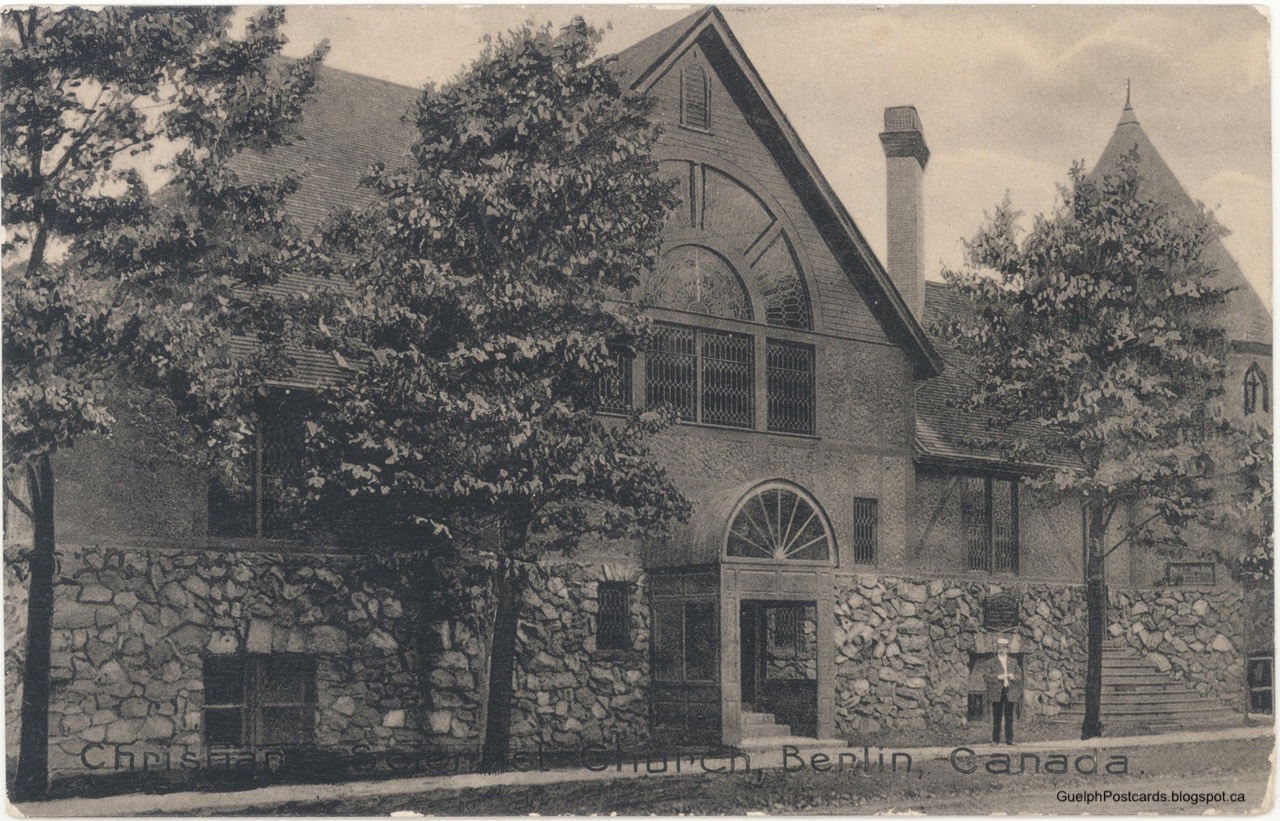
The venue was the historic First Church of Christ, Scientist in Kitchener. As it happens, the church itself features in some old postcards, such as the following:

("Christian Scientist Church, Berlin, Canada," ca. 1909. Courtesy of Leigh Hogg.)

(First Church Christ, Scientist; courtesy of Google Maps.)

The subject of the talk was the postcard views of Guelph as provided by the International Stationery Co. (ISC) of Picton, Ontario. In this post, I will give a precis of the talk and show some of the images. The point of the presentation is not to give a history of places shown but to give an impression of the aesthetic quality of the individual postcards as pictures and of the whole set as a curated show of the Royal City as it then existed.

Among Canadian deltiologists, that is, postcard collectors, the ISC is known for its set of fine sepia-toned collotype postcards from the early 20th century. Consider the example below.

("Collegiate," #130.)

This is the predecessor of the current Guelph Collegiate and Vocational Institute, shown from near the corner of Paisley and Arnold streets. For inventory purposes, ISC numbered their cards; this card is number 130. The photo is nicely layered, with paths leading from the foreground into the image, where people can be seen walking under the trees and in front of the pointy buildings. Clouds billow upwards in the sky, drawn there by arists in Germany, where the cards were printed. As will become evident, this composition is typical for cards of Guelph from this set.

The history of the ISC goes back to "The Fair", a kitchen supply and grocery store located in Picton and founded by local boy James Livingstone (1868–1949) in 1895. The Fair was successful and expanded into new locations and goods. As the postcard craze took hold in the Edwardian era, Livingstone got into the act. Postcards turned into a big business for the ISC, which specialized in views from southern Ontario and the Montreal area. It carried on for some decades and left an interesting legacy of topical views.

To judge from postmarks, postcards of Guelph began circulation in 1913 and persisted into the early 1920s. Serial numbers range from 100 to 199, suggesting that there are about 100 views of Guelph in the set—quite a few! ISC expert Ian Robertson reports about 900 cards total in his collection, so the Royal City seems to have enjoyed attention disporportionate to its modest size. What was the charm?

The ISC set includes views of the usual suspects, such as the card below of the Carnegie Public Library. Designed by local boy William Frye-Colwill and erected in 1905, the building was a regular part of postcard sets of Guelph. Images were almost always taken from diagnoally across Norfolk street, which produces this dramatic angle. Even so, the photo appears to have been taken especially for the ISC.

("Carnegie Public Library," no number.)

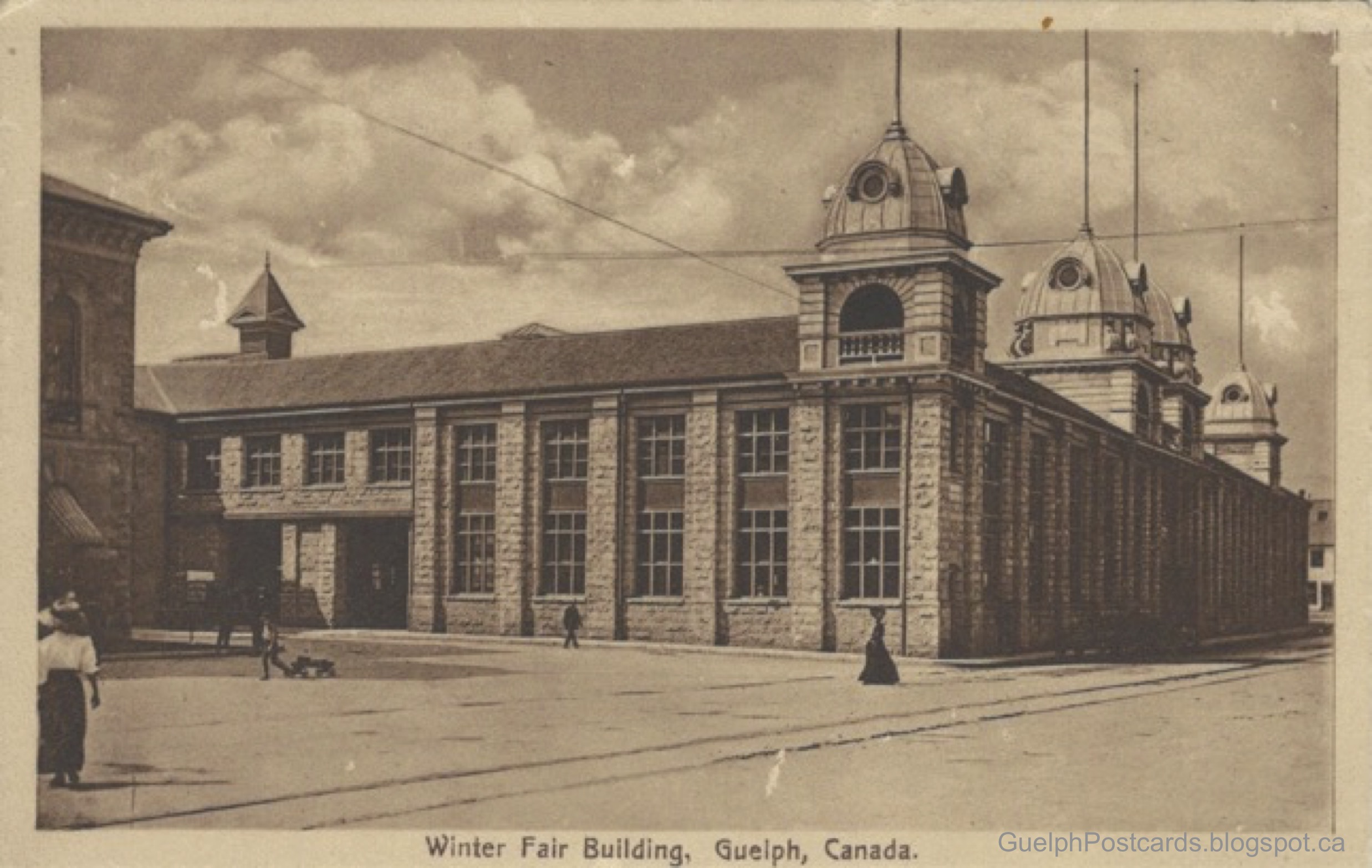
The Winter Fair Building is another fine card. The building was located on Carden street, in front of the new City Hall, where the splash pad/outdoor rink is now located. It was built to house the agricultural fairs that used to be held downtown. The corner of the old City Hall, now a Provincial Court House, can be seen on the left. As usual, the scene is animated by figures walking hither and thither.

("Winter Fair Building," #110.)

Another good, downtown view is the end of the Bell Piano & Organ factory, seen from the old Grand Trunk train station, today the city bus depot downtown. The photo gives a good impression of the bulk of the building, which was meant to dominate the old market square and train station. Beneath the near facade is the street sprayer, a wagon drawn by two horses and carrying a big barrel of water that was sprayed onto the dirt streets in the summer in order to keep the dust down. To the upper left is the clock tower, perhaps the oldest illuminated clock dial in Canada. Alas, the building burned to the ground in 1945 and the site is now a parking lot for the Royal Inn and Suites.

("Bell Piano and Organ Co.," #122.)

Another interesting view is the one below of the side of the Ontario Reformatory, popularly known in the day as the "Prison farm." The view was taken from the bluff at the back of what used to be the Turfgrass Institute. In the foreground is the Guelph Junction Railway while the three-span concrete bridge over the Eramosa River lies in the middle ground. The bridge was built from limestone from the on-site quarry and using prison labour. The prison buildings themselves lie in the background, making this card one of the few showing the Reformatory that do not feature the buildings themselves up close.

("Prison Farm," #178.)

One of the features of the ISC cards is that there are sometimes multiple views of a given building or site. Such collections of views can provide an impression of a place that would not be possible with a single image—and also would help to sell multiple cards!

One such set in Guelph is of the old Central School. The school lies along the shoulder of the drumlin that is topped by the Church of Our Lady, just one block away. With its prominent site and tall belfry, the old Central School seems to have been intended to leave a strong visual impression on anyone looking around from the downtown, and competing for visual profile with the neighbouring church. The old Central School was demolished in the 1960s and replaced by the current, one-storey structure.

("Central School," #173, looking along what is now Commercial street from Norfolk street.)

("Central School," no number, looking from Cambridge street across Dublin street—the opposite facade to the one above.)

("Guelph Model School," #142, seen from the south along Cambridge street.)

It was certainly an imposing structure!

Naturally, many of the ISC cards feature sites on the Ontario Agricultural College (OAC), now the site of the University of Guelph. For present purposes, I will feature views of Massey Hall & Library. The story has it that OAC President James Mills happened upon Walter Massey, head of the farm implement giant, on a Toronto streetcar and persuaded him to fund construction of a campus library. Thus did this charming structure come into being!

As with many ISC images, the main entrance of Massey Hall & Library can be seen behind a number of trees and elegantly-dressed ladies walking the path from the OAC garden.

("Massey Hall and Library, O.A.C.," #176.)

Below is a view of the Hall from the reverse angle, looking along the entry lane from what is now Gordon street. The MacLaghlan Building is more in the foreground on the right, with the Main Building (where Johnston Hall now stands) behind on the left.

("Massey Hall and Library, O.A.C.," #108.)

The third card with the same caption returns us to the uphill side of the Hall but further down what is now "Winegard Walk". Here, it appears that some sort of open-air lecture is underway, with the audience sitting in rapt attention on the bank of the College reservoir. No photographer on the OAC campus could resist the reflections afforded by this artificial pool!

("Massey Hall and Library, O.A.C.," #173.)

The University of Guelph has produced the following short video relating the story of the Hall:

One of the real treats contained in the ISC set of Guelph are the many pictures from Old Home Week, 1913. Old Home Week, also known as the Old Boys' Reunion, was a city-wide party for residents and former residents. The first installment was the Old Home Week 1908, the second was the Old Home Week 1913, while the third occurred in the Royal City's centennial year, 1927. ISC postcards of the 1913 event are the only images of that installment that I am aware of. The cards are characterized by decorated buildings, people milling about, parades, and events in Exhibition Park. A few selected images will give an appropriate impression.

This card shows a crowd of well-heeled ladies and gentlemen disembarking from a train at the CPR station and making their way through Trafalgar Square towards the downtown. A small omnibus waits by the station's front entrace. It is labelled, "Hotel New Wellington." The actual Hotel New Wellington was only a stone's throw away but the omnibus may have been handy for passengers who arrived with a lot of luggage. The site is today the location of the Trafalgar Square apartments on Cardigan street.

("C.P.R. Station," #136.)

The Grand Trunk railway station (now the VIA station) was also the entry/departure point for many participants in the Old Home Week. In the card below, a train can be seen in the background while people mill about the entrance and the intersection of Wyndham and Carden streets in the foreground. At the front entrance to the station can, once again, be seen the Hotel New Wellington Omnibus. Those must have been busy days for the bus driver! Also doing a good business was the city's peanut vendor, whose cart, I believe, is the focus of attention on the street corner in the centre of the image. Bags of roasted peanuts were a common street snack in those days, and passengers probably arrived with an appetite, not to mention money in their pockets.

("G.T.R. Station," #190.)

The actual Hotel New Wellington itself is featured in the card below. It is suitably dressed up for the occasion. In the foreground is a sandwich board and overhead sign for the Bogardus Pharmacy, which had a storefront facing the corner of Wyndham and Woolwich street in those days.

("Hotel New Wellington," #139.)

There are also many scenes of parades in the set. I include the one below, looking up Wyndham street towards St. George's Square, because the caption actually names the event shown in the image, instead of referring to the places or buildings in the background.

("Old Boy's Home Week at Guelph," #111.)

A number of pictures show crowds in Exhibition Park but the one below is the best (at least of those that I know of at present). At the right is the grandstand, roughly where Hastings Stadium is now, overlooking the track where many racing events and parades were held. To the left are many cars, which were parked in the park for the day. In the background were some of the Exhibition buildings, including the unusual octagonal barn.

("Exhibition Grounds," #127.)

For a final Old Home Week card, I cannot resist one of my Guelph favourites, which shows a woman guiding what I suppose are her young daughters across Woolwich street towards the Hotel New Wellington. Nice outfits! Also, the picture features an interesting composition, with the three figures in the foreground on the right of centre that balance out the dramatic fall and rise of Eramosa road in the background to the left of centre. Very deliberate photography!

("Eramora [sic] Road," #121.)

I will finish by giving a few examples of characteristic street scenes. One of the quirks of the ISC set of Guelph is the photographer's affection for scenes with people walking towards or (more often) away from the camera.

The example below is a card of two gentlemen in fashionable straw boaters striding up Delhi street, which the viewer can see was a dirt road at the time. Their retirement into the middle layer of the composition animates the picture in away that a simple picture of the sidewalk could not.

("Delhi St.," #181)

The locations seems to be near the intersection with Eramosa Road, with the house at address 34 Delhi in view at the left margin. Compare with the Street View image below.

(Delhi street, June 2016; courtesy Google Street View.)

The scene below is Waterloo Avenue, with a woman walking down the sidewalk away from the camera, while a horse & wagon and a streetcar move along the street. Judging from the shadows, the view is looking eastward along the north side of the avenue. It is hard to say which crossroad is in the foreground.

("Waterloo Ave.," #115.)

The penultimate view is of Woolwich street, the main thoroughfare leading north-west out of town. Two well-dressed ladies approach the camera along the sidewalk. A man on horseback rides down the street on the other side.

("Woolwich Street," #145.)

It is difficult to be sure but my sense is that this picture is set just north of the First Baptist Church, looking towards the intersection with London Road in the distance. In that case, the intersection on the left side of the picture is Edwin street. Compare with the Street View image below.

To conclude the tour, have a look at the image below. It shows two ladies and a young man—well turned out, of course—walking across the second Heffernan street footbridge towards Queen street. It seems a fitting image on which to finish.

("Foot bridge," # not known. Courtesy of Guelph Civic Museums, 2004.32.61.)

(As you may have guessed, I do not have a copy of this card in my collection—yet. For the postcard collector, there is always hope.)

Of course, there are many more excellent views in the ISC tour of the burgeois Royal City of 1913. The images are impressively composed and curated and form an appealing tour of the town, all the more poignant as it was, unknowingly, on the verge of the precipice of the Great War, which would change it profoundly.


Works consulted include:
  • Ian Robertson and Barb Henderson (2016) “The International Stationery Company of Picton, Ont.” Card Talk v. 37, n. 2.)

Sunday, 29 October 2023

Joseph "Long Joe" Lawrence: Guelph's tallest man

As noted in the post about Guelph's Old Home Week 1908, special attention was drawn to Joseph "Long Joe" Lawrence. As part of the burlesque parade, the townsfolk had prevailed on Johnson to dress up in a fine white dress and parasol and stroll the streets of Guelph to the amusement of all.
(Real photo postcard of "Long Joe" Lawrence in a white dress with parasol, parading through St. George's Square. Courtesy of Guelph Civic Musuems 2009.3.1. The message on the back states, "This is the only one I have got left of Guelph Old Home week procession[.] it is a man standing seven feet in a lady dress representing a firm from Toronto" )

Being 6 feet, 11 inches tall, Joe Lawrence stood out. Thanks to his height, we have some more records about him than we might have otherwise.

(Real photo postcard view from the Post office/Customs house of a parade marching through St. George's Square. Note Joe Lawrence in a dress in the foreground and a marching band following him. A hand-written message on the front states, "scenes during Old Home week on main street, Guelph".)

For example, his obituary adds a bit of colour to its account of his statistics (Mercury, 20 January 1958):

In Guelph he worked at Taylor-Forbes. He was a keen member of the Canadian Legion and made a host of friends with whom he kept up a regular correspondence. When he last made a visit to Guelph, in 1955, he complained that the dry air of the West had caused him to shrink half-an-inch—to a mere six feet 10 ½ inches. Blessed with a lively sense of humor he was a highlight in Guelph’s Old Home Week when he put on a disguise as a woman and he always claimed to be unbestable at cribbage.
Lawrence was born on 9 December 1882 in Partick, a suburb of Glasgow, Scotland. He immigrated to Canada in 1904 and settled in Guelph. He does not appear in the city directories of Guelph at that time. However, his Canadian Expeditionary Force attestation papers note that he was a "mechanic," perhaps with the Taylor-Forbes company.

His papers also note that he had three years in the Wellington Rifles.

("Four Members of the Wellington Rifles," ca. 1907. Courtesy of the Guelph Museums, 1952X.00.127. Guess which one is Joe Lawrence!)

It was in this connection that he first came to the notice of the press, to wit (Hamilton Evening Times, 23 Jun 1906):

Giant with appendicitis.

London, Ont., June 22.—Pte “Long Joe” Lawrence, of Guelph, very thin, and seven feet nine inches tall, who is in the militia camp here, was taken to the hospital to-night with appendicitis. It is said there was not a cot long enough to accommodate the patient.
Life in the militia seems to have agreed with Lawrence, as he grew 10 inches in the service!

Happily, the doctors found a suitably long operating table and his condition was treated successfully.

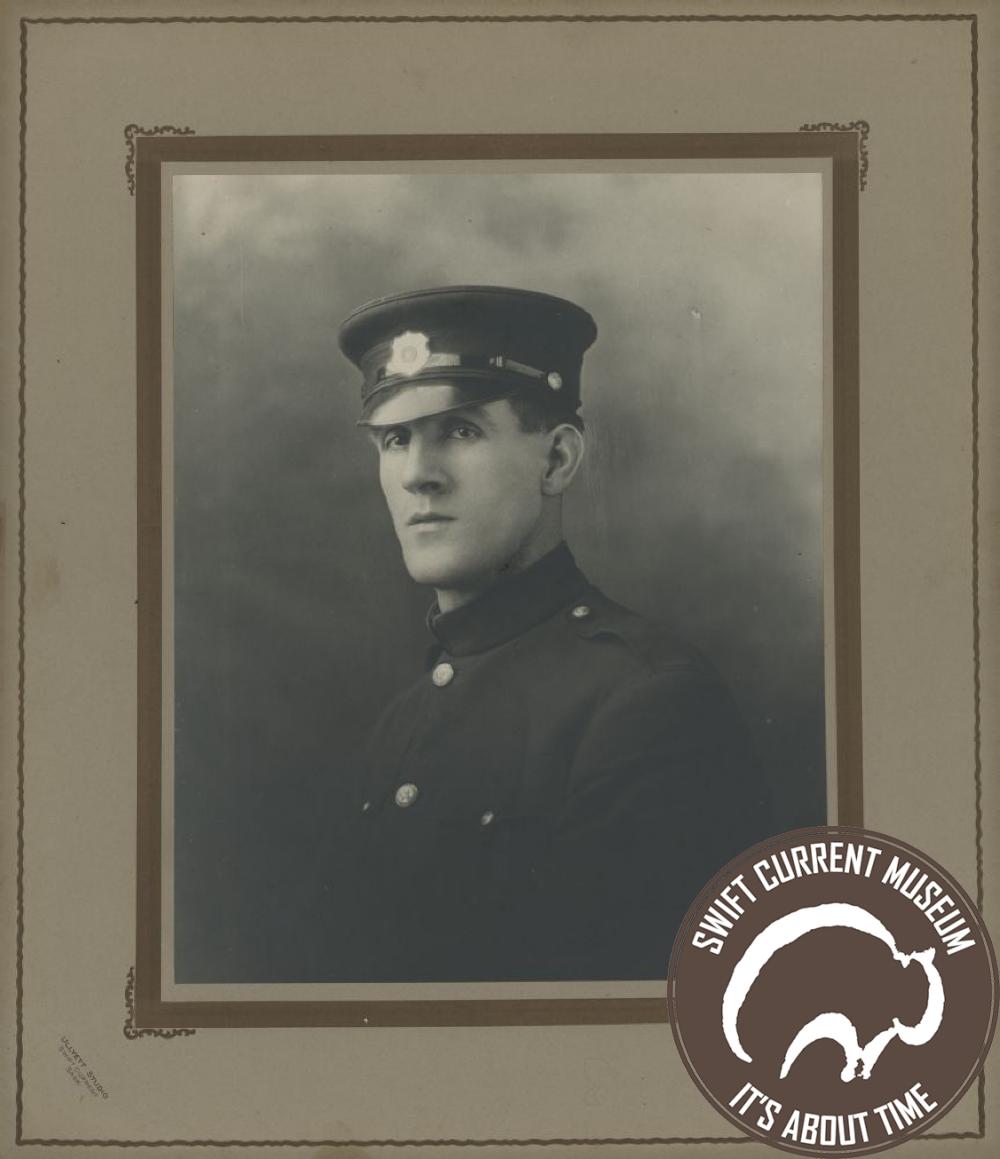
("Joseph J Lawrence (c.1913)." Courtesy of Swift Current Museum, 2008.31.1.)

In 1908, so not long after his seminal appearance in a dress during Old Home Week, Lawrence moved to Swift Current, Saskatchewan, and joined the police. Once again, his unusual height brought him a press notice (Berlin News Record, 13 June 1912):

Canada’s biggest policeman

Mr. Joe Lawrence, formerly of Guelph, but now of Calgary, stands 7 feet 2 inches and is the biggest policeman in Canada. He is in the employ of the C.P.R. and according to a letter addressed to his friend, Mr. Geo. Hubert of Galt, he is well pleased with his position. The tall figure of Mr. Lawrence used to be a familiar sight on Berlin streets before his emigration westward.
The move out west seems to have reduced Lawrence towards his previous height. Was the dry air at work?

On 10 December 1915, Lawrence joined the 89th Battalion of the Canadian Expeditionary Force at its Calgary office. His occupation is listed as mechanic, which, it seems, was his job with the Swift Current police.

Lawrence's obituary mentions that he was a drill instructor, for which he qualified due to his previous service with Wellington Rifles. He may have had this job while in Alberta; it is not mentioned in his military record.

Lawrence sailed to England on 2 June 1916. His height did not fail to make an impression in the Old Country. An article in the Daily Mirror (15 August 1916), "Giant Canadian in the army," notes his stature and shows a photograph of Lawrence towering over two other soldiers, with his arms stretched out to his sides and over their heads.

[If anyone has a copy of this picture, do let me know!]

A subsequent item in the Berlin News Record (14 September 1916) raises the matter that must have occurred to many on hearing of his departure: "Local friends are wondering how Joe will manage to keep his head down when he gets to the trenches."

How indeed? Lawrence's obituary notes an irony: Despite his height, the only place the Germans got him was in the foot. His military medical record mentions a "wire cut" followed by trench foot late in 1916. There is no mention of enemy action, so it may be that it was the CEF that "got" him.

After a few operations and stays in hospital, Lawrence was struck off strength and demobilized back to Alberta, where he arrived in 1919.

Lawrence seems to have stayed in Calgary rather than returning to Swift Current. His mother Mary lived there, where she had immigrated in 1913, probably on the death of her husband. Agnes Lawrence (née Dawson) also appears in the Calgary census of 1921. I have not yet found a marriage record but Lawrence's military record mentions "Agnes Lawrence (wife)" as Joe's beneficiary on his final pay document in 1919, so that appears to be the year of their nuptuals.

Bucking the trend of men who had "gone west" in their youth, Joe Lawrence returned east to the Royal City with his new family in 1924, where he is listed as a mechanic with the Taylor-Forbes company. As was the case for many, his situation changed during the Great Depression, when his job became caretaker with the company of F.W. Jones & Son.

The family seems to have prospered, however. The Lawrences moved from rented apartments on Woolwich street to a house at 16 Havelock street, which remains in place today.

In 1938, Joe's daughter Christina is listed as a hairdresser at the Ideal Beauty Parlour (or Shop or Salon), and his son James is listed as a driver for the Home Creamery Company in 1944. His wife Agnes died in 1943.

In 1945, Joe Lawrence is listed a machine operator with the Page-Hersey Company, a return to his former type of occupation. His address also changed to 156 Ontario street, a residence not unlike his former one though located near to his new employer in the Ward.

In 1949, Lawrence went west once more, settling on Okotoks, Alberta, where his daughter Christina appears to have moved after her marriage to a Mr. J.R. Aikins.

("Joe Lawrence, Guelph's Tallest Man." Courtesy of Guelph Civic Museums, 2014.84.78. The photo appears to be dated August 1955 and shows Lawrence in uniform next to a much shorter man, also in uniform, standing in front of an Eaton's store in an unnamed city.)

Lawrence's last visit to Guelph came in 1955. It was celebrated in the Mercury with a photo of him between two "Mercury girls" standing on chairs so as to look him in the eye.

(Detail of "Scrapbook, Guelph History, Marion and Eleanor Ryan, 1950-1979," page 48. Courtesy of Guelph Civic Museums, 2022.12.2.)

The photographic record of Joe Lawrence certainly speaks to the enduring fascination with height in our culture.

Joseph "Long Joe" Lawrence was buried in what we may assume was a lengthy coffin in the Union Cemetery in Calgary.