Showing posts with label George Creelman. Show all posts

Monday, 31 August 2020

Guelph gets in the swim: Swimming tanks invade the Royal City

The following notice in the OAC Review heralds the arrival of a new sport facility in Guelph, the swimming bath (1894, v. 5, n. 5, p. 6):

The sound of the hammer is again heard within the walls of the gymnasium. In the basement a large swimming bath is being put in, while in the hall a very capacious stage is under construction.
Previously limited to outdoor splashing, the Royal City was getting its first taste of indoor swimming.

As noted previously, the history of (outdoor) swimming in Guelph went through some interesting changes in the pre-WWI era. Bathing started out as a purely informal activity undertaken at "swimming holes" abounding in the Royal City's creeks and rivers. This sort of bathing was practiced mainly by young men and often without the benefit of dress.

Attempts were made to render this sort of bathing "decent" by mandating the wearing of bathing costumes and encouraging the setup of commercial bathing houses, the most prominent of which was Hazelton's baths. However, success was achieved only with the construction of a family-oriented swimming hole in Riverside Park, which combined the 19th century swimming hole with the Edwardian amusement park where a genteel standard of decorum was expected and enforced.

At the same time, swimming in Guelph was influenced by another change in the wider world, namely the rise of swimming as a sport. Bathing was an activity indulged as a social pastime and a relief from summer heat but swimming was a form of locomotion in the water and, thus, could be performed competitively. In England, indoor pools first opened in 1828 with swimming races following a decade later. Interest in the sport followed English migrants to the new world

In 19th century Canada, universities and colleges were centers of innovation in sport. Football, hockey, and soccer were first pursued in a broad, organized fashion in the nation's institutions of higher learning, with interest spreading from there to the wider public (Morrow 2017). Much the same was true for swimming, though the sport did not achieve the same profile as football or hockey.

The idea of "physical education" did find its way as a subject taught during instructional hours, especially activities such as marching or drill that had military associations. Sports such as football, that were regarded as having a warlike side were sanctioned also, though as activities pursued outside of regular teaching.

Although it was not a warlike activity, swimming was accepted in a roughly similar vein. Competitive swimming and diving were vigorous endeavours that could bring glory to the victors and their institutions. Swimming was also endorsed by luminaries such as Egerton Ryerson, the superintendent of education in Ontario from 1844 through 1876. So, it is not surprising that the Report of the Provincial Farm Commission, that laid out paramaters for the new Ontario Agricultural College (OAC) in Guelph, included the following recommendation (Mercury, 9 March 1874):

That there should also be a building attached to the main edifice, containing a sufficient supply of baths for the use of the pupils, and, if possible, a swimming-bath.
It is also not surprising that this recommendation was not carried out. Although desireable, a swimming bath was not a high priority at the small, rural college.

Things began to look up for swimming at the OAC when the Gymnasium/Convocation Hall was built in 1891. Although it was still a multi-purpose building, the gymnasium showed the commitment of the mature OAC to physical education. Two years later, a "swimming tank" was incorporated in the Gymnasium's basement, a normal place for a swimming pool at the time. The building operations column of the Mercury provides the following description (2 November 1893):

T. Matthews [a Guelph builder], swimming bath at O.A. College gymnasium, 16 feet deep, 20 wide and 40 long. Cost, $2000.
A nice image of the gymnasium is provided in the postcard below, by an unmarked publisher:


The postcard was sent in 1920, although the picture is from much earlier, to a Miss Helen Clifford of Ancaster from her friend, who was likely a student at the adjoining Macdonald Institute:
Box 19. O.A.C. Guelph // July 19, 1920. // Dear Miss Clifford :— Your letter received & I enjoyed it so much. Many thanks—but I would rather if you had not done that. We had some fine music & singing yesterday afternoon. Your sincere friend, May Muir
How odd to scold a friend for writing a letter! This response may be explained if Miss Clifford owed her friend a letter but had not sent one when the missive from Ancaster arrived. Perhaps feeling chastised, Miss Clifford has lashed out with this (mere) postcard of the Gymnasium in reply. After 100 years, it is hard to be certain.

In any event, the Gymnasium is a dignified building with large windows for good illumination (although the effect is diluted a little by the three milk cans holding open the side door). Windows along the ground level would have provided the main illumination for the swimming tank beneath.

There is little further mention of the swimming tank in the OAC Review for the next decade. In 1897, it is mentioned that the tank might be used as a water reservoir in case of fire, which, although practical, still seems like faint praise. It seems that use of the tank was casual, with certain professors perhaps taking classes there to lead occasional swimming and life-saving lessons as interest and their abilities allowed. This sort of use was not unusual for swimming pools in late Victorian Canada.

Even so, the swimming tank was enough of a success that it was eventually improved. In 1904, the OAC Review provides the following remarks (v. 16, n. 8, p. 68):

We are pleased to note the alterations and improvements being made in the basement of the gymnasium. The swimming bath is to be made fifteen feet longer, the lockers and other obstructions removed from the sides of the bath, and all the old wooden floor replaced by cement. These changes will give more room for swimming, and better access to the bath. They will also make the basement a bright clean place, instead of the dark dirty dungeon it was before. Greater interest in aquatic sport should result from this improvement, and next year we hope to see a large number of the boys joining in this excellent exercise.
[Unhappily, pictures of the swimming tank itself in the University of Guelph archives are not available at the moment.]


(Picture of George C. Creelman, OAC President 1904–1913; From "OAC—"Science with practice"", 1924.)

The improvements may have come at the behest of George Creelman, who became President of the OAC in that year. In 1906, President Creelman had Mr. Corsan, Varsity team swimming instructor at the University of Toronto, visit the College to give a lecture and practical demonstration of swimming and life-saving to interested students (OAC Review, v. 18, n. 4, pp. 188–189). One highlight was the life-saving demonstration, given in the lecture:

When the discourse turned on life-saving, it became necessary to have a subject on whom he could operate. For this purpose [he] chose Scotty Chisholm, and as events turned out, the choice was well made ; Chisholm’s struggles were so realistic that Mr. Corsan found him as hard to save as a drowning person.
Of course, the true highlight was the practical part:
After the lecture we adjourned to the basement, where Mr. Corsan proceeded to give us a practical demonstration in the water. He coached a few fellows, who took advantage of his very kind offer to help any of the students to improve their swimming. The final act was a race between Treherne and the instructor. The result was a dead heat.
Did Mr. Corsan hang back in order not to discourage Traherne? Who now can say?

After this point, mentions of swimming in the Review become regular, although not frequent. In May 1907, for example, a swimming, diving, and life-saving competition were included in a general, year-end athletic competition (v. 19, n. 8). The main event was swimming underwater for the longest distance—a modest beginning but a beginning nonetheless.

Finally, a Swimming Club was formed by students in 1909 (OAC Review, v. 21, n. 6, pp. 355–356). Its first event was held in February, whereupon Mr. Corsan returned to provide another demonstration and supervise the competition. Four teams of OAC students entered and competed in a variety of events. Reminiscent of contemporary picnic games, events included a 50- and 175-yard races—in addition to "walking the greasy pole" and "diving for plates," the latter two of which caused much amusement. Over 200 students witnessed the spectacle.

A select team of OAC students, Treherne, Ryan, Bell-Irving, Harries, and Cleverly, journeyed to Toronto to take on swimmers from the University of Toronto and McGill. Harries was the hero in the underwater swim and placed second in the "plunge for distance." Ryan placed third in the "swimming three styles" event. Although Varsity and McGill dominated the awards, as would be expected, the OAC team had made a promising start.

That fall, another OAC team had a friendly match against Varsity in which they improved their performance, although still losing overall to the more experienced team (OAC Review, v. 21. n. 7, pp. 406–408). This event consisted mainly of serious events such as a 100-yard race and "50 yards back swim," as well as diving. However, it did include a tub race.

For the first time, a picture of the OAC swim team is included:


At last, swimming had truly arrived at the OAC.

To top the matter off, the same issue notes that the OAC held an intramural water polo tournament. Each year of students was invited to enter a team, with only the fourth year declining. The second-year team was dominant throughout and went undefeated 4–0, the third year team went an even 2–2, while the first-year squad finished 0–4.

The following year, the OAC Review notes that the College registered with the Canadian Amateur Swimming Association and the Ontario Water Polo League, so that its swimmers could enter official competitions (1910, v. 22, n. 7). In fact, the OAC Water Polo team carried off the Wainless Trophy in a tournament against the Toronto Swim Club, University of Toronto, and the Paris YMCA.

The swimming tank was finally successful in its invasion of the OAC. Competitive swimming in a regulation, indoor pool was firmly established at the College. Like other sports practiced on university campuses in the period, swimming in pools might be expected to attract attention in town. But, that is a story for another time.


The Gymnasium building was located where the MacKinnon Green is now, along the Winegard Walk. Construction of the new ImprovLab and theatre is taking place there, which will see the return of the site as a performance venue. Perhaps the shovels will uncover traces of Guelph's first swimming pool, ever hidden out of sight.

Friday, 20 July 2018

Isabella Preston and the Creelman lillies of the OAC

The postcard below, mailed in 1937, conveys a pleasant view of the Administration Building (now Johnston Hall), constructed only a few years earlier, with reflecting pond and the canon, Old Jeremiah, in the foreground.


The card was published by the Photogelatine Engraving Company of Ottawa, a prolific source of Guelph postcards in that era. (From the John Keleher collection.)

However, the most interesting feature of this postcard is the message on the back, sent by "M" to Mrs. Gerald Badke of Kitchener, Ontario:

55 Dundas Rd. Guelph // July 19/37 // Dear Sister.—Before I go to bed I want to write this to tell you that the Creelman Lilies are just out in perfection now and in case any of you wish to see them come this week. They are beautiful. I counted 1st on one stem with the buds to-day. I am tired to-night. We try Field Husbandry to-morrow. Love. M.
The "Creelman Lilies" refers to both one of the great success stories of the Ontario Agricultural College (OAC) and one of its longest-standing mysteries.

As luck would have it, there is a photograph of the very lilies that M. was writing about:


This picture was published in the OAC Review (1937, v. 49, n. 8, p. 479), so very likely shows the bed of Creelman lilies—very plainly labelled—planted that year beside Zavitz Hall. (Courtesy of University of Guelph Library McLaughlin Archives, RE3 OAC A005037.) I hope that "M"s family went to see them.

First, to the success story. The "Creelman lily" (officially Lilium princeps x "George C. Creelman") was a hybrid of two lilies from southern China, L. regale and L. sargentiae. The crossing was made by Isabella Preston, a young horticulturalist working in the OAC greenhouses. In her book "Garden lilies" (1929, p. 110), she described the process as follows:

On July 20th, 1916, when I was attached to Mr. Crow’s Department at the Ontario Agricultural College, Guelph, Ont., I pollenized L. sargentiae (growing in the greenhouse) with L. regale. Three seedpods formed, the seed was sown in pots in the greenhouse and the seedlings began to germinate on January 15th, 1917. These were transplanted to a cold frame and bloomed well in 1919. It was named G.C. Creelman [the OAC President] by the Guelph Department in 1923.
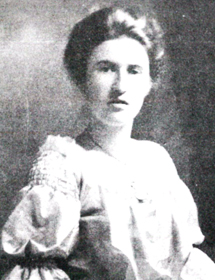
Isabella Preston (1881–1965) herself was a crossing, a young English woman who had emigrated to Canada with her sister Margaret after their mother's death in 1912. She was determined to work in horticulture and the prior lack of professional, female horticulturalists did not dissuade her. Upon her arrival in Guelph, she immediately enrolled in the subject at the OAC.


(Isabella Preston. Courtesy of the Ontario Agricultural College.)

After a year's study, Miss Preston entered a self-study course and took up work full-time in the greenhouse headed by Professor James W. Crow. There she was introduced to the art and science of hybridization. Apparently enthralled, she read "all the books in the library" on the subject and began to experiment, with special attention to lilies. Both her talent and her hard work paid off handsomely.

The Creelman lily won immediate and universal praise. In 1939, Howard L. Hutt, Emeritus Professor of Horticulture at the OAC, recalled his initial response to the appearance of the lily (quoted in von Baeyer, 1987, p. 131):

I can well remember seeing their first bloom, four and five immense white flowers on sturdy stems about three feet tall. And I thought well here is a worth while new lily. But when I happened to be at the College a week later and saw two or three of the original plants at least five feet high and bearing fifteen blooms I felt like taking off my hat, even if I did not throw it up in the air.
In 1923, after four years of trials, the new Creelman lily was put on the market. It was a smash hit and eventually spread around the country and even overseas.

Like her new lily, Isabella Preston's career began to bloom. In 1920, she left the OAC for the Botanic Garden at the Central Experimental Farm at Ottawa. There, she developed many new botanic hybrids but remained best known for her work with lilies. As testimony to her reputation, von Baeyer (1987, p. 125) relates the following anecdote:

After World War II, a Japanese admiral was brought to the United States as part of a friendship promotion program. He was asked if there was any special attraction he would like to see—Niagara Falls perhaps? The admiral thanked his hosts very politely and then answered (in rough translation), "I would really like to travel to Canada to meet Miss Isabella Preston." He was a lily enthusiast.
In 1946, at age 65, Preston had retired from her long and productive official career. She spent a year in England but found that, like her flowers, she was no longer adapted to that climate. So, she returned to Canada and settled in Georgetown, Ontario where she kept a large garden in which Creelman lilies were likely a prominent feature.


Isabella Preston, 1957. Courtesy of the Isabella Preston Collection, Royal Botanical Gardens Archives.


Now, to the mystery. Creelman lilies remained a popular choice for gardens and special occasions for many years. Of course, there is the large bed on the OAC campus in 1937, shown above. In addition, news items from the Guelph region mention the flower in various connections. For example, it was used to decorate a home in Georgetown for a wedding that same year (Georgetown Herald, 11 August 1937):

Miss Ruth Evelyn Giffen, daughter of the late Mr. and Mrs. John Giffen, of Ashgrove, became the bride of Howard C. Wrigglesworth, son of Mr. and Mrs. Fred Wrigglesworth, Ashgrove, at the home of her sister, Mrs. Elmer May, Hornby, on Saturday afternoon. Rev. B. Eyre, of Ashgrove United Church officiated. The home was decorated with pink and white gladiolus, white Creelman lilies and fern.
Then, there was the wedding of Muriel Ricketts, married at her parents' house on Grove Street in Guelph, in which Creelman lilies also featured prominently (Acton Free Press, 30 July 1942):
The house decorations were in pink and white, harmonizing prettily with the gowns of the bride and bridesmaid. Bouquets of Creelman lilies, roses and baby’s breath added to the charm of the home, while the wedding cake was attractively placed on the festive table with tall white tapers.
Creelman lilies continued to be grown by enthusiasts in the region. Special mention must be made of Mr. & Mrs. Arthur K. Thomas of Rockwood, who were well-known for their dedication to Creelman lilies throughout the 1950s. Indeed, the Acton Free Press gives a full report of his entry in the North American Lily Show in 1958 (24 July 1958):
Rockwood flower gardens specialize in Creelman lilies

Enthusiastic flower lovers, Mr. and Mrs. A.K. Thomas, Guelph St., Rockwood, took a special joy in their garden this past week for their George C. Creelman lilies, despite cool weather, began to bloom in time for the North American lily show, held in Hart House, Toronto.
The beautiful lilies thrive in the Thomas garden and many lily growers visit the spot, envious of the beautiful blooms. There are a dozen other lily varieties there as well as the Creelman but none are half as lovely as these splendid blooms.

25 years ago
Mr. Thomas bought his first clump over 25 years ago from William Harris. The great mass of thousands of fragrant flowers in the garden today have grown from that one plant.
Mr. Thomas recalls paying three dollars for it and thinking at the time that the price was somewhat high. Today, however, he feels it was very little to pay.
The lily was developed at the O.A.C. by Miss Isabella Preston and named after Dr. George C. Creelman.

Blooms specially packed
New at entering flowers in a show, Mr. and Mrs. Thomas found the idea exciting and full of interest. The blooms had to be packed with cotton to keep the petals clean.
The spikes cut for the show had to be chosen carefully. A tinge of frost bite on the leaves was one item that had to be watched for.
As Miss Preston and the Thomases frequented the same, local flower shows, it seems a safe bet that they were well known to one another. I imagine that Miss Preston was flattered.

However, mention of the Creelman lily falls away by the 1960s. The reason is obscure but is hinted at in Miss Preston's obituary in the Georgetown Herald (6 January 1966):

She continued working at the Ontario Agricultural College in Guelph, crossing various strains of lilies. The well known George C. Creelman is an ancestor of most of the white tubular lilies that are so popular now. Crow’s Triumph is the other and was more favoured by florists.
It seems that the fashion in flowers moved on and the Creelman lily, like many a reigning monarch, was finally supplanted by its offspring.

Though the plant itself apparently vanished, knowledge of it did not fade entirely. In 2007, Alex Henderson, curator of living collections at the Royal Botanical Gardens (RBG) in Burlington, Ontario, received a napkin with the words "George C. Creelman," "Isabella Preston," and "Allan Goddard" scrawled on it. The item was given to him by a colleague who had encountered Allan Goddard, Creelman's great-grandson, at a bar (Giaimo 2017). Henderson knew of the flower by reputation and looked for it in the archives but came up empty-handed. “We didn’t have it, but I went into our plant records, and we used to have it,” he said. On inquiring further, a similar story emerged from other nurseries both near and far. Though once extremely popular, specimens of the lily had not been kept anywhere.

Alex Henderson continued his search. In 2009, Rodger Tschanz from the University of Guelph thought he had some and gave Mr. Henderson some bulbs. These were duly grown and the flowers examined by expert botanists, who Mr. Henderson locked in a room with the plants for two hours. The determination rests on how well the flowers match written descriptions made by Isabella Preston and some early, hand-colored photographs. Their verdict: Close but not quite. The flowers may be near relatives of the Creelman but just not the same.

However, the story may yet have a happy ending. In July 2017, a caller phoned into the CBC Radio talk show Ontario Today ("CSI of horticulture," 24 July 2017) to solicit information from master gardener Ed Lawrence. Cynthia Culp phoned in from Bancroft to ask: How rare were her Creelman lilies? She explained that her grandmother had obtained them from a neighbour who worked at the University of Guelph and had purchased them at a University plant sale around 1950. Ms. Culp's grandmother grew them until she moved house in the 1990s, at which point Ms. Culp's mother brought them home, mentioning that the variety was "Creelman". In 2014, Cynthia Culp rescued the plants from her brother, who planned to sod over the garden.

As the lilies took hold in her garden, Ms. Culp searched on the Internet for current information on the variety. Frustrated in her search, she phoned in to the CBC's gardening show. She was advised that there was someone at the RBG who would be most anxious to hear from her. Alex Henderson politely asked her if she would share some of the plant material with the Royal Botanical Gardens. The answer was "yes."

These materials were duly transplanted and have been grown in pots at the RBG this year. This May, the lilies flowered with the results shown in the following, beautiful photographs:


(Courtesy of Dr. David A. Galbraith/Royal Botanical Gardens, Burlington, Ontario.)

The verdict? So far, so good. Alex Henderson holds the conclusion that these are Creelman lilies to be "tentatively correct." The final verdict will have to wait for at least another year, so that the plants can be grown outside and their normal habit of growth observed. He is cautiously optimistic that another season will put any doubts to bed.

So, it seems that Mr. Henderson's improbable search has borne fruit and Miss Preston's legacy is secured for future generations. I hope that, some day soon, the Creelman lily will grace the gardens of the University of Guelph and beyond once again!


Thanks to Alex Henderson and Dr. David A. Galbraith of the RBG for their kind responses to my queries about the status of the Creelman lily. Keep up the good work!

Saturday, 31 October 2015

Happy 111th birthday, Macdonald Consolidated School!

The new Art Gallery of Guelph opened its doors this past September. Formerly the Macdonald Stewart Art Gallery, the building had been closed for renovations since May. It now opens with some new exhibits, a rebuilt porch, and an accessible entrance. However, the structure did not begin life as an art gallery. It opened officially on Wednesday, 7 December 1904 as the Macdonald Consolidated School.

To judge from postcards made of the School in its early days, its key feature in the public mind was not art but gardening. Here are a two postcards made by the The Valentine & Sons Publishing Co. especially for local druggist A. B. Petrie, both entitled "Gardening Class, McDonald Consolidated School, Guelph, Ont." (Note that the proper spelling is indeed "Macdonald".)

The first picture shows a group of children and young women preparing the soil with hoes. Small signs can seen planted in the ground, doubtless recording which plants were placed where. Some of the children and a teacher can be seen looking towards the camera. The back of the Macdonald Consolidated School can be seen behind them on the left while houses along Brock Rd. (now Gordon St.) can be seen in the distance on the right, along the way leading to Guelph. (Recall that the O.A.C. was in Guelph Township at the time, outside the city limits.)


The postcard is postmarked on 20 Sep 1907, meaning that the picture must be of the school in its first few years.

The second picture shows almost a reverse angle, a scene of the garden with the Macdonald Institute and Hall in the background. In the foreground, young boys and girls—many of the latter in white pinafores—are shown tending to their plots. On the left, some boys are holding down boards set over the soil to prevent them from tramping it down. On the right, a youth seems to be wearing a pith helmet perhaps intended for a wearer with a larger head. In between, teachers in long dresses and proper hats teach the finer points of horticulture.


These gardens were the most visible sign of the special purpose of the Macdonald Consolidated School. Its mission was to help prepare rural youth for a rural life, and that meant farming. The founders of the school were alarmed by the increasing movement of the rural population of Canada to its cities. Between the 1901 and 1911 censuses, the population of Ontario became predominantly urban: 53% urban, 47% rural in 1911 (and 86% urban, 14% rural in 2011, in case you were wondering).

To no small extent, people were responding to economic opportunities that cities presented. Young women, for example, could move to town and find jobs as typists, telephone operators, bookkeepers, etc. As mentioned in an earlier post about the Macdonald Institute, the movement of women to office or factory work was viewed as being unnatural by Adelaide Hoodless, one of the founders of the Institute. Women were better suited to domestic life, which the Institute sought to equip them for. Gardening was part of this scheme, designed to give young women a familiarity and taste for working with the soil. Plus, if they could be persuaded to remain in the countryside, then young men would be more likely to remain also.

The rural school system in Canada was also seen as part of the problem. This system had hardly changed since Confederation. Rural schools typically involved a single, young woman teaching a group of students of all levels within a single classroom. Overworked and likely underpaid, these teachers tended to concentrate on the three Rs and were ill equipped to instruct students in the details of agriculture and farm management. City schools, however, sorted students into specific grades, had teachers who specialized in different grades and subjects, and were better equipped than their rural counterparts.

This disparity between rural and urban schools seems to have been the main concern of Sir William C. Macdonald (1831–1917), the benefactor of the Macdonald Consolidated school. Macdonald was the grandson of a Scottish Jacobite laird who relocated 200 members of his clan, including Macdonald's father, to 20,000 acres of farmland on Prince Edward Island in the late 1700s. Macdonald grew up on the farm and seems always to have felt an affinity for farming life, although he made his fortune as a city businessman. In the 1850s, he and his brother set up a tobacco business in Montreal, purchasing tobacco in Kentucky and processing and selling it locally. Business became brisk during the U.S. Civil War, during which Macdonald purchased tobacco from the Confederacy, processed it in his factory in Montreal, and then sold it into the Union.


(Courtesy of Wikimedia commons.)

Oddly, Macdonald seems to have disliked tobacco and did not use it personally or tolerate its use in his presence. Perhaps his ambivalence towards the source of his vast fortune helps to account for his use of it in philanthropic projects. He once said, "I am not proud of my business, and that feeling, perhaps, has been the reason for my donations." One of his main projects was education. In particular, Macdonald thought that the rural school system of Canada was failing rural residents, not preparing them adequately for making a living in agriculture and, thus, prompting a precipitous migration to urban centers.

A major problem for rural schools was scale. Scattered, small, single-room schools could not compete with concentrated, large, well-equipped urban ones. The obvious solution was consolidation, that is, combining several rural schools together in one place. Consolidation would allow the resulting school to offer the same amenities as urban schools but with a concentration on teaching knowledge and skills needed for rural life. The problem was stated succinctly in a report issued by the Ontario Minister of Education in 1905:

Irregular and small attendance, insufficient equipment, inadequate inspection, the preponderance of the lowest grade of teachers, a curriculum not hitherto happily adjusted, and lack of provision for advanced instruction, all combine to make these schools as a class, far inferior to those in urban centers.
The report notes that several U.S. states had sought to improve the quality of education in rural schools through consolidation. Macdonald believed in this approach and created the Macdonald Consolidated Schools Project to make it a reality in Canada.

Guelph became an obvious site to begin in Ontario. The Ontario Agricultural College there was already a center of agricultural education in the province, which would lend some credence to a consolidated school in the vicinity. Macdonald had already agreed to help organize and fund what became the Macdonald Institute at the site. Student teachers from the Institute could gain valuable experience by assisting at the Consolidated School, which would then profit by their help. It made eminent sense to combine the Institute and the Consolidated School on the O.A.C. campus. Macdonald duly saw that it was done.

Macdonald placed the project in the hands of Dr. James W. Robertson (1857–1930). Robertson was born in Dunlop, Scotland, and immigrated with his family to settle on a dairy farm near London, Ontario in 1875 (Iles 1907). A graduate of Woodstock College in 1879, Robertson gained a reputation for advancement of the industry. In 1886, he became a professor at the O.A.C. and, in 1890, the Dominion's first Commissioner for Agriculture and Dairying. He resigned that post in 1904 when Macdonald invited him to lead the Rural Schools program. Robertson was given charge of a $180,000 budget for the Consolidated School. He was assisted by Dr. James Mills, the Dominion Railway Commissioner, and President George Creelman of the O.A.C.

Construction of the buildings and staffing of the programs proceeded, with the Consolidated School bringing up the rear. Toronto architect George M. Miller designed all three structures, which were all built by Schultz Bros Co., Ltd., of Brantford. The School was typical of the Edwardian classical style for domestic buildings, with a symmetric facade and simple plan, something of a departure from the more grandiose designs of the Institute and Hall. The original porch was a simple gable design, as can be seen in the photo below:

(From The National Monthly of Canada, May 1905).

In 1906, the O.A.C. installed a broader, more ornate porch with Doric columns, more suited the School's aspirations as a temple of learning. The students may have been more impressed with the fancy new, indoor lavatories that were also installed at that time. This new setup and grading can be seen in the following postcard, also published by The Valentine & Sons Publishing Co. for A.B. Petrie.


The postcard is marked on 25 May 1907. A little note along the left-hand side reads, "This is my school. Alice." It would be interesting to find out who Alice was.

There is an interesting tale told about the appearance of the Consolidated School. Here is the version related on the historic plaque in front of the structure:

In planning Macdonald Consolidated School, the trustees made design changes without Sir William's knowledge, resulting in a building with a utilitarian façade and a simple peak-roofed porch. Sir William was so enraged on opening day in 1904 that he refused to leave his carriage, boarded a train instead and never returned to Guelph.
I suspect that this unlikely story is a campus legend. I have found no mention of it in contemporary sources. It seems unlikely since Macdonald was far too careful (though generous) with his money to allow a shamefully plain building to be erected with his name on it. The Mercury (3 Oct 1904) reports that Macdonald was in town—for the second time—to visit the O.A.C. and to view the nearly-completed Institute, Hall, and Consolidated School. Furthermore, the Mercury makes this report about Macdonald's first inspection (14 Sep 1904):
“In looking over the school building,” said Prof. Robertson, “Sir William ‘s only complaint was that sufficient money had not been spent upon it. He thought the exterior ornamentation might be considerably improved.”
The more ornate porch that appeared soon after may have resulted from this remark. In any event, it was known that Macdonald thought the building plain. However, he did return to see it a second time in October.

Curiously, though, Macdonald was absent for the official opening of all three buildings on 7 December. He was supposed to speak on that occasion and see his portrait unveiled in the Macdonald Institute. Newspaper accounts of the opening provide no explanation. Perhaps knowledge of his response to the design of the Consolidated School plus his unexplained absence from the official opening led to the story that he was surprised and mortified by the building's appearance.

At any rate, the building provided all the needed facilities under one roof (Nasby 1995, p. 62):

The basement contained four large lunch and playrooms and on the first floor there were classrooms, a manual training room and a ladies' waiting room. Additional classrooms were on the second floor plus a laboratory for chemistry and nature study, domestic science room and principal's office. An assembly hall to seat 200 with stage and dressing rooms was on the third floor.
The Mercury (14 November) also boasted that the building featured a combined hot air and steam heating system, the first of its kind in North America. Robertson clearly wanted to ensure that the building lacked no facility.

The manual training seemed to be focussed on woodworking, with students learning to make items like birdhouses, cutting boards, and plant stands (Wright 2007, p. 39). Here is a somewhat murky photo of the manual training room (Iles 1907, p. 579).


Another, murkier photo provides a view of the domestic science room, where girls were taught the rudiments of housekeeping (Iles 1907, p. 584).


Another notable feature of the Consolidated School was the transportation of students. Since the School combined students from several, far-flung, rural school sections, most could not make their own way back and forth. To meet this need, Robertson had purchased and shipped a set of special vans from Ottawa that would convey students to and from their homes (Mercury, 14 Sep.). Six routes were arranged, with local teamsters bidding on the contracts (Mercury, 15 Oct.). A slide showing several vans waiting for students in front of the building ca. 1905 can be seen in the collection the Wellington County Archives (A1985.110).

Some children got lifts from the family chauffeur, Dad, especially in winter (Koop 1987, pp. 36–37):

He came into the house and changed from his smock into a fur coat. Us kids were all bundled up too and got into the sleigh. He'd also pick up so many of the other students that were going to the Consolidated School and by the time he'd be going up Gordon Street (it was the Dundas Road back in those days) there would be crowds hanging on to that sleigh
Students who lived on the other side of Guelph often used the streetcars. A Macdonald Institute student signed "G.M.C." writes the following account in the O.A.C. Review (v. 25 n. 6, 1913, p. 333):
When I had waited eight minutes, the car came. It was too cold to frown at the motorman, and as I stumbled against the conductor, I forgot to frown at him. I deserve no credit from restraining those frowns. The car was full of the usual half-breakfasted crowd, with a generous supply of Consolidated School Children to fill in the cracks. It was one of the old cars and a bit cold, which did not make it at all cheerful.
She should be grateful: By caulking the cracks between adults, the Consolidated School children prevented cold drafts from blowing right through the car!

Classes at the Macdonald Consolidated School finally began on 14 November. Vans and streetcars brought students to the door. They were then herded to the assembly hall on the third floor. Principal Hotson gave a short speech of introduction. Then, the students were divided into classes: The primary class went with Miss Workman, the second with Miss Doak, the third with Miss Roddick, the fourth with Mr. Hanlon, and the fifth with Mr. Hotson himself. I wonder who was more nervous at that moment: The teachers or the students?

As mentioned above, the official opening came on 8 December. A host of dignitaries were present in the Macdonald Institute gymnasium, with the odd exception of Sir William Macdonald himself. The speakers were Dr. Mills, Dr. Robertson, Mrs. Hoodless, and Mr. Dryden (the Minister of Agriculture, on behalf of the Minister of Education, who also could not be present for some reason), with O.A.C. President Creelman as the emcee. Dr. Mills gave a speech and then unveiled the portrait of Macdonald. The remaining speakers then sang his praises and outlined their hopes for the new institutions. Then, many of the crowd walked over to the Consolidated School where Mr. Dryden and Dr. Mills said a few words to the students before they departed for home.

Given the lateness of the year, it seems likely that the students did not get on with their gardens immediately. However, they prepared well. For example, some students formed the "Macdonald School Society", which held a meeting with a full program on 16 December (Mercury, 19 Dec.). There were songs, recitations, readings, two mouth organ solos, and a debate. The topic of the debate was: "Resolved that country life is better than city life—Affirmative, Miss F. and Master I. Young; negative, Master H. Atkinson and Master J. Hemming." Given the mandate of the School, it seems likely that the negative side had a tough row to hoe. Indeed, although both sides acquitted themselves well, it turns out that country life is better than city life.

Also, the Consolidated School held an essay-writing contest on the topic of "Bulbs, their planting and care." The winning essays of the Senior Fourth and the Fifth classes, Miss Minnie Sinclair and Miss Emma McAllister, were printed on the front page of the Mercury (21 Dec.). I can only think that these girls, like their bulbs, were ready to get stuck in the dirt first thing in springtime.


The Macdonald Consolidated Schools were not successful in stemming the tide of rural to urban migration in Canada. In spite of the advantages of country living, the attractions or urban living were too great. However, the School in Guelph Township was a success in some ways. In the O.A.C. Review (v. 31, n. 3, Nov. 1918) inspector J.A. MacDonald (no relation to Sir William) writes that the School continued to provide a more ambitious and practical program than in standard rural schools. As evidence of this fact, the article prints the following picture of the Consolidated School gardens, taken from a back window of the building.


Furthermore, attendance at the School was higher than at regular rural schools and many non-resident families were willing to pay an extra fee to send their children to it. Finally, he claims that the community remained proud of the School and its contributions to local society.

Even so, local pride in the Consolidated School did not bring forth enough local money. Macdonald had arranged to defray all the costs of the School for a span of three years. At the end of that time, the School was deeded to the Provincial Ministry of Education for them to run and finance. The Province declined to subsidize the funding, so it was up to members of the Consolidated School districts. The main sticking point was the cost of transportation, which required an extra fee from ratepayers. Although all but one of the parents of children attending the School supported the fee, a majority of residents declined to pay it in a vote in 1907. The two nearest districts continued to run the school on a reduced basis while the other districts reverted to the old system.

A commentary in the O.A.C. Review (v. 23, n. 5, Feb. 1911) surmised that:

After six years' experience with these schools it must be acknowledged that, while the principle of consolidation has been confirmed an undoubted pedagogical success, these two educational reformers [Macdonald and Robertson] have been in advance of their times.
Given that consolidation and bussing is the norm in rural schools today, this claim seems undeniable.

The commentary goes on to muse, I think correctly, that its promoters had not done enough to persuade residents that the Consolidated School was worth the extra expenditure. It was a project that was conceived and executed without much involvement from the community, which was not sufficiently invested in it as a result. The School did not simply sell itself as its founders had supposed. The commentator suggests that a better plan would have involved consolidation on a smaller scale to begin with, scaling up later as circumstances allowed. Perhaps that approach would have been better, although maybe not grand enough for the ambitions of Sir William Macdonald.

In any event, the Macdonald Consolidated School carried on until it was closed by the County Board of Education in 1972. In 1978, it re-opened as the Macdonald Stewart Art Centre. Now it has metamorphosed once again, this time losing its association with the great tobacco magnate from Montreal who loved rural life and hated smoking.