Showing posts with label George Sleeman. Show all posts

Wednesday, 11 September 2024

Better late than never: The Dundas bridge arrives in Guelph

There is an old expresson about a bridge too far. However, a bridge can also be too late, as suggested by the telegram sent by Donald Guthrie, then Guelph's solicitor, to the G. & J. Brown Manufacturing Company of Belleville (Mercury, 2 February 1892):
To G. & J. Brown, Mfg. Co., Belleville.
Do you intend to furnish the bridge to the city, and when. Answer immediately.
Don. Guthrie,
City Solicitor.

Reply:
D. Guthrie.
City Solicitor:
Your bridge will be shipped this week without fail.
W.H. Lee.
The City of Guelph had contracted the previous July with the Belleville Bridge Company (as G. & J. were also known) for an up-to-date iron bridge over the Speed River, to replace its venerable but also decrepit predecessor as a vital link between the Royal City and destinations like Hamilton to its south. Having dismantled the old span and installed piers and footings for the new one, Guelphites waited impatiently for the star of the show to arrive.

The move was not without controversy. For one thing, the contract had been let by the council without competition, prompting accusations of shady dealing. A $2,000 contract was a large sum to pay out without tenders. Also, several observers were concerned that the stonework for the bridge's foundation was not sufficient, and no city inspectors were reviewing the work. Would the bridge be set up only to sink into the Speed?

Would it arrive at all? Delivery was expected in December 1891 but the month passed with no bridge in sight. Even in the days before Amazon, this sort of delay was not acceptable. As the end of January, 1892, came into view, the Mercury editor wrote (26 January), tongue in cheek, that residents of Brooklyn, the part of town south of the Speed, was considering separating from Guelph and instituting a ferry service across the river. In general, grumbling about having to detour into town via Gow's Bridge was getting louder and the city fathers were feeling the heat; thus the telegram.

Happily, the ironwork for the bridge arrived in February and the new Dundas Bridge was open for traffic by the end of the month. The link knitted back together the sinews of the town that were strained in its absence.

("George Sleeman, 190?." Courtesy of Guelph Public Library F38-0-4-0-0-2.)

A fitting test of the new structure was soon made by Mayor George Sleeman, owner of the Sleeman brewery. Five dray loads of ale bound for Toronto were parked on the span in order to assess its performance. An admirably detailed account of the event was recorded in the Mercury (2 March 1892):

The horses, drays and their contents were weighed on the market scales, and are as follows: 1st load, horses, 3,110, load, 8,845; 2nd, 3,230, 8,930; 3rd, 3,375, 8,965; 4th, 3,405, 9,690; 5th, 3,220, 8,855, making a total of 61,025 pounds. The drays were then driven to the bridge, and placed on the centre span, where the test was witnessed by about 200 people. Including the people standing around and everything else, there was about 32 tons weight on this span. City Engineer Tout made the test and reported that there was only a deflection of 3/16ths of an inch on this span, which of course is the main one. The five dray loads were then driven over the bridge at a quick pace in file and the vibration was very slight.
The bridge passed with flying colours! If only all such tests of public infrastructure could be conducted with wagonloads of beer.

The bridge was later recorded in a postcard published by A.B. Petrie, postmarked in 1909.

("Brock Road, Guelph, Ont.," published by A.B. Petrie, ca. 1910.)

The image is not the most aesthetically pleasing one ever printed but it does show the layout of the bridge from a traveller's perspective, facing south. The three iron arches are visible on either side. To the right, a sidewalk with a high fence can be seen while, to the left, a water conduit used to supply city water to the Agricultural College on the hill is visible below the railing. The deck is smattered with horse dung.

Its connection to the south had always been a very important one for Guelph. Farmers in lots south of the city needed a bridge to bring their produce to its market when the time came, while shipping goods to and from Hamilton and Dundas was crucial for the economic goals of the settlement. So, the first Dundas Bridge (as it was often called at the time) was built in 1828, only one year after the foundation of Guelph by John Galt. This bridge was constructed under the supervision of Jehu Clark (sometimes spelled "Clarke") (1797–1879). Born in Sommersetshire, England, in 1797, Clark emigrated to New York State in 1818, later removing to Canada and arriving in Guelph in April 1828. He was put to work building the first Dundas Road bridge and also Strickland's Bridge on the Eramosa road. The next year, he worked at clearing the townsite of Goderich, returning to farm at Guelph. Around 1850, he moved into town and set up a tannery on Surrey street. Around 1871, due to ill health, he sold the tannery and retired to a cottage he had built on Water street. The 1872 list of Guelph building operations in the Mercury (18 December) describes the location as "over Dundas Bridge," a common way of referring to locations in Brooklyn at the time. He died 31 July 1879 (Mercury, 1 August 1879).

Unfortunately, there are no pictures or descriptions of this first bridge that I have come across. Neither are there any images of Jehu Clark. As the bridge lasted over 20 years, we may suppose it had stone rather than wooden footings but was topped by a wooden deck and railings. We are at liberty to imagine Jehu as we like.

The second Dundas bridge was built in 1849. This date is recorded many years later in a Mercury (17 October 1874) article detailing a lawsuit initiated by George Hood against Peter Gow. Gow owned much of the property along the Speed River west of the Dundas Bridge and had a dam across it to provide water for his mill. George Hood owned property upstream along the Eramosa and was suing Gow for flooding his land due to excessive water level rise resulting from the dam. Happily for us (but not for Hood), several witnesses who testified at the court case had worked on the Dundas bridges in prior years. Jehu Clark, for example, was called to the stand and testified that he had worked on the "old Dundas bridge." Then, Richard Ainley told the court that he had the contract for the bridge in 1849. So, via subtraction, we can calculate that the original bridge built by Clark had lasted 21 years before being replaced.

("View from the Cutten Club, ca. 1872." Courtesy of Guelph Public Library, F38-0-14-0-0-487.)

Luckily, the second bridge can be seen in the photograph above of a view of Guelph from the south. The bridge sits in the middle of the image. Stone abutments, two stone piers and railings can be made out. St. Bartholomew's Church (predecessor of the Church of Our Lady) can be seen on the top of the Catholic Hill. The scene is considerably different from today's as the land near the bridge is without any trees and there is no boathouse across the road.

Richard Ainley (1814–1884) was born in Yorkshire, England on 31 December 1814 and immigrated to Canada with his family at age nine, first residing at Rice Lake and then locating to Guelph in 1831, where he spent the rest of his life (Mercury, 19 August 1884). He was a carpenter and builder and appears to have done well, accumulating enough money to retire a number of years before his death in 1884.

Besides his work on the 1849 Dundas bridge, Ainley was the framer of the Royal City's first purpose-built store in 1842. He also worked as a lumber merchant and filled a number of civic jobs including fence viewer and constable.

By his retirement, Ainley had set himself up well. For an auction of his estate in 1887 (Mercury, 21 July), we read the following description of his primary residence at 146 Norfolk Street:

“Crescent Vale,” the late residence, is a very commodious, well built, two story white brick, eight rooms, easily heated, large cellar, hard and soft water, suitable out-buildings. There is a splendid fruit garden, upwards of one hundred well cared-for fruit trees and grape vines, all choicest varieties pears, apples and cherries, black, red, and white currants, black, red and white raspberries, gooseberries, strawberries in abundance. Beautiful cedar hedge, ornamental trees.
It sounds like Ainley had quite a green thumb!

The name "Crescent Vale" derives, no doubt, from the fact that the property bordered on the corner of Norfolk street and Nelson's Crescent, the latter a street now largely occupied by the current site of the Guelph Public Library, Main branch.

The construction of the second bridge in 1849 may have been prompted by serious improvements made to the Dundas road by the governments of the Wellington and Gore districts starting in 1848. The old road provided a notoriously bone-jarring ride, so the new, macadamized surface would greatly facilitate trade and travel to the south.

Unforunately, paying for the improvements and upkeep of the new road proved burdensome and the commission running the bridge set up a toll booth at the corner of the Dundas road and what is now College avenue to collect a fee to defray costs. This toll proved to be highly unpopular and led to the construction of Gow's bridge as free alternative.

Travellers often tried to evade the toll, sometimes with deleterious consequences, as noted in this story from the Guelph Advertiser (6 August 1864):

A pleasure ride and what happened.—Two young men, named C. Pratt and A. Smith, with Mrs. Pratt, Mrs. Rynard, and Miss Sarah Chatterson, started for a drive to Puslinch, to pay a visit to some friends. Returning about nine o’clock they drove through the toll-gate on the Dundas road, without stopping to pay the toll. The keeper of the toll-gate, Mr. John Hockin, immediately came up with them as they were entering on the Dundas Bridge. He at once hailed them, but receiving only laughter to his questions, he seized the horses by the head in order to stop their progress. Not being able to accomplish this he had to let go his hold. By this time the horses had become restive, and before they had proceeded many yards the buggy was overturned in the ditch. The men escaped without injury, but Miss Chatterton had her leg broken, and Mrs. Rynard was more or less injured. The buggy, a handsome double one, was smashed to pieces, but the horses escaped uninjured. One of the men struck Mr. Hockin three times on the face. The horses were taken charge of by the toll-gate keeper, who has taken them in safe keeping.
So, use of the Dundas bridge was long associated in the minds of locals with the unwelcome ceremony of paying a toll.

However, interactions of residents and horses at the second bridge were sometimes of a more comic nature, as illustrated by the following account in the Mercury (13 June 1891):

There was considerable excitement in the neighbourhood of the Dundas bridge yesterday. A blind horse, owned by a bill poster, strayed into the river. Two or three who came to the rescue secured a ducking in trying to get the animal out. The best of the joke was that it freed itself from them all and gained terra firma without assistance.
Happy or sad, the second bridge was certainly showing its age after more than 40 years. And so, residents began to call for a third bridge, as described above.

Bridges are significant places in many ways. They connect places that are otherwise separated, providing new opportunties, for good or ill. They are also a focus of activity of various kinds in themselves, and serve as landmarks by which residents understand their settlements. All these things are very true of the Dundas bridge, which has always been central to living and moving in Guelph.

("Streetcar in front of George Sleeman's Home on Waterloo [ave] 1905." The fender on the front of this car was designed to mitigate collisions with pedestrians and were added in light of incidents like the one described below. Courtesy of Guelph Civic Museums 2009.32.6028.)

For example, the electric streetcar system was built by George Sleeman in 1895, with a route laid down over the bridge to connect it to the Agricultural College on College Hill. This meant that students at the College could more easily make trips to the city, and for students and employees of the College to commute to work. Of course, it also posed a new danger for residents and visitors to Brooklyn. On 19 October 1896, Mrs. Truckle was out shopping with her grandson Charles at a store south of the bridge when the lad wandered out and in front of a streetcar (Globe, 20 October). Mrs. Truckle rushed to his rescue but was struck and crushed by the vehicle. She succeeded, however, in saving Charles, who suffered only minor injuries. This was the first fatal incident involving the new streetcar system.

The bridge was associated with many recreational activities, especialy boating because of the boat houses that were installed nearby, culminating in Johnson's boathouse, which does a good business in tea, ice cream and boat rentals today. See my earlier blog post for more on this topic.

("Men's Curling Match, 1881-82." A composite photograph with hand-drawn scenery, signed "C. Hetherington, Guelph." Courtesy of Guelph Civic Museums 1981X.282.1.)

The confluence of the Speed and Eramosa rivers just upstream of the bridge invited curling in winter. Of course, outdoor matches could be unpredictable. On one occasion, three rinks from Toronto had arrived in the Royal City to play the locals on the river by the Dundas bridge but rain made the conditions unsuitable for "scientific playing," so the group retired to the local indoor rink (Mercury, 27 January 1879). It seems that outdoor curling retained its charm in that era while indoor rinks were something of a last resort.

Skating was another popular pastime that was enjoyed informally on the river near the bridge. The Mercury made note of an "extraordinary" skater who was seen enjoying the activity at that site (23 February 1880):

... A boy named McTague, who had one of his legs amputated near the hip three or four years ago, in consequence of a railway accident, has learned to skate, and on Sunday displayed his knowledge of the art to the amusement of not a few. He only uses one skate and supports the side from which his leg has been removed by a sharp pointed crutch. Though his movements are not particularly graceful he hops over the ice almost as quickly as an ordinary skater, and seems to derive equal amusement.
Swimming was another popular activity near Guelph's bridges, which I have covered in other posts. In this respect, Gow's bridge seems to have been favored for its swimming potential. Dundas bridge was sometimes a haven from the sight of naked youth cavorting in the river downstream (Mercury, 5 August 1887):
Bathing at Gow’s bridge.—Numerous are the complaints that are made about young men and boys bathing at Gow’s bridge in broad daylight and in the evening. They run around the bridge, and dive from the parapet as naked as the day they were born and the language they use is most offensive beyond imagination. Ladies living on the other side of the river, and whose direct road home is over this bridge, are compelled to walk around by Dundas bridge. This state of things ought not to be, and the police authorities should see to it at once.
In the days before swimming lessons and PFDs, swimming could be hazardous also (Mercury, 27 August 1923):
Pulled boy out of river

On Friday evening while Mr. Dan Anderson, Verney Street, was passing along to Gordon Street, near the Dundas Bridge, he heard a boy calling for help. On investigating he found a youngster about 12 years old struggling in the water near the bridge. Mr. Anderson fished the lad out, and when asked for his name the youth took to his heels.
Fishing was also enjoyed in the vicinity of the bridge. This common activity drew little attention in the media except when something unusual happened. The Mercury (8 August 1890) notes that the Rev. W.T. Minter, minister of Guelph's British Methodist Episcopal church—a focus of Guelph's black community—who was "enjoying a quiet fish on the river above the Dundas bridge yesterday, was grossly insulted by a boat-load of young men, who swore at him and used other disgraceful language." Fishing While Black? When the Reverend laid a complaint with the police, one of the youths approached him and apologized, asking him not to press the matter. "He represented that they belonged to the best families of the city, which may be true in one sense, and that it would come hard on them to be publicly prosecuted." Minter agreed provided that the rest of the party apologize similarly. It is not clear that they did.

Besides its proximity to the water, the Dundas bridge was a landmark due to the presence of large fields next to it. Called variously the "flats," "field," or "commons" near the Dundas bridge, what I will call the "Dundas bridge flats" for convenience seems to have been the low-lying land north of the river extending from the bridge to Edinburgh road.

(Detail of "Map, Town of Guelph, 1862." The Dundas bridge flats was an informal name for the north bank of the Speed extending roughly from that bridge to Edinburgh road, and up to Bedford and Bristol streets. Courtesy of Guelph Civic Museums 1981X.233.1.)

The flats did seem to be regarded as a commons, that is, as a place where anyone might hold an event that had some kind of public purpose. For example, Mr. Wm. S.G. Knowles held an auction there of various conveyances of particular interest to farmers (Herald, 19 November 1850):

One very superior double-seated buggy; three single ditto; six very strong wagons, for teaming or farming purposes; four single-horse wagons, (two with steel springs;) seven double-horse sleighs; three pleasure ditto; two cutters; two pair of harrows; seven wheelbarrows, and a pair of blacksmith’s bellows. The above articles are new, and made by experienced workmen. Also, 2 beautiful horses, 1 milch cow, 3 sets of harness, saddle, bridle, &c.
Cash sales preferred!
(John B. Doris’ Great Inter-Ocean Museum, Menagerie & Circus. Cincinnati: Strobridge, ca. 1883.)

The visitation of traveling circuses was always a big event in early Guelph and, manytimes, the big top was set up on the Dundas bridge flats. On 16 July 1885, for intance, the John B. Doris Circus arrived and put up their tents there. The customary parade through the town was held and the Mercury reported that this was headed by "a very creditable band" and featured a menagerie of rare specimens of animals. The Mercury report says little else but the Globe (20 June) provides a more fulsome description of the offerings of this "Mammoth aggregation":

The Mammoth Fifty Cage Menagerie, comprising the largest and most varied collection of rare wild beasts, etc., received from all quarters of the globe, making one of the grandest zoological institutes travelling. The grand Gigantean Three-Ring Circus is comprised of all the leading excellence, equestrians, equestriennes, ten celebrated clowns, gymnasts, leapers, fourteen real brawny Turks, troupe of French bicycle riders, leapers, tumblers, acrobats, Siberian roller skaters, Japanese equilibrists, etc.
No corner of the globe went unmolested in bringing this show to Guelph! What could be more exotic than Siberbian roller skaters?

Sometimes, the locals put on their own shows, impromptu (Mercury, 24 August 1885):

A pugilistic encounter.—A most disgraceful fight took place on Sunday afternoon on the commons near Dundas bridge between two men whose names are given as Keough and O’Brien. The altercation took place on Macdonnell street, and the parties concerned, decided to go to the place above mentioned and fight it out. It is said that the fight lasted for about ten minutes in the presence of a large crowd of people, none of whom interfered to stop the brutal contestants. Both parties got a good pommelling.
Disgraceful though it was, it seems that the editors of the very English Guelph Mercury could not refrain from publishing an account of a donnybrook between two Irishmen. We are told that the affray was judged not by a referee but aftewards in police court.

Flooding was always a hazard, particularly in the spring when rain and snow melt might combine to produce a deluge of water down Guelph's rivers. Although large floods typically caused a great deal of damage to businesses and homes in the area, the result could be of aesthetic interest nonetheless, as in 1897 (Mercury, 22 March):

The whole flats presented the appearance of a lake. The trees were surrounded by water; the boat house had the appearance of a ship at sea, and ex-Alderman Slater’s, near Wells’ bridge, looked as if it was to be submerged.
With dredging and flood control measures in place, such scenes of nature's watery bounty are no longer to be enjoyed by the Royal City's residents.
("Gordon street bridge, 1931." Four young ladies pose on the bridge railing. Courtesy of Guelph Public Library F38-0-15-0-0-420.)

Though it arrived late, the third Dundas bridge remained a fixture of the city for many years. Inevitably, tested by the elements and ever increasing traffic, this bridge was replaced in 1938 with an up-to-date concrete structure. Arthur Sedgewick, chief engineer of the Ontario Department of Highways, cut the ribbon at the opening ceremonies.

By this time, the name "Dundas bridge" had itself been replaced with the handle "Gordon street bridge." Perhaps, the significance of the bridge's connection to Gordon street to the north prevailed over its connection to Dundas road to the south, as the importance of Dundas as a destination slipped into the past.

This bridge served for many years but was itself replaced in 2001 with the bridge now familiar to Guelphites. With its location along the route connecting the Royal Recreational Trail and the Boathouse Tea Room, the bridge continues to serve as an important connection and a significant place in town life.

Wednesday, 24 November 2021

Howard Cant, the Sleeman Trophy, and the Diamond Jubilee

On its first birthday, the Sleeman Trophy sat on display in the window of H.F. Cant & Co., druggist, at 20 Lower Wyndham Street. Doubtless, crowds of avid and occasional curling fans crowded around to see the trophy that Guelph's most famous brewer and sports fan, George Sleeman, had purchased for $350. It was to be the prize for a Guelph curling bonspiel that would attract teams throughout the province west of Toronto.

The tumid tankard can be seen in the possession of the team that won it the following year, consisting of W.W. Macalister, Charles R. Crowe, E.J. Presant, and John Kennedy.

("Royal City Curling Club, Winners of Sleeman Trophy, 1898;" Courtesy of Guelph Civic Museums 2014.84.1112.)

Howard F. Cant was a young man of 26 years, newly arrived from his hometown of Galt. There he worked as a druggist and had bought out the business of W.G. Smith of Guelph in 1896. A curling man, he no doubt hurried hard for the chance to be the one to publicly exhibit the shiny trophy and burnish the reputation of his new store in the doing. To ensure the success of this plan, Mr. Cant took out a special ad in the Guelph Mercury (18 February 1897):

Hm. Why can't you get a bottle of "Beef, Iron, and Wine" at the corner druggist's today?

Happily, the building still stands, now 20 Wyndham Street North:

(Courtesy of Google Street View.)

The historically inclined may recall that 1897 was a special year in Canada, the Queen's Diamond Jubilee, celebrating her 60th year on the throne. The event was celebrated in 22 June, in honour of Victoria's ascension on 20 June 1837. Naturally, the event was observed copiously in the Royal City, with decorations, speeches, parades, games, and so on (Mercury, 23 June 1897). The little triangular park created ten years earlier, previously known as "Alderman Stull's Park" was renamed "Jubilee Park" in honour of the occasion. (In 1911, the VIA station was built on this site.)

No doubt, the window of Herbert Cant & Co. was suitably dressed too.

("Souvenir scarf, 1897," courtesy of Guelph Civic Museums 1975.21.30.)

Another way in which the world-wide empire was celebrated was with the creation of a special postcard. At this time, shortly before private, picture postcards were allowed, the postcard's design was modified for the occasion by having a new frame around the title "Canada Post Card" as well as a "stamp" that showed Victoria as she appeared in 1837 and in 1897. Luckily, one such card was sent from Galt to Howard Cant in Guelph:

The addresse was Lorren Cant, one of Howard's younger brothers. The message on the back reads:
Aug 26/97. // Dear L // Arrived home last night on 6.10 train. Was in Buffalo for the G.A.R. and stayed for a couple of days. Blanche O. came down with me from Peoria and we had a fine time. You better write her if you want to get a photo. All the folks at Caledonia are well and wished to be remembered to you & How. Will be up some day soon. // D —
I assume that "D" was Duncan, Howard's other younger brother. Duncan, it happens, was attending the Buffalo Dental College, where he had recently passed his second examination (Mercury, 14 April 1897).

Like the Jubilee and commemorative postcard, Howard F. Cant's stay in Guelph was brief. Besides his fondness for curling, we learn only a few things about him from the 1897 Mercury. On 1 February, the paper reported that:

The authority to sell postage stamps and postcards, granted the late W.G. Smith, has been transferred to H.F. Cant & Co.
It sounds odd that someone would need a license to sell stamps and postcards but recall that both were strictly regulated by the government before private postcards were allowed a few years later.

On 6 October, we learn of Mr. Cant's success at the "World's Fair" held by the Puslinch Agricultural Society at Aberfoyle:

The following is the prize list: … Toilet set with pin cushion, 1st by H.F. Cant & Co.
Unhappily, we can only guess at the design of this world-class pin cushion.

American immigration records show that Howard Cant migrated to New York in 1897 and there married Minnie Fowler in 1899. However, the couple subsequently relocated to Galt, where they appear to have remained. Thus, it is in the Cambridge archives that a picture of Howard Cant is to be found, posing with members of the Galt Stamp Club around 1950.

("B/W photo of the Galt Stamp Club c.1950;" Courtesy of the City of Cambridge Archives.)

Howard is standing in the second row, second from the left, as shown in the detail below:

Although a Guelphite for only a year, Howard Cant left us a bit of our postcard history, as a good philatelist should. Thanks, Howard!
This post is the third in a series on postcard history before view cards. Here are the previous posts:
  1. Before they had pictures: Wm. Stevenson gets one of Guelph's earliest postcards
  2. A model of industry: J.B. Armstrong, postcards, and the carriage trade

The Sleeman Trophy continued as a curling prize for many years. Here it is in the possession of the Guelph Curling Club in 1938, on the occasion of the club's centennial at the Baker Street rink:
("Centennial year at club;" courtesy of Guelph Public Library F51-0-3-0-0-1.)

A record at Artefacts Canada from 1986 says that "the present whereabouts of the trophy are unknown." So, if you notice it in your attic, basement, or at a yard sale, be sure to let me know!

Monday, 21 December 2020

We had a decent Xmas, 1916

The end of the year is often a good time to look back and take stock, and so it is with postcards. Consider the rather watery postcard below, received in Guelph on 22 January 1917:
The naval theme of the picture is reinforced by the information on the back, which looks like this:
To start with, the "A.S.M" publisher's mark in the centre bottom shows that the card is Italian, published by A. Scrocchi of Milan. The postmarks reveal that this card passed through London (England) on 8 January 1917, Toronto on 21 January, and arrived in Guelph the next day. The large blue circle stamp near the bottom centre says, "Passed by censor," revealing tha the card had a military origin. Military personnel sent billions of pieces of mail home from the First World War, most of which had to be cleared by military authories to ensure that they contained no information that was of strategic significance or that would injure "morale."

A look at the message on the card confirms the judgement of the censor:

Dear Sister
Just a card to let you know I am quite well. I hope you are all the same. We had a decent Xmas. Hope to hear from you soon.
Your Loving Brother
Chris
Mess 5.
The addressee was Mrs. G. Bowles whose P.O. Box was in Guelph.

A little genealogical sleuthing reveals that the addressee was Mrs. George Bowles (née Lydia Wilkins), resident of Guelph Township. Lydia was born in Great Missenden, Buckinghamshire, England in November 1888. Her father John was a platelayer, that is, a man who maintained industrial rail lines. On 6 December 1909, she married George Bowles, in St Marylebone, Westminster.

George Bowles was born in Mile End, Essex, England, in 1889. On his marriage to Lydia, his occupation was listed as footman, that is, a domestic servant. However, it seems that a life of service did not appeal to the new couple, who immigrated to Canada in 1911, settling in Guelph.

The 1911 Census lists George and Lydia as residents of 46 Nottingham street and gives George's occupation as "driller" in the employ of the Standard Valve [and Fittings] Co. The city directory suggests that the couple soon relocated to a stone cottage at 64 Albert street, before moving to Guelph Township around 1915. That is likely where they lived when Lydia received this postcard from her brother Chris. (64 Albert Street; Courtesy of Google Street View.)

The writer, Christopher Wilkins, was born in Great Missenden in 1898. Like his older sister, he was not satisfied with his fortunes there—his occupation in the 1911 census is listed as "paper boy"—and so he enlisted in the Royal Navy in 1913. His first assignments were to training vessels such as the Ganges, where his trade is give as "Boy Tel[egrapher]."

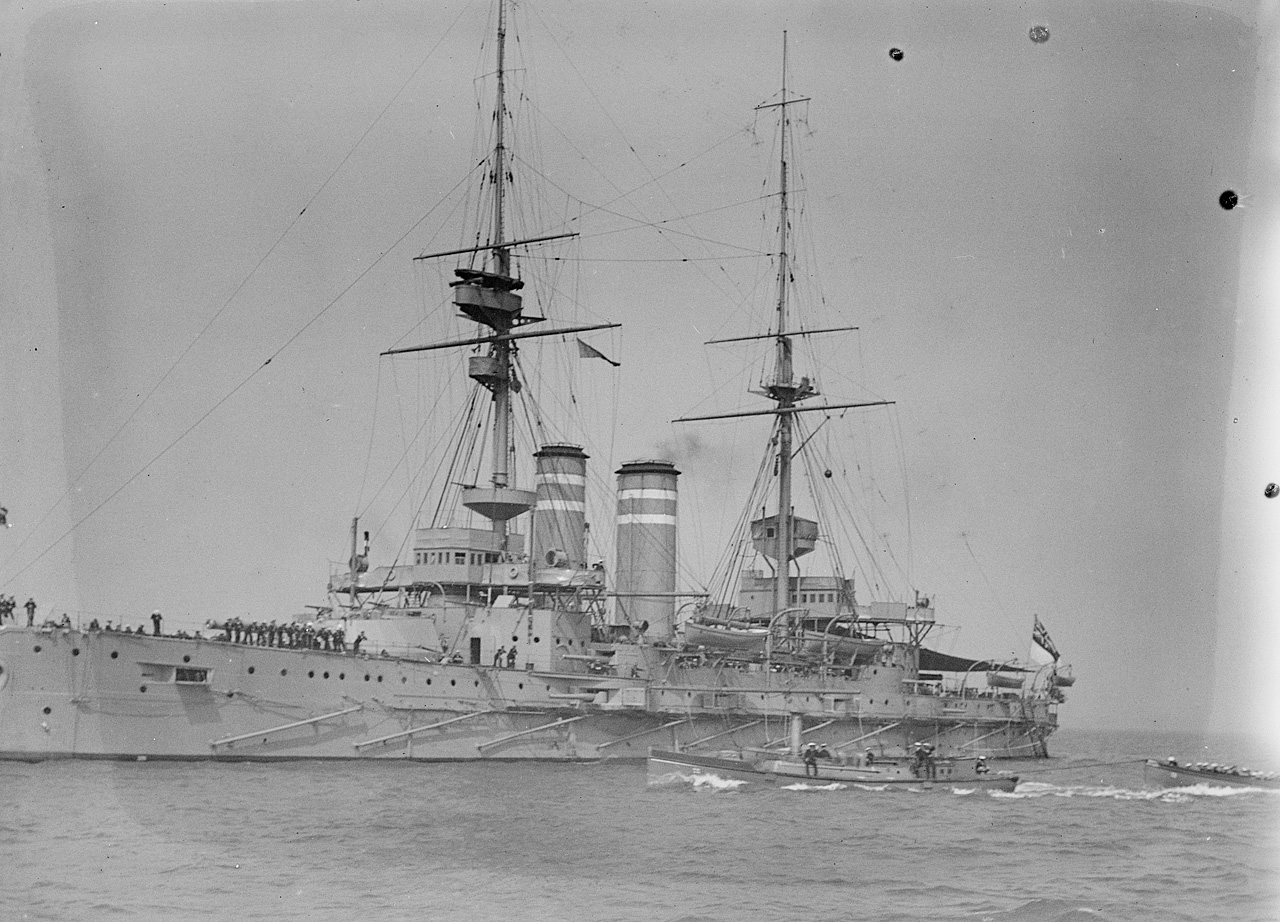
Things got more serious in 1915 when Chris was assigned to the Queen, a pre-Dreadnought battleship that participated in the Dardanelles campaign, including the Gallipoli landings.

(HMS Queen, ca. 1909; Courtesy of Wikimedia Commons.)

In August, 1915, Chris was promoted to Ordinary Telegrapher. The Queen was assigned to support the Italian navy, which explains why he was in Italy for Xmas 1916. He was promoted to Leading Telegrapher by the time he demobilized in March, 1920.

Christopher Wilkins wasted no time in seeking his fortunes abroad. He emigrated to Canada in May, 1920, headed to Toronto to join his brother Stanley, who had made the trip around 1914, intending to work as a telegraph operator. What become of him after that, I am not sure.

In Guelph, Xmas 1916 was a difficult one, as you would expect. On 5 December, the Mercury reported that seven Guelph soldiers had been reported killed in action. Privates Henry Emeny, Austin Henry Thomas, Robert S. O'Drowsky, William Macoll, Charles S. Lawrence, Frederick Willis, and Corporal George Thomas Ryder were reported either killed in action or dead as a result of wounds received in action. It was, said the headline, the "hardest blow the city has received since the outbreak of war."

An article from 9 December notes the availability of foodstuffs for Xmas cooking and compares that with the previous year. Regrettably, dates had gone up in price from 10¢/lb to 15¢/lb and gone down in quality. Something similar applied to currants, which were then imported from Australia rather than Greece, and were dearer but not as juicy. British lemon, orange, and citron peel had almost doubled in price and lard was almost impossible to get, likely because hog fat was considered a strategic good. On the up side, there had been a bumper crop of oranges, which were of good quality and cheaper than in 1915. No doubt, many young Guelphites received oranges in their Xmas stockings that year.

On 19 December came the news that George Sleeman was retiring from public life. He was well-known as a prominent, local business mogul and also for his keen interest in civic life. He was elected councillor for the South Ward in 1876 and was elected the first mayor of the City (no longer town) of Guelph in 1880. He was mayor of the city for six years in total, the last time in 1906. He was elected to the Light and Heat Commission and appointed to the Parks and Shades Commission, where he continued to serve until ill health motivated his present resignation.

(George Sleeman; Courtesy of Guelph Civic Museums 2009.32.951.)

On the bright side, Santa Claus continued to move with the times. Advertisements in the Mercury show St. Nick making use of all the modern conveniences while going about his job. For example, Bell Telepone noted on 5 December that the jolly old elf highly recommends telephones, including a second telephone in order to save running upstairs to answer the first one!

Another plus appears to be that Santa does not need a red-nosed reindeer, at least where the team can just follow the prolific telephone wires.

Another ad for G.B. Ryan & Co. from 7 December shows Santa ditching the reindeer altogether for another modern convenience, the automobile!

This is not to say that Santa had dispensed with all his magic. Early cars (and many late models) were notoriously hard to operate in the cold and snow, so that motorists tended to put them away in winter and operate sleighs instead in 1916. So, driving a car so readily over the snowy streets of the Royal City would have benefited from Santa's magic touch.

In addition, there continued to be a nostalgia for sleigh rides during the holiday season. On Xmas day, every cutter in the city was rented out so that Guelphites with some money to spare could promenade through town in proper style, with horses nodding and sleigh bells ringing (26 December).

One enterprising Guelphite took the obvious step of combining cars and sleighs. An article in the Mercury (30 December) notes:

An addition to a Ford car, which caused comment and interest yesterday afternoon, was the use of runners in place of the two font wheels. This facilitated the running of the car through the snow, and the driver was quite proud of himself.
Santa take note! I wonder if this innovative automobile looked like this:
("A Model T Souped-Up for Snow, 1920." Courtesy of Plainfield Public Libray, Photo #VV60207.)

The same day came the news that the "Prison Farm" just outside of town might be re-purposed as a recuperation and training facility for returned soldiers. In due course, the Reformatory did indeed become the Speedwell Military Hospital.

George Bowles died on 3 March 1952 and was buried in Woodlawn Cemetery. His obituary dwelled mainly on his involvement with the local chapter of the Independent Order of Odd Fellows (IOOF), of which he was elected Chief Patriarch and District Deputy Grand Patriarch in 1932.

Lydia died on 13 February 1961 and was buried next to George.

Sunday, 6 December 2020

Puslinch Lake, Guelph's first resort

Though situated at the confluence of the Speed and Eramosa rivers, which have always provided ample bathing and boating opportunities, Guelph's citizens looked from early times to Puslinch Lake as a desirable retreat. For many years, Guelphites seemed bent on almost annexing the Lake to the Royal City. Despite this close connection between the two places, and the best efforts of Guelph's patricians, this effort eventually failed to bear fruit.

The connection began early on in the history of the settlement of the district. One story had it that a Father Cassidy, founder of a Catholic mission in the village of Guelph, caused a church to be built on the Big Island in Puslinch Lake in 1837. Stones were hauled to the site over the frozen lake that winter and a flat-bottomed scow was built to ferry local parishoners to and from the site.

Another account is that a church was built on the Big Island by Father Simon Sanderl, who ministered to the faithful in St. Bartholemew's Church in Guelph, predecessor of the Church of Our Lady on Guelph's "Catholic Hill," from 1846 to 1850. It seems that construction of the church on the Big Island was a pet project of his. One account says that Sanderl retreated to the church in 1850 after a dispute with a parishoner who balked at paying the Father's dues before burial of his dead child. (Sanderl was, apparently, very forward in collecting dues due to the expense of finishing St. Bartholemew's.) Rather than render the pre-payment, the man buried the child himself, whereupon the good Father ordered the corpse to be exhumed and "as some would say, sold to the doctor."

(St. Bartholomew's Church, ca. 1879. Courtesy of Guelph Civic Museums, Grundy 68.)

On this account, Father Sanderl fled to the Island church to escape the public's opprobrium. In 1852, he relocated to the Gethsemane Monastary in Kentucky and became a Trappist monk.

In any event, Sanderl's modest stone church on the Big Island was abandoned in the 1850s as it was simply too difficult to reach on a regular basis for services. It was then acquired by two men who turned it into a summer hotel but it could not attract enough custom to remain solvent. The church/hotel burned down in 1865.

Even so, the existence of the old ruins added to the romance of Puslinch Lake and fostered legends that a monastery had once existed there on the Island, whose monks had buried their treasure hoard in fear of Indian raids. Later treasure hunting expeditions failed to turn up any gold chalices but the allure of the Lake only continued to grow.

In its early years, people in the area took a predominantly utilitarian view of the Lake. Locals saw it as a place to draw water, wash sheep, shoot ducks, and catch fish. Experience made them apprehensive of its waters. The Lamont family were the area's first permanent settlers, having arrived in 1831. In 1833, their youngest, 17-year-old son drowned in the Lake after falling out of a canoe while duck hunting. Many neighbors believed that his spirit haunted the place, which dampened their enthusiasm for its waters for a couple of generations.

By the 1860s, efforts of hoteliers to popularize Puslinch Lake as a resort began to pay off. Increases in population and income, not to mention improvements to local roads, began to make the Lake a popluar destination. Initially, these hotels were somewhat seedy, served alcohol illegally, and attracted some unsavory elements.

One early mention of the Lake as a honeymoon resort occurred in the Guelph Advertiser (per the Mitchell Advocate, 1 September 1865). It concerned one George Coleman, proprietor of the "Oyster Bay Saloon," a notorious "groggery and gambling hell" in the West Market Square in Guelph. Coleman had married the respectable daughter of one Mr. Hugh McGinnis, of Puslinch, and honeymooned with her by Puslinch Lake (perhaps at the former church-hotel on the Island that was also run by a "Mr. Coleman"). Subsequently claiming to be called away on business to his family in Rochester, New York, Coleman departed but did not return or write to his bride. Communication with his family revealed that Coleman was a scoundrel with several wives in many states, all subsequently abandoned. The author condoled with the poor girl and helpfully added that the tale should serve as a warning to other young ladies to be careful about whom they marry.

Increasing enforcement of liquor laws tended to tidy up the clientele. In July 1867, for example, the Lake played host to a decidedly proper picnic laid on for the Guelph Artillery Company:

Wives and sweethearts are to accompany them, and should the weather be propitious the chivalrous artillery-men will enjoy, what we wish them to the fullest extent—a very pleasant time luxuriating on love and the dainties that are generally considered the indispensable requisites of a pic-nic.
The contrast with Coleman's endeavor could hardly be clearer.

In the 1870s, daytrips to the Lake from Guelph became a commonplace and water sports like rowing were featured attractions, For example (Mercury, 17 July 1874):

The Butchers’ picnic.—The picnic to Puslinch Lake yesterday was, as we anticipated, a most enjoyable affair. Altogether about two hundred persons were present. The spread was, as may be imagined, bountiful; so extensive, in fact, that a quantity of refreshments were brought home again. The best of order prevailed all day. Quoiting, base-ball, boating, dancing on the green, and similar diversions occupied the happy hours. A rowing match, we believe, was one of the features of the occasion, and Mr. George Hood claims the palm as the champion oarsman. The company returned home about dusk, arriving here between eight and nine o’clock.
The increasing popularity of Puslinch Lake with Guelph's well-heeled and well-to-do attracted the attention of the Royal City's patricians. George Sleeman, Mayor of Guelph, owner of the famous brewery, and promoter of the renowned Guelph Maple Leafs baseball club, took a serious interest in recreational development of Puslinch Lake. In 1879, Sleeman bought an eight acre parcel on the north side of the Lake, added 22 acres in 1882, and another 25 acres in 1884. He and his initial partner John Davidson spruced up recreational facilities on the Island.
(Portrait of George Sleeman. Courtesy of Guelph Civic Musuems 2009.32.951.)

In 1882, Sleeman bought out Davidson and turned the hotel on the north shore of the Lake into a full-featured resort.

(Photograph of a picnic at the Puslinch Lake Hotel, owner, George Sleeman, ca. 1905. Courtesy Guelph Civic Museums, 2014.84.1075.1.)

To shuttle people from the shore to the Island facility, in 1880, Sleeman purchased a steamboat signifcantly named the "City of Guelph." Built in Barrie, the boat was a side-wheeler with a 41 foot keel, a 9 foot beam, and was 13 feet tall. With two 4 hp. engines, it could speed 50 persons back and forth at speeds of up to 8 knots. On busy days, up to 100 people jostled cheek by jowl on her deck while she towed a large scow to accommodate even more.

Guelphites and others swarmed to Puslinch Lake on holidays to admire its views and enjoy its recreational opportunties. For example, The Mercury describes the celebrations of Victoria Day in 1881:

The turn-out at this pretty spot numbered about 600. They spent a quiet, enjoyable day with nothing to mar their amusements. The accommodation at the hotel is first class in every respect both for man and beast. The steamer was kept busy.... The small boats, croquet, quoits, and bowling alley were in constant demand and the dancing floor although 30x40 feet in size was none too large. Dancing was a species of amusement and was carried on to the music of a concertina—the boys without coat or vest and hoeing it down to the best of their ability. There were a great number of little family picnics all of whom declare it is the nicest and cheapest place to spend a holiday. The last of the visitors left about 9 p.m.
The wear and tear on the City of Guelph seemed too great and she ceased service after the 1883 season. Visitors to the Big Island could make their way in a small fleet of manually-powered craft provided for the purpose.
("Puslinch Lake near Hespeler, Ont." published by Chas. P. Grill., postmarked in 1910.)

New visitors to the resort also made the acquaintance of another of its legends, the Puslinch Lake Serpent. The Mercury describes one sighting as follows (6 Sep. 1884):

While rowing from the island to the mainland at Puslinch lake on Thursday two Galt gentlemen saw a huge serpent rise fully four feet out of the water. The reptile headed towards their boat and only ceased following them when shallow water was reached. The serpent is described as being fully 14 feet in length with a large flat-topped head. An old farmer who lives across the lake says the same serpent was seen twelve years ago.
Sightings of the serpent continued for some years but the creature was never captured for close study. Perhaps put off by the increasing crowds of visitors, it may have slithered to a more secluded residence.
("A view of Puslinch Lake near Galt," published by F. H. Chapple, Galt., postmarked 1908.)

However that may be, the increasing popularity of Puslinch Lake with Guelphites and others pleased Sleeman. In 1901, he approached City Council with the idea of extending the Royal City's streetcar system to its shore. This system was owned by Sleeman and inaugurated in 1895. Although popular enough, the system was not making money. In addition, there were several proposals to establish an electric railway between Hamilton and Guelph, all of which would include a stop at Puslinch Lake. Convinced that a connection to Puslinch Lake would be profitable, and wanting to fend off competition, Sleeman convinced the provincial government to amend his company's charter to allow the extension.

The Bank of Montreal and the Traders Bank loaned Sleeman money to pursue the scheme but required a mortgage on the streetcar system and Sleeman's property at Puslinch Lake as security. In 1902, Sleeman was unable to make the loan payments and trustees for the banks took over the properties. These were then purchased by the city of Guelph in 1903.

("Puslinch Lake—near Preston Springs Hotel," real-photo postcard, postmarked in 1926.)

The city took a hands-off approach to the properties, leasing them to proprietors who ran them at a profit. In 1916, to make up for continuing losses from the streetcar system, the City subdivided some of its holdings into 42 cottage lots and sold them off. J.W. Lyon, a Guelph magnate who had purchased 35 acres at the Lake in conjunction with Sleeman's project, subdivided his holdings and sold them off for cottages as well.

The city of Guelph maintained ownership of the resort into the 1930s. In addition, various new schemes were proposed to build railways connecting Guelph to the Lake. For example, the Grand River Railway, a Canadian Pacific Railway subsidiary, proposed to take over the Royal City's streetcar system and extend it to Hespeler, including a spur line to the Puslinch Lake resort. This scheme was opposed by Sir Adam Beck, boss of the forerunner of Ontario Hydro, who sought to build an inter-city railway service run by the utility. Guelphites voted down the proposal and thus scotched the idea for good.

In any event, the conception of Puslinch Lake as the site of a public resort was slowly fading. One reason was that construction of cottages there was turning its shores into private property. Increasing prosperity in Ontario allowed or even prompted its residents to purchase vacation properties rather than renting accommodtions or using shared facilties. Puslinch Lake was very much an instance of this development.

("Aerial view, private section, Barber’s Beach, Puslinch Lake, R.R. 2, Hespeler, Ont.," real-photo postcard, postmarked in 1948.)

Another reason was increasing adoption of automobiles. As the province's middle classes took to their cars more and more to enjoy the countryside, and as governments spent large sums to improve roads, enthusiasm for railway connections waned. Rather than have a relatively small number of railways transport holiday makers to a small set of resorts, people increasingly expected to drive anywhere in the province they had a yen to visit. Although automobile adoption widened the potential audience for recreation at Puslinch Lake, it also increased competition for motorists' attention.

After World War Two, cottage and residential development tended to dominate at the Lake.

("At Puslinch Lake," real-photo postcard, ca. 1910.)

Perhaps the swan song of Guelph's direct involvement with Puslinch Lake came on 1 July 1928, when George Young, the Canadian swimmer who had first conquered the channel from Catalina Island to mainland California the previous year, came to swim at the Lake. (Young had visited Guelph itself previous year.) Andrew Aitcheson of Puslinch had arranged for the noted natator and some colleagues to go to Puslinch Lake to show off their strokes and have a friendly 1-mile contest with local marathon swimmer Stanley Hodkinson (Toronto Star, 3 July 1928).

(Ad in the Evening Mercury, 29 June 1928.)

Unfortunately, this plan ran afoul of the Lord's Day Act of 1906, which expressly forbade any sporting competitions on Sundays. As a result, Young's contribution to the proceedings was somewhat underwelming:

Provincial Police Inspector Grey made this point quite clear. Young could swim but he could not race. The result was that, almost unheralded, the conqueror of the Catalina channel stepped into the water, showed a few of the strokes that carried him to victory, and then stepped out.
As a result, only a few of the 6000 people, who had driven to the Lake in at least 2000 automobiles, actually witnessed Young's performance.

No matter. Besides Young's brief appearance, the event was to include a huge bash featuring music and dancing. To avoid conflict with the Lord's Day, the music was slated to start after midnight—thus on Monday morning rather than Sunday night. This nice distinction had drawn protest to City Council from the Royal City's religious leaders but the city fathers decided that the affair could proceed as long as Aitcheson undertook never to organize another such slippery celebration again.

After eight hours of enjoying the Lake's paths and rustic benches, or simply canoedeling in their cars, the assembled took to the dance floor after midnight when the band began to play. The result was apparently quite a bash:

Parked cars were emptied and rustic benches deserted as the young people answered the call of the dance music. But the desertion was not for long. It was impossible for all to dance at one time. Many watched the dawn come from the dance hall floor, but just as many saw it come through the windshield of an automobile and from the sheltered nooks along the water’s edge.
Guelph's possessive embrace of Puslinch Lake soon slackened. Despite George Sleeman's best efforts to haul it in, like the legendary serpent, Puslinch Lake will always be the one that got away from the Royal City.
Works consulted for this post include:
Puslinch Lake also has the honour one of the many places described as the location of this scene:
("On Puslinch Lake, near Preston, Canada," published by Stedman Bros, Brantford, Canada, ca. 1910.)

In fact, this is a picture of Florence Sallows paddling a canoe in the vicinity of Goderich, Ontario. Her father, Reuben Sallows, was a noted Canadian photographer who was the source of thousands of beautiful postcard images of Canada. As Mike Smith explains, "I discovered that the crafty Goderich photographer repeatedly conscripted his daughter when he needed a female model. Flo Sallows was certainly an excellent choice—she was very attractive and undoubtedly saved her father a bundle on modelling fees."

Smith's book, "The Reuben R. Sallows picture postcard handbook," lists no fewer than 24 different postcards featuring this image but captioned variously as "Black Creek, Port Dover, Ont." to "River Lynn, Simcoe, Ont."

This little item confirms that collectors have to remember that picture postcards, like any images, are not always what they seem.

Friday, 3 April 2020

Guelph is now baseball mad: The Maple Leafs were Inter-County champions of 1921

"Guelph is now baseball mad," said the opening line in the Mercury's article of 25 August 1921. Only the day before, thousands of Guelphites had converged on Exhibition Park to witness the sudden-death game for the Inter-County League championship, played between the Guelph Maple Leafs and the Galt Terriers. The two teams were tied in the best-of-three tournament, each having won a closely-fought contest in the previous week. Given that the Guelph team had won the previous two seasons' pennants, a victory would mean not just bragging rights for the year but a historic three-peat such as the Royal City had not witnessed in decades. Guelphites and baseball nuts from miles around made their way to the Park to take in the tilt for themselves.

Both the Maple Leafs and Terriers had finished the regular season with 9 wins and 3 losses, far ahead of Brantford and Kitchener with 2 wins and 8 losses each. However, the smart money remained with the Maple Leafs since they had won 3 out of 4 contests with the Terriers during regular play. Given this advantage, the first game of the series had been held in Guelph's Exhibition Park on 13 August.

This game was played before an (enthusiastically) estimated 4,000 fans, crowded into the grandstands and circling the field. Tension mounted as the 3:15 start time came and went, as the visitors launched a "childish" dispute over who was to umpire the game. Just as Lee of Brantford and Murray of Toronto were set to officiate, the Terriers' staff "waltzed" (not literally, one assumes) out onto the field to demand that Hett of Toronto work in place of Lee. After half and hour, Galt won the debate and Hett donned his pads and assumed his place behind home plate.

It was the only thing Galt won that day. The Terriers' pitcher, Fred Graham, had a rough first inning, hitting three batters with wild pitches and finally allowing three runs to score. The rest of the fixture was rather more even, with both sides scoring an additional run each, producing a result of 4 to 1 for the Maple Leafs.

The pattern was somewhat reversed in the succeeding game played in Galt on the following weekend. On this occasion, the Galt management tried to have Guelph's catcher, "Patty" Patterson, disqualified for a violation of the League's residence rule. This protest was denied but the team proceeded to win the match itself (Mercury, 22 August 1921). A close-fought affair led to Guelph starting the ninth inning down 2 runs to 4. With two men out and two on base, Ralph Pequegnat pinch-hit a triple to the far right field. Luckily for the Manchester City squad, the ball took a big bounce off the fence right to the fielder, who relayed it home just in time to prevent the tying run from scoring.

All agreed that it had been a fine game with an exciting finish for the roughly 3,500 in attendance. A coin was tossed to determine home field for the tie-breaker on the following Wednesday, with the Royal City coming out on top.

With the game set to start at 5pm, fans began flooding into Exhibition Park by 3 o'clock. The grandstand was jammed an hour in advance, and people began to crowd around the outfield. Motorists parked their cars in a ring around the outfield, two or three deep, starting at noontime so as to have special "box seats" to take in the game. More and more vehicles arrived, bringing more and more spectators (Mercury, 25 August):

The grounds were fairly black with motor cars, and in addition to the immense circle of autos around the diamond, hundreds of others were parked in the vicinity of the race track, while as many more weren’t even brought into the park, but were lined outside the fence, and along Exhibition and Kathleen streets.
Somewhere around 500 cars were parked on or around the grounds. Estimates of the crowd size varied from 3,000 to 6,000, with the Mercury preferring the latter figure. In any event, it was a record gathering.


("Galt at Guelph, Inter-County Final, Aug 24, '21." Image from a real-photo postcard taken from the top of the Exhibition Park grandstand. Note the new Victory School in the background. Fans were held back with help from a rope and local police. From the author's collection.)

The game was a close-fought contest. The twirlers Freddy "Whet" Whetstone for Guelph and Leeds for Galt both threw good games, though the Terriers' fielding seemed a little shaky.

The Maple Leafs scored one run in the opening frame, with the Terriers responding with one of their own in the top of the fifth. The Manchester City fans, a thousand or more having made the trip from Galt, cheered wildly. Yet, Cockman's Maple Leafs answered McFadyen's Terriers straight away with another run in the bottom of the inning. At this point, the Mercury informs us, the Galt fielders seemed to lose heart and were increasingly outplayed thereafter.

Guelph touched up Leeds for two runs in the eight inning, taking a 4 to 2 lead. This prompted the Manchester City's manager McFadyen to pull Leeds and put Graham on in his place, a move that met with the catcher's disapproval and was said to "smash the morale" of the Galt team. Nevertheless, the Terriers' responded with a run in the top of ninth but were then shut down by "Whet's" pitching. After Oliver was thrown out easily at first base, the game was over and the crowd erupted with joy: "Three times Inter-County champions. All hail the Maple Leafs."

In fact, the game may have been over before it started. The day before, Guelph pitcher Freddy "Whet" Whetstone had placed a horseshoe under the Maple Leafs' bats piled up in the park, thus ensuring good luck. On their way to Guelph on game day, the special bus hired by the Terriers had broken down, delaying their arrival and causing their manager "Mac" McFadyen to wonder if their appearance was not ill-omened.

Whether is was due to fortune or the quality of their play, the Maple Leafs had covered themselves and their hometown in glory. The three-time championship was most welcome and for a number of reasons.

For one thing, it brought back distant memories of Guelph's former baseball dominance. Baseball was introduced into Guelph in 1861 when the Maple Leafs were formed and named after a club in Hamilton (Johnson 1977, pp. 328–331). The team steadily improved and won the Canadian Championship in 1869, which they defended successfully in the next two seasons, making for their first three-peat. Their high-water mark was reached in 1874 when the team won the American championship in semi-professional competition, thus making them world champions.


("George Sleeman with the Guelph Maple Leaf baseball team," 1874. Sleeman (lower right, front row) was then the owner and prime mover of the team. Courtesy of the Guelph Civic Museums 2009.32.2071.)

By that time, baseball was becoming more broadly organized and Guelph was later unable to compete with richer clubs for players who could win at such a high level. The Maple Leafs did win the Canadian semi-professional championship in 1894 but could not repeat the success and popularity of their glory days.

Yet, the conclusion of the Great War marked a new beginning. A number of local boys had acquired significant baseball experience in the previous years, among them several returned soldiers who played during their military service (see below). When these men took up places in local factory teams, they proved to be quite competitive in intra-city and regional competition.

When the Inter-County League was organized in 1919, its championship was won by the local Partridge Rubber Company team (Mercury, 25 August 1921). In 1920, the championship went to the local Spring and Axle Company team. It was decided that the team should then be named the Maple Leafs, to recall the glory days of yore:

Early in 1921 it was decided that instead of having the Guelph team run by an industrial concern, it would be a timely move to revive the name of the once famous Maple Leaf club, of Guelph, champions of the world.
Of course, this change also helped to broaden the appeal of the team beyond the factory it happened to represent at a given time. All residents of the Royal City could identify with, support, and pay to attend the games of the Guelph Maple Leafs Baseball Club. Biographies of the players in the Mercury emphasized that almost all were local boys, long-time or born-and-bred.

Both elements were combined in the person of Jimmy Cockman, the team's manager. Born in Guelph in 1873, Cockman played with the Maple Leafs of the newly formed Inter-County league in the mid-1890s and then gone on to an illustrious career in a variety of American and Toronto teams. He had retired and returned to Guelph in 1912 but returned to the game to manage the Maple Leafs during the 1921 campaign.

With their victory, the Maple Leafs had earned a berth in the Ontario League championship, where they finished a highly creditable second place. The team remained competitive for the next decade, although the Terriers won most of the League championships. In any event, it remained a famous victory and restored baseball as a key pastime and entertainment in the Royal City for many years to come.


The Guelph Mercury (25 August 1921) published a photo of the championship team, which was also printed as a real-photo postcard:


Original caption:
Standing left-to-right—V. King, trainer; J.H. Runstadtler, outfielder; J. O'Connor, left field; F. Murphy, pitcher; F. O'Connor, first base; F. Whetstone, pitcher; J.N. Jones, second base; "Sandy" Little, centre field; Jimmy Cockman, coach.
Middle row—H. Pequegnat, catcher; "Tim" Elliott, outfielder; R. Stewart Clark, Business Manager; A.J. Hewer, President; Mort Johnston, Treasurer; Harry Nunan, right field; Tom Patterson, catcher.
Front row—P.M. Clark, short stop; "Bob" Fennix, mascot; Ralph Lindsay, third base.
Note the Victory School in the background again.


The Mercury (25 August 1921) provides the following biographies of the champion Guelph Maple Leafs:

Secured experienced coach.
During the first season in O.B.A.A. company the locals battled away under a heavy handicap owing to the fact that they were unable to secure a capable coach, but towards the latter part of last year this trouble was remedied when Jimmy Cockman, the well known Guelph boy who had a distinguished career as a ball player in the various professional leagues for seventeen years, came to their rescue and volunteered his services as official coach. Not long after Jimmy took over his duties, the local lads showed marked improvement in their playing, and it is no doubt due to his valuable assistance, that the “home brews” are today rated in a class with the best amateur clubs in Ontario.

17 years in “Pro” company.
Jimmy Cockman, as the majority of Guelphites are aware, received his early baseball schooling with the world’s famous Guelph Maple Leaf team. After making a name for himself with the Maple Leafs he journeyed to the Virginia League, where he played with the Roanoke team in 1896. The following year saw him performing with the Indianapolis club in the Western League, while in 1898–99 he accepted a handsome offer to play for Reading in the Atlantic League. In 1900 Jimmy drifted over with the Wheeling club in the Inter-State League and in 1901 he went back to the Western League as a member of the Minneapolis team. As Captain of the Milwaukee nine in 1902–03 he had one of the most successful seasons in his baseball career, and piloted his club to the top position in the Western League in the latter year. 1904 saw Jimmy with Newark in the International League, and after completing a four year contract with this club, played with Toronto in 1908. Jimmy, although owned by Newark, finished the 1908 season with the New York Yankees. In 1909 he went to St. Paul in the American Association, while in 1910–11 he shifted back to the Western League, playing with Lincoln. Jimmy closed a long and successful professional baseball career in 1912, when after managing the Grand Island team in the Nebraska State League, he returned to Guelph and retired from the grand old game.

Who the players are.
J. Sanders Little—centre fielder; ago 26, born in Guelph; playing manager for three years; broke into baseball in local city and church leagues, later going to Toronto, where he performed with St. Mary’s Judeans, Belwoods and St. Pats teams in Stanley Park league. While in the army “Sandy” was with the W.O.R. nine.

Fred J. O’Connor—Better known as “Big Dan” first baseman on the Inter-County team three years; age 26, born in Guelph. All old time sports in Guelph will agree that “Big Dan” handles himself around the initial sack after much the same style as his dad, Daniel O’Connor, who held down first base on the original Maple Leafs. Fred, before breaking into Inter-County company was for several years with various local city and church league teams.

John N. Jones—Second baseman, age 22, has also been with the Inter-County team three years. Joner started his career with that snappy local junior team, the Strathconas, with which he played for six years, while in 1918 he was a member of White’s team, City League champs. He is one of the most promising young ball players in the city, and has played a good steady game with the Leafs all year. “Joner” as his many other team mates, is a native of the Royal City.

Harry A. Nunan—Right fielder, age 21 years. Although still quite young, “Nunie” has been at the game a long time, making his debut with the St. Aloysius team in this city in 1914. The two following years he played in the Inter-Catholic League, and in 1917–18, was with the Strathconas, Western Ontario junior champions. He has also been with the Inter-County nine for the past three seasons. Harry was born in Guelph.

Ralph J. Pequegnat—Catcher, age 20; “Peggy” as his is more familiarly known to the baseball enthusiasts of Guelph is rated as the best catcher for his age playing in senior amateur company in the Province. “Peggy” caught for the Strathconas from 1914 to 1918, when he signed on with the Inter-County. He was also born in Guelph.

James P. O’Connor—Left fielder, age 20; “Jimmy” broke in with the Leafs in 1919. Although only 17 years of age at that time it was to be seen that he had the making of a real ball player, and today he is classed as one of the niftiest outfielders in the league. Jimmy had no previous experience, but just broke in as a natural player. He is a wicked hitter, and is considered one of the most valuable men on the local line up. Jim has lived in Guelph all his life.

Fred. C. Whetstone—Pitcher, age 25; as a twirler Fred has made a remarkable showing this year, and it is largely due to his steady work on the mound that the Leafs have forged their way to the top in the last two years. “Whet” joined the Leafs last year. Before signing on with the Inter-County team he had previously played with Taylor-Forbes, St. John’s and the Malleables in the City League. He was born in Guelph.

Fred M. Murphy—Pitcher, age 22; Fred is also one of the old timers on the Inter-County line up. He has been a regular moundsman for three years, and although suffering from a sore arm for the greater part of this season, has commenced to show his old time form of late. “Murf” formerly hurled for St. John’s in the Inter-Catholic League, and while overseas pitched for the 3rd D.A.C. team, runners up for the Third Division championship in 1918. Also born in Guelph.

Ralph W. Lindsay—Third baseman, age 23; although only two years with the Inter-County team, Ralph, with his lightning speed has developed into a real nifty third sacker. He plays his position like a veteran, and his snappy work on the field this year has featured many a game in which the locals figure. In 1919 Ralph played with the G.W.V.A. team in the City League, and while in France was on the 9th Brigade nine, runners up for the Divisional championship in 1918. He is another member of the Leafs born in Guelph.

Thomas Patterson—Catcher, age 28. Since joining the Leafs this year “Patty,” by his good natured disposition, and happy-go-lucky manner, has made himself one of the most popular players on the local line-up. As a receiver “Patty” is there a thousand ways, as was shown in the important series with Galt just finished, in which he distinguished himself in every performance. He is an old timer at the game, and while overseas had the distinction of being picked on the all-star Canadian team which trimmed the Yanks in London, England, and Bonn, Germany. “Patty” also played with the 18th and 25th Battalions and the 2nd Division Machine Gun teams in France.

Percival M. Clark—Shortstop; age 28. “Clarkie” came to the Royal City from Toronto three years ago, and while in the Queen City played on the St. Andrew’s Crescents and West Enders teams. He has been with the Leafs three seasons, and besides playing shortstop performs as relief pitcher. “Clarkie” is also a returned man and while overseas was a member of the 4th D.A.C. team. He is a native of Toronto.

T. Arnold Elliott—Centre fielder, age 35. Although the daddy of ‘em all, “Tim” can still show the majority of amateur players in these parts the finer points on how to play the outer garden. He is lightning fast on his feet, and a sure catch. “Tim’s” baseball career dates back to the old city league in the days of the Park Nine and Alerts. He was with White’s championship team in 1918, captained the Veterans nine in 1919; managed the Carpet Mills team in 1920, and is managing the Arenas, city league leaders this year. “Tim” was born in Guelph.

J. Herman Runstadtler—Left fielder, age 26. “Runny” came to Guelph from Walkerton to enlist with an artillery unit, and since his return from overseas has made his permanent residence here. He has played for three years on the Inter-County team, and in 1919 held the distinction of being the best hitter on the club, winning a gold watch donated by Mr. Pequegnat. Before coming to Guelph “Runny” played around Walkerton and Owen Sound.

George Stapleton—Catcher, one of the most valuable all round players on the team is George Stapleton. George is Johnny on the spot no matter what position he is assigned to. He is a Guelph boy, and has played in the various local city and church leagues for several years.