Showing posts with label Quebec street. Show all posts

Monday, 29 August 2022

A church off the old block: The origin of Chalmers Church

From the perspective of postcard collecting, the main issue relating to Chalmers Church in Guelph (now the Royal City Mission Church) is the rarity of postcards featuring views of it. The card below is the only one that I have yet come across.
("Chalmers Church, Guelph." Courtesy of the John Keleher collection. Publisher unknown.)

Comparison with a recent Google Streetview image shows that the exterior of the church has not changed a great deal since the postcard picture was taken sometime in the early 20th century.
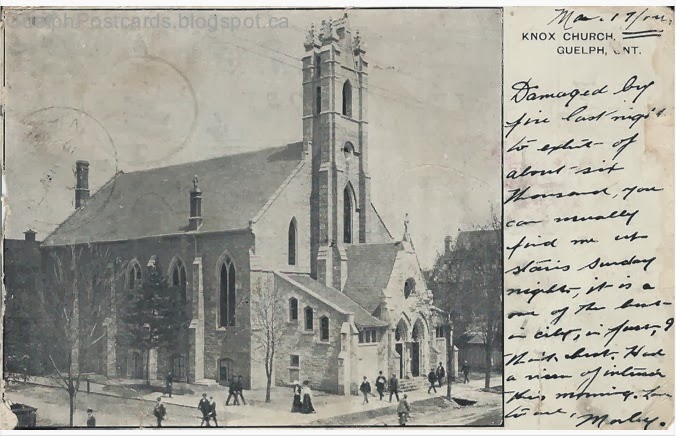
Stone churches were a highly collectable category of picture postcard back in the day and the Chalmers Church was no slouch in the aesthetics department. Furthermore, the Knox Church just down the block was represented on a number of postcards.
(From "Knox Church fire of 1904.")

Like Knox, Chalmers was also a Presbyterian Church, a mainstream denomination that any city like Guelph would boast of. So, why Knox would be prominently featured while Chalmers was the Royal City's secret remains a head-scratcher.

Interestingly, Chalmers Church owes its existence to Knox Church. The first Knox Church edifice on Yarmouth Street was sold to the Raymond Sewing Machine company when it expanded its shop along that street. The congregation built itself a smart new home around the corner on Quebec Street, where the cornerstone was laid in October, 1868.

(The first Knox Presbyterian church on Yarmouth Street, to the right of the Raymond Sewing Machine factory, ca. 1870. Courtesy of Guelph Civic Museums, Grundy 249.)

By the early months of the following year, a sizeable portion of the congregation was looking to break away! Official histories are somewhat mum on the reason. C.A. Burrows (1877), in his Annals of the Town of Guelph, says only that there was an "unhappy divison" within the congregation, while Smith (1955, p. 96) says that some members were "at variance" with the minister, W.S. Ball.

(Rev. W.S. Ball, ca. 1880. Courtesy of Guelph Civic Museums 1997.21.2.)

Perhaps my favourite perspective is that of George B. Anderson, who reminisced about the incident, which occured when he was a boy (Mercury, 20 July 1927):

About the time I came to Guelph to live we all went to Knox Church. Knox Church was a barn-like structure on Yarmouth Street, a diagonal street running from Norfolk Street to Woolwich. There is, or was, a sewing machine factory on the site of the church. But two factions sprung up, over some question I could never quite understand what it was all about. However, the Chalmers Church faction broke away and worshipped in the Court House for some time, until the present church was built.
Luckily, issues of the Evening Mercury from 1868 survive and provide some details. As noted by Smith, the matter turned on some acrimony regarding Rev. Ball, to whom some parishoners took great exception (17 April):
Knox’s church, Guelph.—The Presbyterial investigation of charges preferred against the Rev. W.S. Ball by members of his congregation, which began on Tuesday evening, closed on Thursday afternoon. The decision of the Presbytery will be read to the congregation on Sunday first by the Rev. Mr. Smellie, of Fergus, who has been appointed to preach on that day.
The resolution adopted by the Presbytery as a result of their investigation was printed subsequently (Mercury, 20 April). To make a long story short, the resolution focusses on a few specifics. It notes that Rev. Ball continued to enjoy the support of many members of the church. However, some members had impugned his "pulpit abilities" and his spread gossip about his "moral character." Access to Sabbath School and pew rentals also seem to have underwhelmed some congregants. In fairness, the Presbytery found that Rev. Ball had addressed the situation using "imprudent language," thus feeding the fire afflicting the congregation.

It is hard to know exactly what to make of these points. However, the mention of pew rents is interesting. It was a custom brought from the old country that pews were rented to congregants. The best pews were at the very front and were rented to the wealthiest and most prominent families. Rents got cheaper the closer to the back they sat, while some at the very back were freely available to strangers and indigents.

Rents were not very expensive but were an important source of income for churches. Collecting pew rents, which were frequently in arrears, was a regular headache for the pastors of churches where rents were applied.

Of course, since the location of a family's pews was a signficant signal of social status, they could also be a source of social dispute. Since the Knox congregation had recently moved into a new building and thus had to negotiate pew rentals for everyone, it may well be that some members of the congregation took exception to their new arrangement, to which Rev. Ball may have responded with impatience.

Doubtless, the situation was complicated and particular to local circumstances. As Tolstoy wrote, “All happy families are alike; each unhappy family is unhappy in its own way.”

In any event, attempts at reconciliataion proved fruitless and a segment of the Knox Congregation applied to the Presbytery to form its own group named Chalmers Church, in honour of Thomas Chalmers, a luminary of the Free Church of Scotland. This petition was granted and the group began to hold services in the city Court House while making plans to establish its own place of worship.

(An ad from the Guelph Mercury, 24 July 1868, for the first meeting of the Chalmers church in the Court House.)

The founders' plans went well. In September of 1869, Rev. Thomas Wardrope of Knox Church, Ottawa, agreed to become minister of the new church. The cornerstone of the new building was officially laid by Rev. D.H. MacVicar, Principal of Montreal College, on 22 June 1870, and services began there in December of the following year.

("Laying Cornerstone—Chalmers United Church 1870." Courtesy of Guelph Civic Museums 1970.39.17. In the background on St. George's Square, note the original Wellington Hotel on the left, the old Bank of Montreal building in the centre, and the rear of the second St. George's Anglican church on the right.)

Leaders of the new church spared no expense in setting themselves up. They hired Toronto architect Henry Langley, "the undisputed dean of ecclesiastical architecture in Ontario during the last half of the 19th century." The Board of Managers were quite specific that they wanted a church in the latest taste, modeled on the Knox Church of Montreal, though on a smaller scale. Langley certainly delivered! The church cost a total of $25,000, a considerable amount for a new congregation.

(Henry Langley. Courtesty Wikipedia.)

Gilbert Stelter (1989) makes the following point about the relation of Chalmers Church to Knox Church down the block:

The choice of a site for the new church seems almost provocative, for it was almost next door on the same downtown street (Quebec) as Knox Church, from which they had split. And the use of a relatively sophisticated Gothic design must have been calculated to look more impressive than the very simple Gothic of Knox's new building, designed by James Smith of Toronto a year earlier. Knox Church was essentially a rectangular box ornamented only with plain pointed windows. Chalmers, however, was described as "the best constructed and the most elegantly furnished church in town" when it opened for services in 1871.
The building was also distinguished by the fact that it constructed of imported gray limestone rather than the plentiful, warm local material. No doubt, this measure also serveed to distinguish the church from Knox church.
("Knox Presbyterian Church, 1871." Courtesy of Guelph Civic Museums, Grundy 63.)

The congregtation grew during the Victorian era and the church was altered and expanded to meet additional demands for space. A substantial renovation was completed in 1896. Designed by the original architect, Henry Langley, the shingles on the roof were replaced by slate and a series of dormer windows were added as well. Each row on either side of the roof could be opened at once with a hand crank. The ventilation thus achieved served as an early form of air conditioning.

A new gallery was added around the main auditorium, which could seat 320 people, bringing the total capacity to 850 persons. In a pinch, partitions between the vestibule and the auditorium could be lowered mechanically and 200 seats added to the vestibule also, meaning that the church could hold over 1,000 souls.

A point of particular pride was that the lighting of the church was converted to electricity. A review in the Mercury (23 September 1896) speaks most highly of the two main electroliers suspended in the auditorium. (In fact, many of the fixtures were hybrids that combined incandescent lighting with gas, as a precaution in case the power went out, which was not so unusual in that era.)

The total cost of these renovations was $6,050, a considerable outlay.

Perhaps the most interesting alteration in that era was the purchase and installation of a pipe organ in 1890. Today, organ music and singing in church services is de rigeur but it was not so when Chalmers Church was founded. Until 1873, singing in Prebyterian church was "lined", that is, a leader or "precentor" read a line from a Psalm and the congregation sang it back. A tuning fork was sometimes deployed to assist everyone in hitting the appropriate pitch.

In 1867, just before Chalmers Church was founded, Knox Presbyterian Church in Montreal created a brouhaha by including organ music in its services. The issue of whether or not instrumental music was kosher for its churches was referred to the national Synod. This body made no decision, thus effectively leaving the matter to each Presbytery to decide for itself.

An "interesting discussion" was held on the matter in the Guelph Presbytery (Mercury, 15 January 1868), which voted down the idea. Even so, services gradually became more musical. Chalmers' first choir was formed in 1871. Hymn singing was introduced to service a few years following. The organ question was revisited again in 1884 and rejected in a vote of the congregation.

Finally, installation and use of an organ was approved in 1890. It may have helped that Knox Church had approved the use of an organ in 1887. True to form, the new organ was a top-of-the-line instrument featuring 900 pipes in all, powered hydraulically by connection with the city waterworks. Considerable renovations were required to accommodate it (Mercury, 8 September 1890).

("Chalmers Church, ca. 1890." Courtesy of Guelph Civic Museums, 1975.21.21.)

While Chalmers and Knox churches remained social rivals the actual division between their congregations was neither profound nor long-lasting. At the time Chalmers Church was formed, there were four different Presbyterian groups in Canada. These had been engaged in negotiations for a union for some time, a project that resulted in the amalgamation of all four into the Presbyterian Church in Canada in 1875. Thus, Chalmers and Knox congregations became equal members of a single, national body.

Chalmers Church became Chalmers United Church when the the United Church of Canada was formed in 1925.

In his reminiscences, Geo. B. Anderson notes that many of the great and good of the Royal City were members of Chalmers Church in its early days:

  • Peter Gow, who ran a tannery business where Gow's bridge now lies, was twice Mayor, Guelph's first M.P.P. after confederation, and held the post of Provincial Secretary. He assumed the office of County Sheriff upon his retirement in 1876.
  • David Stirton, who owned a farm in Puslinch near town, was elected as the Member for the Legislative Assembly of the Province of Canada (1858–1867) and then Member of Parliament (1867–1876), after which point he retired to Guelph and assumed the office of Postmaster.
  • Donald Guthrie, a local lawyer, succeeded Stirton as M.P. for Wellington South (1876–1882), and then served as M.P.P. in the same area (1886–1894).
  • James Innes was for 36 years an editor and publisher of the Guelph Mercury.
  • Hugh Guthrie, son of Donald Guthrie, was also a local lawyer who had a long and eminent career as M.P. for Wellington South (1900–1935) during which time he held many high offices.
So, whatever it lacked in postcard representations, Chalmers Church was an eniment fixture in the culture and landscape of Victorian Guelph and, happily, continues to adorn Quebec street to this day.
Works consulted include:

Wednesday, 4 December 2019

Guelph postcard producers: The Waters Bros.

The Waters Bros. were regular advertisers in local newspapers like the Guelph Mercury. A typical ad might run like this:
Waters Bros., Guelph
Headquarters for O.A.C.
And School supplies
For
Nature study
Botanical
Entomological
Drawing
Painting

41 Wyndham Street
Phone 350
So, it was likely a surprise to readers when the following ad appeared in the usual space (Acton Free Press, 29 Apr 1915):
No reasonable offer refused

Show cases and equipment
Picture frames, china and glassware, etc.
Everything must be sold

Waters Bros., Guelph.
Suddenly, the Waters Bros., a long-established Guelph enterprise, was going out of business. What happened?

The Waters Bros. was a Picture and Art Supply business founded in Guelph in 1878 by Frederick and Florance Waters. Frederick (b. 1853) and Florance (b. 1854) were sons of Charles and Frances Waters. Charles was a customs official in the southeast of England. In 1877, the two had immigrated to Canada, where Frederick had set up a business in Guelph. When his brother Florance joined him there in 1878, they formed the Water Bros., and placed the following notice in the Daily Mercury (23 April):

Important.
Frederick Waters begs leave to inform the public that he has taken into partnership his brother Florance Waters. The business will be carried on under the style of Waters Bro’s.
The new firm offers a large and varied assortment of oil paintings, chromos, engravings, frames, mouldings, &c., at lowest prices.
Upholstering as usual. Carpets made and laid. Mattresses re-made and made to order.
Parties furnishing will find it advantageous to call and inspect the stock of Waters Bros.
148 Quebec street, Guelph, West of McCrae’s Wood Yard.
The address would be approximately where 33 Quebec St. stands today.


(Quebec street west in 1874, roughly as it appeared when Waters Bros. set up shop there a few years later, about half-way down the south, left-hand side. Courtesy of Guelph Civic Museums 2013.72.94.)

The partnership did not last long. In 1881, the brothers dissolved it and Frederick moved on to Stratford. Florance took over the business but kept the "Waters Bros" name. It seems that Florance was not the brother interested in upholstery and carpets, since these are left out of the description of the business in the "Industries of Canada" (1886):

Waters Bros.—The Picture Gallery, near Post Office; Picture Frames, Oil paintings, steel engravings, mouldings, poles, cornices, and mirrors, well known in Guelph as a reliable house in every respect at which to purchase pictures or get them framed; also artists’ materials, and every article required by amateurs and professionals—established their business eight years ago, on their arrival in this country from England, the land of their nativity. They occupy very neat premises, near the Post Office, which are 25x25 feet in dimensions and two stories in height
The title "The Picture Gallery" remained the slogan of the business in future. Note this title in the ad below, from the 1882 Evans City Directory:


One of the benefits of owning a prosperous business is that Florance could get married. On 12 April 1879, Florance married Fanny Lacy, also an English immigrant, who resided in Palmerston at the time. By 1882, the couple had moved into a lovely house at 94 Liverpool Street (now 86), as shown on Google Street View below.


Charles and Fanny had a large family, Charles Jr. (b. 1880), Florence (a girl, b. 1881), Edith (b. 1883), Caroline (b. 1885), Fanny (b. 1887), George Percy (b. 1889), William (b. 1892), and Arthur (b. 1894) (1901 Census). It seems that the picture and arts supplies trade paid decently enough.

Of course, the future is never certain. By 1884, the Waters Bros. had moved a couple of times and then occupied a space on the south side of Quebec street opposite the Bank of Montreal, facing out on St. George's Square. This spot must have been considered prime real estate for trade. Yet, shortly after noon on 31 May 1887, the block in which their store sat caught fire (Mercury). The blaze imperiled the whole block, from Mr. Copeland's barber shop at the south end, Nunan's book bindery, Hall's tailor shop, Clark & Thompson's carpet store, as well as the Waters Bros.

One advantage of the locale and time was that many people were on hand to pitch in:

Soon a crowd gathered, and when it was discovered that Mr. Copeland and his family had removed, efforts were directed to saving the property of Waters’ Bros, for nothing could be done in the bindery. Willing hands were soon at work, and succeeded in getting out the most valuable portion of the stock in an increditable short space. Those engaged in the work seemed to “keep their heads,” and rescued the contents in such a safe manner as it seldom witnessed now.
The Waters Bros' loss was estimated at $1500, with a $1000 of insurance.

Alderman Hearn, who had recently purchased the block, had insurance and decided to rebuild. However, the Waters Bros. had to vacate their building. They moved temporarily to the store previously occupied by James Nelles (father of Charles Nelles, subject of a previous blog) at 25 Wyndham street to hold a fire sale, "Where they are preparing to sacrifice their tremendous stock."


(25 Wyndham St., currently the location of Wimpy's Diner; courtesy Google Street View)

The Waters Bros remained at this site for a couple of years. However, when the new Hearn Block was ready, they relocated back into the fancy, new digs, with double the space. The announcement was made as follows (Mercury, 25 July 1889):

Going west.—Stock must be reduced. No reasonable offer refused as Waters Bros., will remove in a few days to the double store in Hearn’s block, St. George’s square.
The phrase "Going west" usually applied to people who were moving to western Canada; Florance was using it here to refer jokingly to his move from the east to the west side of Wyndham street.

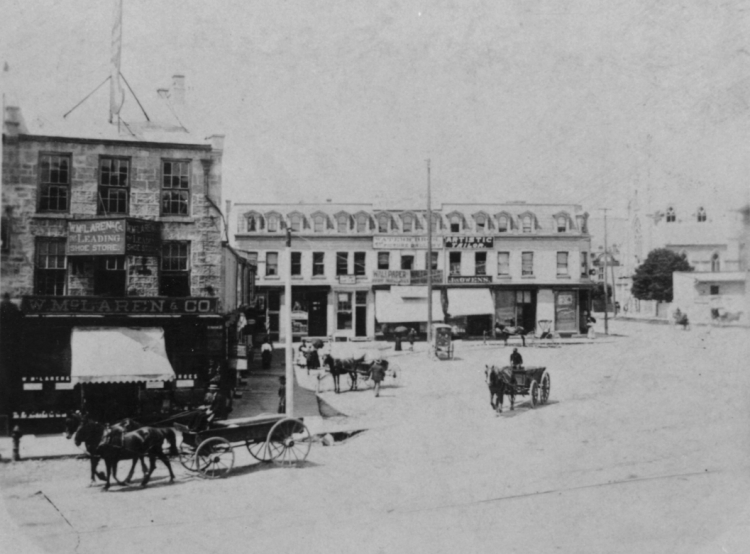
The Waters Bros. store in the Hearn Block, ca. 1895, can be seen in the photo below. It lies in the middle of the block, in the right background of the photo, behind the tall pole.


(Courtesy of Guelph Public Library, F38-0-15-0-0-22.)

The sign below the attic windows reads, "Waters Bros. // The Picture Gallery." A sign over the awning reads, "Wall paper," always a good seller, and other things that are hard to make out.

Apparently, the west did not suit the Waters Bros store for long. In September 1898, the store returned east to 39 Wyndham street, just south of St. George' Square, currently the location of a nightclub. A few years later, they moved one door up the street to 41 Wyndham street, currently the home of Guelph Today.


(41 and 39 Wyndham street, courtesy of Google Street View.)

At around the same time, the Waters family moved from Liverpool street to a substantial stone house at 27 Arthur street (now 86), backing on to the Speed River. It seems that The Picture Gallery had made Florance Waters and his family a picture of prosperity!


(86 Arthur street; Courtesy Google Street View.)

When the picture postcard craze swept the Edwardian era, the Waters Bros was a perfect position to capitalize. The store had always carried souvenir goods for special occasions such as Christmas. This, and their attention to pictures, made postcards and related phenomena a natural extension of their product line.

Postcards bearing the imprimatur of the Waters Bros. seem to come in two groups. The first group have postmarks in the date range 1908–1911 and have the same backs (in brown ink) as those published by the Pugh Mfg. Co. of Toronto (in blue ink), suggesting that both used the same printer. The views on these cards are typical for Guelph postcards of the era. For the most part, the pictures seem to have been borrowed from other producers, although a few may have been taken especially for the Waters Bros. stock.

For example, here is a nice view of Massey Hall at the Ontario Agricultural College, with a gentleman standing outside of it:


This card was addressed in 1909 by Stanley R. Dayton of Little Britain, Ontario to H. Smith of Ingersoll as part of a postcard exchange, a common arrangement of collectors who sent each other postcards of interest. The text sounds like the sort of thing that two enthusiastic, young postcard collectors would ask of each other:
Many thanks for your pretty card. How many cards have you? Do you get many out of the exchange? What do you work at? I am going to school all the time and soon.
The picture is the same as one found in a contemporary Warwick Bro's card, even to the awkward cropping on the right-hand side.

On the back, the card is identified as "Published by Waters Bros, Guelph, Ont."

Another interesting picture shows a view taken from the top of Goldie's Mill, looking down the Speed River, over the Norwich street bridge towards the spire of St. George's Church.


This card was postmarked on 3 September 1908 and was addressed by "Cousin Neil" to Miss Sadie McPherson of Guelph as follows:
Dear Sadie, You will be at school now. Ida & Tina did not get up in the holidays. Maybe they’ll come some Saturday. Our flower Sunday at Sunday School is on Sunday, the 6th Sept. How are Uncle Donald & Aunt Christie & John & all you girls? I had a good time at your place.
This image is the only version I know of issued as a colour lithograph. There is a halftone version with no publisher's mark that may have originated with Charles Nelles.

The second set of Waters Bros. cards are reprints of cards issued by the Illustrated Post Card Co. of Montreal, with postmarks in the 1911–1913 range. For example, here is a view of the then-new Carnegie Library, with a well-dressed couple posing in front:


The postcard was sent from Fergus by Harold to Harry and Florrie Lewar of London, England on 14 June 1913:
Many thanks for letters. so pleased to hear that you are not moving from London. I went washing sheep for Hastings the other day & then took a swim. I will write that character for you Harry before I leave here.
Swimming with sheep sounds like it might be highly therapeutic.

Another nice postcard from this set depicts Gow's Bridge, now often known as the McCrae Bridge, when the mill and other buildings were still present:


The subdued, watery palate of the series shows the river to good effect.

Certainly, the Waters Bros were selling postcards with their own imprimatur in the 1908–1913 period. It is quite possible that they sold postcards from other producers beforehand and even at the same time. In all, it seems likely that postcards formed a nice side line for the business

As with so many other things, the Great War changed all that. Shortly after war was declared, young William Waters volunteered for the British Columbia Horse (Mercury, 11 August 1915). The previous year, he had taken a job with Guelph's Taylor-Forbes foundry, which sent him to their Vancouver office. Finding that horses were too scarce, Waters travelled to the training camp at Valcartier, Quebec, and joined the 5th Battalion, infantry.

His military records reveal that Corporal Waters's service was not long or easy. He suffered a case of the flu in December, followed by bronchitis in January 1915. His regiment was among the first sent to France, where it became involved in the Second Battle of Ypres, where poison gas was first deployed by German forces. At Langemarck, Corporal Waters was reported to be wounded on 25 April and evacuated to a field hospital, which authorities reported to his father, Florance.

Corporal Warron, a friend of Corporal Waters who had been lightly wounded in the same attack, noted that his friend was not to be found and instigated a search. It turned out that the field hospital where Waters lay was overrun by German forces and Waters had become a prisoner of war. In August, German authorities listed Waters as dead, with no details given as to the cause. The Canadian military listed Waters as deceased and informed his family in Guelph on 10 August.

It seems likely that this string of events precipitated the sudden decision to liquidate the Waters Bros. business in April 1915, as noted above. The process was completed in September, shortly after news of William's death reached home. Curiously, advertisements for the liquidation sale are to be found in the Acton Free Press but not in the pages of the Mercury itself. It may be that the news was all over town anyway, so that local advertisements were unnecessary but that is only a guess.

A picture of Corporal William Waters was published in the Mercury on 18 August:


Curiously, for the family of a picture business, this is the only photograph of a family member that I have yet come across. (If anyone has more, let me know!)

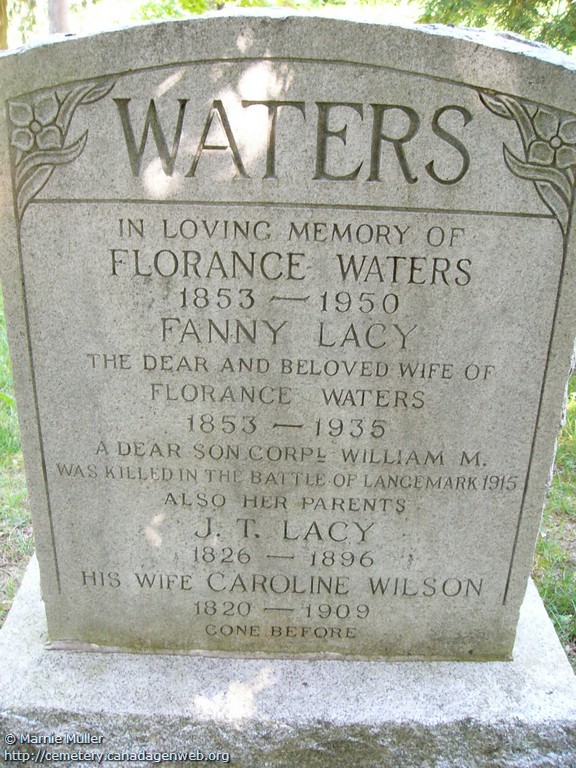
In a few months, Florance and Fanny packed up and moved to Vancouver, for reasons that remain unclear but may be connected to William's residence there. Even at such a large distance, the family was not forgotten in the Royal City. A marker is to be found in Woodlawn Cemetery, commemorating Florance and Fanny, Fanny's parents, and William:


(Courtesy of CanadaGenWeb Cemetery Project.)

Besides this marker, we have their postcards to remind us of the Waters family, their business, and the Guelph that they lived in before the Great War.