Showing posts with label James Merlihan. Show all posts

Sunday, 2 June 2024

The Ontario Bank branched into Guelph

(Front and back of postal card addressed to the Bank of Hamilton from the Ontario Bank, Guelph branch, on 25 April 1876. Pencil notes on the back are due to an earlier collector.)

This very quotitidan postcard conveys a very quotidian messsage:

Ontario Bank, Guelph, Ont. 25 Apr, 1876
I have received your letter of the 22nd inst. with enclosing … Manager.
This sort of card, sometimes known as a "postal card," was often used for business correspondance in the last quarter of the nineteenth century. As this Ontario Bank "postal" illustrates, they could be printed as form cards, useful for quick acknowledegement of correspondence, cheques, or goods received. Addressees could then keep these postals in their books as a record that a transaction had been completed, an important bookkeeping function for a commercial enterprise.

Undoubtedly, the most interesting bit of this postal is the loopy signature. I believe it is the signature of Edmund Morris, who was the manager of the Ontario Bank Branch in Guelph in the 1870s. The signature begins with an "E" consisting of two upper loops themselves encompassed by a loop that seems to transition into a capital "M" followed by a "orris" in a peaky scrawl.

As Stephen Thorning explains, the banking system of Ontario was substantially different in the early days of the province than it is today. The Province chartered a small set of "offical" banks that were subject to the regulations of the banking act. These big banks concentrated in the big cities such as Toronto. Branches were located in a few, second-tier locations, such as Guelph, but small cities and towns were mostly served by regional or private banks. A private bank was typically a local man or two who had deep pockets or perhaps good credit with a big bank that would loan him money that he could then re-loan to the locals or invest on his own account. Regional and private banks effectively functioned as bank branches do today, and also allowed the chartered banks to apply their money by proxy in ways that weren't strictly allowed by the rules.

(The most notorious private bank in Guelph was the aptly named Guelph Bank, owned by W.H. Cutten— the father of "Wheat King" Arthur Cutten—though that is a story for another occasion.)

The Ontario Bank actually preceeded confederation, being set up in 1857 in Bowmanville with the object of serving the banking needs of farmers and other rural businesses on Ontario and Durham Counties (thus the name). By 1862, the Ontario Bank had expanded to a number of other locations such as Guelph. At that time, the city directory lists its location as the Market Square (Carden street) and its employees as:

Alexander Fisher, manager
G.H.G. McVity, accountant
P.H. Gibbs, teller
Alex Fisher was born at Scotsburn, near Tain in Rosshire, Scotland, in 1817 and immigrated to Canada with his father John in 1832 (Globe, 20 April 1882). He began his business career with the Bank of Upper Canada (as Ontario was known before 1841) but later joined the Bank of Ontario. He was (apparently) the first manager of the Guelph branch but then left to manage the Toronto branch in 1864. There he remained until his death by suicide in 1882, brought on by ill health.
("Group in garden," ca. 1870. Edmund Morris is standing in the back row, right-hand side, wearing a straw boater. Courtesy of Guelph Civic Museums, 1975.21.187.)

Fisher was succeeded as manager by Edmund Morris, whose signature adorns the postcard above. On Morris's watch, the Guelph branch of the Ontario Bank seems to have done well. In 1887, the Guelph branch took over the accounts of the Central Bank, a regional bank that had finally succumbed to bad loans made to brokers and speculators. However, the Central Bank had a snazzy office on Quebec street, to which Morris moved his branch ASAP.

For reasons not entirely clear, the Ontario Bank closed its Guelph branch in 1890. The accounts—and nifty offices—were taken over by the Traders Bank. Edmund Morris was presented with a gold watch and chain by some of the Royal City's leading citizens in gratitude for his many years of service. He relocated to Toronto, where he moved up to the position of Inspector in the Ontario Bank's main office in the Queen City.

One possible reason for the move was a set of "defalcations." Some accountants with Ontario Bank in Toronto were found to have embezzeled a substantial amount of money from the bank, perhaps prompting it to rationalize its liabilities (Mercury, 28 January 1890).

Edmund Morris died in his Spadina residence in 1899 (Globe, 18 December 1899).

The Ontario Bank folded up its tent in 1906. The end was brought about by Charles McGill, the general manager, who attempted to expand the bank's assets through unwise stock market speculation, though McGill insisted they were "investments" (Toronto World, 13 October 1906). Rather than allow the bank to simply collapse, and perhaps start a general panic, the Bank of Montreal took over its affairs and made good its deposits.

News reports concerning the Ontario Bank in Guelph give us glimpses into the operations and challenges of running small town banks in the late Victorian era. For example, the Acton Free Press (16 November 1877) reports that people had been presenting counterfeit ten dollar bills issued by the Ontario Bank to branches in Guelph as well as other Ontario cities. Trying to pass "funny money" was a serious issue.

(Ontario Bank $10 bill, engraved date 1 June 1888. Courtesy of the Bank of Canada Museum, Object ID: 1972.0231.00001.000.)

This notice is a reminder that, between 1871 and 1944, chartered banks were authorized under Canadian law to issue their own currency for circulation. Today, the only cash that most Canadians carry is issued by the Bank of Canada but it wasn't always so. Of course, any bank that issues currency has to protect against fraud, which applied to the Guelph branch, as this example illustrates.

In 1880, a scandal resulted when a local businessman tried to abscond with funds that belonged to the Ontario Bank in Guelph (Globe, 10 December). Mr. J.E. Merlihan, a prominent Clifton businessman, had bought a large amount of wool earlier in the year and stored it in a Guelph warehouse on credit obtained from the Ontario Bank. His plan was to wait until the wool price increased so he could sell it at a profit. This happened and Merlihan sold the wool to Winans & Co. of Toronto, who issued him a cheque for $7,000. Merlihan cashed the cheque at the Federal Bank in Guelph. It was quickly noticed at the Ontario Bank that Merlihan did not appear to make good his debt to them:

In the afternoon the Manager of the Ontario Bank found out that Merlihan had got the draft and as they held the warehouse receipt he wondered why Merlihan had not brought the money to the bank as he should have done.
Why indeed?
On making enquiries he soon learned that Merlihan had driven to Hespeler, the first station south of here; and suspecting that he would take the first train there for Suspension Bridge, telegraphed the Chief of Police at Clifton, and his arrest followed, $6,960 and a ticket for Buffalo being found on his person.
It seems that Merlihan had reckoned without the social network of local bankers.

As Stephen Thorning points out, the turn of the century saw consolidation of Canadian banks. Big banks had worked out how to run branches in smaller centres and still make money. Potential employees gravitated to the big banks because they could offer career growth in the form of promotions and higher salaries. Local banks were just a few people in size and were not apt to grow. In addition, smaller banks like the Ontario Bank sometimes got into financial trouble and Ontarians took a dim view of the prospect that they might one day open their newspapers to read that their bank had gone under, taking most if not all their money with it. Banks got fewer and bigger and assumed more of the form that is familiar to Ontarians today.

The departure of the Ontario Bank from Guelph in 1890 was a sign of things to come.


Works consulted for this post include:
Sharp-eyed readers may have noted the absence of images of the Ontario Bank premises. I have noticed this also! Nothing of any quality has come to my attention. If you, dear reader, can supply the deficit, please let me know!

Sunday, 2 February 2020

Guelph's first automobiles

Marjorie Armour sent this postcard to her brother J.C. in Allan's Mills, Ontario on Easter Sunday of 1913. In it, she assigns her sibling a bit of holiday work:
Suppose you are having great time in your holidays. Would you get a flat box with earth in it ready for us to plant our slips in when we go home as we intent to take our little plants home.
The postcard is a promotional, generic type known as a "banner card" for the obvious reason that it has a banner in which the name of the promoted town is printed—Guelph, in this case.


The card was printed by the Samson Brothers, prolific printers of generic postcards from New York City.

The card is interesting here because it depicts an automobile and because it was sent in 1913. By all accounts, that year was the one in which car ownership took off in the Royal City. Up until that point, automobiles were regarded primarily as amusements for the well-to-do, good only for larks in the countryside during the summer months when roads were dry and (mostly) passable. Afterwards, cars came to be regarded as a reasonable means for personal mobility, perferable to streetcars and horses.

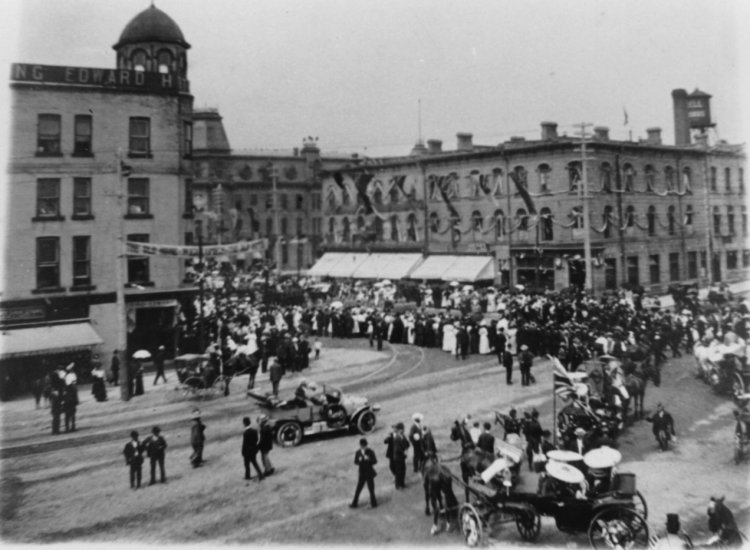
The parade of automobiles during the Old Home Week of 1913 perhaps helped to push this transition in Guelphites' thinking. Indeed, automobiles can be seen lurking in postcard views of the occasion, such as the three below.


There is a nice photo of Russell Daly, a newsseller and tobaccanist in St. George's Square, with his new Studebaker in 1913.


(Courtesy of Guelph Public Library; F38-0-10-0-0-5.)

Daly later operated the Pioneer Bus Line with routes as far as Mount Forest.

Earlier photos of automobiles in Guelph are more difficult to come by. A picture of Carden street during the Old Home Week of 1908 shows a car involved in the proceedings in front of the old City Hall.


(Courtesy of Guelph Public Library; F38-0-15-0-0-459.)

Going further back, there are a few contenders for the earliest car owned by a Royal City resident. Provincial automobile registration records for 1903 (when registration was first required) identify the following Guelphites as car owners:

Name Make License No. Address Occupation
Geo. Williams Cadillac runabout 121 107 Wyndham Baker
John McHardy Autocar (4 seats) 144 96 Glasgow Butcher
L.C. Wideman Conrad (4 seats) 177 16 Arthur Architect

George Williams's claim is supported by the photograph below of a woman in what may be a driving cap seated behind the wheel of a car.


(Courtesy of the J.W. Kelleher collection.)

The back of the photo has the following annotation:

Cadillac, Ada Walker at the wheel; first car in Guelph. // 1902 Cadillac Ada Walker at the wheel of the first car in Guelph. // From E. Hart
The car does appear to be a Cadillac Model A, sporting head- and side-lamps, although it is clearly a four-seater and not a runabout and was first available in 1903. The Evening Mercury (28 Apr 1923) says that George Williams and George Walker got a car between them, so it may well be that Mrs. Walker drove the car too. Mrs. Walker's given name was Ida, so the name on the annotation may represent a slight confusion. (The Walkers had a 10-year-old daughter named Agnes, often known as Ada, which may explain this issue.)

John McHardy's claim to the distinction of first car-owner of Guelph is backed up in the Evening Mercury (20 Jun 1921). It says that, in 1901, Mr. McHardy, a former alderman and co-owner of a pork-packing business, had a garage built especially to house his new toy. The Autocar was the first shaft-driven automobile, had a two-cylinder motor, and was steered by a crank handle on the left-hand side of the car.


(Courtesy of the American Museum of National History.)

However, the Evening Mercury (28 Apr 1923) identifies Major Louis Wideman as the first car owner of Guelph. Wideman was a prolific builder responsible for many structures still standing in the Royal City, as well as an officer in the local militia. The car was described as a "one cylinder affair, of the crude touring body type then in vogue" while the registration records describe it as a Conrad four-seater. Altogether, it sounds as though the car may have been a Conrad Touring Car. The Conrad Motor Carriage Company, of Buffalo, originally produced steam-powered cars but began producing gas-powered ones in 1903, including the Touring Car.


(Courtesy of Grace's Guide to British Industrial History.)

Of John McHardy, the 1923 articles describes him as, "another early motorist, and from the first an enthusiast." The paper goes on to repeat an interesting story about his early experiences, with the proviso that it may be apocryphal:

Whether true or not, it is said that on one occasion, while driving along the Brock Road (Gordon street), he was about to overtake a wagon, in which there were a man and his wife. The team stopped and the woman climbed down from the high seat and ran to the side of the road. Mr. McHardy pulled up his car and one of the party got out and went ahead to hold the horses. The farmer was not at all alarmed about them though, and jocularly remarked, “I think I can hold the horses if you will hold my wife.”
The 1921 article relates another story about the attitude of local farmers to McHardy's vehicle, though of a different tenor:
Mr. McHardy informed the Mercury today that at the time he purchased his first car, the farmers in the vicinity of Guelph were so anxious to see the wonderful invention, that they often ‘phoned to him from miles around wanting to know in which direction he was traveling with his bus on the following Sunday.
Perhaps McHardy was exaggerating or did not fully comprehend why local farmers were concerned about his travel plans. In any event, it is unclear how literally we should take his claim to be absolutely the first car owner of Guelph.

Clearly, though, early automobile ownership was not easy or straightforward. For example, the 1923 article relates a tale about J.W. Lyon, another early car enthusiast, and his encounter with a farmer who did not look kindly upon his contraption:

On one occasion when he was on his way home with a party late at night they got lost. The country roads were not then known so well to drivers as they are now. They stopped at a farmer’s house to ask directions, but the farmer obstinately refused to give these, and they had to get the necessary information elsewhere.
As this anecdote suggests, many Ontarians, rural or urban, viewed automobiles as playthings of a wealthy elite, whose only effect on them was to run them down or frighten horses unnecessarily during heedless jaunts down country lanes.

Early news about horseless carriages could be unpleasant. On 8 Aug 1902, the Mercury carried the news that Mrs. Annie Merlihan, a long-time Guelphite who had relocated to Chicago, had been killed rescuing her daughter Genevieve from being run down by an automobile (Globe, 9 Aug 1902). After pulling her daughter out of the vehicle's path, she was herself run down and her skull crushed under the hooves of a horse that the car had just frightened. The occupants of the car did not stop, perhaps unaware of the carnage in their wake.

Complaints about dangers from automobile use became a regular feature in the Mercury, such as the following letter to the Editor (14 Nov 1904):

Dear Sir—As I was driving home from church to-day, Sunday, the 12th inst., I very near had a serious runaway accident by an automobile driven by some citizen of Guelph. In all justice and Christianity they should have waited until people attending church could get home. There should be a law prohibiting the horrid and dangerous nuisance from the public highways. An elderly lady in Guelph had her arm broken by the same nuisance causing her horse to run away.
There were occasional attempts to sabotage automobile travel in the township, as when a log was thrown across the road at night in Eramosa, apparently with the intention of causing a wreck (Evening Mercury, 13 Sep 1912).

Of course, the situation changed as more people drove cars and government efforts to pave the roadways made travel by automobile easier and more reliable. As noted above, registration of automobiles surged around 1913. In 1922, the Guelph Motor Club was formed, which lobbied for road signage, paving, and construction of intercity highways. As the automotive age began, Guelphites took a last look back at the time when horseless carriages were an oddity whose future was far from certain.


For more information on the early history of automobiles in Guelph and Ontario, see: