Showing posts with label old post office. Show all posts

Tuesday, 17 August 2021

In "Dolly Varden" and Lillian Spencer, Guelph receives a comical treat

When you examine the scene below, what do you see?

One of the pleasures of looking at old postcard views, such as this one printed for the druggist A.B. Petrie & Son, is they can be enjoyed in many ways. They can be enjoyed simply for their aesthetic value. They can be enjoyed for the glimpses that they afford into the people and things depicted in them. They can also be enjoyed as puzzles, challenging viewers to figure out what is happening and when. What you see depends on what you are looking for.

Of course, the image in the postcard above is of St. George's Square, an image that was reproduced in several Edwardian postcards and that I have discussed in a previous post.

In aesthetic terms, the image is nicely layered. In the foreground is a woman with a parasoal strolling away from the camera, off on some unknown errand. In the middle ground is a two-wheeled cart. Although such an item would draw attention in the middle of the road today, no one is paying it any mind in the image. In fact, it is a sanitation cart, whose purpose was removal of horse droppings from the streets. In an era before motor vehicles, the sanitation cart was a familiar, unremarkable sight, as was its cargo.

Nearby is a wagon being drawn by two horses. The driver is speaking to someone on the street, who may well be the custodian of the sanitation cart. The errand of the wagon driver is not clear, although the sign on the side of the tank on the wagon is suggestive: "Gasoline." Why is a tank of gasoline being pulled down Wyndham Street on a wagon? Perhaps that is what the custodian wants to know.

In the middle of the Square is the Blacksmith Fountain, a symbol of "industry" and the industrial aspirations of the Royal City.

In the background stands the old Post Office/Customs House. The structure projects both forwards and upwards, presiding over the Square as a reminder of the authority of the Canadian state that it and the city belong to. Curiously, the clock face that one would expect in the circle at the top of the tower is missing. This little puzzle is easily resolved: Although the clock tower was added to the old Post Office in 1903, the clock itself was not installed until late in 1906—not an unusual sort of occurrence at the time. This fact also helps to date this image to that interval.

Although the image is largely static, there is one dynamic element, namely the streetcars approaching down Wyndham Street to the left. These cars were the small open ones (no windows) that were bought for the system when it began operations in 1895. A closeup of the front of the nearest car shows that it was carrying a sign on its fender:

The sign reads, "Dolly Varden // Opera House // To-Night." This little detail dates the image to exactly one day, since Dolly Varden played in Guelph on 19 Sep. 1906 only (Mercury):

As the ad states, Dolly Varden was a "dainty comic opera," that is, a musical comedy with a marriageable woman in the lead role. In fact, the character Dolly Varden has an interesting history of its own.

"Dolly Varden" was a character from Charles Dickens's Barnaby Rudge, a beautiful coquette distinguished by her colourful manner of dress. The character proved to be a popualar one and inspired a whole style of Victorian ladies' dress that was named the "Dolly Varden" after her. It was a Victorian reintepretation of the fashions of the 1780s, when Barnaby Rudge was set. Clothing stores advertised Dolly Varden dresses, hats, and shoes. Women could wear such outfits to costume parties, where they were sure to be recognized as a "Dolly Varden."

("Music sheet cover depicting women wearing Dolly Varden costumes." Courtesy of Wikimedia Commons.)

With the commercial potential of this character in mind, it is no surpise that Dolly finally got her own day in the sun. Around 1900, writer Stanislaus Stange and composer Julian Edwards wrote a comic opera with her as the main character. The plot has little to do with Barnaby Rudge, beyond being set in the 1780s and featuring the gaily-dressed Miss Varden. In the opera, Dolly Varden is an very pretty, assertive, but somewhat unsophisticated orphan girl set to inherit a tidy fortune. She visits London with her jealous guardian, Jack Fairfax, who desires to have her to himself. However, she manages to outfox him and marry her true love, the dashing army officer Dick Belleville. Not only that, Dolly prevents her friend Letitia from marrying the inappropriate fop Lord Gayspark, instead setting her up with the manly Captain Harcourt.

Naturally, this sort of action called for a great deal of singing. The opera was packed with comic and romantic ditties including:

  • For the knot there's no untying;
  • An aural misunderstanding;
  • Song of the sword;
  • The girl you love;
  • The lay of the jay;
  • My ship's the girl for me;
  • Dolly Varden (of course);
  • We met in Lover's Lane; and
  • A cannibal maid!
Sheet music for the opera sold well and "We met in Lover's Lane" became a number one seller.

You can hear this hit single, sung by William F. Hooley in 1902 (courtesy of the Library of Congress):

The piece was cast and rehearsed in New York but opened in Toronto on 23 Sep. 1901. In brief, it was a smash. The review in the Globe gushed (24 Sep 1901):

A crowded house last night at the Princess Theatre gave an enthusiastic reception to the new comic opera, “Dolly Varden,” which was presented for the first time on any stage by the Lulu Glaser Opera Company. So emphatic was the success with the audience of the “premiere” that the composer, Mr. Julian Edwards, who conducted for this occasion only, the librettist, Mr. Stanislaus Stange, and the star, Miss Glaser, were repeatedly called before the curtain on the close of the first act, and Mr. Stange had to make a little speech on behalf of himself and colleagues, in acknowledgment.
The lush costumes and rich settings were praised to the roof. The music was praised as "bright and tuneful" and Sullivanesque.

The songs were well recieved, with the audience demanding encores and sometimes double encores on many occasions. The composition was ambitious and demanding, and much praise was heaped on how effectively it was presented:

The ensemble finale of this act is a clever bit of work. The composer has contrived to work up the volume of sound by simple means to a grandeur approaching the effect of grand opera, and here the excellent material he had at command in the number of leading voices, showed to advantage. In the second act, in addition to a taking dance and chorus at the opening, and a pretty minuet, with a flavor of an Offenbachian Tylorienne, there may be mentioned a double quintette of fine tonal effects and light and shade, and an octette that won instant approval. The quartette of leading women’s voices also showed to advantage in this act.
Naturally, the leading lady, Miss Lulu Glaser, won particular admiration:
The star of the company, Miss Lulu Glaser, is too well known as a clever and attractive comedienne to need much comment upon her performance. Vivacious and bright, with a superabundance of spirit, and possessing a voice of good quality, she held the stage whenever she had anything to do, and as the sprightly Dolly Varden, she was well suited with the role.
The show stayed in Toronto for a week before hitting the rails. As a big hit, and seeking to be worthy of the New York stage, it stuck to the big cities and did not visit Guelph, though Guelphites must have heard of it.

Certainly, it was a big breakthrough for its leading lady, Lulu Glaser. She featured prominently in promotional material, like this picture of what must be a key scene (Hamilton Times, 26 Sep. 1903):

Miss Glaser's image, in costume, appeared in the promotional postcard below:
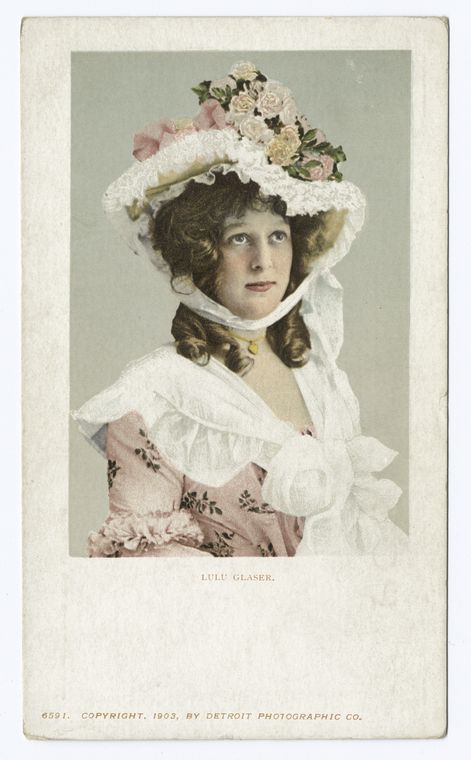
("Lulu Glaser." Courtesy of the New York Public Library.)

A similar picture appeared on the cover of The Billboard trade magazine in 1902.

The show toured the continent twice. A company was formed to present it in Britain as well. It also achieved its highest aspiration, a lengthy run in New York. In fact, it was staged in Herald Square, New York City, for the entire summer of 1902. This was no small feat since theatres normally closed between May and September. In the days before air conditioning, it was simply not feasible to pack hundreds of people into a dark and poorly ventilated auditorium for hours while the mercury ascended the thermometer to sweltering heights. (Nor was it healthy for the performers.) The Billboard (17 May 1902) noted that the theatre was specially modified for the occasion:

Eight big noiseless fans are being set in different parts of the house and a large hole is being cut in the top of the dome of the auditorium, in which is being placed a “suck fan,” through which the hot air will be removed. New summer costumes for the whole cast are promised for Decoration Day.
Of course, all good things must come to an end and Lulu Glaser left "Dolly Varden" after the 1903–04 season. The show ran for one more season with Maud Hollins, who was Miss Glaser's understudy (I think).

There the matter may have rested, and Guelph deprived of this musical spectacular, but for the intervention of the Aborn Operatic Company. Milton and Sargent Aborn were on the lookout for a vehicle for a potential star they had picked out, Miss Lillian Spencer. She had attracted their attention after graduating suddenly from the chorus to the lead in the musical comedy "Florodora" along with her subsequent work. They felt that she would be a good fit for the lead role in "Dolly Varden" and so purchased the rights to stage another run of the show.

("The Aborn Company presents Dolly Varden;" ca. 1906. Courtesy of the Library of Congress.)

They had good reason for this judgement. Although only 21 years old, Lillian Spencer had a long history in showbusiness, particularly in comedy. At the tender age of three years, she trod the boards with American-German actor Joseph "Fritz" Emmet. Mr. Emmet cut his teeth in the post Civil War era in a minstrel troupe, where his claim to fame was singing songs in German while in blackface. He graduated to ethnic comedy, speaking and singing in a stagey German accent while yodelling and performing spectacular dance numbers.

He was most noted for his roles in the character of "Fritz," a German who experienced misadventures in various locales, while singing, dancing, and playing the guitar. The first "Fritz" show involved the character's arrival in America, with later reditions set in Ireland, Australia, etc. The plot and details of each play made little sense but that was of no consequence: The audience always wanted the same dances, the "Cuckoo song," and whatnot.
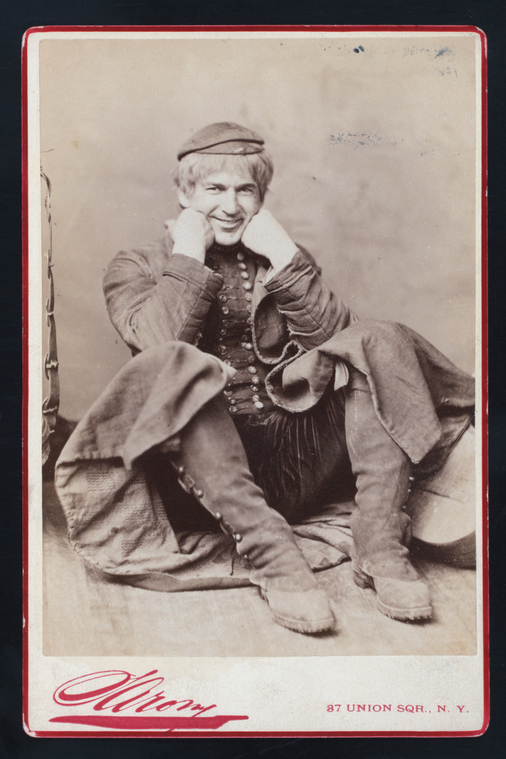
("Joseph K. Emmett in the stage production Fritz, Our Cousin German, 1869." Courtesy of the New York Public Library.)

Part of his act was interacting with children: searching for missing ones, singing them lullabies, and so on. So it was that a three-year-old Lillian Spencer tumbled out of a prop suitcase on stage in 1888, probably during a production of "Uncle Joe; or, Fritz in a Madhouse." Audiences took to the little waif immediately and she became a professional, child actor.

Why Lillian Spencer entered the theatre at such a young age is unclear. However, the 1900 US Census shows her living in a boarding house in Manhattan along with a Jessie Spencer, age 35, whose occupation is also listed as "actress." Her marital status is listed as divorced. Although records are sparse, it seems that Jessie was Lillian's mother and may have put her on stage as a way of earning a living while being a single mother, although that is speculation.

In her early career, she was often billed simply as "Baby Spencer" and made her way as an actor and a model (The Labor World, 1 Dec. 1906):

For a number of years, she played children’s parts, and at the same time, became noted as an artist’s model. Her piquant style of childish beauty made her much sought after for idealistic paintings, and her likeness was used by many famous artists.
It would be interesting to track down some of those images.

In any event, "Dolly Varden" returned to the rails for the 1906–07 season. It played in many of the same cities as the earlier runs, such as Toronto and Hamilton. However, although the show had been revised for its new rendition, some of the novelty had worn off and it played one-night stands in smaller cities that were bypassed in previous years. And so it was that "Dolly Varden" arrived in Guelph, where, as in many other small cities, advertisements that hung on streetcars carried with them Miss Lillian Spencer's hopes for a career as a mature performer.

(The Opera House Guelph—now the site of the Guelph Community Health Centre at Wyndham and Woolwich streets— printed by the Pugh Mfg. Co. of Toronto, ca. 1910.)

The Mercury did not review the show, so it is hard to say exactly what sort of reception it got. However, the publicity stills below, published in the Sep. 12 and 14 Chatham Daily Planet provide some idea of what audiences saw.

("Lillian Spencer with 'Dolly Varden.'" Miss Spencer appears to have a flower in her teeth and is covered in straw.)
("Lillian Spencer and Huntington May in 'Dolly Varden.'" Mr. May played Jack Fairfax.)

In lieu of a report from Guelph, this short review from the performance in Duluth, Minn. (26 Sep 1906) provides an idea of the show's reception:

“Dolly Varden” was very prettily produced at the Lyceum theater last evening. The production is worthy of its title of comic opera success. Its music is a delight, and the stage pictures and costumes are charming. When first in Duluth, with Lulu Glaser in the title role, it met with great public favor, and last night this success was repeated, although Miss Glaser is no longer with the company. For some reason or other the audience was a small one, but what there was of it was enthusiastically appreciative.
Lillian Spencer is the present Dolly Varden. She is a small, very active person, graceful and light of foot, with a piquant air and a contagious laugh. Her singing was well received, and her acting full of spirit. Her support was quite satisfactory.
Piquant to Miss Glaser's sprightly, it sounds as though Miss Spencer succeeded in putting her own impression on the role. We may assume that Guelphites gave it their approval also.

To my knowledge, Miss Spencer never returned to Guelph. Her encounter with the Royal City was fun but largely inconsequential to both. Even so, the incident is illustrative of the life of small cities of Ontario in the Edwardian era, and how they were connected to the larger world. In matters of popular entertainment, Guelphites relied on the theatrical circuits centered on the metropolises of the day, as also illustrated in the case of the play Officer 666. The entertainment world has changed substantially in the meantime but we may enjoy a glimpse back in time through media like old postcards, if we are willing to look for it.


Although "Dolly Varden" did not catapult Lillian Spencer to stardom, it does seem to have provided her with a lasting career separate from her early stint as Baby Spencer. She remained in New York and featured in many productions, although not usually as the star. In 1917, she joined the Charles Coburn company, which prompted the following review of her career up to that point (Sun, 27 Jan 1917):
A newcomer in the company now presenting “The yellow jacket” with Mr. and Mrs. Coburn at the Harris Theatre is Lillian Spencer, who plays the roles of Duc Jung Fah and See Quoc Fah (Fuchsia Flower and Four Season Flour). Miss Spencer’s interpretation of the role of the Second wife is a sprightly contribution to the performance and a somewhat intimate rendering of a part to which full justice has not heretofore been done. Miss Spencer may lay claim to the irregularly expressed but nevertheless clearly understood title of “natural born actress.” She has been on the stage since she was 5 years old. She was known as the youngest star in the theater when she appeared in the title role of “Dolly Varden” under the management of Milton Aborn. She has played important parts with Maude Adams in “What every woman knows,” “Chantacler” and “Jeanne d’Arc,” and although she never actually publicly appeared in place of Miss Adams, she was that eminent actress’s understudy and substituted for her at most of the rehearsals of these plays. Miss Spencer has appeared also in the support of Fritz Scheff, Blanche Ring and Julian Eltinge. More recently she enacted the role of the Lisping Girl in “The Girl who smiles” at the Longacre Theatre, and also impersonated one of the matrimonial chances offered to the hero of “Seven Chances” played originally at the Cohan Theatre.
The final record that I have found about her is a notice in Variety (17 Nov 1926) stating that she had a role in the Coburn production, "Ole Bill, M.P.".

If any reader has further information about her, please leave it in the comments below!


Pictures of Miss Lillian Spencer are not exactly common. Besides the publicity images shown above, there is a set of photographs taken in the 1910–1915 period by photographer Arnold Genthe, who was particulary known for his images of notable persons of the day. I will show a few here; the rest are accessible at the Library of Congress website.

A photo from Theatre Magazine (Jan 1918) shows Miss Lillian Spencer luxuriating in a Balch Price motor coat made of finest Australian opossum. She looks warm! Perhaps she continued to do modeling work in addition to acting.

Sunday, 31 August 2014

The origin of the Blacksmith Fountain

As noted in an earlier post, St. George's Square is the centre of some controversy. The Square is due for some infrastructure upgrades and, it is proposed, some reconfiguration. More specifically, one proposal calls for the establishment of a large island in its middle. The island would be the site of various attractions and events, as yet not specified.

In that earlier post, I summarized the history of the previous island in the square. That history began with the construction of the Blacksmith Fountain and its surrounding garden in 1885. Of course, that history leaves open an important question: How did the Blacksmith Fountain get there? That takes some explaining.

Here is another postcard in which the Fountain has center stage.


If you look closely at the edge of the grass right under the Fountain, you can see an old reel lawn mower. There also appears to be a young man relaxing behind a post at the left edge of the grass. Perhaps he is supposed to be pushing the mower.

This image is actually the same as the one in the earlier posting but not colourized. It was published by Warwick Bro’s & Rutter in Toronto and was posted 5 Dec. 1908. Curiously, the message reads:

How do you like these stone buildings? The P. O. [Post Office] is in the foreground. Am here at the Winter Fair. Your letter came safely and will answer soon. P. F. C.
In fact, the Fountain is in the foreground. The P.O. is in the background. Nevermind.

As with the current situation, the story of the Blacksmith Fountain begins with some infrastructure upgrades. In 1878, the Royal City began planning a water works, that is, a system of town-wide water distribution through pipes from a central reservoir, located upstream of the town on the Eramosa ("Guelph water supply", Gilbank 1969). By the end of 1880, some ten miles of pipe had been laid.

The aim of the effort was focussed on the provision of hydrants for fire control. Some 94 were positioned by the end of 1880. However, the townsfolk had further ambitions for the system. As Alderman Read put it in 1883, after the citizens had sunk thousands of dollars into the construction of the water works, they still could not get a drink (Guelph Mercury, 21 Aug. 1883). Already in 1880, people were thinking in terms of a fountain for St. George's Square (5 May 1880):

The suggestion had been made that a cheap drinking fountain for horses should be placed in the centre of St. George's Square. The city may contemplate placing a large fountain there at some future day...
No cheap fountain was put in place, that I am aware of. However, the idea for a grand installation seems to have stuck in people's minds.

So, the infrastructure was underground and the idea was in the air. However, the cash was lacking. That problem was addressed by the generosity of the city's leading men of industry. In the summer of 1883, the town council received a "liberal offer" from Mr. David McCrae (see photo here). McCrae, father of the famous John McCrae, was a farm owner and animal breeder, co-owner of the profitable Armstrong, McCrae & Co., a woolen clothing factory, and also captain of the Ontario Battery of the 1st Provisional Brigade of Field Artillery, formed in 1880 (Johnson 1977, p. 211). Mr. McCrae offered to pay the town one or even two years of his taxation exemption (think "tax refund") as a contribution towards some civic improvement (21 Aug. 1883). The council leaped at the chance and talk turned immediately to fountains. Alderman Read suggested four or five "not expensive" fountains might be placed around the town. Alderman Stevenson, however, was keen on something more dramatic:

Ald. Stevenson was in favor of having something grand–say an imposing fountain on St. George's Square, and the work to be commenced at once.
Alderman Laing suggested a park. However, Ald. Stevenson's idea carried the day and the council struck a Special Committee to pursue the matter.

By October, it became clear that the council did not have money enough for the imposing fountain it desired. It is not clear why. Either McCrae's donation was not sufficient, or perhaps they split it up amongst several projects. In any event, they began to look for additional sources of funding (2 Oct. 1883).

The Committee collected money by subscriptions throughout the fall and winter. In this way, they collected the substantial sum of $500 (8 Apr. 1884). However, the breakthrough came in May with the arrival of another generous donation from a well-to-do business man, Mr. J. B. Armstrong. Mr. Armstrong sent the following open letter to Mayor Caleb Chase, reprinted in the Mercury (6 May 1884):

To His Worship the Mayor and Corporation of the City of Guelph:
In reply to a wish by the Council toward erecting and fitting up a fountain on St. George's Square, I beg to say I should be pleased to present the city with a fountain according to the accompanying design, the other subscribers to furnish the base surrounding and fit it up. It will be about 12 or 14 feet high, the central figure representing Industry.
Mr. Hall has kindly furnished the accompanying sketch, and will furnish you any particulars you want.
Yours very truly,
J. B. Armstrong.
Too bad that the paper did not publish the sketch!

J. B. Armstrong (who seems always to be referred to as "J. B." instead of "John" or "James") is listed as a 33-year-old carriage maker in the 1871 census. The Industrial Number of the Mercury in 1908 states that the business was founded in 1834 and incorporated under the name J. B. Armstrong in 1876. Its addresses were 41, 43 & 45 Macdonnell St. Clearly, Mr. Armstrong was doing well.

Why he decided to contribute to the fountain in St. George's Square is not clear. Perhaps he was related to the Armstrong who was David McCrae's business partner and was persuaded to climb aboard the project. Perhaps, like Mr. McCrae, he was a civic booster with a desire to improve the city and make a splash. Perhaps he thought that a monument to industry was overdue. None of the material I have found makes the matter any clearer.

The City gratefully accepted the offer. The form and location of the fountain were now set. However, even with this generous donation, funds were a little short (20 May 1884). That is when the Guelph Amateur Dramatic Club entered the stage.

The Amateur Dramatic Club (ADC) was a group of drama enthusiasts who put on occasional performances in the city. Sometimes, they would donate their box office proceeds to worthy causes. The ADC had just put on a performance of a drama called "Meg's Diversion" and the farce "Done on both sides." The show was a sell-out and the ADC had decided to put on another performance with the proceeds going to the Fountain fund. The proposal, made in a letter to council by ADC President, Mr. E. F. B. Johnston, was immediately accepted (2 Jun. 1884). And so, Guelphites were treated to a repeat performance.

The plot of Meg's diversion is complex (30 May 1884). Meg is persuaded by her father Jeremy Crow to affect feelings for Jasper Pidgeon so that Jeremy can borrow money from Jasper to pay off his looming debts. The ruse works but is then exposed by Japser's older brother Roland. Roland then pursues Meg and wins her affections. However, Meg then discovers that Roland really loves her sister Cornelia and was merely toying with her for revenge. Cornelia, though, is promised to Ashley Merton, Esq. However, Ashley actually prefers Mrs. Netwell (who, I assume, is a widow) and so is relieved to give up his engagement to Cornelia who, then, is free to marry Roland. Jasper, meanwhile, renews his attentions to Meg, who finds that she loves him after all. Finally, Jasper discovers that he has made a fortune (it is not clear how), meaning that he and Meg can live happily ever after in spite of their devious relatives.

The performance was praised in the Mercury:

Miss [Lizzie] Mercer ["Meg"], always a favorite on such occasions, excelled herself... She was accurate throughout, and succeeded in bringing out the double character of a flirt and sincere lover very successfully. ... Mr. [E. F. B.] Johnston ["Jasper"] brought out effectually the value of the true heart and honest, manly character and bearing which belonged to the rough exterior of the carpenter.

The farce Done on both sides is less complex. Mr. Brownjohn visits the Whiffle family to woo Lydia Whiffle and invites himself to dinner. The Whiffles are perplexed because they are hard up and have nothing to eat. The situation is saved by the timely arrival of Mr. Pygmalion Phibbs who is a veterinary surgeon carrying a haunch of venison as a gift for the President of the Veterinary College. The Whiffles tell Phibbs that Brownjohn is the President, whereupon Brownjohn orders Phibbs to prepare the venison for the family dinner, much to Phibbs' dismay. Finally, the truth is revealed and everyone, ludicrously, is reconciled.

The audience seems to have enjoyed it. Perhaps the characters were parodies of local bigwigs.

The event raised around $40 or $50 towards the fountain, which was considered an appreciable sum (6 Jun. 1884). Perhaps it put the project over the top. Mr. J. B. Armstrong soon gave the contract for construction of the granite foundation to Mr. J. H. Hamilton (14 Jun. 1884), owner of a "Monumental Works" on Woolwich St. founded in 1871. The measurements for the statue's base were four feet square by eighteen inches high.

The Blacksmith Fountain was officially inaugurated on Queen Victoria's birthday in 1885. It is described in its historic designation as follows:

The statue of a blacksmith is cast in a metal alloy. Supporting the statue is an octagonal basin, held by a Rococo-style cast iron pedestal. The water spouts from the mouths of eight rams heads that decorate the basin's rim. The base is constructed of red-granite and bears the historic inscription, “Presented by J.B. Armstrong 1884”.
But the tale of the origin of the Blacksmith Fountain is not a tale of iron and granite. It is a tale of plumbing, industry, and amateur dramatics.

PS. The Blacksmith Fountain was removed from St. George's Square in 1922 so that the roadway could run through the middle of the Square. If the middle becomes an island again, should the old gentleman return as well? What would the Fountain Family say?

Monday, 26 August 2013

The Scotiabank Clock

The theme of civic clocks is continued in this post with some notes about the Scotiabank clock. The term "Scotiabank clock" may not be a familiar one, so let me set the scene a little.

I described earlier how the old Post Office got its clock installed in its tower, just in time for New Years in 1907. The new clock occupied a prominent place physically, three storeys above St. George's Square and also projecting out into the Square in front of the Post Office. Such a position was considered decorous because of the importance of time to civic life and of the importance of the Federal government in delineating it.

Some 53 years later, however, the old Post Office (or "Customs House", as it had become in the meantime) was demolished. The demolition was a controversial and emotional issue at the time, and a discussion of it can be found in Gilbert Stelter's "Buildings and Guelph's character" in Guelph: Perspectives on a century of change (pp. 196ff). For present purposes, what matters is that the destruction of this building in 1960 also meant the removal of the City's central timepiece.

It seems that the importance, practical or symbolic, of having a civic clock in St. George's Square was not lost on the designers of the new building. One of the first articles in the Mercury about the as-yet unnamed structure makes special note of a clock, among its other, more modern conveniences (26 Jan 1961):

St. George's Sq. to get new clock
... Eleavator service to all floors will be installed for general public and tenant convenience, and the building is to be completely air-conditioned.
... An item of interest to all citizens concerning the construction of the modern building is the fact that a clock will be installed on the face of the building where it can be conveniently seen by all.
Convenience, rather than decorum, was an important attribute of modernist architecture. So, if a clock were to make sense at all in the new building, it would have to be as a convenience.

Construction of the new building began in April, by which time it had become known that the main tenant would be the Bank of Nova Scotia (or Scotiabank). Again, the Mercury makes special note of the fact that the need for a clock has not been overlooked (5 April 1961):

... A clock will once again look down over the square, but as will be seen in the architect's sketch of the new building there is only one face. The city council, however, wish the clock to have two faces, the other on Wyndham St.
...
Almost everyone in Guelph must, from force of habit, have looked up to see the time on the old customs building clock in St. George's Sq. since the building was demolished late last year.
Although Guelphites would have their clock, they would still have to change their habits to find it, as the architect's sketch shows:


Whereas the Customs House clock was perched up above the main entrance in the center of the front elevation and projecting forward into space, the new clock would be between the first and second storeys, displaced to the side of the building, and flush with its surface. And just one face.

The building turned out follow the sketch closely, as can be seen in this postcard from about 1965:

(The postcard was made by the Mutual Wholesale Stationary Limited, London, Ont., and has no message written on it except for "7/19/69, Carol Ridler." Courtesy of John Parkyn.)

The convenience of this arrangement is easy to see. The clock face is close to the sidewalk, so that people need not crane their necks up or to the side to view it. Also, in minimalist, modernist fashion, the clock has no face and no numerals. Instead, in the manner of Aarne Jacobsen's "City Hall clock", it has lines to indicate the divisions of the hours. Less is more!

On Wednesday, November 15, the hands were set in motion for the first time (Mercury, 17 Nov. 1961, "Newest clock in operation"). The building itself officially opened the next Monday, November 20.

It is not clear how this clock was received by Guelphites who still looked up for the time in St. George's Square. However, Verne McIlwraith, a member of the newly-formed Guelph Historical Society, professed himself disappointed and suggested that the old Post Office clock should be kept in public view as an accoutrement to a building in Royal City Park, along with the old City Hall bell (22 Nov. 1961):

Suggests City Hall Bell located Royal City Park
...
Council also has the old clock that was removed from the original post office building when it was razed to be replaced by the disappointing new structure.
If desired it could be arranged so that the old clock could be housed in the same bell-tower on the Royal City Park building.
The proposed building never appeared. What become of the old clock, I do not know.

In the meantime, it seems that the people in Guelph got out of the habit of getting the time from the Scotiabank clock. It remained in place until quite recently, when it was covered up by new Scotiabank signage. Have a look at the face of the building in the Google Street View image:


View Larger Map

Notice how the orange Scotiabank sign that wraps around the building between the first and second storeys covers up the location of the clock. I believe that this new signage went up in 2006. In 2005, Scotiabank applied to the City of Guelph for a variance to put up a large new sign, to compete with the new signage on neighbouring banks. According to the City Council Meeting minutes (20 May 2005), the bank wanted to permit a "24.0 square metre first storey building sign and to permit a 18 square metre second storey building sign." The City refused. It appears that the bank went ahead later with the first storey sign, thus completing the removal of the civic clock from St. George's Square. No one appears to have noticed.

Of course, time has moved on. The correct time is just as important today as in yesteryear. However, people get it from other technologies, e.g., their cell phones. So, we look down, not up, for the local time, and our civic space reflects this fact.

Tuesday, 16 July 2013

The Post Office clock

In a posting about the City Hall clock, I noted how clocks in civic spaces—and on civic buildings—perform more than a time-keeping function. They also help the powers that be to assert their centrality to the civic order. Here, I want to explore the theme a little further by looking at the clock in Guelph's Old Post Office/Customs House in St. George's Square. Here is a nice view of the building, from a postcard that was first presented in this posting about Guelph after dark.


The postcard was printed by The Valentine & Sons' Publishing Co., Ltd. of Montreal and Toronto. The image appears to date from 1907, after the clock was installed but before the island around the Blacksmith Fountain was renovated in 1908. The image is appropriate, in part, because it gives a view of the Square from ground level, looking up at the central tower on the Post Office.

The importance of the clock's physical position is quite plain. It is made prominent in several ways. First of all, like the City Hall clock, it is situated high up on the building. This allows it to be seen from a distance and also to cast its cyclopean gaze over the space around it. Second, also like the City Hall clock, it is centrally located in an important public area. The City Hall clock looks out over the marketplace, whereas the Post Office clock looks out over St. George's Square, the place that had become the focus of town commerce at the time. Third, and unlike the City Hall clock, the Post Office clock projects forward from the face of the building. This projection enhances the visibility of the side faces of the clock, and asserts the importance of the clock in the life of the city into which it intrudes.

This arrangement is no accident. Part of the significance of federal government structures in the young Dominion was to make visible the presence of national institutions, and to underline their importance in the greater scheme of things. The ritual of sending and receiving mail there helped to integrate the federal government into daily life. Also, use of the clock to synchronize watches amongst the townsfolk helped to reinforce the power of the government to regulate the conduct of affairs.

Beyond the symbolic importance of the clock is the interesting story of its arrival. The old Post Office had been enlarged with a third storey in 1903 (more on that another time) and blank faces had been left in the tower top to accommodate a clock at a later time. As Marc Boileau notes in "Towers of time" (2006), this procedure was not uncommon. Perhaps it helped to reduce the factor of sticker shock if the new building (or renovation, in this case) could be constructed a piece at a time. In some cases, the clock never arrived and the empty, round windows where its faces would be continued to stare blankly out over the streets.

However, three years after the raising of the roof, the Post Office received its new timepiece. In fact, the story of its arrival and installation is well told in the Guelph Evening Mercury's "Local News" columns, which I will excerpt below:

Nov. 16, 1906: New Clock Here.

The new clock for the post office tower has arrived, via C.P.R., and been cleared from the customs by Mr. W. A. Clark. The new time piece is of Boston manufacture, an eight-day Howard clock, and will have dials illuminated by electricity. A 1,500 lb. bell will be part of the equipment. The clock will be put into position as soon as the representative of the makers arrives to superintend the operation.
The maker must have been E. Howard & Co., a Boston watch and clock maker that had exported many tower clocks to Canada for similar sites over the years. The clock was a single mechanism that drove several dials via electric or pneumatic means. Probably, this model was electric.

There is no record I can find of the model of clock or its cost. The "Sessional Papers of the Dominion of Canada, 1906–7" has a line item for "Guelph Public Building—addition, improvements, furniture, etc." in the amount of $5,122.91. There is no line item for a "tower clock" for Guelph in any federal records for that year that I can find. However, line items for "tower clock" for other towns in that period vary in $750–$2,000 range. So, the $5,122.91 for Guelph must include other renovations.

The arrival of the new clock excited some admiration and expectations of its immediate installation:

Nov. 24, 1906: Installing The New Clock.

The representative of the Howard Clock Co., the makers of the new post office clock, has arrived and the work of installation commenced this morning. The huge bell weighing 1,500 lbs. is being hoisted into place this afternoon, and the work will probably be completed by the middle of next week.
The weight of the bell gets notice again. It should be quite audible, once it is working!

Expectations for a speedy installation were frustrated, however. About two weeks later, the following piece appears:

Dec. 6, 1906: What Time Is It?

The above query was heard frequently on the streets this morning. The reason is simple. The town clock discontinued operations at 8.22. It no doubt has made a gallant effort to stay in the business until the post office clock was ready, but has grown weary of waiting for the hands to appear.
It seems that part of the excitement about the arrival of the Post Office clock may have been relief over the imminent breakdown of the City Hall clock. At this point, the city finds itself without an official timepiece. In its absence, people are not sure what the time is.

The next item identifies the snafu that has thrown a wrench into the installation of the new clock:

Dec. 11, 1906: The P. O. Clock

Mr. W. A. Clark had hoped to have the P. O. [Post Office] Clock in full working order for the Winter Fair week, but the central part of the dials have gone astray in course of transportation. Although tracers have been out for several days, the efforts to locate them so far have proved unsuccessful. Should they not be found, it will take three months to replace them with new ones. The works are going, the bell strikes, and the outer portion of the dials is illuminated at night. The clock, when complete, will prove a great public convenience, and will look swell. The pity is that an unfortunate miscarriage of a portion of it will prevent its completion at this particular time.
The fact that the faces are illuminated is interesting. So far as I am aware, the City Hall clock did not have this feature. It also suggests that the clock was designed to run each face through an electrical circuit (as opposed to pneumatic control). The illumination of the clock faces also suggests how the night life of the city was changing, thanks to electric lighting. As noted in an earlier post, electric street lighting allowed decent folk to be abroad at night. Presumably, they would like to know the official time while out about their business.

The good people of Guelph did not have to wait three months to see their new clock tell time, however. Replacements for the missing dials arrived forthwith:

Dec. 29, 1906: Those Missing Dials

Mr. W. A. Clark recently ordered another set of dials for the post office clock; they were shipped some time ago, and which have been expected to arrive for some days past. Mr. Clark had hoped to have them put in to be able to start the clock the beginning of the New Year, but it would now seem that this will be impossible; however, if the dials arrive today an effort will be made to have the put in on Monday.
Now the suspense builds! Will the new dials arrive in time to bring in the New Year?

Unfortunately, the New Year's issue of the Mercury is not on record. However, it does appear that the clock was (almost) completely functional a week later:

Jan. 8, 1907: Town Clock Celebrates

At the hour of midnight last night the town clock, after clanging the requisite dozen peals, instead of stopping and commencing the new day like a respectable clock, kept on ringing for about five minutes. The care-taker says that it must have “slipped a cog,” but it is quite possible that it could not resist the opportunity to celebrate the election of Mayor Newstead by a majority which was doubtless the greatest of any election since it was installed.
The Mayoral race took place at the beginning of each year. There is no more mention of the dials, from which I infer that they were installed and thus no longer newsworthy.

The Post Office/Customs Building clock continued to tell Guelphites the official time for over 50 years.

The message written on the back of this postcard also relates to January in Guelph, although from a few years later:

Am spending the day in this town, a very small place about one hundred miles from Toronto. I hope to finish my business in Canada by January 17th. Am very anxious to get back[.] it[']s just a little too cold for me in these parts. Best regards from Sincerely Frank Kiosny (??)
The postmark bears the date of Jan. 12, 1910. His letter was addressed to Miss A. Zimmermann of 199 6th Ave. in Brooklyn, N.Y. Was she his sweetheart? At least Frank could count the hours until his warm reception in Brooklyn, day or night, by the new town clock.

More on Guelph's civic clocks to come...

Tuesday, 19 March 2013

Guelph after dark

This postcard is an unusual one.  Normally, postcards are based on photos of outdoor, daytime scenes.  Except in small spaces, there were few practical ways of illuminating a large, outdoor space in order to take a photograph.  However, this postcard is clearly set after dark.


The postcard was published by Valentine & Sons' Publishing Company of Dundee, Scotland, and was printed in Great Britain.  There is no writing or post mark on the back.  The text in the upper right corner says "Post Office & Wyndham St., Guelph, Ont."  In the lower right corner is the text "102,147 (JV)", perhaps a serial number from the publisher.

Probably, you recognize this scene as St. George's Square, which was introduced in a previous posting.    Recall from that posting that the "Old Post Office" (as it was later known) had a clock installed in its tower in November, 1906.  Since the clock is missing in the picture above, it should be from before then. It also happens that the Old Post Office received its third floor in 1902 (Coulman 1977, n. 147).  So, the photo in the postcard appears to show St. George's Square as it was in about 1905.

Set at nighttime, the picture is of special interest for a number of reasons.  For one, it emphasizes the importance of street lighting to the city.  Note the tall pole in the middle of the image, standing beside the island, to the left of the "Blacksmith fountain".  At the top of the pole is a crossbar from which two lamps are hanging.  Those lamps seem to be radiating a cool, blue light into the warm, dark air above the Square.

In fact, those lamps are arc lights.  Each lamp consists of two small carbon rods separated by a gap.  Light is produced by passing a spark across the gap at high voltage.  Although it is hard to tell from this picture, the lights are suspended from the cross bar by block-and-tackle set that can be accessed near the base of the pole.  That is a good thing as the carbon burns out quickly and must be frequently replaced.  The City would have had some employees whose job it was to maintain the lights.  They would go from pole to pole on a schedule, hauling a cart carrying supplies.  At each post, the employee would loosen the rope from its cleat, lower the lamps, and assess the carbon rods in them, replacing them as required.

David Allan (1939, p. 64) notes that the arc light system first appeared in Guelph on January 11th of 1888, replacing the previous lighting system based on coal gas.  In her book "The history of the Board of Light and Heat Commissioners of the City of Guelph" (2001, p. 10), Elizabeth Thomson notes that the arc lights were themselves replaced in 1912 by a system based on incandescent bulbs.

Beyond these technological changes, the presence of night lighting had some profound effects on how people used the streets.  For example, it changed the night life of the city.  As Paul Moore (2004) explains, city streets were associated with poverty, prostitution, and other unsavoury things, at least after dark.  The advent of street lighting allowed the nighttime streets to be rehabilitated for respectable, middle-class activities such as shopping and movie-going.

Of course, the opening up of city night life did have some unintended and unwelcome (to some) consequences, as becomes clear in this November 30, 1912 Toronto Star article, entitled "Guelph Young People Must Keep off the Streets":
A meeting of the Police Commissioners was held Saturday to consider drafting a by-law to prohibit young people from promenading up and down the streets of the city and in the public parks at all hours of the evening until late at night unless they have with them a chaperon.
Mayor [George] Thorp, one member of the Commission, states that some stringent means must be taken to prevent promiscuous promenading in the city for hours at night, as conditions here during the past year have been shocking.
Why not just turn off the lights?

Thorp's dismay highlights the general anxiety over regulation of night life in the era of street lighting.  With "stringent" control, perhaps with the aid of police, street lights would permit city night life to take on a safe and respectable, middle-class character.

Also, I am intrigued by a comment that David Allan makes about the character of the light shed by the arc lighting of the streets, based on the fact that they are suspended from a pole (1939, p. 64):
The light swayed back and forth with the wind and produced deep, shifting shadows.
Imagine walking through St. George's Square or down one of other old city streets at night with the lamps swaying back and forth in the breeze!

Unfortunately, there is no evidence of this dramatic lighting in the postcard.  Although the moon appears to be casting shadows, the street lights do not.  In fact, this observation suggests that this postcard is not quite what it appears to be: Why is the moon casting shadows but not the street lighting?  The answer is that this postcard scene is taken from a daytime photo of the Square, not one taken at night!  Have a look at the following postcard:


Look familiar?  In fact, this treatment of daylight images is not so unusual.  The trope involved taking a daylight image, darkening the sky and scenery, adding a moon wreathed in wispy clouds, then making other corrections, such as erasing a lady's parasol in this case.  Fiendishly, the colourizer has also erased the town clock, which is clearly visible in the daylight image.  In fact, this picture must date from after November 1906, when the clock in the Old Post Office was installed, but before the island in the middle of the Square was turned into an oval shape later in 1908.

Here is the scene today in Google Streetview:


Although the central island is long gone, the street light at the corner of Quebec and Wyndham streets, near the center middle-ground, is near to the location of the old arc lamp pole.  How many of the City's youth have promiscuously promenaded beneath it, I wonder?

Tuesday, 26 February 2013

St. George's Square

This panoramic postcard depicts the epicenter of downtown Guelph, namely St. George's Square, looking north.  The street to the left is Upper Wyndham St., whereas the street on the right is Douglas Street.


This postcard is an unusual one because it is, so far, the only double postcard in my collection.  That is, it is the width of two standard postcards.  If you look in the middle of the card, you can see a crease where it is designed to be folded in half, with the picture on the inside.  I suppose this arrangement makes sense since it leaves the destination address visible outside to the mail handlers.

The card was printed by the Warwick Bro's & Rutter of Toronto, which we have seen before.  The card was not sent or postmarked, so the date of production is unclear.  However, the scene itself can be dated by clues from the structures depicted in it.

For example, note the tower of the "Old Post Office" in the center of the picture.  In A Picture History of Guelph (p. 56), Robert Stewart notes that the clock was installed in the tower in 1906.  Since the tower is shown with its clock, it cannot be older that that.

Notice also that the streetcars in the picture are diverted around the fountain and plantings in the octagonal island in the middle of the Square.  (The fountain was known as "Blacksmith Fountain" and has since been moved to another location.)  A photo from the Guelph Public Library database, taken of the Guelph "Old Boys Reunion" in 1908, shows that the island had been replanted strictly with grass and restructured into an oval shape, with its long axis aligned with Wyndham St.  So, the postcard, with its octagonal island, cannot be newer than that.

Therefore, let's say that the photo in the postcard was taken ca. 1907.

One of the most basic questions about St. George's Square is, "How did it get that name?"  In the postcard, if you look down Douglas Street to the right of the Old Post Office, you can see the spire of St. George's Anglican Church reaching upwards at the end of the block.  In fact, St. George's Church was originally located in the middle of the Square, right about where the Fountain later stood.  As noted in the History of St. George's Parish (p. 3), John Galt, the founder of Guelph, had "set aside for the Anglicans a plot of rising ground where they might build their church."  The first St. George's was a frame building, followed by a stone structure on the same site.  However, a third and perhaps more convenient St. George's Church was built from 1870 on Woolwich St., at the end of Douglas.  This move allowed the creation of St. George's Square, a generous public space in the middle of the city, named in honour of the structure that made way for it.

St. George's Square remains the middle of downtown Guelph, although its configuration and environment have been profoundly altered, as the current Google Streetview image shows:


View Larger Map

There are plenty more views of St. George's Square, so we shall return!