Showing posts with label Central School. Show all posts

Saturday, 9 December 2023

An International Stationery Co. tour of Guelph

Yours truly recently gave a talk at a meeting of the Kitchener-Waterloo-Cambridge-Regional-Post-Card Club (KWCRPCC). This was the Club's first meeting since the arrival of the COVID pandemic, so it was an honour to help the group resume operations after a long hiatus.

The venue was the historic First Church of Christ, Scientist in Kitchener. As it happens, the church itself features in some old postcards, such as the following:
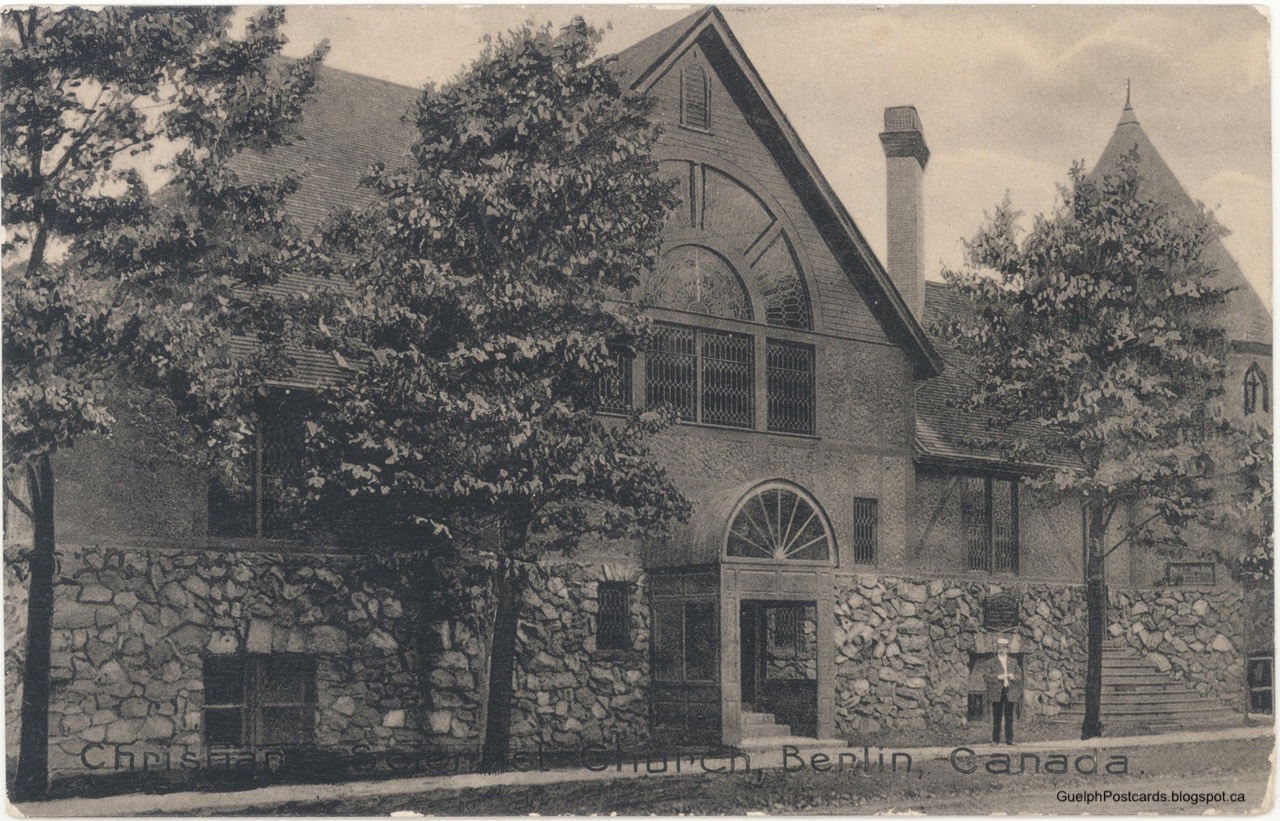
("Christian Scientist Church, Berlin, Canada," ca. 1909. Courtesy of Leigh Hogg.)

(First Church Christ, Scientist; courtesy of Google Maps.)

The subject of the talk was the postcard views of Guelph as provided by the International Stationery Co. (ISC) of Picton, Ontario. In this post, I will give a precis of the talk and show some of the images. The point of the presentation is not to give a history of places shown but to give an impression of the aesthetic quality of the individual postcards as pictures and of the whole set as a curated show of the Royal City as it then existed.

Among Canadian deltiologists, that is, postcard collectors, the ISC is known for its set of fine sepia-toned collotype postcards from the early 20th century. Consider the example below.

("Collegiate," #130.)

This is the predecessor of the current Guelph Collegiate and Vocational Institute, shown from near the corner of Paisley and Arnold streets. For inventory purposes, ISC numbered their cards; this card is number 130. The photo is nicely layered, with paths leading from the foreground into the image, where people can be seen walking under the trees and in front of the pointy buildings. Clouds billow upwards in the sky, drawn there by arists in Germany, where the cards were printed. As will become evident, this composition is typical for cards of Guelph from this set.

The history of the ISC goes back to "The Fair", a kitchen supply and grocery store located in Picton and founded by local boy James Livingstone (1868–1949) in 1895. The Fair was successful and expanded into new locations and goods. As the postcard craze took hold in the Edwardian era, Livingstone got into the act. Postcards turned into a big business for the ISC, which specialized in views from southern Ontario and the Montreal area. It carried on for some decades and left an interesting legacy of topical views.

To judge from postmarks, postcards of Guelph began circulation in 1913 and persisted into the early 1920s. Serial numbers range from 100 to 199, suggesting that there are about 100 views of Guelph in the set—quite a few! ISC expert Ian Robertson reports about 900 cards total in his collection, so the Royal City seems to have enjoyed attention disporportionate to its modest size. What was the charm?

The ISC set includes views of the usual suspects, such as the card below of the Carnegie Public Library. Designed by local boy William Frye-Colwill and erected in 1905, the building was a regular part of postcard sets of Guelph. Images were almost always taken from diagnoally across Norfolk street, which produces this dramatic angle. Even so, the photo appears to have been taken especially for the ISC.

("Carnegie Public Library," no number.)

The Winter Fair Building is another fine card. The building was located on Carden street, in front of the new City Hall, where the splash pad/outdoor rink is now located. It was built to house the agricultural fairs that used to be held downtown. The corner of the old City Hall, now a Provincial Court House, can be seen on the left. As usual, the scene is animated by figures walking hither and thither.
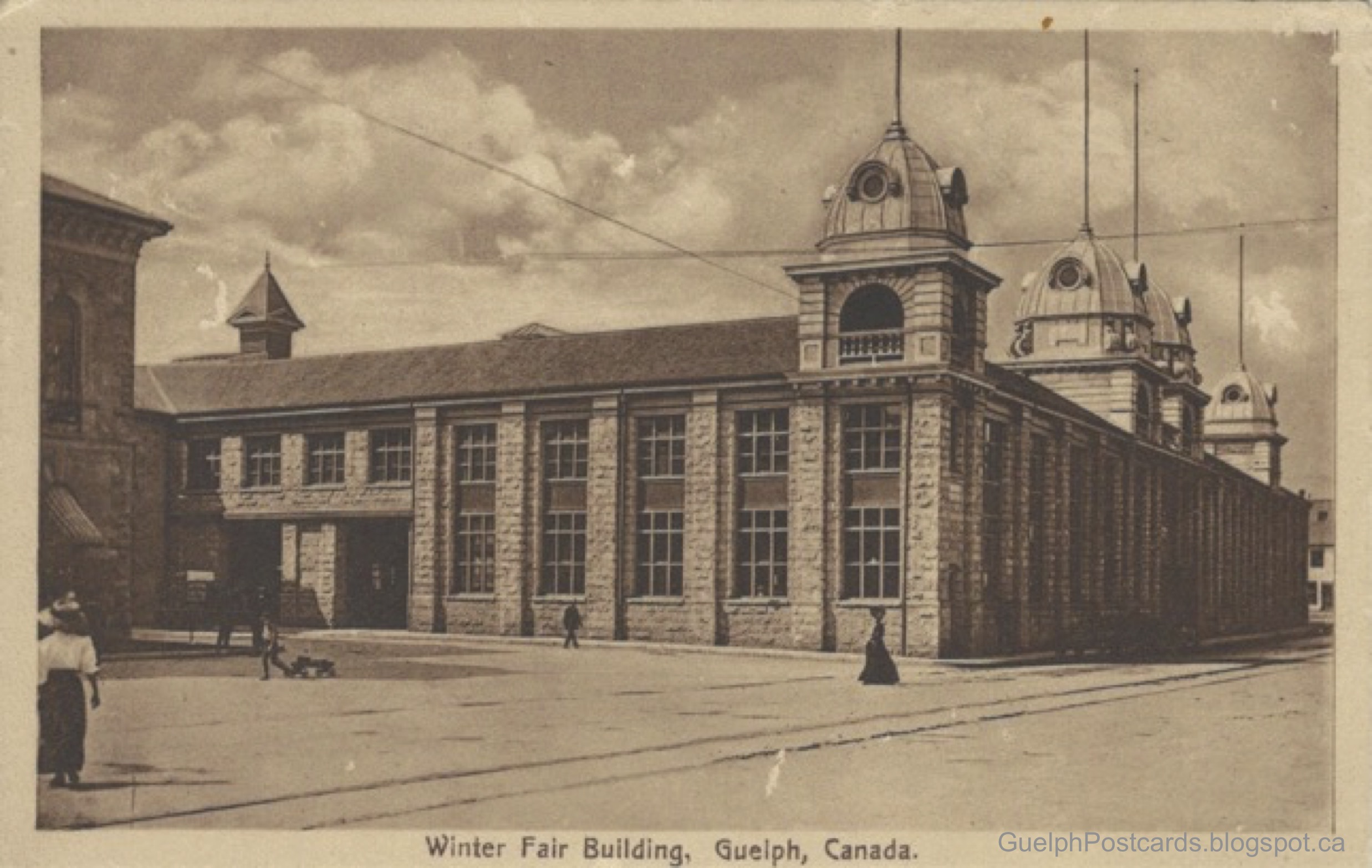
("Winter Fair Building," #110.)

Another good, downtown view is the end of the Bell Piano & Organ factory, seen from the old Grand Trunk train station, today the city bus depot downtown. The photo gives a good impression of the bulk of the building, which was meant to dominate the old market square and train station. Beneath the near facade is the street sprayer, a wagon drawn by two horses and carrying a big barrel of water that was sprayed onto the dirt streets in the summer in order to keep the dust down. To the upper left is the clock tower, perhaps the oldest illuminated clock dial in Canada. Alas, the building burned to the ground in 1945 and the site is now a parking lot for the Royal Inn and Suites.

("Bell Piano and Organ Co.," #122.)

Another interesting view is the one below of the side of the Ontario Reformatory, popularly known in the day as the "Prison farm." The view was taken from the bluff at the back of what used to be the Turfgrass Institute. In the foreground is the Guelph Junction Railway while the three-span concrete bridge over the Eramosa River lies in the middle ground. The bridge was built from limestone from the on-site quarry and using prison labour. The prison buildings themselves lie in the background, making this card one of the few showing the Reformatory that do not feature the buildings themselves up close.

("Prison Farm," #178.)

One of the features of the ISC cards is that there are sometimes multiple views of a given building or site. Such collections of views can provide an impression of a place that would not be possible with a single image—and also would help to sell multiple cards!

One such set in Guelph is of the old Central School. The school lies along the shoulder of the drumlin that is topped by the Church of Our Lady, just one block away. With its prominent site and tall belfry, the old Central School seems to have been intended to leave a strong visual impression on anyone looking around from the downtown, and competing for visual profile with the neighbouring church. The old Central School was demolished in the 1960s and replaced by the current, one-storey structure.

("Central School," #173, looking along what is now Commercial street from Norfolk street.)

("Central School," no number, looking from Cambridge street across Dublin street—the opposite facade to the one above.)

("Guelph Model School," #142, seen from the south along Cambridge street.)

It was certainly an imposing structure!

Naturally, many of the ISC cards feature sites on the Ontario Agricultural College (OAC), now the site of the University of Guelph. For present purposes, I will feature views of Massey Hall & Library. The story has it that OAC President James Mills happened upon Walter Massey, head of the farm implement giant, on a Toronto streetcar and persuaded him to fund construction of a campus library. Thus did this charming structure come into being!

As with many ISC images, the main entrance of Massey Hall & Library can be seen behind a number of trees and elegantly-dressed ladies walking the path from the OAC garden.

("Massey Hall and Library, O.A.C.," #176.)

Below is a view of the Hall from the reverse angle, looking along the entry lane from what is now Gordon street. The MacLaghlan Building is more in the foreground on the right, with the Main Building (where Johnston Hall now stands) behind on the left.

("Massey Hall and Library, O.A.C.," #108.)

The third card with the same caption returns us to the uphill side of the Hall but further down what is now "Winegard Walk". Here, it appears that some sort of open-air lecture is underway, with the audience sitting in rapt attention on the bank of the College reservoir. No photographer on the OAC campus could resist the reflections afforded by this artificial pool!

("Massey Hall and Library, O.A.C.," #173.)

The University of Guelph has produced the following short video relating the story of the Hall:

One of the real treats contained in the ISC set of Guelph are the many pictures from Old Home Week, 1913. Old Home Week, also known as the Old Boys' Reunion, was a city-wide party for residents and former residents. The first installment was the Old Home Week 1908, the second was the Old Home Week 1913, while the third occurred in the Royal City's centennial year, 1927. ISC postcards of the 1913 event are the only images of that installment that I am aware of. The cards are characterized by decorated buildings, people milling about, parades, and events in Exhibition Park. A few selected images will give an appropriate impression.

This card shows a crowd of well-heeled ladies and gentlemen disembarking from a train at the CPR station and making their way through Trafalgar Square towards the downtown. A small omnibus waits by the station's front entrace. It is labelled, "Hotel New Wellington." The actual Hotel New Wellington was only a stone's throw away but the omnibus may have been handy for passengers who arrived with a lot of luggage. The site is today the location of the Trafalgar Square apartments on Cardigan street.

("C.P.R. Station," #136.)

The Grand Trunk railway station (now the VIA station) was also the entry/departure point for many participants in the Old Home Week. In the card below, a train can be seen in the background while people mill about the entrance and the intersection of Wyndham and Carden streets in the foreground. At the front entrance to the station can, once again, be seen the Hotel New Wellington Omnibus. Those must have been busy days for the bus driver! Also doing a good business was the city's peanut vendor, whose cart, I believe, is the focus of attention on the street corner in the centre of the image. Bags of roasted peanuts were a common street snack in those days, and passengers probably arrived with an appetite, not to mention money in their pockets.

("G.T.R. Station," #190.)

The actual Hotel New Wellington itself is featured in the card below. It is suitably dressed up for the occasion. In the foreground is a sandwich board and overhead sign for the Bogardus Pharmacy, which had a storefront facing the corner of Wyndham and Woolwich street in those days.

("Hotel New Wellington," #139.)

There are also many scenes of parades in the set. I include the one below, looking up Wyndham street towards St. George's Square, because the caption actually names the event shown in the image, instead of referring to the places or buildings in the background.

("Old Boy's Home Week at Guelph," #111.)

A number of pictures show crowds in Exhibition Park but the one below is the best (at least of those that I know of at present). At the right is the grandstand, roughly where Hastings Stadium is now, overlooking the track where many racing events and parades were held. To the left are many cars, which were parked in the park for the day. In the background were some of the Exhibition buildings, including the unusual octagonal barn.

("Exhibition Grounds," #127.)

For a final Old Home Week card, I cannot resist one of my Guelph favourites, which shows a woman guiding what I suppose are her young daughters across Woolwich street towards the Hotel New Wellington. Nice outfits! Also, the picture features an interesting composition, with the three figures in the foreground on the right of centre that balance out the dramatic fall and rise of Eramosa road in the background to the left of centre. Very deliberate photography!

("Eramora [sic] Road," #121.)

I will finish by giving a few examples of characteristic street scenes. One of the quirks of the ISC set of Guelph is the photographer's affection for scenes with people walking towards or (more often) away from the camera.

The example below is a card of two gentlemen in fashionable straw boaters striding up Delhi street, which the viewer can see was a dirt road at the time. Their retirement into the middle layer of the composition animates the picture in away that a simple picture of the sidewalk could not.

("Delhi St.," #181)

The locations seems to be near the intersection with Eramosa Road, with the house at address 34 Delhi in view at the left margin. Compare with the Street View image below.

(Delhi street, June 2016; courtesy Google Street View.)

The scene below is Waterloo Avenue, with a woman walking down the sidewalk away from the camera, while a horse & wagon and a streetcar move along the street. Judging from the shadows, the view is looking eastward along the north side of the avenue. It is hard to say which crossroad is in the foreground.

("Waterloo Ave.," #115.)

The penultimate view is of Woolwich street, the main thoroughfare leading north-west out of town. Two well-dressed ladies approach the camera along the sidewalk. A man on horseback rides down the street on the other side.

("Woolwich Street," #145.)

It is difficult to be sure but my sense is that this picture is set just north of the First Baptist Church, looking towards the intersection with London Road in the distance. In that case, the intersection on the left side of the picture is Edwin street. Compare with the Street View image below.

To conclude the tour, have a look at the image below. It shows two ladies and a young man—well turned out, of course—walking across the second Heffernan street footbridge towards Queen street. It seems a fitting image on which to finish.

("Foot bridge," # not known. Courtesy of Guelph Civic Museums, 2004.32.61.)

(As you may have guessed, I do not have a copy of this card in my collection—yet. For the postcard collector, there is always hope.)

Of course, there are many more excellent views in the ISC tour of the burgeois Royal City of 1913. The images are impressively composed and curated and form an appealing tour of the town, all the more poignant as it was, unknowingly, on the verge of the precipice of the Great War, which would change it profoundly.


Works consulted include:
  • Ian Robertson and Barb Henderson (2016) “The International Stationery Company of Picton, Ont.” Card Talk v. 37, n. 2.)

Sunday, 26 September 2021

Before they had pictures: Wm. Stevenson gets one of Guelph's earliest postcards

When you think "postcard," you likely of a small paper rectangle with a picture on one side and some writing and maybe a stamp on the other. This postcard form has been almost ubiquitous since about 1900 and remains so today. Yet, the first postcards were in circulation decades earlier and did not usually feature pictures at all, apart from a small portrait of the Queen.

What might be called the "pre-history" of the postcard was recently outlined by Andrew Cunningham in Cardtalk (2021, v. 42, n. 2) the newsletter of the Toronto Postcard Club (of which I am a member). He explains that the idea of postcards as a specific and regulated piece of mail was introduced in Austria in 1869. Postcards could be sent through the mail just like letters but at a lesser rate (often half-price), the downside being that they could convey only short messages and afforded less privacy than regular mail.

The idea proved immediately popular and was soon copied elsewhere. In 1871, the Canadian government adopted rules allowing postcards in domestic mail. As abroad, "post cards" or "postals" were soon adopted by Canadians. Unlike later practice, postcards were then used chiefly for business correspondence, to request prices of goods or acknowledge receipt of payments, for example.

Here is an example of this type of card, sent to "Wm. Stephenson Esq." of Guelph on 25 Sep. 1872:

A brief inspection reveals that this item was indeed a novel form of mail, since it has strict instructions printed on it: "The address only to be written on this side." No chit-chat here! In place of a stamp, it has a portrait of Queen Victoria printed in the upper-right corner. This portrait assured the post office that the fee for mailing the card—one cent—had indeed been paid as part of the purchase price of the card. Since the right to print this "stamp" lay solely with the government, they were the only printers of these cards. Some very small type at the bottom of the card reveals that the printer contracted for the job was the "British American Bank Note Co., Montreal & Ottawa."

The back of the card could hardly be plainer: It was a complete blank—write whatever you like. This may sound potentially exciting but most messages are disappointinly uninspired. Here is the back of the card sent to the Mr. Stephenson:

The message says:
Deeds to you & Fleming duly executed. When will you & he be in to complete the purchase. W.M. Merrit // Sept. 25/72
Short and to the point—businesslike. Indeed, the point of the card is apparently to further a real estate transaction. Let's see who was in on the deal.

Mr. Wm. M. Merritt was a Guelph lawyer. He studied law in Toronto and was called to the bar in 1868, at which point he took up practice in Guelph in the firm Dunbar & Merritt (Globe, 1 Apr 1898). He specialized in commercial law, so handling the deed in a real estate transaction was right up his alley. So, it appears that this postcard was sent from a Guelph address to another one—a short trip!

The year after he sent this postcard, Mr. Merritt moved back to Toronto, where he remained for the rest of his life. Even so, Guelph seems to have made an impression. He returned briefly in 1876 to marry local girl Miss Elizabeth Robertson, in what the Mercury (23 Feb) described as a notably fashionable wedding.

The "Fleming" mentioned in the postcard was likely Mr. George Fleming, a recently retired farmer. Mr. Fleming was an early settler of Guelph, having emigrated from Paisley, Scotland around 1836, when the former was still mostly a set of modest, log buildings (Mercury, 6 Dec 1876). For 32 years, he farmed a 100-acre lot a short distance east of town and then relocated to a residence on Berlin st. (now Foster Ave.) upon retirement.

It seems that shortly after his arrival, Mr. Fleming was the victim of disrobement (Mercury, 12 Aug 1868):

Guelph Police Court.
…
James Fitzgerald was charged with the theft of a shirt from Geo. Fleming. He took it off the clothes line and put it on, and when the Chief Constable caught him he became pugnacious. At first we was for having the case tried at the County Court, but after the witnesses were examined he thought better of it, pleaded guilty, and consented to its being disposed of summarily. He was sent to gaol for a month at hard labour.
Perhaps this incident could be taken as a compliment to Mr. Fleming's good taste in shirts.

The recipient of the postcard was Mr. Wm. Stevenson, an important figure in Guelph's early days. Mr. Stevenson was born in 1817 near Thrumpton Hall, Nottinghamshire and immigrated to Guelph at the age of 20, at about the same time as Mr. Fleming. In religion, he was an active Methodist. He and James Hough were the prime movers behind the organization of the Norfolk Street Methodist Church in 1836, and he served as a preacher there from 1841.

(Norfolk Methodist Church, Guelph, ca. 1910., printed by the International Stationary Co.)

Wm. Stevenson took quite an active part in the governance of the city. He was a Town Councilor in 1851 when Guelph became an incorporated town, separate from the surrounding township. He also served as town alderman (Councilor) in 1854, 1872, 1879, and 1880–1884. In 1885 and 1886, he was Mayor of the Royal City. One of his accomplishments in that time was organizing the Guelph Junction Railway, which connected the city with the Canadian Pacific Railway, thus providing some competition with the Grand Trunk Railway. While this connection helped the commercial interests of the city, its adoption of the Priory as a station set that building on the road to ruin, an outcome that Mr. Stevenson certainly did not anticipate nor would have approved.

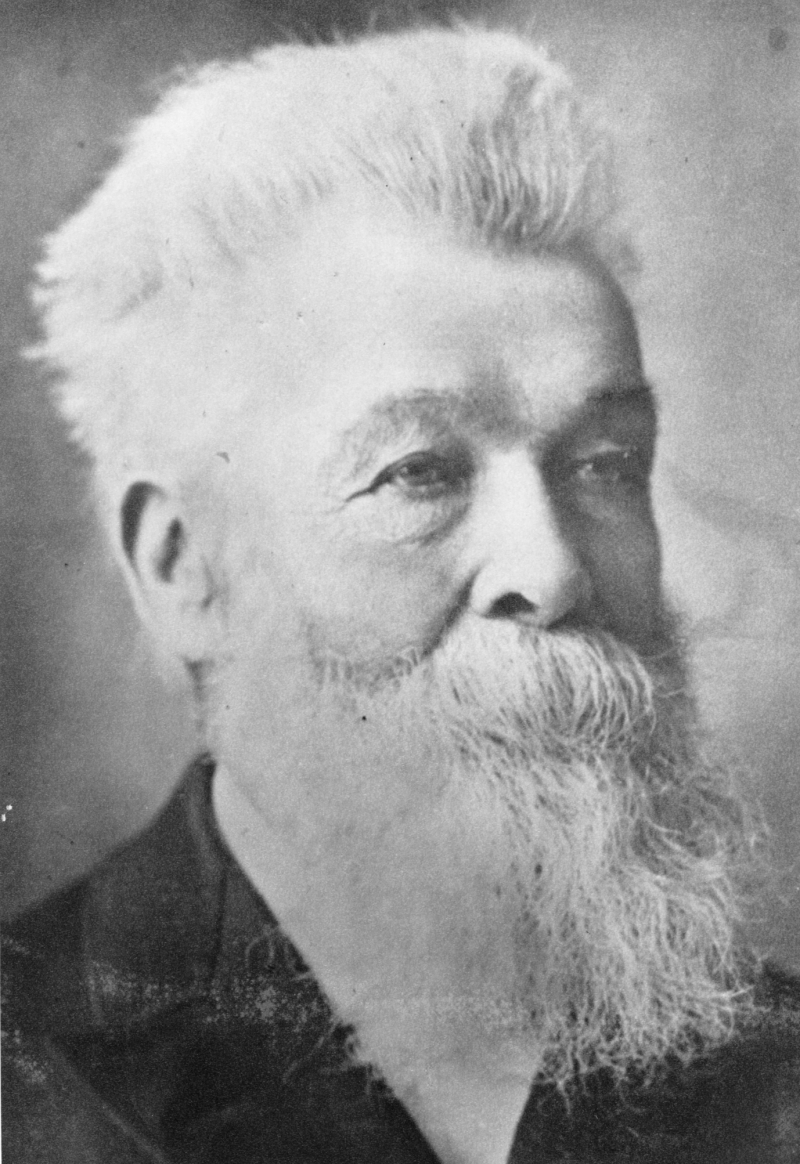
("William Stevenson," perhaps at the time he served as Mayor; Courtesy of Guelph Public Library Archives, F38-0-4-0-0-4.)

Apparently a fan of reading and education, Mr. Stevenson also served on the Board of Education and took an active part in the founding of the Central School which competed with the Church of Our Lady for attention on Guelph's downtown skyline from 1876 until its replacement with a more modest structure in 1968.

("Central School, Guelph," printed by A.L:. Merrill, Toronto, ca. 1910.)

Did I mention that Mr. Stevenson had a day job? He was a "nurseryman," that is, he grew and provided plants and trees to order. An ad from the Mercury (13 May 1874) gives an idea of what was on offer:

In 1872, when the postcard above was sent, Mr. Stevenson made a number of entries in Guelph's Central Exhibition, which was his usual practice. The Mercury (4 Oct) records that he won prizes in a number of categories, including Gravenstein apples, pears (variety and Bartlett), grapes (Adirondac, "ereveling," Hartford), and melons (scarlet flesh), not to mention his first prize showing in floral design.

All of this work was carried out at his ample residence of "Maple Bank," at the corner of Grange and what is now Stevenson Street (yes, named after Wm. Stevenson).

(The location of Wm. Stevenson's nursery and Maple Bank in Wellington County Atlas, 1877.)

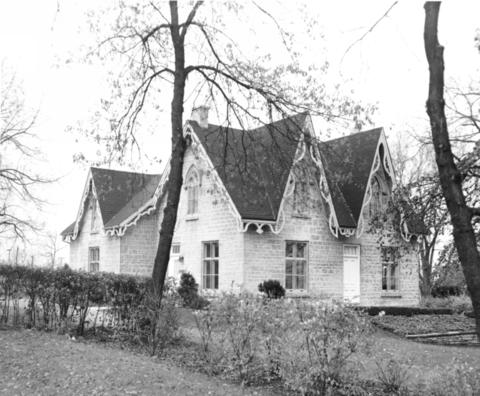
The house itself was built sometime in the 1850s and is quite a nifty example of the Gothic Revival style in Ontario.

("Maple Bank," ca. 1960; Courtesy of Guelph Public Library Archives C6-0-0-0-0-466.)

Happily, Maple Bank survives today and can be glimpsed from Grange street, as in this Google Street view scene:

Here is a picture of the Stevenson family, posed at Maple Bank, ca. 1860:

("Stevenson family," ca. 1860; Courtesy of Guelph Public Library Archives, F38-0-14-0-0-473.)

In the back row stand Wm. Stevenson next to his second wife, Isabella, with Ephraim in behind. The girls are probably Miriam, Laura, Belvedera, Caroline, and Clara (ages, 10, 8, 6, 5, and 1, respectively, in the 1861 census). Given that Clara appears to be about 4–5 years old in the photo, it was likely taken around 1865.

Among Guelph history buffs, Mr. Stevenson is also remembered for the brief reminiscences he delivered in a speech in 1877. It follows the usual form of dates, names, and brief recollections, which the reader would like to know more about. For example, here is his brief recollection for 1854:

In October of 1854, about a dozen of the best stores on Wyndham and Macdonell Streets were burned down, causing a loss of many thousand dollars. About this time the town limits were enlarged, much to the disgust of those parties included in the new limits.
Why were the new Guelphites so disgusted, and what form did their distaste take? It would certainly have been nice to know more of Mr. Stevenson's thoughts on the matter, particularly since he was a town Councilor at the time.

In any event, our humble postcard serves to remind us of one of the influential figures of Victorian Guelph.

Wm. Stevenson died on 6 June 1899 at the age of 81 and is buried at the Woodlawn Cemetery.


It would be remiss of me not to mention that some of the Stevenson children became noted figures in town. Ephraim Stevenson was a member of the Guelph Maple Leafs baseball club that held the semi-professional world championship in the early 1870s.

In a reminiscence about his early years in Guelph, Frank Coffee describes his memory of the team in these words (Mercury, 26 Oct 1918):

The original Maple Leafs had won a Canadian championship; Jim Nichols, Bill Sunley, Eph. Stevenson, Johnnie Colson, Tommy and Billie Smith, Jack Goldie, Kenneth Maclean, Harry Steele, were names to conjure with, as in successive seasons they held, against all comers, the championship emblem—the first silver ball.
I have yet to find a labelled photo of Ephraim in his Maple Leafs uniform but I think that this photo from a collage assembled in 1871 is a good match for the young man posed on the porch of Maple Bank above:
(Detail from "Maple Leaf Baseball Team, 1871." Courtesy of Guelph Civic Museums, 1979X.00.762.)

Despite his prowess at baseball, Ephraim's calling was to be a Methodist clergyman.

William and Isabella's youngest daughter, Maud, achieved fame as a singer. A paragraph from a short biography provides some details of interest:

The Toronto Globe of November 4, 1899, carries an account of Miss Stevenson and mentions that she is known from coast to coast across Canada for her concert work. Also in London, England, she received flattering comments on the tone and quality of her voice as well as the keen dramatic instinct she possessed. She was, it said, able to sing with equal ease, the most difficult classical selections and Scottish ballads. Her soprano voice had a magnificent range and sweetness. She was called "Guelph's sweet-voiced singer."
There is a portrait of her from ca. 1880 in a Notman photograph in a dark outfit and looking rather severe:
She is identified by her married name of Maud Stevenson Pentelow. (Courtesy of Guelph Civic Museums, 2014.84.1066.)

Maud's older sister Clara was also an excellent singer, though she did not enjoy an international reputation. Nonetheless, she is commemorated in the name of Clara Street in the St. George's Park neighbourhood. The reason is not clear to me, although it may not be a coincidence that Clara was the second wife of local mover-and-shaker J.W. Lyon. Anyone who knows the story is invited to fill it in in the comments below.

A portrait of the children of William and Isabella Stevenson, taken ca. 1925, is shown below:

(Courtesy of Guelph Civic Museums, Grundy 12.)

From left to right, the figures are Belvedera, Clara, Carolina, Minnie (Miriam?), Maude, Rev. Ephriam, and Laura.


Sources consulted for this post include:
  • Sudbury, H. "Stevenson, William." Publication of the Guelph Historical Society 1965. 5,9: 1–2.

Friday, 24 May 2013

Central School

This postcard depicts the old Guelph Central School, as seen from the east at the intersection of Norfolk St. and Cambridge St. (now Commercial St.) The address of the school was 93 Dublin St., that street being in behind the building from the perspective of this postcard. It is unusual for postcards to show the back of a building, but there is an interesting reason for it in this case.


The postcard was made for A. L. Merrill, who had a stationary business in Toronto. As with many postcards of the era, it was colourized and printed in Germany. The postcard also has very explicit instructions to the user: "The address only to be written on this side", meaning the entire back of the card. The now-familiar divided-back format, in which a message was written on the left side of the back and the recipient's address on the right, became common after 1905. Probably, this card (and the photo in it) were made before that year. The card is postmarked Oct. 16, 1907, and was addressed to a Miss Eliza Beacock, Wolseley P.O., Ontario. It reads, "We got your letter safely & I am watching the mail every day & will come to the station to meet the train you say, with love to all." With the back wholly taken up with the address, only the small white space on the front was left for recording messages.

The card also provides another illustration of how postcards were often used to make quotidian arrangements in the Edwardian era.

Prior to the construction of the Central School, secondary public schooling in Guelph was held in "three or four rented rooms in the Guelph Cartage Company building, at the corner of Essex St. and Gordon" (Waugh 1961, vol. 1, no. 4). These accommodations had become too meager and, along with the need for more educated workers and Egerton's Ryerson's 1871 Education Act, the local Board of Education decided to build a new, larger school on the ridge of Dublin St., next to "Catholic Hill." The Board acquired the necessary properties, which included a slice of Cambridge St. which, according to the official survey, went straight over the ridge from Norfolk St. in the east to Yorkshire St. in the west. In fact, the ridge was much too steep for vehicles of the day, so no one was inconvenienced by having the street divided. In 1956, the short part of Cambridge St. in the foreground that connected with Norfolk was renamed as "Commercial St." (Irwin 2002).

The Toronto architectural firm of W. R. Strickland won the contract to design the school. Construction began in 1873 and finished in 1876. The Guelph Herald of 1876 gave the following description of the city's shiny new building (Pollard & Pollard 1981, "Guelph's building boom of 1875-76", pp. 70-73):

It is built of Guelph stone, the dimensions being 120 ft. in length and 86 ft. in width, four storeys in height, consisting of basement, ground and 1st floors and mansard storey; 9 ft. 14 ft. 13 ft. and 12 ft. in height respectively. The centre portion of the building breaks out from the line of the building 4 ft. and is carried up 10 feet higher in the centre than the surrounding parts, which gives relief to the structure and from the additional height affords space for a large assembly hall. The roof is of the French or Mansard style, covered with purple and green slate arranged in appropriate patterns, and the deck or flat portion of the roof is covered with tin, surrounded by a handsome railing. The slopes of the roof are pierced by dormer windows, by which the upper rooms are lighted, and by which the plain surface is relieved. ... The basement contains the caretaker's apartments, lunch rooms, fuel rooms and heating apparatus. Upon the ground and first floors are situated the class rooms, 16 in number, 8 on each flat, also the teachers' and apparatus rooms. The upper or Mansard storey contains the assembly hall and 4 ante rooms two on either side. ... The belfry stands 45 feet above the roof, terminating in a handsome wrought iron finial 12 feet in height, with weather vane, and scroll work with gilded points, &c. The belfry is octagonal in shape, with louvred ventilators, and is covered with galvanized iron on the sides, the roof being slated."
A broad staircase connected the back of the building with Cambridge (Commercial) St., although it seems to have been removed in favour of a more modest link by the time of the photo in the postcard.

As noted by Gilbert Stelter (1989, "Henry Langley and the making of Gothic Guelph"), there was a "profusion of spires" in city skylines around the English-speaking world at the time, as churches were built with tall spires in order to dominate their city skylines. The vertical thrust of the Central School, capped by its 45 ft. belfry, seems like a secular entry into that competition. The school, sited near the resplendent Church of Our Lady, and on the shoulder of the same drumlin, was designed not merely to provide room for Guelph's students, but also to stake out a slice of the city's horizon.

This gesture also explains why the school is pictured from the rear. It is the back of the school that looks out over downtown Guelph, while the front faces Dublin St., in the other direction. Downtown Guelph is where the attention was that the school building was meant to attract, so the building faced that way. Knowing this, the photographer took his picture from that vantage point.

Central School endured, with many changes, until the 1960s when it began to seem more-and-more behind the times. The belfry was removed about 1963 and the building demolished in 1968 (Anderson and Matheson 2000, p. 76). It was replaced by the modern Central Public School, with quite a different set of architectural priorities, as you can see from the photo below.


The new building is long and low, reflecting a priority on cost-efficiency, as it is cheaper to build along the ground than up in the air, at least when land is inexpensive. The low profile also probably makes it much more accessible than the old one. In addition, the building has firmly turned its back on the downtown core, with a fence to separate the yard from Commercial St. No doubt this measure is for security, to help limit the number of places where students and others can access the campus. A remnant staircase is still present on the side of the hill.

A much better view of the building is afforded at its front face on Dublin St., as you can see from this Street View image.


View Larger Map

Waugh (1961) records an interesting observation about the Guelph limestone used in the old building:

If you look carefully at the stone in the front of this building, you can see the imprints of sea animals.
You'll find no fossils embedded in the concrete of the new school. However, you will find a relic there: The bell from the old school was preserved and mounted beside the entrance of the new one. It is hard to make out in the Street View picture, but can be seen more plainly here.


The inscription on the bell reads, "The Jones & Company, Troy Bell Foundry, Troy N.Y., 1876." The plaque says, "CENTRAL SCHOOL BELL // This school bell was cast in Troy, New York, and was hung in in the original Central School on this site in 1876. It remained in use until the school was demolished in 1968. This plaque was presented to the Wellington County Board of Education by Craig, Zeidler & Strong Architects, September 1969."

What would the old bell say about its new perch, I wonder, if it could?