Postcards of Guelph, Ontario, Canada, from my collection, spanning the early 20th century to the present. Click on postcard images to see them enlarged, and on Street View images (where given; copyright to Google) to compare with the present-day city. Also, check out my Flash from the Past columns with the Waterloo Record.
As noted in the post about Guelph's Old Home Week 1908, special attention was drawn to Joseph "Long Joe" Lawrence. As part of the burlesque parade, the townsfolk had prevailed on Johnson to dress up in a fine white dress and parasol and stroll the streets of Guelph to the amusement of all.
(Real photo postcard of "Long Joe" Lawrence in a white dress with parasol, parading through St. George's Square. Courtesy of Guelph Civic Musuems 2009.3.1. The message on the back states, "This is the only one I have got left of Guelph Old Home week procession[.] it is a man standing seven feet in a lady dress representing a firm from Toronto" )
Being 6 feet, 11 inches tall, Joe Lawrence stood out. Thanks to his height, we have some more records about him than we might have otherwise.
(Real photo postcard view from the Post office/Customs house of a parade marching through St. George's Square. Note Joe Lawrence in a dress in the foreground and a marching band following him. A hand-written message on the front states, "scenes during Old Home week on main street, Guelph".)
For example, his obituary adds a bit of colour to its account of his statistics (Mercury, 20 January 1958):
In Guelph he worked at Taylor-Forbes. He was a keen member of the Canadian Legion and made a host of friends with whom he kept up a regular correspondence. When he last made a visit to Guelph, in 1955, he complained that the dry air of the West had caused him to shrink half-an-inch—to a mere six feet 10 ½ inches. Blessed with a lively sense of humor he was a highlight in Guelph’s Old Home Week when he put on a disguise as a woman and he always claimed to be unbestable at cribbage.
Lawrence was born on 9 December 1882 in Partick, a suburb of Glasgow, Scotland. He immigrated to Canada in 1904 and settled in Guelph. He does not appear in the city directories of Guelph at that time. However, his Canadian Expeditionary Force attestation papers note that he was a "mechanic," perhaps with the Taylor-Forbes company.
His papers also note that he had three years in the Wellington Rifles.
("Four Members of the Wellington Rifles," ca. 1907. Courtesy of the Guelph Museums, 1952X.00.127. Guess which one is Joe Lawrence!)
It was in this connection that he first came to the notice of the press, to wit (Hamilton Evening Times, 23 Jun 1906):
Giant with appendicitis.
London, Ont., June 22.—Pte “Long Joe” Lawrence, of Guelph, very thin, and seven feet nine inches tall, who is in the militia camp here, was taken to the hospital to-night with appendicitis. It is said there was not a cot long enough to accommodate the patient.
Life in the militia seems to have agreed with Lawrence, as he grew 10 inches in the service!
Happily, the doctors found a suitably long operating table and his condition was treated successfully.
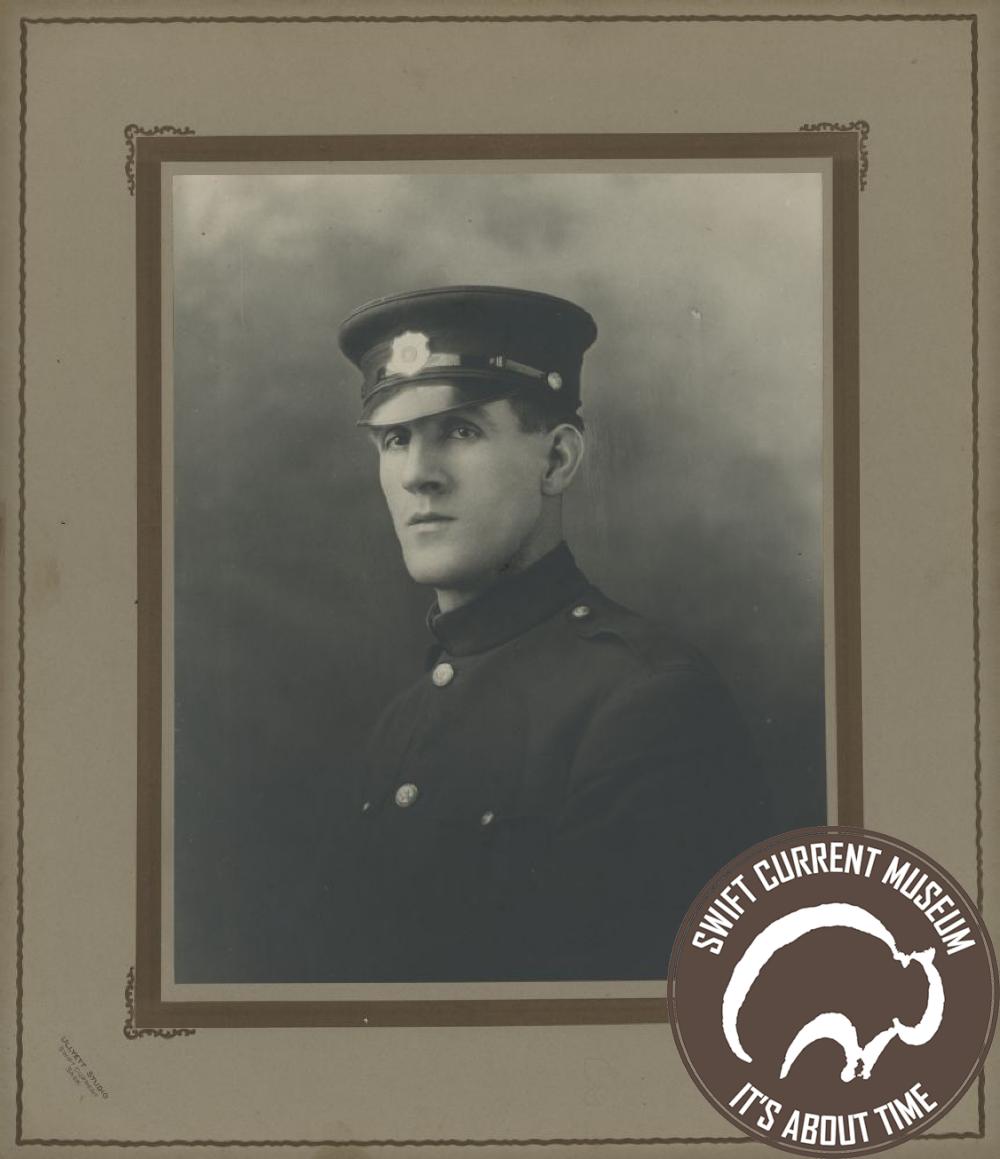
("Joseph J Lawrence (c.1913)." Courtesy of Swift Current Museum, 2008.31.1.)
In 1908, so not long after his seminal appearance in a dress during Old Home Week, Lawrence moved to Swift Current, Saskatchewan, and joined the police. Once again, his unusual height brought him a press notice (Berlin News Record, 13 June 1912):
Canada’s biggest policeman
Mr. Joe Lawrence, formerly of Guelph, but now of Calgary, stands 7 feet 2 inches and is the biggest policeman in Canada. He is in the employ of the C.P.R. and according to a letter addressed to his friend, Mr. Geo. Hubert of Galt, he is well pleased with his position. The tall figure of Mr. Lawrence used to be a familiar sight on Berlin streets before his emigration westward.
The move out west seems to have reduced Lawrence towards his previous height. Was the dry air at work?
On 10 December 1915, Lawrence joined the 89th Battalion of the Canadian Expeditionary Force at its Calgary office. His occupation is listed as mechanic, which, it seems, was his job with the Swift Current police.
Lawrence's obituary mentions that he was a drill instructor, for which he qualified due to his previous service with Wellington Rifles. He may have had this job while in Alberta; it is not mentioned in his military record.
Lawrence sailed to England on 2 June 1916. His height did not fail to make an impression in the Old Country. An article in the Daily Mirror (15 August 1916), "Giant Canadian in the army," notes his stature and shows a photograph of Lawrence towering over two other soldiers, with his arms stretched out to his sides and over their heads.
[If anyone has a copy of this picture, do let me know!]
A subsequent item in the Berlin News Record (14 September 1916) raises the matter that must have occurred to many on hearing of his departure: "Local friends are wondering how Joe will manage to keep his head down when he gets to the trenches."
How indeed? Lawrence's obituary notes an irony: Despite his height, the only place the Germans got him was in the foot. His military medical record mentions a "wire cut" followed by trench foot late in 1916. There is no mention of enemy action, so it may be that it was the CEF that "got" him.
After a few operations and stays in hospital, Lawrence was struck off strength and demobilized back to Alberta, where he arrived in 1919.
Lawrence seems to have stayed in Calgary rather than returning to Swift Current. His mother Mary lived there, where she had immigrated in 1913, probably on the death of her husband. Agnes Lawrence (née Dawson) also appears in the Calgary census of 1921. I have not yet found a marriage record but Lawrence's military record mentions "Agnes Lawrence (wife)" as Joe's beneficiary on his final pay document in 1919, so that appears to be the year of their nuptuals.
Bucking the trend of men who had "gone west" in their youth, Joe Lawrence returned east to the Royal City with his new family in 1924, where he is listed as a mechanic with the Taylor-Forbes company. As was the case for many, his situation changed during the Great Depression, when his job became caretaker with the company of F.W. Jones & Son.
The family seems to have prospered, however. The Lawrences moved from rented apartments on Woolwich street to a house at 16 Havelock street, which remains in place today.
In 1938, Joe's daughter Christina is listed as a hairdresser at the Ideal Beauty Parlour (or Shop or Salon), and his son James is listed as a driver for the Home Creamery Company in 1944. His wife Agnes died in 1943.
In 1945, Joe Lawrence is listed a machine operator with the Page-Hersey Company, a return to his former type of occupation. His address also changed to 156 Ontario street, a residence not unlike his former one though located near to his new employer in the Ward.
In 1949, Lawrence went west once more, settling on Okotoks, Alberta, where his daughter Christina appears to have moved after her marriage to a Mr. J.R. Aikins.
("Joe Lawrence, Guelph's Tallest Man." Courtesy of Guelph Civic Museums, 2014.84.78. The photo appears to be dated August 1955 and shows Lawrence in uniform next to a much shorter man, also in uniform, standing in front of an Eaton's store in an unnamed city.)
Lawrence's last visit to Guelph came in 1955. It was celebrated in the Mercury with a photo of him between two "Mercury girls" standing on chairs so as to look him in the eye.
(Detail of "Scrapbook, Guelph History, Marion and Eleanor Ryan, 1950-1979," page 48. Courtesy of Guelph Civic Museums, 2022.12.2.)
The photographic record of Joe Lawrence certainly speaks to the enduring fascination with height in our culture.
Joseph "Long Joe" Lawrence was buried in what we may assume was a lengthy coffin in the Union Cemetery in Calgary.
The postcard shows a lovely, summery scene featuring the Blacksmith Fountain in St. George's Square. The streetcars carry passengers in their summer attire, who are probably happy that the open sides let in cooling breezes. Perhaps the driver of the oncoming car secretly hopes to apply the made-in-Guelph cow-catcher on the front to scoop an errant pedestrian out of the way.
("St. George's Square, Guelph, Canada," ca. 1910. Published by the International Stationary Company, Picton, Ontario.)
Although postcard publishers tended to prefer summer photography, postcards were sent all year round, and this card was actually dispatched from Puslinch to Guelph on 31 December 1914, when the Royal City and its surroundings had be socked in under repeated snowfalls.
Addressed to Mrs. James D. McPherson on York Road in Guelph, the message relates to the holiday season:
Dear Jim & Belle:—
We got the photos and you could not have sent us a better Christmas box. Glad to hear baby is growing so well.
Wishing you all
A Happy New Year
Aunt Flora
Of course, the year 1914 was an unusual one in Guelph. The Great War had begun a few months earlier and Canadians were still unsure what it would amount to. Many young men had left with the Canadian Expeditionary Force and were still in Britain training for combat. Herbert Philp wrote a letter home to his family, which they subsequently published in the Mercury (24 December), under the ironic title "Salisbury mud a wonderful thing." In it, Philp speaks eloquently of the frustration of the contingent:
For, despite the eagerness of practically every man in the contingent to be "over the way," we are still wallowing about in England's mud.
Philp explains that the conditions were fine and dry on their arrival, and they pitched their tents in a "slight valley." Then down came the English rains, leaving their modest dwellings with:
ambitious rivulets flowing either through them or snuggling close to their sides. Not a tent but contained a pool of water.
When the weather let up, the tents were moved up slope but the cookhouse remained down in the valley, meaning that everyone had to line up there three times a day, in whatever weather, to get their food. The result was frequenty cold tea and soup and soggy bread at meal times.
Philp finishes his letter thus, "But, so far as excitement and entertainment are concerned, Salisbury Plains still runs a close second to the grave."
(Herbert Philp's many and eloquent letters home throughout the Great War have been collected by Ed Butts in the book, "The Withering Disease of Conflict: A Canadian Soldier's Chronicle of the First World War." It is available from the Guelph Historical Society and I highly recommend it!)
War news was a mixed bag. Accounts of terrible battles were featured, but the general tone conveyed the sense that the Allies had the upper hand and German defeat in the near future was still a possibility, though not by Christmastime.
Rumours of German attacks on or in Canada circulated. For example, a national article printed in the Mercury (1 December) related a scheme set in motion for German forces to take over Quebec City. A concrete structure made the previous year near St. Anne de Beaupré by a German movie crew in 1913 was thought to be a bunker intended as a weapons cache for a surprise attack launched by sea. Luckily, British naval superiority had frustrated this plan, it was thought.
The many Canadians of German descent in the region also caused concern. A letter to the Editor (11 December) attempts to address rumours of a German-Canadian fifth column thus:
Editor of the Mercury.
Dear Sir: Who are the meddlers who have been reporting to Guelph authorities that secret meetings are being held in Morriston by the Germans and German-Canadians?
There are no secret meetings held in Morriston to my knowledge. Perhaps the meddlers had reference to the revival meetings, held in the Evangelical church, which are held annually. These meetings are not secret, but sacred, and people of all nationalities are welcome to attend.
Are such meddlars as these throughout the Dominion interested in uplifting our Canada? No, they are too ignorant to realize the harm they are doing their own village and community, also their own country, Canada.
Yours respectully,
A life-long Mercury reader.
As ever, conflict breeds suspicion and mistrust, well-founded or not. Locally, misplaced suspicion of German- and Catholic Canadians resulted in the Guelph Novitiate Raid of 1918.
("Evangelical Ch., Morriston." Courtesy of Wellington County Museum and Archives A2009.124, ph. 31342.)
Compared to previous years, the Xmas shopping ads in the Mercury seemed subdued. Still, they were far from absent. The D.E. Macdonald & Bros. shop urged Guelphites to "Hurry up! Only two more Saturdays before Christmas" (11 December). Extensive gift suggestions for him, her, and baby were provided, along with an illustration of Santa Claus hauling a prodigious sack of goodies.
Similarly, Moore and Armstrong noted that there were only nine shopping days left (14 December): "If you have not got the Christmas Spirit yet, you will have it in large measure when you get to the White House," that is, their store on Wyndham street.
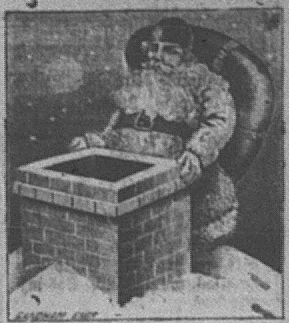
Their illustration also showed Santa Claus carting a super-sized sack of gifts. One can understand the look of relief on the jolly old elf's face at the sight of the very wide chimnney before him!
If nothing else, Santa's message was to go big or go home, or both!
Even Santa Claus was not unaffected by the conflict in Europe. This cartoon shows how low German Kultur had sunk with the war (22 December):
The caption says, "An act of barbarism: Not only are the Germans firing on the Red Cross and flags of truce, but they are rendering the work of Santa Claus difficult and hazardous."
Being magical, Santa had the means to rectify the situation, as shown in a subsequent cartoon (26 December):
Here, Santa deploys what I assume is a stocking full of doorknobs to give Kaiser Bill a jolly good thrashing.
People on the home front carried on. The Guelph Musical Society held a parade downtown on 9 December. The performance was marred somewhat when large bulldog followed the squad down Wyndham street. The drummer found that the dog would bite the drumsticks whenever he raised them to beat the kettle drum. Fearing that he might be "minus a wing" if he provoked the dog further, the drummer ceased drumming and the band had to proceed without their bass.
The animals did not have it all their own way. A bear cub named "Teddy" had been kept as a curiousity at the American Hotel on Wynhdam street for most of the year. Having reached the size of 200 lbs, Teddy was sent Bernard Schario, the butcher, who turned him into roasts and steaks as a holiday feast for the hotel residents (24 December).
The skating season took shape. With the cold weather, Guelphites were soon skating on the pond above Goldie Mill. Skating also began indoors at the Royal City Rink (formerly Petrie's Athletic Park and Rink) at Wellington and Gordon streets.
(Detail of "The Petrie Rink, Gymnasium and Baths," 1898. Courtesy of Guelph Museums 2014.84.2.)
Curiously, the street railway company decided not to open their usual skating rink on Howitt's pond, on the basis that it would not be "a paying proposition" (18 December). In previous years, the rink behind the streetcar barns on Waterloo road had been run as an attraction to get people onto the streetcar system in winter.
Perhaps they had too much competition. The City had decided to fund a rink on the grounds of the Guelph Collegiate Institute on Paisley street. A room in the basement was even made available for people to put on their skates (22 December). Perhaps this level of comfort and style attracted skaters who might have been inclined to travel to the streetcar rink in previous years.
("Collegiate Institute, Guelph, Ont." Postcard printed for Waters Bros., Guelph, ca. 1910. Courtesy of Guelph Museums 2009.20.1.)
The Royal City Rink was also home to Guelph's very first NHL team! Yes, Guelph entered a team in the 1914–15 Northern Hockey League senior series (21 December). Although some of the players trying out for the team were from out of town, lots of local boys turned out to show their stuff, including Allan, Anderson, Stricklerr, Greer, Hayes, Spalding, Ogg, King, Mowat, and Bulgin.
The side lost their first exhibition game against the Dutchmen of Waterloo (26 December). Although the Guelphites mainly acquitted themselves well, the superior size of the Seagramites gave them a distinct advantage, resulting in a 5–2 win for the visitors.
Another tilt against the same team was arranged for the first regular season game. This time, the Royal City skaters were better prepared. The result was a "wild sort of affair," beginning with a dispute over whether one of the Guelph players was a professional—strictly forbidden! The play was very physical and Referee Knell of Berlin (Ontario) "had his hands full."
The police had to be called in to break up a melee after the crowd joined in an on-ice altercation in the second half. Tied at the end of regulation play, the game went ten minutes into overtime before Guelph's centre, McGregor, put the home team up 7–6.
At the Reformatory (or "Prison Farm"), the provincial government announced plans to install an abattoir on site (31 December). The Ontario prison system required 600–700 tons of meat annually in its operations, which was obtained from private butchers. Building an abbatoir at the prison meant that prisoners could be employed to perform the butchering at a lower cost than private butchers, saving the system some $50k a year. In addition, prisoners would learn skills that they could use to obtain regular employment as meat dressers in private industry after release.
("Ontario Reformatory Guelph, Jan. 1915 The Abattoir." Courtesy of Guelph Museums 2014.84.1276, p. 59, ph. 3.)
A final point of interest came with the annual, municipal elections. First, there was some talk of not holding the elections at all, in view of the war situation (17 December). But, the election went ahead as usual.
Besides electing a Mayor, Aldermen (Councilors), and other officials, citizens of Guelph were asked to weigh in on the following by-law, "Are you in favor of municipal votes for married women?" (8 December). The 'Women's Franchise plebisite' was carried by a majority of (male) voters 1140 to 838 (5 January 1915).
Women's groups had long campaigned for women's suffrage in Ontario. In the Edwardian era, efforts tended to focus on municipal voting. In 1914, the Canadian Suffrage Association, led by Dr. Margaret Gordon, had lobbied many Ontario municipalities to hold referenda on extending votes to women. It appears that Guelph was one of 33 municipalities where the effort met with success, albeit for married women only.
Women's role in the Great War led to further support for the cause. In 1917, Ontario women finally gained the right to vote in provincial elections.
In many respects, the holiday season of 1914 was like those of previous years. Even so, as the prospect of the end of the conflict in Europe receded, it was clear that times were changing and that the New Year would bring on many new challenges.
The end of the year is often a good time to look back and take stock, and so it is with postcards. Consider the rather watery postcard below, received in Guelph on 22 January 1917:
The naval theme of the picture is reinforced by the information on the back, which looks like this:
To start with, the "A.S.M" publisher's mark in the centre bottom shows that the card is Italian, published by A. Scrocchi of Milan. The postmarks reveal that this card passed through London (England) on 8 January 1917, Toronto on 21 January, and arrived in Guelph the next day. The large blue circle stamp near the bottom centre says, "Passed by censor," revealing tha the card had a military origin. Military personnel sent billions of pieces of mail home from the First World War, most of which had to be cleared by military authories to ensure that they contained no information that was of strategic significance or that would injure "morale."
A look at the message on the card confirms the judgement of the censor:
Dear Sister
Just a card to let you know I am quite well. I hope you are all the same. We had a decent Xmas. Hope to hear from you soon.
Your Loving Brother
Chris
Mess 5.
The addressee was Mrs. G. Bowles whose P.O. Box was in Guelph.
A little genealogical sleuthing reveals that the addressee was Mrs. George Bowles (née Lydia Wilkins), resident of Guelph Township. Lydia was born in Great Missenden, Buckinghamshire, England in November 1888. Her father John was a platelayer, that is, a man who maintained industrial rail lines. On 6 December 1909, she married George Bowles, in St Marylebone, Westminster.
George Bowles was born in Mile End, Essex, England, in 1889. On his marriage to Lydia, his occupation was listed as footman, that is, a domestic servant. However, it seems that a life of service did not appeal to the new couple, who immigrated to Canada in 1911, settling in Guelph.
The 1911 Census lists George and Lydia as residents of 46 Nottingham street and gives George's occupation as "driller" in the employ of the Standard Valve [and Fittings] Co. The city directory suggests that the couple soon relocated to a stone cottage at 64 Albert street, before moving to Guelph Township around 1915. That is likely where they lived when Lydia received this postcard from her brother Chris.
(64 Albert Street; Courtesy of Google Street View.)
The writer, Christopher Wilkins, was born in Great Missenden in 1898. Like his older sister, he was not satisfied with his fortunes there—his occupation in the 1911 census is listed as "paper boy"—and so he enlisted in the Royal Navy in 1913. His first assignments were to training vessels such as the Ganges, where his trade is give as "Boy Tel[egrapher]."
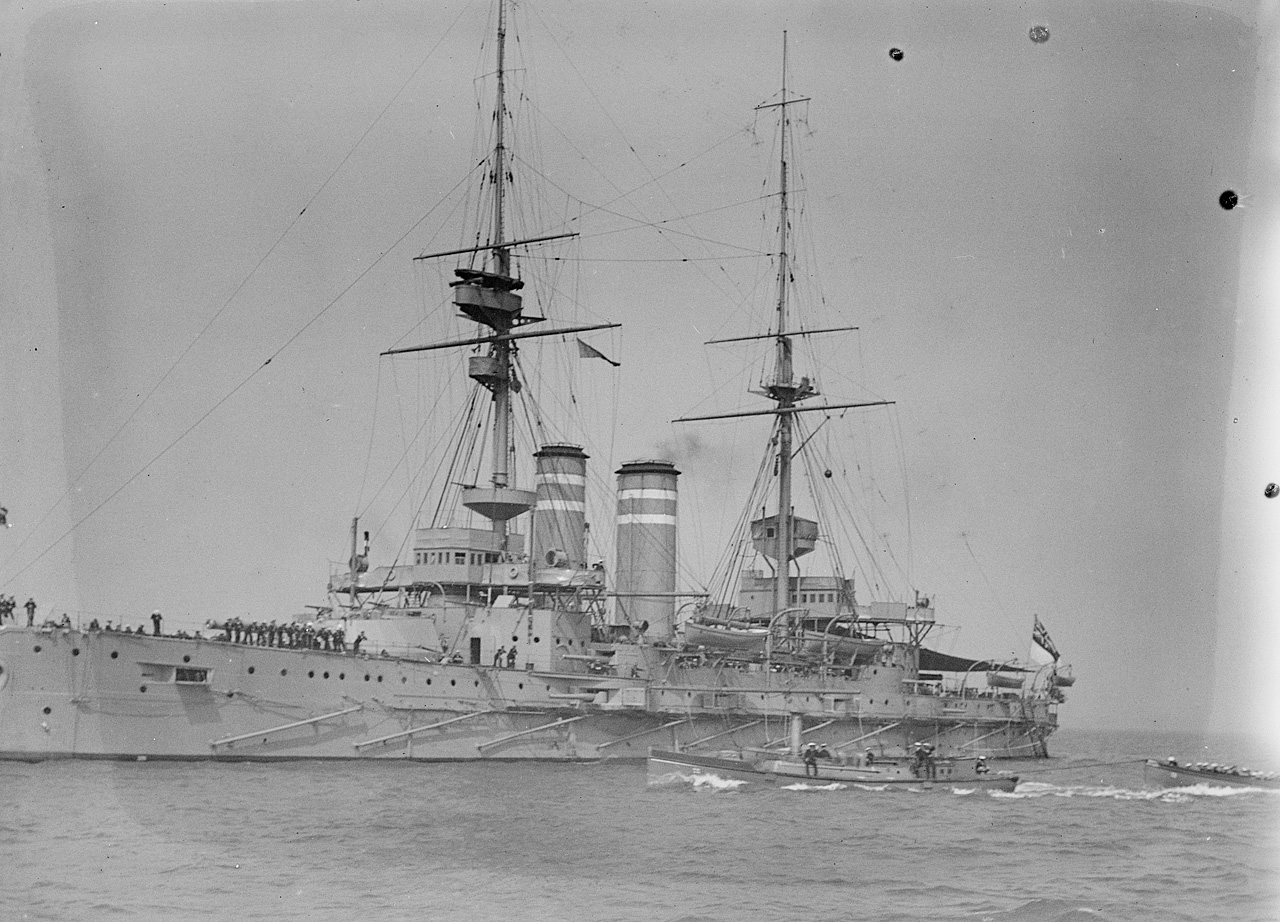
Things got more serious in 1915 when Chris was assigned to the Queen, a pre-Dreadnought battleship that participated in the Dardanelles campaign, including the Gallipoli landings.
In August, 1915, Chris was promoted to Ordinary Telegrapher. The Queen was assigned to support the Italian navy, which explains why he was in Italy for Xmas 1916. He was promoted to Leading Telegrapher by the time he demobilized in March, 1920.
Christopher Wilkins wasted no time in seeking his fortunes abroad. He emigrated to Canada in May, 1920, headed to Toronto to join his brother Stanley, who had made the trip around 1914, intending to work as a telegraph operator. What become of him after that, I am not sure.
In Guelph, Xmas 1916 was a difficult one, as you would expect. On 5 December, the Mercury reported that seven Guelph soldiers had been reported killed in action. Privates Henry Emeny, Austin Henry Thomas, Robert S. O'Drowsky, William Macoll, Charles S. Lawrence, Frederick Willis, and Corporal George Thomas Ryder were reported either killed in action or dead as a result of wounds received in action. It was, said the headline, the "hardest blow the city has received since the outbreak of war."
An article from 9 December notes the availability of foodstuffs for Xmas cooking and compares that with the previous year. Regrettably, dates had gone up in price from 10¢/lb to 15¢/lb and gone down in quality. Something similar applied to currants, which were then imported from Australia rather than Greece, and were dearer but not as juicy. British lemon, orange, and citron peel had almost doubled in price and lard was almost impossible to get, likely because hog fat was considered a strategic good. On the up side, there had been a bumper crop of oranges, which were of good quality and cheaper than in 1915. No doubt, many young Guelphites received oranges in their Xmas stockings that year.
On 19 December came the news that George Sleeman was retiring from public life. He was well-known as a prominent, local business mogul and also for his keen interest in civic life. He was elected councillor for the South Ward in 1876 and was elected the first mayor of the City (no longer town) of Guelph in 1880. He was mayor of the city for six years in total, the last time in 1906. He was elected to the Light and Heat Commission and appointed to the Parks and Shades Commission, where he continued to serve until ill health motivated his present resignation.
(George Sleeman; Courtesy of Guelph Civic Museums 2009.32.951.)
On the bright side, Santa Claus continued to move with the times. Advertisements in the Mercury show St. Nick making use of all the modern conveniences while going about his job. For example, Bell Telepone noted on 5 December that the jolly old elf highly recommends telephones, including a second telephone in order to save running upstairs to answer the first one!
Another plus appears to be that Santa does not need a red-nosed reindeer, at least where the team can just follow the prolific telephone wires.
Another ad for G.B. Ryan & Co. from 7 December shows Santa ditching the reindeer altogether for another modern convenience, the automobile!
This is not to say that Santa had dispensed with all his magic. Early cars (and many late models) were notoriously hard to operate in the cold and snow, so that motorists tended to put them away in winter and operate sleighs instead in 1916. So, driving a car so readily over the snowy streets of the Royal City would have benefited from Santa's magic touch.
In addition, there continued to be a nostalgia for sleigh rides during the holiday season. On Xmas day, every cutter in the city was rented out so that Guelphites with some money to spare could promenade through town in proper style, with horses nodding and sleigh bells ringing (26 December).
One enterprising Guelphite took the obvious step of combining cars and sleighs. An article in the Mercury (30 December) notes:
An addition to a Ford car, which caused comment and interest yesterday afternoon, was the use of runners in place of the two font wheels. This facilitated the running of the car through the snow, and the driver was quite proud of himself.
Santa take note! I wonder if this innovative automobile looked like this:
("A Model T Souped-Up for Snow, 1920." Courtesy of Plainfield Public Libray, Photo #VV60207.)
The same day came the news that the "Prison Farm" just outside of town might be re-purposed as a recuperation and training facility for returned soldiers. In due course, the Reformatory did indeed become the Speedwell Military Hospital.
George Bowles died on 3 March 1952 and was buried in Woodlawn Cemetery. His obituary dwelled mainly on his involvement with the local chapter of the Independent Order of Odd Fellows (IOOF), of which he was elected Chief Patriarch and District Deputy Grand Patriarch in 1932.
Lydia died on 13 February 1961 and was buried next to George.
The Waters Bros. were regular advertisers in local newspapers like the Guelph Mercury. A typical ad might run like this:
Waters Bros., Guelph
Headquarters for O.A.C.
And School supplies
For
Nature study
Botanical
Entomological
Drawing
Painting
41 Wyndham Street
Phone 350
So, it was likely a surprise to readers when the following ad appeared in the usual space (Acton Free Press, 29 Apr 1915):
No reasonable offer refused
Show cases and equipment
Picture frames, china and glassware, etc.
Everything must be sold
Waters Bros., Guelph.
Suddenly, the Waters Bros., a long-established Guelph enterprise, was going out of business. What happened?
The Waters Bros. was a Picture and Art Supply business founded in Guelph in 1878 by Frederick and Florance Waters. Frederick (b. 1853) and Florance (b. 1854) were sons of Charles and Frances Waters. Charles was a customs official in the southeast of England. In 1877, the two had immigrated to Canada, where Frederick had set up a business in Guelph. When his brother Florance joined him there in 1878, they formed the Water Bros., and placed the following notice in the Daily Mercury (23 April):
Important.
Frederick Waters begs leave to inform the public that he has taken into partnership his brother Florance Waters. The business will be carried on under the style of Waters Bro’s.
The new firm offers a large and varied assortment of oil paintings, chromos, engravings, frames, mouldings, &c., at lowest prices.
Upholstering as usual. Carpets made and laid. Mattresses re-made and made to order.
Parties furnishing will find it advantageous to call and inspect the stock of Waters Bros.
148 Quebec street, Guelph, West of McCrae’s Wood Yard.
The address would be approximately where 33 Quebec St. stands today.
(Quebec street west in 1874, roughly as it appeared when Waters Bros. set up shop there a few years later, about half-way down the south, left-hand side. Courtesy of Guelph Civic Museums 2013.72.94.)
The partnership did not last long. In 1881, the brothers dissolved it and Frederick moved on to Stratford. Florance took over the business but kept the "Waters Bros" name. It seems that Florance was not the brother interested in upholstery and carpets, since these are left out of the description of the business in the "Industries of Canada" (1886):
Waters Bros.—The Picture Gallery, near Post Office; Picture Frames, Oil paintings, steel engravings, mouldings, poles, cornices, and mirrors, well known in Guelph as a reliable house in every respect at which to purchase pictures or get them framed; also artists’ materials, and every article required by amateurs and professionals—established their business eight years ago, on their arrival in this country from England, the land of their nativity. They occupy very neat premises, near the Post Office, which are 25x25 feet in dimensions and two stories in height
The title "The Picture Gallery" remained the slogan of the business in future. Note this title in the ad below, from the 1882 Evans City Directory:
One of the benefits of owning a prosperous business is that Florance could get married. On 12 April 1879, Florance married Fanny Lacy, also an English immigrant, who resided in Palmerston at the time. By 1882, the couple had moved into a lovely house at 94 Liverpool Street (now 86), as shown on Google Street View below.
Charles and Fanny had a large family, Charles Jr. (b. 1880), Florence (a girl, b. 1881), Edith (b. 1883), Caroline (b. 1885), Fanny (b. 1887), George Percy (b. 1889), William (b. 1892), and Arthur (b. 1894) (1901 Census). It seems that the picture and arts supplies trade paid decently enough.
Of course, the future is never certain. By 1884, the Waters Bros. had moved a couple of times and then occupied a space on the south side of Quebec street opposite the Bank of Montreal, facing out on St. George's Square. This spot must have been considered prime real estate for trade. Yet, shortly after noon on 31 May 1887, the block in which their store sat caught fire (Mercury). The blaze imperiled the whole block, from Mr. Copeland's barber shop at the south end, Nunan's book bindery, Hall's tailor shop, Clark & Thompson's carpet store, as well as the Waters Bros.
One advantage of the locale and time was that many people were on hand to pitch in:
Soon a crowd gathered, and when it was discovered that Mr. Copeland and his family had removed, efforts were directed to saving the property of Waters’ Bros, for nothing could be done in the bindery. Willing hands were soon at work, and succeeded in getting out the most valuable portion of the stock in an increditable short space. Those engaged in the work seemed to “keep their heads,” and rescued the contents in such a safe manner as it seldom witnessed now.
The Waters Bros' loss was estimated at $1500, with a $1000 of insurance.
Alderman Hearn, who had recently purchased the block, had insurance and decided to rebuild. However, the Waters Bros. had to vacate their building. They moved temporarily to the store previously occupied by James Nelles (father of Charles Nelles, subject of a previous blog) at 25 Wyndham street to hold a fire sale, "Where they are preparing to sacrifice their tremendous stock."
(25 Wyndham St., currently the location of Wimpy's Diner; courtesy Google Street View)
The Waters Bros remained at this site for a couple of years. However, when the new Hearn Block was ready, they relocated back into the fancy, new digs, with double the space. The announcement was made as follows (Mercury, 25 July 1889):
Going west.—Stock must be reduced. No reasonable offer refused as Waters Bros., will remove in a few days to the double store in Hearn’s block, St. George’s square.
The phrase "Going west" usually applied to people who were moving to western Canada; Florance was using it here to refer jokingly to his move from the east to the west side of Wyndham street.
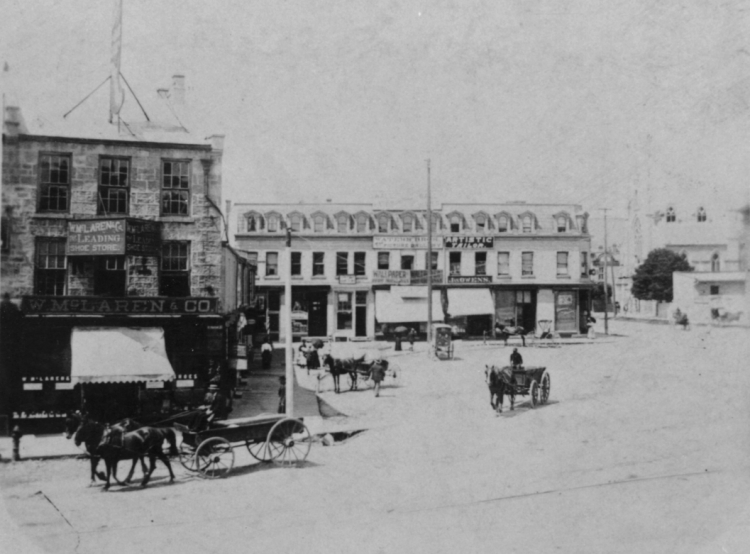
The Waters Bros. store in the Hearn Block, ca. 1895, can be seen in the photo below. It lies in the middle of the block, in the right background of the photo, behind the tall pole.
The sign below the attic windows reads, "Waters Bros. // The Picture Gallery." A sign over the awning reads, "Wall paper," always a good seller, and other things that are hard to make out.
Apparently, the west did not suit the Waters Bros store for long. In September 1898, the store returned east to 39 Wyndham street, just south of St. George' Square, currently the location of a nightclub. A few years later, they moved one door up the street to 41 Wyndham street, currently the home of Guelph Today.
(41 and 39 Wyndham street, courtesy of Google Street View.)
At around the same time, the Waters family moved from Liverpool street to a substantial stone house at 27 Arthur street (now 86), backing on to the Speed River. It seems that The Picture Gallery had made Florance Waters and his family a picture of prosperity!
(86 Arthur street; Courtesy Google Street View.)
When the picture postcard craze swept the Edwardian era, the Waters Bros was a perfect position to capitalize. The store had always carried souvenir goods for special occasions such as Christmas. This, and their attention to pictures, made postcards and related phenomena a natural extension of their product line.
Postcards bearing the imprimatur of the Waters Bros. seem to come in two groups. The first group have postmarks in the date range 1908–1911 and have the same backs (in brown ink) as those published by the Pugh Mfg. Co. of Toronto (in blue ink), suggesting that both used the same printer. The views on these cards are typical for Guelph postcards of the era. For the most part, the pictures seem to have been borrowed from other producers, although a few may have been taken especially for the Waters Bros. stock.
For example, here is a nice view of Massey Hall at the Ontario Agricultural College, with a gentleman standing outside of it:
This card was addressed in 1909 by Stanley R. Dayton of Little Britain, Ontario to H. Smith of Ingersoll as part of a postcard exchange, a common arrangement of collectors who sent each other postcards of interest. The text sounds like the sort of thing that two enthusiastic, young postcard collectors would ask of each other:
Many thanks for your pretty card. How many cards have you? Do you get many out of the exchange? What do you work at? I am going to school all the time and soon.
The picture is the same as one found in a contemporary Warwick Bro's card, even to the awkward cropping on the right-hand side.
On the back, the card is identified as "Published by Waters Bros, Guelph, Ont."
Another interesting picture shows a view taken from the top of Goldie's Mill, looking down the Speed River, over the Norwich street bridge towards the spire of St. George's Church.
This card was postmarked on 3 September 1908 and was addressed by "Cousin Neil" to Miss Sadie McPherson of Guelph as follows:
Dear Sadie, You will be at school now. Ida & Tina did not get up in the holidays. Maybe they’ll come some Saturday. Our flower Sunday at Sunday School is on Sunday, the 6th Sept. How are Uncle Donald & Aunt Christie & John & all you girls? I had a good time at your place.
This image is the only version I know of issued as a colour lithograph. There is a halftone version with no publisher's mark that may have originated with Charles Nelles.
The second set of Waters Bros. cards are reprints of cards issued by the Illustrated Post Card Co. of Montreal, with postmarks in the 1911–1913 range. For example, here is a view of the then-new Carnegie Library, with a well-dressed couple posing in front:
The postcard was sent from Fergus by Harold to Harry and Florrie Lewar of London, England on 14 June 1913:
Many thanks for letters. so pleased to hear that you are not moving from London. I went washing sheep for Hastings the other day & then took a swim. I will write that character for you Harry before I leave here.
Swimming with sheep sounds like it might be highly therapeutic.
Another nice postcard from this set depicts Gow's Bridge, now often known as the McCrae Bridge, when the mill and other buildings were still present:
The subdued, watery palate of the series shows the river to good effect.
Certainly, the Waters Bros were selling postcards with their own imprimatur in the 1908–1913 period. It is quite possible that they sold postcards from other producers beforehand and even at the same time. In all, it seems likely that postcards formed a nice side line for the business
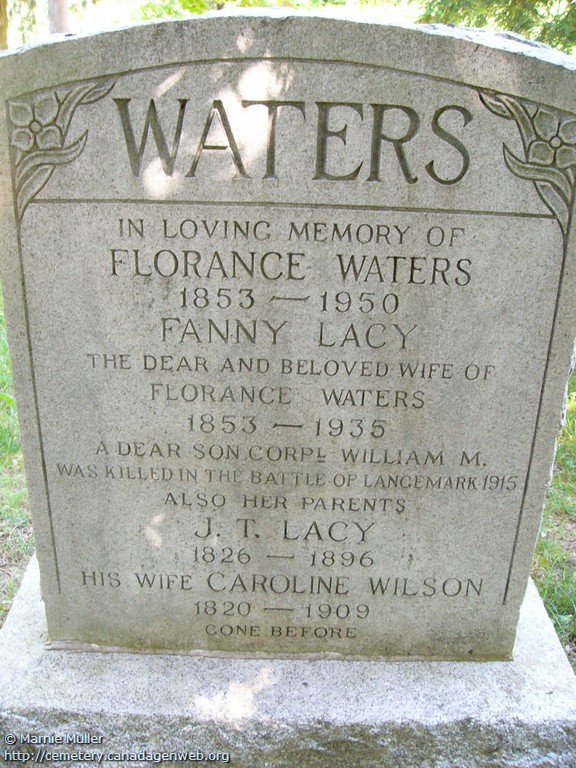
As with so many other things, the Great War changed all that. Shortly after war was declared, young William Waters volunteered for the British Columbia Horse (Mercury, 11 August 1915). The previous year, he had taken a job with Guelph's Taylor-Forbes foundry, which sent him to their Vancouver office. Finding that horses were too scarce, Waters travelled to the training camp at Valcartier, Quebec, and joined the 5th Battalion, infantry.
His military records reveal that Corporal Waters's service was not long or easy. He suffered a case of the flu in December, followed by bronchitis in January 1915. His regiment was among the first sent to France, where it became involved in the Second Battle of Ypres, where poison gas was first deployed by German forces. At Langemarck, Corporal Waters was reported to be wounded on 25 April and evacuated to a field hospital, which authorities reported to his father, Florance.
Corporal Warron, a friend of Corporal Waters who had been lightly wounded in the same attack, noted that his friend was not to be found and instigated a search. It turned out that the field hospital where Waters lay was overrun by German forces and Waters had become a prisoner of war. In August, German authorities listed Waters as dead, with no details given as to the cause. The Canadian military listed Waters as deceased and informed his family in Guelph on 10 August.
It seems likely that this string of events precipitated the sudden decision to liquidate the Waters Bros. business in April 1915, as noted above. The process was completed in September, shortly after news of William's death reached home. Curiously, advertisements for the liquidation sale are to be found in the Acton Free Press but not in the pages of the Mercury itself. It may be that the news was all over town anyway, so that local advertisements were unnecessary but that is only a guess.
A picture of Corporal William Waters was published in the Mercury on 18 August:
Curiously, for the family of a picture business, this is the only photograph of a family member that I have yet come across. (If anyone has more, let me know!)
In a few months, Florance and Fanny packed up and moved to Vancouver, for reasons that remain unclear but may be connected to William's residence there. Even at such a large distance, the family was not forgotten in the Royal City. A marker is to be found in Woodlawn Cemetery, commemorating Florance and Fanny, Fanny's parents, and William:
Besides this marker, we have their postcards to remind us of the Waters family, their business, and the Guelph that they lived in before the Great War.
At Christmas time, it is fun to pick out a postcard with a seasonal message to investigate. This year's card conveys a scene from the campus of the Ontario Agricultural College, ca 1900. Specifically, it shows what is today known as Winegard's walk after William Winegard, the University of Guelph's second president.
(Courtesy of the John W. Keleher collection.)
In the right foreground is Day Hall (then the "Experimental building"), then, to the left of the tree, is the Gymnasium, the Chemistry Building, and the Main Building (all now demolished).
The postcard is of an early type in which the message goes on the front with the picture while the address alone goes on the back (called an "undivided back" card for that reason). The message on the front reads:
Many thanks for Xmas greetings. Wishing you a very happy new year. L.A.Y.
The addressee is Master Hyde Auld, “Summerhill”, Guelph. The card was printed by Warwick Bros. & Rutter and was postmarked on 29 Dec. 1904.
Summerhill was one of Guelph's houses grand enough to merit a special name. Summerhill was becoming quite well-known—even notorious—in the Royal City, so it could readily be used as an address, all by itself.
The history of Summerhill is well summarized in the booklet "Brooklyn and College Hill" (Guelph Arts Council, p. 11–12). It was built in 1840 by James Thompson at the centre of what was then a large estate. In 1865, it was rented to Colonel Thomas Saunders, Wellington County's first magistrate and an important local figure. He was soon to sell his large farm, "Woodlands," which later became Vimy Ridge Farm. He also figures in the Christmas post from 2015 as one of the founders of St. James church in Guelph.
Summerhill became notorious because of two of the Colonel's granddaughters who grew up there: Lucy and Elinor Sutherland. In 1860, their mother Elinor had married Douglas Sutherland, a British engineer who took her to India, South America, and then London, where the girls were born. In 1865, Douglas died of typhoid fever, prompting the widow to journey to Summerhill with her young family (Mercury, 20 July 1927).
Although shorn of its estate, Summerhill still stands at 25 Harcourt Drive and can be seen looking resplendent in the Google Street View picture below.
Even though the old laneway leading to Summerhill from Dundas Road (now Gordon Street) is now gone, the gates can still be seen halfway up College hill, on the west side of the street:
The family remained at Summerhill until 1871, when Elinor married Mr. David Kennedy and removed to his residence on Woolwich Street, next to the new St. George's Church and opposite the Court House (where the Wellington Catholic District School Board building now stands). The Mercury relates a scene from their childhood on the side of the Speed River (perhaps a recollection shared by the ladies during a later visit to town):
Here the children watched with great interest the building of the new St. George's Church, the old one being in St. George's Square, and here with one or two of their young cousins, the Saunders boys, they slid on boards through the basement [of the church], and climbed as far as possible the scaffolding about the tower, then in the process of erection.
In 1874, Mr. Kennedy took his family back to the Old Country.
A brief sketch can hardly do justice to the careers of these two woman, so let the following sketch suffice. Lucy became a dressmaker and then a noted fashion designer. In 1900, she married Sir Cosmo Duff-Gordon and, in 1903, opened "Lucile Limited" in London. Her's was the place the English glitterati got their best clothes for the next 20 years.
Lucile was later known for surviving the sinking of the Titanic in 1912. She and her husband survived in a life boat that carried only 12 people although it had a capacity of 40. Rumors spread that Duff-Gordon had bribed the crew to leave the ship prematurely. A subsequent inquiry exonerated him.
Anyway, as the website of Lucile and Co. states today, Lucile Duff-Gordon was the "It girl" of the Belle Epoque.
Lucy's sister Elinor married Clayton Louis Glyn in 1892 but the marriage proved unworkable. As a result, Elinor Glyn began a series of affairs with various high-flying British aristocrats. If that were not scandalous enough, she began to publish risqué novels based on her experiences. The best-known is "Three weeks," about a young English nobleman who has a three-week fling with an older woman in Switzerland, and published in 1907 (and based on a true story!).
The book inspired the following bit of popular verse:
Would you like to sin
With Elinor Glyn
On a tiger skin?
Or would you prefer
To err with her
On some other fur?
The book was panned by critics as vulgar, silly, and disreputable and, naturally, sold very well.
Elinor went on to write and produce screenplays for early Hollywood films. Perhaps the most famous of these was "It" (1927), about a spunky young redhead who sets her cap at her wealthy employer. The movie popularized the concept of the "It girl", a woman who possesses "It," defined by Elinor as follows:
With It, you win all men if you are a woman and all women if you are a man. It can be a quality of the mind as well as a physical attraction.
Clara Bow, who played the heroine in the movie, was thus the first official It girl.
So, when our postcard arrived at the Guelph post office in 1904, "Summerhill" was already known as the former residence of the Sutherland girls, each making a name for herself in the Old Country.
As luck would have it, the postcard's recipient, Master Hyde Auld, was also destined to make a name for himself and the Royal City but in his own way.
James Hyde Auld was born in Guelph on 27 June 1891. He was the third child of Charles and Jessie Auld. Charles Auld was in the carriage goods business, having worked as a traveling salesman for the Guelph Carriage Goods Co. (Mercury, 20 July 1927). In 1887, Auld and his partner Augustus Woodyatt took over the Guelph Sewing Machine and Novelty Works on Nelson Crescent (now the site of a parking lot at 8 Paisley Street) and began to manufacture lawn mowers there. The business expanded quickly and was moved to the former McCrae Woolen Co. mill lands (now on Arthur Street South, below the railway bridge). By 1902, the business became part of the Taylor-Forbes Co. Besides lawnmowers, it produced steam boilers, general hardware, metal castings and, later, auto parts.
Jessie Auld, née Forbes, was a daughter of Robert Forbes, who was half of Taylor-Forbes Co. and who had bought Summerhill in 1874. Although her husband Charles is usually listed as living in the downtown area, it seems that Jessie remained at Summerhill, at least much of the time. So it was that her son James Hyde could be found there in 1904 when our postcard was dropped in the mail.
James Hyde, who went by "Hyde," signed up for the Canadian Expeditionary Force at Woodstock in November, 1915. The fact that he did so in Woodstock instead of Guelph suggests that he might not have had his mother's approval.
His profession is given as "salesman," suggesting that he had followed his father, probably at Taylor-Forbes. For reasons unknown, he was not assigned to overseas duty and signed up a second time in Toronto in June, 1916. His record notes that he suffered and attack of diphtheria in March, 1917 and so was not sent overseas until October of that year. He then seems to have suffered at attack of chicken pox in Britain, which further delayed his deployment to France until May, 1918.
There, he joined the 78th Battalion (Winnipeg Grenadiers) as a Lieutenant. On 2 Sep 1918, he was shot through the right leg just above the knee. The location near Dury and the date suggests that he was taking part in the Battle of the Hindenberg line, the Allied offensive that eventually brought about the defeat of the German army.
He was evacuated to London for treatment and rehabilitation. The wound was quite profound, and he was returned to Canada only in September, 1919. There, he was fitted with a knee brace but continued to have significant difficulty walking, which, I imagine, persisted for the rest of his life.
By the time that Hyde returned to Canada, his mother and sister had relocated to 123 Glasgow Street (north), where he and other family members remained for the rest of his life. The house remains there today, a classic Royal City residence made from local stone (dormers are a recent addition):
Hyde evidently decided on a change of career. Instead of resuming his job in sales, which may have been difficult, given his injury, he pursued a career in music. Specifically, Hyde joined the Presto music club of Guelph and began training and performing as a baritone. A short survey of his ambitious training is given in the Toronto Globe (15 Sep 1927):
His many friends will be interested to learn that Hyde Auld, Canadian baritone, is now studying in Paris with Jean Perier of the Opera Comique. During the past season Mr. Auld has been much in demand in and around New York for private musicales and soirees, and in November will make his European debut in Paris. Arriving home in December, Mr. Auld will be available for engagements in January, February and March. He then returns to Paris, going later to Italy.
His first performance that I have found is in Toronto under the tutelage of James Campbell-McInnes of that city in December, 1921. It seems that he wasted little time upon his return to Canada.
Hyde performed both classical works and folk songs. For example, he sang "Duna" and "The old road" at the grand re-opening of the Guelph Collegiate and Vocational Institute (Mercury, 8 Nov 1923). A notion of what this performance sounded like may be gained from the singing of "Duna" by the baritone Thomas L. Thomas in 1956:
(Courtesy of Youtube.)
On 8 May 1929, Hyde performed on a broadcast of the Imperial Oil hour on CKGW Toronto, a radio station based at the King Edward Hotel (Globe). While the Imperial Oil Symphony Orchestra played, Hyde sang "Ich liebe dich" by Grieg. (How many oil companies have symphony orchestras today?) Hyde was one of several performers on the program.
That he sang in German suggests that Hyde did not hold a grudge. This attitude seems to be confirmed by the fact that Hyde later visited Munich, Germany for advanced study in his field (Globe, 6 July 1935). One wonders what he thought of the Nazis then in power there.
Besides being a well-known Canadian baritone, Hyde took an interest in teaching. He had become a member of the Ontario Educational Association by 1939, when he is listed as a sponsor of the seventh annual concert of music students of Ontario, given in Massey Hall in Toronto (Globe, 12 April 1939). Later records give his profession variously as musician, vocalist, and music teacher. By 1957, he is listed as "retired."
James Hyde Auld died on 6 November 1981 at the age of 90 years. Although not as well-known as the Royal City's most famous tenor, Edward Johnson, Auld deserves to be remembered for his achievements in the national and international music scenes, all accomplished in the face of significant adversity.
Of course, the Xmas tableau would not be complete without mention of some significant events of the season in 1904.
On Dec 5, Mr. John Gordon of Nassagaweya lost his left leg below the knee after being run over by a train at the C.P.R. station (that is, the Priory). The Mercury explains that the event occurred on the passenger platform as Mr. Gordon jumped on and off the train as it pulled in (5 Dec). He slipped and his leg went under a wheel. The loss of his services, the article notes, would be a "serious drawback" to his wife and six children and their work on the farm.
The Street Railway (that is, the streetcar) provided free trips on Dec 13 to celebrate the installation of its battery system. The purpose of the system was to provide for more efficient use of power in driving the streetcars, as explained by Mr. Rufus N. Chamberlain, of the Gould Storage Battery Co. of Depew N.Y.:
The surplus power produced by the steam driven generator when the cars are in operation or at a standstill, as they all are at the ends of the line, or on St. George's Square, is stored, and when extra power is required for pulling cars, freight and passengers from the C.P.R. station or up the Brock Road (now Gordon Street) hill to the Agricultural College, it is drawn from the storage battery.
The principle is much the same as in hybrid engines today. Curious passengers could tour the giant battery jars in the power house behind the streetcar barns at the end of the Waterloo Avenue.
My favourite Xmas gift advertisement is for a new-fangled, Bissell carpet sweeper as available from G.B. Morris's hardware store, located at 22 Lower Wyndham Street (now the site of Lutherwood Employment Centre). Morris had opened the store in 1889 and sold it in 1906 when he became manager of the Royal Bank.
What wife wouldn't appreciate the gift of a modern carpet sweeper?
As usual, pupils in each school were allowed to show off their accomplishments. For example, pupils in Miss Rose's drawing and woodworking class in Alexandra School (next to Central School) displayed their handicrafts (Mercury, 22 Dec):
On the blackboard was the suggestive quotation from Michael Angels: "Trifles make perfection but perfection is no trifle." The motto for the term was: "Not good enough but as good as you can do." This was suggested to Miss Rose by the pupils asking frequently in connection with their work, "Is that good enough?"
...
The pupils in the senior fourth classes were restricted to key racks, match scratchers and calendar backs, and marvelous as well as beautiful were the results, some combining all three purposes in one model.
Good enough!
The usual winter recreational opportunities were open, including skating at the Street Railway rink (behind the car barns on Waterloo Avenue) and on the Speed Open Air Rink, that is, the Goldie Mill pond, with the entrance off Perth Street (now Arthur Street North).
On Dec 31, the Elliott Home was officially opened by the Lieutenant-Governor of Ontario, Mr. William Mortimer Clark. The institution was funded by the estate of Mr. George Elliott as shelter for the poor, old and infirm. The original plan was to call it by the customary name, "The Home for the Friendless." However, as the Mercury noted, such a dreary name seemed out of keeping with the times. It suggested "Fairview," a sunnier name that reflected the building's high perch in the middle of Delhi Street, which then overlooked an array of bucolic farms to the north. In the end, "The Elliott Home" stuck.
Easter has traditionally been an important time of year in Guelph, both for religious and secular reasons. Part of its significance is that it marks the change of seasons from winter to spring. Appropriately, people often chose to get in touch with one another at this time, perhaps hoping to get together. Postcard makers issued special cards with Easter motifs to help people honor the occasion.
The card below exemplifies this tradition. It features a drawing of a cute little girl feeding a couple of bunnies with a special dropper, with the message "A Happy Easter" to make the intent completely clear. The logo in the lower-left corner identifies the printer as the Stecher Lithographic Company of Rochester, New York.
Writing on the back identifies the addressee as Miss Grace Benham of Rockwood. The message is of the typical how-are-you sort:
Dear Grace: How is all the folks at your place. hoping every one is fine. I wish you & George will come in some Saturday & spend the day. wishing you all a happy Easter. from Agnes Bennett
The cancellation mark is from Guelph on 3 April 1920. Unfortunately, there is no listing for Agnes Bennett in the contemporary Guelph city directory, so it is unclear who she is.
Easter 1920 must have been especially significant for Guelphites. The trauma of the Great War was still present but people clearly hoped for better in the coming decade.
One continuing difficulty regarding the Great War was how to put it in perspective. For its part, the Ontario Agricultural College began a funding drive to raise $100,000 to construct a building to memorialize Canadian soldiers who fought and died in the conflict (Mercury, 6 Jan.). The result was the War Memorial Hall built on the campus in 1924. The Hall commemorates Canadians who lost their lives in both World Wars. However, it is often used for happier events, including conferences and convocation.
An unpleasant reminder of the war came as a recurrence of the Spanish flu that first appeared in 1918. The strain was infamous for its lethality and the fact that it seemed especially dangerous for young and healthy people. One article in the Mercury (3 Feb.) remarked on the number of young and well-known Guelphites who had been carried off in only the previous 24 hours. These included Walter Iveson, Mrs. Frank O'Drowsky, Emma Reinhart (daughter of Rudolf and Lena Reinhart, owners of the Fountain House hotel), William McArthur, Mamie Olive Guild of Rockwood, Douglas Pettipiece, Alice Kelly, and Lavelle Germain. The latter was a Great War veteran who was in Guelph to take a vocational course at the Speedwell Hospital. Some of the things Germain had welded during his training were exhibited to the Prince of Wales on his visit to the Royal City in the previous year. Germain, who was staying at the King Edward Hotel, complained one evening that he felt unwell and asked to see a doctor. The doctor arrived to find the man only a few hours away from death.
In addition, Guelphites read with alarm stories in the Mercury about current events in Europe. In Germany, for example, the Versailles Treaty came into effect. The new Weimar Republic, which had replaced the German Empire, was required to demobilize large parts of its armed forces. Rather than submit, German marines staged a coup under Wolfgang Kapp. On 13 March, marines marched into Berlin, ominously bearing swastikas emblazoned on their helmets. The German military was largely in favor of the so-called Kapp Putsch and the Republican government fled the city.
However, resistance to the coup arose in the form of a national strike led by German labor unions. Millions of Germans left work and protested in the streets, effectively paralyzing the country. Finding their situation untenable, Kapp and the generals resigned and left Berlin and, ultimately, the country.
Feeling that their time had come, socialist and communist strikers in the German industrial heartland of the Ruhr turned their resistance into a coup of their own. The so-called Ruhr Uprising attempted to install a "dictatorship of the proletariat", supported by the self-organized Red Ruhr Army. In April, the uprising was brutally suppressed by the German army and paramilitary forces. As the presence of the German army was against the Versailles Treaty, French and British forces occupied several western German cities. Happily, German troops backed off and no shots were fired between them.
The situation in Eastern Europe was even more chaotic. Nationalist and communist forces fought for control of territories in the former Austrian and Russian empires. Guelphites were likely concerned about the advances of the Soviet Red Army against the White Russian forces in the Ukraine during the Russian Civil War and were glad that the Canadian Siberian Expeditionary Force had returned from Vladivostok the previous year.
However, the international news was not all grim. For example, the League of Nations was brought into being on 16 January 1920 as a part of the Versailles Treaty. The League consisted of a General Assembly, a Council of the great powers, a Permanent Court of Justice, and the International Labor Organization (which still exists). One of the main aims of the League was to establish an effective alternative to warfare in international relations, in the hope of preventing another world conflict. Over the years, it met with some success in resolving border disputes but, of course, failed to prevent the occurrence of a second World War.
Locally, Guelph was still finding its way to a new normal for peacetime. In his inaugural speech to the City Council, Mayor Henry Westoby described his plans for the Royal City in 1920 (Mercury, 20 Jan.). They included renovation of the water supply system and storm sewers, renewed street paving to smooth the path for the city's increasing population of cars, support for the proposal to allow the Ontario Hydro utility to take over the city's streetcar system (accomplished in 1922), adoption of Daylight Saving Time, and construction of a public swimming pool.
Although no pool was built that year, a new ice rink was opened on 7 February (Mercury, 9 Feb.). The rink stood at the corner of Cambridge (now Commercial) Street and Norfolk, where the Royal Plaza now stands. Over a thousand people lined up to enjoy the opening ceremonies and events, which were filmed for a "moving picture" show. The opening event was a game between two teams of women's "hockeyists", one from the Guelph Collegiate Institute and the other from "White's," perhaps referring the Colonial Whitewear Company on Northumberland Street, which had many female employees. The reporter praised the teams for their vigorous play, which included many "stiff" bodychecks. The crowd was also amused at how the women, who were used to playing broom ball, handled their hockey sticks. The game was very competitive and the final result, after two periods of play, was a 3–1 victory for the GCI girls.
The women's game was followed by two matches between men's teams. In the first game, a team from the Guelph Carpet Mills Co. on Neeve Street played to a 0–0 tie with a team from the Partridge Rubber Co. on Clark Street (now Ferguson). In the second match, a junior all-star team from Toronto edged a junior all-star team from Guelph by a score of 6–5. The Mercury reporter thought that the events of the new arena's first evening augured a bright future for the facility.
The Priory, the first building constructed in the city, continued to fall into disrepair after it had been decommissioned as the city's C.P.R. train station in 1911. During a visit to the Royal City, eminent horticulturalist Dr. F.C. Bennett (any relation to Agnes Bennett?) was shocked to discover that such a historic structure had been left to fall into ruin (4 March):
Mr. Bennett was astonished to think that such a land mark of the city was being left to go to waste, and at a meeting of the Horticultural Society held last evening he proposed that the Society take the building over and fit it up as a permanent home for the local horticulturalists. His idea was to leave the old building on the property where it now stands, and put it in a good state of repair, and also that a great deal be gone to the grounds surrounding by planting flowers, shrubs and other improvements that would add to the general appearance of a picturesque home.
George Sleeman, former Mayor and the building's owner, was in favor of the plan. Unfortunately, it never bore fruit.
At the end of March it was learned that Canadian actress, and "America's sweetheart", Mary Pickford had married Hollywood heartthrob Douglas Fairbanks (Mercury, 1 April). She and Fairbanks, along with Charlie Chaplin, had just formed the independent production company United Artists. Pollyanna, her first movie with the new company, was a big hit in early 1920. It established Pickford's popular "little girl" persona and also the term "Pollyanna" for someone who is naively optimistic about life, based on "The Glad Game" portrayed in the movie in which players must describe things they are grateful for, even though they may be miserable.
You can get sense of the movie from this scene between Pollyanna and her dying father at its outset:
If you are intrigued, then feel free to watch the whole thing (courtesy of Wikimedia Commons)!
Pickford was undoubtedly grateful for the divorce from her first husband, Owen Moore, who had became an abusive alcoholic. She must have been keen on a new beginning since she acquiesced to Owen's demand for a $100,000 settlement. Pickford's marriage to Fairbanks probably caused tongues to wag in the Royal City, coming as it did only days after the divorce.
Guelph also began to deal with implications of the ascent of the automobile, renewed with vigor since the end of the war. The Mercury's editor (25 May) noted that there were a number of incidents in which cars hit children who were crossing or playing in the streets. Streets had always been used as places to play by young Guelphites but the increasing number and velocity of cars meant that this practice was becoming rather dangerous. The editor blamed parents of the children in question, arguing that it was not fair to motorists that naive children should be allowed to play in the streets and retard traffic. He suggested that the city should construct more playgrounds and that parents should see to it that children restrict their fun to designated play areas.
As Easter approached, store owners urged customers to impress their lady friends with—what else?—chocolate! Here is an ad in the Mercury from the pharmacy of Bogardus and Barton (5 April).
Easter itself fell on 4 April in 1920. The Mercury noted that the weather was uninviting, featuring a cold east wind and "sharp cutting snow" (5 April). Nevertheless, Guelph's churches were ready:
All the churches of the city were ready for the occasion with a profusion of flowers adorning chancel, pulpit and platform, all being significant of the new life that marks the passing of the winter of death, ushering in a season of joy and gladness and a hope for the good and the beautiful in life.
The article duly summarized the service in each of the City's main churches. All featured hymns, Easter lillies and recounting of the resurrection story. Reverend George Little of Chalmers Church (now Royal City Church) also took issue with doubters who looked to science or spiritualism for the truth about the afterlife. At Norfolk Street Methodist (now Lakeside Downtown), Mrs. Cook gave a talk entitled "Mission work in Japan." The Mercury reported that, despite the adverse weather, services in morning, afternoon, and evening were well attended.
In view of daunting events in recent history, it may be that Guelphites were looking extra hard for some Easter optimism as the 1920s began.












#/media/File:It1927clarabow.jpg)