Friday, 3 April 2020

Guelph is now baseball mad: The Maple Leafs were Inter-County champions of 1921

"Guelph is now baseball mad," said the opening line in the Mercury's article of 25 August 1921. Only the day before, thousands of Guelphites had converged on Exhibition Park to witness the sudden-death game for the Inter-County League championship, played between the Guelph Maple Leafs and the Galt Terriers. The two teams were tied in the best-of-three tournament, each having won a closely-fought contest in the previous week. Given that the Guelph team had won the previous two seasons' pennants, a victory would mean not just bragging rights for the year but a historic three-peat such as the Royal City had not witnessed in decades. Guelphites and baseball nuts from miles around made their way to the Park to take in the tilt for themselves.

Both the Maple Leafs and Terriers had finished the regular season with 9 wins and 3 losses, far ahead of Brantford and Kitchener with 2 wins and 8 losses each. However, the smart money remained with the Maple Leafs since they had won 3 out of 4 contests with the Terriers during regular play. Given this advantage, the first game of the series had been held in Guelph's Exhibition Park on 13 August.

This game was played before an (enthusiastically) estimated 4,000 fans, crowded into the grandstands and circling the field. Tension mounted as the 3:15 start time came and went, as the visitors launched a "childish" dispute over who was to umpire the game. Just as Lee of Brantford and Murray of Toronto were set to officiate, the Terriers' staff "waltzed" (not literally, one assumes) out onto the field to demand that Hett of Toronto work in place of Lee. After half and hour, Galt won the debate and Hett donned his pads and assumed his place behind home plate.

It was the only thing Galt won that day. The Terriers' pitcher, Fred Graham, had a rough first inning, hitting three batters with wild pitches and finally allowing three runs to score. The rest of the fixture was rather more even, with both sides scoring an additional run each, producing a result of 4 to 1 for the Maple Leafs.

The pattern was somewhat reversed in the succeeding game played in Galt on the following weekend. On this occasion, the Galt management tried to have Guelph's catcher, "Patty" Patterson, disqualified for a violation of the League's residence rule. This protest was denied but the team proceeded to win the match itself (Mercury, 22 August 1921). A close-fought affair led to Guelph starting the ninth inning down 2 runs to 4. With two men out and two on base, Ralph Pequegnat pinch-hit a triple to the far right field. Luckily for the Manchester City squad, the ball took a big bounce off the fence right to the fielder, who relayed it home just in time to prevent the tying run from scoring.

All agreed that it had been a fine game with an exciting finish for the roughly 3,500 in attendance. A coin was tossed to determine home field for the tie-breaker on the following Wednesday, with the Royal City coming out on top.

With the game set to start at 5pm, fans began flooding into Exhibition Park by 3 o'clock. The grandstand was jammed an hour in advance, and people began to crowd around the outfield. Motorists parked their cars in a ring around the outfield, two or three deep, starting at noontime so as to have special "box seats" to take in the game. More and more vehicles arrived, bringing more and more spectators (Mercury, 25 August):

The grounds were fairly black with motor cars, and in addition to the immense circle of autos around the diamond, hundreds of others were parked in the vicinity of the race track, while as many more weren’t even brought into the park, but were lined outside the fence, and along Exhibition and Kathleen streets.
Somewhere around 500 cars were parked on or around the grounds. Estimates of the crowd size varied from 3,000 to 6,000, with the Mercury preferring the latter figure. In any event, it was a record gathering.


("Galt at Guelph, Inter-County Final, Aug 24, '21." Image from a real-photo postcard taken from the top of the Exhibition Park grandstand. Note the new Victory School in the background. Fans were held back with help from a rope and local police. From the author's collection.)

The game was a close-fought contest. The twirlers Freddy "Whet" Whetstone for Guelph and Leeds for Galt both threw good games, though the Terriers' fielding seemed a little shaky.

The Maple Leafs scored one run in the opening frame, with the Terriers responding with one of their own in the top of the fifth. The Manchester City fans, a thousand or more having made the trip from Galt, cheered wildly. Yet, Cockman's Maple Leafs answered McFadyen's Terriers straight away with another run in the bottom of the inning. At this point, the Mercury informs us, the Galt fielders seemed to lose heart and were increasingly outplayed thereafter.

Guelph touched up Leeds for two runs in the eight inning, taking a 4 to 2 lead. This prompted the Manchester City's manager McFadyen to pull Leeds and put Graham on in his place, a move that met with the catcher's disapproval and was said to "smash the morale" of the Galt team. Nevertheless, the Terriers' responded with a run in the top of ninth but were then shut down by "Whet's" pitching. After Oliver was thrown out easily at first base, the game was over and the crowd erupted with joy: "Three times Inter-County champions. All hail the Maple Leafs."

In fact, the game may have been over before it started. The day before, Guelph pitcher Freddy "Whet" Whetstone had placed a horseshoe under the Maple Leafs' bats piled up in the park, thus ensuring good luck. On their way to Guelph on game day, the special bus hired by the Terriers had broken down, delaying their arrival and causing their manager "Mac" McFadyen to wonder if their appearance was not ill-omened.

Whether is was due to fortune or the quality of their play, the Maple Leafs had covered themselves and their hometown in glory. The three-time championship was most welcome and for a number of reasons.

For one thing, it brought back distant memories of Guelph's former baseball dominance. Baseball was introduced into Guelph in 1861 when the Maple Leafs were formed and named after a club in Hamilton (Johnson 1977, pp. 328–331). The team steadily improved and won the Canadian Championship in 1869, which they defended successfully in the next two seasons, making for their first three-peat. Their high-water mark was reached in 1874 when the team won the American championship in semi-professional competition, thus making them world champions.


("George Sleeman with the Guelph Maple Leaf baseball team," 1874. Sleeman (lower right, front row) was then the owner and prime mover of the team. Courtesy of the Guelph Civic Museums 2009.32.2071.)

By that time, baseball was becoming more broadly organized and Guelph was later unable to compete with richer clubs for players who could win at such a high level. The Maple Leafs did win the Canadian semi-professional championship in 1894 but could not repeat the success and popularity of their glory days.

Yet, the conclusion of the Great War marked a new beginning. A number of local boys had acquired significant baseball experience in the previous years, among them several returned soldiers who played during their military service (see below). When these men took up places in local factory teams, they proved to be quite competitive in intra-city and regional competition.

When the Inter-County League was organized in 1919, its championship was won by the local Partridge Rubber Company team (Mercury, 25 August 1921). In 1920, the championship went to the local Spring and Axle Company team. It was decided that the team should then be named the Maple Leafs, to recall the glory days of yore:

Early in 1921 it was decided that instead of having the Guelph team run by an industrial concern, it would be a timely move to revive the name of the once famous Maple Leaf club, of Guelph, champions of the world.
Of course, this change also helped to broaden the appeal of the team beyond the factory it happened to represent at a given time. All residents of the Royal City could identify with, support, and pay to attend the games of the Guelph Maple Leafs Baseball Club. Biographies of the players in the Mercury emphasized that almost all were local boys, long-time or born-and-bred.

Both elements were combined in the person of Jimmy Cockman, the team's manager. Born in Guelph in 1873, Cockman played with the Maple Leafs of the newly formed Inter-County league in the mid-1890s and then gone on to an illustrious career in a variety of American and Toronto teams. He had retired and returned to Guelph in 1912 but returned to the game to manage the Maple Leafs during the 1921 campaign.

With their victory, the Maple Leafs had earned a berth in the Ontario League championship, where they finished a highly creditable second place. The team remained competitive for the next decade, although the Terriers won most of the League championships. In any event, it remained a famous victory and restored baseball as a key pastime and entertainment in the Royal City for many years to come.


The Guelph Mercury (25 August 1921) published a photo of the championship team, which was also printed as a real-photo postcard:


Original caption:
Standing left-to-right—V. King, trainer; J.H. Runstadtler, outfielder; J. O'Connor, left field; F. Murphy, pitcher; F. O'Connor, first base; F. Whetstone, pitcher; J.N. Jones, second base; "Sandy" Little, centre field; Jimmy Cockman, coach.
Middle row—H. Pequegnat, catcher; "Tim" Elliott, outfielder; R. Stewart Clark, Business Manager; A.J. Hewer, President; Mort Johnston, Treasurer; Harry Nunan, right field; Tom Patterson, catcher.
Front row—P.M. Clark, short stop; "Bob" Fennix, mascot; Ralph Lindsay, third base.
Note the Victory School in the background again.


The Mercury (25 August 1921) provides the following biographies of the champion Guelph Maple Leafs:

Secured experienced coach.
During the first season in O.B.A.A. company the locals battled away under a heavy handicap owing to the fact that they were unable to secure a capable coach, but towards the latter part of last year this trouble was remedied when Jimmy Cockman, the well known Guelph boy who had a distinguished career as a ball player in the various professional leagues for seventeen years, came to their rescue and volunteered his services as official coach. Not long after Jimmy took over his duties, the local lads showed marked improvement in their playing, and it is no doubt due to his valuable assistance, that the “home brews” are today rated in a class with the best amateur clubs in Ontario.

17 years in “Pro” company.
Jimmy Cockman, as the majority of Guelphites are aware, received his early baseball schooling with the world’s famous Guelph Maple Leaf team. After making a name for himself with the Maple Leafs he journeyed to the Virginia League, where he played with the Roanoke team in 1896. The following year saw him performing with the Indianapolis club in the Western League, while in 1898–99 he accepted a handsome offer to play for Reading in the Atlantic League. In 1900 Jimmy drifted over with the Wheeling club in the Inter-State League and in 1901 he went back to the Western League as a member of the Minneapolis team. As Captain of the Milwaukee nine in 1902–03 he had one of the most successful seasons in his baseball career, and piloted his club to the top position in the Western League in the latter year. 1904 saw Jimmy with Newark in the International League, and after completing a four year contract with this club, played with Toronto in 1908. Jimmy, although owned by Newark, finished the 1908 season with the New York Yankees. In 1909 he went to St. Paul in the American Association, while in 1910–11 he shifted back to the Western League, playing with Lincoln. Jimmy closed a long and successful professional baseball career in 1912, when after managing the Grand Island team in the Nebraska State League, he returned to Guelph and retired from the grand old game.

Who the players are.
J. Sanders Little—centre fielder; ago 26, born in Guelph; playing manager for three years; broke into baseball in local city and church leagues, later going to Toronto, where he performed with St. Mary’s Judeans, Belwoods and St. Pats teams in Stanley Park league. While in the army “Sandy” was with the W.O.R. nine.

Fred J. O’Connor—Better known as “Big Dan” first baseman on the Inter-County team three years; age 26, born in Guelph. All old time sports in Guelph will agree that “Big Dan” handles himself around the initial sack after much the same style as his dad, Daniel O’Connor, who held down first base on the original Maple Leafs. Fred, before breaking into Inter-County company was for several years with various local city and church league teams.

John N. Jones—Second baseman, age 22, has also been with the Inter-County team three years. Joner started his career with that snappy local junior team, the Strathconas, with which he played for six years, while in 1918 he was a member of White’s team, City League champs. He is one of the most promising young ball players in the city, and has played a good steady game with the Leafs all year. “Joner” as his many other team mates, is a native of the Royal City.

Harry A. Nunan—Right fielder, age 21 years. Although still quite young, “Nunie” has been at the game a long time, making his debut with the St. Aloysius team in this city in 1914. The two following years he played in the Inter-Catholic League, and in 1917–18, was with the Strathconas, Western Ontario junior champions. He has also been with the Inter-County nine for the past three seasons. Harry was born in Guelph.

Ralph J. Pequegnat—Catcher, age 20; “Peggy” as his is more familiarly known to the baseball enthusiasts of Guelph is rated as the best catcher for his age playing in senior amateur company in the Province. “Peggy” caught for the Strathconas from 1914 to 1918, when he signed on with the Inter-County. He was also born in Guelph.

James P. O’Connor—Left fielder, age 20; “Jimmy” broke in with the Leafs in 1919. Although only 17 years of age at that time it was to be seen that he had the making of a real ball player, and today he is classed as one of the niftiest outfielders in the league. Jimmy had no previous experience, but just broke in as a natural player. He is a wicked hitter, and is considered one of the most valuable men on the local line up. Jim has lived in Guelph all his life.

Fred. C. Whetstone—Pitcher, age 25; as a twirler Fred has made a remarkable showing this year, and it is largely due to his steady work on the mound that the Leafs have forged their way to the top in the last two years. “Whet” joined the Leafs last year. Before signing on with the Inter-County team he had previously played with Taylor-Forbes, St. John’s and the Malleables in the City League. He was born in Guelph.

Fred M. Murphy—Pitcher, age 22; Fred is also one of the old timers on the Inter-County line up. He has been a regular moundsman for three years, and although suffering from a sore arm for the greater part of this season, has commenced to show his old time form of late. “Murf” formerly hurled for St. John’s in the Inter-Catholic League, and while overseas pitched for the 3rd D.A.C. team, runners up for the Third Division championship in 1918. Also born in Guelph.

Ralph W. Lindsay—Third baseman, age 23; although only two years with the Inter-County team, Ralph, with his lightning speed has developed into a real nifty third sacker. He plays his position like a veteran, and his snappy work on the field this year has featured many a game in which the locals figure. In 1919 Ralph played with the G.W.V.A. team in the City League, and while in France was on the 9th Brigade nine, runners up for the Divisional championship in 1918. He is another member of the Leafs born in Guelph.

Thomas Patterson—Catcher, age 28. Since joining the Leafs this year “Patty,” by his good natured disposition, and happy-go-lucky manner, has made himself one of the most popular players on the local line-up. As a receiver “Patty” is there a thousand ways, as was shown in the important series with Galt just finished, in which he distinguished himself in every performance. He is an old timer at the game, and while overseas had the distinction of being picked on the all-star Canadian team which trimmed the Yanks in London, England, and Bonn, Germany. “Patty” also played with the 18th and 25th Battalions and the 2nd Division Machine Gun teams in France.

Percival M. Clark—Shortstop; age 28. “Clarkie” came to the Royal City from Toronto three years ago, and while in the Queen City played on the St. Andrew’s Crescents and West Enders teams. He has been with the Leafs three seasons, and besides playing shortstop performs as relief pitcher. “Clarkie” is also a returned man and while overseas was a member of the 4th D.A.C. team. He is a native of Toronto.

T. Arnold Elliott—Centre fielder, age 35. Although the daddy of ‘em all, “Tim” can still show the majority of amateur players in these parts the finer points on how to play the outer garden. He is lightning fast on his feet, and a sure catch. “Tim’s” baseball career dates back to the old city league in the days of the Park Nine and Alerts. He was with White’s championship team in 1918, captained the Veterans nine in 1919; managed the Carpet Mills team in 1920, and is managing the Arenas, city league leaders this year. “Tim” was born in Guelph.

J. Herman Runstadtler—Left fielder, age 26. “Runny” came to Guelph from Walkerton to enlist with an artillery unit, and since his return from overseas has made his permanent residence here. He has played for three years on the Inter-County team, and in 1919 held the distinction of being the best hitter on the club, winning a gold watch donated by Mr. Pequegnat. Before coming to Guelph “Runny” played around Walkerton and Owen Sound.

George Stapleton—Catcher, one of the most valuable all round players on the team is George Stapleton. George is Johnny on the spot no matter what position he is assigned to. He is a Guelph boy, and has played in the various local city and church leagues for several years.

Sunday, 2 February 2020

Guelph's first automobiles

Marjorie Armour sent this postcard to her brother J.C. in Allan's Mills, Ontario on Easter Sunday of 1913. In it, she assigns her sibling a bit of holiday work:
Suppose you are having great time in your holidays. Would you get a flat box with earth in it ready for us to plant our slips in when we go home as we intent to take our little plants home.
The postcard is a promotional, generic type known as a "banner card" for the obvious reason that it has a banner in which the name of the promoted town is printed—Guelph, in this case.


The card was printed by the Samson Brothers, prolific printers of generic postcards from New York City.

The card is interesting here because it depicts an automobile and because it was sent in 1913. By all accounts, that year was the one in which car ownership took off in the Royal City. Up until that point, automobiles were regarded primarily as amusements for the well-to-do, good only for larks in the countryside during the summer months when roads were dry and (mostly) passable. Afterwards, cars came to be regarded as a reasonable means for personal mobility, perferable to streetcars and horses.

The parade of automobiles during the Old Home Week of 1913 perhaps helped to push this transition in Guelphites' thinking. Indeed, automobiles can be seen lurking in postcard views of the occasion, such as the three below.


There is a nice photo of Russell Daly, a newsseller and tobaccanist in St. George's Square, with his new Studebaker in 1913.


(Courtesy of Guelph Public Library; F38-0-10-0-0-5.)

Daly later operated the Pioneer Bus Line with routes as far as Mount Forest.

Earlier photos of automobiles in Guelph are more difficult to come by. A picture of Carden street during the Old Home Week of 1908 shows a car involved in the proceedings in front of the old City Hall.


(Courtesy of Guelph Public Library; F38-0-15-0-0-459.)

Going further back, there are a few contenders for the earliest car owned by a Royal City resident. Provincial automobile registration records for 1903 (when registration was first required) identify the following Guelphites as car owners:

Name Make License No. Address Occupation
Geo. Williams Cadillac runabout 121 107 Wyndham Baker
John McHardy Autocar (4 seats) 144 96 Glasgow Butcher
L.C. Wideman Conrad (4 seats) 177 16 Arthur Architect

George Williams's claim is supported by the photograph below of a woman in what may be a driving cap seated behind the wheel of a car.


(Courtesy of the J.W. Kelleher collection.)

The back of the photo has the following annotation:

Cadillac, Ada Walker at the wheel; first car in Guelph. // 1902 Cadillac Ada Walker at the wheel of the first car in Guelph. // From E. Hart
The car does appear to be a Cadillac Model A, sporting head- and side-lamps, although it is clearly a four-seater and not a runabout and was first available in 1903. The Evening Mercury (28 Apr 1923) says that George Williams and George Walker got a car between them, so it may well be that Mrs. Walker drove the car too. Mrs. Walker's given name was Ida, so the name on the annotation may represent a slight confusion. (The Walkers had a 10-year-old daughter named Agnes, often known as Ada, which may explain this issue.)

John McHardy's claim to the distinction of first car-owner of Guelph is backed up in the Evening Mercury (20 Jun 1921). It says that, in 1901, Mr. McHardy, a former alderman and co-owner of a pork-packing business, had a garage built especially to house his new toy. The Autocar was the first shaft-driven automobile, had a two-cylinder motor, and was steered by a crank handle on the left-hand side of the car.


(Courtesy of the American Museum of National History.)

However, the Evening Mercury (28 Apr 1923) identifies Major Louis Wideman as the first car owner of Guelph. Wideman was a prolific builder responsible for many structures still standing in the Royal City, as well as an officer in the local militia. The car was described as a "one cylinder affair, of the crude touring body type then in vogue" while the registration records describe it as a Conrad four-seater. Altogether, it sounds as though the car may have been a Conrad Touring Car. The Conrad Motor Carriage Company, of Buffalo, originally produced steam-powered cars but began producing gas-powered ones in 1903, including the Touring Car.


(Courtesy of Grace's Guide to British Industrial History.)

Of John McHardy, the 1923 articles describes him as, "another early motorist, and from the first an enthusiast." The paper goes on to repeat an interesting story about his early experiences, with the proviso that it may be apocryphal:

Whether true or not, it is said that on one occasion, while driving along the Brock Road (Gordon street), he was about to overtake a wagon, in which there were a man and his wife. The team stopped and the woman climbed down from the high seat and ran to the side of the road. Mr. McHardy pulled up his car and one of the party got out and went ahead to hold the horses. The farmer was not at all alarmed about them though, and jocularly remarked, “I think I can hold the horses if you will hold my wife.”
The 1921 article relates another story about the attitude of local farmers to McHardy's vehicle, though of a different tenor:
Mr. McHardy informed the Mercury today that at the time he purchased his first car, the farmers in the vicinity of Guelph were so anxious to see the wonderful invention, that they often ‘phoned to him from miles around wanting to know in which direction he was traveling with his bus on the following Sunday.
Perhaps McHardy was exaggerating or did not fully comprehend why local farmers were concerned about his travel plans. In any event, it is unclear how literally we should take his claim to be absolutely the first car owner of Guelph.

Clearly, though, early automobile ownership was not easy or straightforward. For example, the 1923 article relates a tale about J.W. Lyon, another early car enthusiast, and his encounter with a farmer who did not look kindly upon his contraption:

On one occasion when he was on his way home with a party late at night they got lost. The country roads were not then known so well to drivers as they are now. They stopped at a farmer’s house to ask directions, but the farmer obstinately refused to give these, and they had to get the necessary information elsewhere.
As this anecdote suggests, many Ontarians, rural or urban, viewed automobiles as playthings of a wealthy elite, whose only effect on them was to run them down or frighten horses unnecessarily during heedless jaunts down country lanes.

Early news about horseless carriages could be unpleasant. On 8 Aug 1902, the Mercury carried the news that Mrs. Annie Merlihan, a long-time Guelphite who had relocated to Chicago, had been killed rescuing her daughter Genevieve from being run down by an automobile (Globe, 9 Aug 1902). After pulling her daughter out of the vehicle's path, she was herself run down and her skull crushed under the hooves of a horse that the car had just frightened. The occupants of the car did not stop, perhaps unaware of the carnage in their wake.

Complaints about dangers from automobile use became a regular feature in the Mercury, such as the following letter to the Editor (14 Nov 1904):

Dear Sir—As I was driving home from church to-day, Sunday, the 12th inst., I very near had a serious runaway accident by an automobile driven by some citizen of Guelph. In all justice and Christianity they should have waited until people attending church could get home. There should be a law prohibiting the horrid and dangerous nuisance from the public highways. An elderly lady in Guelph had her arm broken by the same nuisance causing her horse to run away.
There were occasional attempts to sabotage automobile travel in the township, as when a log was thrown across the road at night in Eramosa, apparently with the intention of causing a wreck (Evening Mercury, 13 Sep 1912).

Of course, the situation changed as more people drove cars and government efforts to pave the roadways made travel by automobile easier and more reliable. As noted above, registration of automobiles surged around 1913. In 1922, the Guelph Motor Club was formed, which lobbied for road signage, paving, and construction of intercity highways. As the automotive age began, Guelphites took a last look back at the time when horseless carriages were an oddity whose future was far from certain.


For more information on the early history of automobiles in Guelph and Ontario, see:

Monday, 30 December 2019

Winter was a big one in Guelph, 1911–12

In the so-called golden age of postcards, people often printed pictures on postcard stock so they could send interesting views to wow their friends and relations. Extreme events like train wrecks or fires were especially popular subjects for this treatment. So, it is not shocking to see these three well-dressed ladies posing beside some prodigious snowbanks in Guelph's winter of 1911–12.


(Courtesy of the John W. Keleher collection.)

The caption on the front reads, "Winter scene in Guelph City. Delhi Street, March 23rd 1912." On the back is the message:

May 19th, 1912 // My Dear Molly // Don’t be suspicious if Marg. Wolfe & I am up some Sunday morning when the days are a little warmer. This is a snap I took this winter but is not very clear as the cards & plates are old. It is the sidewalk leading to the Homewood Sanitarium. With love from Ella
The postcard was addressed to Miss Gertie Maitland of nearby Ponsonby, Ontario.

It is always welcome when such real-photo cards include details of the views they depict. It seems likely that one of the women in the picture is Ella, though the identity of the trio remains uncertain. Of course, the remarkable feature of the scene are the heaps of snow on either side of them. Surely, the winter of 1912 is what is now called an "old-time winter". Of course, some strategic shoveling may have been used to exaggerate the extent of the recent snowfall for photographic purposes.

Looking back on this scene from over 100 years later invites us to recall the winter season of 1911–12, starting with the Xmas holiday.

The Christmas season of 1911 began with an athletic spectacle in the form of a ten-mile footrace between Tom Longboat and Fred Meadows (Mercury, 1 December 1911). Longboat was an Onandaga (Haudenosaunee name Cogwagee) distance runner from the Six Nations Reserve and already had an international reputation after winning the Boston Marathon in 1907 and turning professional.


(From left to right: Meadows, Wood, Queal, and Longboat, ca. 1910–1915; Bain News Service/Wikimedia Commons)

The race took place at the Victoria Rink (since demolished), situated behind Knox Presbyterian Church. Since there were 12 laps to the mile in the Rink, the race would go for 120 laps. Over 1000 people crowded into the rink to see the event, which Longboat led all the way, winning in 51.5 minutes, a lap and a half ahead of Meadows.

Longboat also served in the Great War as a dispatch runner and survived the conflict in spite of being wounded twice. June 4, his birthday, is now known in Ontario as Tom Longboat Day in his honour.

Guelph enjoyed a visit from another fine performer on the same day in the person of Miss Mabel Beddoe, a contralto singer from Toronto who was at the outset of a distinguished career spanning North America. The Norfolk Street Methodist Church (now Lakeside Church downtown) put on a choral performance with Miss Beddoe as feature soloist. The Mercury (1 December) expressed the crowd's delight with her singing:

Miss Mabel Beddoe, of Toronto, was the soloist of the evening and her numbers were a veritable treat to the music lovers of the city, who were present. She possesses a mezzo contralto voice of richness and purity, of volume and elasticity, which was delightful to listen to. Her enunciation was perfect, her control thorough, and she possesses dramatic qualities and expression, such as few of the many vocalists who come to Guelph possess. Kipling's beautiful "Recessional" to the music of Reginald DeKoven was especially fruitful in dramatic force, as was Bruno Huhn's "Invictus." Her second number, "I am far frae my hame," the delightful old Scotch air, was a favorite, and brought tears to the eyes of many of the land of the heather. Her other numbers, all of which were heartily appreciated, were the arias, "God shall wipe away all tears," Sullivan; "He shall feed his flock," from "The Messiah," and E.L. Ashford's "My task."


(Mabel Beddoe, Courtesy of The Globe, 11 September 1929.)


Perhaps an idea of the performance can be gained from Robert Merrill's performance of Invictus in 1947.

Besides these special visitors, Guelphites awaited the arrival of old man winter, whose snow and ice afforded pleasant, seasonal recreation. There was both bad news and good news (Mercury, 4 December). The bad news was that Mr. Foster, Manager of the Street Railway (streetcar), had decided against providing a toboggan slide in the park behind the car barn on Waterloo Avenue. The children, and some adults, of the Royal City could take consolation in the use of their usual toboggan venues, which often included the precipitous hills on Cork Street and Eramosa Road.

The good news was that the skating rink behind the car barns was to open in a few days. So, anyone looking to get an early start on skating could simply ride the streetcar down Waterloo Avenue and skate on the pond at the current location of Howitt Park.

Of course, the most anticipated visitor of the season was Santa Claus. To judge from the pages of the Mercury, no one looked forward to this night with more gusto than the storekeepers of the Royal City. Many ads urge Guelph's citizens to shop early and often so as not to disappoint the many good girls and boys of the town. Pictures of Santa generously imparting gifts are included as a model of the appropriate behaviour.


The ad above, from 9 December, announces the opening of Toyland at D.E. Macdonald & Bros. emporium, on the southeast corner of Wyndham and Macdonnell streets.

With the fireplace in the background, this first ad refers to the tradition that Santa flew from house to house in a magic sleigh and entered each dwelling down its chimney. Other ads testify that Santa was progressive and could change with the times.


This ad on 15 December, from the Kandy Kitchen on Wyndham Street, shows that the jolly old elf grasped the advantages and perhaps the pleasures of the automobile, anticipating by many years the modern reliance on delivery vehicles to bring Christmas home.

Another ad on 18 December from D.E. Macdonald & Bros. shows Saint Nick riding the cutting edge of contemporary technology, delivering presents from an airplane resembling a Wright Flyer.


This advertisement eerily foreshadows the use of drones to bombard houses with Xmas presents greatly anticipated by Guelphites today.

Perhaps because it was then old hat, Santa was not depicted making deliveries by streetcar. Yet, a significant development in Guelph was the expansion of the streetcar network into St. Patrick's Ward (AKA "The Ward") in 1911. On 14 December, shortly before 11am, the first streetcar made its way from St. George's Square into the Ward (Mercury, 14 December). Inside it were the usual dignitaries, including Manager Foster and Commissioners Lyon, Ryan, and Drew, and reporters from the Mercury, Herald, Toronto Globe, and the Mail and Empire.

The procession made good time and was observed by many of the Ward's residents from their sidewalks and doorways. The route went down Neeve street, over the bridge, along Ontario street and then York road. The route was originally conceived by J.W. Lyon for freight only, to help service the factories that were springing up in the area. However, passenger service was added in 1912, which proved to be popular with Ward residents who commuted to work in other parts of town.

The highlight of the maiden trip of the new line was when James Gow, of Ontario street, stopped the car and presented each passenger with a cigar.


(Streetcar on York Road, 1920s. Courtesy of Guelph Civic Museums 2014.30.1.)

Xmas day itself passed quietly in the Royal City in 1911. This calmness may have had something to do with the general satisfaction derived from Santa's use of new technologies to delivery presents more efficiently. Also, as noted in the Mercury (26 December), festivities may have been affected by the closure of bars and liquor stores on the day itself, due to the recent Ontario Liquor License Act:

Never in the history of Guelph has there been such a lack of evidence of excessive use of intoxicants on the streets as there was yesterday.
One hopes that Xmas 1911 was a merry one in Guelph nonetheless.

As the postcard above suggests, the winter of 1911–12 brought a heap of snow to the Royal City. That was great for Santa Claus and winter recreation enthusiasts. However, the all the snow and ice did not go quietly.

A peculiar incident presaged a precipitous end to winter. Around 10:30pm on 4 April 1912, residents of Cardigan street heard cries of "Help, help!" coming from the river (Mercury, 6 April). Through the gloom, they eventually spotted a man floating down the Speed River through Goldie's Mill pond on an ice floe. Although the block of ice was not far from the bank, the man refused to launch himself to shore. As the cake of ice sank beneath his weight, it swung towards the bank and the man was saved from an icy dip in the flood.

Once safely ashore, the man gave his name as Richardson and said that he was a resident at Cardigan street. He claimed to have no idea how he ended up on an ice floe in the Speed River at that hour. However, his rescuers gained the impression that Richardson was suffering the influence of alcohol and had wandered onto the ice "in a dazed condition." At any rate, he seemed not much the worse for wear.

A bout of mild weather produced a quick and heavy melt off. The result was the biggest flood in Guelph since 1869 (Mercury, 8 April). Several bridges were swept away, including the footbridge to Homewood above Goldie's dam, the footbridge from Goldie's mill to the cooperage across the river, and the centre span of Well's bridge (Edinburgh Road today).

Goldie's dam nearly burst its banks. However, flour sacks filled with earth by a gang of workmen were employed successfully to shore up its sides. Of course, this success meant that floodwaters were squeezed downstream into the centre of town.

The rushing water broke up the river ice north of Allan's dam, which then piled up and burst the mill race there. Combined with a pileup of debris from the washed out bridges upstream, Allan's bridge was put under a great deal of pressure. Water poured over the occluding mass in what the Mercury described as a "miniature Niagara." Happily, the debris was dislodged before the bridge collapsed. Nonetheless, the flood tore up the earth next to the nearby Light and Power substation, recently converted to Niagara Power, undermining a critical transmission pole, which was then held in place solely by its guy wires. The Taylor-Forbes plant next door was flooded well above the 15 inches for which it was prepared, destroying thousands of dollars of tools and materials.


(Allan's bridge during the the 1929 flood, which perhaps gives an idea of the 1912 event; Courtesy of Guelph Civic Museums 1971.6.2).

Ice built up against the low arches of the Neeve Street bridge. The bridge remained intact but floodwaters rose up and spilled over into the neighboring streets. The Guelph Spinning Mills on Cross Street was flooded to a depth of two feet.


(The Neeve Street bridge in calmer times, 2018. From the author's collection.)

Water flooded up Huskisson Street (now Wyndham Street south) and Wellington Street. The Guelph Waterproof Clothing factory there was flooded. Little damage was done, not because the goods were waterproof but because workers had spent the previous day moving everything to higher ground. Floodwaters scooped dirt from the Wellington Street roadbed, to a depth of three feet in places, and piled it up on the far sidewalks.

In spite of the extensive damage done, the flood was not without its lighter side, duly noted in the pages of the Mercury:

Mr. J.M. Taylor, of the Taylor-Forbes Co., was down at the factory on Saturday night at about eleven o'clock, having a look around to see what could be done. He was walking on the York road behind the moulding foundry, when he saw a lady standing at the corner of Cross street, evidently desiring to get to her home, which is in the flooded section. He volunteered to carry her home, he having long rubber boots, and she mounted on his shoulders, while he painstakingly walked through the water, with Chairman John Kennedy acting as rear-guard with a lantern, shedding some light on the situation.
Mr. Taylor dropped his burden at the first house, having been nearly choked as she hung on to his windpipe, and though there was a good deal of pleasure in assisting one of the fair sex, it would not be out of place to say that he was pleased to have the pressure on his windpipe released.
"This is not my house," said the lady in surprise as he dropped her, and again he had his burden to carry further down the street, while John Kennedy chuckled with laughter, adding to Mr. Taylor's injured feelings.
Mr. Taylor was not the only one whose rubber boots led him to folly. The Mercury also relates the following tale about Mr. H.H.O. Stull, a dealer in animal hides and tallow, who donned his galoshes to probe the floodwaters at the south end of Huskisson Street:
Mr. H.H.O. Stull waded out in the stream, clad in a pair of rubber boots. Suddenly he put his foot into a washout, and went in, only his head and one arm remaining out of the water. The large number of spectators had a hearty laugh at his expense.
It is sometimes said that comedy and tragedy are each the mirror image of the other. Here, the flood of 1912 gives us further grounds to reflect on the truth of this statement.

At any rate, some kind soul got out a canoe and rescued the many stranded residents of the Cross Street area who did not possess rubber boots.

Certainly, the winter of 1911–1912 was a memorable one, mostly because of how it ended. Yet, memories, like floodwaters, recede over time. Happily, we have old accounts, photos, and postcards to remind us.

Wednesday, 4 December 2019

Guelph postcard producers: The Waters Bros.

The Waters Bros. were regular advertisers in local newspapers like the Guelph Mercury. A typical ad might run like this:
Waters Bros., Guelph
Headquarters for O.A.C.
And School supplies
For
Nature study
Botanical
Entomological
Drawing
Painting

41 Wyndham Street
Phone 350
So, it was likely a surprise to readers when the following ad appeared in the usual space (Acton Free Press, 29 Apr 1915):
No reasonable offer refused

Show cases and equipment
Picture frames, china and glassware, etc.
Everything must be sold

Waters Bros., Guelph.
Suddenly, the Waters Bros., a long-established Guelph enterprise, was going out of business. What happened?

The Waters Bros. was a Picture and Art Supply business founded in Guelph in 1878 by Frederick and Florance Waters. Frederick (b. 1853) and Florance (b. 1854) were sons of Charles and Frances Waters. Charles was a customs official in the southeast of England. In 1877, the two had immigrated to Canada, where Frederick had set up a business in Guelph. When his brother Florance joined him there in 1878, they formed the Water Bros., and placed the following notice in the Daily Mercury (23 April):

Important.
Frederick Waters begs leave to inform the public that he has taken into partnership his brother Florance Waters. The business will be carried on under the style of Waters Bro’s.
The new firm offers a large and varied assortment of oil paintings, chromos, engravings, frames, mouldings, &c., at lowest prices.
Upholstering as usual. Carpets made and laid. Mattresses re-made and made to order.
Parties furnishing will find it advantageous to call and inspect the stock of Waters Bros.
148 Quebec street, Guelph, West of McCrae’s Wood Yard.
The address would be approximately where 33 Quebec St. stands today.


(Quebec street west in 1874, roughly as it appeared when Waters Bros. set up shop there a few years later, about half-way down the south, left-hand side. Courtesy of Guelph Civic Museums 2013.72.94.)

The partnership did not last long. In 1881, the brothers dissolved it and Frederick moved on to Stratford. Florance took over the business but kept the "Waters Bros" name. It seems that Florance was not the brother interested in upholstery and carpets, since these are left out of the description of the business in the "Industries of Canada" (1886):

Waters Bros.—The Picture Gallery, near Post Office; Picture Frames, Oil paintings, steel engravings, mouldings, poles, cornices, and mirrors, well known in Guelph as a reliable house in every respect at which to purchase pictures or get them framed; also artists’ materials, and every article required by amateurs and professionals—established their business eight years ago, on their arrival in this country from England, the land of their nativity. They occupy very neat premises, near the Post Office, which are 25x25 feet in dimensions and two stories in height
The title "The Picture Gallery" remained the slogan of the business in future. Note this title in the ad below, from the 1882 Evans City Directory:


One of the benefits of owning a prosperous business is that Florance could get married. On 12 April 1879, Florance married Fanny Lacy, also an English immigrant, who resided in Palmerston at the time. By 1882, the couple had moved into a lovely house at 94 Liverpool Street (now 86), as shown on Google Street View below.


Charles and Fanny had a large family, Charles Jr. (b. 1880), Florence (a girl, b. 1881), Edith (b. 1883), Caroline (b. 1885), Fanny (b. 1887), George Percy (b. 1889), William (b. 1892), and Arthur (b. 1894) (1901 Census). It seems that the picture and arts supplies trade paid decently enough.

Of course, the future is never certain. By 1884, the Waters Bros. had moved a couple of times and then occupied a space on the south side of Quebec street opposite the Bank of Montreal, facing out on St. George's Square. This spot must have been considered prime real estate for trade. Yet, shortly after noon on 31 May 1887, the block in which their store sat caught fire (Mercury). The blaze imperiled the whole block, from Mr. Copeland's barber shop at the south end, Nunan's book bindery, Hall's tailor shop, Clark & Thompson's carpet store, as well as the Waters Bros.

One advantage of the locale and time was that many people were on hand to pitch in:

Soon a crowd gathered, and when it was discovered that Mr. Copeland and his family had removed, efforts were directed to saving the property of Waters’ Bros, for nothing could be done in the bindery. Willing hands were soon at work, and succeeded in getting out the most valuable portion of the stock in an increditable short space. Those engaged in the work seemed to “keep their heads,” and rescued the contents in such a safe manner as it seldom witnessed now.
The Waters Bros' loss was estimated at $1500, with a $1000 of insurance.

Alderman Hearn, who had recently purchased the block, had insurance and decided to rebuild. However, the Waters Bros. had to vacate their building. They moved temporarily to the store previously occupied by James Nelles (father of Charles Nelles, subject of a previous blog) at 25 Wyndham street to hold a fire sale, "Where they are preparing to sacrifice their tremendous stock."


(25 Wyndham St., currently the location of Wimpy's Diner; courtesy Google Street View)

The Waters Bros remained at this site for a couple of years. However, when the new Hearn Block was ready, they relocated back into the fancy, new digs, with double the space. The announcement was made as follows (Mercury, 25 July 1889):

Going west.—Stock must be reduced. No reasonable offer refused as Waters Bros., will remove in a few days to the double store in Hearn’s block, St. George’s square.
The phrase "Going west" usually applied to people who were moving to western Canada; Florance was using it here to refer jokingly to his move from the east to the west side of Wyndham street.

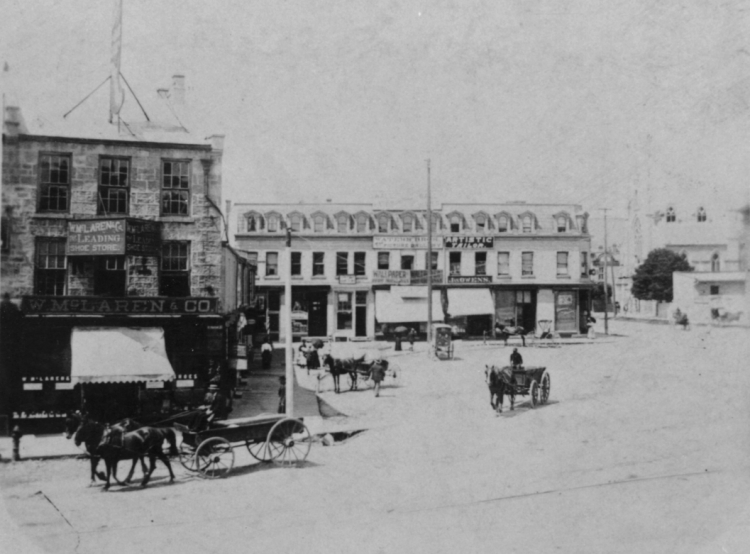
The Waters Bros. store in the Hearn Block, ca. 1895, can be seen in the photo below. It lies in the middle of the block, in the right background of the photo, behind the tall pole.


(Courtesy of Guelph Public Library, F38-0-15-0-0-22.)

The sign below the attic windows reads, "Waters Bros. // The Picture Gallery." A sign over the awning reads, "Wall paper," always a good seller, and other things that are hard to make out.

Apparently, the west did not suit the Waters Bros store for long. In September 1898, the store returned east to 39 Wyndham street, just south of St. George' Square, currently the location of a nightclub. A few years later, they moved one door up the street to 41 Wyndham street, currently the home of Guelph Today.


(41 and 39 Wyndham street, courtesy of Google Street View.)

At around the same time, the Waters family moved from Liverpool street to a substantial stone house at 27 Arthur street (now 86), backing on to the Speed River. It seems that The Picture Gallery had made Florance Waters and his family a picture of prosperity!


(86 Arthur street; Courtesy Google Street View.)

When the picture postcard craze swept the Edwardian era, the Waters Bros was a perfect position to capitalize. The store had always carried souvenir goods for special occasions such as Christmas. This, and their attention to pictures, made postcards and related phenomena a natural extension of their product line.

Postcards bearing the imprimatur of the Waters Bros. seem to come in two groups. The first group have postmarks in the date range 1908–1911 and have the same backs (in brown ink) as those published by the Pugh Mfg. Co. of Toronto (in blue ink), suggesting that both used the same printer. The views on these cards are typical for Guelph postcards of the era. For the most part, the pictures seem to have been borrowed from other producers, although a few may have been taken especially for the Waters Bros. stock.

For example, here is a nice view of Massey Hall at the Ontario Agricultural College, with a gentleman standing outside of it:


This card was addressed in 1909 by Stanley R. Dayton of Little Britain, Ontario to H. Smith of Ingersoll as part of a postcard exchange, a common arrangement of collectors who sent each other postcards of interest. The text sounds like the sort of thing that two enthusiastic, young postcard collectors would ask of each other:
Many thanks for your pretty card. How many cards have you? Do you get many out of the exchange? What do you work at? I am going to school all the time and soon.
The picture is the same as one found in a contemporary Warwick Bro's card, even to the awkward cropping on the right-hand side.

On the back, the card is identified as "Published by Waters Bros, Guelph, Ont."

Another interesting picture shows a view taken from the top of Goldie's Mill, looking down the Speed River, over the Norwich street bridge towards the spire of St. George's Church.


This card was postmarked on 3 September 1908 and was addressed by "Cousin Neil" to Miss Sadie McPherson of Guelph as follows:
Dear Sadie, You will be at school now. Ida & Tina did not get up in the holidays. Maybe they’ll come some Saturday. Our flower Sunday at Sunday School is on Sunday, the 6th Sept. How are Uncle Donald & Aunt Christie & John & all you girls? I had a good time at your place.
This image is the only version I know of issued as a colour lithograph. There is a halftone version with no publisher's mark that may have originated with Charles Nelles.

The second set of Waters Bros. cards are reprints of cards issued by the Illustrated Post Card Co. of Montreal, with postmarks in the 1911–1913 range. For example, here is a view of the then-new Carnegie Library, with a well-dressed couple posing in front:


The postcard was sent from Fergus by Harold to Harry and Florrie Lewar of London, England on 14 June 1913:
Many thanks for letters. so pleased to hear that you are not moving from London. I went washing sheep for Hastings the other day & then took a swim. I will write that character for you Harry before I leave here.
Swimming with sheep sounds like it might be highly therapeutic.

Another nice postcard from this set depicts Gow's Bridge, now often known as the McCrae Bridge, when the mill and other buildings were still present:


The subdued, watery palate of the series shows the river to good effect.

Certainly, the Waters Bros were selling postcards with their own imprimatur in the 1908–1913 period. It is quite possible that they sold postcards from other producers beforehand and even at the same time. In all, it seems likely that postcards formed a nice side line for the business

As with so many other things, the Great War changed all that. Shortly after war was declared, young William Waters volunteered for the British Columbia Horse (Mercury, 11 August 1915). The previous year, he had taken a job with Guelph's Taylor-Forbes foundry, which sent him to their Vancouver office. Finding that horses were too scarce, Waters travelled to the training camp at Valcartier, Quebec, and joined the 5th Battalion, infantry.

His military records reveal that Corporal Waters's service was not long or easy. He suffered a case of the flu in December, followed by bronchitis in January 1915. His regiment was among the first sent to France, where it became involved in the Second Battle of Ypres, where poison gas was first deployed by German forces. At Langemarck, Corporal Waters was reported to be wounded on 25 April and evacuated to a field hospital, which authorities reported to his father, Florance.

Corporal Warron, a friend of Corporal Waters who had been lightly wounded in the same attack, noted that his friend was not to be found and instigated a search. It turned out that the field hospital where Waters lay was overrun by German forces and Waters had become a prisoner of war. In August, German authorities listed Waters as dead, with no details given as to the cause. The Canadian military listed Waters as deceased and informed his family in Guelph on 10 August.

It seems likely that this string of events precipitated the sudden decision to liquidate the Waters Bros. business in April 1915, as noted above. The process was completed in September, shortly after news of William's death reached home. Curiously, advertisements for the liquidation sale are to be found in the Acton Free Press but not in the pages of the Mercury itself. It may be that the news was all over town anyway, so that local advertisements were unnecessary but that is only a guess.

A picture of Corporal William Waters was published in the Mercury on 18 August:


Curiously, for the family of a picture business, this is the only photograph of a family member that I have yet come across. (If anyone has more, let me know!)

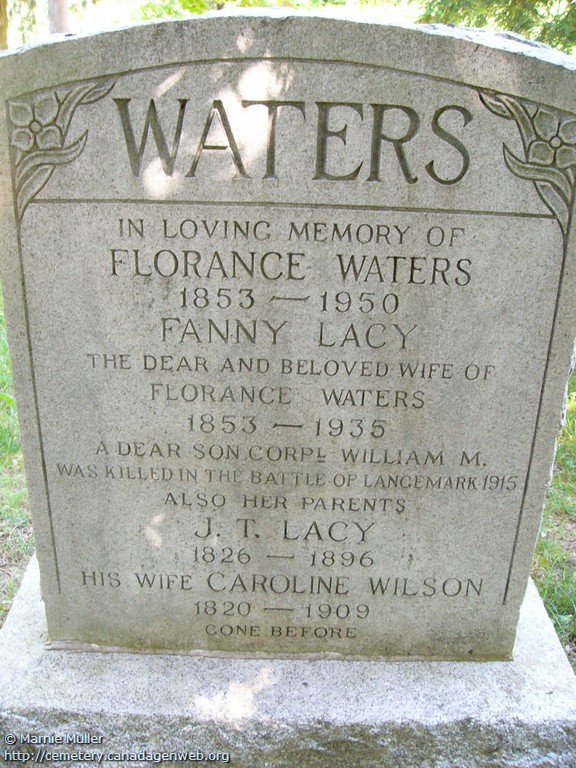
In a few months, Florance and Fanny packed up and moved to Vancouver, for reasons that remain unclear but may be connected to William's residence there. Even at such a large distance, the family was not forgotten in the Royal City. A marker is to be found in Woodlawn Cemetery, commemorating Florance and Fanny, Fanny's parents, and William:


(Courtesy of CanadaGenWeb Cemetery Project.)

Besides this marker, we have their postcards to remind us of the Waters family, their business, and the Guelph that they lived in before the Great War.

Wednesday, 30 October 2019

T.J. Hannigan: Power and politics—and postcards

Thomas Joseph Hannigan was a runner: He ran in road races, he ran businesses, he ran lobby and special interest groups, and he ran for office. He was an important figure in Guelph in the first four decades of the twentieth century. Plus, he sold a few postcards along the way.

Thomas Joseph (very often abbreviated to "T.J.") Hannigan was born on 6 Nov 1869 in Campbellford, Ontario, to John and Ellen. The family moved to Guelph in 1888 (Mercury, 27 June 1940). The 1889 city directory lists John as a tinsmith and young Thomas as a "finisher". The 1891 directory specifies Thomas's place of work as the Bell Organ factory, where he likely finished the organ cabinets.

Hannigan was a joiner in more sense than his work in carpentry. He quickly became involved in various community organizations. In 1891, he is noted as a participant in a minstrel show put on by the Guelph Catholic Union (Mercury, 30 Jan. 1891). He performed in a number called "Africans Bluebeard" described as a musical burlesque. (It's quite possible the performance was in blackface, which would be a liability for a future politician today but was unremarkable for people like Hannigan in that era.)

In 1892 and 1895, Hannigan is listed as an officer of the Canadian Order of Foresters, Court Wellington, No. 180.

In spite of his growing involvement in the social life of the Royal City, sometime in the mid 1890s, Hannigan moved to Plattsville, where he became a hotelkeeper. No doubt this move was a step up the ladder of success, working for himself rather than an employer.

In spite of the move, the connection with Guelph was not severed. In 1895, Hannigan returned to the Royal City to wed local girl Mary Tait in the Church of Our Lady (Mercury, 3 July 1895). The next year, Hannigan's father John died in Plattsville and was buried in Guelph. By 1901, Thomas and his new family had returned to the Royal City.

It seems that Hannigan was a fan of the sport of running. Once back in Guelph, he helped to found the Guelph Cross Country Run and Road Race Association (Mercury, 27 June 1940). With a time-out during the Great War, this association organized running competitions in Guelph, focussed on a set of road races on Thanksgiving Day. Hannigan's interest seems never to have wavered:

He has served as president, General manager and treasurer of this association on numerous occasions. Last year [1939] he was president again. Mr. Hannigan was also president of the Guelph Track Club.
From 1902, city directories list T.J. as the manager of a billiard hall, situated at 1 Wyndham Street, apparently on the second floor of what was the southern half of the Macdonald Block. From its windows, gentlemen at leisure would have had a splendid view of Jubilee Park, old City Hall, and the marketplace.


It appears that T.J. remained in this business until about 1910. It was during this time that he dabbled in the contemporary postcard craze. I am aware of two postcards marked "Published by T.J. Hannigan" on the back, one of St. George's Square and the other of the Church of Our Lady, where he was married. Note the distinctive handwriting featured in the captions below.


Neither card provides a printers name and neither image is unique to T.J. Hannigan. The image of the Post Office in St. George's Square can be dated to about 1904, as the third storey was added to the building in 1903, and the clock added to the empty portal in the tower in 1905. Neither postcard has been postally marked. One card, not in my possession, bears a postmark 16 Jan. 1906.

Further postcards featuring similar captions also exist. All of these have a generic "Private Post Card" logo on the back. Three cards, featuring views of the Court House, Speed River, and Macdonald Institute, have no publisher's or printer's marks. Another six cards are marked "W.G. MacFarlane," a Toronto publisher of the era. These cards feature views of St. George's Church, the Carnegie library, the General Hospital, and the Ontario Agricultural College (OAC). Cards in this set have postmarks from 3 November 1905 through 20 September 1906.

Here is a card of a man canoeing on the Speed River, probably north of the dam in Riverside Park. It has no publisher's or printer's mark.


Here is a card of the barns at the OAC. They were situated where Rozanski Hall lies today, as seen looking down Trent Lane from the north. Cards like this one are marked "W.G. MacFarlane" on the back.


Indexes on the back of these cards are marked A.103, A.105–108, and A.110, suggesting that A.104 and A.109, at least, are still to be found.

It may be that Hannigan decided to sell some postcards in his billiards hall as a side hustle, not an unusual arrangement at the time. He obtained them from W.G. MacFarlane and made them available from late 1905 and into 1906. Perhaps he saw the MacFarlane cards for sale in other businesses and ordered a few specially made for him. Alternatively, he may have sold cards from MacFarlane and perhaps others, not bothering to personalize them except for one small run.

It is hard to know for sure. It seems likely, though, that Hannigan took only a brief interest in the trade. He had other matters on his mind.

Hannigan was also involved in the organization of the Old Home Week festivities in 1908. In particular, he produced the official, souvenir program for the event, which featured views from his postcards and a lovely photo of himself.


(T.J. Hannigan, from the 1908 Old Home Week Souvenir booklet. Courtesy of Guelph Civic Museums, 1973.23.26)

The caption notes that the booklet was a sample of Hannigan's advertising. Presumably, this reference is to a business in which he was involved, although I am not yet sure what that was. It may be that his interest in postcards and in advertising at that time were somehow related. It was just as well that he was branching out.

On 17 Dec. 1909, a fire gutted the Norrish block on the Market Square (now Carden St. west), including Hannigan's pool room on the third floor (where it had been recently relocated). It was time to put the billiard business behind him. Hannigan began a new business venture, running "McDougall & Hannigan," a real estate and insurance company. In 1913, the partnership was dissolved and Hannigan operated the business on his own account. He remained in this line of work for the remainder of his life.


(Advertisement for MacDougall & Hannigan, "The men who sell real estate" from the Christmas edition of the Mercury, 1910. The address "just around the corner" seems cryptic; the city directory gives the address 89 Quebec Street East—now part of the Quebec Street Mall. Also, is it just me or does it appear that the photos are mixed up?)

Hannigan's interests in real estate in the Royal City seem to have been widespread. Irwin (1998) notes that he was involved in the disposition of properties such as Wheeler Avenue in the Ward, and Chester and Stanley streets near Exhibition Park. Plans in the University of Guelph archives associate him with developments near St. James's Church and Crimea Street.


(Ad for Hannigan's real estate business, "He knows." From the Industrial edition, 1915.)

The property that Hannigan was most involved with was Wellington Place (or Boulevard, later renamed Riverview Drive and Waverley Drive), on the east side of Riverside Park. The city directory gives his address as Wellington Place starting in 1922. There, he named his house "Athlone," presumably after the town in central Ireland where, it may be, that the Hannigan family originated.

His tenure there was not untroubled. On 7 May 1928, Hannigan was awakened at an early hour to find that his house was on fire and his bedroom filled with smoke (Mercury):

When the pungent, penetrating fumes of smoldering wood aroused him, Mr. Hannigan, clad only in his pyjames, hastened to the upper portion of the back verandah, and climbed down a post to the ground. Securing a ladder, he placed it against an upstairs window, and re-entering the smoke-filled room, assisted Mrs. Hannigan, who was dazed from the fumes, to the outside of the house.
Although there was considerable damage, Hannigan probably had the house insured. Evidently, it was repaired and he remained there for the rest of his life. Hannigan's special fondness for flowers is apparent in the remark in the article that "many valuable bulbs stored in the cellar were ruined."

Hannigan became politically active. He was elected an alderman for St. John's ward in 1913 and 1914, and in 1919 and 1920. He joined the local Conservative Party and took on a leading role. In 1937, he opposed the nomination of local boy (and future Ontario Premier) George Drew for the South Wellington seat. Rumors swirled that Hannigan would run as an Independent Conservative or that he had already prepared cards listing him as a Farmer-Labor candidate (Globe, 29 Sep. 1937). Hannigan stated that he could neither confirm nor deny the rumors, although he did not run in the end.


(George A. Drew; courtesy Wikimedia Commons)

Hannigan also threw his hat into the ring as Conservative nominee for the 1939 federal election, although he was superseded by Lieut.-Col. C.D. Crowe (Globe, 16 Aug. 1939). He put his name forward again as a National Government candidate in 1940 but again was unsuccessful (Globe, 23 Feb. 1940). At the age of 70 years, he clearly had not lost his enthusiasm for the political life!

During his life, Hannigan was best-known for his role in the development of Hydro power. In the late 19th Century, cities in southern Ontario, including Guelph, had adopted electricity for illumination, powering factories, and private use. Electricity was generated locally, near where it was consumed. In the early 20th Century, power stations were built at Niagara that could generate enough power to run many cities. Distribution of Niagara power constituted the beginning of the electrical grid that we know today.

One important matter concerned ownership of the grid. Would Niagara power be owned and distributed by private companies or a public utility? The campaign for public ownership was led by London M.P.P. Adam Beck, later knighted for his efforts. Organizations including the Hydro Electric Railway Association of Ontario and the Ontario Municipal Electric Association were quickly formed to push the program forward.


(Sir Adam Beck, ca. 1902 as Mayor of London; courtesy of London Public Library)

In Guelph, the public option was broadly preferred. As Stephen Thorning pointed out (2000), the Royal City was pleased with its own track record with its city-owned power utility and the Guelph Junction Railway. Prominent Guelphites organized to support the public option, led by millionaire publisher and civic booster J.W. Lyon, who became president of both Railway and Electric associations.


(J.W. Lyon; Men of Canada (1891, p. 230).)

Hannigan joined both efforts in top positions, such as secretary, treasurer, or both. He took over leadership from Lyon after the latter retired from the fray in the mid-1920s. He continued to promote public ownership of utility for the rest of his life, defending it against encroachments on its turf. He was successful in maintaining public ownership of the grid, although efforts to electrify the inter-city railway system did not bear fruit.

Hannigan's tenure in the Ontario Municipal Electric Association was not without controversy. Liberal leader and Premier Mitchell Hepburn accused the Association of being a "slush fund" used by Hannigan to oppose the government and conduct shady insurance deals (Globe, 13 Aug. 1934). Certainly, Hannigan was a staunch Conservative. However, such allegations were never substantiated, so far as I am aware.


(Mitchell Hepburn; courtesy of Wikimedia Commons.)

No account of T.J. Hannigan's life would be complete without some mention of his passion for flowers. He was president of the Guelph Horticultural Society for many years, and also the Ontario Horticultural Association (Mercury, 27 June 1940). He was a particular authority on gladioli and entered his blooms in many competitions.

For example, Hannigan won many awards in the second annual exhibition of the Ontario Gladioli Society, held at the Ontario Agricultural College in Guelph and attended by gladioli gurus from across the continent (London Free Press, 23 Aug. 1923). Hannigan triumphed in the categories of Best six spikes Pink Perfection, Best three spikes smokey, Best six spikes yellow, Best six spikes pink; and second place in Best 12 spikes Le Marechal Foch (Holland variety), Best three spikes variegated, Best six spikes blue, Best three varieties three spikes each, and Best 12 spikes golden.

Hannigan also became Secretary-Treasurer of the Simcoe Tobacco Plantation Ltd. in 1930 and director of the Ontario Flue-Cured Tobacco Marketing Board. It seems that he was Catholic not only in religion but in botany as well.

T.J. Hannigan died in 1940 and was buried in Marymount Cemetery (Mercury, 27 June 1940). The Guelph Cross Country Run and Road Race Association decided to name its one-mile Thanksgiving Day race the "T.J. Hannigan special race" in his honour (Mercury, 24 Sep. 1940). Certainly, it was a fitting tribute for a man who enjoyed running so much.


(Guelph Cross Country & Road Association Annual Meet, 1909. Hannigan is seated in the front row, extreme left. Courtesy of Guelph Civic Museums 1981.212.1.)

Friday, 4 October 2019

McQuillan's bridge

Without fanfare, the County of Wellington advertised for tenders for the construction of six concrete bridges (Engineering and Contract Record 1916, v. 30, n. 21, p. 46):
Sealed tenders will be received by Jas. Beattie, Esq., County Clerk, Fergus, up to 2 p.m. on Thursday, June 1st, for the construction of the following concrete bridges for the County of Wellington:

Four concrete arched trusses of 70 ft., 65 ft., 60 ft. and 30 ft., spans, and two 14-ft. slab bridges.

For plans, specifications and estimate of quantities, apply to
Bowman & Connor
31 Queen St. W., Toronto.
So far as I can tell, the 70 ft. concrete arched truss bridge was to become the new "McQuillan's bridge," that is, the crossing over the Eramosa River on the boundary line between Guelph Township and Puslinch. This bridge, like its wooden predecessors, was known as McQuillan's bridge after the McQuillan family whose farm lay immediately to its north.

The McQuillan bridge is shown in the off-centre, real-photo postcard below:


The postcard was not addressed or mailed but has "Guelph le 1er Mais 1919, Ontario Canada" written on the back, suggesting it was taken on the 1 May 1919.

Today, McQuillan's bridge can be viewed from its replacement, the Stone Road bridge, via Google Street View:


A comparison of images shows that McQuillan's bridge retains its original form, although the knobs that once capped its midsection have since gone missing. The little shield in the middle of the crosspiece over the centre of the bridge says "1916," to celebrate the year of its construction.

This type of bridge is commonly known as a bowstring bridge, to describe how the parabolic shape of the arches on the deck resemble the curve of a bow with its ends held in tension by a bowstring in the form of the bridge deck. The metaphor is apt: The bridge works by suspending the weight of the deck from the arches by virtue of steel bars in the vertical columns and handles the horizontal thrust of the arches by virtue of steel bars embedded lengthwise in the deck.

Engineers of the day called the design a concrete truss bridge with a suspended floor. This type of bridge originated in France in the early years of the 20th Century and quickly spread elsewhere, including Canada. Frank Barber (1914) wrote a short article describing the type of bridge and its early deployment in Ontario, in which he was closely involved. For example, Barber had designed the Middle Road Bridge between Toronto and Mississauga in 1909.

As Barber explains, an important advantage of the bowstring bridge is that since the superstructure of the bridge resides entirely above the deck, it does not need to be raised high on large abutments. A look at McQuillan's bridge from a low angle shows that its designers were happy to have it sit low over the Eramosa River, on the plausible assumption that nothing large needed to pass under it.


McQuillan's bridge was designed by the engineering firm Bowman and Connor of Toronto. As engineers for Wellington County (and Waterloo), they designed and oversaw the construction of many such bridges in the region.

The winning tender for this construction project went to Charles Mattaini of Fergus. Mattaini was born and raised in Vergiate, Italy, near Milan, where he worked as a mason. He immigrated to Canada in 1898 and continued his work in the construction trade (Mattaini 1979). In 1903, he moved to Fergus with his new bride, Marie Landoni, and set out his shingle as builder with expertise in foundations, cisterns, water troughs, culverts, bridges, sidewalks, etc.

Mattaini's ledger for 1916 mentions a number of projects: bridge on Irvine, bridge for Erin Township, culvert at Prison Farm, County Council bridge, and McQuillan's bridge. It seems likely that he and his crew used material from the quarry at the Prison Farm nearby to complete the culvert and McQuillan's bridge.

The McQuillan family after whom the bridge was known were also masons (Daily Mercury, 23 May 1881). James McQuillan immigrated to Canada from County Monaghan, Ireland, and arrived in Guelph in the summer of 1827, only a few months after the village was founded in April. His skills as a mason and a builder proved immediately valuable. He built the first stone structure in the village, which was, perhaps, the stone school house at the corner of Neeve and Waterloo (now Fountain) streets (since demolished).

McQuillan and his family later occupied a farm on land now part of the University of Guelph along the north side of Stone Road east of Gordon Street. There he farmed and kept a tavern for some time. He then moved a little further east to a farm north of Stone Road and east of Victoria Road, which included a stretch of the Eramosa River, where he spent the rest of his life.

The map below shows the final McQuillan farm in the 1906 Wellington County Atlas. At that time, the farm was in the possession of Arthur and Bernard, two of James McQuillan's sons. On the map, the circle in the lower-right corner shows the location of McQuillan's bridge.


The box on the map shows the laneway to McQuillan's house, which he also built (since demolished), from Victoria Road. A photograph of this house was taken by Gordon Couling in March 1969 and resides in the Wellington County Archives.


("Stone house, Concession 1 Lot 10 in Division G, Guelph Township, 1969." Wellington County Archives A1985.110.)

James McQuillan died suddenly of "old age" on 21 May 1881, in his 85th year.

In 2000, Stone Road was widened to two lanes and rerouted north of the McQuillan's bridge. As noted in "The Grand River Watershed Heritage Bridge Inventory" (2013), the old bridge was designated as a heritage structure in 2004:

The Stone Road [McQuillan] Bridge is included on the Ontario Heritage Bridge List, spans a designated Canadian Heritage River route and is considered to be an early and rare surviving example of concrete bowstring arch construction in a local, provincial and national context.
It now functions as pedestrian bridge for hikers and as a memorial to the technology and taste of builders of the early 20th century.


The McQuillan bridge is not the only memento of the prolific McQuillan family. For example, the McQuillan Block on 101–107 Wyndham Street was built by Arthur and Francis (Frank) McQuillan, two of James's sons.


The Block sits behind the tree in this Google Street View scene. Built in 1874, the Block originally extended further along the street, through the Budd's clothing store (since vacated) in the picture. In 1965, a fire destroyed the two northern units. The old sidewall of the original block can still be seen over the roof of the replacement building on the extreme left of the image.