Wednesday, 31 July 2019

The Toronto Suburban Railway: Guelph's streetcar to Toronto

On 12 April 1917, a lone streetcar from Toronto pulled into Guelph. On hand to greet it were a passel of railway dignitaries along with a clutch of curious locals. Officials with the Ontario Railway and Municipal Board and with the Toronto Suburban Railway (TSR) itself climbed on board for a "trip of inspection" back to the Big Smoke (Toronto Globe, 13 April 1917).

Before their departure, Mr. R.T. Hagen, Chief Engineer of the TSR confirmed that regular service between Guelph and Toronto was slated to start on Saturday the 14th although there would be but one car per day each way. On 1 May, after a period to identify and correct any difficulties, more frequent service would begin.

The new service was immediately well patronized. Although regular railway service between the Royal City and the Queen City had been established for decades, the idea of riding the trolley between the two (or points along the way) seemed to fulfill a need.

The cars themselves sound as though they were quite inviting. Car 101, a passenger car built at the Preston Car and Coach Company, was well appointed, finished in attractive cherrywood. The upper sashes of the side windows were glazed with leaded glass. Cars were entered from a center stairway that reached to street level for added convenience.

(TSR car #105 in front of old City Hall, Carden St., January 1918. Courtesy of Guelph Public Library F38-0-15-0-0-268.)

At the back of the car was the Main Room, featuring green, plush, upholstered, high-backed seats with headrests and footrests. A polished bronze handle on the aisle sides allowed passengers to seat themselves with dignity. A pushbutton was provided in each setting so that riders could inform the motorman of their desire to get off at the next stop. Overhead were luggage racks for storage and a three-ply, poplar veneer ceiling. A private toilet was located at the front.

At the front of the car was the Smoking Room, outfitted with low-backed seats upholstered with green pantasote—imitation leather—for a look reminiscent of a gentlemen's club. In service, the Smoking Room would have been filled with clouds of hot ash and tones of gentlemanly conversation. At the front of this room was the motorman's compartment, with the pedals, gears, levers, bells and gongs needed to control the train and communicate with its passengers.

Travelers on the TSR often used it to commute to larger centers for shopping or socializing. It became common practice for the Railway to add a trailer car to the Saturday train for shopping purposes. Ladies from smaller places along the line would visit Guelph to do their shopping and could deposit their purchases on the car over the course of the day. In the evening, the car would leave the Royal City to haul its load of goods and women on their trip home.

Traveling to parks was also a popular use. Guelphites were known to ride the TSR to attend dances at Edgewood Park in Eden Mills. In 1925, the TSR purchased Eldorado Park, a private park along the route in Chingoucousy Township, now within the town of Brampton. The idea was to boost ridership on the line by providing an attraction for passengers to visit, much as the Guelph Radial Railway (streetcar) built Riverside Park in 1905. A Ferris Wheel and Merry-Go-Round were added to make the proposition more attractive.


("Electric railways, Canada (1923)"—apparently a special excursion train from Toronto to Eldorado Park. Courtesy of British Pathé)

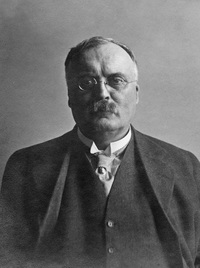
The Toronto Suburban Railway began life in 1890 as the Weston, High Park & Toronto Street Railway Company, with service centered on the town of West Toronto Junction (now known simply as "The Junction"). Two prominent railway wheeler-dealers, Sir William Mackenzie and Sir Donald Mann, known as "King" and "Duke" respectively, acquired the TSR in 1911 and began an ambitious expansion program. A line to from Lambton to Guelph was surveyed in 1911–1912, although grading and track-laying was delayed due to the Great War. Plans to carry the line through to Berlin (now Kitchener) were never realized.

(Sir William Mackenzie, April 1917. Courtesy of Library and Archives Canada.)

(Sir Donald Mann, 1907. Courtesy Wikimedia Commons.)

When the TSR Guelph line began operations in 1917, it had only four cars, 101, 104, 105, and 106, the first two being passenger coaches while the latter two also included baggage compartments. Cars 102 and 103 had burned in a fire at the Preston Car Coach Company before they could enter service. By 1918, it was clear that the TSR required more capacity, which was met by the purchase of four used, wooden, open-platform cars from the New York Elevated Company. These old wooden cars made for quite a contrast with the modern, steel cars already on the line.

(TSR car at Stop 101, in front of the Grand Trunk Station (now VIA—not seen) on Carden St., 1919. A trailer acquired from the New York Elevated Co. is attached behind. Courtesy of Guelph Public Library, F38-0-15-0-0-267.)

Two further passenger cars, 107 and 108, were added in the mid 1920s, along with a locomotive and a car-snowplow.

(TSR car #107, manufactured by the Niagara, St. Catherines & Toronto Railway (NS&T) in 1924. It was returned to the NS&T in 1935 and was rebuilt and used by that railway from 1943 through 1959. It is seen here on the Martindale trestle on the Port Dalhousie West line, 8 September 1957. Postcard by JBC Visuals; photo by Robert J. Sandusky; from the author's collection.)

The TSR had a number of interesting features. First of all, it was electric rather than steam powered. Electricity generated at Niagara Falls had recently been brought to much of southwestern Ontario, so it was available for expansive projects such as regional transportation. Power was provided to the TSR line by an overhead system suspended on brackets attached to 35 foot (10.7m) high wooden poles carrying a 25,000 volt AC, three-phase, 25 cycle current.

Power substations were built at intervals along the line to convert this power to DC for the trains. One was constructed in Guelph on Bay Street (now James Street East) although, in the event, it was used as a freight shed instead.


(Intended TSR power substation, 22 James St. E. Courtesy Google Street View. In Guelph, the TSR used the local streetcar tracks from Carden Street, down Gordon Street and then went its own way along James Street East.)

One of the implications of this system was that TSR trains gave a spectacular show in certain weather conditions. Consider a reminiscence by Jack Watkins, who recalls a memorable trip to take in a hockey game:

"I remember going to Georgetown on the thing, one night in the '20s. It was during a sleet storm—you should have seen the fireworks display from the trolley pole! We were going to see Guelph and Georgetown play hockey. We had to crawl from the suburban station to the arena. I can't remember who won the game!"
Of course, high-power electrical systems can also be quite dangerous. Norman Paul, TSR electrician at the Georgetown power substation, was electrocuted to death on 28 April 1917 (Acton Free Press, 3 May 1917). He was found unconscious with a skull fracture and both arms badly burned. It seems that he came into contact with a live wire and was hurled violently to the floor. He was rushed to Guelph General Hospital but never recovered.

Another feature of the TSR was that its route was notoriously curvy. Its riders estimated that 1/3 of the route consisted of corners instead of straight lines. The result was that the train lurched perilously from side to side during operation. Indeed, the wide, semi-circular seat at the back of the Main Room was known as the "thrill seat" because of the sideways distance it would travel as the train went along. Passengers remembered the line "fondly" as the "Corkscrew Railway" or the "Seasick Railway" as a result.

The reason for this meandering layout was to economize on land acquisition expenses. Where keeping the track straight meant purchasing expensive property, Mackenzie and Mann opted for cheaper, swervier rights of way. Besides the immediate savings, this strategy may have seemed shrewd since even a somewhat jolty trip on a nicely-appointed train was more comfortable than a trip by horse-and-buggy on the province's rutted and potholed roadways, which was the main alternative for many of the TSR's passengers.

Finally, the TSR had some impressive bridges. The most spectacular was the bridge over the Humber River just west of Lambton Park. It stood at 711 foot long and 86 feet high (217 x 26m). Passage over this vertiginous bridge may have added a giddy touch of vertigo to go with the nausea induced by the rest of the route.
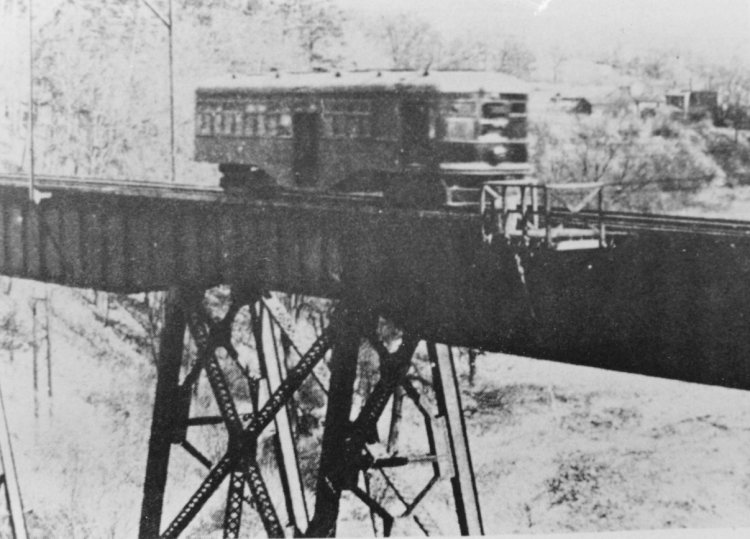
(TSR car crosses the Humber River high bridge, 1920. Courtesy of Guelph Public Library, F38-0-15-0-0-266.)

In spite of its initial popularity and considerable virtues, the TSR was not a paying proposition for long. After the Great War, automobiles found ever greater favor with the public, for both recreation and commuting. Busses began to transport groups of people between cities. Governments encouraged this trend through a broad program of road improvements and expansion. No similar effort was made to encourage rail travel, which suffered accordingly.

The TSR began to operate at a deficit in 1921. Perhaps to address this issue, the company began a freight service in 1923. One customer was the Prison Farm, which shipped milk and produce to Toronto over the line. Thus, the TSR truly became a milk run!

Even so, any hopes of profitability faded from view. The TSR ceased operations in 1931. A delegation of Acton residents went to the Canadian National Railway (CNR) office in Toronto at the time to protest the plan. (In 1918, the TSR was acquired by what later became the CNR.) The meeting ended quickly after the complainants admitted that they had made the trip to Toronto by car.

Although the TSR's assets were sold off and its tracks dismantled in the mid-1930s, some reminders of its existence remain in and around the Royal City. At the end of James Street East, past the intended power house, a trail atop the old railway bed leads under the Cutten Club along the south bank of the Eramosa River past Victoria Road and to the old Speedwell stop, near where a concrete bridge led over the river to the Prison Farm. Another section of the old railway bed can be enjoyed at the Smith Property Loop nearby in Puslinch, which is available for walking and biking.

Anyone interested in the TSR specially and local railway history generally must also visit the nearby Halton County Radial Railway on Guelph Line. The HCRY has restored trains and facilities from regional railway history and lies on a section of the TSR right-of-way through Halton County. It is open May through October.


Thanks to the Guelph Public Library and Guelph Civic Museums for assistance with research for this post.

I consulted the following sources for this effort:
Let me know about any other substantial sources in the comments, please.

Friday, 28 June 2019

The Prison Farm and the Eramosa river

In June, 2019, the Guelph Innovation District was put on sale by the Province of Ontario. This bloc consists of about 330 acres and includes the old Turfgrass Institute and also conservation lands on the west bank of the Eramosa River. Who the new owners will be and what they will build on the land is up in the air.

Change was in the air in the early 20th Century as well. As noted in an earlier posting, the Eramosa River had become a focus for recreational boating for Guelphites in the 19th Century. As a result, the geography of the river was familiar in much detail to many locals. As the 20th Century began, the Eramosa remained popular for this purpose. The summer of 1911 was no exception (Evening Mercury, 24 July 1911):

Many canoeists out.

Canoeing is one of the most popular sports followed in Guelph and the river was fairly dotted with the graceful craft yesterday. The Speed River provides one of the best canoeing courses in this part of the country, and many took advantage of the fine day for a paddle.
However, the arrival of the Ontario Prison Farm the previous year had changed the character of the Eramosa significantly. No longer mainly recreational, the Eramosa River also flowed through the boundaries of an important institution.

I have previously outlined the development of the Prison Farm, so a quick recap will do here. In 1907, local M.P.P. Joseph Downey led a government committee that made recommendations for reform of short-term prisons in the province. Up to that point, prisoners sentenced to terms between a few months and two years were often incarcerated in the Central Prison, Toronto (administered by James Massie of Guelph for many years). The Central Prison sought to recoup the costs of incarceration by putting prisoners to work in several manufacturing trades, combined with a liberal application of corporal punishment. The arrangement was never truly successful, so the government was looking for alternatives.

(Wellington South M.P.P. Joseph P. Downey, Wellington County Historical Atlas, 1906.)

The Downey report suggested construction of a new prison facility in an agricultural setting, so that prisoners could enjoy the character-building features of farm work. Plus, the farm produce could offset the cost of incarceration. Also, the facility would employ a "minimum-security" approach, forgoing bars on windows, guards with dogs and guns, etc. In this way, the "boys" could learn employable skills and gain a sense of responsibility for their own conduct.

(Provincial Secretary William J. Hanna; courtesy of Dictionary of Canadian Biography.)

Set-up of the new "Prison Farm" was led by Provincial Secretary W.J. Hanna. Since the new prison was to be an agricultural operation, the Secretary sought the advice of one of the foremost authorities at the Ontario Agricultural College (OAC) in Guelph, Professor Charles Zavitz (after whom Zavitz Hall is named). After a thorough search, Prof. Zavitz suggested the perfect locale—Guelph—as Mr. Hanna later explained in a speech on the subject to the Canadian Club of Guelph (Evening Mercury, 28 Oct. 1911):

“We asked for a land suitable for this purpose—easy of access to railways, and to some town—land suitable for agricultural purposes, with sand, gravel, stone and other materials also on the farm. There were many answers from Montreal to Winnipeg. We started out with the idea of putting the responsibility on some one else, and taking the credit to ourselves, so we went to the O.A.C., and got help there. After some investigations, Prof. Zavitz returned disappointed, for there was none suitable. Then he admitted, with great modesty, that the very thing was within sight of the O.A.C., and the city of Guelph. His modesty then was remarkable."
The land along the Eramosa certainly fulfilled these criteria, with two railways, a river, productive farmland, and surface deposit of quarry-ready stone all on site, not to mention proximity to the expertise available from the OAC itself.

(Professor Charles Zavitz; courtesy of Wikimedia Commons.)

The Province began to acquire the land immediately, finishing with the purchase of Arthur McQuillian's farm in January 1910, making a total of more than 800 acres (Globe, 18 Jan. 1910). In April, Secretary Hanna, M.P.P. Downey, and other leaders in the project visited the site to settle their plans (Globe, 2 Apr. 1910). The first contingent of 14 prisoners were transferred from the Central Prison on 11 April (Globe, 12 Apr. 1910). These "boys" were referred to as "trusties," meaning that they were trusted to behave themselves, instead of being handcuffed, shackled, or made to wear prison uniforms. They were housed in a wooden lean-to, up against a small brick cottage left standing on the grounds, and employed in sowing wheat, oats, and barley under direction of "practical men and by students from the Agricultural College" (Toronto Star, 16 Apr. 1910).

Two large, temporary barracks were constructed for lodging while permanent buildings were being designed. These were completed in June, allowing for the transfer of up to 300 prisoners.

(Temporary barracks; Courtesy Guelph Civic Museums 2004.32.101.)

Workshops were also built to facilitate construction and farm work. Perhaps the most urgent of these efforts was construction of a lime kiln in order to make the quarry operational. A kiln and stone crusher were duly built by the river in the vicinity of The Rocks, thereafter known as The Quarry. A short railway was built to facilitate transportation of the aggregate and lime to the prison's workshops.

(Stone crusher and lime kiln; Courtesy Guelph Civic Museums 2004.32.101.)

These products were needed for construction of the remainder of the prison buildings and connections to the railway. In particular, since the quarry lay on the opposite side of the Eramosa river from the CPR line, some bridges were necessary. Two were constructed. One was a picturesque concrete bridge of three spans, made using material from the quarry and labor by the prisoners.

(Three-span, concrete bridge; Courtesy of Guelph Civic Museums 2004.32.101.)

The second bridge was more utilitarian: a small, wooden trestle bridge to carry a spur line from the CPR to the farm railway near the lime kiln.

(Trestle bridge today, author's photo, 2019.)

Since the bridges were built using prison labor, there are no contract tender records that state when they were built. However, the concrete bridge is mentioned in connection with a visit to the Prison Farm of the Parole Board (Globe, 17 Dec. 1910):

After the commissioners arrived at the Reformatory, they spent some time in going over the Reformatory property, visiting the various points of interest and inspecting the live stock, particularly the magnificent herd of Holsteins. They had luncheon at the Reformatory, and afterwards visited the stone quarries, the lime kilns, and the new bridge over the River Speed, recently constructed of reinforced concrete by the prisoners and over 160 feet in length.
So, the concrete bridge was apparently in service by December, 1910.

("Prison Farm"; Postcard by International Stationary Co., ca. 1915; author's collection.)

The postcard above shows a view of the concrete bridge and Prison Farm from the west side. Background left stands the administration building and dormitories, while the workshops stand on the right.

Officials seem to have been less proud of the trestle bridge, since there is no report of it being inspected by any bigwigs. However, the Railway Commissioners of Canada had to provide express permission for any modifications of the CPR line. An authorization for the Prison Farm spur line duly appears in the The Canadian Engineer (22 Dec. 1910; v. 19, n. 25, p. 787):

[Order no.] 12409—Nov 29—Authorizing the C.P.R. Co. to construct a spur for the Provincial Reformatory, Township of Guelph, County of Wellington, Ont.
Given the haste that authorities were in to export products of the Prison Farm, it seems safe to conclude that the trestle bridge and spur line were completed shortly after this authorization was given, in other words, late 1910 or early 1911.

Construction on the Prison Farm grounds was sufficiently advanced for Ontario Premier Sir James Whitney to ceremonially lay the cornerstone of the Administration Building on 25 September 1911. Over 200 dignitaries from near and far arrived for the show. They were treated to a display of the farm produce and, of course, the feats of building accomplished by the prisoners, including the new, concrete span (Evening Mercury):

A little dump railway ran through the grounds, in which the heavy material was transferred to points where it was needed, and the handsome concrete bridge across the river Speed, where it crosses the grounds, showed what could be done in an artistic way by men who have fallen under evil influences.

(Wielding the silver trowel, Premier Whitney officially lays the cornerstone; Globe, 7 Oct. 1911.)

In their inspection of the prisoners' sleeping quarters, notice was drawn their use of postcards, among other paraphernalia, to domesticate their rooms:

The dormitory especially proved a scene of interest, as a number of the prisoners, by means of picture post-cards, calendars and newspaper pictures had made a home-like effect of their surroundings.
After the cornerstone laying and inspection, the dignitaries were treated to luncheon, served by the prisoners and featuring the produce of the farm itself. Some amusement was evident at the sight of government officials and policemen rubbing elbows with convicts. Premier Whitney took the opportunity to remark on the rectitude of this aspect of the government's efforts, given that the purpose of the Prison Farm was not primarily retribution but rehabilitiation of "unfortunate" men who had, perhaps under the influence of drink, committed minor offenses:
“This project has no part with the antics of certain hysterical people, usually women, who make heroes of wrongdoers and place offerings before murderers,” quoth Sir James. “It is designed to prove that the public is prepared to extend a helping hand to its unfortunate friends who seek to regain lost ground. It is the ordinary consideration of the most elementary fair play to give the unfortunate an opportunity to redeem themselves in future.”
The Prison Farm embodied this new program, to reform the misguided and return them to society as productive citizens.

(Sir James Whitney; courtesy Wikimedia Commons.)

Unsurprisingly, the behavior of prisoners was the subject of much local interest. For the most part, people were positively impressed. Indeed, the prisoners behaved themselves notably better than did the students of the OAC on the occasion of Halloween in 1910 (Toronto Star, 3 Nov. 1910):

If the inmates of Guelph’s prison farm had broken loose on Hallowe’en and done as much damage as is charged against the students of Guelph’s Agricultural College, there would have been protests from all over the Province, and strong pressure would have been brought to bear on Mr. Hanna to relinquish his plans for the amelioration of convict life.
The students were credited with a number of misdeeds: delaying streetcar service by greasing tracks, pulling down a highboard fence, trying to paint a fountain, blocking a streetcar track with vans, blocking Macdonald Hall entrance with vehicles, and demolishing a college post-office by locking a steer in it.

These activities resulted in eight arrests, two lawsuits, and an investigation by OAC President Creelman. One wonders how President Creelman would have compared his job to that of the Prison Warden.

Of course, the main concern was about escapes. Some escapes were regarded with amusement (Globe, 14 Nov. 1910):

A city minister claims that the prison farm inmates will not attend Sunday services unless there is a band or special soloists present. When the Protestant minister goes out he finds that most of the men are professing Roman Catholics, and when the Roman Catholic priest goes out to speak to them he finds that a surprisingly large number of them are Protestants.
Escaping Sunday sermons was perhaps understandable to some locals.

Of course, not all prisoners could resist the urge to run off. The first was George Cowan, a 16-year-old English lad jailed for sneaking rides on railway cars. He snuck away from his dormitory one evening but left an easy-to-follow trail in the wet grass and was picked up quickly in Eden Mills (Globe, 1 Oct. 1910).

Another was Charles Anderson, a Hamiltonian serving an eight-month sentence for theft (Durham Chronicle, 29 May 1913). He stole away to a hideout in a swamp near the Prison Farm but was found buried in muck with only his eyes and mouth protruding. He was disinterred and taken to the County Jail.

Other escapes were harder to fathom (Evening Mercury, 21 Jul. 1911):

Boat stolen from prison.

A boat was stolen from the Prison Farm and on searching it was found on Mr. Macalister’s property near the waterworks. It had a chain on, held by staples driven into a tree.
This escapist boat slipped away once more only four days later:
Boat again stolen.

The boat, which was stolen from the Prison Farm some time ago again mysteriously disappeared and was found pulled up on the river bank some distance below the farm. The next time the boat is tampered with the guilty party, if found, will be prosecuted.
Would the guilty party, if prosecuted, be sent to the Prison Farm? Or, was the boat not stolen but instead possessed? Why did the Prison Farm have a boat, anyway? To my knowledge, these questions were never answered. No river gives up all its secrets and the Eramosa is no exception.

In any event, Guelphites' views of that region of the Eramosa River had begun to take on a different character. It was no longer their playground but a somewhat alien place, belonging to the government and inhabited by people they did not necessarily want to mingle with. Paradise had become a prison yard. The Rocks had become the Quarry. The new bridges over the river were also visible symbols of the reach of the new institution.

(Satellite image of Eramosa river by the Prison Farm; Courtesy of Google Maps.)

Now that the land around the Eramosa is set to change hands once more, Guelphites' perspectives on the river are likely to change again.


I have not yet found any old photos of the trestle bridge. However, it remains in place although in somewhat dilapidated condition. The railway bed, minus the tracks, leading from the CPR line to the bridge still remains in place. A path leads through the brush to the deck, which is covered in grass.

(Author's photo; 2019.)

The concrete bridge was removed some years ago. However, the road bed leading from the CPR tracks to it remains in place. A path leads along its top to the river, though it is now more appreciated by geese than by people.

(Author's photo; 2019.)

Here is a picture of the Quarry being worked in its early days. Note the railway ties on the ground.

(Courtesy of Guelph Civic Museums 2004.14.18.)

Remnants of the Prison Farm railway at the Quarry can still be found in the form of ties embedded in the ground.


A 1911 booklet with a description of the Prison Farm and photos of its facilities—used above—can be found on the Guelph Civic Museums website (2004.32.101).

Saturday, 18 May 2019

Boating on the Eramosa

The Speed and Eramosa rivers have always been central to life in Guelph. John Galt chose a site by the Speed so that the swift current of the river could provide water power for mills that would process grain and lumber harvested from the surrounding region. As a result, mills shaped the early geography of the Speed, as occurred at Goldie's Mill.

Unlike the Speed, the Eramosa river keeps a languid pace, making it less attractive for milling. In the town's early days, the Eramosa (often known as the Eramosa branch of the Speed) was remembered for its use by an immense flock of passenger pigeons for a rookery in 1835. Of course, it was also used as a source of water for people and animals.

As far as the citizens of Guelph were concerned, the Eramosa came into its own later in the 19th century as a place for recreational boating. Increasing incomes allowed for some leisure time and extra cash to spend on boating gear. The usually docile current also rewarded the rowers' or paddlers' efforts more easily than did the Speed.


(Stereograph of rowers at Victoria Park on the Eramosa River. Note the Victoria Road bridge in the background. Courtesy of Guelph Civic Museums 2014.84.73.)

At the same time, around Confederation, rowing began to gain nationwide attention as a sport. In 1867, Robert Fulton, George Price, Elijah Ross, and Samuel Hilton, of St. John, New Brunswick, crossed the Pond to compete in regattas against top European Crews. The arrival of these "colonists" was greeted with some derision but the sneers vanished as the team left their competitors in their wake. They won the Paris Exposition regatta, becoming famous thereafter as the "Paris Crew." In England, they beat the cream of the Oxford University, London, and Leanders clubs—all this in an old-fashioned boat 100 pounds heavier than their rivals'. They returned to Canada to a tumultuous welcome.


(Courtesy Heritage Canada.)

The success of the Paris Crew was followed by that of Edward "Ned" Hanlan of Toronto Island. Ned Hanlan developed a local reputation competing in single sculls events in the early 1870s. He won the national championship in 1877 over a five-mile course in Toronto Bay.

From 1878 until 1884, Ned Hanlan covered himself in glory. He won the American championship in Pittsburgh in 1878, the English championship in 1879 on the Tyne, and the world championship in 1880 on the Thames in London before a crowd of 100,000 spectators. This victory made Hanlan Canada's first world champion in an individual event and an instant hero throughout English Canada.

Besides being a superb rower, Hanlan knew how to work the crowds:

Hanlan's popularity, celebrity even, resulted as much from his showmanship as from his rowing. He often toyed with opponents, slowing down, taunting them, blowing kisses at spectators, faking collapse or rowing in zigzags. (The English press lectured him sternly for his flamboyance.) He was easily Canada's "first national sporting hero," at least in English Canada. After his first English triumph he was met back home by a flotilla 5 kilometres long. In New South Wales a town was renamed Toronto in his honour. He endeared himself to Torontonians by stressing his Canadian identity. He actively took part, like any celebrity today, in numerous promotions, particularly in whistle-stop autograph tours on the eve of races. He organized his own touring shows, raced local heroes, and indulged in showboating, performing tricks such as rowing in a straight line with only one oar.


(Courtesy of CanadaSports150.)

Rowing fever quickly spread to Guelph. In April 1870, the first Guelph Boating Club was organized, accounting for about 35 members (Hacking 1873). The focus of the club was on boating for pleasure and they took some trouble to clear the river of obstructions so that it could be more easily navigated.

Indeed, it seems likely that boaters set out the local geography of the Eramosa River that remained so familiar to Guelphites for about the next fifty years. Hacking's city directory (1873, pp. 18–19) makes mention of several locales along the river connected with boating:

The Eramosa branch is specially admired by pleasure-seekers. Some distance up is an island known as “Rice Island,” and, higher yet, a spot that from its beauty has been christened “Paradise.” The approach to this spot is very fine, especially within half-a-mile of Victoria Bridge, where the long straight watery avenue, thickly clad with shrubs, and the bridge seen in the distance has a really artistic effect. Another place of resort is “The Rocks,” where good duck-shooting is to be had. Here commence a series of shallows, beyond which boating is impracticable.
Several now unfamiliar names occur here. At the time, there was only one island in Eramosa River near Guelph, a small island near the foot of Bell Avenue. Presumably, this place is Rice Island. There is no explanation given for the name but it may be that wild rice was observed to grow there. On Google Maps, the island has been dubbed "Goose island," presumably for the favor it has found with some Canada Geese. (See map below.)


Paradise refers to the area where the Eramosa bends southward about a half-mile east of the Victoria Road bridge. Today, this area is occupied by the Royal City Jaycees Park and the neighboring land subsequently turned into lakes by prisoners of the Reformatory in the 1920s–30s. Paradise was known as a beauty spot and a picnic ground. For example, the Daily Mercury (23 June 1879) relates that:

Chalmers’ Church Bible class boated to Paradise on Friday last and pic-nicked in the beautiful shade to be found there. It was a pleasant party.
Apparently, amenities such as swings and seats were provided. In 1880, the locale is described as "Bradley & Craig’s pleasure grounds," Bradley and Craig being the proprietors of the brand new boat house erected near the Dundas Bridge (and the site of today's Boat House and Tea Room). This note implies that Bradley and Craig had built up an integrated business: renting out boats in the town and arranging a pleasant destination in the township for customers to make for.


(Bend of the Eramosa River at Paradise, 2017. Author's photo.)

In addition to such feminine pursuits as swinging and picnicking, Paradise offered more manly forms of amusement (Daily Mercury, 9 June 1880):

Take care.—Pleasure parties going up the river to Bradley & Craig’s pleasure grounds at “Paradise” yesterday, report random shooting at the range while boats were passing up and down, and no red flag shown. The whistling of a bullet and report as it strikes the target may suit the ears of men and growing boys, but when ladies and children are on pleasure, it will be well for the marker and marksmen to have a care. It will be well, too, for passing navigators to stop and give some kind of alarm when in sight of the target, and then pull by as quickly as possible when the red flag is hoisted.
Today, Guelph rowers must find other incentives for pulling hard on their oars than dodging bullets.

The directory also mentions "The Rocks." The location of this feature is cleared up in the reminiscences of David Allan (1939, p. 98) where he recalls that The Rocks had later become a quarry used by the Reformatory. This locates The Rocks on the north bank of the Eramosa close to Stone Road.


(The Rocks, after quarrying by prisoners of the Ontario Reformatory, 2017. Author's photo.)

The Rocks are part of a series of rocky prominences along the Eramosa River, which were given the name the Eramosa formation in its honour. Geologically, these "Guelph dolomites" take the form of compressed layers of bituminous shales and may be as old as 425 million years.

Speaking of The Rocks in particular, Williams (1915, p. 2) notes that:

South of the prison farm near the Eramosa river, a coral reef rises through Eramosa beds which have been eroded from its top but still flank its sides. The reef is 35 yards wide by 85 yards long and rises about 20 feet at the centre.
It is interesting to think that the banks of the Eramosa River were once the site of a coral reef.

Besides their interesting geology, The Rocks were known as a good place to find wild food. Ducks for shooting have already been mentioned. In the summer, wild berries could also be found there (Mercury, 25 July 1904):

A party of berrypickers, on the dairy farm at the Rocks, of which there are quite a number, had a fright on Friday. One of the ladies nearly tramped on a snake about three feet long. They thought that it was a rattle snake by the sound that it made in its flight. It was a question of whether the ladies or the snake were more scared. Apparently the snake went for its cover, but it is certain that the ladies left the berry patch for home.
As Guelph grew, the geography of the Eramosa sustained more alterations. On 25 June 1886, another private park took shape on the south bank of the Eramosa just west of Victoria Road. The Park was named Victoria Park, after both the nearby road and, of course, the British Queen. The Boating Club made arrangements to rent the land from its owner, Mrs. Evan MacDonald, cleared it up, added tables, chairs, and other amenities suitable for picnics and camping. A sturdy dock was installed on the riverbank, along with stairs carved into the Eramosa rock for the convenience of those arriving by boat or from the nearby road.

A lovely description of Victoria Park is provided in a letter sent as an advertisement to the Acton Free Press to entice customers from further afield to enjoy the Park's offerings (22 July 1886):

... the banks are replete with natural beauty; green hedges dotted with flowers, and interspersed with vines that mount in tangled profusion to the tops of the trees in some places, and fringed at the water’s edge are ferns reflected in the clear mirror of the river, and you row along in a fairy land of nature’s own. You land at a broad wharf when you reach Victoria Park, and a sidewalk of strong planks winds away inland through ferns and tangled brushwood, and mounts on a strong stairway, with romantic seats here and there, the face of the precipice. Or, if you wish a glimpse of moss-grown boulders and lovely lovers’ walks, leave the plank walk and follow the path round the foot of the rocks which tower high over your heads, where you will find much to interest you, especially if you have with you the one person of all the world to you, to help you enjoy it.
If you mount the steep stairway you will find a high dry open space, with grand trees here and there, seats are placed round some, swings are hanging from others, and there is plenty of scope for the largest party to have the best of all good times.
The dock, seats, and swings are now gone, but the place where Victoria Park used to stand can still be accessed from the Guelph Radial Line trail or the easternmost hole of the Cutten Fields golf course.


(Victoria Park Landing, Guelph, ca. 1910, published by W.G. Macfarlane, Toronto. Author's collection.)

Later reminiscences cast a rosy glow over the pleasures of Victoria Park. During the warmer weather, people would often paddle out every Friday to camp there for the weekend. The most determined clients would camp there all summer, paddling downriver for work each morning and returning each evening.

Boating together was considered a highly romantic activity and it was said that, "Many a prominent business man in Guelph today can look back and thank the old canoe excursions for the helpmate who has been his life partner since those days of carefree companionship" (Mercury, 20 July 1927).

During its heyday in 1895–1900, boating to Victoria Park was a focus of leisure activity for many Guelphites. Campers would enjoy musical entertainments including the singing of a young Eddie Johnson (later a world-famous tenor) and the piccolo playing of Arthur Wheatley. At midnight, boaters would return to town en masse, still singing:

All the way, the river valley would echo and re-echo to the noisy choruses which were shouted lustily all the way down. Hands and arms would be made into grappling irons and the great armada of frail craft would be welded together on the return trip. Only those in the rear would paddle, and that just enough energy would be expended to keep the fleet in motion.
Another landmark arrived on the Eramosa River in 1888 in the form of a bridge to service the new Guelph Junction Railway, which initially ran from the Priory to the Canadian Pacific Railway (CPR) line at Campbellville. As the railway is operated by the CPR, the bridge is often referred to simply as the CPR bridge.


(The River Speed—Guelph, Ontario. Publisher unknown. Note the CPR bridge in the background. Author's collection.)

Although viewed with great fondness, the Eramosa River, like the Caney Fork River, is a taker and a giver. A number of boaters drowned in its waters and accounts of these events relate more of its geography to us.

The most noted drowning in the Eramosa in that era was of Hector Cooper and Eugene Gagnon on 24 May 1905. Cooper was then finishing his third year at the Ontario Agricultural College (OAC) while Gagnon, of Quebec, was taking commercial and English training at the Central School in preparation for studies at the OAC (Evening Mercury, 25 May 1904). The boys had become good friends and had decided to go for a paddle up the Eramosa at 4 o'clock that afternoon. They rented a canoe at the Boat House and set out.

A half-hour later, their canoe and a coat were found floating on Hood's bay by other boaters. Upon being informed, Mr. Johnson, owner of the Boat House, suspected that the boys had tipped over and set out for home to dry out, leaving the canoe for him to bring in. This sort of occurrence was not an uncommon one. Nevertheless, finding some of Cooper's letters in the coat pocket, Johnson sent word to the OAC to locate the boys. When Cooper was not to be found, a search party set out along the river. Cooper's body was found a few yards west from the corner turning into Macdonald’s spring. Gagnon's body was found a few hours later about fifty yards further downstream.

Both boys were fit and Hooper was said to be an excellent swimmer, so the cause of their drownings remained a mystery.

The term "Hood's bay" likely refers to George Hood, a butcher who had lived on a property on the York Road at the intersection with the eponymous Hood Street, still bearing that name today. His property backed onto the Eramosa river near where it changes from a westerly to a northerly heading. At a guess, then, Hood's bay may refer to a stretch of the river that widens out northwest of this bend, behind the location of St. Mary's Ukrainian Church today.


(Hood's bay, 2018. Photo by author.)

The feature referred to as Macdonald's spring must then be what local cartographer Jeremey Shute calls Whiteley's Creek, which rises on the University of Guelph campus and flows down through the Cutten Fields, emptying into the Eramosa River just east of Hood's bay. The Macdonalds owned the property on the south bank of the Eramosa in town and their home and other buildings lay near this stream.

Last, but not least, among the familiar places in the landscape of Eramosa boating was the Waterworks. The city Waterworks were built at the foot of Ontario street on the banks of the Eramosa in 1879. Since the waterworks were public property, the location was treated as a public park and boaters with their own craft would use it as a launching point.

Unfortunately, the accessibility of the waterworks also made it a hangout for idle young men. Sometimes, these "loafers" amused themselves at the expense of boaters (Mercury, 14 June 1887):

Bad boys—there is a fine opportunity for the police to nab the number of bad boys who congregate lightly on the Rivers edge in the bushes behind the water works. They sit there, and as every boat goes past, most vulgar and unbecoming remarks are made about the occupants, which are most revolting to the ears of the lady occupants as well as the gentleman. The employees of the water works, although having nothing to do in the matter, for the sake of decency chase them away whenever they can, but the young scamps are so wide-awake that whenever they see them approach they scamper off among the bushes and hide, only to return again when all danger is passed. A policeman in plain clothes would have no difficulty in nabbing the whole gang.
Whether or not these miscreants were ever caught I do not know.

As postcards of the Edwardian era attest, boating on the Eramosa remained a popular pastime. However, the Guelph Boating Club of 1895 came to grief in 1900. An attempt to form a new club was made in 1927 but did not succeed. With the adoption of automobiles, people took drives out in the country to have their picnics. There was talk of paving parkways along the Speed so that it could be enjoyed by car (Mercury, 28 September 1918), though the money to do so was lacking.


(Scene on the river Speed, Guelph, Canada. Published by the International Stationary Company, Picton, Ontario, ca. 1910. Author's collection.)

In addition, the geography of the Eramosa was the subject of more changes, for example, with the arrival of the Ontario Reformatory. However, that is a matter for another time.

Sunday, 21 April 2019

Elizabeth Carter, a deaf person's life in Guelph

The year 1936 was a good one for the Evangelical Church for the Deaf (United) at 56 Wellesley street (east; since demolished) in Toronto. Samuel Carter, former Mayor of Guelph and M.P.P. for Wellington South, had donated $25,000 to establish an endowment for the institution. Furthermore, the church had inducted its first minister who could communicate in sign language, Rev. Alec MacGowan, also formerly of Guelph. Curiously, neither Mr. Carter nor Rev. MacGowan were deaf. How, then, had both come to take such an interest in this service for deaf Ontarians?


(Evangelical Church for the Deaf, courtesy Toronto Public Library Archives tspa_0111020f.)

It is hard to know for certain, but it may well be that the answer lies with the recipient of the Easter postcard below:


The card was postmarked in Guelph on 7 April 1917 with the following message:
Hello Lizzie! // Thank you for remembering me in Fathers letter. How are you? I hope you have a joyous Easter you’ll soon be coming home. Ruby & the baby are coming home in May, so I am busy. Fond love, Selina
I am not sure who Selina and Ruby were, but Lizzie refers to the addressee of the postcard, Miss Elizabeth Carter, resident at the Institute for the Deaf in Belleville, Ontario. Miss Carter was a daughter of Samuel Carter and a pupil at the school. I suspect that Miss Carter accounts for her father's and Alec MacGowan's interest in the deaf.

Elizabeth Carter was born on 30 May 1899 to Samuel and Emma Carter of Guelph. Samuel Carter (usually known as Sam) was from a family of weavers of Ruddington, England, and immigrated to Canada in 1882, where he was a founder of the Royal Knitting Company. In 1898, the Company's factory was located on Norwich Street near Cardigan (now a condo building).


Besides being a prominent business person, Sam Carter was an active member of Dublin St. Methodist (later, United) Church and took part in political life. As an Alderman and Mayor, Carter promoted public ownership of utilities, such as the Light and Power Company and the city's street car system. He was elected as M.P.P. in 1914 and ran unsuccessfully for federal office in 1921.


(Samuel Carter, courtesy Wikimedia Commons, Fair use, Link)

Records of Sam Carter's life are reasonably plentiful but records of Elizabeth's life are not, so we must make do with snippets such as the postcard above. For example, the Sessional Papers of the Ontario Parliament record that Lizzie Carter was a pupil at the Ontario Institution for the Education of the Deaf and Dumb in 1909. Similar records suggest she attended that school through at least 1917. This school still exists and is now known as the Sir James Whitney School for the Deaf in Belleville. A postcard from ca. 1910 gives an idea of what Elizabeth Carter knew as her home away from home:


(Courtesy Toronto Public Library Archive PC-ON 183.)

The school was founded in 1870 as part of the new Province of Ontario's effort to provide education broadly for all its young citizens. When Elizabeth came along, it was the obvious place for her family to send her to school, as Guelph had no similar facilities. The Institution was a boarding school, so Elizabeth was away from her family a fair amount at an early age, which was no doubt stressful for her. As illustrated above, her family and friends sent her postcards to stay in touch. I have three in my collection, including the one above and the following:


This card was sent to Lizzie on 23 May 1913 by her sister, Edith, along with the following message:
Dear Lizzie // Just a card to tell you I’m going to Laconte to-morrow to see Josephine. I will remember you to her. Tim (??) & Alex & Fred are all playing foot-ball to-night. Will take you up to see them when you come home. With love, Edith
The card is a generic one that was likely used for cities all over the continent, so it likely does not show a local geographic feature. It was just a cheap and accessible way to stay in touch.

Ellis (2019, p. 128) notes that the method of instruction typical of the time was oralism, that is, teaching lip reading and speaking to the exclusion of sign language. Reasons for the approach stemmed from what was seen as an overriding need to integrate deaf people in to the general population by conforming to common practices, which did not include learning of sign language:

Bolstering pure oralism were eugenicists, nativists, progressives, and many medical professionals. They feared the expansion of a deaf community that used only sign language and intentionally separated itself from hearing people, disdained signing deaf people as backward, or viewed deafness as a pathological condition that needed modern medical treatment. Pure oralism, used in day school classes in public schools, was presented as a powerful corrective to these problems." Palen wrote that speech and lip-reading instruction represented "the making of the deaf child a part of the community, instead of apart from the community."
A fascinating overview of instruction at the Institution from 1925 is available. It displays the oralist approach to teaching and suggests how Elizabeth Carter was educated during her time there. Appropriately, the film is silent.


(Courtesy of the Library and Archives of Canada.)

In spite of this education, Elizabeth Carter did learn sign language, which students used to communicate with each other outside of their classrooms.

(Emphasis on teaching sign language to deaf pupils is known as manualism and is now normal practice in schools for the deaf.)

Although he was not deaf, Rev. MacGowan learned it also, perhaps because of Elizabeth herself.

Alexander MacGowan Jr was born in 1887 in Stirling, Scotland. Alex MacGowan Sr, a weaver, immigrated to Canada with his family in 1903 and found employment as a foreman at the Guelph Carpet Mills on Neeve street just south of the Speed River.


(Guelph Carpet Mills, courtesy of Guelph Civic Museums, 1978.29.8.2.)

It seems that Alex MacGowan Jr worked in the factory until the early 1910s, when he decamped for the University of Toronto, graduating with a degree in the Arts in 1919 and in Theology from Victoria College in 1921 (Globe, 4 July 1936). Perhaps through connections in the local weaving industry, MacGowan met the Carter family and took an interest in Sam Carter's daughters. Indeed, he may be the football-playing Alex mentioned by Edith in her postcard to Elizabeth in 1913. Evidently, Edith was impressed and became Mrs. Alex MacGowan on 9 June 1921. In 1936, he became the sign-language-using minister of the Evangelical Church for the Deaf in Toronto. Since neither he nor Edith were deaf, it is likely that his interest in the matter stemmed from his sister-in-law, Elizabeth. No doubt Sam Carter's own interest in the same church, and its new minister, were due to the same reasons.

Elizabeth Carter's doings after graduation from the Institute are not easy to trace. Tidbits come periodically from the social column of the "Deaf-mutes' Journal", a weekly publication for deaf readers that featured a "Canadian News" section. As the daughter of a prominent Canadian, news about Elizabeth appears periodically in its pages.

The first mention comes in the 25 July 1925 issue:

While Mr. and Mrs. William P. Quinlan were lately in Elmira, they called on Mr. and Mrs. Roland Hillis to meet Mrs. Quinlan’s schoolmate, Miss Elizabeth Carter, of Guelph, who with her mother, was visiting her sister, Mrs. Hillis, at that time, and all were delighted to meet each other.

Miss Elizabeth Carter and her mother, of Guelph, are spending the summer at that well known summer resort, Grimsby Beach.
From the 22 July 1926 issue, we learn that Miss Carter shared the fashion sense typical of a young woman her age:
Miss Elizabeth Carter, of Guelph, was a guest of Miss Margaret Golds for several days, prior to the latter’s recent marriage and helped the bride-to-be to prepare her trousseau for the big event on June 24th.

Miss Elizabeth Carter, of Guelph, is now one of our bobbed hair flappers.
A new figure in Elizabeth's story appears in the column of the 23 January 1930 issue:
Miss Elizabeth Carter, of Guelph, and Mr. Alfred Pemphrase [sic], of Windsor, were in this city [Toronto], over the New Year’s recess, wishing their many friends the season’s compliments.
In such a gossipy column, the fact that Miss Carter and Mr. Penprase are keeping company seems to have special significance, even though nothing is said explicitly.

Both are mentioned together again in the 16 April 1931 issue:

We were so pleased to have these two smiling ladies from Guelph, the Misses Elizabeth Carter and Mary McQueen, in our midst over Easter. The former’s father, Mr. Samuel Carter, former mayor of Guelph and M.P.P. for South Wellington, as well as her sister and brother-in-law were also with us. As was Mrs. Alfred Penprase, of Windsor.
Mr. Alfred Penprase was born in 1897 in Elmstead, near Windsor, Ontario. He and his elder sister, Ruth, were both deaf and both attended the Institute in Belleville. Alfred and Elizabeth were there at the same time, implying that they were then acquaintances, at least.

It seems that Mr. Penprase returned to Windsor after his studies and tried his hand at various jobs. The Deaf-Mutes' Journal of 14 May 1931 makes the following observation:

After our Bible conference at Easter, Mr. Alfred Penprase, of Windsor, remained here [Toronto] to look up some means to prepare himself for the future, and now he is taking a course in the art of linotyping and likes it fine. Whenever there is a meeting at our church, you are sure to meet Alfred’s genuine smiles and warm handshake.
What would cause a young man to turn his thoughts to preparations for the future?

Mr. Alfred F. Penprasa [sic] first appears in the Guelph City Directory in 1933. The following year, Mr. Alfred Penphrase [sic] appears with the occupation of poultryman. In the 1935 directory, he appears as Mr. Alfred Penphrase [sic] (Elizbth), meaning he had a wife named Elizabeth, and then resided at 245 Dublin Street, the Carter home. Elizabeth Carter became Mrs. Alfred Penprase on 24 September 1934 and the couple moved into Mr. & Mrs. Samuel Carter's residence, where Elizabeth had remained.


The last mention of the Penprases in the Deaf-mutes' Journal (17 February 1938) that I know of says the following of the new couple:

From Guelph blew in Mr. and Mrs. Alfred Penprase for a short visit with friends. Mrs. Penprase, to convince some of her skeptical friends that her home town is much colder than it is here [Toronto], went and got herself a beautiful fur coat. Ensconced in cold-proof apparel she returned home with a song on her lips to know she can now battle King Winter on even terms.
Alfred and Elizabeth continued living in the house after the deaths of Elizabeth's parents.

Though not detailed, this glimpse into the life and times of Elizabeth Carter invites us to consider what the Guelph and Ontario of former times was like to someone who experienced it from an unusual perspective.

Elizabeth died in 1968 and is memorialized at the Carter family plot in Woodlawn Cemetery along with Alfred.

Saturday, 6 April 2019

Fatal derailment at Trainor's Cut, Guelph, 1907

On 26 February 1907, the 2.50 p.m. train from Toronto for Chicago did not pull into the Grand Trunk station in Guelph at the expected time. A few minutes later, word arrived in the city that there had been a derailment—a bad one involving many injuries and several deaths. How many was uncertain but it was clear that Trainor's Cut had once again lived up to its unfortunate reputation.

Located not far east of Guelph, Trainor's Cut had been a trouble spot since the Grand Trunk Railway (G.T.R.) was laid from Rockwood to Guelph in 1855–56. In 1864, a freight train ran off the rails at the site. More recently, two freight trains had collided there in 1904, resulting in a pile up of cars over 30 high and the deaths of two employees. The latest derailment, though, seemed to be the worst yet.

Injured passengers were brought to town and began to tell concerned Guelphites what had happened (Evening Mercury, 26 Feb.):

The first passenger to reach the city was Mr. Arch. Priest, machinist of the Canadian-American Linotype Co., who was on his way to Guelph to put in a day or two at work in the Mercury office. He was driven into the city, his face covered with blood and complaining of pain in the abdomen. The extent of his injuries are not yet known. He said it was the second railway accident he had ever been in, and it was the last he ever wanted to experience. He was in the passenger coach following the baggage car, and stated that when it left the track it rolled over once before reaching the bottom of the forty foot embankment. The worst experience came with the final jar when it stopped at the bottom. Seats were wrenched from their places, the car wrecked and passengers thrown forcibly downwards, and the wreckage precipitated on top of them. Mr. Priest found himself stretched prostrate with two or three others piled on top of him, one of whom must have bled profusely, as the blood which covered his face did not come from himself.
Police and town doctors were summoned and sent to the wreckage. As passengers, officials, and bodies were brought to the city, details of the event began to emerge.

Train No. 5 was on its way from Rockwood to Guelph on its regular run (Evening Mercury, 27 Feb.). It consisted of engine 955 plus its coal tender followed by a baggage car, a combination baggage and smoker car, two passenger coaches and a Pullman parlor car. It appeared that a break occurred in a rail while the train was passing over it. Under the weight of the train, the tracks began to come apart, causing the combination car and three rear coaches to derail. These skipped over the ties for a short distance and then broke off and fell over the embankment. The coaches slid down the icy slope and then rolled over violently at the bottom. The combination car rolled to a right angle with the track and was struck by the passenger car following it, forming an "L". The cars came to rest perhaps 200 yards from the initial breakage.

The engine, tender and baggage car continued down the track. The baggage car, having skipped over the ties to this point, broke loose and dragged the tender away with it. At this point, driver William Thompson became aware of the situation and applied the emergency brake, bringing the locomotive to a stop.

The violence of the derailment was confirmed by survivors (Evening Mercury, 27 Feb.):

Mr. Anderson a foundryman, of Guelph, who was slightly injured, says that he plainly felt the jar when the car struck the broken rail. A moment later the passengers were flying through the air, grasping at anything that offered support. He was certain that the car he was on in the combination baggage and smoker turned over to or three times and he could not understand how so few were killed.
Albert Rogers, whose home is in Oshawa, thought that the car had turned over at least a couple of times before coming to a standstill at the bottom of the declivity. He was surprised that the coolness of the passengers when they had been extricated from the coaches, but said that there were some wild scenes before its windows were broken open. Some persons endeavored to escape by making a footstool of the bodies of others.
Of course, there were many serious injuries as well as three deaths: John O'Donohue and Charles Rankin, both of Stratford, and Ennis Walker, of Peterborough. Mr. O'Donohue, an ex-Mayor of Stratford and Ennis Walker were in the last passenger coach. R.J. Waite, employee of the G.T.R. who was on the car, related the scene:
Ex-Mayor O’Donohue, of Stratford, was sitting on the side of the car opposite to me, and was shot across the car, landing with his head on the clothes rack above the windows. His neck seemed to be broken, and he never moved, being instantly killed.
The child killed was seated beside her little brother. They were accompanied by their mother. They were seated on the same side as myself, and immediately ahead of me. The little girl seemed to disappear at once, and must have gone through the window and under the car. We were looking for her inside, when they got her from under the wreck. The little boy was not much hurt, apparently. The mother was dazed and distracted with grief and suffering from shock and bruises.
The fate of Charles Rankin, a hockey player, was described by Rev. R.E. Knowles of Knox Church, Galt. Rankin was sitting next to Knowles in the parlor car when the derailment occurred. Rankin had been sleeping and was hurled through a window and instantly killed. He had been married only 10 days earlier.

The bodies of the dead were taken to Tovell's undertaking house on Quebec Street. The badly injured were taken to the General Hospital and St. Joseph's Hospital. Those who sustained lesser injures or had access to their own physicians made their way home as best they could, often with the help of friends and family. The Rev. Knowles, for example, made it home to Galt that afternoon:

Rev. Mr. Knowles reached his home in Galt at 4.30, and was met by Dr. Varden. His injuries consist of a broken left shoulder blade, a sprained elbow and severe cuts on the hand. His back is also hurt. The injured clergyman said on being interviewed: “I am more a sufferer from shock than physical wounds. The awful experiences were enough to drive one mad. I scarcely think I shall have nerve enough to board another railway train."
Guelph police arrived on the scene to secure the site and any physical evidence for the Coroner's inquiry that was sure to follow.

In addition, disasters like this always drew the curious public, some of whom took pictures. Among these are the following real-photo postcards.


The caption accurately describes the scene as "Wreck near Guelph." Taken from near the top of the embankment, the picture shows the prostrate passenger cars, with many men standing both in front of and and on top of one of them. Since the car was on its side, the only way in or out was through the windows exposed on the top.

In the foreground, a man can be seen with his back to the camera who also appears to be taking a picture of the scene. So, this card is also a piece of meta-photography: a picture of someone taking a picture. Inadvertently, perhaps, it serves to remind the viewer that the scene on the card was chosen for a particular purpose In this case, the purpose seems to be to gratify an urge to gawk at disasters, suggesting that postcards could serve a purpose not unlike some images communicated through social media today.

Above second car from the right is drawn an "X". This is explained by the message on the back:

Received your card and I am sure that if you cannot get any small photo a large one will be quite acceptable. So send one along and I will await its arrival with interest. This is a photo of the place where Charlie Rankins was killed last winter the cross marks the car which crushed him. Well so long send photo soon // Earl K
The card was sent to Miss Verna Jeffrey of Saskatoon on 17 June 1907. This card is another example of senders using mark-ups to personalize postcards for their recipients. (See my earlier post, "Personalizing postcards: X marks the spot" on this device.) It also reflects the off-handedness with which disaster postcards could be selected for use.

A second car shows an image of the same scene from the east.


This image must be from somewhat later as the crash scene has been further processed. The car that the men were standing on in the first image has been flipped upright and placed on a temporary track that the G.T.R. installed to remove their assets. Damaged trucks and other parts are lined up next to the embankment on the left. Wires attached to the car can be seen overhead, leading to a derrick out of sight on the right brought to tow the cars back to the main line and on to a repair facility. The car that crushed Charles Rankin remains on its side in the foreground.

The caption confirms that the scene depicted is indeed a wreck east of Guelph and the postmark of 4 March 1907 confirms that it is the same wreck.

Between them, these images also confirm the site of the wreck. Both show the wreck on the bottom of a steep embankment. The first also shows a fairly flat landscape in the background with a couple of farm buildings in the middle distance. The second shows a dramatic upslope immediately to the west with a barn only a short distance away.

Interestingly, the Daily Mercury (10 Apr 1907) refers to postcard pictures of the wreck:

An excellent photograph, showing the position fo the coaches at the bottom of the bank east of Trainor's Cut after the recent wreck there, has been developed by Mr. Geo. Stiven, of the local Bank of Commerce staff, in post card form, and is being circulated amongst his friends.
Perhaps at least one of the postcards above was among those taken by Mr. Stiven.

Along the G.T.R. (now Canadian National) track east of Guelph, superposition of a Google Maps terrain map on top of the 1908 Wellington County Atlas shows that a site just east of Jones Baseline matches the one shown in the image. The Atlas shows the farm building of Thomas Gilfillan, shown in the first image. To the northwest and up the nearby slope is the building belonging to Joseph Fletcher, whose property fence the derailed carriages have dislodged. The site of the derailment is marked with a star.


This conclusion suggests that Trainor's Cut refers to the point where the G.T.R. tracks curve around the southern slope of the moraine beneath Jones Baseline where it intersects York Road (now Highway 7), and not a Cityview Drive, which I suggested in my post about the wreck of the Royal City hay train.

The site of the wreck can be discerned from the bridge over the tracks at the baseline, looking east towards Rockwood, just at the point where track curves out of sight.


The immediate cause of the derailment seemed clear enough: The broken rail found at the site had bounced the train from the tracks. The real issue was whether or not the G.T.R. had been negligent in its practices (Evening Mercury, 28 Feb). Coroner Dr. W.J. Robinson began an inquiry into the death of Charles Rankin, immediately empanelling a jury and arranging viewings of the bodies, the scene, and the physical evidence. In subsequent meetings, evidence was presented and the opinions of experts solicited.

The weight of the rail taken from the scene was a cause for concern. It was found to weigh about 69 lbs. per yard, considerably less than the 79 lbs. per yard that was supposed to be in place (Evening Mercury, 6 March). In addition, the railway had recently begun to use heavier engines for its trains. The engine pulling the wrecked train, No. 955, weighed about 91 tons, in contrast to earlier engines, which weighed about 80 tons. Bigger engines could pull larger loads and do it more quickly, but they might also damage rails that were not heavy enough to support them.

Similarly, the speed of the train was considered. Witnesses testified that the train was traveling fast. Its speed was eventually ascertained to be around 60 miles per hour (over 95 kph). Could this speed and the weight of the engine account for the wreck? It suggested that the engine may have broken the rail while passing over it, leaving the following cars to derail when they encountered it.

Officials of the G.T.R. argued that the rail was heavy enough for the trains and that the speed was not excessive. Yet, their arguments struck Robinson as confused and evasive. As to the rails, officials argued that the old rails were made in Britain of better steel than the new, Canadian-made, heavy rails, and so were adequate for the heavier engines. Even if true, this answer was hardly reassuring.

Robinson noted that the G.T.R. had been reinforcing the bridges along its routes in view of the bigger locomotives. So, why not reinforce the rails and roadbeds as well? Railway officials replied that it was hard to say, as bridges, roadbeds, and locomotives were under different authorities at the corporation (Evening Mercury, 13 March). Frustrated, Robinson threatened to subpoena every senior executive at the railway until he found one who could give him a straightforward answer.

G.T.R. Superintendent Brownlee appeared at the inquest a few days later (23 March). His answers struck the Mercury reporter as unenlightening. He asserted that the rails were adequate to bear the weight of the new trains. As to the condition of the roadbed, Brownlee said that:

... although the roadbed on this section was not as good as the best in the States, it was better than the 70% of them; but none used schedules of 60 miles per hour, although some ran a good deal faster, at times, to make their schedules of 50 miles per hour.
He acknowledged that a speed of 60 miles per hour was not safe for the Toronto-Sarnia run in general. Nevertheless, it was acceptable for the Rockwood-Guelph section because that section was, he claimed, unusually well adapted to high speeds. In any event, the G.T.R. had no fast rules regarding speed, which was up to the crew to decide depending on circumstances. Of course, those circumstances included the schedules defined by management, which seemed to necessitate a high speed in this section.

There was also the matter of inspection of the rails. Daily inspections were untaken by a man on a hand cart and weekly inspections by a man on foot. No inspection had taken place on the day of the wreck because the section men had been taken to Toronto for other work. Could the accident have been prevented had the daily inspection taken place? No one could say for sure but Robinson was clearly unhappy that the G.T.R. did not have enough personnel to carry out its regular safety inspections reliably.

After all the evidence and various opinions were heard and taken into account, the jury determined that the G.T.R. had been negligent in the events leading up to the death of Charles Rankin (26 March 1907, Evening Mercury):

From a careful perusal of the evidence we are of the opinion that the train was traveling at a dangerous rate of speed considering the season of the year. The weight of the rail, and engine, and we further believe were, the direct cause of the accident, that caused the death of Chas. R. Rankin.
Of course, a Coroner's jury could not lay legal blame but it could make recommendations. Hoping to prompt the G.T.R. to change its ways, Coroner Robinson communicated the result of the inquiry to the Dominion Railway Commission and the Ontario Railway and Municipal Board (Evening Mercury, 27 March). However, the signs were not good. The last piece of evidence submitted to the jury was the observation that trains from Rockwood to Guelph, featuring the heavier locomotives, were still running through Trainor's Cut at 60 miles per hour after the derailment.


In the early 20th century, the Grand Trunk Railway went on an aggressive program of expansion. There were several reasons. One was that finances were more available as the economy had finally recovered from the Panic of 1893. The G.T.R. had also hired a gung-ho, American railroad man, Charles Melville Hays, to lead the company into better times (MacKay 1993, pp. 8ff). Among his initiatives were the formation of the Grand Trunk Pacific, another transcontinental railway to compete with the Canadian Pacific, and the purchase of new locomotives and track upgrades. Prime Minister Wilfred Laurier magnified these plans to better serve his political interests in Quebec.

The plan set the railway on a collision course with insolvency. Even in this prosperous era, the economy could not support the amount of track being laid. Also, the government had considerable control over the railway, which it heavily subsidized, and did not permit increases in fees sufficient to defray costs. Also, the economic boom did not last long enough for the G.T.R. to recoup its debts.

The Grand Trunk Railway went bankrupt in 1919 and was folded into the Canadian National Railway, along with several other insolvent companies.

Charles Hays did not live to see the foundering of the railway. He was on killed on 14 April 1912 in the sinking of the Titanic while returning from a trip to London to solicit investment in the Grand Trunk Pacific. On the eve of the collision, Hays is supposed to have had a premonition of the consequences of the steamship lines' headlong adoption of bigger, faster ships, "The time will come soon when this trend will be checked by some appalling disaster."

It is curious to note that this period was one of the deadliest in the history of the railway. Nearly 600 people were killed in incidents on the Grand Trunk Railway in 1907, about half of them employees (MacKay 1993, p. 161). The account of the wreck at Trainor's Cut conveys the sense that G.T.R. employees had plenty of experience of train wrecks (Evening Mercury, 27 Feb 1907):

One passenger tells of a wise move on the part of the negro porter, who as soon as he felt that the car was off the track lay flat on his stomach in the aisles and clung to the legs of the seats. The narrator of the incident saw the wisdom of his action and followed his example, and both escaped without injury. The porter afterwards stated that he had adopted this plan of action in about 25 wrecks, and had only a rib broken on one occasion, but he added that this was the worst wreck he had experienced.
The reporter considers the number of wrecks experienced to be an exaggeration, yet the statistics suggest it should not be dismissed out of hand.


Brian Skerrett points out that the name "Trainor's Cut" apparently refers to J. Traynor, the owner of the property near where several derailments occurred. From the 1861 local atlas:


Brian also points out that Clythe's Creek runs through a culvert under the railway tracks on Traynor's property. Thus, "Trainor's Cut" may refer to that culvert.

This attribution is quite plausible. Yet, it would put Trainor's Cut west of Watson Road rather than east of Jones Baseline, a difference of some 3km (2mi). References to "Trainor's Cut" in the newspapers are maddeningly imprecise, placing it anywhere from 1 to 4 miles east of Guelph, leaving it unclear whether that means east of the city centre or the eastern boundary of the time at Victoria Road. Perhaps the term came to refer broadly to the stretch of GTR track in the vicinity of Guelph to its east.


There are a number of further photos of the wreck:


(Courtesy of Guelph Public Library F38-0-10-0-0-10.)


(Courtesy of Guelph Public Library F38-0-10-0-0-11.)


(Courtesy of Guelph Civic Museums 1980.77.1.)


(Courtesy of Guelph Civic Museums 2000.6.1.)


(Courtesy of Guelph Civic Museums 2000.6.2.)


(Courtesy of Guelph Civic Museums 2014.63.1.)

This image looks very much as though it was taken by the photographer seen in the foreground of the first postcard image shown above.


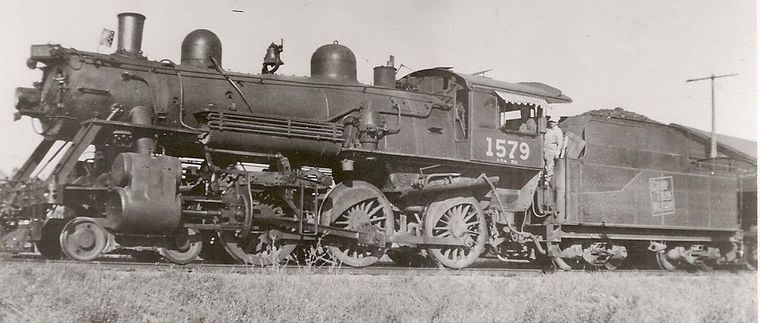
Locomotive 955 was apparently a ten-wheel locomotive built by the Locomotive and Machine Co. of Montreal (later Montreal Locomotive Works—MLW) in 1904 and belongs to 4-6-0 subclass 1-7-a. If so, then it would have looked like this:


(Courtesy of Old Time Trains.)