Saturday, 26 July 2014

The Homewood Retreat grounds

Currently known as the "Homewood Health Centre", Guelph's place of refuge for the afflicted and addicted began as the Homewood Retreat on 18 May 1883. The Retreat was the first wholly, privately owned sanitarium in Canada. The prime movers of its establishment were A. J. W. Langmuir and E. A. Meredith, both of whom were former inspectors of asylums in the Province of Ontario.

They were motivated by both humanitarian and commercial interests. Langmuir thought that a private institution might be able to enact reforms in the care of patients that were not practicable in government institutions (Sanitarium 1983). At the same time, Canadian patients who sought a higher level of comfort and service were traveling to the United States for care. A local institution would keep that revenue in the country and make a profit for the shareholders (Hurd et al., 1917).

Finding a suitable location was crucial to the success of the venture (Sanitarium 1983, p. 1):

[Langmuir] conceived the idea of a private psychiatric hospital, preferably outside of the pressurized life of the big city of Toronto, yet near enough to be accessible by railway or road for horse-drawn vehicles.
Toronto, apparently, was not a good place for people to find rest and recovery. Besides which, land would be more affordable out in the countryside.

However they did it, Langmuir and his associates located an ideal site about one mile north of the centre of Guelph. The 19-acre property epitomized the ideals of the Picturesque. It contained the crest of one of the city's many drumlins, one that commanded an excellent view of the Speed River. In addition, a large and romantic residence sat along the hilltop. This house was "Craiganour", the former home of Donald Guthrie, once the local Member of Parliament, who named it after his birthplace in Scotland.

Craiganour was made of local stone and built in the Italianate idiom then very popular in the country. Notable features include the paired windows with rounded heads, the belvedere in the projecting tower and the broad awning over the porch that stretched around two sides of the structure. The effect was meant to be impressive but, at the same time, inviting. It is a great shame that it was destroyed by an electrical fire in January 1911.

The old building can be seen in the following postcard printed by Rumsey & Co., ca. 1910.


Although the building dominates the photograph, it is the grounds that are the centre of attention. The broad lawn is impressively flat, an observation reinforced by the substantial roller in the middle. Several figures are seen at the edges of the lawn, perhaps preparing to play tennis or croquet. To the left, a stairway can be seen connecting the lawn with the main building.

The site and grounds proved helpful in the rehabilitation of patients. Clearly, outdoor recreation was an important part of the therapy. A report on the facility in the Toronto Globe mentions lawn tennis and quoiting ("The Homewood Retreat at Guelph described," 27 April 1901). The Industrial Number of the Mercury also mentions "cricket creases" (1908). In addition, there are photographs of patients playing bowls on the broad lawns (Sanitarium 1983, p. 18). In fact, a game of bowls on the lawn appears in another postcard, this one published by the International Stationary Co. of Picton also around 1910.


One thing that I enjoy about many of the postcards from this publisher is that people are integral to the photographs. (Look through previous postings to see other examples.) Here, interest in the scene consists of the postures and arrangements of the people in it. Several men sit at their ease in stick furniture while others stand about apparently discussing the play. One lies recumbent on the ground to one side, echoing the posture of the chair in the middle foreground. It is a quiet and even indolent moment.

Besides gaming and sporting possibilities, the grounds offered opportunities for the simple enjoyment of water and greenery. Visitors never failed to notice the beauty of the site and its therapeutic potential. A Globe article on the opening of the institution describes them thus ("The Homewood Retreat", 31 May 1884):

On each [patient's] flat is an alcove with large bay windows facing south, so as to receive the sun for the greater part of the day. From these windows the prospect is a delightful one. The greater part of the twenty-acre park surrounding the building spreads out in front, stretching down to the River Speed, which forms the southern boundary. Glinting patches of the river's surface are seen, changing always as the gently moving leaves close or broaden the view. Dazzled with the brightness, the eye seeks relief and finds it in the sunny or shaded green of the grove, lawn, and meadow.
...
A ramble in the grounds was almost a day's outing. The trees are all strong and beautiful and the grass close and of healthy growth. At the rear of the house are the vegetable garden and orchard, also the stable and stable-yard.
There is one postcard that may capture a view of the Speed near this place. It is labelled simply "River Speed" and was published by Valentine & Son’s sometime around 1905.


The course of the Speed and the shape of the hill opposite are appropriate for a photo taken from the Riverslea estate, built originally by James Goldie and now on the Homewood grounds a little south of the original Homewood. The vista from the belvedere at the Homewood Manor might have been similar.

Another interesting description was given in a letter sent by "Veronica" to a column called "Circle of Young Canada" in the Globe (1 April 1916). In the letter, Veronica describes the scenery where she lives in Guelph:

I'm sure you'd all admire the view from our front windows. I'm not a very good painter of pen-pictures, or any other kind for that matter, but will try to describe it to you. Our house is at the head of a little street that runs down to the River Speed, so we have a clear view of that stream. The other side of the river is closely wooded and the trees were a picture when they were turning all colors. The Homewood Sanitarium is on top of the hill, and every day as the leaves fall we discover new buildings that couldn't be seen before. One of the buildings is called "The Manor" and looks just like an old English home situated in a large park. The scenery all around is beautiful also as there are hills in every direction, either wooded or laid out as farms.
Perhaps Veronica lived near the intersection of Strange (now Dufferin) St. and Clarke St., which affords a decent view of Homewood from across the river.

Besides surveying the Homewood grounds from her window, it may be that Veronica could have explored them readily on foot. A foot bridge had been built across the Speed for the use of patients to get to Homewood from the C.P.R. line on the other side of the river (Sanitarium 1983, p. 8). It was used as such by a special delegation from the Canadian Medical Association in 1910, who were entertained with a buffet luncheon on the lawns.

(This bridge was swept away in the flood of 1912, and it is unclear whether or not it was rebuilt. There is also mention of a foot bridge near Riverslea that existed "within memory of some older Homewood employees" but was removed due to decrepitude; Sanitarium 1983, p. 8).

The Homewood grounds continue to be an important part of the facility and of the greater community. It is, for example, the site of a "horticultural therapy program". Patients learn how to plant and maintain a vegetable garden, which is therapeutic in itself and brings them outside where they can enjoy their surroundings ("Homewood garden part of food production project", Mercury, 16 July 2014):

Currently the garden grows on a roughly 190-square-metre piece of land, surrounded by the centre's beautiful lawns, woods, trails, and historic buildings.

[Program director Tami] Proctor said patients started all of the garden plants from seed and transplanted the seedlings just over a month ago. "It's a true seed-to-table garden," she said.

"This teaches people how to plant a garden," she said. "Some have never planted before, and it gives those with gardening experience the opportunity to really shine and share what they know."

A garden, she said, acts as a "grounding tool," helping patients reconnect with nature, with their senses, and with a sense of inner peace. Digging in the dirt, hearing the surrounding sounds, engaging the sense of smell and taste, is all therapeutic.
The idea is reminiscent of the original idea for the Guelph Correctional Centre, in which prisoners were to be given agricultural tasks to perform in order to detach them from their fondness for alcohol.

Unfortunately, the future of the Homewood grounds may be in question. The current owner, Schlegel Health Care Inc., has applied to the city to sever a number of the lots on the property ("Committee of Adjustment", 12 June 2014). Although no permissions have been granted, it may be that some of the Homewood estate is headed for the auction block. Whether or not that would be a good thing remains unclear, but it would change fundamentally the character of that well-trodden terrain.


26 April 2016:
Schlegel's plans for Homewood portend big changes for the site, or sites. See the Friends of Homewood Grounds website for more information.

Also, see rych mill's Flash from the Past column for more history of the site and institution.

Monday, 30 June 2014

Happy Canada Day, 2014

Canada Day (formerly Dominion Day) seems like a good time to bring out the patriotic postcards. These fall into at least two types. First, some postcards depict patriotic occasions, such as Victoria Day or Dominion Day. For example, we have already encountered this card of St. George's Square taken on Dominion Day 1954.


A second type of patriotic postcard imposes patriotic decorations on a normal scene. An example of this type can be seen in the card below. It was printed by Warwick Bros & Rutter and was postmarked on 18 Oct. 1904. Typical of early cards, it has an undivided back; that is, the back is reserved entirely for the address of the recipient, leaving only a small space on the front for a message.


The message is a very brief, "Our joint, notice the crowd. Jim." The card is addressed to Miss F. Leslie of St. Marys, Ont.

The photo on the card provides quite a nice view across St. George's Square as it appeared around the turn of the 20th Century. In the foreground is a view of the Blacksmith Fountain with the streetcar paraphernalia surrounding it.

In the background is the old Bank of Montreal building built in 1858 to the designs of architect William Thomas. To its right in the picture is the bank manager's residence, designed in the Chateau style by George Miller in 1892 (Anderson et al., 2000). On the left of the bank lies Quebec St. West with Chalmers and Knox Churches prominently in view.

The Street View photo best corresponding to this view would be the one below:


View Larger Map

The new Bank of Montreal building is visible in the place of the earlier structures, razed in 1961.

The special "Industrial number" of the Guelph Mercury of 1908 has the following to say about the bank:

The Guelph branch was established more than sixty years ago and occupies a handsome stone building which was erected by the bank about half a century ago. This was the first bank established in Guelph, and is one of the strongest and most popular in the city, a condition largely due to the able and conservative business methods under which, for the past ten years, it has been conducted by its manager, Mr. H. Lockwood. He has been identified with this bank for the past 30 years, and is one of its most honored and trusted officials. He is one of Guelph's most representative and substantial business men.
The item includes a photograph of Mr. Lockwood.

A Henry Lockwood, age 48, is listed living in Guelph in the 1901 census, along with wife Anne, children Kathleen and Norman, parents William and Eleanor, and Teresa Weiler, a domestic servant. It seems as though the manager's house on St. George's Square was both comfortable and well used.

The image of these fine bank buildings in the postcard, run by substantial, middle-class men, surely captures the image that the Royal City wished to project to the world.

The photograph is framed by patriotic symbols. On the right are the British and Canadian flags along with that odd set, a beaver with a lion and unicorn. On the left is a shield sporting the symbols of all the provinces, along with another Union Jack, topped by an imperial crown and supported with crossed sprigs of maple leaves.

In spite of the heavy use of symbolism, I do not think that the card was intended to celebrate a particular occasion. Printing photographs on paper was a costly process in that era, one that could be reduced in price by printing a smaller photo and in halftone rather than in colour. Coloured drawings could be added to take up the leftover space at relatively little additional expense. So, it is price more than patriotism that may explain the design of this card. Even so, it is an appropriate card for the country's birthday.

That leaves us with the issue of the identities of card's sender and recipient. There is a J. E. Leslie listed as a teller at the Bank of Montreal in the Vernon's City Guide of 1905–07. That is probably "Jim", who is listed as listed as a 15-year old in St. Mary's in the 1901 census as the only son of the six children of John and Mary Leslie. Miss Florence Leslie, 19 years old, is listed as his one of his sisters and is likely the addressee. So, when Jim mentioned "our joint," he did indeed mean the Bank. When he commented ironically on the "the crowd" at the bank (only one figure is visible), was he in jest, or was he another young man a little bored with his clerical job?

Since we are dealing with Canada Day and 1904, it seems appropriate to close with the Dominion Day activities planned in Guelph that year. A short article in the Mercury (30 June) gives the details. The Maple Leaf baseball team was to play a double-header against Galt in Exhibition Park, followed by a concert by the Guelph Musical Society band. As a special treat, there was to be a "throwing contest" between Guelph's Bert King and a "great throwing outfielder" from Galt.

In addition, the 11th and 16th Field Batteries were to stage a mock battle during a break in the morning game, followed by a tug of war between the two units in the afternoon. The winner would receive a silver cup from Adjutant Petrie. (Any relation to A. B. Petrie?) Also, the day would include a raffle in with the following prizes: 1st, a ticket to St. Louis; 2nd, a set of dishes; 3rd, a rocking chair; 4th, a silver cake-basket; and 5th, a lemonade set.

And so it was in the City of Guelph at Canada Day 110 years ago.

Tuesday, 10 June 2014

Wells' bridge

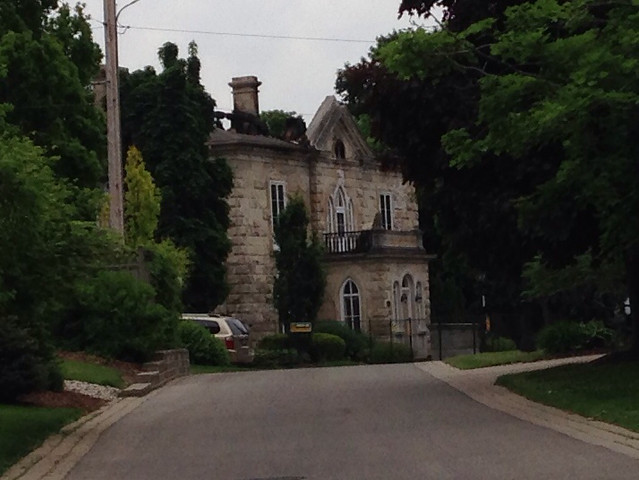
In the early morning hours of 13 May 2014, lightning struck the old manor at 25 Manor Park Crescent in Guelph. The old stone home caught fire, requiring the efforts of five city fire stations to extinguish. Witnesses described the conflagration as "fierce."

As noted in the Mercury article, the old Manor was built ca. 1857 for Arthur Wells (1824–1900), in the midst of his property just south of the Speed River, west of Edinburgh Rd. In those days, the location was known to locals as "Wells' Grove" and was considered to be at the very western edge of town at the time. Perhaps having property at the edge of town allowed Arthur and his wife Georgina Dora (née Rideout) to have a house and property of the grandeur they preferred.


As you can see below, the house is indeed striking. Gordon Couling (1976, v. 16) notes that it was probably designed by Wells and built by noted local mason Matthew Bell. Couling describes it as, "One of the finest stone homes in the city - of major architectural significance," and made from "limestone quarried on the property." Fire damage to the roof over the front gable is clearly evident.


In addition, pictures of the house are available at the Public Library Archive (here also), and the Wellington County Museum and Archives. The Library also has a portrait of Arthur, Georgina, and the family taken at the Grove ca. 1870. (The photo seems to show all eleven of their children and the youngest, Ralph, was born in 1866.) Plus, the Guelph Civic Museum has a photo of the stone barns that also sat on the property. The Wells family lived in style.

The story of Arthur Wells is related in some detail by a descendant, Jane Wells with Kathryn Bassett. Arthur was born and raised in Toronto and went to Upper Canada College. At the age of fifteen, he journeyed to Avignon in the South of France to study civil engineering at the University there. After graduation, he worked on building railway bridges in France and then returned to Canada to work on bridge building for the Grand Trunk Railway.

That work brought Arthur to Guelph where he supervised building of railway bridges at Rockwood and Guelph, at Allan's Dam. He must have liked the place as he settled in the town with Georgina and worked in various capacities, such as Deputy Postmaster, for a number of years. To all appearances, the family were upstanding citizens.

Then, in 1880, (proverbial) lightning struck the household. Arthur ran off with his housekeeper, Martha Glover. Stephen Thorning says that Wells experienced "a serious case of mid-life crisis" (Wellington Advertiser, 23 March 2007) and, indeed, Glover may have been pregnant when the pair left Guelph for Pueblo, Colorado. There, Arthur married Martha and the couple had a family of eight children in the United States.

Wells' Grove and Manor does not feature in any postcards of Guelph that I am aware of. However, the bridge over the Speed nearby at Edinburgh Road had become known as "Wells' bridge" and is labelled as such in the card below. This card was published by Warwick Bro’s & Rutter of Toronto, probably ca. 1905. (On some printings, the bridge is mislabeled as Gow's bridge, which stands further upstream.)


In those days, the Speed River flowed in not one but three channels at Edinburgh Road. Or, to put it another way, there were two large islands in the Speed at that time, requiring three bridges to span the gaps. (See this later aerial photo where the bridges are at the bottom centre.) The bridge in the postcard seems to be the three-span middle bridge, as seen roughly from the west. Look at this photo from 1928 for a similar view. Note that the Spring Bank Brewery, built by Sleeman's in 1900, is not visible in the postcard image, suggesting that it was taken before the turn of the century.

It is not clear how or when exactly Wells' name became associated with the bridge. Although Wells was a bridge builder, there is no mention of his having constructed this span. Also, since Edinburgh road itself was designated by the Canada Company in 1828 (Ross 1998), it seems likely that the structure preceded Wells' arrival in town.

The earliest use of the term "Wells' bridge" that I am aware of is in the 19 April 1869 Mercury, in which it is noted that "Wells' bridge" remained "uninjured" by a spring flood that year. Perhaps the bridge became associated with Wells because he took a special interest in it. For example, on 20 August 1867, he sent a report to the Town Council stating that the span was in a "dangerous condition" and should be open only to foot traffic until it could be repaired. It may be that this report cemented the association between Wells and the bridge in the minds of the townsfolk.

In any event, one certain connection between Arthur Wells and Wells' bridge is matrimonial misadventure, for the bridge was the site of a kidnapping and forced marriage. On 25 July 1877, Miss Annie Mary Carr, a niece of Sheriff Peter Gow, received a letter, apparently from her father stating that he would be in town the next day and asking her to meet him at Wells' bridge (Mercury, 30 July 1877 ff). She complied.

Instead of her father, however, she was met by a carriage with three men who said that they had been sent to pick her up. Unsuspecting, she climbed in and was taken to the corner of Wellington and Gordon streets where the carriage was met by Frederick Sturdy, a local painter and the man with whom she had recently broken off an engagement! He and his daughter Louise pushed her into the back of the carriage and ordered her to be quiet. The carriage proceeded out of town by Victoria road and south to Hamilton, where Miss Carr was confined in a house in a secluded location. Plied with alcohol and threats, Miss Carr agreed to marry Sturdy, the ceremony being quickly performed at the residence of the Rev. D. H. Fletcher, who seems to have suspected nothing.

It seems, though, that Miss Carr was missed and Sturdy suspected. Two constables from Guelph were sent to Hamilton on Saturday to investigate. They located Sturdy's carriage at the American Hotel there. Although Sturdy's whereabouts were not known, he had left instructions to prepare his horses for Sunday afternoon at five o'clock, so the constables decided to wait him out. Sheriff Gow arrived at 4pm and the three of them arrested Sturdy when he turned up. Upon finding out the location of Sturdy's hideout—104 Locomotive St.—Gow drove out and rescued his niece. She was returned to Guelph, and Sturdy and his daughter (and Sturdy's other assistants) were brought there to prison to await trial.

The sensational story was evidently picked up by newspapers around the continent, even as far as the Feliciana Sentinel of St. Francisville, Louisiana (25 August 1877). The Mercury described the abduction and forced marriage as "one of the blackest crimes ever committed in Guelph" and a deed that,

... would make the blood of all respectable citizens boil over with righteous indignation, and at the same time ask the question, "Can such an outrage have been committed in a civilized community?"
Despite the infamy of the abduction, it is not recalled in later histories of the town, much like Wells' flight to Colorado with his housekeeper. Perhaps both were tales too painful to repeat.

In any event, Wells' bridge remained in continuous use for 100 years or more. By the 1950s, however, the City of Guelph and the Grand River Conservation Authority had decided on some major alternations to the Speed River downtown. The City wanted to widen the bridge at Edinburgh Road to increase the flow of cars. This improvement to Edinburgh would also help with plans for a major new road along the riverfront ("Memorial Parkway", now Wellington Road). The Conservation Authority sought likewise to increase the flow of water in the Speed and thus reduce the perennial risk of flood along its banks.

In 1957, contractors dredged out the middle channel of the Speed, widening and straightening it like a highway. The overburden was used to fill in the north and south channels of the river, where Wellington Road and the Royal Recreation Trails now lie (Mercury, 23 Feb. 1956; 18 July 1957). Mostly likely, the rubble from Wells' bridge lies buried there too, along with whatever other tales it might have had to tell.

Wednesday, 7 May 2014

The island in the Square

The City of Guelph is contemplating some further changes to its downtown spaces. One of the changes under consideration is the construction of a large roundabout in St. George's Square. The main aim of the proposal is to establish a convivial public plaza in the large space that the new design would create there. A mock-up of the new design appears in the draft Streetscape Manual produced recently by the city:


The report on downtown Guelph prepared by the Project for Public Spaces notes that:

Throughout history, St. George’s Square has always been a Central Square for the City of Guelph. During the past half century however, the Square’s more ceremonial and iconic elements gave way to more functional elements that were needed to support a growing city, namely transit service and a growing street network. Until very recently, St. George’s Square was the central bus transfer hub for downtown Guelph.
The proposed redesign would, among other things, return the Square to its earlier role.

Of course, the history of St. George's Square, and the space in its centre, is more complicated than that. It has been the site both of much traffic and of much controversy. A little of the story of St. George's Square appears in this earlier blog entry. However, since the Square has been of perennial interest to postcard makers, its history can be explored in this blog more thoroughly. For the present, I will outline this history and save more detailed accounts for later postings.

The Square began as a spot dedicated by John Galt to the Anglican Church. The first St. George's Church, a wood frame structure, was built in the middle of the space in 1833. Thus, it was the first island in the Square. Its location in the middle of Wyndham St. made it "one of the most conspicuous objects in the town..." in the opinion of a British visitor (Johnson 1977, p. 114). By 1851, the growth of the congregation required a larger church, and a stone building was constructed in the same location. As soon as 1859, however, prominent parishioners were seeking a new site for the church, one that was bigger still and removed from the commercial centre of the City (Johnson 1977, p. 223). By 1873, Dr. William Clarke had arranged for a new site (the current one) and the sale of the old site to the town. The second church was razed and the new one built at that time. After the rubble was removed, the Square stood empty for almost the first time.

The removal of the Church seems to imply that the townsfolk did not appreciate the detour that it necessitated. However, it did not take them long to seek out a new landmark to put down in the same place. In 1884, the citizens decided that the middle of the Square would be a good place for a fountain. The City Council collected donations, including a bronze statue of a blacksmith from local manufacturer J. B. Armstrong. The statue was placed atop a marble fountain and surrounded by a little garden, the whole becoming known as "The Blacksmith Fountain" (Couling 1996, p. 6).

The Blacksmith Fountain was octagonal in shape, framed by a small stretch of grass, and surrounded in turn by a short fence. It was joined by an arc-light on a pole for illumination. And thus, St. George's Square had its island back. A photo of the Square featuring the Blacksmith Fountain can been seen here.

The first major change to the island was the arrival of the Guelph Street Railway system in 1894. George Sleeman, the brewer, entered into what we would call a public-private partnership with the City to build a streetcar system (Johnson 1977, p. 285). As the tracks were laid up Wyndham St., they passed on either side of the Blacksmith Fountain. The Fountain then became an important stop along the streetcar's route. This confluence of uses proved fateful.

A good view of the Fountain as it then appeared can be seen on the postcard below. It was printed by Warwick Bros. & Rutter of Toronto.


The photo was taken in 1907. The presence of the clock face in the Post Office tower dates the photo to no earlier than 1907 and the Fountain was altered in 1908, as we shall see.

The photo provides an excellent view of the Fountain and its immediate surroundings. The plantings around it are rendered in green by the lithographer, and the streetcar tracks on either sign are quite visible. Also visible is the base of the arc-light pole on the Upper Wyndham side. Interestingly, serrations are also apparent on the top of the fence rails around the Fountain. It seems clear that the designers of the garden wanted to let no casual intruders near the structure. It was for viewing only!

In 1908, Guelph celebrated its first Old Home Week. Photos of St. George's Square during parades through the city (like this one) show that the island had been renovated. The Fountain appears unchanged but the garden around it has been enlarged and changed to an oval shape, with the long axis along Wyndham St. The oval neatly fills in the lines of the streetcar tracks around the Fountain. Also, the arc-light pole has been replaced by a flag pole.

Photos of Old Home Week that year tend to obscure the island (although this photo shows people sitting in it while enjoying a parade.) However, postcards from roughly the same time more clearly show the island after this renovation. The card below, for example, shows the island along with its new fence. Keep off the grass! Also, note that the arc light is now mounted on a wire strung across the Square.


This card was also printed by Warwick Bros. and Rutter of Toronto, although in halftone (now yellowed). In addition to the features already mentioned, you can see benches placed at the end of the island facing Upper Wyndham for people to sit on as they kill time or await the next streetcar.

One aspect of street life that stands out in those older pictures is that people, streetcars, and horse-drawn conveyances tend to mingle freely on the street. In those days, streets were regarded as public places. Thus, everybody had a right to be in them. Standing in the middle of the street talking or waiting for a streetcar, for example, were perfectly acceptable things to do. All that changed in the era of the automobile.

By the 1920s, people were committed to the automobile as their main means of personal transportation. As a result, other street users were pressured to change their ways. Streetcars struggled to compete for ridership, while people on foot were increasingly confined to the sidewalks. These trends are certainly evident in the changing fortunes of the island in the Square.

In 1921, the Guelph streetcar system was purchased by Ontario Hydro, which set about rationalizing its service. One of their first moves was to make changes in the layout of the island. The Blacksmith Fountain was removed and relocated to its new home in Priory Square, where it remains today. New streetcar tracks were run directly through the centre of the Square, while two half-oval gardens were planted on either side. In effect, the island was split in two. Its inside edges provided boarding platforms for the streetcars while benches were placed on its outside edges for people to sit in the street.

This configuration can be seen in the postcard below. It was printed by The Valentine & Sons United Publishing Co., Ltd., Toronto, from a photo taken ca. 1925. (It is postmarked on 1 April, 1931.)


The picture suggests how many cars were commonly on the street at that time. With increasing car traffic in the Square, the presence of a transit depot in its centre island seemed bound to create conflict. And it did! However, remarkably perhaps, the island in the Square persisted for quite a while yet. Among other factors, the Great Depression and the Second World War delayed any major changes in infrastructure.

One change that did occur in that time, however, was the replacement of the streetcars by busses. The streetcar system proved to be a money-loser for Ontario Hydro, which attempted to sell the system back to the City in 1926. No sale! Finally, the streetcars were replaced entirely by busses in 1937, which continued to use the island as a central depot.

The island of this era, now going by the name of "The Circle", can be viewed in this postcard from 1942 (Coulman, 1977, n. 211). It was published by the Photogelatine Engraving Co., Ltd., Toronto and was postmarked in 1953.


The Circle remains much as before, although it now plays host to buses, and there are no benches to allow people to sit in the street. Still, pedestrians are clearly expected to cross through traffic in order to get to the bus stop, a maneuver that grew increasingly dangerous as time went on.

After the Second World War, the economy picked up steam and car ownership resumed its climb. As such, the Circle had to go. In 1953, in the midst of much controversy, the City altered the island again. It increased the middle space from two lanes to four and placed concrete barriers along each side. The barriers discouraged pedestrians from walking through the middle of the Square to catch a bus.

This setup can be seen in the following postcard, taken on Dominion Day in 1954 (Coulman, 1977, n. 212). (Note the patriotic bunting hanging over the roadway.) It was published by the Photogelatine Engraving Co., Ltd., Toronto ca. 1955.


Not long after this photo was taken, the island was removed entirely. Bus stops were moved off to the sides of the Square. Now cars could pass along Wyndham Street straight through the middle of the Square without impediment.

The Street View scene roughly equivalent to the previous postcard would be the one below. No island there!


View Larger Map

The fate of the island illustrates the impact that automobile adoption had on many streets in older cities. Designed originally for foot and horse traffic, these streets were redesigned to more closely resemble highways, by widening and straightening. The island in the Square resisted this treatment for a long time, out of its centrality to public transit and perhaps the attachment of older citizens to the Royal City's established ways. These are themes that can be explored in further postings.

Setting aside any practical considerations, I find it intriguing to imagine being on foot on an island in the middle of the Square, having traffic pass around me like the spokes on a wheel turning about its hub. It is hard to imagine, though, since I am used either to fleeing across it on foot or to wheeling through it in my car. If the notion of putting an island back in St. George's Square is to succeed, it will have to capture the imaginations of Guelphites, who will now find it alien and unfamiliar.

Monday, 7 April 2014

The Prince of Wales visits the O.A.C.

The first sentence in the 1919 O.A.C. Review article (v. 32, no. 3, p. 134) puts the matter succinctly: "October the 21st was a red letter day in the history of the College—the Prince of Wales visited us for a couple of hours." Of course, Edward, then Prince of Wales, visited much of the Royal City, including the College, but it was his brief tour of the O.A.C., and Macdonald Hall in particular, that caught the public's attention.

During his extensive tour of Canada in 1919, the future Edward VIII visited many Canadian cities. On October 21, his train pulled into the Grand Trunk Station downtown so that he could make a stop in the Royal City. On his arrival, he was greeted by Mayor James Carter, M.P. Hugh Guthrie, and other civic dignitaries. After a brief inspection of the veteran's honour guard, the party proceeded across the street to a platform at the old City Hall where the Mayor gave a speech of welcome (The Globe, 22 Oct., p. 7).

The main purpose of the Prince's tour of Canada was to thank the nation for its efforts in the Great War and to reaffirm its importance to the Mother Country. These points were the main ones made in his brief reply to the Mayor (Guelph Evening Mercury, 21 Oct. 1919):

Mr. Mayor, I thank you most sincerely for your hearty welcome and loyal address. Your warm expression of attachment to the King and Queen has touched me very much, and I will not fail to convey it to them on my return. Their Majesties have, I know, a very pleasant recollection of their visit to Guelph eighteen years ago.
...
I know that the war services of Guelph were very great, and I wish to congratulate all your citizens, men and women, on their fine contribution to the united effort which has finally given us victory and peace.
There were more speeches, a medal presentation, and a parade up Wyndham St. and Woolwich St., as far as Clark St. Although it was raining, the Prince had the roof of his car left open so that people lining the parade route could see him. However, he did get "soaked to the skin."

Afterward, the Prince was driven through town to the Speedwell Hospital, formerly the "prison farm", where military veterans were recuperating from the war. Following that, His Royal Highness (HRH) went on to the O.A.C.

The remaining pages of the Evening Mercury give the O.A.C. visit barely a mention. However, other papers give pride of place to this part of HRH's visit, especially his interactions with the young women of Macdonald Hall. Arriving at about 11:45, the Prince was treated to luncheon there. The Toronto Star (22 Oct.) provides the most detailed account in an article entitled "Prince won hearts of all Guelph Co-eds":

The fair co-eds at Macdonald Hall, more than 200 of the prettiest and peppiest girls imaginable simply threw themselves at the head of the Prince of Wales on his visit to Guelph Agricultural College yesterday and gave him the most heart-thrilling time of his young male life.
The students sang "Johnny's in Town", a favourite tune of the Prince, and waved "a hurricane" of white handkerchiefs up and down, which was a customary way for women to wave at a parade at the time.
The Prince lunched in the bay window recess of the dining room, the girls greeting him with cheers and standing until he took his place. Six of the very prettiest, who had begged the honour, waited on the Prince's table, trim and chic in blue dresses with white aprons and collars.
After lunch and a dessert of pumpkin pie, the young party went out to the front steps of the Hall and posed for the photographers and "movie men" who accompanied HRH on his tour. At that time, this photograph was taken.


This reproduction is a postcard produced after the tour by British firm, J. Beagles and Co., which specialized in celebrity images. In it can be seen the Prince, holding a cigarette and sporting a flower in his lapel given him by the Mac girls. To the right of him in front stands Mary Watson, principal (dean) of the Macdonald Institute, and in back of him stands Katherine Fuller, the matron of the Hall (Guelph McLaughlin Archives RE1 OAC A0234).

You can see the front steps as they appear today in this image from the University of Guelph campus map:


Everyone appears to be laughing. The cause is the umbrella being held by the young woman in the lower left corner. The Toronto Star describes it in this way:

In the vivacious scramble one girl's umbrella handle got twisted. She was sure the Prince had done it. "I will buy you another," he offered, laughing.
"No, indeed," she replied, pertly. "I'll just keep it as a souvenir."
In his "A picture history of Guelph" (v. 1, p. 12), R.A.M. Stewart gives a slightly different account:
The general merriment was caused by the fact that the end of a cigarette thrown away by the Prince burned a little hole in the umbrella of the maiden on the extreme left, with the result that H.R.H. gallantly desired to replace it.
Stewart's account, along with his reproduction of the same photograph, may come from the front page of the Mercury, now missing from the archives.

Many photographs were taken of the Prince's visit to the city and the O.A.C. However, this image and the story behind it was, by far, the most widely reported and remembered. Why were reporters so keen on relating it?

Perhaps it related well to the general mission of the tour. HRH was in Canada, in part, to reaffirm the old order. During the war, women had assumed a number of roles and occupations previously reserved for men. Afterwards, they were expected to relinquish them to the returning veterans. The Prince's visit to the women's school, with the accompanying emphasis on his virility in contrast to the residents' femininity, symbolized the return of normalcy in gender roles.

It may also be that the visit played into local stereotypes about the Macdonald Institute. James Snell ("Macdonald Institute", 2003, p. 52) notes that many students at the Hall found husbands on campus:

Many of the young women "paired off" with men from the OAC, so much so that by the early 1910s the Mac program, particularly the short program, had already earned the famous nickname, the "diamond ring" course.
The marital reputation of the Hall was ready-made for a news story, with HRH, though unattainable, in the place of the male O.A.C. students.

Certainly, the Mac girls did seem to be star-struck. For example, the young women who waited on HRH in the Hall snatched some unusual souvenirs, including the butt of his cigarette and several unconsumed items of his food such as a piece of celery, a pie crust, and a lump of sugar. As he set out for his campus tour, they trailed after him singing "For he's a jolly good fellow." Later, when he got into his car to leave for the train station, they crowded around begging for his cigarettes (Toronto Star, 22 Oct.):

He took out his case, stuck one in his mouth, and then emptied the whole lot into their outstretched hands. There was much giggling and scrambling for the precious smokes.
You might see similar behaviour at a boy-band concert today!

Mind you, the Prince or his staff had planned for just such a situation. They had prepared souvenir photographs of HRH for distribution to the Hall residents, an example of which can be found in the archives. Either they anticipated the behaviour of the residents, or they wanted to prompt it.

By about 2pm, the Prince had been driven downtown and was on board his train headed for Stratford. The reporters were busy writing up their stories presenting HRH as "Prince Charming" to the pretty girls of the Macdonald Institute. It seems clear that the Mac women were duly impressed. For his part, it seems that the Prince also found the moment a pleasant one (Toronto Globe, 22 Oct.): "The Prince expressed himself pleased at his visit here, and at meeting so many young ladies, the change from meeting so many men being a most agreeable one."

In addition to still photographs like the one in this postcard, there are also several movie reels of the Prince's Canadian tour. Some parts are shown in this video from Library Archive Canada:


Others can be found in segments at British Pathé: Part 1, Part 2, Part 3, and
Part 4. Unfortunately, none of these videos shows HRH in Guelph. Perhaps that reel, if it exists, remains in storage somewhere.

Monday, 17 March 2014

The Knox Church fire of 1904

As we have seen, people have had many uses for postcards, from merely staying in touch to entering contests. Another use for postcards has been for people to report on and relate themselves to important events of the day.

This postcard of Knox Church on Quebec St. provides a good example. (Note that the message space is placed on the side of the front of the card and not on the back. This feature identifies this card as an early type, made from ca. 1900–1905 called the "undivided back". The entire reverse side was reserved solely for the destination address.)


Knox Church can trace its origins to the so-called Disruption of the Church of Scotland of 1843. Presbyterians were divided over the role that the state should play in the affairs of the Kirk. Those who wanted to lessen the role of the State broke away to form the Free Church of Scotland.

However, there was dissent within the Free Church itself. In Guelph, this dissent resulted in the formation of two separate congregations breaking away from St. Andrew's church. One group was optimistically called the United Presbyterians, who erected a small building at Cambridge and Dublin Streets (long gone). The other group built a small chapel called Knox Church on Yarmouth St. in 1847 (Anderson, "History of Guelph", p. 112). (See a photo of this church here.) In the late 1860s, this site was sold to the Raymond Sewing Machine Company, which erected their factory along that block (Couling 1996, p. 12). The Knox congregation built itself a smart new stone church around the corner at the intersection of Quebec and Baker Streets. The cornerstone was laid in October 1868 (Historic Guelph, v. 1, n. 7). (See a photo of this church here.)

The vestibule and bell tower prominent in the postcard were added in 1900–1, along with an extension to the back to accommodate a new organ.

Here is the building today, looking remarkably preserved.


View Larger Map

One reason why the preservation of Knox Church is remarkable is that the building suffered a major fire 110 years ago, in March 1904, the year it celebrated its diamond jubilee. The Guelph Evening Mercury of March 17 gives a detailed account of the blaze, its handling by the fire department, and its cost.

The fire seems to have originated in one of the church's two furnaces, the one in the south corner of the basement. On Wednesday, March 16, the church janitor started a fire in that furnace at about 3pm and remained until 4pm to see that it was burning properly. The fire was not large as the janitor had used only four coal scuttles instead of the usual eight. The reason for the spread of the fire was unclear, although the writer speculates that it may have migrated up the cold air return by igniting some stray, flammable material there.

In any event, flames spread from the furnace up the stairs and into the gallery on the main floor. Also, they ran between the basement ceiling and the flooring above, scorching much of that space.

The fire was noticed about 6:20pm, at which point the alarm was raised. Some citizens set to work fighting the blaze with extinguishers while the fire department was summoned. The newspaper gives a detailed account of how the fire department performed. The hose wagon was slightly delayed by slippery conditions but soon had five streams of water to bear on the flames. At that point, however, things seemed ominous for the church:

About the time the firemen came up an explosion occurred inside the church, and the one half of each of the windows on the side of the church looking toward Nelson Crescent [west], was forced out. A few moments later, a second explosion occurred, and the windows on the other side were all similarly affected. The large window and one of the smaller windows at the front end were also blown out. At one time, with the smoke pouring out of all the upper windows and mounting away up in the tower, it looked as if the whole building was doomed.
It must have been quite a sight!

Happily, though, the firemen were well-equipped and determined, and had the blaze under control by 8pm and extinguished by about 10pm.

They did this in spite of facing several difficulties apart from the fire itself. The paper reports that, in addition to the slippery conditions, other vehicles did not clear off the road. The hook and ladder truck had to swerve around a "bake cart", causing it to overturn and strike a bystander who was thrown into a ditch, though not severely injured. The truck sustained some wheel and body damage. A fireman was accidentally struck "on the eye" by the axe of another although he somehow escaped serious injury. A hose burst when it was hooked up to a hydrant, and four respirators somehow went missing in the confusion which "... the firemen would like to have ... returned as soon as possible."

Although the building was saved, there was substantial damage. According to the Mercury of March 21, 1904, the insurance appraisers put the total cost of repairs at $6190, of which $750 would go towards the restoration of its new organ. Happily, the church had $10,000 in coverage, so repairs could be undertaken immediately. In the meantime, the congregation held services in the Opera House on Upper Wyndham St.

It is easy to imagine how eager people would be to spread and discuss news of this major event. Our postcard certainly testifies to that. Here is the message from the side of the card, sent the very next day after the fire:

Mar 17/04 // Damaged by fire last night to extent of about six thousand. You can usually find me upstairs Sunday night. It is a one [sic] of the best in city, in fact, I think best. Had a view of interior this morning. Love to all. Morley.
The addressee is "Mrs. J. C. Allens, Brooklin, Ont". No publisher is identified.

I am not certain who Morley was. However, a "Marley [sic] Walker" is listed in the Vernon Street Guide to Guelph (1917) as a clerk in the city Post Office. This person is likely the same Morley Walker who later became the Postmaster from 1936-1945. A Morley Walker is also listed in the Program of 100th Anniversary Services for Knox Presbyterian Church (1944) as Chairman of the Centennial Committee. Since "Morley" was not a common name, it is plausible that these various records refer to the same individual. The 1901 Census lists Morley as born in 1882 in Wellington South, so he would have been 21 years old when the fire occurred. Perhaps young Morley was doing some clerical work for the church at the time while also getting started at the Post Office. How appropriate, then, that he should use a postcard to relate news of the fire!

Knox Church was repaired by and reoccupied on July 10, 1904. With the trauma and excitement of the blaze behind them, the congregation and the general population of the City went on with their lives. Memory of the blaze faded from mind but a glimpse of it and those affected by it are afforded again through this postcard.

Thursday, 20 February 2014

Guelph Correctional Centre

If asked about long-standing institutions in the Royal City, you might think first of the Ontario Agricultural College. That would be perfectly understandable. However, Guelph is also the site of another historical, Provincial institution, lately known as the Guelph Correctional Centre. For about 90 years, Guelph was the site of a provincial jail. How did it get there?

The answer involves changes in provincial politics and attitudes towards crime ("Joseph P. Downey and prison reform", W. J. Waines, Historic Guelph 16, 1977). In 1902, Joseph Downey was elected the first conservative member of the Legislative Assembly of Ontario from Wellington South. In 1905, Downey was re-elected and became part of the first Conservative government of the province under James Whitney. Downey, it seems, had a special interest in prison reform and was appointed chair of the Special Committee on Prison Labour in 1907.

The Committee was given a mandate to inquire into the issue of how prison labour might comport with "free" labour in the province. At the time, prisoners were not normally given opportunities to work while incarcerated, while those who did laboured under what we would call sweatshop conditions. Downey had the idea that work under normal conditions would be beneficial for prisoners–who would acquire employable skills–and for society because employable ex-prisoners would be less likely to re-offend.

The Committee members visited prison facilities in the Central Prison in Toronto, and also reform facilities in Europe, Australia, and New Zealand. In their report to the Legislature in 1908, the Committee recommended that the Province should set up a reformatory, where first-time prisoners guilty of minor offenses could be rehabilitated through employment. In particular, the Committee singled out agricultural work as most suited to the purpose of reform:

How does employment in the open air, especially farm work, meet these
requirements? It is productive, for nature is generous in her return for
labor expended on the soil. It is remunerative because the produce of the
field can immediately be used not only by the Institution itself but by other
Institutions under Government control, thereby saving materially the cost
of maintaining the Institutions. It is labor which offers the least compe-
tition to free labor.
In addition to its productivity, agricultural work is especially good for the character of people prone to criminality (note the connection with the temperance movement of the era):
Crime, in a large majority of cases is traceable to alcoholism and its consequences.
Work in the open air with well regulated diet is without doubt the best means of curing the drunkard, and this is especially so if the reformatory can detain him until cured. ... Outside labor improves the health of the prisoner, and in improving the physical condition, lays the foundation for moral improvement. The great diversity of occupations which may be carried on in an Agricultural Reformatory permits a constant change of work which is in itself a great help towards a prisoner's reformation. Labor on the farm is educational because of the many different kinds of occupation offered, and the opportunities for intensive agriculture. The interest the prisoner takes in his task when he sees the product of his labor growing and bearing fruit may be in many cases regarded as the measure of his reclamation. The constant surveillance of a prison is largely done away with, and the relative freedom enjoyed reconciles the prisoner to his surroundings, and thus helps on the work of reformation.
Just as the prisoner's efforts bear edible fruit, so does the province's efforts to cultivate law-abiding citizens!

The report won the support of W. J. Hanna, the Provincial Secretary, and the project was a "go"!

Given the emphasis on agriculture in the project and the chairmanship of Mr. Downey, it seemed natural that Guelph was selected as the site of the new "prison farm", as it was then often referred to. In 1908, 800 acres east of Guelph were purchased. In 1910, prisoners were transferred from Central Prison in Toronto to the new site to begin preparing the land and erecting the new facilities. (They were apparently housed in the existing farm structures left over from the previous owners of the lands.)

Architect John McIntosh Lyle was hired, also in 1910, to design the facility. Trained in the Beaux Arts style, Lyle chose a restrained classical form for the main building. However, Secretary Hanna ultimately found Lyle's fees too dear and gave most of the design work to James Govan, an architect in the Secretary's own Department. So, the gatehouse, outbuildings, and layout of the grounds are largely the work of Govan and his collaborators.

In 1915, the work was complete enough that the remaining prisoners at the Central Prison in Toronto were transferred to the new facility. Although the site became a military hospital from 1917 to 1921, it remained in use as a "prison farm" for most of the time until the late 1970s. Indeed, it was well known for its orchards, its cattle herds, and its abattoir. In addition, the prisoners did a great deal of work on the grounds, quarrying stone at a nearby site and using the stone to landscape the grounds into the early 1930s.

Eventually, however, the province could no longer see the relevance of the agricultural rehabilitation offered by the Correctional Centre. Farming skills were no longer so much in demand, or were increasingly provided by machinery or migrant labour. Finally, the facility was closed in 2001 and the Province began to seek new uses for the property.

This process continues today. The Province and the City of Guelph are soliciting ideas for the development of what they call the "Guelph Innovation District". Plans would include some mixture of residential and commercial development, along with a college campus, perhaps.

A group called the Yorklands Green Hub advocates the establishment of

a demonstration and educational centre in Guelph where residents, business persons, schools, community groups of all ages and cultures can see, learn and practice appropriate technologies for water, energy and resource conservation, urban farming and people powered transportation.
All parties also wish to protect the historic structures on the site, as well as the significant features on the grounds. Not doubt, this will be quite a challenge!

In the 1930s, the Reformatory attracted attention from postcard makers. Both the Photogelatine Engraving Company (PECO) of Ottawa and Valentine-Black (VB) of Toronto produced a series of cards displaying its main building and grounds. Let's start with the main building itself. Here is a view of the front elevation taken from the west near the York Rd. entrance.


It was made by PECO and has a caption that says, "Ontario Reformatory, Guelph, Ontario, Canada. - 32". The picture provides a good view of the the layout of the building, with its classical orderliness and sprawling wings. Also, it displays the emphasis placed on the bucolic setting of the structure. It was set into large, open grounds that were meant to provide a feeling of verdure and openness, in contrast with the massive and confined design of typical prisons.

Here is another frontal view of the main building, this time by VB. The caption here says, "Administration Building, Jail Farm, Guelph, Ont., Canada."


This card gives a better view of the details of the building. However, the facade is colourized to resemble white limestone instead of its actual buff stone, making it look a little "off" (or perhaps too classical). Clearly, the colourizer had not seen the building or a colour reproduction of it.

VB also includes a photo of the grounds that includes a picture of the gatehouse by the entranceway to the main building. Here it is, with the caption, "Scene by the Highway, near Guelph, Ontario, Canada".


The scene shows one of the ponds constructed by the prisoners, with the bridge and gatehouse as incidental accoutrements in the background. The caption does not even mention the "Jail farm" but only the nearby Highway 7 (York Rd.), which was outside the city limits at the time. This postcard was actually mailed in 1937, confirming that the photos in this series were taken before that time (likely around 1935).

The water features on the grounds appear in many more postcards. Here is a good example from PECO. The caption reads "A corner of the lake, Ontario Reformatory, Guelph, Ontario. - 28."


Interest in the Reformatory seemed not to survive World War Two, at least among postcard makers. However, PECO (now in Toronto) did produce a Kodachrome card of the same old pond in the 1950s. The caption on the back read, "Ontario Reformatory, Guelph, Ontario, Canada - 9."


In this picture, the greenery hides the bridge and gatehouse behind, throwing all the emphasis on the pond and stream in the foreground.

Not unusually, the postcards display an interest in the buildings and grounds of the jail farm, but no interest in the prisoners or even their orchards, fields, or herds.

Of course, it is difficult to match these pictures exactly since the grounds have changed somewhat. Also, Google Street View provides shots only from the roadway. (You can take a recent photo tour of the buildings here.) Having said that, this image is close to the one above. If not a perfect match, it is the kind of scene that postcard markers of the era would have appreciated as a "beauty spot".


View Larger Map

The City of Guelph continues to grow and now the old prison farm will be incorporated into its fabric. How that will happen remains to be seen. I suppose it would be fitting if the site could become a centre for urban farming, reforming urbanites with agriculture has it did convicts many years ago.

Update (23 April 2014): This posting is mentioned in a Mercury article by Andrew Vowles on Guelph's visioning process downtown.