Monday, 13 July 2015

In Guelph and in poor health

Postcards are generally noted for their sunny views and sunny messages. Messages on postcards are often confined to mundane expressions about good health, such as "we are all fine" and "hope this post card finds you well." However, that is not always the case. Sometimes, postcards convey messages about ill health, from simply feeling poorly to reports of fatalities. It is interesting to look through the messages found on postcards for these unusual but sometimes telling glimpses into how people experienced illness in the Edwardian era. In this posting, I will share a few messages relating to illness from my collection. For the sake of focus and space, I will restrict the messages to physical illness—thus excluding psychological problems like home sickness—and set aside injuries such as work related accidents (where the distinction is clear).

First of all, illness is often mentioned simply in order to explain or excuse people's manner of writing. A simple example would be the following from a postcard postmarked in 1908:

Was ill on Sunday and have been too busy to write since. Am all right now. G.
Sending a postcard saying that you cannot write may sound like an oxymoron. However, in the Edwardian era, it was usually the case that only a full letter counted as "writing". A mere postcard with a line or two did not qualify. Here, the postcard mentions an illness to excuse the fact that "G" has not written when that might have been expected. Nothing serious.

Besides excusing one's own want of letter writing, postcards describing illness could be used to prompt letters from others. I have the sense that such prompting is partly behind the following message addressed to Master L. Frayer of Galt on 11 April 1907:

Apr. 11/09 // My Dear Lauren // Are you ever going to write to me again[?] have been looking for a letter the last few days. If P. comes up on S. tell him to bring me Mrs. (??) have not been so well the last few days but hope to be well soon. Love ??
Postcards were frequently used to scold tardy letter writers, and the mention of illness might be a kind of passive-aggressive measure to help ensure an appropriate response. After all, every sick person wanted letters of sympathy and well-wishes.

Winter was a particularly bad time for the flu. Postcards mailed in January, February, or March that mention illness often relate to the flu. In my collection, the French term "la grippe" is often used to designate the flu, as in this message from a postcard mailed on 26 January 1906:

... These are real spring days surely, but so much La Grippe am afraid to say I’ve escaped so far, but hope it continues. I believe in preventatives and so far it’s alright. I suppose you’re not looking for anything more or have you been in style[?] I believe you were too. Hope your throat is O.K. by now. ... Jean.
In the era before vaccinations, the annual flu was a risk that was hard to avoid, apart from the use of "preventatives", to which we will return.

Some postcards mention chronic conditions, such as asthma. Here is one example, sent to Mrs. Henry Sanders of Detroit on 25 September 1907, which mentions asthma in conjunction with a number of other ailments:

Guelph, Sept. 25, 1911 // Dear Cousin. // A few lines to let you know we are still living. But Richard is layed [sic] up with the asthma. Hope yours are all well. Did you hear Uncle George burried [sic] his youngest son Eddie and his wife is laying very low[;] waiting for her to go off at anytime. She may be dead by now. I have not wrote to your mother yet but will try & soon write to her. Mother is very poorly. How is Bertha do you hear & her baby. good by with love & best wishes from your loving cousin Bertha. I got your card & book all O.K. Write soon.
Some families seemed to get more than their fair share of troubles!

As a chronic condition, asthma could be quite limiting, as noted in this post card sent to Miss E. M. Wade of Smithville, Ontario:

Dear Eleanor :- Maude & Rob went to Toronto fair to-day so I am taking care of the children. we have just been down town for ice cream. we were going to Riverside Park, but it started to sprinkle so we had to come in. Robert is just so wheezy as can be. It is awful to be so susceptible to cold. ...
The term asthma is not used, but it seems to apply to poor, young Robert.

Serious illnesses seem to have been regarded with more resignation than might be the case today. For example, a half-dozen cases of mumps today is a major concern (and properly so). Old postcards reporting incidents of such diseases of childhood seem to treat it rather matter-of-factly. For example, this line was addressed to "Master Herbert Nelson" of Sarnia in 1909:

How is that “measley” boy coming up? Your Old Aunt.
Herbert was about 10 years old at the time and measles would have been a common ailment for a boy that age. Certainly, his aunt seems unfazed at the news.

Infectious diseases became more ominous during the First World War. Large camps full of soldiers in crowded quarters made for an elevated risk of outbreaks. For example, smallpox and diphtheria were on the rise in Ontario (Globe; 8 Jan. 1915) with a serious smallpox outbreak occurring in the Six Nations Reserve in Brantford. As a result, recruits in central and western Ontario were ordered vaccinated against those illnesses (Globe; 20 Jan. 1915). Perhaps this outbreak explains the following postcard message from Agnes Stewart to Miss Annie McCaig of Sarnia (2 Feb. 1915):

My dear Annie, Did you know that I had come here [Guelph General] as resident nurse? Your Aunt & I are good friends and she wishes to thank you for your letter & all the news you gave her. She did not know about the smallpox. She is well & hopes you will write again to her. Kind regards. Agnes Stewart // Glad you all getting well. Take care of yourself.
It sounds like Annie may have had a case, although a minor one.

Undoubtedly, the gravest epidemic of the period was the Spanish flu. Its origin is contested but the concentration of soldiers in Europe and North America helped it to spread rapidly around the globe. It is estimated to have infected 500 million people and killed at least 50 million, making it one of the deadliest disasters in human history. Some 50,000 Canadians are thought to have died of it. The flu continued to circulate well into the 1920s and was known for striking down people who were otherwise quite healthy, often devastating families. One report of the flu in Wellington County is given in a lengthy postcard (in tiny writing) from "Edith" in Erin to her cousin Susan, Mrs. H. H. Harding, of Guelph on 29 March 1920:

Dear Cousin.. Your card received O.K. Glad to hear from you. But sorry to hear you all have been sick with the flu. But oh how thankful you should be that yous [sic] have come through it safely when so many have died lately. There’s a young boy up the lane died this week, and young married women up at Orangeville I used to go to school with died and left 4 little children - the oldest 6 and baby 8 months[.] she was only 23-years old herself. ...
There must have been many more such sad stories related in the postcards of that time.

Some illnesses were more mysterious and seemingly arbitrary. Postcard descriptions convey a sense of helplessness, as in this example addressed to Miss Bessie Reid of Mobeetie Texas on 1 September 1910:

Guelph Sep 1st // Dear Children // John is sitting up today is feeling pretty well but cannot rise his legs yet at all nor his hands hope he will get better of that love from Mama
Here is a similar example, addressed to Mrs. D. C. Parsons of Davenport, Iowa on 19 November 1910:
Saturday, Mother still keeps growing weaker. face enlarging & discharging very rapidly. Little Sadie is not expected to live with Brain Fever. - has had the fever about 3 days. - E. Jaap
The term "brain fever" is a Victorian one that could refer to any number of illnesses, thought to have been brought on by some severe, emotional distress. Brain fever tended to be a life-threatening ailment.

In the face of these various threats to health, Guelphites of the day responded in various ways, including the use of "preventatives", as mentioned earlier. Some of these prophylactics seem to have been folk remedies, as suggested in this message from a card sent to Mrs. J. N. Babson of Cleveland on 14 November 1906:

... The cold is about all gone - took a proper dose of “onion” yesterday fore-noon - concluded my experimental dose had been insufficient. Met E. Crowe - she says K. is better. L.
L. does not say what a "dose of onion" would be but it sounds like a household cure. Onions are still held to have curative powers.

In her book, How to be a Victorian (pp. 270ff), Ruth Goodman notes that people of the era were the objects of a barrage of drug advertising. Such ads promised good health if only the reader would keep a stock of patent medicines on hand, perhaps taking them regularly or, at least, at the first sign of discomfort. Each advertised physic was said to be able to mitigate or cure a wide variety of ailments. For example, consider the text from an ad for Dr. Wood's Norway Pine Syrup that mixes fear, hyperbole, and neuroticism in its appeal to potential customers (Globe, 31 March 1906):

More terrible than war!

More terrible than war, famine, or pestilence is that awful destroyer, that hydra-headed monster, Consumption, that annually sweeps away more of earth's inhabitants than any other single disease known to man.
"It is only a cold, a trifling cough," say the careless, as the irritation upon the delicate mucous membrane causes them to hack away with an irritable tickling of the throat. When the irritation settles on the mucous surface of the throat, a cough is the result. To prevent Bronchitis of Consumption of the Lungs, do not neglect a cough however slight as the irritation spreading throughout the delicate lining of the sensitive air passages soon leads to fatal results. If on the first appearance of a cough or cold you would take a few doses of Dr. Wood's Norway Pine Syrup you would save yourself a great deal of unnecessary suffering. Dr. Wood's Norway Pine Syrup contains all the life-giving properties of the pine trees of Norway, and for Asthma, Croup, Whooping Cough and all Throat and Lung affections it is a specific. Be sure when you ask for Dr. Wood's Norway Pine Syrup to get it. Don't be humbugged into taking something else. Price 25 cents.
Miss Lena Johnston, Toledo, Ont., writes: "I have used Dr. Wood's Norway Pine Syrup for throat troubles after taking numerous other remedies, and I must say that nothing can take the place of it. I would not be without a bottle of it in the house."
Is it a coincidence that "Pine Syrup" is being sold by a man whose name is "Dr. Wood"? The leading tuberculosis researcher of the day, Robert Koch of Germany, had tried and failed to find an effective treatment for tuberculosis ("consumption"), so it seems all the more like that "Dr. Wood" is a pseudonym and his specific a "humbug".

The ad makes broad claims for the power of this specific, without saying much about the nature of the "life-giving properties of the pine trees of Norway." The contents of such specifics, tonics, and the like were not regulated and could contain a variety of powerful drugs (Goodman 2013, p. 282):

Morphine, opium, cocaine, laudanum, heroin, chloroform, ether, aspirin and cannabis were all purchasable, without any form of medical supervision, and for a very few pence.
As a result, Goodman observes, addiction to these medicines was all too common. Although people sometimes fell ill and even died from these addictions, addiction was not recorded as a cause of death at the time. Thus, anyone, even children, reported to have "wasted away", "died in his sleep" or perished from a "brain fever" may have suffered from a drug overdose.

Scepticism about these tonics had prompted some official investigation. Specifically, governments of the era were concerned with "adulteration", that is, the inclusion of fraudulent ingredients in drugs (or foods). For example, a preliminary investigation by the US Inland Revenue Department found that many over-the-counter drugs contained very little active ingredient and a great deal of alcohol, up to 40% (Globe, 28 Feb. 1906):

These preparations contain so small an amount, if any, of effective drugs or medicines, and so large an amount of alcohol as to make their use as intoxicants not uncommon.
Being so potent, the medicines would have an obvious and immediate impact and at least give the taker the impression that they were taking some effective action to treat themselves. With so much alcohol in common medicines, the Inland Revenue investigators suggested that druggists should require a liquor license to sell them.

Illnesses that did not simply go away or yield to the confections of druggists might result in a visit to the doctor. Once prohibitively expensive for most, visits to a doctor had become more affordable for the Edwardian middle class in Guelph. In that light, there were times when a doctor's attention was definitely what was required, as in the case mentioned in this postcard by "Fred", which was never addressed or sent:

The Dr. lanced my face four or five days ago. it was as big as a tea cup. I think it must be from the poison ivy. I was some sick. all kinds of pain and sick feeling and weak. I could hardly walk. I hope I will be able to come in the Freight. It will be some experience. Coming with the cattle. we might only bring the sixteen cattle we have already bought. I haven’t shaved for a week. I will have some whiskers when I come home. Eddie has had a bad cold. We got lots of warm clothes for him before he starts. Fred
I imagine that Fred's face must have hurt for a while after that experience!

Of course, some ailments demanded a trip to one of Guelph's hospitals. Hospitals and nursing facilities were a point of pride in the Royal City, and were depicted frequently in postcards of the Edwardian era. Many postcard messages also speak of stays in hospital. With some good fortune, the hospital was a place where sick people could recuperate from their illnesses, as mentioned in this postcard to Mrs. H. C. Schumm of Baden, Ontario on 18 June 1912:

G. General Hospital // Dear Alice // I have been perched up on pillows to-day but am down flat again. Come to see me soon as you can. this is my first writing. I am tired so good bye. With love, Luella
Another postcard dated 23 June notes that Luella had left the hospital for Hespeler, so I assume that she had recovered by that time.

Luella gives the General Hospital as her address. Also, the card depicts the hospital itself, as shown below.


The card was published around 1910 by the Illustrated Post Card Co., Montreal. It was evidently taken in the spring before the foliage could completely obscure the building. It may be that the hospital kept a stock of such cards on hand for the use of patients and assisted in getting them into the mail.

The old General Hospital was located roughly where the Medical Health Centre on 75 Delhi St. currently sits (just down the road from the current hospital), which you can see in the Google Street View image below.


The hospital is where operations for various ailments might be performed, as mentioned in this postcard from Lena Martin to Miss Martha Polzen of Berlin (now Kitchener) on 13 June 1910:

Guelph. June 12th/10 // Thought I would let you know that Katie is at the General Hospital at Guelph from an operation for appendiscitis [sic] a week ago. is doing nicely but may have to undergone [sic] another operation soon for internial [sic] trouble. With love, Lena Martin per Katie Bachert
Wasn't it nice of Katie to write this postcard on Lena's behalf? The operation was probably performed in the east wing (right in the postcard), named the Victoria Jubilee Wing after the Queen's Jubilee when its construction began in 1887 (Golden Jubilee: School for Nurses, 1938). That wing contained the first proper operating theatre in the hospital. Happily for Katie, the appendectomy operation had been well advanced by 1910. Before about 1885, most sufferers of appendicitis were expected to die of infection.

Of course, not all operations were expected to succeed, as reported matter-of-factly in this postcard by Susie sent to Mrs. Noah Sunley of Chilliwack on 16 August 1912:

Thur evening Aug 16th // Dear Mother:— I hope you are enjoying yourself. We are all well at present. We throw in with the haying and started harvest. G. Swan went through a very serious operation Tues. Very little hopes for him. We will write a letter in a few days. Dont’ forget to write again as we do enjoy your letters. hoping all is well. Bye Bye. Your daughter, Susie.
With a few exceptions, surgery remained the treatment of last resort for those who were unwell in Guelph.

The messages conveyed in postcards tend to be brief and quotidian. Mentions of health are often confined to "we are well" and "hope you are fine." For such reasons, postcard messages are often overlooked in favour of their pictures. Yet, postcard messages can serve to illustrate the life experiences of their writers, and postcards on the experience of illness seem to bear this out. In messages like the ones above, we get a glimpse through a proverbial keyhole of what it meant when you were not well in the Royal City of about 100 years ago.

Sunday, 21 June 2015

Riverside Park's 110th anniversary

On 24 May 1905 (Victoria Day), thousands of Guelphites headed up Woolwich St. to their new playground, a park by the side of the river Speed. Many took the handy streetcar, which stopped by the entrance to the park. Only a year before, the place had been a private farm belonging to Alfred Lace. However, the city had managed to purchase the property with a view to turning it into a park. The citizens of Guelph were on their way to experience it and render their verdict.

According to the Mercury the next day, Guelphites were impressed by what they found. The park was not complete. Trees and undergrowth had been cleared but many of the planned amenities were not yet in place. However, the beauty and potential of the site were widely appreciated:

The promise is that when in shape it will prove a very popular resort for citizens, will aid in increasing the number of excursionists who visit Guelph, and will prove profitable to the city, aside from the additional earnings it will make for the street railway. Invariably yesterday’s visitors expressed themselves as pleased with the park and its promise as a pleasure resort.
The people were happy and receipts for the street railway were up. Indeed, the Mercury reported, the street railway carried 1109 more passengers than on Victoria Day the previous year.

What led the Royal City to buy the grounds and construct the park? Why had it bought land in that location, then north of the city limits, and not elsewhere? The answer is complex but centers on the prominent Guelph businessman J. W. Lyon.

According to the The Canadian Album (1891, p. 230), James Walter Lyon was born in Uniondale, Susquehanna Co., Pa., in 1848. He found his calling in business early on:

At age nineteen he left home to canvass for books in Michigan, and at twenty-two he had made and saved ten thousand dollars. He was then taken into partnership by his employer, O. A. Browning, of Toledo, Ohio, and in 1872 they opened a branch of the business in Canada, which proved a great success.
The Canadian office was sited in Guelph. According to the Historical Atlas of the County of Wellington (1906), Lyon liked what he saw in Canada and in the Royal City. In 1874, he sold off his interest in the US company and bought out his partner's interest in the Canadian branch, renaming it the "World Publishing Company". The new name was well chosen: The World Publishing Company became a global success with branches in Australia, South Africa, East and West Indies, and South America. Although book printing was carried out in Toronto, the head office, and J. W. Lyon, as he was always known, stayed in Guelph.

(J. W. Lyon, Historical Atlas of the County of Wellington, 1906)

Besides his publishing empire, Lyon became a highly successful real estate developer. He bought and sold land throughout the US and Canada. Partridge (1992) notes that Lyon bought about 400 acres in the area of York and Victoria roads in Guelph and donated the sites to manufacturers for development. He bought and upgraded John Hogg's old pile at 67 Queen Street, which he named "Wyoming" after the Wyoming Valley in Pennsylvania where he grew up. All his enterprises were blessed with success and he became Guelph's first millionaire. The stretch of Queen Street where he lived was sometimes known as "Millionaires' Row".

Lyon was also Commissioner of the Guelph Radial Railway Company (the streetcar) and keen on its development. Built originally by the brewer George Sleeman, the streetcar system was running well but had not yet become a money-maker. Lyon realized that part of the problem was the limitation of its clientele. The streetcars helped Guelphites commute to work and got students up College hill to the O.A.C. and back. To make money, the streetcar needed to attract new ridership and also to increase business on its northern route, which ended at the Woodlawn Cemetery, hardly a big draw although, of course, people were dying to go there. Besides, it needed more ridership during down times like evenings and weekends.

Lyon saw an opportunity and announced it in a letter to the editor of the Mercury (14 Oct. 1904):

New Park
Scheme for obtaining one proposed by Mr. Lyon


To the editor of the Mercury:
Dear Sir, —Myself and my Directors are extremely anxious to make the Guelph Radial Railway a success, financially as well as the means to recreation for the people of Guelph. ... The trouble with our line, however, is that it starts nowhere and goes nowhere, or, as it is said with a smile, “from the brewery to the cemetery.” The College end is satisfactory, and we desire to make the opposite end, up the Elora Road, equally satisfactory and profitable. With that in view, we have obtained an option on the Alfred Lace property—two properties, five acres and nine and a half acres. By acquiring this we would have a splendid outside park, excellently adapted for Sunday school and other picnics, well timbered, fronting about a quarter of a mile on the river Speed, and the dam for Pipe’s Mill furnishing boating and bathing, an ideal ground for all sports, games, amusements and band stand, an added attraction being an excellent spring of water.
...
A park would address both issues at once: It would create an attraction on an underperforming route and lure picnickers, especially Sunday school children, as passengers into the system. The new park could help put the streetcar in the black.

The problem, as Lyon realized, was that the development would cost a fair amount of money. The option obtained by the directors put the price of the land at $3,200. That would be a large sum for the city and would be seen as extravagant by some ratepayers. He raised a number of arguments to make his case.

  • The first point, of course, was that it would make the streetcar profitable. In 1903, the city had bought the streetcar system from investors for $30,000 and assumed liability for its debt of $48,000 (Mills 2010, p. 185). So, the sooner it made money, the better it would be for the taxpayers.
  • Lyon noted that the city was losing its park land downtown. Guelph had recently sold part of the Market grounds to the Canadian government for the construction of the Armory. Also, the Grand Trunk Railway was in the process of expropriating Jubilee Park, a public park where the VIA station now stands. There was a need for new park land and it seemed only fair, argued Lyon, that the money from these sales should go to the establishment of a new park.
In a second letter to the editor of the Mercury (30 Dec. 1904), Lyon made further points in answer to his critics.
  • For example, he argued that the new park would put Guelph ahead of its regional rivals, especially Berlin (now Kitchener):
    In my opinion the natural features are superior to those of the celebrated park in Berlin. The Berlin people talk of the money they make out of the Guelph people. Let us make some money out of Berlin and other towns, and get a double fare out of the June excursionists; when they have seen the College, then take them to the park.
    The park that he does not dignify with a name is likely Riverside Park in Bridgeport, built in 1902 as an attraction for patrons of the Berlin and Bridgeport Street Railway.
  • Lyon also noted that the park would be serviced by the existing streetcar system. This would save the city the thousands of dollars it would cost to build a new route to some other destination and provide more cars and employees to run it.
  • He also rejected the argument that the city should wait until it could buy build a park at Puslinch Lake. The city of Guelph was very interested in developing a recreational park at the Lake, and businessmen like Lyon and George Sleeman had bought property there. However, Lyon noted that it would take a great deal more money, and many more years, for such a project to materialize. (It never did.) The new park on the Lace property could be opened in a few months.
Besides, Lyon reiterated the beauty and allure of the site.

In the end, Lyon took matters into his own hands. With the option to buy the Lace property nearing its end, and the City council waiting to hold a referendum on the matter, Lyon simply bought it (21 Nov. 1904). If the city supported its purchase, they could have it at cost. Otherwise, he could sell it to other interested parties, of whom there were several by then. The bylaw to purchase the property was passed and the city bought it from Lyon. Lyon was made the Chairman of the parks board and put in charge of the park's development.

On Victoria Day, 1905, the park opened and was another success for Lyon. The postcard below, published shortly after the opening of the Park for A. B. Petrie, shows its main entrance off the Elora Road (now the northern section of Woolwich St.).

Note the small signs on either side of the main "Riverside Park" marquee. They say, "No driving allowed." It was decided that people could not drive their own vehicles (horse- or motor-powered) into the park (Mercury, 13 June 1905). Perhaps Lyon wanted to spare patrons the need to dodge horses or their droppings. Or, perhaps this was his way of encouraging them to take the streetcar.

Lyon proceeded with the planned improvements. The first improvement was a box of monkeys. That was evidently Mayor Sleeman's idea (Mercury, 13 June 1905):

Swings and other facilities will be pushed forward and, as a special treat for the children, Chairman Lyon was empowered to purchase a cage of monkeys. No restrictions as to color, breed, or behavior were laid upon the chairman. The Mayor spoke of his experience when he had a monkey: it was a trade winner from the word go.
Six monkeys—four ringtails and two rhesus monkeys—arrived from New York on 22 June. They were to be fed bread, fruits and nuts but no meat. They were kept in their shipping box until their cage was completed. The monkeys were the beginning of the zoo that featured in the park for many years.

In an early instance of crowdsourcing, the board decided to hold a contest to find an official name for the new park. The Mercury had been calling it the "New Park", the "Street Railway Park" and "Riverside Park" but nothing had been made official. The Mercury announced the contest on 23 June, soliciting entries especially from school children and offering a book of streetcar tickets as a prize. The contest drew an enthusiastic response and the Mercury printed many of the suggestions received by Mr. Hackney, the manager of the streetcar system (16, 17, 19, & 22 June). The suggestions revealed many ideas about how to name the place:

  • Honor (or flattery): Lyon Park, Lyon's Park, Lyondale, Lyonhead, Lyonville, Lyon Valley, Lyon Hurst, Lyon Lane, Lyoneese, Lyon's Cliff, Car Lyon, and Hackneydale.
  • Scenery: Speedview Park, Speedvale Park, Speedside, Speed River, Ferndale, River View, Lakeview, Cedar, Elmdale, Forest Nook, Woodlawn, Woodview, Woodland, Springdale, Cedarvale, Pipe's Dam, Edgewater, Bush, and, of course, Riverside.
  • Loyalty: King Edward Park, Royal City Park, The King's Park, Alexandra, Hanover, Park Royal, Commonwealth, Gotha, Princess, Balmoral, Sandringham, Kensington, and Maple Leaf.
  • Romance: Inverlea Park, Saltaire Park, Wausakasene ("by the side of the river"), Kill Kare, Gretna Green, Lover's Rest, and Restormal.
  • Whimsical: Eureka Park, Ideal Park, Madeline Square Garden, Sans Souci, Mikado, Spurliner's, Line Rhine, Uneeda Rest, Minnetonka, and Togo.
The selection was announced in the Mercury (11 July) with a brief note: "'Riverside Park' is the name selected for the street railway park." With so many other Ontario cities like Berlin establishing a "Riverside Park", it seems that Guelph would not be left out.

(The date 11 July is sometimes given as the official opening of the Park. The Mercury contains only a brief mention of the naming and nothing else. Perhaps we could say that this date was its christening.)

The Park proved quite popular. On 6 July, "practically" the first concert was given by the Guelph Musical Society in the new bandstand (Mercury, 7 July 1905). Over 2,000 people were on hand, and the streetcars were packed. Mr. Hackney estimated that one-third more people wanted to use the streetcars but could not due to limited capacity. Lyon and the other directors must have been smiling.

Riverside Park was meant not only for the comfort of Guelphites but also to impress out-of-towners. This it seemed to do. The Mercury (25 Aug. 1905) printed an except from a letter by Rev. J. B. Mullan of Fergus to the Fergus News-Record giving his assessment in a suitably ministerial tenor. The account tells us about the Park's facilities, both present and lacking, as people of the time saw them:

The Riverside Park will yet be an ideal one. The Radial Company, who own it, are determined to make it the most attractive of all the parks in neighboring towns and villages, such as Stanley at Erin, or Idlewyld in Hespeler, or the still more famous one in Berlin. There are fifteen acres in it, and the Company are about to add as many more to it, most of which is composed of rock and hill, and dell and stream and river, and wood and spring—features of natural scenery which will yet make it, with the help of taste and money, an ideal park. Already there is a large refreshment of ice-cream building, a splendid band stand, a never failing spring, a museum, a number of swings, and many fine rustic seats. Bathers, too, of both sexes, who have their suits, find good bathing there. The caretaker also gives lessons in swimming. There is a large stretch of water, too, above the dam, for boating, but the Company have not yet supplied the boats. There are one or two features of the Park which I do not care about. The merry-go-round and the shooting gallery should not be there, as the children and young people are tempted to spend too much of their money. One of the attractions of Idlwyld, Hespeler, is that they have all the dishes you need for a large picnic, and you can have the use of them for a few cents; but at Riverside there are no dishes, and no place round where you can borrow any. We had all the trouble of bringing them from the city. These defects will be supplied through time. Rome was not built in a day, neither can you make a Park in a year. It is a slow growth like the oak. We met, however, with such kindness and consideration at the hands of all the officials of the G.T.R., the trolley, and the Park, that we feel that if spared, we would like to go back with all the Sabbath schools—a big union picnic next year. In conclusion, permit me in kindness to any who are about to visit the Park, to utter this warning—Beware of the wasps.
Note that the Reverend also declines to name the park in Berlin! Did non-Berliners have to spit on the ground if they said it?

Below is a postcard published ca. 1910 by the Valentine & Sons Publishing company. It shows several youngsters enjoying a swim in the Speed at the park. (Or, are they fleeing the wasps?) The photo may have been taken from on top of the dam of the Speedvale Mill.

It looks very refreshing, an impression helped by the watery palate chosen by the colourizer.

Besides the facilities of 1905, we gain an insight into the activities of well-heeled picnickers in Riverside Park from a detailed article in the Mercury (28 Aug. 1905) describing the First Annual Picnic of the Commercial Travellers' Association, that is, men who travelled frequently in pursuit of their business. The group was well connected, as Mayor Sleeman, M.P.P. J. P. Downey, and M.P. Hugh Guthrie were all in attendance.

The picnic was highly organized by the Association's picnic committees, and nearly every member and his family attended, making nearly three hundred in all. The affair began with a series of games and athletic contests:

The proceedings commenced shortly after three o’clock, when the married men essayed to down the single men at baseball, but the job was too much for them and they gave it up after three innings. The score resulted 6-4 in favor of the single men.
In defense of married men, I should point out that single men tend to be younger.

Next came the foot races, with separate events for boys under 10, girls under 10, boys under 16, girls under 16, young women, single men, married men, and fat men. The victory of "Jock" Smith in the fat men's race is described in some detail.

After a men's and a ladies' egg race, the events became more gender specific. The men ran a backward race and a sack race. The ladies ran a "soap race" and a "tack and hammer race". A soap race at a Toronto Retail Grocers' picnic in 1896 is described as follows:

There were 22 entries for the soap race, ranging in age from girls of 17 to women of 50. The conditions of the race were that each woman was to run 100 yards, picking up a bar of soap every 10 yards, and carrying all her soap in an apron to the finish. The stumbling and falling of the women in their attempts to pick up the soap as they ran, was indeed funny "for the spectators."
In the tack and hammer race, the women had to hammer sixteen nails into a box.

Then came the "thread and needle race". This race was mixed gender and probably similar to the following event held on a British steamship in 1902:

... the thread & needle is good fun. The gentlemen race from one end of the ship with a needle in one hand to a lady with thread & she must thread the needle for him with one hand before he can start back again - they get so excited they cannot hold the needle still & the lady keeps missing the eye & all scream & laugh together.
To make it more interesting, the Association appears to have reversed the gender roles with the ladies running and the men trying to thread the needles.

At six o'clock, everyone sat down in the Pavilion for a "sumptuous tea" provided by the Kandy Kitchen, followed by several speeches. The speakers praised the Association, its members, their families, and the British Empire for furnishing them with so many possibilities for travel and business. Some remarks made by Hugh Guthrie, the M.P., would sound a little peculiar today:

They were the great channel of distribution of home and foreign made goods, and Mr. Guthrie paid high tribute to the colonizing power of Great Britain, whose trade followed the flag. Especially in newer Canada did the commercial men make trade bound forward; they were all proud of the commercial standing of Canada. To a marked degree, the commercial travellers were “the men behind the gun.” The present age would hardly permit of the simple, quiet life; it was more nearly a case of the survival of the fittest, and Canada and Canada’s travellers, employers, and capitalists were no laggards.
He wished them all "health, happiness, and contentment—and higher emoluments", which they met with applause. After more teasing and eulogizing, the evening wrapped up with an auction of wheelbarrows and boxes from the wheelbarrow race ("in which the contestants had to wheel home a box which persisted in slipping off"). Each box contained "some useful article", including an "all day sucker", from the Kandy Kitchen, I assume. Exhausted and amused, the picnickers then headed for the streetcars.

The next day, 29 August, a fireworks display was held (Mercury, 30 Aug. 1905). Somewhere between 2,500 and 3,000 people attended. It lasted from 8 o'clock to past nine and brought the summer park season to a close with a bang.

As J. W. Lyon had predicted, the park helped the streetcar finally to turn a profit. The net take for the 1905 financial year was $1,915.71, much better than the net loss of $2,378.80 the previous year (Mercury, 7 Nov. 1905). Receipts were up 30% over the previous year, which Mr. Hackney put down to the opening of the park. Lyon's gamble, if that's what it was, had paid off.

Riverside Park continues to be a fixture in the social life of Guelph. Its continued popularity is a legacy of several aspects of the Edwardian city. First, it is a monument of sorts to the long-vanished streetcar system. Streetcar technology had made it possible to move large enough numbers of people to and from this location outside of town cheaply and efficiently. Second, it testifies to the prosperity and growth of the city. Guelph now had enough citizens with sufficient income and leisure time to support a park built especially for their amusement. Third, Riverside Park is the legacy of J. W. Lyon, whose business acumen and civic boosterism made it possible.


I have yet to find a map of the interior of Riverside Park in its early days. However, its initial boundaries are included in the Historical Atlas of the County of Wellington (1906). See the detail below.

The entrance was evidently in about the same location as today, at the south end of the lot on Woolwich. The solid black square above the word "Riverside" is the location of the Lace house, which remains in that place today as a park office.

Compare the detail above with the satellite image below, from Google Earth, with the original park boundaries marked by white lines.

Saturday, 23 May 2015

The John McCrae Memorial Garden

May 2015 marks the 100th anniversary of the writing of "In Flanders Fields", the poem for which John McCrae is famous. Although McCrae lived long enough to enjoy some of the admiration of his work, his life was cut short by pneumonia in 1918.

However, regard for his poem continued to live and grow even after the end of the Great War. Testimony to this fact resides in the many memorials and monuments dedicated to McCrae and his work. For example, a brass plaque eulogizing McCrae was presented to Guelph Collegiate (now Guelph Collegiate and Vocational Institute), his alma mater, on 13 November 1919. Many other memorials of various kinds have been dedicated to him over the years since, for example (Guelph Mercury, 30 April 2015):

Stained glass windows are erected to his memory at McGill University, Royal Victoria Hospital in Montreal and at the University of Toronto and here in Guelph at St. Andrew's Church. Four schools have been named after him: John McCrae Public School here in Guelph, John McCrae Senior Public School in Scarborough, John McCrae Public School in Markham and John McCrae Secondary School in Nepean which opened in 1999.
And, of course, the McCrae House, where McCrae was born and raised, became a national historic site in 1966 and a public museum in 1968. It is now part of the Guelph Civic Museum.

Next to the McCrae house stands the John McCrae Memorial Garden. The basic layout of the Garden can be seen in this postcard printed by the Photogelatine Engraving Co., Ltd., Toronto, in Kodachrome in the early 1950s.


The photo looks into the Garden diagonally from the intersection of Water St. and McCrae Boulevard. Notable in this photo are the low stone walls and gateway formed by pillars on either side. Through the iron gate is a path that leads through flower plantings to the John McCrae shrine. A look at the site through Google Street View shows how little the memorial has changed and how much the trees have grown:


The shrine itself is more closely featured in the card below, also printed by the Photogelatine Engraving Co., Ltd., Toronto but from a photo taken in 1946 (cf. "The Torch" 1946, p. 32):


The shrine sits on a raised, dais and features a limestone block with the words "Lest we forget" carved on it. On top of the block is an open, bronze book with the verses of "In Flanders Fields" inscribed. At the back of the dais is a low wall featuring urns at either side. In the center is a memorial surrounded by carved torches and featuring an alcove with an inscription in memory of John McCrae and an illuminated, bronze torch in the center. Around the shrine are beds of flowers in which poppies are usually prominent. (A close-up photo of the monument can be found in the Guelph Public Library archive.)

The Garden and the House are well integrated and visitors move easily from one to the other. It is thus easy to forget that the Memorial Garden was established as a public monument some 20 years before the House. Considering the obvious association between McCrae and his birthplace, how then did the first monument to him in Guelph happen to arrive in the form of a garden next door?

The answer begins with the early history of Brooklyn, the area of Guelph just south of the Speed. By the early 1850s, a large block of the area belonged to Henry William Peterson Jr., a prominent citizen and local politician. The estate and its grand house were known officially as Ulmenwald ("Elmwood") and locally as "Peterson's Grove" (see "Ulmenwald"; Piper 2008). Its address was 122 Water St. and it included the land on which the Memorial Garden now stands as well as much more to the south.

The Peterson family sold the property to Thomas Joseph Bedford in 1924. Bedford was a farmer in Guelph Township who moved to town with his wife and several children. Bedford was born in Guelph Township in 1857 and married Mary Jane Hockett in 1885. The 1901 and 1911 Ontario Census reveals that the Bedford clan was a large one: Thomas Sr. (b. 1857), wife Mary (b. 1859), with children Elenor (b. 1886), Florence (b. 1887), Francis (b. 1890), Thomas Jr. (b. 1892), Mary (b. 1894), Eva (b. 1895), John (b. 1899), Melba (b. 1901), Frederick (b. 1904), Charles (b. 1905) and Lucy (b. 1908)! It also notes that the family was Catholic.

(Thomas Joseph Bedford, Courtesy of the Guelph Daily Mercury, 28 May 1947.)

In 1913, Bedford sold a farm in Guelph Township to the Jesuit Fathers, who began the St. Stanislaus Novitiate there. Bedford was an active man (Mercury, 28 May 1947):

He served at one time as councilor in Puslinch township, and was a firm Conservative in politics. He maintained a keen interest in livestock and for many years was a land valuator for the Guelph Trust Company. In the latter category, he travelled widely throughout the western part of Canada.
According to Vernon's City Directory for Guelph, the family lived in several locations in town before settling at Ulmenwald in 1928. In 1932, they relocated around the corner to 49 Mary St.

It is not clear why the Bedfords moved into town but the family farm may have been insufficient to support the whole clan. In any event, many members found jobs in Guelph. In 1926, Bedford Motor Sales appeared on Quebec St. East (now in the Quebec St. Mall), selling Dodge cars. A photo of Thomas Bedford Jr. (misidentified as "I. J. Bedford") appears along with siblings Fred and John in a photo in the Guelph Civic Museum Archive.

As with Thomas McCloskey's garage, Bedford Motor Sales was hit hard by the Depression. By 1932, Bedford Motor Sales was no more and the brothers worked at other businesses or at casual labor. By 1940, Bedford had retired and the family may have been considering disposing of the Ulmenwald property.

By 1943, the national government was beginning to plan for the end of the Second World War. In particular, it was concerned about providing enough housing to meet the pent-up demand of soldiers who were to return from the conflict. Housing development had become a national and a local priority. So, Bedford was looking to sell the property at 122 Water St. and developers were looking to buy it.

At around the same time, the notion of memorializing John McCrae was raised. In the 1943 edition of The Torch (p. 21), the yearbook of the Col. John McCrae Memorial Branch of the Legion in Guelph, H. G. Hewitt talks about a suggestion made in a column of the Guelph Mercury:

Some months ago, an article appeared in the Guelph Mercury written about the names of the streets in Guelph. In that article, it was suggested that it would be nice if a street was named after John McCrae. The McCrae Legion has acted on that suggestion ...
The article Hewitt seems to have in mind is 3 March 1943, which talks about the development of new streets in Guelph and how they should be named:
If new streets in Guelph are to be opened or old ones renamed, the names chosen should carry on, as long as that street lasts, some worthwhile association. This is the suggestion made to the Guelph Daily Mercury by one of Guelph's citizens. He suggested that the name might be that of an important battle or engagement in which Canadians participated or will participate in the present war.
The article mentions Inkerman and Crimea streets, named after places from the Crimean War, as well as Vimy Ridge Road just outside the city boundaries. (The latter is now Laird Road and was the site of the Vimy Ridge Training Farm after the Great War and, by coincidence, was also the same road where Bedford owned other lots.) The article makes no mention of John McCrae.

Perhaps Bedford had read the same article and considered the matter. In any event, he approached the local Legion with the object of donating some property for a John McCrae memorial (Mercury, 1 Aug. 1946):

Creation of the Colonel John McCrae Memorial Garden ... began when the executive of the Colonel John McCrae Memorial Branch Number 257 of the Canadian Legion, British Empire Service League was advised that Thomas Bedford had donated to the branch a lot near the cottage where Colonel McCrae was born.
The Legion officially took on the project at a meeting in May, 1943 (Mercury, 10 May 1943).

No one seems to have asked Bedford what gave him the idea or why he made the donation, so we can only guess at his reasons. Thomas J. Bedford Jr. had volunteered for the Canadian Expeditionary Force in 1916. There is a recruitment record for "Thomas Joseph Bedford", a resident of Guelph Township, birthday 7 October 1892, on 4 March 1916. No prior military experience is noted. Clearly, the recruiting officer mixed up Bedford Jr.'s name with his father's and mis-recorded Bedford Jr.'s birthday, which was 7 October 1891.

Curiously, there is a conscription record for "Thomas James Bedford", a resident of Guelph Township, birthday 7 October 1891, on 15 October 1917. On it, Thomas is recorded to have served 3 months with the 55th Battery. The 55th Battery was an artillery unit formed in Guelph in the spring of 1916, trained at Camp Petawawa over the summer, and sent overseas in September of that year. Apparently, Bedford Jr. trained with this unit in 1916 but did not depart with them. Perhaps he was needed back home to help run the family farm. Given the farm labour shortages of the time, farm work was considered as a reason for young men to remain home and support the war effort through growing food.

In any event, it appears that the Bedford family supported the war effort. In addition, the family name "Bedford, —" appears on the Honor Roll of the Order of Service for the dedication of the Guelph Cenotaph in 1927. This notation appears to signify that the Bedford family had helped to fund that monument. Whatever the details of his military service, this record suggests that Thomas Bedford also supported the construction of public memorials to Guelph's soldiers.

In any event, in 1943, Bedford donated a parcel of land for the Memorial Garden. The McCrae Branch of the Legion then proceeded with fundraising and planning efforts under the direction of Ivan Glover. The plans quickly outgrew the donated lot. Joseph Wolfond, to whom Bedford had sold the neighbouring property, agreed to donate another lot, enlarging the Garden's size from 140 x 50 feet to 140 x 100, the frontage on Water St. and the new McCrae Boulevard respectively (Mercury, 17 Sep. 1943). The enlargement suggests that the Legion was already thinking about integrating the Garden with the McCrae home next door (Mercury, 17 May 1944), then owned by Elizabeth Mowat Nind.

The work took time, not surprisingly considering that the country was at war. Architect A. C. Burnett Nicol of Toronto was retained to design the shrine itself and the Sharp Brothers Cut Stone Co., of Hamilton to build it. William Parker of Guelph received the contract to build the surrounding wall. The land was cleared, leveled and the wall built by the end of 1944 ("The Torch" 1944). Limestone for the shrine would not arrive from Indiana and Queenston for nearly another two years.

The Guelph Horticultural Society helped with preparation and planting of the grounds. The Legion set out to raise $10,000 to cover the costs. The effort began to attract wider attention. For example, the Toronto Star ran a piece about it (1 Aug 1945), noting that blacksmith Al Smith had made the wrought-iron gates for the entrance and showing a photo of Legion Branch president Charles Vince beside one of the entrance posts.

Finally, the shrine and garden were complete and opened officially on 6 August 1946, described in detail in the Mercury. A parade led by veterans proceeded from St. George's Square to the memorial site, where a ceremony of dedication took place:

Following the opening hymn, "Land of Hope and Glory," J. Creighton Sanders, president of McCrae Branch, gave a short address, explaining development of the shrine and gardens. Scripture reading was followed by dedication prayers, with Major the Rev. E. Brillinger, rector of St. James' Anglican Church, officiating.
Other dignitaries in attendance included Ian Mackenzie, Federal Veterans' Affairs Minister, and Mayor Gordon Rife.

Many postcards of the memorial have been printed since then. My own favourite is the following, imaginatively coloured picture taken in the late 1940s and published by Valentine-Black Co. Ltd., of Toronto.


By framing the shrine and its flanking torches in the background between the two, spiky gate posts, the picture suggests that the posts themselves take the form of torches, though of a less formal sort. It is a kind of "rhyme" that I imagine John McCrae would have appreciated.

The garden and shrine continue to do good service, pleasing the eyes of visitors and dignifying the memory of John McCrae. I imagine that Thomas Bedford was pleased also. He died 27 May 1947 and is buried in Marymount Cemetery.


PS. Thanks to Kathleen Wall of the Guelph Civic Museum for help searching the Museum's archives.

Monday, 27 April 2015

St. George's Anglican Church clock

Guelph has had many prominent civic clocks, including the Bell Organ and Piano clock, the Scotiabank clock, the old Post Office clock, the City Hall clock, and the Floral clock. However, Guelph's longest-lasting civic clock is perhaps its most humble one: the clock of St. George's Anglican Church.

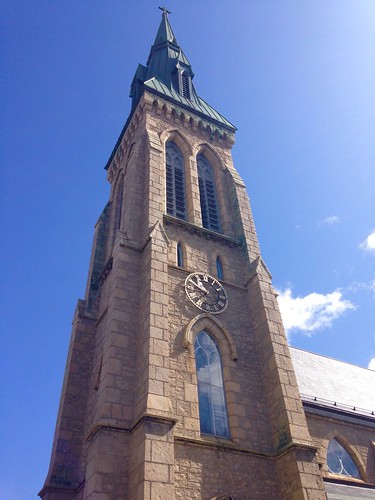
Since this clock has a subtle visual presence, it makes sense to start by pointing it out. Here it is in a Google Street View image:


The dial is visible just above the lancet window on the second storey of the tower. It may not be evident from this image, but the dial measures 6 feet or 1.82 m across. This view already suggests one reason why the clock does not pop out: It has a dial but no face. The gold arms and markings of the dial and hands also do not contrast sharply with the limestone wall of the Church. It seems that the clock was designed to blend in with the building rather than to stand out against it.

Postcard photographers certainly did not go out of their way to feature the clock. It is barely visible at a sharp angle in this postcard published by Progress Printing, Preston, Ontario around 1970:


(You can get a better view in pictures of the church from 1966 and from 1982.)

In spite of its subtlety, the church clock is the most time-honoured timepiece in Guelph. It was a gift to the church by the famous Arthur William Cutten. Cutten was the second of nine children born to Walter Cutten and Annie MacFadden (13 Apr 1870), a family of devout Anglicans. Arthur grew up in Guelph, attended church, and went to high school at Guelph Collegiate. However, rural Guelph could not satisfy this young man's ambition, so he lit out to Chicago in 1888, where he was employed as a bookkeeper. To make a long story short, Cutten used his modest income to speculate successfully on commodities and became a very wealthy man. However, in spite of his yen for the big city, he never forgot his little home town.

In the 1920s, Cutten lavished money on the old burg in general and St. George's Church in particular:

In Guelph he donated $20,000 to pay off the Guelph YMCA mortgage; he donated funds to St. George’s Church for stained glass windows, marble floors, a bell, an organ, and a carillon (the chimes alone were estimated to have cost over $25,000); to Woodlawn Memorial Park he donated funds for more land, iron fencing, entrance gates and other property improvements ($13,000) and was instrumental in creating the Cemetery Commission and establishing the Perpetual Care (Maintenance) Fund. As well, he provided financial support for all his siblings.
His best-known project was the Cutten Fields golf course, still a central feature of the Royal City.

The clock was given to the Church in connection with the carillon, which included a set of 23 bells (now 36) mounted in the Church belfry and played from a touch-sensitive keyboard. St. George's carillon was only the fourth in Canada and was thus quite a bragging point for its parishioners. Both clock and carillon were made in Croydon, England by Gillett and Johnston (Mercury, 18 March 1926), makers of the carillon in the Peace Tower and a firm that continues in operation to the present day. The paper also remarks that the largest bell in the set weighed in at 1,745 lbs. (about 790 kg), so the device was clearly designed to produce a big sound.

The clock uses some of the bells of the carillon and rings every quarter hour from 7:15 am to 11:00 pm. In fact, the clock plays the "Westminster quarters", patiently described in the Mercury for the uninitiated:

At a quarter past the hour four notes will ring out; at the half hour, eight notes, the first four and four others to blend in pleasing melody; at the three-quarters, twelve notes; and at the hour sixteen, followed by the strokes, indicative of the hour.
In case that is not clear, here is a small clock sounding the Westminster quarters:


St. George's clock rings out the hours 24/7. It was initially powered by a system of weights that had to be raised up the tower twice a week by pulling on furnace chains—no small task! In the 1950s, this system was replaced with an electric one. Don Hamilton, the carillonneur of St. George's since 1987, notes that the original clock mechanism continues to serve well: It keeps time to within a few seconds a day and can be adjusted by changing a system of weights attached to its 4 1/2 foot pendulum.

I was fortunate enough to be given a tour of the clock and carillon by Mr. Hamilton. A steep and narrow stairway of 59 steps leads from the base of the tower up to the clock level. There, the clock sits mounted in front of the big lancet window facing onto the street. The clock can be seen striking the half hour in the video below:


Note the pendulum swinging in front of the window, the flywheel spinning in the background during the chimes, and mechanism on the right that pulls the chords connected to the bell clappers.

Up another narrow flight of stairs is the room with the carillon keyboard. This keyboard features a set of "batons", sticks that are arranged somewhat like piano keys and played by using fists to depress them. Acoustics can be controlled by varying the force used on the batons and by using a set of foot pedals beneath. The carillon of 36 bells at St. George's provides three octaves, enriched by the harmonies set up among the bells themselves.

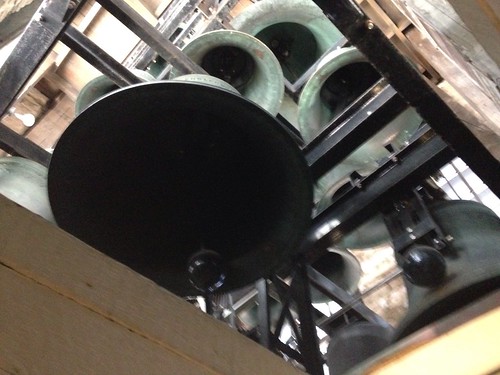
Those bells can be glimpsed through a hatchway into the belfry on top of the keyboard room:


Note the clapper inside the bell on the lower left. Clappers inside the bells are attached to the carillon. Now, note the clapper on the outside of the bell on the lower right. Those bells with clappers mounted outside are also a part of the clock chiming mechanism.

The History of St. George's Church (Moore 1982, p. 77) notes that the carillon (and thus the clock) was ready for action on Saturday, 17 April 1926. The clock, carillon and organ were dedicated by Bishop Owen on 19 May (History of St. George's Parish 1832–1932, p. 81). The clock has kept time faithfully ever since.

One question remains: Why did Arthur Cutten donate the clock and carillon to St. George's Church? Mr. Hamilton notes that the church previously had a set of chimes in the belfry, which were not nearly as loud or sophisticated in comparison to a carillon. So, the clock and carillon would improve the church's acoustical profile and increase the pride of the parishioners in their edifice. In addition, not far away, the Catholic Church of Our Lady was having two magnificent towers added to its facade in 1926, considerably increasing its civic profile. St. George's Church was not in a position to compete architecturally but the clock and carillon may have provided a different way to keep up with the Joneses. Or, it may have been a coincidence.

Whatever the reason, the clock of St. George's Church remains the Royal City's most enduring civic timepiece.

Saturday, 28 March 2015

Postcard from the trenches: Charles Mogk

When Canadians went overseas to fight in the Great War, communication with friends and family at home became significant for morale in both places. With the great popularity of picture postcards in the preceding decade, it was natural that postcards would be an important part of that process. As noted in my earlier post about Thomas McCloskey, social groups such as the Y.M.C.A. often provided postcards for the use of soldiers to send quick notes home. However, the armed forces themselves realized the significance of postcards for this purpose and sought to provide them to the troops. However, they decided to design a special postcard of their own.

Indeed, hardly had the British Expeditionary Force crossed the Channel when letters and postcards from the Tommies began to flood back to the UK. Since stamps were often hard to come by on the battlefield, the postage was frequently collected by the Post Office from the recipients. This process proved to be too costly and time-consuming, so the House of Commons quickly passed an act making all letters (and postcards) from active service personnel free.

This measure solved the stamp problem but left the military with the problem of how to monitor the information that was being sent from the front through the mail. There was the potential that service personnel might leak news that was of operational importance. Also, and perhaps more significantly, they were concerned that a flood of unvarnished information about the conflict might undermine morale on the home front. To deal with this issue, the military produced its own postcard, officially "Army Form A.2042" or "The British Field Service Post Card" (F.S.P.C.).

When it arrived in France, the Canadian Expeditionary Force was also issued the F.S.P.C. so that Johnny Canuck could write home too. An example of this card, send to Guelph in 1917, can be seen below.

Front side:


Back side:


The card has some remarkable features. Text in the left margin on the front states that, "The address only to be written on this side. If anything else is added the post card will be destroyed." The back side contains a similarly dire warning: "NOTHING is to be written on this side except the date and signature of the sender. Sentences not required may be erased. If anything else is added the post card will be destroyed." The army had dealt with the problem of censoring these postcards by making it possible to communicate only an extremely limited type of message with them.

A look at the back of the card shows how the system worked. The sender had a menu of pre-formed sentences among which to choose for communication. The choice was signified by crossing off the sentences that did not apply in the sender's case. In this case, the sender has left "I am quite well", "Letter follows at first opportunity", and "I have received no letter from you {lately/for a long time}", and signed his name, C Mogk, and the date, Dec. 9 [1917]. On the front, only the address has been pencilled in: "Mrs. Hy Mogk // 344 Woolwich St. // Guelph, Ont // Canada". Having complied with the directions, the letter was cancelled by the Army Post Office and sent to Guelph.

Commentators have emphasized the draconian way in which these cards attempted to control the narrative about the war. For example, Paul Fussell says (1975, p. 185):

The implicit optimism of the post card is worth noting—the way it offers no provision for transmitting news like "I have lost my left leg" or "I have been admitted into hospital wounded and do not expect to recover."
Only good news was allowed and only movement away from the front could be explicitly communicated. Soldiers sometimes rebelled against this censorship in clever ways. The poet Wilfred Owen had an understanding with his mother that when he crossed out "I am being sent down to the base" with a double line, it meant that he was really being returned to the front lines.

In spite of the Procrustean nature of the card, it was massively popular. Untold millions were printed, filled out, and mailed. By the autumn of 1917, the British Expeditionary Force was sending over 285,000 pieces of mail per day, many of them in the form of these cards. Part of their appeal was that they got home quickly since they did not have to be opened and laboriously checked by military censors. As such, they were called "Whizz bangers" or "Quick firers" by the troops, after German shells that travelled faster than sound (Fussell 1975, p. 183). Booth (1996, p. 14) notes that the cards were often sent off after a major battle, to let people at home know the sender was still alive, if not "quite well."

Perhaps this is the reason for the card home from Charles Mogk. Born on 16 Jan. 1888, Charles was one of five offspring of Henry and Catherine Mogk of Bornholm, Ontario. His Attestation Paper shows that he was inducted in the army at Radisson, Saskatchewan, 17 Feb. 1916, near Richard where he was apparently working as a farm laborer.

No part of his service record is available online. However, the postcard may suggest that he had seen action in the Second battle of Passchendaele, which occurred in late October and early November. In that battle, the Canadian Corps succeeded in taking high ground near Passchendaele in the face of some determined opposition. Perhaps Charles was sending the postcard to assure his family that he had survived.

The postcard is addressed not to his family in Bornholm but to Henry Frederick Mogk in Guelph. Henry was Charles's older brother and is listed in the 1917 Vernon's City Guide to Guelph as a carpenter living at 344 Woolwich St. Also at that address were his wife, Devina, and their son Clarence, who is listed as a clerk in the Candyland confectionary on Wyndham St. What an ideal job for a 13 year-old boy! Henry and Devina seem to have had a penchant for double middle names, for all their children have them. The 1921 census lists Ida Florebett Eugenia Mogk, Clarence Clina Faraligh Mogk, Jais Mary Marie Mogk, and Henry William Stanley Mogk. The house is one of Guelph's characteristic stone cottages and can be seen in this Google Street View image:


The Mogk family were in Guelph for only a few years. They appear for the first time in the 1914 directory and disappear after the 1917 edition. The 1949 Voters' list puts them in Hamilton. (There was another Mogk family in Guelph, headed by August Mogk, that lived for a long time in the Royal City. Although the two families were probably related through ancestors in Germany, August's ancestors were associated with the Waterloo region and not Bornholm.)

Interestingly, Charles observes the custom of addressing his postcard not to his brother but to his sister-in-law, Devina. Many postcards in that era were addressed to young girls, who might collect them for the pictures. However, it was also not unusual for postcards to be addressed to the wife of the sender's immediate relation. Perhaps, as family correspondence was regarded as a domestic matter, it was considered appropriate to send it to the woman who had charge of the home.

Happily for the Mogk family, Charles survived the war. The 1921 census lists him back in Bornholm living with his parents. Also listed is Jean Mogk (née Stevens) who was Charles's new wife. The census states that Jean, who was born in Scotland, immigrated to Canada in 1920. It is not clear when the couple married, but the timing suggests that Jean was a war bride. I wonder if they had met by the time Charles sent his postcard in 1917.

A picture of the new couple has come down to us, courtesy of Brenda Rohrer Smith:


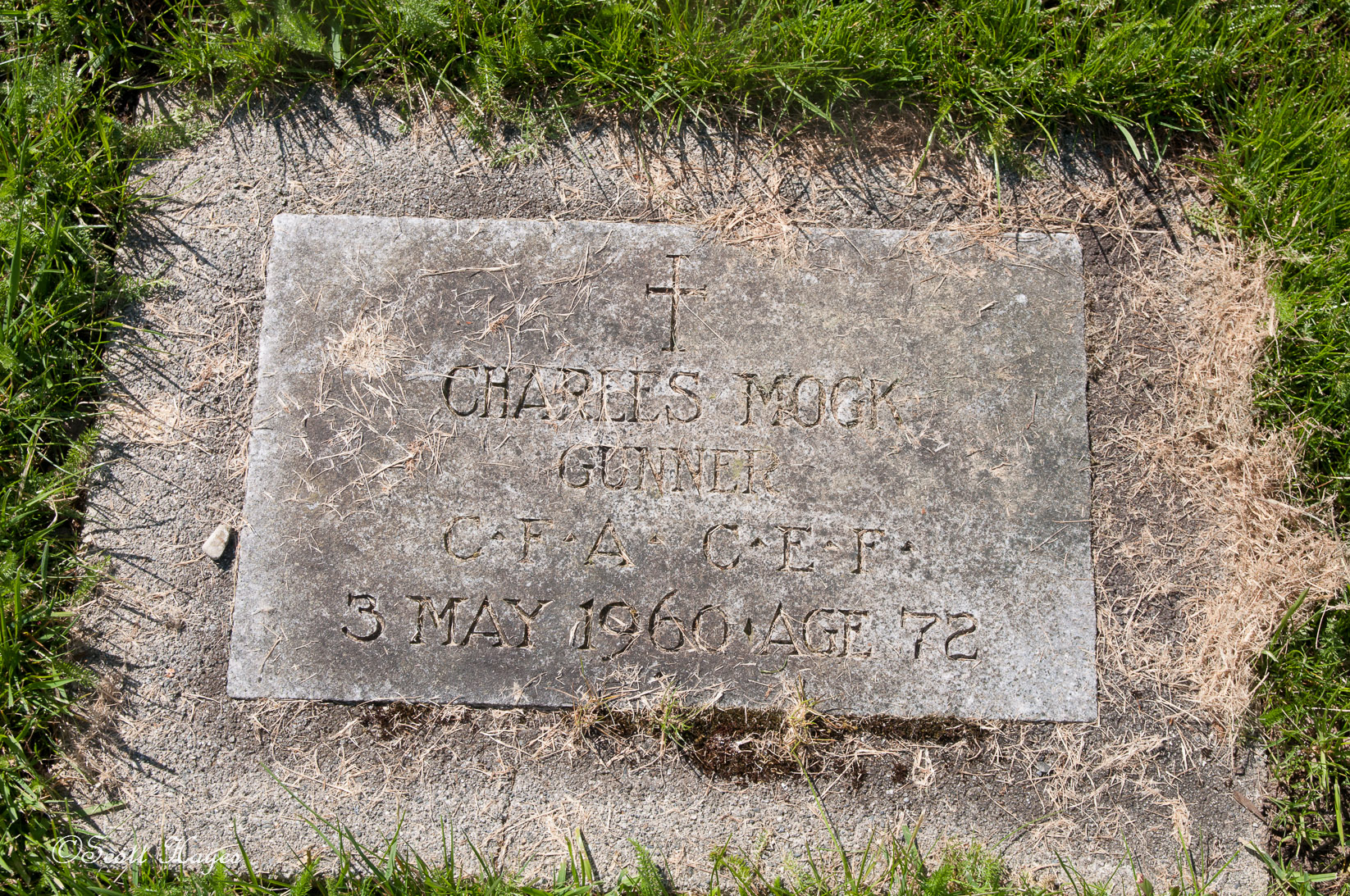
Unfortunately, the marriage was cut short when Jean died in Perth, Ontario, in December 1925. Charles later married Ethel Hannah Case, who had previously been married to George Ross of Keppel in Grey County. Records are silent on the matter, but Ethel may have been widowed around the same time that Charles became a widower. Perhaps looking for a change of scene, and recalling his work as a youth in western Canada, Charles and Ethel moved away from Ontario and are to be found on the 1958 Voters' list in Penticton, B.C. Charles died on 3 May 1960 and Ethel on 15 May 1973 and both are buried in the Maple Ridge Cemetery. Charles's grave marker can be seen below:


The marker notes only his name, age, and military service: "Gunner // C.F.A. C.E.F.". I believe this stands for "Canadian Field Artillery, Canadian Expeditionary Force", suggesting that Charles served as an artilleryman during the conflict. The marker is brief, formulaic, and to the point, much like the F.S.P.C. that he sent to Guelph from the front lines all those years before.


Postscript

The British Field Service Post Card apparently had a lasting impact on modern life. Fussell says that it set the precedent for one of the most unwelcome, modern types of written communication, the bureaucratic form (1975, p. 185):

The Field Service Post Card has the honor of being the first widespread exemplar of that kind of document which uniquely characterizes the modern world: the "Form." It is the progenitor of all modern forms on which you fill in things or cross out things or check off things, from police traffic summonses to "questionnaires" and income-tax blanks.
The mechanism of the British F.S.P.C. was widely parodied after the war. Fussell remarks on the following note written from after the war by Wilfrid Owen to fellow poet and veteran, Siegfried Sassoon (p. 185):
My dear Siegfried,
Here are a few poems to tempt you to a letter. I begin to think your correspondence must be intercepted somewhere, So I will state merely
I have had no letter from you {lately/for a long time}.
Besides being the origin of the form, the F.S.P.C. seems to have fixed in people's minds the notion that government agents might be watching their mail.

As such, the F.S.P.C. had become a familiar, running joke in the English-speaking world. Commercial postcard makers also produced parodies of them for many years after the war. I wonder if the soldiers felt nostalgic for them or merely enjoyed abusing the knock-offs as a kind of revenge.

Also, the F.S.P.C. was issued in Urdu for use by the India Expeditionary Force. I wonder what they thought of it.

Friday, 27 February 2015

Tytler Public School

Tytler Public School is back! The old public school in the Ward was closed in June of 2013 after a remarkable 135 years of service. The students even gave it a big hug as a send-off! However, it was recently announced that Tytler school would be brought back into service for young French Immersion students. And the story was even illustrated with a lovely postcard, a copy of the one below.


The card was published by The Valentine & Sons Publishing Co., Ltd. Montreal and Toronto sometime around 1910. The picture shows a stately Edwardian building with perhaps a bit of local character in the gable over the central stairway. The postcard label shows that its original name was "St. Patrick's Ward School". This recalls the days when Guelph had an elementary school for each of its wards, each named after saints, plus one in the middle, the "Central School".

Compare the postcard image with that from Google Street View.


It looks quite well preserved, although some windows have been blocked up and the school yard paved.

The school was designed by William Austin Mahoney (1871-1952), a prolific local boy who learned architecture through the International Correspondence School of Scranton, Penn. while working as a carpenter in Chicago. He put up his shingle back home in Guelph in 1905 and was soon busy. He designed a number of local buildings of note, including several schools beside St. Patrick's. The "Building Operations" column of the Mercury (12 Sep. 1908) itemizes the work done to erect the building:

St. Patrick's Ward School — Four room, up-to-date school. Red brick, on Ontario street; Sam Rundle, stone and brick; George Scroggie, carpenter; Dempsey Bros., painting; J. J. Mahoney, plastering; H. Occomore & Co., heating; G. W. Brown & Co., slaters; Mahoney Bros., plumbing; W. A. Mahoney, architect. Cost, about $13,000.
Note all Mahoneys! Going by the City Directory of Guelph (1917), the Mahoney Bros. were Harry and Richard, William's brothers. J. J. Mahoney was his brother James. J. Mahoney, a building contractor. Perhaps brother Jeff D. Mahoney, also a building contractor, was on vacation. In any event, St. Patrick's Ward School was something of a family affair.

This history still leaves us with at least a couple of mysteries. First, how did "St. Patrick's Ward School" become "Tytler School"? Second, if the school was 135 years old in 2013, how do we account for its construction only 105 years earlier?

The first mystery is easily solved. St. Patrick's Ward School was re-named in honour of William Tytler on 14 Feb. 1922. The School Board conferred the honour on Mr. Tytler (1842-1932), who had been the local Public School Inspector and Secretary of the Board for almost 30 years. A native of Nicol Township, Tytler graduated from the University of Toronto in 1862 and enjoyed a very successful career in education. In 1875, he was hired from St. Mary's High School to become headmaster of the new Guelph Collegiate Institute. He become Public School Inspector in 1893, a position he retained until 1924. He resigned for good from the Board only in 1930, for a remarkable career spanning about 66 years. So, it is no wonder that he had a local school named after him, although it is not clear why St. Patrick's School was selected.

The pre-history of St. Patrick's School is also an interesting story. In fact, the Mercury (4 May 1908) gives a complete run-down of it. In the author's view, the first school in St. Patrick's Ward was actually the very first school in Guelph. John Galt had ordered the construction of a school in 1828. Originally called the "Galt Academy" (and later "The Old Stone School"), it stood near what is now the corner of Fountain and Neeve Streets, roughly where the Chamber of Commerce sits today (Allen 1939, p. 23). Thus, it seems to have been part of Galt's plan to aggrandize Priory Square. After the railway tracks were laid next to it in the early 1850s, the location became just too noisy and the building was abandoned. Because it sat in the east end of the town, as it then was, the article's author regards it as the first East Ward school.

For many years, school in the east end of town was carried on in rented accommodations. However, demand increased to the point where the School Board decided on a permanent structure. Property was purchased and a building put up on Ontario Street in 1878. This school was designed by another industrious Guelph architect, John Hall Jr. It is described in this way in the Mercury's "Building Operations" column (27 Nov. 1878):

The building is T shaped and built of stone, and has at the rear a very fine roomy play ground. The architecture follows more closely the Italian than any other style, and is in every respect an ornament to the neighborhood. On the north corner there is a handsome belfry, which rises to a height of 36 feet. The stone is laid in imitation of random coursed work. The openings are pla[i]n corners of cut stone and the entrances are surmounted by ornamental hoods. The building is divided into two school rooms, each 22 by 28 feet. There are two entrances into the school—one for boys and the other for girls. The lobbies and cloak rooms lead from the entrances into the school rooms already referred to. Here all the modern and improved school furniture and appliances are to be found. The building is heated by stoves. The total cost was about $1,900.
Unfortunately, I have not been able to find any pictures of it. But, it is fun trying to imagine it.

In any event, the construction of two rooms was providential, since it was ten years before there were enough students to occupy more than one room. Of course, as time went on, the two-room school become overcrowded and it was eventually razed to make way for the new, four-room building designed by William Mahoney. (Coincidently, William Mahoney's father, Richard, appears to have done the carpentry work for the earlier school. School construction was truly in the family DNA.)

So much for the history of the building. Luckily, we also have some reminiscences of student life in the place. Mr. James L. Hunt provides a number of interesting anecdotes about his time as a pupil there in the early 1940s. Education at Tytler in that era focussed on the Three Rs, cultivated through lots of memorization, which suited young Mr. Hunt just fine. We get some interesting glimpses of the staff. For example, his grade 3 teacher, Miss Dooley, was thought very pretty by all the boys and remained a teacher for her whole career, meaning that she never married. In those days, getting married ended a woman's career, at least in school.

However, the school custodian was not so amenable:

The school had one real tyrant in the form of the school janitor Mr. Smith who took a perverse delight in tyrannizing the boys. At every recess the first thing that happened was that everyone was herded into the washrooms whether you had to pee or not. It was presumably believed that this would minimize the incidents of hands being raised and "Please Miss may I leave the room?" The boys washroom had about 6 urinals and Mr. Scott [sic] was always there waiting to maintain order and decorum. Perversely he always organized the boys into two lines: one at station 1 and the other at station 2. As 3, 4, 5, and 6 became available he manned them always from the number 2 line which therefore moved quickly. However, if you were unfortunate enough to be ordered into the number one line you simply waited your turn and missed half the recess. There was no appeal, no fairness you did as you were ordered and offered no lip. We hated him with a fiery passion!
Hopefully, Tytler School has since abandoned this practice!

So, Tytler School has had an interesting history, both institutional and personal, and one that, by some accounts, goes right back to the foundation of the town itself. Plus, it seems, there is more yet to come.