Tuesday, 25 April 2023

Baker Street has taken many turns over the years

In its overview of the Baker District Redevelopment project, the City of Guelph notes that:
We’re transforming a former municipal parking lot into a compact district nestled in Guelph’s historic core that will create a renewed area of activity, commerce and civic space for the local community and city.
The old parking lot is slated to be replaced by a civic hub, including a new public library, an urban square, residential units, commercial and institutional spaces, and, of course, parking.

As this process continues, it is interesting to take a look back at the tranformations that the space has seen in the past. Of course, many notable changes have taken place there—too many to catalog here. But, a sketch would be informative.

As the city's background information points out, the triangular lot that is currently the Baker Street parking lot was designated by the Canada Company as a burial ground at the time of the town's founding in 1827. It was common practise in Britain for graveyards to be placed in proximity to churches, so this was simply extended to Guelph (Laqueur 2015).

(Detail of a map of Guelph, 1827. The Burying Ground is the yellow triangle on the left side. Courtesy of Guelph Civic Musems, 1994.15.1.)

However, times were changing and the trend in Britain was soon to move cemeteries outside of towns, and Guelph eventually followed suit. (For one thing, cemeteries in the old country were filling up, such that the crowding of corpses became regarded as insalubrious.) In 1853, the village of Guelph closed the burial ground and purchased a site from Dr. Clarke in the township for that purpose instead. This site remains in use today as Woodlawn Cemetery.

The lot remained undeveloped and the townsfolk began making informal use of the space. One Mr. Hubbard employed it as a tree nursery, for example (Irwin 1999). Others used it recreationally and the grounds became known as Cemetery Park. In 1879, the town of Guelph petitioned the Provincial government to convey the property to the town to formalize this use. In 1885, the city undertook a project to transform the property by removing all remaining graves to the Union (Woodlawn) Cemetery. The lot was renamed Central Park and the lane that the city created around its periphery became Park Lane.

(Alfred A. Baker, ca. 1880. Courtesy of Guelph Civic Museums, Grundy 5.)

At this time, the street had a largely residential character, at least, on its west side. Initially labelled Elizabeth Street, it was renamed Baker Street after Alfred A. Baker, a County court clerk who built himself a house there around 1860. Formerly 70 Baker Street, the house was demolished in 1966 to make way for a parking lot.

(The Baker Home, April 1966, under demolition. Courtesy of Guelph Public Library, F38-0-3-0-0-44.)

Next door was the residence of R.E. Nelson, clothing merchant and Mayor of Guelph (1899–1900). Formerly 74 Baker Street, now 76 Baker Street, this is currently the home of the Baker Street Station.

As neighbouring streets like Wyndham became the downtown section of Guelph, the Baker Street lot began to be developed. One development in keeping with the recreational character of the park was the construction of a rink in 1892 for the Guelph Curling and Skating Club. This new rink, named the "Victoria Rink," served as an upgrade on the "old curling rink" situated at Wellington and Huskisson (now Wyndham South) Streets, which was then torn down. The new rink was situated on Central Park just behind Knox Church and Chalmers Church.

(Lord Stanley of Preston, Governor General of Canada, May 1889. Courtesy of Library and Archives Canada, 3194700.)

During a tour of southern Ontario in 1893, Lord Stanley, then the Governor General of Canada, made a visit to Guelph on 6 January. During this event, the GG made an unscheduled stop to inspect the new Victoria Rink, no doubt because he was an avid curler. The curlers graciously interrupted their play to meet His Excellency.

Before the advent of artificial ice, curling had to be played when the weather permitted. So, the Victoria Rink served as a roller skating rink during the summer months.

("Knox Church, Guelph, Ont.," ca. 1895. What appears to be a drawing of the Victoria Rink appears on the left behind the church. Courtesy of the Guelph Public Library, F38-0-15-0-0-353.)

Besides the action on the ice, excitement was brought to the Rink when it burned to the ground. On 26 August 1914, a problem with its electrical wiring set the structure ablaze (Globe, 27 Aug. 1914). A strong east wind launched embers far abroad so that Knox Church and the Guelph Creamery Company, across Baker Street, were nearly set on fire as well. Happily, most of the $30,000 in damages was covered by insurance, so that the rink was subsequently rebuilt.

("Curlers In Front Of Old Victoria Rink, ca. 1909." Courtesy of Guelph Civic Musems, 2009.32.2067.)

In 1936, the Club defaulted on its rent and surrendered its lease on the property to the City. In turn, the City sold the property to the Club for $1, so that it could remain in operation.

("Victoria Rink Lawn Bowling Green, ca. 1900." Courtesy of Guelph Civic Museums, Grundy 150.)

In addition, the Guelph Lawn Bowling Club began operating greens outside of the Victoria Rink around 1900. The Club produced some good players, perhaps the most notable being Graham Chapman, who won the Novice Singles Championship of Canada in 1904 and Dominion Singles Championship in 1908. In the same year, the Club won the Seagram Trophy.

("Lawn Bowling at Baker St., ca. 1940." Courtesy of Guelph Civic Museums, 2002.81.33.)

Lawn bowling continued in the Baker Street lot until about 1950.

Besides these recreational uses, factories were also sited on the lot. The Raymond Manufacturing Company built a three-storey brick factory just up the street from the Victoria Rink.

Charles Raymond moved his sewing machine company to Guelph in 1862 and set up operations in the town. Today, the Raymond Sewing Machine Company is most remembered for the factory that it built on Yarmouth Street in 1875. However, the company expanded and diversified over the years.

("Raymond's Machine and Moulding Shop, Guelph, Ont.," ca. 1905. Postcard published for A.B. Petrie. Note that the factory is buff-coloured and not gray as the lithographer has depicted it here.)

Perhaps the sewing machine market had become tapped out. In 1895, the Raymond Sewing Machine Company reincorporated under the name Raymond Manufacturing Company and diversified into cash registers and bicycles (Globe, 23 December 1895). In 1897, the company was sold to the White Sewing Machine Company of Cleveland, Ohio. By 1899, the Company added cream separators to its product line, licenced under the National Cream Separator Company.

("Suffolk Street and Raymond Factory, Guelph, Canada." Postcard published by Rumsey & Co., ca. 1905. Suffolk Street (right) here intersects with Yarmouth Street (left), with Woolwich Street in the foreground. This factory was built in 1872, with later additions.)

At this point, Raymond Manufacturing Company built a three-storey factory on the east side of Baker Street, where the cream separators were to be made. This site was connected with the Raymond Works on Yarmouth Street by both tunnels and a bridge over Baker Street.

(Detail of "Insurance plan of the city of Guelph, Ontario, Canada," 1911, page 6. Courtesy of Library and Archives Canada, R6990-430-9-E.)

These features can also be glimpsed in the postcard below.

("Raymond Manufacturing Co.y, Limited, Guelph, Ontario, Canada." Postcard published ca. 1910 by the Valentine & Sons Publishing Company. The Baker Street factory is the large red-brick plant at the rear with the big chimney belching smoke behind it. Note the bridge over Baker Street connecting it to the older Yarmouth Street plant. The surroundings are mainly fanciful embellishments contributed by the lithographer, although the Victoria Rink is represented on the right under the caption.)

Unfortunately, the business continued to decline. It was surely a bad sign when the new plant was the site of a horrible death as employee Charles Walker got his foot caught in a loose drive belt and was brutally dismembered by the machinery. His severed right leg was "hurled with great velocity" through a window and landed in the middle of the street (Globe, 5 October 1912). A coroner's inquiry produced the verdict of accidental death.

In 1916, the White Sewing Machine Company took over direct control of the old Raymond facilities and the business was wound up in 1922.

Space in the factory was occuped subsequently by a number of industries. City directories of the period mention the Hammond Brass & Aluminum Company, the Guelph Granite and Marble Works, Hepburn & Spotton (radio engineers), St. Williams Plantations Ltd and Windham Plantations Ltd, which I have little information about. Some of these concerns appeared only briefly while a few lasted for several years.

By far, the chief new occupant of the site was Steele's Wire Springs Company. The aptly named James Steele founded the business in 1883 and made steel springs, which it sold to other manufacturers for a variety of uses. Under the management of his sons, the company continued to expand and moved from place to place in doing so. It bought up the old Raymond plant on Baker Street in 1926.

(Detail of "Aerial Photograph of Guelph Downtown in Winter c. 1940." Baker Street is at the left margin. Courtesy of Guelph Civic Museums, 1979.35.14.)

The most controversial businesses that set up shop in the old Raymond plant were the Popular Cloak Company and the Superior Cloak Company. In July, 1934, these garment manufacturers relocated from Toronto to Guelph to lease space in the old building. Apparently, this move was intended in part to dodge an agreement that the companies had with their employees in Toronto (Durtnall 2021, pp, 322–325). Local workers, eager for employment in the midst of the Great Depression, were hired and operations began.
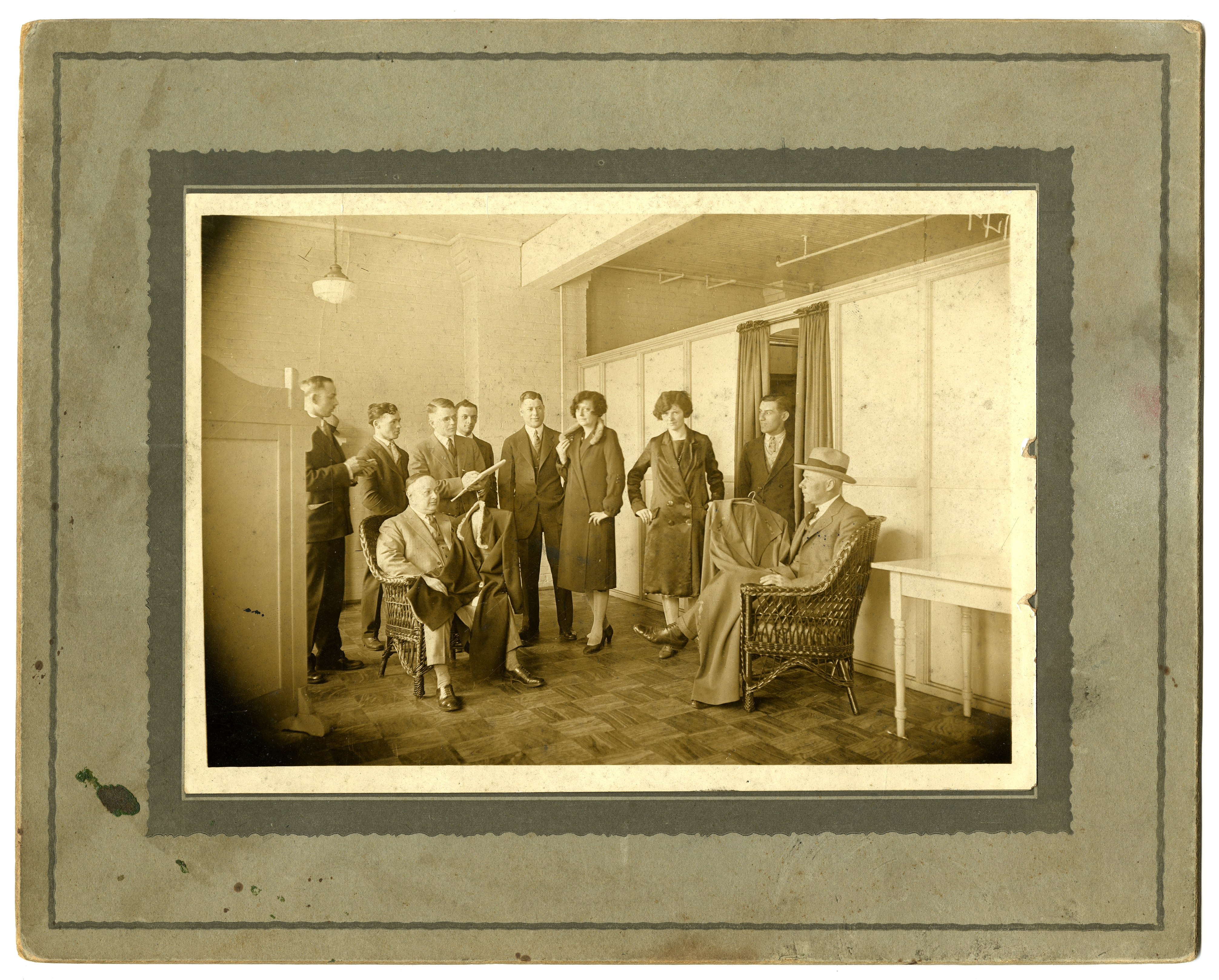
("Posluns business activities, 192-," Superior Cloak Company. Courtesy of Ontario Jewish Archives, Samuel Posluns fonds.)

However, workers from Toronto descended on Guelph in shifts to protest the Cloak Companies' tactics. Pickets were set up in front of the factory on Baker Street. In early August, the proceedings were peaceful but spiraled into violence by the end of the month. On 21 August, a "wild melee" broke out on Baker Street and spilled into neighbouring Quebec and Wyndham Streets. Arrests and the threat of having fire hoses turned on calmed the situation temporarily.

As negotiations for a settlement went under way, tensions reached the breaking point on 24 August. Strikers attacked the plant, smashed many of its windows, and dismembered a car belonging to a company official. The group also hurled volleys of bricks, stones, and bottles at a nearby police squad. After about an hour, the police, augmented by special constables sworn in from Guelph and surrounding towns, responded by turning on the fire hoses. Both strikers and citizens, who had gathered to watch the proceedings, were bowled over like nine pins. When this measure failed to have the desired effect, police launched tear gas bombs into the crowd.
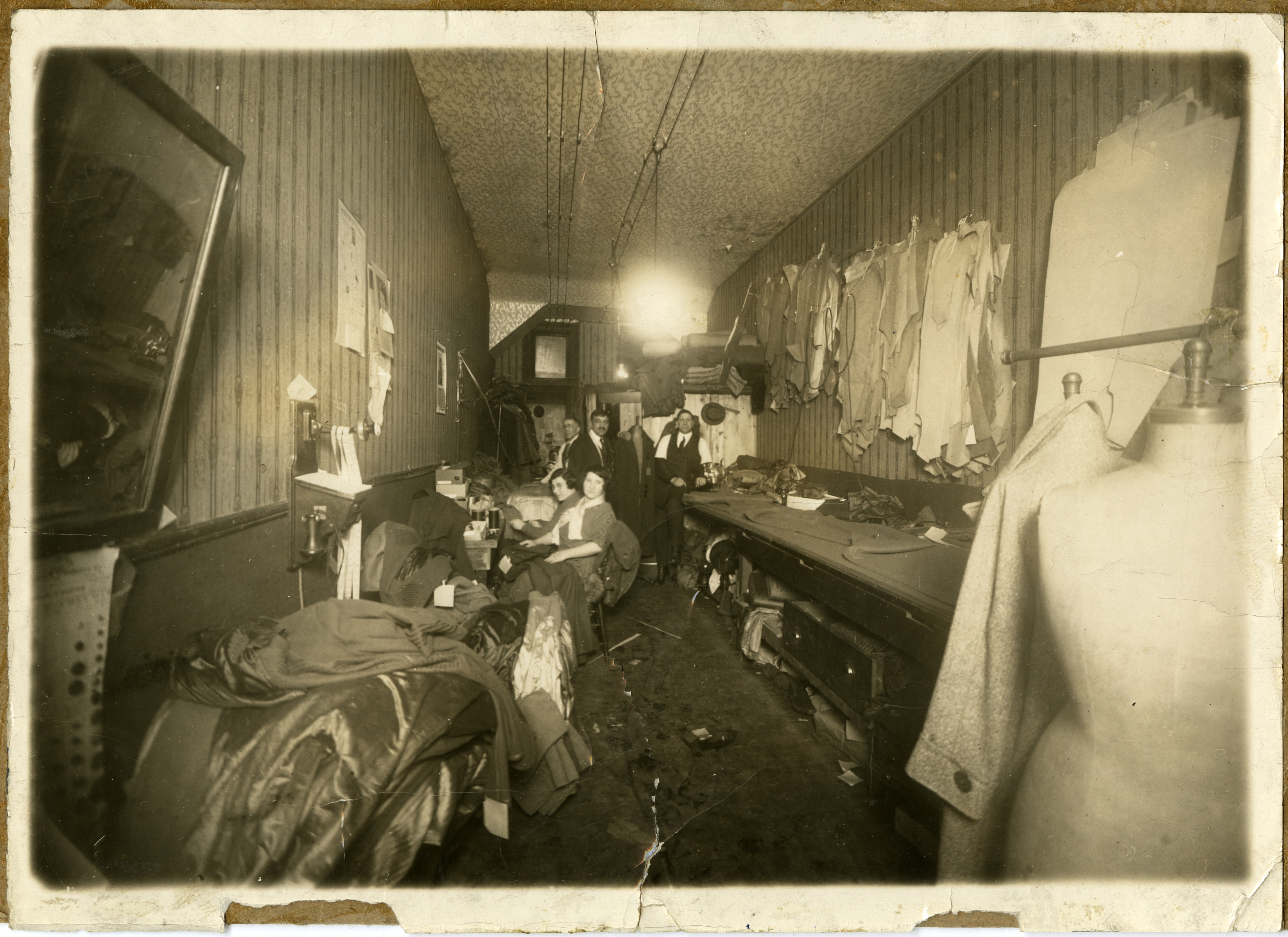
("International Ladies' Garment Workers' Union, 192-." This union represented workers at the Superior and Popular Cloak Companies. Courtesy of the Ontario Jewish Archives, 1978-4-6.)

On 30 August, after nearly two weeks of violent disturbances, a settlement was reached in which the Superior Cloak Company returned to Toronto while the Popular Cloak Company remained in Guelph. The latter did not remain long, however, returning to Toronto late in 1935, where, apparently, it was more popular.

("Victoria Curling Rink, 1968." Courtesy of Guelph Public Library, F38-0-15-0-0-63.)

Around the same time as these ructions, profound change stole into Baker Street. In 1933, both Rae's wagon works and Swanston's auto repair service appeared across the street from the Steele factory. Remarkably, the wagon works remained in business until about 1949. However, the auto repair service set the pattern for the future. Around 1940, Heffernan Motors took over this space, which served as the used car department of their business, which fronted on Yarmouth Street. Around 1950, the used car department expanded with the set-up of a used car lot on the east side of the street. Parked cars had begun their inexorable takeover of the old park.

(View of Baker Street. Courtesy of Google Street View, October 2020.)

About 1960, the Steele Wire Springs company relocated and the old Raymond plant was demolished. The space became part of the Municipal Parking Lot. In 1968, the Guelph Curling Club moved to a new location and the Victoria Rink was torn down, its site paved to house more cars.

What the future holds remains to be seen.


Sources used include:

Sunday, 19 March 2023

From Rochdale to Guelph with Ethel Foulds

Sometimes, old postcards reveal themselves through curious coincidences. That was certainly my feeling when British purveyor of postcards Paul Sutton-King, whom I follow on Twitter, tweeted a pic of a real photo postcard of a fancy wedding cake that he had picked up in a flea market in Cheshire. Imagine my surprise to see that the recipient was one Ethel Foulds, resident of 98 Surrey Street in Guelph! Paul kindly shared the card with me and I began my investigation.

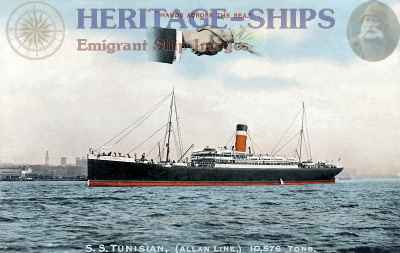
The usual sources soon revealed the basics. Ethel Jean Foulds was born in Acton, Ontario, on 23 March 1907, the daughter of William Edward and Eleanor Barwise (née Wilson). William was a Lancashire man, born in Littleboro in 1875, who had emigrated to Canada abord the Tunisian in 1904. He took up work as a tanner in Acton, home of the substantial Beardmore & Co. tannery. He married Eleanor there on 4 January 1905. She too had just arrived in Acton from England, making me suspect that they were bethrothed there and had married once William had got himself set up on the other side of the pond.

(S.S. Tunisian, courtesty of Norway Heritage.)

Nor were the Foulds the only former inhabitants of Rochdale, Lancashire, to relocate to Acton at that time. From the Acton Free Press (22 July 1926), we learn that Mr. and Mrs. Edward Tweedale, plus daughters Phoebe and Sarah, arrived in Acton in July of 1906 with the intention of settling there. On arrival, they stayed at the residence of Mr. and Mrs. Sunderland Taylor, who were themselves former Rochdale people. In fact, Mrs. Taylor was none other that Ruth Hannah, née Tweedale, who married Edward in England in 1890 (Acton Free Press, 13 June 1912). They immigrated to Acton in 1903, where Edward took up work at the Acton Tanning Company. Had he spread the good word about Acton to the folks back home? It seems that, by 1907, Edward had made six trips across the Atlantic in the previous two or three years, so something was certainly going on (Acton Free Press, 26 September 1965).

(The fates of these families also illustrate that long-distance travel was not without its hazards. Mrs. Tweedale died only six weeks after her arrival in Acton in 1906. She had suffered from "lung trouble" for some time and her doctor thought sea travel would be good for her (Acton Free Press, 30 August 1906). Apparently not. Mr. Taylor died in 1912 after a "prospecting trip" to a paint factory in Victoria, British Columbia, where he met with a fatal dose of lead poisoning (Action Free Press, 13 June 1912).)

In any event, the Foulds family had better luck. By 1907, they had upped sticks and moved to Guelph, where William is listed as a machinist. He is later listed as a member of the 'Quarter-Century Club,' that is, employees of at least 25 years employment, with the International Malleable Iron Company (or IMICO, locally known simply as "Mall'able Iron") of Guelph, starting from 1914 (Daily Mercury, 29 January 1952). He was raised a Methodist and is listed as a member of the board of the Paisley Memorial United Church (Daily Mercury, 29 July 1927).

(Former Paisley Memorial United Church, now the River of Life Church.)

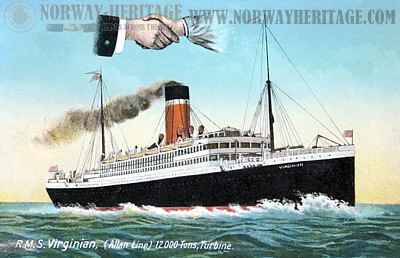
The Foulds maintained ties with the Old Country. Ships' records show Ethel Foulds and her mother Eleanor traveling from Liverpool to Quebec abord the Virginian on 13 May 1914. Significantly, the message on the back of the wedding cake card sent to Ethel states: "Eva Mae // Cake // April 29/14." I suspect that the two had taken a trip to Lancashire to visit relations there, during which time they attended a marriage featuring the wonderful cake. Unfortunately, I have not been able to track down what wedding it might have been. Was Eva Mae the bride? If any Yonners can ferret this out, please let us know in the comments!

(R.M.S. Virginian, courtesy of Norway Heritage.)

It seems that William continued work with Mall'able Iron until shortly before his death on 10 July 1947 (Mercury, 11 July 1947).

The City Directory of 1914 gives the Foulds's address as 98 Surrey Street East (since demolished), where the postcard in question was sent that very year. Around 1917, the family had moved to 25 Wood Street in the Ward, near Tytler School. The house has recently been heightened and expanded, as can be seen in this Street View image from 2009.

Finally, around 1925, the Foulds relocated to their 'forever' home at 149 Kingsmill Ave., a 'shotgun' house located close to the Eramosa river. Since the area was developed around that time, the Foulds were liklely the first occupants of this house.

Just before this move, Ethel Foulds made her own appearance in the City Directory, as a shoemaker in the employ of the nearby Northern Rubber Company. Incorporated in 1919, Northern Rubber manufactured a variety of rubber footwear.

Identified for heritage designation, the iconic building is being renovated for condos as part of a larger redevelopment of the site.

As it happens, there is a panoramic photo of employees of the Norther Rubber plant, taken in 1934.

("Northern Rubber Employees, 1934." Courtesy of Guelph Civic Museums, 2005.14.2.)

Amazingly, someone included a sticky note that points out an employee in the fourth row named "Ethel." Could this be Ethel Foulds?!

It appears that Ethel Foulds remained with the company until it folded up its tent in 1941. Thereafter, she is listed as an "operator" with the Aberfoyle Manufacturing Company. More specifically, it appears that her job was that of "quiller," which, I gather, refers to someone whose job is to operate a machine that winds yarn onto spools.

I don't have much information on the Aberfoyle Manufacturating Company. The 1943 Canadian Trade Index lists its products as mercerized bleach and dye, and cotton yarns. Its location was later reported not in the town of Aberfoyle but at 69 Metcalfe Street, today 69 Huron Street, in Guelph. A stone's throw from the Northern Rubber Plant, this facility was also in easy walking distance of Ethel's home.

(This plant later became part of the W.C. Wood Company, makers of fridges and freezers.)

At this point, the trail came to an end. Ethel Founds disappeared from the City Directory around 1950. At the same time, her mother, Mrs. Eleanor Foulds (widow of William), was suddenly recorded as a resident of R.R. (rural route) 5 in Rockwood, not far from Acton. What happened?

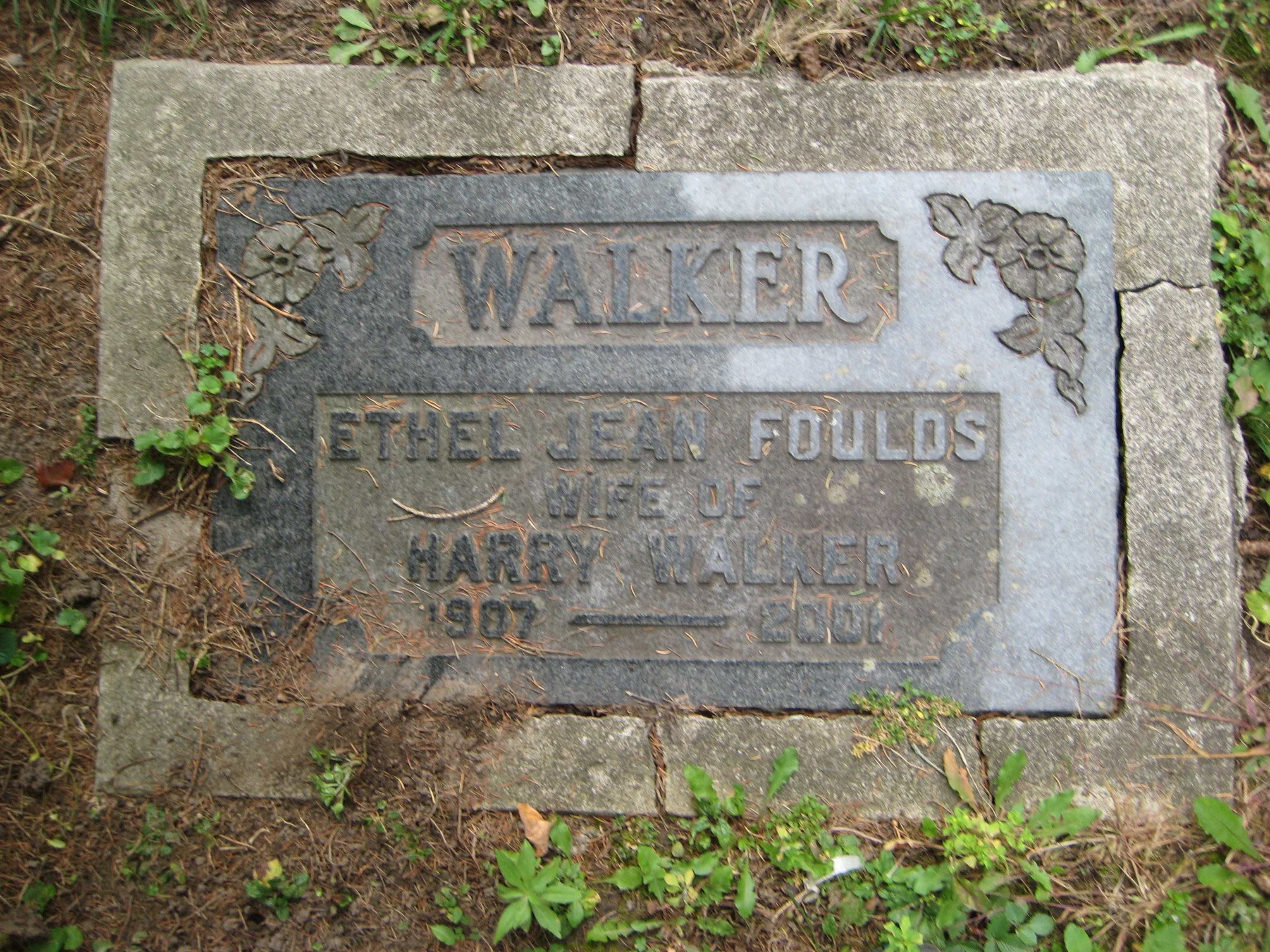
Records from Woodlawn Cemetery in Guelph revealed that William's widow Eleanor died in 1953 and was buried alongside him. Cemetery records also reveal the final resting place of Ethel Jean Foulds, who died in 2001 and is listed as the wife of one Harry Walker. Indeed, an Ethel Walker appears as a resident of R.R. 5 of Rockwood at the right time. Ethel had married and her mother had moved in with her son-in-law!

Unfortunately, there were at least three Harry Walkers in the region of Rockwood, and no record of their marriages resides online. However, the Acton Free Press mentions a Harry Walker "of Rockwood" as a pall bearer at a funeral, accompanied by several brothers. This Harry Walker was born in 1889, farmed in Eramosa township, and had married Jennie McLean in 1919. Jennie died in 1943, which would have made Harry available for marriage around 1950. This Harry Walker died in 1965, and his obituary in the Mercury (3 December) turned up the facts that he had the brothers mentioned in the earlier article and had married the former Ethel Jean Foulds in August 1949. Voilà!

A further look at the Guelph City directories showed that Ethel Walker (wid. Harry) had taken up residence at 149 Kingsmill Avenue in 1967, the old Foulds household. Ethel likely kept possession of the house, rented it out upon her marriage, and returned to it afterwards. She is not listed with an occupation and instead seems to have enjoyed a long retirement.

Harry Walker was buried with his first wife Jennie McLean in Stone United Church Cemetery in Erasmosa Township. Ethel Jean Walker (née Foulds) was buried with her parents in Woodlawn Cemetery in Guelph.


If you have any further information about Ethel Foulds or her family, in Canada, England, or elsewhere, please let us know in the comments below!
Speaking of coincidences, shortly after finding and tweeting the wedding cake postcard addressed to Ethel Foulds, Paul Sutton-King reported this: Yes, another random postcard found in England was addressed to Ethel Foulds, this one sent from Acton!

The transcription goes as follows:

Acton Sept 20, 1920
Dear Ethel:
You will be thinking I have forgotten you all, but I have not. I got your lovely card when I came home last Sat. I got some lovely cards for my birthday. will any of you be down for the Fair Wed. love from Alice
xxxx
At a guess, this postcard may have been sent by Miss Sarah Alice Tweedale, daughter of Edward Tweedale, whom I mentioned above as another emigrant from Rochdale to Acton.

It seems likely that the young Ethel Foulds enjoyed postcards and may have kept and collected those that she received. At some point, this collection may have found its way to relations in the Old Country, who have since dispersed it there. So, keep your eyes peeled, Britishers, and report any more finds!

Saturday, 18 February 2023

Edgewood Park: Eden Mills summer camp

The local papers printed a number of accounts of an interesting new facility in Eden Mills. For example, the 10 September 1924 edition of the Acton Free Press notes that Mr. and Mrs. Nodwell and family of Toronto recently left for Hogtown after spending the summer at their cottage in Edgewood Park, Eden Mills.

In a previous post, I noted that Eden Mills was known early on mostly as a rural village featuring several mills and a modest hotel. However, things had recently changed and the village had become something of a regional destination. At least, it now sported a popular park and summer homes for out-of-towners.

The history of Edgewood Park really begins with the arrival of the Toronto Suburban Railway (TSR) in the village in 1917. Bypassed earlier by the Grand Trunk and the Guelph Junction Railways, the inclusion of a TSR station at Eden Mills promised to lower shipping costs for the produce of the village's mills and the region's farmers.

Of course, the TSR could also bring passengers into town. This meant that people from nearby towns like Guelph, Acton, and Georgetown could easily make day trips to Eden Mills, as could anyone from Toronto who might desire to do so. The commercial potential of this connection was not lost on towns along the route. For example, a fun facility called El Dorado Park was set up at a TSR stop in what is now Brampton. A Ferris Wheel, a Merry-go-round, and other attractions were added to entice daytrippers to buy tickets on the railway.

In 1924 or perhaps early 1925, a group of Eden Mills residents led by Duncan McDougall got together and built a park next to the Eden Mills station. Land was cleared, a picnic area and baseball diamond laid out, and cottages built. In addition, a dance hall was constructed, where acts from Toronto and beyond could drop in by rail and perform for the delight of locals and courting couples.

One of my favourite early ads for the dance venue featured George Wade and his "Corn Huskers", featuring Sid Jackson, the piano accordian expert (Acton Free Press, 18 July 1929):

McDougall added a swimming pool in 1928. Children simply could have swum in the Eramosa river, but a swimming pool was more family friendly. As explained in my post on Riverside Park in Guelph, parks promoted co-ed swimming by building special swimming facilities where boys could be prevented from swimming au natural, as was their wont.

Schools and social groups soon began to hold picnics at Edgewood. The Acton Free Press of 10 September 1924 mentions that, "The Union Sunday School pic-nic was held at Edgewood Park on Monday afternoon, an enjoyable time being spent."

The venue also became an annual host to Labor Day festivities. This holiday was established in Canada in 1894 as part of the movement to celebrate industrial labour and provide workers with more time off the job. The 1925 Labor Day celebration at Edgewood Park as quite a shindig:

The celebration here on Labor Day was a fine success and well attended considering the threatening weather that prevailed. The affair was started off with a Calithumpian parade, headed by Acton Citizens’ Band from the village to Edgewood Park. The hard time prize outfits were won by W. Mino and R. Argo and E. Reid. The first ball game was between Arkell and Eden Mills, and was won by Arkell, and in the second game York Road won from Brookville. The third game was won by the picked team against the W.S. Progress Lodge, of Guelph.
Not to mention the numerous races and horseshoe throwing contest!

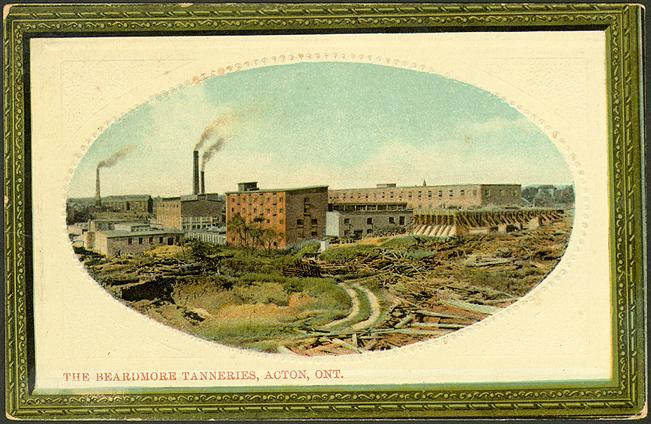
Perhaps the most memorable blowouts at Edgewood Park were the company picnics. The Acton Free Press (6 January 1971) makes special note of the Beardmore & Co. picnics. Beardmore & Co. were a leather tannery in Acton, said to be the largest in the British Empire around 1900. Ontarians of a certain vintage will associate Acton with the Olde Hide House, a large leather goods store and a successor to Beardmore, which made it "worth the drive to Acton."

("The Beardmore Tanneries, Acton, Ont," ca. 1910. Postcard courtesy of the Toronto Public Library, PCR-6.)

The 1938 event, held on July 28, was attended by about 500 company employees, their families, and well-wishers. All the usual picnic pleasers were held, including swimming and races for the children, an egg race for the ladies, a fat man's race, and a performance by the Acton Citizens Band. Naturally, the main event was a copious picnic supper.

A special feature of the 1938 edition was the taking of a panoramic picture of the attendees. This was reproduced in the 1971 newspaper thus:

(If anyone knows where a better copy is available, let me know.)

This was not the first panoramic photo taken at Edgewood Park. A photo of the "Nth Erin & Gara. picnic at Edgewood Park, Eden Mills," 1930, is available at a better resolution:

(Courtesy of Wellington County Museum and Archives, A2018.4 ph. 51164.)

Look carefully and you may see that a man near the middle of the picture appears to have a teacup upside down on his head. Why, we may never know.

Attendance at the 1938 Beardmore & Co. picnic was made possible by the use of "nearly all the motor vehicle transportation available" in Acton at the time. This note reminds us that the TSR was no longer operating when the picnic took place. The Railway was in financial difficulty since its inception, since it was hard to compete with private automobiles and hefty, government road building programs. In 1931, the TSR ceased operations and its assets were sold off. However, its downfall seems not to have clipped the wings of Edgewood Park, which remained an established place for regional recreation.

Even so, change did come to Edgewood Park. In 1944, the Park was purchased by the Lutheran Church of the Canada Synod as a location for their annual summer youth camps. The Church had run a Lutheran Boys Camp at Fishers Glen on Lake Erie since 1936. (A Girl's camp was started in 1940.) However, the camp had outgrown the facility there and the Church went looking for a larger one, which led it to Edgewood Park. Around 1,000 people attended the official opening service on 30 July!

Camp Edgewood, as it came to be known (later Edgewood Camp and Conference Centre), provided camping facilities for various youth organizations, not to mention adult and family retreats, Luther League and Synodical Brotherhood meetings, and Salvation Army events. For example, the Guelph YMCA held its annual camp there until 1951, when they moved on to Camp Nagiwa.

In so doing, Camp Edgewood became part of a significant cultural phenomenon: The Ontario Summer Camp. As Sharon Wall (2009) explains, summer camps for city children had become increasingly popular destinations for young Canadians, particularly in Ontario, especially after the Great War and picking up pace after World War II.

Some camps emphasized a 'wilderness' ideal, in which children were taught how to 'rough it' by swimming, canoeing, woodcraft, and sleeping under canvas. These sorts of camps were typically private, sited in more northern areas of the province (as far as Temagami), and catered to the scions of well-to-do city dwellers.

So-called 'Fresh Air' camps were sited near the big cities and were operated by charities. Their clientele were typically children of low-income families who otherwise would have no respite from the noxious fumes of Ontario's major urban centres like the Big Smoke. (The Toronto Star's Fresh Air Fund began in 1901 as a charity to help urban children escape their overheated urban slums.)

In between were 'agency' campus run by organizations like the YMCA that catered to the middle-class and so funded their operations mainly through fees. Like Fresh Air camps, they lay near the big cities and featured less a wilderness experience than a chance to escape urban hothouses for rural idylls and what be called nature literacy. Camp Edgewood fell into this category.

An article in the 12 June 1952 Toronto Globe & Mail provides an insight into the sort of expeience that campers at Edgewood would have:

Enjoy bedtime snack of hot dogs, crawl in creek to find crayfish
By Eldon Stonehouse
Guelph, June 11.—The little red school house was never like this.

Pupils in Guelph have moved out doors for this week to get their lessons under the open sky. So far the idea has been working well, and the pupils, at least, wouldn’t mind if teacher Ron Campbell never took them back under the school house roof.

The children, aged 9 to 13, are camped at Edgewood Lutheran Camp at Eden Mills, a few miles from Guelph. And, while some subject such as arithmetic may be slightly neglected during the week in the open air, other subjects such as art, marine life, birds agriculture and water safety are getting more attention than they have since last September.

Teacher Campbell, who was once a swimming instructor, has 36 young students under his care at the wood-fringed camp. And, while they have been as quiet as they ever were in classroom during the first couple of days, the children are enjoying their lessons more than they did during the first part of the year. (Hot dogs for bedtime snacks have helped.)

The open air schoolhouse is something new for Ontario, although it has been tried in various sections of the United States. So far, the Department of Education is keeping a watchful eye on the camp from Toronto and saying practically nothing. Guelph’s school board hopes that when the department does make its comment, it will be favorable.

The Guelph department launched the idea and put up the first $150. Parents of the Grade 5 children added $1 per day for the period the pupils will spend at the camp. The Home and School Association will pick up what’s left of the cheque after the pupils come back to town.

The children moved into the camp on Monday night, and, after getting accustomed to their new surroundings, were hard at work (hah!) by Tuesday. Monday, of course, was a holiday.

On Tuesday, and each succeeding day, the class was divided into groups, each for a different type of outdoor classroom work. Teacher Campbell took the class in first-aid, and also in water safety at the swimming pool.

Supervisors gave the regular teacher a helping hand with various other types of study. Helen Marr taught art in the dining hall, and Ray Mulford each day took a separate group to a nearby bird sanctuary and on a compass hike through the woods.

The Ontario Lands and Forests Department, although not directly involved, lent a hand too. Representatives just happened to drop into the camp to take the youngsters into the woods and teach them how to identify various trees. This lesson caught on about as fast as any, with the possible exception of Bill Hawley’s historical hikes and marine life studies. He had the children in the near-by creek in the water up to their knees capturing crayfish and underwater creatures for identification.

Keith Barber took another group to near-by farms to let them see what life was like in the rural areas. And, lest there be some need for added physical education, Ernie Berner from the Guelph YMCA was on hand to give the boys and girls some pointers on muscle development.

By the end of the first day at the Lutheran Camp, Ron Campbell had decided the outdoor school was a great idea.

“I wouldn’t mind,” he said, “teaching like this for 10 months of the year.”

Bob Noel, 9-year-old pupil, added his approval. “Gee,” he said, “This is keen.”

But if it rains during the week, it’s back to the books on arithmetic and you know what in the buildings on the camp grounds.
The "Shoebox memories: Edgewood Park" column of the North Halton Compass (2 July 2004) provides a two-page spread of very interesting pictures spanning Edgewood Park's history, which I will insert below. The pictures run from the earliest on page 8 to the later ones on page 9. Page 8:
Page 9:
The Edgewood totem pole reminds us that 'Playing Indian' was a common feature of summer camp programming in that era. As the ersatz totem pole suggests, the point was not mainly to provide education about Ontario's indigenous peoples but to allow modern children to indulge in a confabulated 'primitive' play-acting, which was held to be a kind of theraputic relief from the ails of modernity they faced in city living.

Postcards of Edgewood reveal an interesting dichtomy in its depiction.

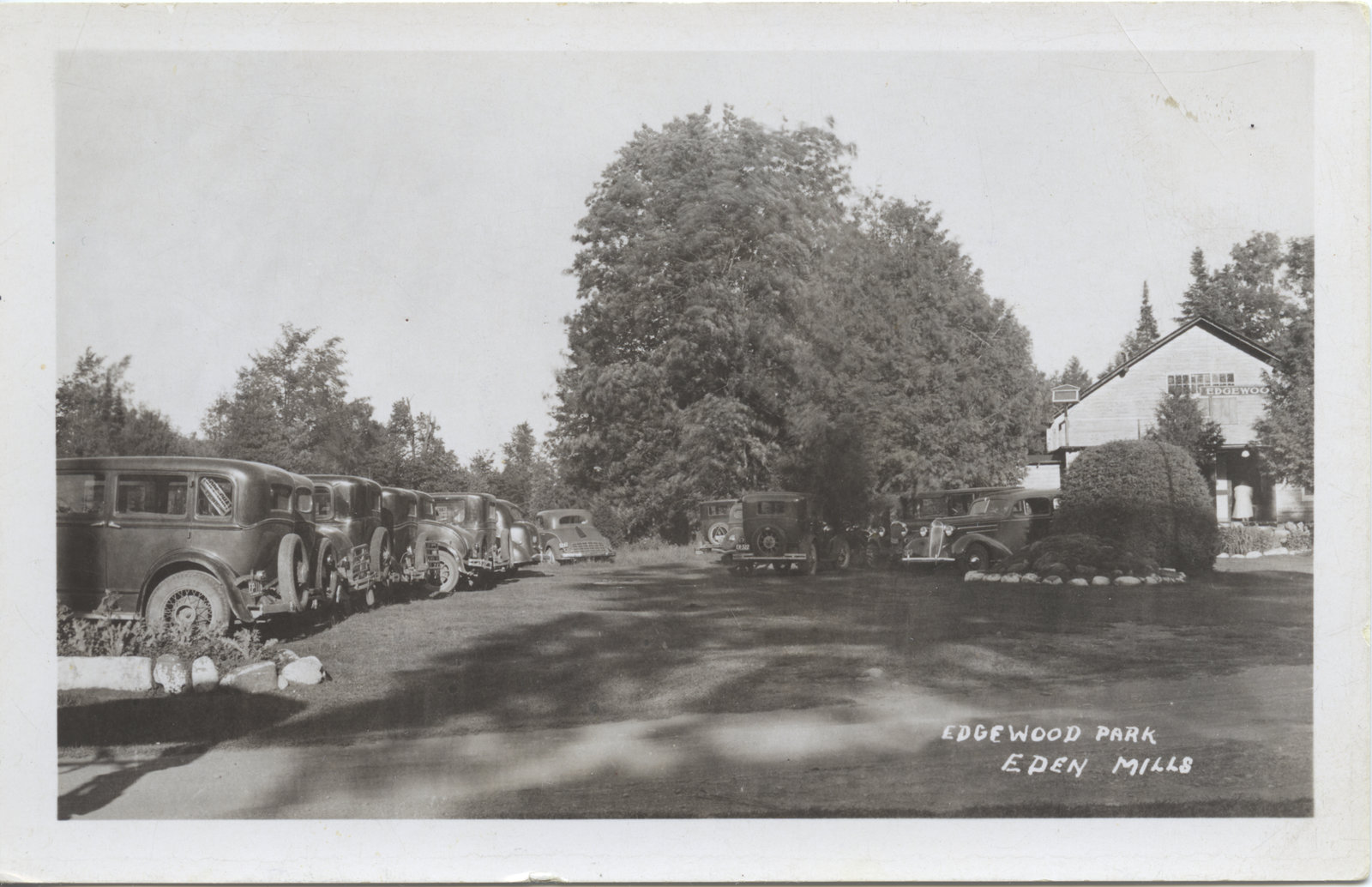
The first postcard shows the entrance to Edgewood Park, ca. 1940, featured on page 8 of the Shoebox memories article above:

("Edgewood Park, Eden Mills." Real photo postcard; courtesy of Wifrid Laurier University Archives.)

While the picture does not show any people, their presence is revealed by the semi-orderly arrangement of parked cars near the office inside the camp entrance, whose shadow is visible in the lower-left corner.

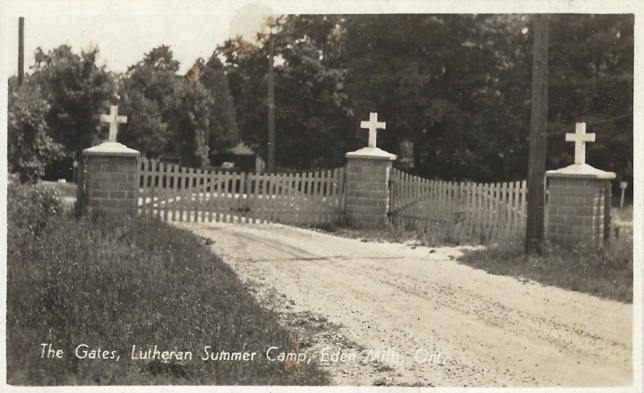
The postcard below shows the entrance to Camp Edgewood, ca. 1950.

("The Gates, Lutheran Summer Camp, Eden Mills." From the author's collection.)

This image omits any suggestion of people and instead determinedly shows the camp's gate firmly closed and its religious orientation displayed. The impression it leaves on the viewer is that of a locale under the decided control of its managers and focussed on its sectarian mission. Wall (2009) points out that one of the main concerns of parents sending their kids to camps was the safety, both physical, spiritual, and otherwise, of the facility and its management. The image above seems designed to assure them Camp Edgewood is a secure place.

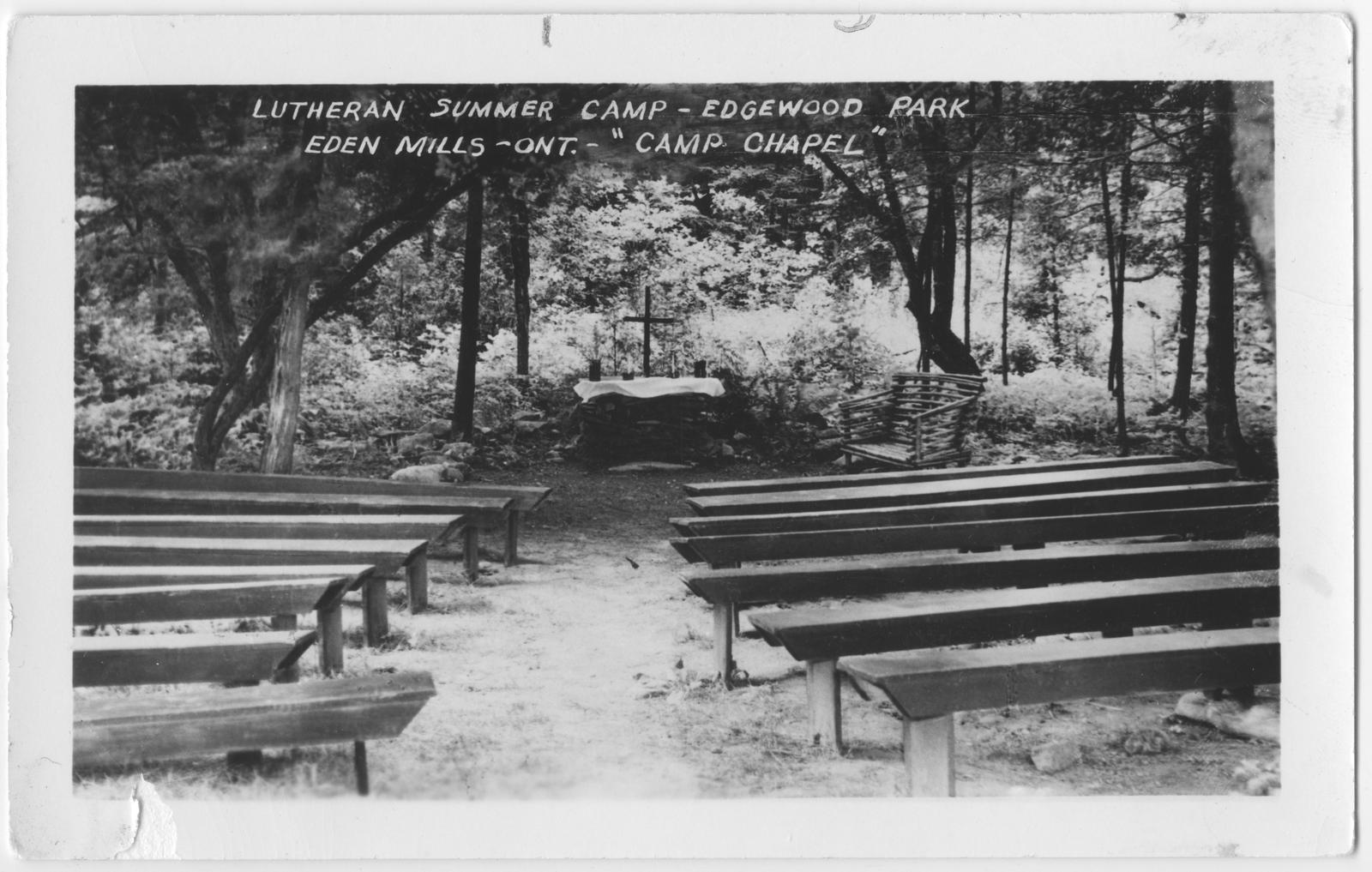
Another postcard of similar vintage is designed to leave a similar impression:

("Lutheran Summer Camp—Edgewood Park. Eden Mills, Ont.—'Camp chapel'," ca. 1950. Courtesy of Wilfrid Laurier University Archives.)

Again, no people are shown. Instead, the outdoor chapel is featured, with its religous symbols and orderly rows of seating. Though rustic, the impression remains one of order and security.

A futher card in the series shows one of the natural attractions of the Camp:

("Lutheran Summer Camp—Edgewood Park. Eden Mills, Ont.—'Camp stream'," ca. 1950. Courtesy of Wellington County Museum and Archives, A2015.1.3, ph. 45682.)

This card was sent to Mrs. Dundas, Waterloo, Ont. on 7 August 1951, from Betty, who reports

I am having a very nice holiday and I am hoping you are too.

A final view from the same series shows the scene inside the entrance of Camp Edgewood:

("Lutheran Summer Camp—Edgewood Park. Eden Mills, Ont.—'Inside of camp entrance'," ca. 1950. From the author's collection.)

As expected, no one is present but the orderliness of camp is dipslayed in the form of the prominent flagpole, the carefully trimmed lawn and greenery, and the park office looking out from behind it.

This postcard was actually sent through the mail and is postmarked on 10 July 1951. The message states:

Dear Frank [??]

Monday evening and still Hanging on. The sun was shining swell to-day. Can’t get Bill to go in swimming. Love to you all

Wes
It's good to know that people were having a swell time at the Camp!

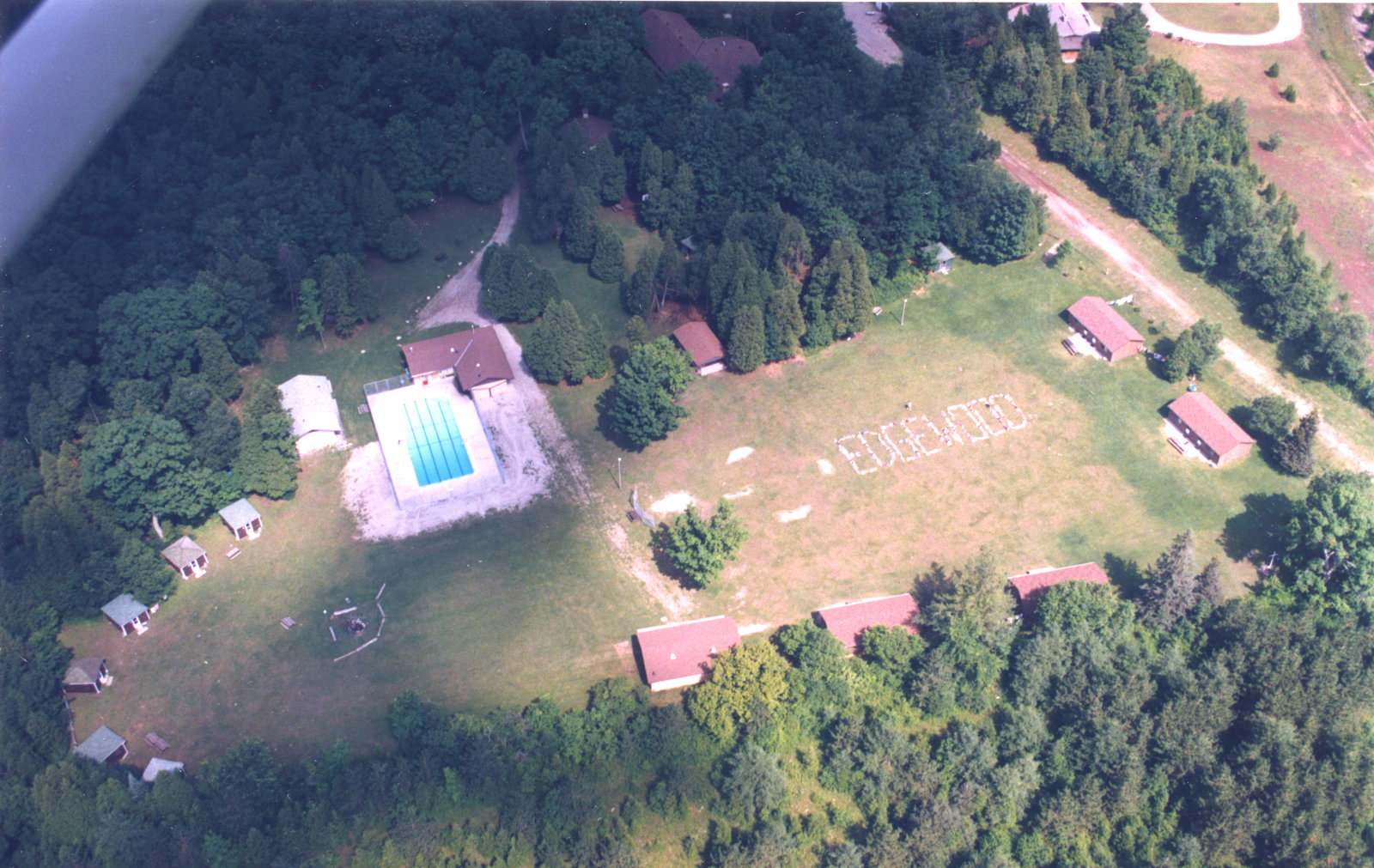
Camp Edgewood was renovated and continued in operation until 2017. It was sold to the Eden Mills Eramosa River Conservation Association (EMERCA), who are incorporating it, under the name Edgewood Trails, into a naturalized area.

(Aerial photo of Edgewood Camp and Conference Centre, 16 July 1996. Courtesy of Wilfred Laurier University Archives.)
Works consulted for this post include: Wilfrid Laurier University Archives also has an extensive collection of Camp Edgewood materials.

Sunday, 22 January 2023

The Heffernan street footbridge 3.0

Early in the morning of 5 February 1913, Martin O'Donnell came across a grisly surprise, "the body of a dead man, frozen stiff, in the centre of the through siding near the C.P.R. freight shed, one arm being missing" (Mercury). The body was later identified as Carmillo Angelo, who lived in a boarding house in the "Italian colony" in the Ward.

Forty-two years old, Angelo worked at the Pipe Mill (later the Old Mill) and was probably returning to his boarding house when he was struck by the 8:30pm train from Toronto, which dragged him some distance and severed his arm. He had lived and worked in Guelph for five years and had become naturalized only a couple of months before. He left a widow and five children back in Italy.

The incident occurred in behind the CPR freight shed, formerly the Speed Skating Rink, near the Heffernan street bridge. Angelo's death illustrated the hazard to pedestrians of having a popular pedestrian route, fed by the pedestrian bridge, hard by a railway.

As noted in an earlier post, Guelphites seemed generally happy with the convenience and aesthetics of the second Heffernan street footbridge. However, the proximity of its southern entrance to the Guelph Junction Railway was always problematic.

(This view shows the proximity of the second Heffernan street footbridge to the Gueplph Junction Railway. Postcard published by the International Stationary Co., ca. 1910. From the author's collection.)

In the early 1900s, the Canadian Pacific Railway was spending money on improvements to its facilities and, in Guelph, aimed to build a new railway station to replace the decrepit Priory, the first building constructed on the townsite. In conjuction with this plan, the CPR made a offer to the City of Guelph: It would build gates at the Eramosa Road railway crossing, and erect a new Heffernan street bridge that went over the tracks, if the city would upgrade the crossing at Allan's bridge (Mercury, 17 November 1909). This would ensure that the CPR would be in a position to build a new railway station at the nearby Trafalgar Square site in the following year or so.

(Indeed, it appears that the board of the Railway Commissioners ordered a new footbridge to be built that passed over the tracks, though I have yet to find a record of the order itself.)

The city seems to have accepted the deal and the tender of Rutherford & Paten, of St. Catherines, was accepted to construct the new bridge.

This was duly not accomplished. The city's Board of Works returned to the old idea that a vehicular bridge should be built to carry street traffic over the river. This plan was not carried out, apparently because the city refused to drain the river for the purpose of construction, as the builders had assumed they would (Mercury, 15 April 1912).

So, the Board reverted to the scheme of having another footbridge constructed instead. New plans were drawn up and a call for tenders issued. Ever indecsive, the City's call for tenders listed two different designs for the bridge (Engineering and Contract Record, 23 April 1913):

Tenders will be received up to April 26th by Board of Works and Sewerage Commissioners for: (1) steel foot bridge, consisting of 2 97-ft. deck spans, 1 through truss at 100 ft. and 6 I-beam approach spans; (2) construction of concrete substructure for the above; (3) alternative tenders for a reinforced concrete bridge on same site. Plans, etc., from City Engineer. $5.00 deposit required for concrete bridge plans.
Option (1) seems much like the previous bridge, albeit with extra approaches and elevation on a concrete substructure. Option (2) was for a newer style featuring 100% reinforced concrete, perhaps reflecting a desire that the bridge might appear more "modern" than the earlier one.

Spoiler alert: A tender for option (2) was selected, from the company of Galbraith & Cate of Montreal. Construction seems to have begun in September and finished around November 1.

("Construction of the Heffernan Street Walking Bridge," 1913. Courtesy of Guelph Civic Museums, 2013.72.77.)

Naturally, the third Heffernan street footbridge featured in many postcards of the post-Great War era. Its graceful arches and interesting slope were too much for photographers to resist. Consider the view below, taken from Eramosa street bridge upstream.

("Speed River, Guelph, Ont." Published by the Bulman Bros., B. C. Lithography & Printing Ltd, Vancouver, BC, ca. 1925. From the author's collection.)

Another picture taken from downstream shows the same interest in the juxtaposition of the river and the slanting angle of the new bridge.

("Footbridge over the Speed River, Guelph, Ontario." Published by F.H. Leslie, Niagara Falls, ca. 1930. The perforations on the left margin show that this card was sold in a booklet along with other cards, which could be torn out individually for use. From the author's collection.)

The elegant concrete arches of the bridge's substructure invite closeups, as they appear almost like the path a stone might follow if skipped over the river.

("Foot Bridge over Speed River, Guelph, Ont." Published by the Heliotype Co. of Ottawa, ca. 1920. From the author's collection.)

Note the original lighting system featuring inverted-J poles.

Guelphites took to the new bridge as they had with the previous one. It soon became home to the same sorts of uses, such as serving as a "dressing room" for youth taking dips in the Speed (Mercury, 5 August 1926):

A number of citizens have been objecting to the practice of a number of boys dressing and undressing under the Heffernan Street bridge. They state that the practice has become very prevalent lately and, besides being a danger to the boys themselves, is offensive to passers-by. One of the objectors said that while passing over the bridge last night, with a lady, the lads were using extremely bad language and when he remonstrated with them they only redoubled their efforts.
Plus ca change!

A few unusual events were also reported occurring under the bridge. Consider the picture below, showing Guelphites waving to the crew of the HMCS Swansea, the only naval vessel to pass under the bridge (Mercury, 1 April 1953):

The ship, on her way back from battle manoeuvers in the Georgian Bay area, nosed her way slowly down the Speed River to the cheers of amazed and sleepy-eyed early risers.
If you are similarly amazed, then take note of the date of the picture's publication.

Of course, a lot of water has passed under the bridge since its construction, and it experienced a few close calls as it aged. In 1951, the bridge underwent repairs to fix up the cracking and spalling that concrete structures tend to suffer over time. It was closed for four weeks while cracks and holes were sealed with steel mesh and additional concrete (Mercury, 27 July 1951).

In 1971, when the bridge needed further repairs, the Guelph City Council made plans to tear it down. Despite the urgency that was broadly felt to make Canadian cities more modern and shed vestiges of the past, there was a public outcry at the news and the Council reversed its decision, opting for repairs instead.

(Photograph of the Heffernan street footbridge by Gordon Couling, 1982. Courtesy of the Wellington County Museum and Archives, A1985.110, ph. 9510).

In 1990, the Heffernan street footbridge was declared a heritage site and the City Council decided to return it to its original appearance. Thus, the bridge was demolished and rebuilt. As Troy Bridgeman remarked (Guelph Today, 10 December 2019), it remains today one of the most photographed city landmarks. It is also a monument to the vagaries of civic traffic patterns and the survival of old structures in growing cities.

("Repair of Heffernan Street Walking Bridge," 1990. Courtesy of Guelph Civic Museums, 2009.32.5402.)
("Heffernan street footbridge," 20 October 2019. Courtesy of Peter Burian via Wikimedia Commons.)

Saturday, 17 December 2022

Merry Xmas and Happy New Year, 1914

The postcard shows a lovely, summery scene featuring the Blacksmith Fountain in St. George's Square. The streetcars carry passengers in their summer attire, who are probably happy that the open sides let in cooling breezes. Perhaps the driver of the oncoming car secretly hopes to apply the made-in-Guelph cow-catcher on the front to scoop an errant pedestrian out of the way.
("St. George's Square, Guelph, Canada," ca. 1910. Published by the International Stationary Company, Picton, Ontario.)

Although postcard publishers tended to prefer summer photography, postcards were sent all year round, and this card was actually dispatched from Puslinch to Guelph on 31 December 1914, when the Royal City and its surroundings had be socked in under repeated snowfalls.

Addressed to Mrs. James D. McPherson on York Road in Guelph, the message relates to the holiday season:

Dear Jim & Belle:—
We got the photos and you could not have sent us a better Christmas box. Glad to hear baby is growing so well.
Wishing you all
A Happy New Year
Aunt Flora
Of course, the year 1914 was an unusual one in Guelph. The Great War had begun a few months earlier and Canadians were still unsure what it would amount to. Many young men had left with the Canadian Expeditionary Force and were still in Britain training for combat. Herbert Philp wrote a letter home to his family, which they subsequently published in the Mercury (24 December), under the ironic title "Salisbury mud a wonderful thing." In it, Philp speaks eloquently of the frustration of the contingent:
For, despite the eagerness of practically every man in the contingent to be "over the way," we are still wallowing about in England's mud.
Philp explains that the conditions were fine and dry on their arrival, and they pitched their tents in a "slight valley." Then down came the English rains, leaving their modest dwellings with:
ambitious rivulets flowing either through them or snuggling close to their sides. Not a tent but contained a pool of water.
When the weather let up, the tents were moved up slope but the cookhouse remained down in the valley, meaning that everyone had to line up there three times a day, in whatever weather, to get their food. The result was frequenty cold tea and soup and soggy bread at meal times.
(Detail of "Herbert William Philp," no date; Courtesy of William Ready Division, Archives and Research Collections, McMaster University Library, via The Canadian Encyclopedia.)

Philp finishes his letter thus, "But, so far as excitement and entertainment are concerned, Salisbury Plains still runs a close second to the grave."

(Herbert Philp's many and eloquent letters home throughout the Great War have been collected by Ed Butts in the book, "The Withering Disease of Conflict: A Canadian Soldier's Chronicle of the First World War." It is available from the Guelph Historical Society and I highly recommend it!)

War news was a mixed bag. Accounts of terrible battles were featured, but the general tone conveyed the sense that the Allies had the upper hand and German defeat in the near future was still a possibility, though not by Christmastime.

Rumours of German attacks on or in Canada circulated. For example, a national article printed in the Mercury (1 December) related a scheme set in motion for German forces to take over Quebec City. A concrete structure made the previous year near St. Anne de Beaupré by a German movie crew in 1913 was thought to be a bunker intended as a weapons cache for a surprise attack launched by sea. Luckily, British naval superiority had frustrated this plan, it was thought.

The many Canadians of German descent in the region also caused concern. A letter to the Editor (11 December) attempts to address rumours of a German-Canadian fifth column thus:

Editor of the Mercury.
Dear Sir: Who are the meddlers who have been reporting to Guelph authorities that secret meetings are being held in Morriston by the Germans and German-Canadians?
There are no secret meetings held in Morriston to my knowledge. Perhaps the meddlers had reference to the revival meetings, held in the Evangelical church, which are held annually. These meetings are not secret, but sacred, and people of all nationalities are welcome to attend.
Are such meddlars as these throughout the Dominion interested in uplifting our Canada? No, they are too ignorant to realize the harm they are doing their own village and community, also their own country, Canada.
Yours respectully,
A life-long Mercury reader.
As ever, conflict breeds suspicion and mistrust, well-founded or not. Locally, misplaced suspicion of German- and Catholic Canadians resulted in the Guelph Novitiate Raid of 1918.
("Evangelical Ch., Morriston." Courtesy of Wellington County Museum and Archives A2009.124, ph. 31342.)

Compared to previous years, the Xmas shopping ads in the Mercury seemed subdued. Still, they were far from absent. The D.E. Macdonald & Bros. shop urged Guelphites to "Hurry up! Only two more Saturdays before Christmas" (11 December). Extensive gift suggestions for him, her, and baby were provided, along with an illustration of Santa Claus hauling a prodigious sack of goodies.

Similarly, Moore and Armstrong noted that there were only nine shopping days left (14 December): "If you have not got the Christmas Spirit yet, you will have it in large measure when you get to the White House," that is, their store on Wyndham street.

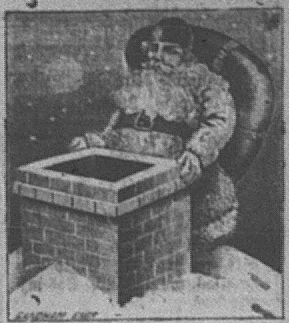
Their illustration also showed Santa Claus carting a super-sized sack of gifts. One can understand the look of relief on the jolly old elf's face at the sight of the very wide chimnney before him!

If nothing else, Santa's message was to go big or go home, or both!

Even Santa Claus was not unaffected by the conflict in Europe. This cartoon shows how low German Kultur had sunk with the war (22 December):

The caption says, "An act of barbarism: Not only are the Germans firing on the Red Cross and flags of truce, but they are rendering the work of Santa Claus difficult and hazardous."

Being magical, Santa had the means to rectify the situation, as shown in a subsequent cartoon (26 December):

Here, Santa deploys what I assume is a stocking full of doorknobs to give Kaiser Bill a jolly good thrashing.

People on the home front carried on. The Guelph Musical Society held a parade downtown on 9 December. The performance was marred somewhat when large bulldog followed the squad down Wyndham street. The drummer found that the dog would bite the drumsticks whenever he raised them to beat the kettle drum. Fearing that he might be "minus a wing" if he provoked the dog further, the drummer ceased drumming and the band had to proceed without their bass.

The animals did not have it all their own way. A bear cub named "Teddy" had been kept as a curiousity at the American Hotel on Wynhdam street for most of the year. Having reached the size of 200 lbs, Teddy was sent Bernard Schario, the butcher, who turned him into roasts and steaks as a holiday feast for the hotel residents (24 December).

The skating season took shape. With the cold weather, Guelphites were soon skating on the pond above Goldie Mill. Skating also began indoors at the Royal City Rink (formerly Petrie's Athletic Park and Rink) at Wellington and Gordon streets.

(Detail of "The Petrie Rink, Gymnasium and Baths," 1898. Courtesy of Guelph Museums 2014.84.2.)

Curiously, the street railway company decided not to open their usual skating rink on Howitt's pond, on the basis that it would not be "a paying proposition" (18 December). In previous years, the rink behind the streetcar barns on Waterloo road had been run as an attraction to get people onto the streetcar system in winter.

Perhaps they had too much competition. The City had decided to fund a rink on the grounds of the Guelph Collegiate Institute on Paisley street. A room in the basement was even made available for people to put on their skates (22 December). Perhaps this level of comfort and style attracted skaters who might have been inclined to travel to the streetcar rink in previous years.

("Collegiate Institute, Guelph, Ont." Postcard printed for Waters Bros., Guelph, ca. 1910. Courtesy of Guelph Museums 2009.20.1.)

The Royal City Rink was also home to Guelph's very first NHL team! Yes, Guelph entered a team in the 1914–15 Northern Hockey League senior series (21 December). Although some of the players trying out for the team were from out of town, lots of local boys turned out to show their stuff, including Allan, Anderson, Stricklerr, Greer, Hayes, Spalding, Ogg, King, Mowat, and Bulgin.

The side lost their first exhibition game against the Dutchmen of Waterloo (26 December). Although the Guelphites mainly acquitted themselves well, the superior size of the Seagramites gave them a distinct advantage, resulting in a 5–2 win for the visitors.

Another tilt against the same team was arranged for the first regular season game. This time, the Royal City skaters were better prepared. The result was a "wild sort of affair," beginning with a dispute over whether one of the Guelph players was a professional—strictly forbidden! The play was very physical and Referee Knell of Berlin (Ontario) "had his hands full."

The police had to be called in to break up a melee after the crowd joined in an on-ice altercation in the second half. Tied at the end of regulation play, the game went ten minutes into overtime before Guelph's centre, McGregor, put the home team up 7–6.

At the Reformatory (or "Prison Farm"), the provincial government announced plans to install an abattoir on site (31 December). The Ontario prison system required 600–700 tons of meat annually in its operations, which was obtained from private butchers. Building an abbatoir at the prison meant that prisoners could be employed to perform the butchering at a lower cost than private butchers, saving the system some $50k a year. In addition, prisoners would learn skills that they could use to obtain regular employment as meat dressers in private industry after release.

("Ontario Reformatory Guelph, Jan. 1915 The Abattoir." Courtesy of Guelph Museums 2014.84.1276, p. 59, ph. 3.)

A final point of interest came with the annual, municipal elections. First, there was some talk of not holding the elections at all, in view of the war situation (17 December). But, the election went ahead as usual.

Besides electing a Mayor, Aldermen (Councilors), and other officials, citizens of Guelph were asked to weigh in on the following by-law, "Are you in favor of municipal votes for married women?" (8 December). The 'Women's Franchise plebisite' was carried by a majority of (male) voters 1140 to 838 (5 January 1915).

Women's groups had long campaigned for women's suffrage in Ontario. In the Edwardian era, efforts tended to focus on municipal voting. In 1914, the Canadian Suffrage Association, led by Dr. Margaret Gordon, had lobbied many Ontario municipalities to hold referenda on extending votes to women. It appears that Guelph was one of 33 municipalities where the effort met with success, albeit for married women only.

Women's role in the Great War led to further support for the cause. In 1917, Ontario women finally gained the right to vote in provincial elections.

In many respects, the holiday season of 1914 was like those of previous years. Even so, as the prospect of the end of the conflict in Europe receded, it was clear that times were changing and that the New Year would bring on many new challenges.