Tuesday, 4 July 2023

Fire, water, and flowers: The Rose Bowl at the OAC

Time, like fire, is one of the chief consumers of old structures. Fire was never likely to consume the Ontario Agricultural College's (OAC) reservoir but time has always brought new things to campus and taken old things away.

So it was that the the old water reservoir, often called the "Rose Bowl," would soon "be history" (Sands 1956). The campus was being updated and, as it no longer served its original protective purpose, the reservoir was being filled in.

The history of the reservoir begins in the spring of 1896, when the OAC's Chemical Laboratory burned to the ground. Fire was ever a hazard for individual buildings but, as the College grew and its stock of buildings increased, the potential loss to fires increased rapidly. The College's existing fire-fighting equipment was no longer up to the task of controling blazes, so measures to improve it were undertaken.

In the previous year, wells had been drilled to supply the campus with water but there was no place to store water for use in emergencies such as fires. So, as a new Chemical Building was erected on the site of the old one, a rectangular pit was dug between it and the Massey Library to act as a reservoir. The pit was 100 ft. long, 63 ft. wide, and 10 ft. deep, holding about 250,000 gallons of water. It was lined with cement and pumps and hoses were set up so that water could be extracted and used to douse any campus blazes.

(The Gymnasium Building reflected in the new reservoir. Postcard published by Rumsey & Co., Toronto, 1906. The swimming "tank" in the basement of the Gymnasium was also set up to act as a reservoir for fire-fighting when the need arose.)

A report in the OAC Review states that first- and second-year students were employed to dig the pit! If true, then we can only lament that standards for extra-curricular activities on campus have sadly fallen since that day.

("Massey Hall and Library, Ontario Agricultural College, Guelph." Postcard published by A.B. Petrie & Son, ca. 1910.)

In any event, students were called out to witness and participate in the system's first test (Mercury, 24 Nov. 1897). It was conducted by Chief Robertson of the Guelph Fire Brigade and went well:

The students were called out and a detachment detailed off to work the hose. The double fire pump was started up, forcing the water into the hydrants. The first trial was made on a hydrant at the foot of the gymnasium, when a stream was thrown about twenty feet over the dome of the barn, a distance of about 60 or 70 feet, while the gauge showed 115 lbs. pressure. In front of the College proper, while the ground is a trifle higher, there was 120 lbs. pressure. At the rear of the main building two lines of hose were attached to one hydrant, and the water was thrown some 20 or 30 feet over the building. They have two new hand reels and 800 feet of new hose.
Success!

The reservoir seems to have proved its worth on a number of occasions. One fire of particular note occurred on 20 March 1942 when the main barns on campus caught fire. These structures were notoriously prone to fires and, being full of flammable things, tended to burn down rapidly. The first campus barns had burned to the ground in 1885 and their replacements, built the following year, in 1888 (Buchanan 1942). The third set lasted for 55 years but finally succumbed.

At the time, part of the OAC was in use as a military training facility, especially for RCAF Wireless School No. 4. It was two students of the School who turned in the alarm that evening. The fire-fighting effort went well (Buchanan 1942):

Fortunately, the splendid fire fighting equipment of the Air Force was close at hand and was quickly brought into use. A little later the Guelph city fire brigade arrived, and between them the fire was sufficiently held in check to make possible the safe removal of all the livestock, both horses and cattle. Then, too, by persistent fire fighting the fire was completely checked at the junction of the horse stable and the main barn, so that only the east wing and the main barn were destroyed.
In the effort to rescue the farm animals, OAC students and staff were assisted by Wireless School trainees, a collaboration that helped to ease tensions between groups then sharing the campus.
("Excursionists at O.A.C., Guelph." Postcard by unknown publisher, ca. 1905. The Chemical Building can be seen at the left margin, the Gymnasium in the centre, and the new barns in the background on the right side.)

Of course, campus residents found uses for the reservoir beyond fire-fighting. For example, in its very first winter, students began to skate on it and play hockey. In the summer time, the reservoir was used for swimming to cool off from the seasonal heat.

("Reservoir and Gynmasium." OAC Review, June 1907, v. 19, n. 9.)

Besides seasonal fun, a pool on a large campus afforded opportunities for students to discipline one another. One example may be illustrative (OAC Review 1913, v. 26, n. 1, p. 46):

I knew a big, stout fellow who came to school with the avowed intention of stirring the place around some—and he proceeded to do it too. After he had been held under the surface of the reservoir for half a minute he was only mildly profane. Another half and he could have posed as a model sheep. His fellow students enjoyed life more pleasantly because of his hazing.
At the same time, having a large pool of water around presented a hazard to safety, despite the presence of a three-foot-high fence. This risk was illustrated on 5 August 1916 when Billy Green, six-year-old son of Engineer A.E. Green fell into the reservoir and drowned (OAC Review 1916, v. 29, n. 1, p. 18).
("In memory of little 'Billie' Green, who was drowned on August 5th, in the College reservoir." OAC Review v. 29, n. 4, p. 114.)

On 4 November 1939, second-year student Ronald Miller fell into the pool and drowned while searching for insects beside it (OAC Review 1939, v. 52, n. 2, p. 80).

("Massey Hall and Library." OAC Review 1935, v. 47, n. 8.)

In aesthetic terms, the pool became widely admired for providing pleasing reflections of nearby landscape and buildings. After the Main Building was demolished in 1930 (among other things, it was determined to be a fire hazard), replaced by Johnston Hall, and its front gardens buried, the canon known as Old Jeremiah was placed next to the reservoir, adding another attraction and a focal point to the site.

("Massey Hall, O.A.C., Guelph, Ontario." Postcard published by F.H. Leslie, ca. 1935; from the Keleher Collection. Note the position of Old Jeremiah at the north side of the reservoir, not to mention what appear to be newly planted roses in the surrounding garden— the birth of the Rose Bowl.)

In the same year, the reservoir was chosen to be the site of the Rose Test Garden. The Rose Society of Ontario was looking for a site to house its program to develop varieties of roses, both for show and for commercial purposes. The OAC was chosen as host, in part because Paul Sanders, then in charge of ornamental horticulture at the College, was a fan (Rolph 1942). With the blessing of the College administration, work began with the planting of 450 roses in the garden in 1931. The garden was sited directly next to the reservoir, perhaps for ease of access to water and to enhance a place that was already regarded as a campus beauty spot.

("Administration Building, O.A.C., Guelph, Ontario, Canada - 4." Postcard published by F.H. Leslie, ca. 1935. Here we see the back of Old Jeremiah from across the Rose Bowl.)

In honour of this association, the reservoir and garden became known informally as the Rose Bowl.

The Rose Bowl worked its way into the culture and imagination of OAC students. Being of large size, the reservoir water did not heat up quickly and gained a reputation for being cold. This characteristic became the basis for poetic comparisons among students, as in this poem published about (and by?) a resident of Macdonald Hall, the Home Economics school for young women on campus (OAC Review, v. 53, n. 2, p. 84):

Apologies to Rossetti

The Mac Hall girl leaned out
From the cold and draughty sill,
Her eyes were cold as Rose Bowl water
In November’s awful chill.
She had three apples in her hand.
The curlers in her hair were seven.

The Mill’s Hall boy looked up
From the hard and frozen ground.
She looked down with intense displeasure...
He could not make a sound.
Still with his eyes he could be beg—
He got those apples—on his head!
Ouch! Not Romeo and Juliet's balcony scene but maybe more true to life.
("In the grounds—Ontario Agricultural College, Guelph, Canada." Postcard published by Valentine-Black Co., ca. 1945; from the Keleher Collection. Note the roses, Old Jeremiah, and the Portico in the background.)

The Second World War proved a setback for the Rose Bowl. Maintenance was cut back as energy was devoted to the war effort and control of the campus was divided between the RCAF and the Province of Ontario. After the war, the campus was restored entirely to the OAC but the Rose Test garden fell further into disrepair. By 1950, the Rose Society of Ontario decided to abandon it.

("Administration Building, Ontario Agricultural College, Guelph, Ontario, Canada." Postcard published by Alex Wilson Publishing Ltd., ca. 1950.)

In the mid-1950s, a newer and bigger water reservoir was built further east, near the water tower that had been built in conjunction with the erection of Johnston Hall. That made the old Rose Bowl reservoir redundant. The time had come for its removal.

("Administration Building, Ontario Agricultural College, Guelph, Ontario, Canada." Postcard published by L.F. Charter, ca. 1960. Note that the Rose Bowl has vanished.)

The ornamental fence was dug out, the hole filled in, and the site covered up. Memory of the Rose Bowl faded away, its image now confined to old pictures and postcards of the OAC campus.

("Massey Hall and Library, O.A.C., Guelph, Can." Postcard published ca. 1915 by International Stationary Co.; from the Keleher Collection.)
Works consulted include:
  • Buchanan, J. (1942). "Fire!—Fire!—Fire!" OAC Review, 54(7): 397–398, 435.
  • Rolph, A.H. (1942). "Ten years of the Test Garden." Annual of the Rose Society of Ontario, p. 58.
  • Sands, D.R. (1956). "The 'Rose Bowl'." OAC Review, 68(4): 16–17, 25.

Wednesday, 31 May 2023

Close encownters: Urban cows and their regulation in the Royal City

They gathered furtively at the residence of Albert Fred Farley in Guelph, to discuss the foundation of a Communist Party of Canada (Easterbrook 1995). Discussion was held in Farley's barn in order to allow space for the number of people involved. Of course, the barn already had several residents, whose presence sometimes intruded on the proceedings:
“They brought food to us from the house in pails, so people would think they were feeding the cows,” said Dolgoy,” There were cows alright; I remember that whenever a cow urinated, the speaker had to stop for a minute.”
Besides the cattle's disregard for the delegates, what is perhaps most surprising is that there were cows in Guelph at all. Since its early days, and even in 1921, when this meeting occurred, it was not uncommon to encounter cows in town. Today, meeting with a cow in Guelph would be startling. (Well, apart from the OAC.)
(The former home of Albert Fred Farley, now 257 Metcalfe Street. The historic barn is no longer present.)

So, it is interesting for us to look back to ascertain what cows were doing in Guelph in its earlier days and what changed in the meantime.

Cattle had a number of uses in nineteenth century Canada. They were used for muscle power to haul heavy loads or sometimes to provide power for machinery. They were the source of beef, a food much prized in the Anglo-American world. And, cows could provide milk, which was an important part of most Canadians' diets.

(Two oxen yoked in front of the Albion Hotel, ca. 1895. Courtesy of Guelph Civic Museums 2009.32.2163.)
For city residents, using cattle for muscle power was not usually necessary. Steam power, and later electricity, were available where human or horse-power were not adequate. Beef cattle require large investments as they normally take several years to grow to a size where it would be profitable to sell them to a butcher. However, milk cows pay off immediately in the form of regular milk production, which can help to meet the immediate nutritional needs of families and where any excess can be sold to generate extra income.

Ogle (2013) explains that it became common practise in the United States (and in Canada) for urban cattle to be pastured more-or-less where they lived. Early settlers got used to the idea that free pasture was never far away in what they regarded as the wilderness just outside of their towns. Cattle could simply be turned loose, forage for themselves, and be rounded up when need be. The habit proved enduring.

One obvious problem with this arrangement is that urban cows "running at large" can be a nuisance. No respecters of manners or property, cows eat whatever looks good that they can get at. This would be not only food and pasture provided for them but also their neighbour's lawns and gardens.

(Allan's bridge, ca. 1880. Note the two cows near the left-most pier. Courtesy of Guelph Civic Museums 1997.21.1.)

Towns and cities in Ontario passed "cow by-laws" since their early days. A typical cow bylaw made it an offence for citizens to allow their cattle to run unrestricted ("at large") in city limits. They had to be either under supervision of a cowherd while in pasture or going to or from the same in the streets. When at their owners homes, cows' movements had to be restricted with fencing or similar measures to keep them from wandering off. The consequences of violating a cow by-law were usually a fine and damages.

In 1876, Guelph adopted such a bylaw. It is not clear what precipitated the move at this time. Bradbury (1984) argues that animal bylaws were a symptom of class conflict. Urban livestock were kept mostly by poorer residents, who relied on them for non-cash support for their prosperity. Mainly urban chickens, pigs, and cows provided food and thus helped families to retain cash earned by wages for other needs. Restrictions on urban livestock constituted a way of disciplining such families and thereby ensuring their dependence on wage income, which the capitalist class controlled. So, controlling the domestic livestock or urban wage-earners was a way of controlling those people themselves.

Interestingly, there was an awareness of the class issue in Guelph. Debate in Council about the bylaw made note of the dependence of poorer urbanites on their cows (Mercury, 16 May 1876):

Town Council.
...
Mr. Hart moved the third reading of the By-law forbidding cattle running at large.
Mr. MacMillan spoke strongly in opposition to such a law being put in force at once, without any previous warning having been given. There were a great many cows in town mostly owned by poor people, who had at considerable expense managed to winter them, and if they were forced to sell now, just at the time they were beginning to be of use, it would be a hardship.
Mr. Hood although opposed to cattle running at large considered it would be a great hardship to compel people to sell off their cows at once, without having some time wherein to dispose of them.
A clause was then added to the By-law providing that it does not take effect until the 1st of Sept., next.
The news suggests some concern for the poor cow-owners of Guelph but also implies that Councilors expected most of them to have to sell their animals to comply with the bylaw, probably because those people often allowed their animals to forage "at large."

Of course, passing a law is one thing, enforcing it another. Remarks about the bylaw in the next few years often convey complaints of official laxity on the matter. Consider, for example (Mercury, 22 May 1877):

Cattle running at large.—On several occasions the Mercury has called the attention of owners of cattle to the provisions of the By-law prohibiting cattle running at large on the highways of the corporation, and to the proper authorities, whoever they be, to see that said provisions are rigidly enforced. Almost every day there are parties complaining about cattle breaking into their premises, and if not destroying anything they tramp down lawns and otherwise render themselves obnoxious to those who wish to live in peace with their neighbors. It is said that those who have suffered should impound the cattle, and assess damages. That would answer very well, and parties aggrieved would be justified in doing so, but by so acting they would incur the displeasure of their neighbors who might be proprietors of the cattle. If there is no official whose duty it is to see to the enforcement of the By-law, one should be speedily appointed.
Besides such editorials, citizens wrote letters to the paper to decry insufficient enforcement. In one such letter, we also learn of a connection between the bylaw and attempts by the city at civic beautification (Mercury, 19 October 1878):
Cows at large.

To the Editor of the Mercury.
Two or three years ago the Council offered a premium to parties who would beautify the town streets with trees, and on taking care of them for three years would be rewarded. I don’t suppose that many would claim the reward and that most of us were only too pleased to see that our City Fathers were alive to the necessity of making the place attractive as well as in future years rendering us a pleasant shelter from the sun. however, unless more stringent steps are taken to prevent cattle and horses running at large we shall never attain success.
In the ward in which I live there are four or five cows, and sometimes a couple of horses tramping round the entire night, and sometimes during the day, so that one is compelled to be always on the watch to prevent one’s trees being stripped of leaves and tender branches—our ornamental casings, however high, cannot prevent a horse doing what he likes. This annoyance is not confined to one ward and should receive attention.
If there was an enclosure or pound in each ward the annoyance could easily put an end to—driving animals down to the market is rather too far.
Guelph, Oct. 18, 1878
Ratepayer.
In its early days, the Guelph townsite had been nearly clear-cut so that it looked almost barren. By the 1870s, the city had decided to encourage reforestation through establishment of parks and planting street trees. This was the job of the Parks and Shade Trees Commission. In addition, private citizens were encouraged to plant trees and establish lawns and gardens to beautify the streetscapes and enhance the reputation of the town with respect to its provincial neighbours (and competitors).

Adoption of the cow bylaw could be understood as a part of this project. Cows (and horses and pigs) tend to eat and degrade the lawns, trees, and gardens vital to urban beautification. So, their movements or even presence must be restricted.

This association could be viewed, as Bradbury (1984) suggests, as a manifestation of class conflict: Fancy lawns, trees, and gardens are mainly bourgeois concerns, whereby middle- and upper-class citizens distuinguish themselves from their poorer neighbours (and compete for status). If urban livestock make this distinction difficult, then they must be removed.

At the same time, parks and shade trees are civic amenities that should, ideally, benefit all citizens. But, they can be promoted only with control of hungry, urban herbivores.

One welcome feature of coverage of the cow bylaw in The Mercury is that we can get some idea of where the cows were. Explicit mention of locations is sometimes made. W.H. Jacomb (a housepainter) complains that it is particularly common in the West Ward for residents to turn their animals out to roam at night (Mercury, 15 June 1877). An editorial claims that St. Patrick's Ward (in the east) is "particularly blessed with bellowing bovines" (Mercury, 27 March 1879). Waterloo Avenue gets several mentions as a street where roving cows may be found. Another article makes mention of cows being a persistant nuisance on the streets behind Horsman's Hill (Grange Road) (Mercury, 28 May 1886).

("View of Guelph, Ont. 1874." The perspective is from Horsman's Hill, now Grange Hill. Note the cows in the field in the lower, right-hand corner of the image. Courtesy of Guelph Civic Museums 1973.48.1.)

One item points out numerous complaints of roving bovines at "the Park," meaning Exhibition Park (Mercury, 1 October 1895). The article continues on to observe, "It is said the police arrested one cow last night, but there are still several at liberty."

Even so, cows were not always fugitives in Guelph. Vacant lots were considered fair game for hungry cattle. Also, some open areas were considered pastures where they could graze. There was a pasture near London and Woolwich Streets. Before it became a park in 1909, St. George's Park was also available for pasturing cattle.

(A real photo postcard view of Guelph, ca. 1910. The photo was taken by Guelph photographer D.H. Booth, apparently from the top of Idlewyld, a manor at 27 Barber Avenue, looking towards the back of the Church of Our Lady and Central School. The foreground shows a number of barns and small fields in the London Avenue and Yorkshire Street area, a likely place to find urban cows.)

Another place where roaming cattle seem to have been easily found was at the Speed River in the vicinity of Well's bridge (or The Three Bridges). Today, this site is the location of the Edinburgh Road bridge over the Speed.

The real photo postcard above shows several cows, with the derriere of a black one featured prominently, on the north shores of the Speed River, with the three spans of Wells's Bridge in the background. A message is written on the front: "Yours truly // Helen A. Bollert // Guelph Ont." The recipient's address, recorded on the back is, "M.elle Bertaux // 17 rue des Bastions // Cherbourg // France." The card is postmarked 18 May 1906.

It seems that this postcard was sent by Helen Amelia Bollert of Guelph, then 16 years of age, to a young woman in France as part of a postcard exchange. Such exchanges were often arranged through clubs, newsletters, etc., and allowed prospective recipients to identify the kind of postcards they would like to receive. Anyone who sent a postcard would receive an appropriate one in return, so that everyone could build up their collection. What was M.elle Bertaux's request? Did she like cows?

Remarkably, this image was reprinted in as a commercial postcard by Warwick Bros. and Rutter of Toronto.

The card above was postmarked on 13 April 1907. It is also notable because the caption misidentifies the bridge in the background as Gow's Bridge. Later versions of this card carried a corrected caption. (This is also a reminder that you cannot always believe postcard captions.)

In any event, by 1880 the police seemed to take enforcement of the cow bylaw more seriously and hired someone for the express purpose of impouding guilty cattle. This may have been Andrew McLeod, described as a "boy," who joined up for this assignment. Not everyone was grateful: young John Hollaran was brought before the judge on the charge of throwing stones at McLeod during the discharge of his duties (Mercury, 3 May 1880).

Nonetheless, over the next few years, the Mercury reported regularly on prosecutions under the cow bylaw. For example (Mercury, 25 September 1885):

Police Court.—John Armstrong, having a cow running at large, paid a fine of $2 and costs for the privilege.
Many reports are similarly brief, suggesting the matter had finally become a largely quotidian affair.

The number of milk cows in Canadian cities dropped steadily in the final quarter of the 19th century and into the 20th (Kheraj 2015). As the human population grew, space for cows started to shrink, thus squeezing them out. The effect of cow bylaws in making cows more difficult to keep may also have played a role, as did increasing sanitary concerns. Of course, another factor was no doubt the increasing availabilty of bottled milk. As urban and nearby rural dairy operations scaled up, delivery of fresh milk came increasingly easy and within reach of urbanites. The benefits of keeping domestic milk cows decreased.

Still, cows could be found wandering the streets and fields of the Royal City into the 1940s. This report from the Mercury (4 August 1943) would not sound much out of place in 1880:

Page Boy Blue—Cows on the lawn

Two large, healthy, contented cows calmly occupying a fine lawn on Paisley Street, drew the amused attention of pedestrians this morning. Oblivion [sic] to rain, wrath of the owner, and the fine points of etiquette, the bovine ladies were munching succulent grass with a sly nip now and then at relish in the form of garden plants.
Today, you would be astounded to find cows at large on the streets of Guelph but, in earlier times, you could cownt on it.
Works consulted include:

Tuesday, 25 April 2023

Baker Street has taken many turns over the years

In its overview of the Baker District Redevelopment project, the City of Guelph notes that:
We’re transforming a former municipal parking lot into a compact district nestled in Guelph’s historic core that will create a renewed area of activity, commerce and civic space for the local community and city.
The old parking lot is slated to be replaced by a civic hub, including a new public library, an urban square, residential units, commercial and institutional spaces, and, of course, parking.

As this process continues, it is interesting to take a look back at the tranformations that the space has seen in the past. Of course, many notable changes have taken place there—too many to catalog here. But, a sketch would be informative.

As the city's background information points out, the triangular lot that is currently the Baker Street parking lot was designated by the Canada Company as a burial ground at the time of the town's founding in 1827. It was common practise in Britain for graveyards to be placed in proximity to churches, so this was simply extended to Guelph (Laqueur 2015).

(Detail of a map of Guelph, 1827. The Burying Ground is the yellow triangle on the left side. Courtesy of Guelph Civic Musems, 1994.15.1.)

However, times were changing and the trend in Britain was soon to move cemeteries outside of towns, and Guelph eventually followed suit. (For one thing, cemeteries in the old country were filling up, such that the crowding of corpses became regarded as insalubrious.) In 1853, the village of Guelph closed the burial ground and purchased a site from Dr. Clarke in the township for that purpose instead. This site remains in use today as Woodlawn Cemetery.

The lot remained undeveloped and the townsfolk began making informal use of the space. One Mr. Hubbard employed it as a tree nursery, for example (Irwin 1999). Others used it recreationally and the grounds became known as Cemetery Park. In 1879, the town of Guelph petitioned the Provincial government to convey the property to the town to formalize this use. In 1885, the city undertook a project to transform the property by removing all remaining graves to the Union (Woodlawn) Cemetery. The lot was renamed Central Park and the lane that the city created around its periphery became Park Lane.

(Alfred A. Baker, ca. 1880. Courtesy of Guelph Civic Museums, Grundy 5.)

At this time, the street had a largely residential character, at least, on its west side. Initially labelled Elizabeth Street, it was renamed Baker Street after Alfred A. Baker, a County court clerk who built himself a house there around 1860. Formerly 70 Baker Street, the house was demolished in 1966 to make way for a parking lot.

(The Baker Home, April 1966, under demolition. Courtesy of Guelph Public Library, F38-0-3-0-0-44.)

Next door was the residence of R.E. Nelson, clothing merchant and Mayor of Guelph (1899–1900). Formerly 74 Baker Street, now 76 Baker Street, this is currently the home of the Baker Street Station.

As neighbouring streets like Wyndham became the downtown section of Guelph, the Baker Street lot began to be developed. One development in keeping with the recreational character of the park was the construction of a rink in 1892 for the Guelph Curling and Skating Club. This new rink, named the "Victoria Rink," served as an upgrade on the "old curling rink" situated at Wellington and Huskisson (now Wyndham South) Streets, which was then torn down. The new rink was situated on Central Park just behind Knox Church and Chalmers Church.

(Lord Stanley of Preston, Governor General of Canada, May 1889. Courtesy of Library and Archives Canada, 3194700.)

During a tour of southern Ontario in 1893, Lord Stanley, then the Governor General of Canada, made a visit to Guelph on 6 January. During this event, the GG made an unscheduled stop to inspect the new Victoria Rink, no doubt because he was an avid curler. The curlers graciously interrupted their play to meet His Excellency.

Before the advent of artificial ice, curling had to be played when the weather permitted. So, the Victoria Rink served as a roller skating rink during the summer months.

("Knox Church, Guelph, Ont.," ca. 1895. What appears to be a drawing of the Victoria Rink appears on the left behind the church. Courtesy of the Guelph Public Library, F38-0-15-0-0-353.)

Besides the action on the ice, excitement was brought to the Rink when it burned to the ground. On 26 August 1914, a problem with its electrical wiring set the structure ablaze (Globe, 27 Aug. 1914). A strong east wind launched embers far abroad so that Knox Church and the Guelph Creamery Company, across Baker Street, were nearly set on fire as well. Happily, most of the $30,000 in damages was covered by insurance, so that the rink was subsequently rebuilt.

("Curlers In Front Of Old Victoria Rink, ca. 1909." Courtesy of Guelph Civic Musems, 2009.32.2067.)

In 1936, the Club defaulted on its rent and surrendered its lease on the property to the City. In turn, the City sold the property to the Club for $1, so that it could remain in operation.

("Victoria Rink Lawn Bowling Green, ca. 1900." Courtesy of Guelph Civic Museums, Grundy 150.)

In addition, the Guelph Lawn Bowling Club began operating greens outside of the Victoria Rink around 1900. The Club produced some good players, perhaps the most notable being Graham Chapman, who won the Novice Singles Championship of Canada in 1904 and Dominion Singles Championship in 1908. In the same year, the Club won the Seagram Trophy.

("Lawn Bowling at Baker St., ca. 1940." Courtesy of Guelph Civic Museums, 2002.81.33.)

Lawn bowling continued in the Baker Street lot until about 1950.

Besides these recreational uses, factories were also sited on the lot. The Raymond Manufacturing Company built a three-storey brick factory just up the street from the Victoria Rink.

Charles Raymond moved his sewing machine company to Guelph in 1862 and set up operations in the town. Today, the Raymond Sewing Machine Company is most remembered for the factory that it built on Yarmouth Street in 1875. However, the company expanded and diversified over the years.

("Raymond's Machine and Moulding Shop, Guelph, Ont.," ca. 1905. Postcard published for A.B. Petrie. Note that the factory is buff-coloured and not gray as the lithographer has depicted it here.)

Perhaps the sewing machine market had become tapped out. In 1895, the Raymond Sewing Machine Company reincorporated under the name Raymond Manufacturing Company and diversified into cash registers and bicycles (Globe, 23 December 1895). In 1897, the company was sold to the White Sewing Machine Company of Cleveland, Ohio. By 1899, the Company added cream separators to its product line, licenced under the National Cream Separator Company.

("Suffolk Street and Raymond Factory, Guelph, Canada." Postcard published by Rumsey & Co., ca. 1905. Suffolk Street (right) here intersects with Yarmouth Street (left), with Woolwich Street in the foreground. This factory was built in 1872, with later additions.)

At this point, Raymond Manufacturing Company built a three-storey factory on the east side of Baker Street, where the cream separators were to be made. This site was connected with the Raymond Works on Yarmouth Street by both tunnels and a bridge over Baker Street.

(Detail of "Insurance plan of the city of Guelph, Ontario, Canada," 1911, page 6. Courtesy of Library and Archives Canada, R6990-430-9-E.)

These features can also be glimpsed in the postcard below.

("Raymond Manufacturing Co.y, Limited, Guelph, Ontario, Canada." Postcard published ca. 1910 by the Valentine & Sons Publishing Company. The Baker Street factory is the large red-brick plant at the rear with the big chimney belching smoke behind it. Note the bridge over Baker Street connecting it to the older Yarmouth Street plant. The surroundings are mainly fanciful embellishments contributed by the lithographer, although the Victoria Rink is represented on the right under the caption.)

Unfortunately, the business continued to decline. It was surely a bad sign when the new plant was the site of a horrible death as employee Charles Walker got his foot caught in a loose drive belt and was brutally dismembered by the machinery. His severed right leg was "hurled with great velocity" through a window and landed in the middle of the street (Globe, 5 October 1912). A coroner's inquiry produced the verdict of accidental death.

In 1916, the White Sewing Machine Company took over direct control of the old Raymond facilities and the business was wound up in 1922.

Space in the factory was occuped subsequently by a number of industries. City directories of the period mention the Hammond Brass & Aluminum Company, the Guelph Granite and Marble Works, Hepburn & Spotton (radio engineers), St. Williams Plantations Ltd and Windham Plantations Ltd, which I have little information about. Some of these concerns appeared only briefly while a few lasted for several years.

By far, the chief new occupant of the site was Steele's Wire Springs Company. The aptly named James Steele founded the business in 1883 and made steel springs, which it sold to other manufacturers for a variety of uses. Under the management of his sons, the company continued to expand and moved from place to place in doing so. It bought up the old Raymond plant on Baker Street in 1926.

(Detail of "Aerial Photograph of Guelph Downtown in Winter c. 1940." Baker Street is at the left margin. Courtesy of Guelph Civic Museums, 1979.35.14.)

The most controversial businesses that set up shop in the old Raymond plant were the Popular Cloak Company and the Superior Cloak Company. In July, 1934, these garment manufacturers relocated from Toronto to Guelph to lease space in the old building. Apparently, this move was intended in part to dodge an agreement that the companies had with their employees in Toronto (Durtnall 2021, pp, 322–325). Local workers, eager for employment in the midst of the Great Depression, were hired and operations began.

("Posluns business activities, 192-," Superior Cloak Company. Courtesy of Ontario Jewish Archives, Samuel Posluns fonds.)

However, workers from Toronto descended on Guelph in shifts to protest the Cloak Companies' tactics. Pickets were set up in front of the factory on Baker Street. In early August, the proceedings were peaceful but spiraled into violence by the end of the month. On 21 August, a "wild melee" broke out on Baker Street and spilled into neighbouring Quebec and Wyndham Streets. Arrests and the threat of having fire hoses turned on calmed the situation temporarily.

As negotiations for a settlement went under way, tensions reached the breaking point on 24 August. Strikers attacked the plant, smashed many of its windows, and dismembered a car belonging to a company official. The group also hurled volleys of bricks, stones, and bottles at a nearby police squad. After about an hour, the police, augmented by special constables sworn in from Guelph and surrounding towns, responded by turning on the fire hoses. Both strikers and citizens, who had gathered to watch the proceedings, were bowled over like nine pins. When this measure failed to have the desired effect, police launched tear gas bombs into the crowd.

("International Ladies' Garment Workers' Union, 192-." This union represented workers at the Superior and Popular Cloak Companies. Courtesy of the Ontario Jewish Archives, 1978-4-6.)

On 30 August, after nearly two weeks of violent disturbances, a settlement was reached in which the Superior Cloak Company returned to Toronto while the Popular Cloak Company remained in Guelph. The latter did not remain long, however, returning to Toronto late in 1935, where, apparently, it was more popular.

("Victoria Curling Rink, 1968." Courtesy of Guelph Public Library, F38-0-15-0-0-63.)

Around the same time as these ructions, profound change stole into Baker Street. In 1933, both Rae's wagon works and Swanston's auto repair service appeared across the street from the Steele factory. Remarkably, the wagon works remained in business until about 1949. However, the auto repair service set the pattern for the future. Around 1940, Heffernan Motors took over this space, which served as the used car department of their business, which fronted on Yarmouth Street. Around 1950, the used car department expanded with the set-up of a used car lot on the east side of the street. Parked cars had begun their inexorable takeover of the old park.

(View of Baker Street. Courtesy of Google Street View, October 2020.)

About 1960, the Steele Wire Springs company relocated and the old Raymond plant was demolished. The space became part of the Municipal Parking Lot. In 1968, the Guelph Curling Club moved to a new location and the Victoria Rink was torn down, its site paved to house more cars.

What the future holds remains to be seen.


Sources used include:

Sunday, 19 March 2023

From Rochdale to Guelph with Ethel Foulds

Sometimes, old postcards reveal themselves through curious coincidences. That was certainly my feeling when British purveyor of postcards Paul Sutton-King, whom I follow on Twitter, tweeted a pic of a real photo postcard of a fancy wedding cake that he had picked up in a flea market in Cheshire. Imagine my surprise to see that the recipient was one Ethel Foulds, resident of 98 Surrey Street in Guelph! Paul kindly shared the card with me and I began my investigation.

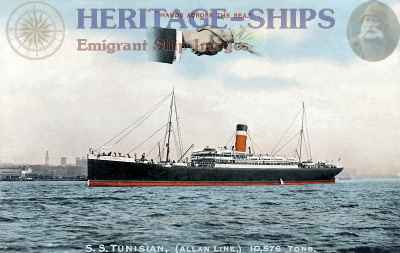
The usual sources soon revealed the basics. Ethel Jean Foulds was born in Acton, Ontario, on 23 March 1907, the daughter of William Edward and Eleanor Barwise (née Wilson). William was a Lancashire man, born in Littleboro in 1875, who had emigrated to Canada abord the Tunisian in 1904. He took up work as a tanner in Acton, home of the substantial Beardmore & Co. tannery. He married Eleanor there on 4 January 1905. She too had just arrived in Acton from England, making me suspect that they were bethrothed there and had married once William had got himself set up on the other side of the pond.

(S.S. Tunisian, courtesty of Norway Heritage.)

Nor were the Foulds the only former inhabitants of Rochdale, Lancashire, to relocate to Acton at that time. From the Acton Free Press (22 July 1926), we learn that Mr. and Mrs. Edward Tweedale, plus daughters Phoebe and Sarah, arrived in Acton in July of 1906 with the intention of settling there. On arrival, they stayed at the residence of Mr. and Mrs. Sunderland Taylor, who were themselves former Rochdale people. In fact, Mrs. Taylor was none other that Ruth Hannah, née Tweedale, who married Edward in England in 1890 (Acton Free Press, 13 June 1912). They immigrated to Acton in 1903, where Edward took up work at the Acton Tanning Company. Had he spread the good word about Acton to the folks back home? It seems that, by 1907, Edward had made six trips across the Atlantic in the previous two or three years, so something was certainly going on (Acton Free Press, 26 September 1965).

(The fates of these families also illustrate that long-distance travel was not without its hazards. Mrs. Tweedale died only six weeks after her arrival in Acton in 1906. She had suffered from "lung trouble" for some time and her doctor thought sea travel would be good for her (Acton Free Press, 30 August 1906). Apparently not. Mr. Taylor died in 1912 after a "prospecting trip" to a paint factory in Victoria, British Columbia, where he met with a fatal dose of lead poisoning (Action Free Press, 13 June 1912).)

In any event, the Foulds family had better luck. By 1907, they had upped sticks and moved to Guelph, where William is listed as a machinist. He is later listed as a member of the 'Quarter-Century Club,' that is, employees of at least 25 years employment, with the International Malleable Iron Company (or IMICO, locally known simply as "Mall'able Iron") of Guelph, starting from 1914 (Daily Mercury, 29 January 1952). He was raised a Methodist and is listed as a member of the board of the Paisley Memorial United Church (Daily Mercury, 29 July 1927).

(Former Paisley Memorial United Church, now the River of Life Church.)

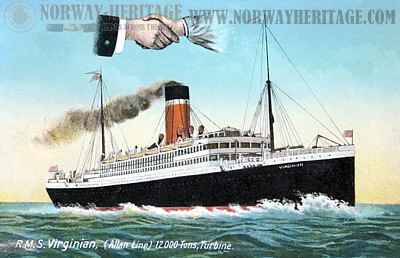
The Foulds maintained ties with the Old Country. Ships' records show Ethel Foulds and her mother Eleanor traveling from Liverpool to Quebec abord the Virginian on 13 May 1914. Significantly, the message on the back of the wedding cake card sent to Ethel states: "Eva Mae // Cake // April 29/14." I suspect that the two had taken a trip to Lancashire to visit relations there, during which time they attended a marriage featuring the wonderful cake. Unfortunately, I have not been able to track down what wedding it might have been. Was Eva Mae the bride? If any Yonners can ferret this out, please let us know in the comments!

(R.M.S. Virginian, courtesy of Norway Heritage.)

It seems that William continued work with Mall'able Iron until shortly before his death on 10 July 1947 (Mercury, 11 July 1947).

The City Directory of 1914 gives the Foulds's address as 98 Surrey Street East (since demolished), where the postcard in question was sent that very year. Around 1917, the family had moved to 25 Wood Street in the Ward, near Tytler School. The house has recently been heightened and expanded, as can be seen in this Street View image from 2009.

Finally, around 1925, the Foulds relocated to their 'forever' home at 149 Kingsmill Ave., a 'shotgun' house located close to the Eramosa river. Since the area was developed around that time, the Foulds were liklely the first occupants of this house.

Just before this move, Ethel Foulds made her own appearance in the City Directory, as a shoemaker in the employ of the nearby Northern Rubber Company. Incorporated in 1919, Northern Rubber manufactured a variety of rubber footwear.

Identified for heritage designation, the iconic building is being renovated for condos as part of a larger redevelopment of the site.

As it happens, there is a panoramic photo of employees of the Norther Rubber plant, taken in 1934.

("Northern Rubber Employees, 1934." Courtesy of Guelph Civic Museums, 2005.14.2.)

Amazingly, someone included a sticky note that points out an employee in the fourth row named "Ethel." Could this be Ethel Foulds?!

It appears that Ethel Foulds remained with the company until it folded up its tent in 1941. Thereafter, she is listed as an "operator" with the Aberfoyle Manufacturing Company. More specifically, it appears that her job was that of "quiller," which, I gather, refers to someone whose job is to operate a machine that winds yarn onto spools.

I don't have much information on the Aberfoyle Manufacturating Company. The 1943 Canadian Trade Index lists its products as mercerized bleach and dye, and cotton yarns. Its location was later reported not in the town of Aberfoyle but at 69 Metcalfe Street, today 69 Huron Street, in Guelph. A stone's throw from the Northern Rubber Plant, this facility was also in easy walking distance of Ethel's home.

(This plant later became part of the W.C. Wood Company, makers of fridges and freezers.)

At this point, the trail came to an end. Ethel Founds disappeared from the City Directory around 1950. At the same time, her mother, Mrs. Eleanor Foulds (widow of William), was suddenly recorded as a resident of R.R. (rural route) 5 in Rockwood, not far from Acton. What happened?

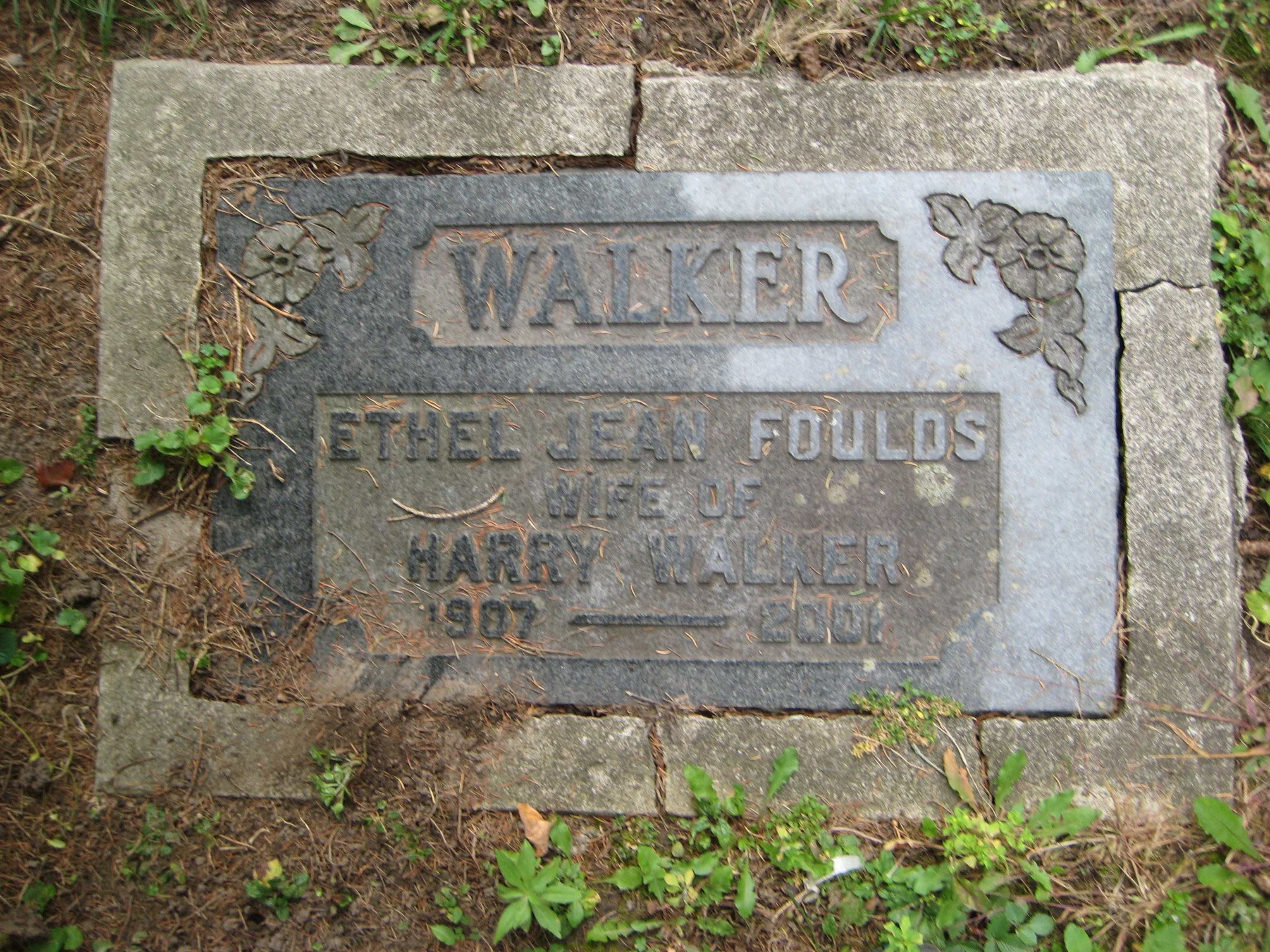
Records from Woodlawn Cemetery in Guelph revealed that William's widow Eleanor died in 1953 and was buried alongside him. Cemetery records also reveal the final resting place of Ethel Jean Foulds, who died in 2001 and is listed as the wife of one Harry Walker. Indeed, an Ethel Walker appears as a resident of R.R. 5 of Rockwood at the right time. Ethel had married and her mother had moved in with her son-in-law!

Unfortunately, there were at least three Harry Walkers in the region of Rockwood, and no record of their marriages resides online. However, the Acton Free Press mentions a Harry Walker "of Rockwood" as a pall bearer at a funeral, accompanied by several brothers. This Harry Walker was born in 1889, farmed in Eramosa township, and had married Jennie McLean in 1919. Jennie died in 1943, which would have made Harry available for marriage around 1950. This Harry Walker died in 1965, and his obituary in the Mercury (3 December) turned up the facts that he had the brothers mentioned in the earlier article and had married the former Ethel Jean Foulds in August 1949. Voilà!

A further look at the Guelph City directories showed that Ethel Walker (wid. Harry) had taken up residence at 149 Kingsmill Avenue in 1967, the old Foulds household. Ethel likely kept possession of the house, rented it out upon her marriage, and returned to it afterwards. She is not listed with an occupation and instead seems to have enjoyed a long retirement.

Harry Walker was buried with his first wife Jennie McLean in Stone United Church Cemetery in Erasmosa Township. Ethel Jean Walker (née Foulds) was buried with her parents in Woodlawn Cemetery in Guelph.


If you have any further information about Ethel Foulds or her family, in Canada, England, or elsewhere, please let us know in the comments below!
Speaking of coincidences, shortly after finding and tweeting the wedding cake postcard addressed to Ethel Foulds, Paul Sutton-King reported this: Yes, another random postcard found in England was addressed to Ethel Foulds, this one sent from Acton!

The transcription goes as follows:

Acton Sept 20, 1920
Dear Ethel:
You will be thinking I have forgotten you all, but I have not. I got your lovely card when I came home last Sat. I got some lovely cards for my birthday. will any of you be down for the Fair Wed. love from Alice
xxxx
At a guess, this postcard may have been sent by Miss Sarah Alice Tweedale, daughter of Edward Tweedale, whom I mentioned above as another emigrant from Rochdale to Acton.

It seems likely that the young Ethel Foulds enjoyed postcards and may have kept and collected those that she received. At some point, this collection may have found its way to relations in the Old Country, who have since dispersed it there. So, keep your eyes peeled, Britishers, and report any more finds!

Saturday, 18 February 2023

Edgewood Park: Eden Mills summer camp

The local papers printed a number of accounts of an interesting new facility in Eden Mills. For example, the 10 September 1924 edition of the Acton Free Press notes that Mr. and Mrs. Nodwell and family of Toronto recently left for Hogtown after spending the summer at their cottage in Edgewood Park, Eden Mills.

In a previous post, I noted that Eden Mills was known early on mostly as a rural village featuring several mills and a modest hotel. However, things had recently changed and the village had become something of a regional destination. At least, it now sported a popular park and summer homes for out-of-towners.

The history of Edgewood Park really begins with the arrival of the Toronto Suburban Railway (TSR) in the village in 1917. Bypassed earlier by the Grand Trunk and the Guelph Junction Railways, the inclusion of a TSR station at Eden Mills promised to lower shipping costs for the produce of the village's mills and the region's farmers.

Of course, the TSR could also bring passengers into town. This meant that people from nearby towns like Guelph, Acton, and Georgetown could easily make day trips to Eden Mills, as could anyone from Toronto who might desire to do so. The commercial potential of this connection was not lost on towns along the route. For example, a fun facility called El Dorado Park was set up at a TSR stop in what is now Brampton. A Ferris Wheel, a Merry-go-round, and other attractions were added to entice daytrippers to buy tickets on the railway.

In 1924 or perhaps early 1925, a group of Eden Mills residents led by Duncan McDougall got together and built a park next to the Eden Mills station. Land was cleared, a picnic area and baseball diamond laid out, and cottages built. In addition, a dance hall was constructed, where acts from Toronto and beyond could drop in by rail and perform for the delight of locals and courting couples.

One of my favourite early ads for the dance venue featured George Wade and his "Corn Huskers", featuring Sid Jackson, the piano accordian expert (Acton Free Press, 18 July 1929):

McDougall added a swimming pool in 1928. Children simply could have swum in the Eramosa river, but a swimming pool was more family friendly. As explained in my post on Riverside Park in Guelph, parks promoted co-ed swimming by building special swimming facilities where boys could be prevented from swimming au natural, as was their wont.

Schools and social groups soon began to hold picnics at Edgewood. The Acton Free Press of 10 September 1924 mentions that, "The Union Sunday School pic-nic was held at Edgewood Park on Monday afternoon, an enjoyable time being spent."

The venue also became an annual host to Labor Day festivities. This holiday was established in Canada in 1894 as part of the movement to celebrate industrial labour and provide workers with more time off the job. The 1925 Labor Day celebration at Edgewood Park as quite a shindig:

The celebration here on Labor Day was a fine success and well attended considering the threatening weather that prevailed. The affair was started off with a Calithumpian parade, headed by Acton Citizens’ Band from the village to Edgewood Park. The hard time prize outfits were won by W. Mino and R. Argo and E. Reid. The first ball game was between Arkell and Eden Mills, and was won by Arkell, and in the second game York Road won from Brookville. The third game was won by the picked team against the W.S. Progress Lodge, of Guelph.
Not to mention the numerous races and horseshoe throwing contest!

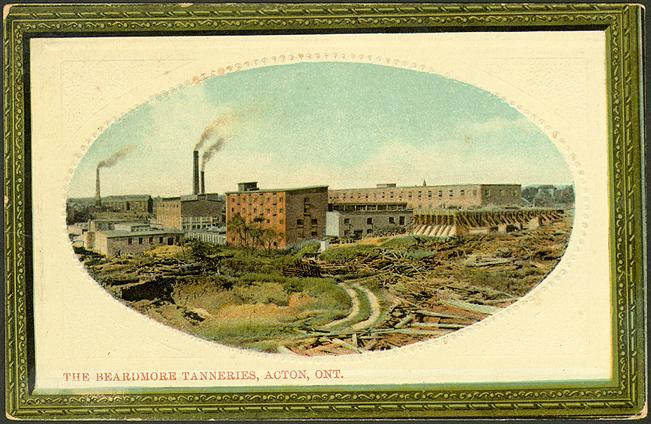
Perhaps the most memorable blowouts at Edgewood Park were the company picnics. The Acton Free Press (6 January 1971) makes special note of the Beardmore & Co. picnics. Beardmore & Co. were a leather tannery in Acton, said to be the largest in the British Empire around 1900. Ontarians of a certain vintage will associate Acton with the Olde Hide House, a large leather goods store and a successor to Beardmore, which made it "worth the drive to Acton."

("The Beardmore Tanneries, Acton, Ont," ca. 1910. Postcard courtesy of the Toronto Public Library, PCR-6.)

The 1938 event, held on July 28, was attended by about 500 company employees, their families, and well-wishers. All the usual picnic pleasers were held, including swimming and races for the children, an egg race for the ladies, a fat man's race, and a performance by the Acton Citizens Band. Naturally, the main event was a copious picnic supper.

A special feature of the 1938 edition was the taking of a panoramic picture of the attendees. This was reproduced in the 1971 newspaper thus:

(If anyone knows where a better copy is available, let me know.)

This was not the first panoramic photo taken at Edgewood Park. A photo of the "Nth Erin & Gara. picnic at Edgewood Park, Eden Mills," 1930, is available at a better resolution:

(Courtesy of Wellington County Museum and Archives, A2018.4 ph. 51164.)

Look carefully and you may see that a man near the middle of the picture appears to have a teacup upside down on his head. Why, we may never know.

Attendance at the 1938 Beardmore & Co. picnic was made possible by the use of "nearly all the motor vehicle transportation available" in Acton at the time. This note reminds us that the TSR was no longer operating when the picnic took place. The Railway was in financial difficulty since its inception, since it was hard to compete with private automobiles and hefty, government road building programs. In 1931, the TSR ceased operations and its assets were sold off. However, its downfall seems not to have clipped the wings of Edgewood Park, which remained an established place for regional recreation.

Even so, change did come to Edgewood Park. In 1944, the Park was purchased by the Lutheran Church of the Canada Synod as a location for their annual summer youth camps. The Church had run a Lutheran Boys Camp at Fishers Glen on Lake Erie since 1936. (A Girl's camp was started in 1940.) However, the camp had outgrown the facility there and the Church went looking for a larger one, which led it to Edgewood Park. Around 1,000 people attended the official opening service on 30 July!

Camp Edgewood, as it came to be known (later Edgewood Camp and Conference Centre), provided camping facilities for various youth organizations, not to mention adult and family retreats, Luther League and Synodical Brotherhood meetings, and Salvation Army events. For example, the Guelph YMCA held its annual camp there until 1951, when they moved on to Camp Nagiwa.

In so doing, Camp Edgewood became part of a significant cultural phenomenon: The Ontario Summer Camp. As Sharon Wall (2009) explains, summer camps for city children had become increasingly popular destinations for young Canadians, particularly in Ontario, especially after the Great War and picking up pace after World War II.

Some camps emphasized a 'wilderness' ideal, in which children were taught how to 'rough it' by swimming, canoeing, woodcraft, and sleeping under canvas. These sorts of camps were typically private, sited in more northern areas of the province (as far as Temagami), and catered to the scions of well-to-do city dwellers.

So-called 'Fresh Air' camps were sited near the big cities and were operated by charities. Their clientele were typically children of low-income families who otherwise would have no respite from the noxious fumes of Ontario's major urban centres like the Big Smoke. (The Toronto Star's Fresh Air Fund began in 1901 as a charity to help urban children escape their overheated urban slums.)

In between were 'agency' campus run by organizations like the YMCA that catered to the middle-class and so funded their operations mainly through fees. Like Fresh Air camps, they lay near the big cities and featured less a wilderness experience than a chance to escape urban hothouses for rural idylls and what be called nature literacy. Camp Edgewood fell into this category.

An article in the 12 June 1952 Toronto Globe & Mail provides an insight into the sort of expeience that campers at Edgewood would have:

Enjoy bedtime snack of hot dogs, crawl in creek to find crayfish
By Eldon Stonehouse
Guelph, June 11.—The little red school house was never like this.

Pupils in Guelph have moved out doors for this week to get their lessons under the open sky. So far the idea has been working well, and the pupils, at least, wouldn’t mind if teacher Ron Campbell never took them back under the school house roof.

The children, aged 9 to 13, are camped at Edgewood Lutheran Camp at Eden Mills, a few miles from Guelph. And, while some subject such as arithmetic may be slightly neglected during the week in the open air, other subjects such as art, marine life, birds agriculture and water safety are getting more attention than they have since last September.

Teacher Campbell, who was once a swimming instructor, has 36 young students under his care at the wood-fringed camp. And, while they have been as quiet as they ever were in classroom during the first couple of days, the children are enjoying their lessons more than they did during the first part of the year. (Hot dogs for bedtime snacks have helped.)

The open air schoolhouse is something new for Ontario, although it has been tried in various sections of the United States. So far, the Department of Education is keeping a watchful eye on the camp from Toronto and saying practically nothing. Guelph’s school board hopes that when the department does make its comment, it will be favorable.

The Guelph department launched the idea and put up the first $150. Parents of the Grade 5 children added $1 per day for the period the pupils will spend at the camp. The Home and School Association will pick up what’s left of the cheque after the pupils come back to town.

The children moved into the camp on Monday night, and, after getting accustomed to their new surroundings, were hard at work (hah!) by Tuesday. Monday, of course, was a holiday.

On Tuesday, and each succeeding day, the class was divided into groups, each for a different type of outdoor classroom work. Teacher Campbell took the class in first-aid, and also in water safety at the swimming pool.

Supervisors gave the regular teacher a helping hand with various other types of study. Helen Marr taught art in the dining hall, and Ray Mulford each day took a separate group to a nearby bird sanctuary and on a compass hike through the woods.

The Ontario Lands and Forests Department, although not directly involved, lent a hand too. Representatives just happened to drop into the camp to take the youngsters into the woods and teach them how to identify various trees. This lesson caught on about as fast as any, with the possible exception of Bill Hawley’s historical hikes and marine life studies. He had the children in the near-by creek in the water up to their knees capturing crayfish and underwater creatures for identification.

Keith Barber took another group to near-by farms to let them see what life was like in the rural areas. And, lest there be some need for added physical education, Ernie Berner from the Guelph YMCA was on hand to give the boys and girls some pointers on muscle development.

By the end of the first day at the Lutheran Camp, Ron Campbell had decided the outdoor school was a great idea.

“I wouldn’t mind,” he said, “teaching like this for 10 months of the year.”

Bob Noel, 9-year-old pupil, added his approval. “Gee,” he said, “This is keen.”

But if it rains during the week, it’s back to the books on arithmetic and you know what in the buildings on the camp grounds.
The "Shoebox memories: Edgewood Park" column of the North Halton Compass (2 July 2004) provides a two-page spread of very interesting pictures spanning Edgewood Park's history, which I will insert below. The pictures run from the earliest on page 8 to the later ones on page 9. Page 8:
Page 9:
The Edgewood totem pole reminds us that 'Playing Indian' was a common feature of summer camp programming in that era. As the ersatz totem pole suggests, the point was not mainly to provide education about Ontario's indigenous peoples but to allow modern children to indulge in a confabulated 'primitive' play-acting, which was held to be a kind of theraputic relief from the ails of modernity they faced in city living.

Postcards of Edgewood reveal an interesting dichtomy in its depiction.

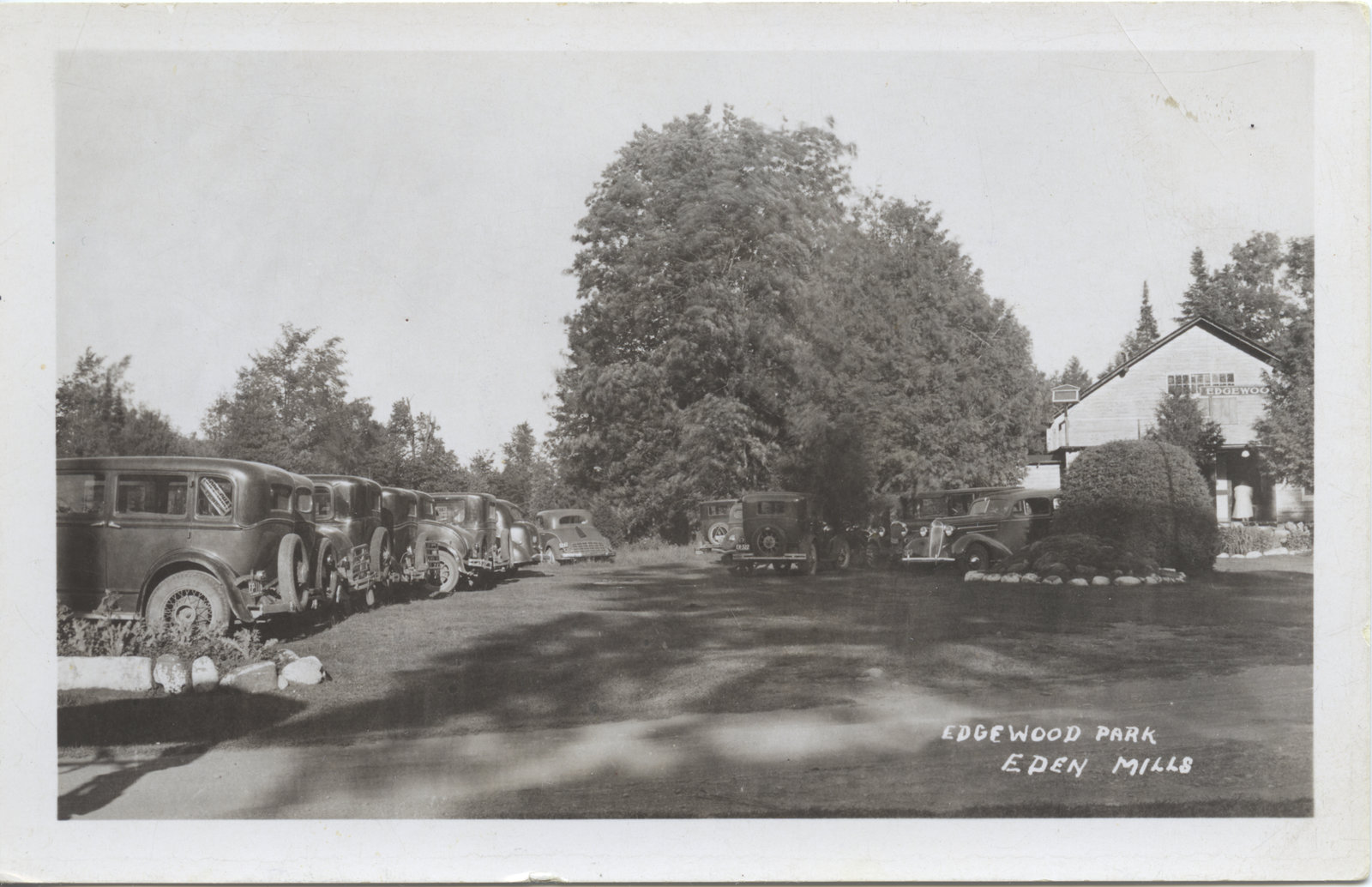
The first postcard shows the entrance to Edgewood Park, ca. 1940, featured on page 8 of the Shoebox memories article above:

("Edgewood Park, Eden Mills." Real photo postcard; courtesy of Wifrid Laurier University Archives.)

While the picture does not show any people, their presence is revealed by the semi-orderly arrangement of parked cars near the office inside the camp entrance, whose shadow is visible in the lower-left corner.

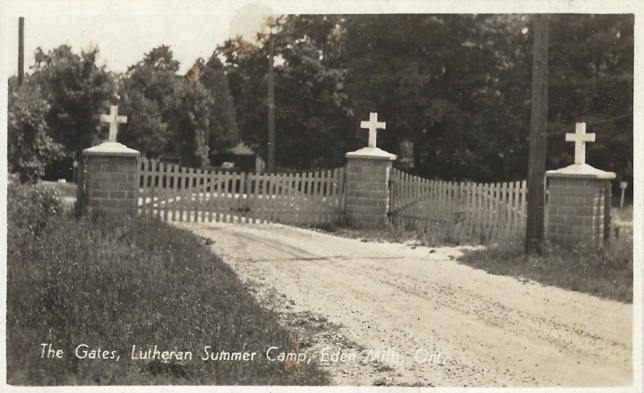
The postcard below shows the entrance to Camp Edgewood, ca. 1950.

("The Gates, Lutheran Summer Camp, Eden Mills." From the author's collection.)

This image omits any suggestion of people and instead determinedly shows the camp's gate firmly closed and its religious orientation displayed. The impression it leaves on the viewer is that of a locale under the decided control of its managers and focussed on its sectarian mission. Wall (2009) points out that one of the main concerns of parents sending their kids to camps was the safety, both physical, spiritual, and otherwise, of the facility and its management. The image above seems designed to assure them Camp Edgewood is a secure place.

Another postcard of similar vintage is designed to leave a similar impression:

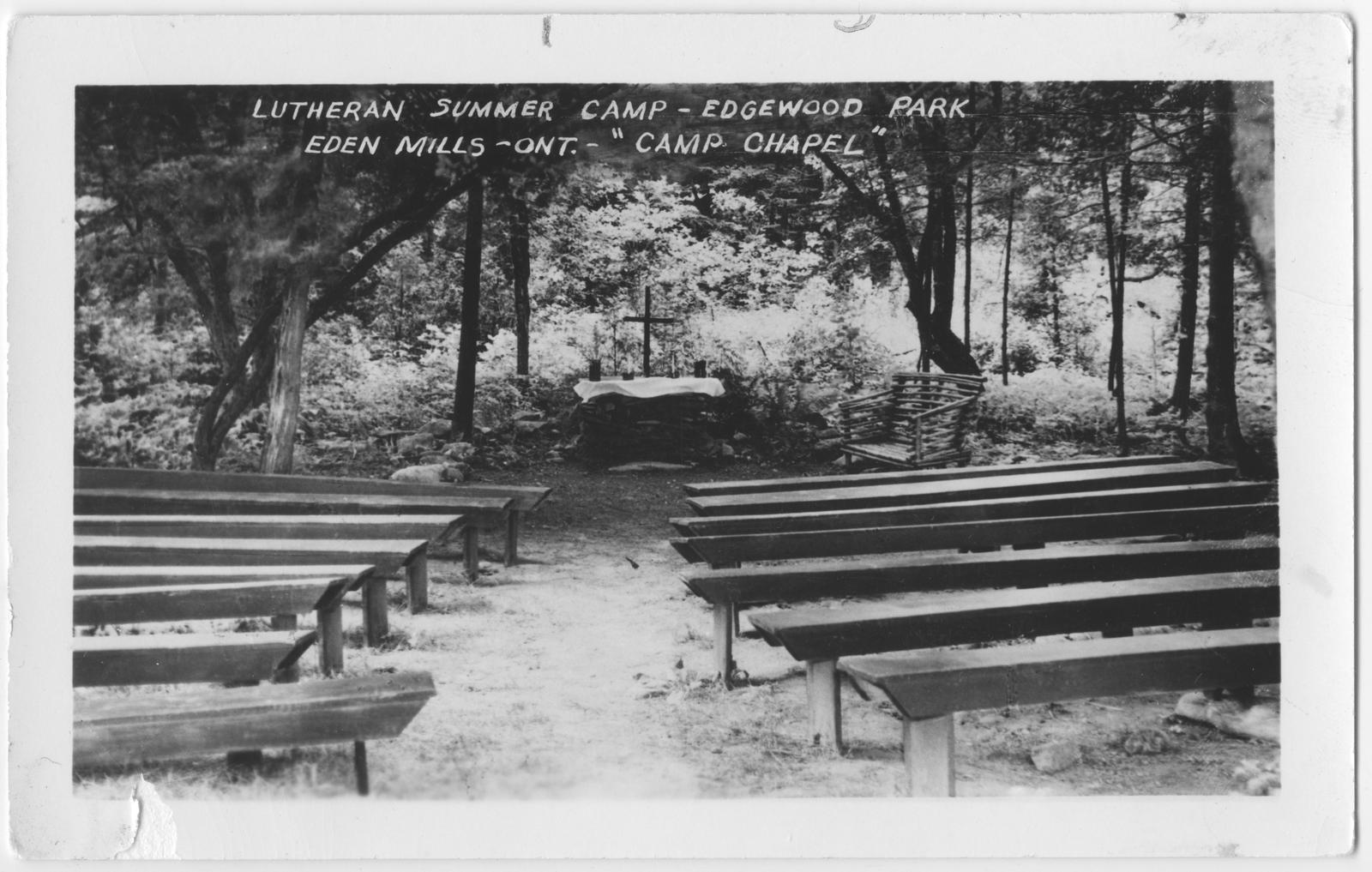
("Lutheran Summer Camp—Edgewood Park. Eden Mills, Ont.—'Camp chapel'," ca. 1950. Courtesy of Wilfrid Laurier University Archives.)

Again, no people are shown. Instead, the outdoor chapel is featured, with its religous symbols and orderly rows of seating. Though rustic, the impression remains one of order and security.

A futher card in the series shows one of the natural attractions of the Camp:

("Lutheran Summer Camp—Edgewood Park. Eden Mills, Ont.—'Camp stream'," ca. 1950. Courtesy of Wellington County Museum and Archives, A2015.1.3, ph. 45682.)

This card was sent to Mrs. Dundas, Waterloo, Ont. on 7 August 1951, from Betty, who reports

I am having a very nice holiday and I am hoping you are too.

A final view from the same series shows the scene inside the entrance of Camp Edgewood:

("Lutheran Summer Camp—Edgewood Park. Eden Mills, Ont.—'Inside of camp entrance'," ca. 1950. From the author's collection.)

As expected, no one is present but the orderliness of camp is dipslayed in the form of the prominent flagpole, the carefully trimmed lawn and greenery, and the park office looking out from behind it.

This postcard was actually sent through the mail and is postmarked on 10 July 1951. The message states:

Dear Frank [??]

Monday evening and still Hanging on. The sun was shining swell to-day. Can’t get Bill to go in swimming. Love to you all

Wes
It's good to know that people were having a swell time at the Camp!

Camp Edgewood was renovated and continued in operation until 2017. It was sold to the Eden Mills Eramosa River Conservation Association (EMERCA), who are incorporating it, under the name Edgewood Trails, into a naturalized area.

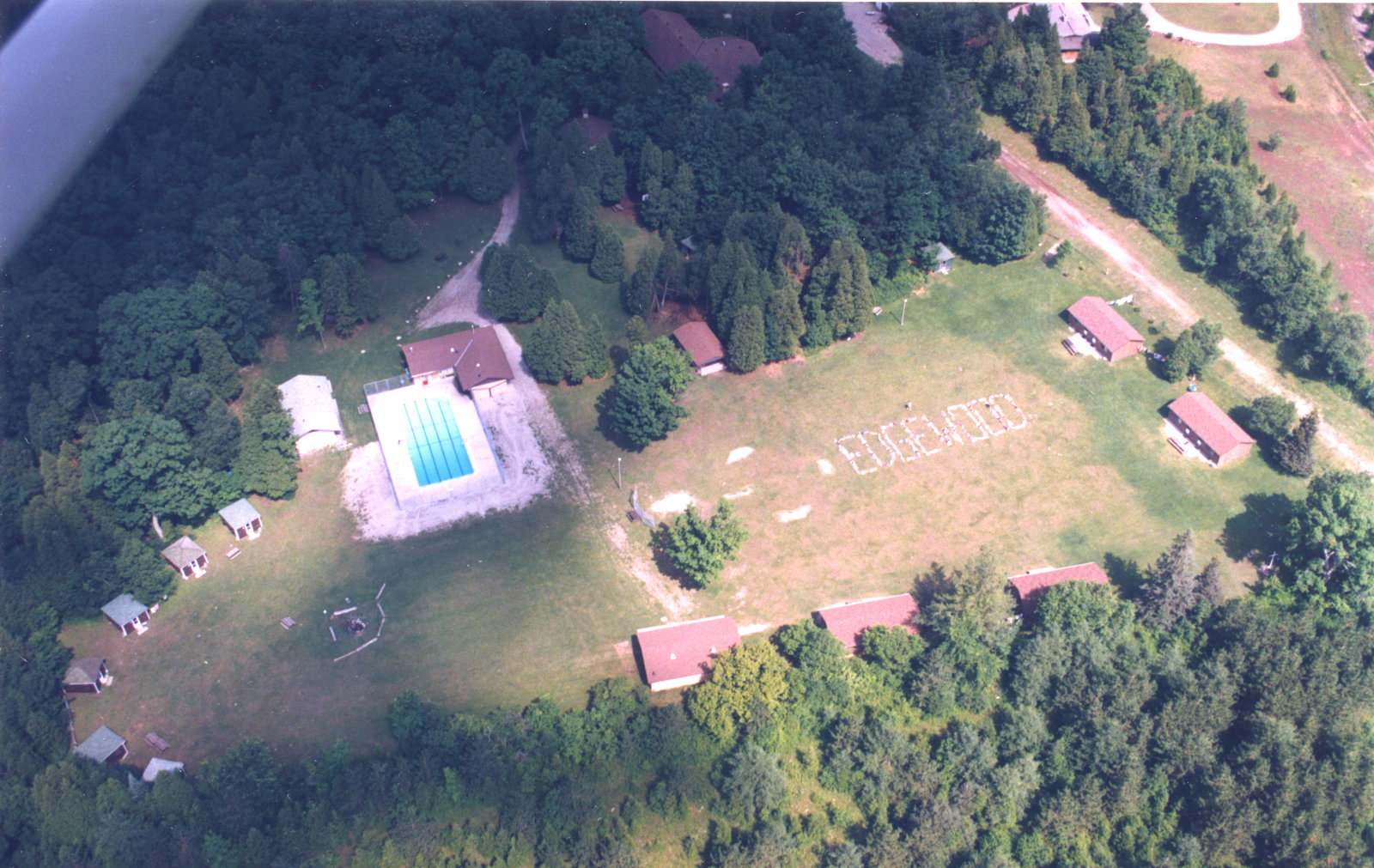
(Aerial photo of Edgewood Camp and Conference Centre, 16 July 1996. Courtesy of Wilfred Laurier University Archives.)
Works consulted for this post include: Wilfrid Laurier University Archives also has an extensive collection of Camp Edgewood materials.