
Wednesday, 9 March 2022
Guelph Historical Society talk: The Blacksmith Fountain
Yours truly is giving a little talk for the Guelph Historical Society on the origin of the Blacksmith Fountain. Don't miss it!

Sunday, 30 January 2022
You would enjoy this sport: The Snow Shoe Club of Guelph
A propos of the winter season, this postcard was sent by A.N.B. from Guelph to Kathleen Tate of Bedford, Pennsylvania, on 21 December 1911.
 A.N.B. writes cheerfully, "You would enjoy this sport. Hope you have a very merry Xmas and a Happy New Year." As the caption notes, the sport depicted is snowshoeing.
 The photo's title is, "A snowshoe tramp on the river ice, Montreal, QC, 1903." No doubt, it depicts members of one of the many Montreal snowshoe clubs out for one of their regular outings.
 ("Indiens voyageant en raquettes avec un traîneau," Cornelius Kreighoff, ca. 1856. Courtesy of Library and
Archives Canada, C-013458.)
("Indiens voyageant en raquettes avec un traîneau," Cornelius Kreighoff, ca. 1856. Courtesy of Library and
Archives Canada, C-013458.)
 ("Snowshoer running, Montreal, QC, about 1875." Photograph by William Notman. Courtesy of McCord Museum VIEW-1018.1)
 The figure wears a dark blue tuque, sash, and leggings, along with red epaulettes and trim on his coat, suggesting that these were perhaps the Club markings.
 ("Snowshoe group, Mount Royal, Montreal, QC, about 1901." N.M. Hinshelwood. Courtesty of McCord Museum, MP-1985.31.182.)
 ("Hurdle race on snowshoes, Montreal, QC, 1892," William Notman & Son. Courtesy of McCord Museum, VIEW-3147.0.)
 ("Miss R. Hamilton and snowshoe, Montreal, QC, 1886." William Notman & Son, II-80085.1.)
 ("Toronto Snowshoe Club, in front of fountain, Queen's Park, at head of University Avenue," ca. 1884. Courtesy of Toronto Public Library, PICTURES-R-5289.)
Works consulted include:
The card was printed by the large British publisher Raphael Tuck and Sons beginning in 1908. It was not a Guelph scene. In fact, it was adapted from a photograph taken by noted Montreal photographers William Notman & Son (Courtesy of the McCord Museum of Montreal, VIEW-3613). It was made to resemble an oil painting; thus the descriptor "Oilette" in the bottom-right corner.

Snowshoeing, of course, was nothing new in Canada. French soldiers, farmers, coureurs de bois and voyageurs all learned to use snowshoes from the Indigenous peoples they encountered. Members of the NorthWest Company learned it from them. In their day, using snowshoes was a necessity for getting around in wintertime.
As the nineteenth century wore on, the need for snowshoes declined. Lower and Upper Canada were becoming increasingly settled so that road networks and sleighs, then railways, tended to sideline snowshoeing as a form of winter travel. So, it was in 1840 that the Montreal Snow Shoe Club (MSSC) was formed to promote snowshoing as a sport and leisure activity.
Enthusiasm for the sport increased and reached a peak in the 1880s, when there were about 25 clubs in Montreal alone and dozens more throughout the country. Guelphites fell into line and the Guelph Snow Shoe Club was formed in 1882.
The Club kept to a regular schedule. One night each week of winter, club members would convene at a conveient site, often the Wellington Hotel, and set out for a "tramp," often to the house of someone who had invited them for the purpose.
For example, the Mercury (6 January 1883) describes a first-season tramp in some detail. Club members mustered at the residence of J.D. Williamson, across London Road from what is now Exhibition Park. At about 8pm, they tramped about 2.5 miles due west then "circled" to the south and called at the residence of Mrs. Armstrong, who was "delighted at the visit" and well prepared:
She extended the club the most cordial hospitality, and correctly perceived the preference of her company in the way of refreshments, when she set before them such a quantity of milk as would have seemed enormous in the eyes of men with ordinary appetites, but which so quickly disappeared before the sharpened appetites of the snow shoeists that one of their number was led to remark, it must have reminded the lady of calves in the spring-time.The men departed and returned to the city at about 11pm, having covered about 5 miles in all.
The trip relates many of the attractions of snowshoeing as it was then practiced. The physical activity was cold but invigorating, which increased the snoeshoeists' relish for their pit-stop refreshments all the more. Navigating in the dark had its pitfalls:
Rough fields, with a snow drift here and a bare spot there, a hill in one place and a hollow in another, are not the most easy places traversed in the darkness, even with a pair of snow shoes as a means of locomotion. This was verified by numerous falls, and one of the tourists was unfortunate enough to tumble into a gravel pit, half filled with soft snow, in which he was almost buried out of sight.Enduring these little setbacks was all part of the fun.
Of course, snowshoeing provided some enjoyable social opportunities. Besides being entertained by hosts, club members often entertained each other with song and competition. Consider one evening spent at the popular camp site called The Rocks (now the quarry site on the Reformatory lands; Mercury 30 January 1885):
About twenty-five members of the Guelph Snow Shoe Club went for a tramp last night. The snow was in splendid condition and the boys enjoyed themselves immensely. Taking a cut across the fields they struck the river at the Water Works and followed it up to the Rocks. There they lit a fire, and after enjoying themselves smoking and listening to some excellent songs by the Captain and others, they marked off a hundred yard track and had some exciting and closely contested snow shoe races.Although certainly boisterous, Club events could be quite civilized. For example, a social event was held at "Springfield" (the farm of James Anderson, to the southwest of town) to raise money for the purchase of an organ for St. Andrew's church. The chief feature of this soirée was a musical programme including instrumentalists, soloists, and an ensemble of the choir. Although late, due to have gotten lost, the Snow Shoe Club arrived to play its part (Mercury, 13 February 1885):
The Snow Shoe Club which tramped out during the evening added a very interesting part to the programme. They signalled their arrival by singing the well known glee “There is a letter in the candle.” Their singing was heartily enjoyed and they presented a very pretty appearance as they stood around together with their blanket coats and tuques."There is a letter in the candle" seems like a charming tune. I cannot locate a recording but there is sheet music if you'd care to try it out.
The passage also mentions part of the snowshoeist's uniform: Blanket coats and tuques. In full, the dress consisted of a white blanket coat tied with a sash, tuque, leggings and moccasins.

Different clubs often distinguished their uniforms with particular colours of hats, sashes and leggings, as well as special epaulettes and badges. Happily, David Allan jr., who was a member of the Club, later drew a picture of a member of the Guelph club (1936/2012, p. 97):
Besides uniforms, showshoe clubs adopted other aspects of military organization. In addition to presidents and board members, clubs had Captains, Lieutenants, and Whippers-in, whose job it was to direct the other members during tramps. The Whipper-in job was take up the rear of the column and ensure that no one got lost or left behind.
Also, snowshoe clubs were predominantly male. Board members and officers of the Guelph Club were all men, which seems to be typical. There is no mention of women joining the tramps, although women certainly did go snowshoeing. In some clubs, women would go for shorter excursions or join the men for part of theirs.

Also like military units, the Club also held occasional marches. Perhaps the biggest one occurred in February 1886, when the Club marched around the downtown core and then led the way to the great toboggan hill on Evan Macdonald's farm (now the Cutten Club) (Mercury, 5 February 1886):
Last evening the members of the Guelph Snow Shoe and Toboggan Club assembled on the Market Square in front of the office of Mr. John Davidson, President, and formed a torch light procession. There were close on fifty members bearing torches, and about a score more without. The President took the lead, having his toboggan attractively decorated with Chinese lanterns. The route taken was along Macdonell to Norfolk Street to the junction with Woolwich, thence along that street to Wyndham. On coming along this street in single file, serpentine fashion, and occasionally shooting off rockets as they proceeded, the effect was very good and the appearance attractive. On reaching St. George’s Square the procession filed around the fountain and discharged a number of rockets, after which they proceeded down Wyndham and Macdonell streets turning at Bell’s factory, and proceeding along Market Square and the Dundas Road to the slide on Macdonald’s hill, where they enjoyed themselves until ten o’clock.In the days before winter street plowing, a pair of snowshoes may have made parading down the city streets quite a bit easier.
Besides recreation, snowshoeing was also done competitively. As noted above, casual events occurred during club outings. However, national competitions were held at the annual Winter Carnival in Montreal. Members of the Guelph Club did not compete at this level, although one entrant with Guelph connections did well: G.M. "Dooty" Watt, who won the 200-yard race (Mercury, 26 January 1883), was a former student at the Ontario Agricultural College.

Given the popularity of the sport, it wasn't long before photographers began to offer snowshoe-related backdrops in their photography studios. In winter of 1885, Guelph photographer William Marshall advertised that he had a "snow shoe scene" available, which must have appealed to club members and their hangers-on. Unfortunately, no photographs of the Guelph Club have yet come to light, although we can get a sense of what was on offer from portraits of showshoeists from other Clubs.

The Mercury (12 April 1883) also mentions "a very fine" sketch of the members of the Club, excuted by Mr. Hetherington. Twenty-seven men were depicted and the work was "the best of the kind that has yet been produced in Guelph" and many photographs of it were taken. This work seems not to have survived but many Clubs of the era had similar portraits done.
Mentions of the Club seem to end after the 1887–1888 season. It's not clear why. Poulter (2003) argues that the sport enjoyed a vogue, in part, because its associations with Indigenous and French Canadian culture distinguished it from British sports like curling and American sports like baseball (much like lacrosse). Perhaps the continuing rise of ice hockey took some of the wind from snowshoeing's sails in this connection.
In any event, Guelphites and other Canadians continued to enjoy snowshoeing, as our postcard suggests. Of course, it continues to be a popular winter activity to this day. If you are a snowshoer, then please enjoy your next tramp! If not, then consider trying it out.
Works consulted include:
- Poulter, G. (2003). Snowshoeing and lacrosse: Canada's nineteenth-century 'National Games'. Culture, Sport, Society, 6(2-3), 293-320.
- Morrow, D. and Wamsley, K.B. (2013). Sport in Canada: A history. Don Mills: OUP Canada.
Tuesday, 28 December 2021
David Johnston Kennedy: Guelph in winter, 1845
On March 8, 1888, the Guelph Mercury reported that "quite a crowd" gathered before the office window of Mr. Charles Davidson, at Wyndham and Carden streets. In the window was a painting of Allan's mill as it appeared on January 19, 1845. The perspective was from the brow of Strange's hill (where Palmer and Queen streets meet), looking over the Speed river.
 ("Allan's Mill, on the river Speed, Guelph, Canada West, 1845.")
 ("Sketch of part of the town of Guelph, Canada West, 1853.")
 ("Yankee Cottage, On the Speed, Guelph, Canada West, 1852." HSP Library 4314.)
David Kennedy's original design for Sunnyside can be seen in the painting he executed:
("Yankee Cottage, On the Speed, Guelph, Canada West, 1852." HSP Library 4314.)
David Kennedy's original design for Sunnyside can be seen in the painting he executed:
 ("Residence Proposed to be Erected Opposite the Priory on the River Speed in Guelph, Ontario watercolor, 1852." HSP Library 4643.)
 ("Guelph, Canada watercolor, 1845". HSP Library 4312.)
 ("Residence of A.M. Jackson in Guelph, Canada watercolor, 1864." HSP Library 3035.)
 ("Priory, Guelph, Ontario, Canada." HSP Library 4015.)
Works consulted for this post include:
The picture would have looked like this:
As the Mercury article notes, the scene was fascinating for the locals as the Guelph it portrayed was, even then, so different from the familiar one:
This part of Guelph in those days was sparsely inhabited indeed, for there are only shown about half a dozen buildings, and were it not for the way the ground is laid out the whole would have the appearance of a farm pretty well cleared. In front where the G.T.R. station now stands, and along the banks of the river are seen numerous stumps, among which is the one of the first tree cut in Guelph.The Priory, the first house in Guelph, can be seen on the right-hand side. Nearby, a horse and sleigh is proceeding up McDonnel street towards that first stump, where John Galt had founded the settlement in 1827. In the middle is Allan's mill and distillery, while on the left-hand side lies Delamere's Tavern, one of Guelph's first inns.
The painting was one of many executed by David Johnston Kennedy, brother-in-law to Charles Davidson. Kennedy was born in Scotland in 1816 and, as a young man, worked as a stone mason alongside his father, William. He also acted as an assistant in his father's archictural drawing classes. Indeed, he decided that he wanted to be an artist but his father "hooted at the idea." Even so, he was permitted to take painting lessons in his spare time. He continued to make numerous sketches and watercolour paintings throughout his life.
In 1833, the family immigrated to Canada, settling on a farm in Nichol Township north of Guelph the next year. David did not like farming, nor did it like him: During his first winter, a pack of wolves nearly caught him as he walked home after a barn dance.
Kennedy's sister Betsy had married a Philadephian and invited him to join her there. This he did, remaining there for the rest of his life. Although he worked as a railroad agent, he created a unique artistic record of the architecture of City of Brotherly Love. However, he visited Guelph on many occasions and made many fine drawings and paintings of the Royal City also, of which Allan's Mill 1845 is one.
Several of his Guelph works were donated to the University of Guelph by the Alma Mater Fund in 1973, which was duly celebrated with an exhibition and the issue of postcards, including the one above. Another painting similarly reproduced shows the same part of town but nearer the east end of Allan's bridge:
In 1839, David's mother and father joined the him in Philadelphia but wisely decided to return to Guelph eight years later. There, William purchased a lot on the east side of Speed River and built a house thereafter referred to as "Yankee Cottage" on Arthur street, just north of Allan's bridge.
David Kennedy painted a picture of it in 1852:
Happily, Yankee Cottage remains today at 9 Arthur Street north.
In fact, the sketch of 1853 shown above was probably made from the front window of Yankee Cottage.
At one point, David Kennedy apparently had plans to return to Guelph himself. In 1850, he designed a house for himself, purchased a lot adjacent to Yankee Cottage, had a basement dug and building supplies moved to the site. However, for whatever reason, his brother-in-law Charles Davidson bought out the property and put up a house of simpler design on the lot.
This house became known as Sunnyside and stands today at 16 Arthur Street north:
Obviously, Sunnyside was considerably simplified from David Kennedy's own plans. His parents moved into Sunnyside and sold Yankee Cottage to the Grand Trunk Railway.
Many of his works are in the collection of the Historical Society of Pennsylvania. With a little patience, images may be viewed at the Society's Digital Library. There are at least 18 images of Guelph, some of which are shown above. Here are a few more:
Yes, it's the same image as in the postcard above! Kennedy sometimes made copies of his own works, which may explain why the colours are different here.
This was at 18 Douglas street—since demolished.
This photo shows the Priory with the stone wall along the riverbank and before it became a railway station, ca. 1870.
David Kennedy seldom exhibited any of his artworks, which were usually displayed informally, as in Charles Davidson's office window. After retirement in 1875, he began to prepare some of his work for publication but, sadly, this project was never completed. He died in Philadelphia in 1898.
Works consulted for this post include:
- Nasby, Judith M. (1976). "A painter of Guelph: David Johnston Kennedy." Historic Guelph 17:36–49.
Wednesday, 24 November 2021
Howard Cant, the Sleeman Trophy, and the Diamond Jubilee
On its first birthday, the Sleeman Trophy sat on display in the window of H.F. Cant & Co., druggist, at 20 Lower Wyndham Street. Doubtless, crowds of avid and occasional curling fans crowded around to see the trophy that Guelph's most famous brewer and sports fan, George Sleeman, had purchased for $350. It was to be the prize for a Guelph curling bonspiel that would attract teams throughout the province west of Toronto.
 ("Royal City Curling Club, Winners of Sleeman Trophy, 1898;" Courtesy of Guelph Civic Museums 2014.84.1112.)
 Hm. Why can't you get a bottle of "Beef, Iron, and Wine" at the corner druggist's today?
(Courtesy of Google Street View.)
Hm. Why can't you get a bottle of "Beef, Iron, and Wine" at the corner druggist's today?
(Courtesy of Google Street View.)
 ("Souvenir scarf, 1897," courtesy of Guelph Civic Museums 1975.21.30.)
 The addresse was Lorren Cant, one of Howard's younger brothers. The message on the back reads:
 ("B/W photo of the Galt Stamp Club c.1950;" Courtesy of the City of Cambridge Archives.)
 Although a Guelphite for only a year, Howard Cant left us a bit of our postcard history, as a good philatelist should. Thanks, Howard!
This post is the third in a series on postcard history before view cards. Here are the previous posts:
The Sleeman Trophy continued as a curling prize for many years. Here it is in the possession of the Guelph Curling Club in 1938, on the occasion of the club's centennial at the Baker Street rink: ("Centennial year at club;" courtesy of Guelph Public Library F51-0-3-0-0-1.)
The tumid tankard can be seen in the possession of the team that won it the following year, consisting of W.W. Macalister, Charles R. Crowe, E.J. Presant, and John Kennedy.
Howard F. Cant was a young man of 26 years, newly arrived from his hometown of Galt. There he worked as a druggist and had bought out the business of W.G. Smith of Guelph in 1896. A curling man, he no doubt hurried hard for the chance to be the one to publicly exhibit the shiny trophy and burnish the reputation of his new store in the doing. To ensure the success of this plan, Mr. Cant took out a special ad in the Guelph Mercury (18 February 1897):

Happily, the building still stands, now 20 Wyndham Street North:
The historically inclined may recall that 1897 was a special year in Canada, the Queen's Diamond Jubilee, celebrating her 60th year on the throne. The event was celebrated in 22 June, in honour of Victoria's ascension on 20 June 1837. Naturally, the event was observed copiously in the Royal City, with decorations, speeches, parades, games, and so on (Mercury, 23 June 1897). The little triangular park created ten years earlier, previously known as "Alderman Stull's Park" was renamed "Jubilee Park" in honour of the occasion. (In 1911, the VIA station was built on this site.)
No doubt, the window of Herbert Cant & Co. was suitably dressed too.
Another way in which the world-wide empire was celebrated was with the creation of a special postcard. At this time, shortly before private, picture postcards were allowed, the postcard's design was modified for the occasion by having a new frame around the title "Canada Post Card" as well as a "stamp" that showed Victoria as she appeared in 1837 and in 1897. Luckily, one such card was sent from Galt to Howard Cant in Guelph:

Aug 26/97. // Dear L // Arrived home last night on 6.10 train. Was in Buffalo for the G.A.R. and stayed for a couple of days. Blanche O. came down with me from Peoria and we had a fine time. You better write her if you want to get a photo. All the folks at Caledonia are well and wished to be remembered to you & How. Will be up some day soon. // D —I assume that "D" was Duncan, Howard's other younger brother. Duncan, it happens, was attending the Buffalo Dental College, where he had recently passed his second examination (Mercury, 14 April 1897).
Like the Jubilee and commemorative postcard, Howard F. Cant's stay in Guelph was brief. Besides his fondness for curling, we learn only a few things about him from the 1897 Mercury. On 1 February, the paper reported that:
The authority to sell postage stamps and postcards, granted the late W.G. Smith, has been transferred to H.F. Cant & Co.It sounds odd that someone would need a license to sell stamps and postcards but recall that both were strictly regulated by the government before private postcards were allowed a few years later.
On 6 October, we learn of Mr. Cant's success at the "World's Fair" held by the Puslinch Agricultural Society at Aberfoyle:
The following is the prize list: … Toilet set with pin cushion, 1st by H.F. Cant & Co.Unhappily, we can only guess at the design of this world-class pin cushion.
American immigration records show that Howard Cant migrated to New York in 1897 and there married Minnie Fowler in 1899. However, the couple subsequently relocated to Galt, where they appear to have remained. Thus, it is in the Cambridge archives that a picture of Howard Cant is to be found, posing with members of the Galt Stamp Club around 1950.
Howard is standing in the second row, second from the left, as shown in the detail below:

This post is the third in a series on postcard history before view cards. Here are the previous posts:
- Before they had pictures: Wm. Stevenson gets one of Guelph's earliest postcards
- A model of industry: J.B. Armstrong, postcards, and the carriage trade
The Sleeman Trophy continued as a curling prize for many years. Here it is in the possession of the Guelph Curling Club in 1938, on the occasion of the club's centennial at the Baker Street rink:
A record at Artefacts Canada from 1986 says that "the present whereabouts of the trophy are unknown." So, if you notice it in your attic, basement, or at a yard sale, be sure to let me know!
Sunday, 31 October 2021
A model of industry: J.B. Armstrong, postcards, and the carriage trade
In 1884, the City of Guelph was offered a statue of a blacksmith to place in the recently vacated centre of St. George's Square. The project gained support and the Blacksmith Fountain was officially dedicated on Victoria Day in 1885. On its base was engraved, "Presented by J.B. Armstrong, 1884."
 (A real-photo postcard of the Blacksmith Fountain, ca. 1910. Courtesy of the John Keleher collection.)
(Courtesy of Google Street View. Zoom in to see the carved plaque "Armstrong Block. A.D. 1875." on the second floor wall.)
(A real-photo postcard of the Blacksmith Fountain, ca. 1910. Courtesy of the John Keleher collection.)
(Courtesy of Google Street View. Zoom in to see the carved plaque "Armstrong Block. A.D. 1875." on the second floor wall.)
 The only notable difference is that the address of the British American Bank Note Co. is now simply "Montreal" instead of "Montreal & Ottawa."
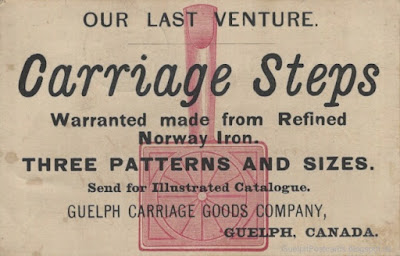 The carriage step depicted look as though it could support the weight of a very substantial biped!
 This card is a little less interesting as it does not depict the Adze eye nail hammers on offer.
 At this point, you may be wondering if Mr. Sheldrick was "sold." As it happens, a later postcard appears to confirm that he was.
 This sort of card is known as the "scroll style" for the obvious reason that the "Canada Post Card" label is now contained within a fancy scroll. (The "stamp" has also been changed to have an oval frame.) The scroll style was introduced in 1882, and Mr. Sheldrick was sent this card on March 5 of the next year.
 The message on the back reads:
 Along with many other going concerns, the Company also had drawings of its factories printed on its letterhead. Here is an example sent to a potential supplier in 1900:
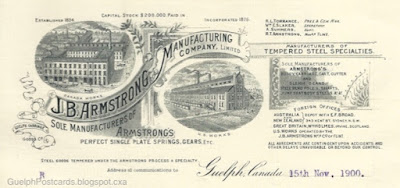 J.B. Amstrong & Co. are the picture of prosperity, showing off its works in Guelph (upper left) and in Flint, Michigan, (right, established in 1889). Information on the right-hand side indicates that the Company had offices in Great Britain and Australia as well.
 (Courtesy of Wellington County Museum and Archives, A1985.110.)
 (Courtesy of Wellington County Museum and Archives, A1985.110.)
 Gilnockie can still be glimpsed from Queen street.
(Courtesy of Google Street View.)
Gilnockie can still be glimpsed from Queen street.
(Courtesy of Google Street View.)
 As noted in the Mercury, the Works extended all the way from the Armstrong Block on Macdonell street to Quebec street at the rear (upper right corner of the inset), now covered by the Quebec Street Mall.
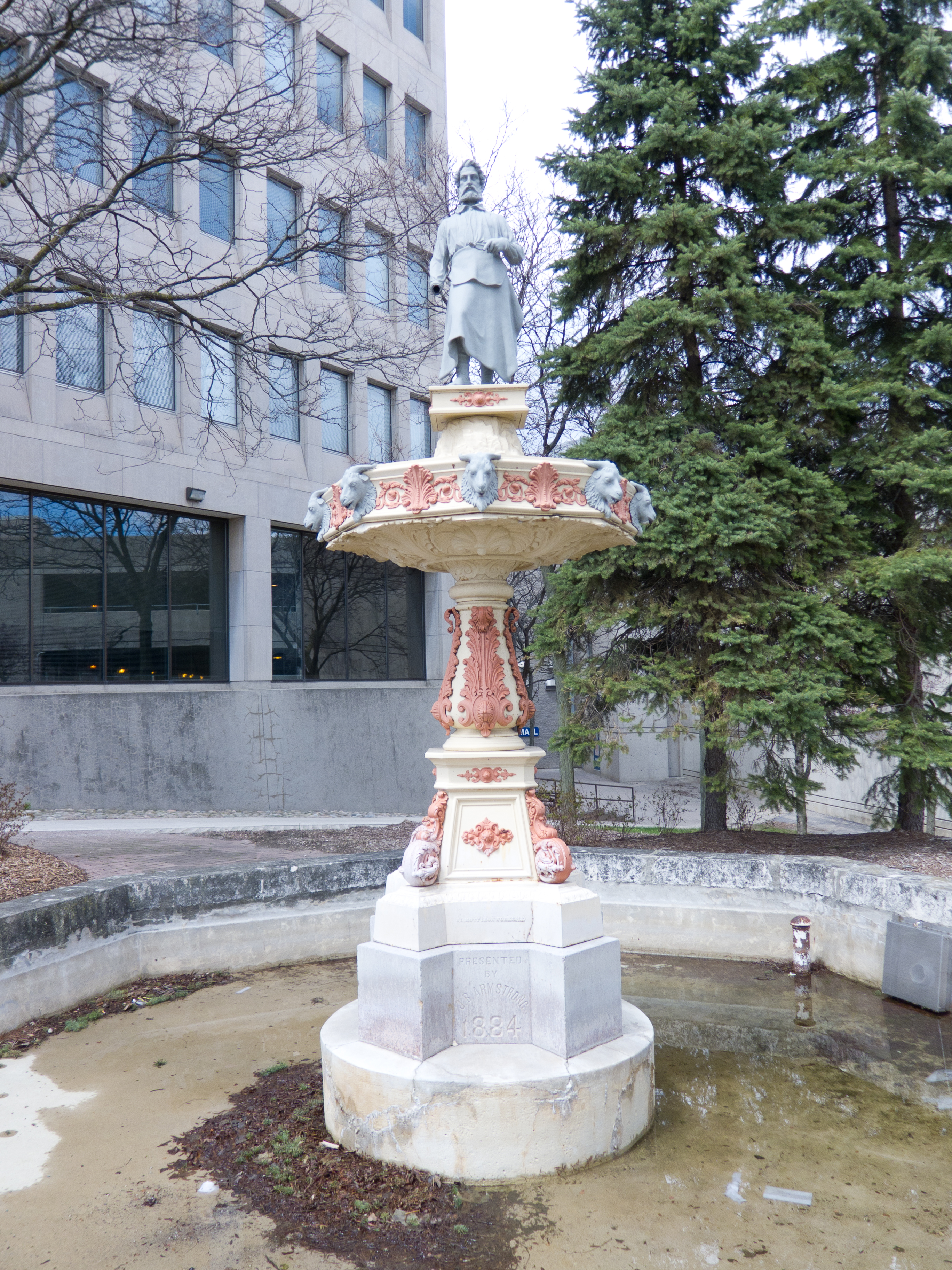 (The Blacksmith Fountain in Priory Square, courtesy of Wikimedia Commons.)
For fun, here are some representations of the vehicles made by the Guelph Carriage Goods Company as depicted in their ads. (Evening Mercury, 25 July 1869.)
 (Toronto Globe, 27 November 1886.)
 (Guelph City Directory, 1892.)
 ("The Armstrong Standard Buggy," ca. 1896. Courtesy of Guelph Civic Musems, 2002.88.2.)

Born in Guelph in 1838, John Belmer (J.B.) Armstrong was the eldest son of Robert and Janet Armstrong, recent immigrants from Scotland. Robert was a blacksmith who had set up a smithy on Macdonell street east in 1834, where he specialized in making wagons and axes. John later boasted that his father had made the first axe in Ontario (Globe, 10 Sep 1886), though this claim may be open to dispute.
Disaster struck when Robert died in 1848, after which his widow ran the business (Mercury, 12 Dec 1892). Adding to the family's woes, the smithy burned down the next year. However, it was rebuilt and leased to Mr. Thomas Anderson, who resumed the manufacture of carriages. It was under Mr. Anderson's tutelage that young John learned the blacksmith's trade.
Subsequently, J.B. decided to seek his fortune south of the border, working for a time in New Jersey and then in Eddyville, Kentucky. There, when the American Civil War broke out in 1861, the carriage trade was disrupted and J.B. returned to his hometown.
Back in Guelph, J.B. entered into a partnership with his brother William at the family factory, going under the name of The Armstrong Bros. The business seems to have gone under a number of names in subsquent years. By 1866, the smithy was styled the "Excelsior Works," then apparently a common name for a foundry looking to gin up a reputation for excellence. By around 1870, the business was also known as the Guelph Carriage Company or J.B. Armstrong & Co. In 1876, J.B. entered into partnership with Thomas Scarff (William having left some years previously), to form the J.B. Armstrong Manufacturing Company, which finally stuck.
The new company had some impressive new digs. In 1875, J.B. had a new structure erected where his foundry stood at what is now 92–98 Macdonell street, named the "Armstrong Block" in his honour. The new edifice was described fulsomely in the Mercury (21 July 1917):
... J.B. Armstrong has erected a block of stone stores three storeys in height, which are second to none in the town for elegance of design and substantial appearance. The stores have a frontage of 70 feet. The most westerly has a depth of 70 feet and the other part is 40 feet in depth. Besides this the old shop fronting on the street has been raised. Two thirds of the ground floor of the new building is to be used as a show room. The additional accommodation in the two flats above the old shop is to be used for trimming room, etc. Entrance to the yards and shops in rear is obtained through an archway between the new building and the shop.Although much altered inside by the Cooperators in the 1990s (which added an attic storey), the facade constructed by renowned Guelph masons Matthew Bell & Son was kept and graces the streetscape to this day, as can be seen in the image below:
J.B.'s plans for his works were ambitious. Besides making carriages and other vehicles, the company began to make carriage parts to sell to other manufacturers. Among the most sought out was the patented Armstrong Carriage Spring, sold across North America and the United Kingdom, as described breathlessly in the Guelph Herald (22 May 1878):
The principle of tempering adopted in this establishment is in use by no other manufacturer in the Dominion, and is the result of many years close study and observation by Mr. Armstrong. Suffice it to say that the process is patented in Canada, the United States and Great Britain, and the effect of its working is such as to command the admiration of those competent to judge such matters.Another section of the works produced some of the toughest buggy seats then to be found on Earth:
As an instance of the great strength of the patent iron seats for buggies it is only necessary to say that though their weight is no more than if made of wood they are so strong that a two hundred pound biped recently stood with a foot on each end of the seat, and though he exerted his whole strength was unable to warp it out of shape.Beyond carriage parts, the company also diversified into parts for agricultural implements, such as rake teeth, cultivator springs, harrow teeth, and so on (Globe, 6 Aug 1892).
One of the ways that J.B. decided to advertise his wares was by postcard. These cards from the early 1880s were very similar to the earliest ones adopted in Canada, which featured an address on the front and a message on the back, without any picture.
Compare this card sent to J. Sheldrick of Hagersville on 8 July 1882 with the postcard sent by Guelph lawyer William Merritt ten years earlier:

However, the back of this card is quite different. Instead of a hand-written message, it contains a pre-printed advertisement for the wares of the Guelph Carriage Goods Co.

The back of this card is reminiscent of the trade cards that were then popular with stores that sold consumer goods. Concerns such as the Bell Organ & Piano Co. would distribute cards with pictures on one side and advertisements on the other for giving away to potential consumers. Stores would give cards to people who walked in the door, hoping to increase their chances of a sale.
In this case, the Guelph Carriage Goods Company has used an illustrated postcard to entice another business to purchase their carriage parts. Mr. Sheldrick must have been a likely prospect, as he was sent several similar cards in the weeks following the one above:

In any event, Mr. Sheldrick was favored with at least two more advertising postcards:


The back of the card contains a hand-written message recorded within a form for business correspondence:

Mar 5th, 1883 // J. Sheldrick Esq // Hagersville // Dear Sir // In reply to your favor of 2 inst[ant]. // we will carry out your instructions // about orders but have received none // from you since our Traveller was // with you[.] // Yours truly // Guelph Carriage Goods Co.So, it appears that Mr. Sheldrick's interest was piqued by the advertising cards, to which he responded, prompting a visit by a traveling representative of the Guelph Carriage Goods Co., as was standard practice. Follow-up postcards, in the new style, were sent the following year.
J.B. Armstrong & Co. continued to send interesting pictures through the mail. Below, for example, is the back of another scroll-style postcard sent to Messrs M.A. Stephens & Sons of Glencairn, Ontario in 1894. It contains both a form letter acknowledging receipt of an order and a lovely drawing of the Armstrong "Peerless" road wagon:


The prowess of the Company had not gone unnoticed and was the subject of a glowing review in the Toronto Globe (6 Aug 1892). Besides relating the breadth and reach of the company's lineup, the article provided some interesting pictures. The first was a (somewhat murky) photograph of the works taken from the Bell Organ Co. building across Macdonell street:
The second was a nice drawing of the man himself:
The last was a picture of J.B.'s bolt hole at 85 Queen street, built by his brother-in-law James Massie, which J.B. named "Gilnockie" after the residence of a Scottish ancestor:

The extent of the Guelph Carriage Works can be seen in the map below, in which the plan of the Works from the Fire Insurance Map of 1892 is superimposed on a Google Maps satellite image of the north side of Macdonell street.

Just as J.B. Amstrong had ascended to the pinnacle of success in the vehicle trade, he was carried away by death (as was a common expresison at the time), dying on 11 December 1892, at the age of 54, following a period of ill health. He was buried in what is now the Woodlawn Cemetery.
The J.B. Armstrong Manufacturing Company continued the trade for a number of years but was wound up in 1913.
J.B. Armstrong was a model of the industrialization of Guelph in the Victorian period and left behind a substantial legacy. The Armstrong Block remains in place along Macdonell street and the Blacksmith Fountain is now located in Priory Square, next to the former Guelph Carriage Works.
J.B.'s personal legacy is also suggestive. The importance that he attached to the trade, and to control of it, is indicated by some of the terms of his will:
... in his will in 1888, he stipulated that his son, Bertie, would not receive his full inheritance, at age 25, if he had not proved himself to be industrious and frugal or if his mother did not approve of his marriage.How Bertie felt about these terms, I don't know.
In addition, although the postcards sent by the Guelph Carriage Goods company are ephemeral, they provide us with an instructive reminder of the conditions in which J.B. did business. When I, for one, think about horse-drawn buggies and sleighs, my impression is of the quaintness of the Victorian era and how romantic it might have been to travel the streets of the Royal City in them.
This may have been the case but the cards also remind us of the centrality of horse-drawn transportation to contemporary life. As Tarr (1971) points out, cities depended on horsepower not only for personal transportation but for shipping. Adoption of steam railways meant that tons of goods from long distances could be delivered to cities in a short period. These arrived at centralized locations, such as warehouses at the edge of town, and were then delivered by horse-drawn vehicles. The expansion of railway networks reinforced this trend.
As a result, the working horse population in the United States became quite substantial:
[In 1900,] Chicago had 83,330, Detroit 12,000, and Columbus 5,000. Overall, there were probably between three and three and a half million horses in American cities as the century opened, compared with about seventeen million living in more bucolic environments.The situation was similar in Canada.
To be put to work, millions of carriages and carriage parts were needed, which the Guelph Carriage Goods Company helped to supply. For the business to work, reliable and affordable communciations were needed to coordinate activity, which the postcards shown above helped to provide. (Not coincidentally, J.B. was one of the first Guelphites to have a private telephone line installed in his house in 1879.) For J.B. Armstrong and his contemporaries, there was nothing quaint about the carriage trade or the means of carrying it out.
For fun, here are some representations of the vehicles made by the Guelph Carriage Goods Company as depicted in their ads.


Sunday, 26 September 2021
Before they had pictures: Wm. Stevenson gets one of Guelph's earliest postcards
When you think "postcard," you likely of a small paper rectangle with a picture on one side and some writing and maybe a stamp on the other. This postcard form has been almost ubiquitous since about 1900 and remains so today. Yet, the first postcards were in circulation decades earlier and did not usually feature pictures at all, apart from a small portrait of the Queen.
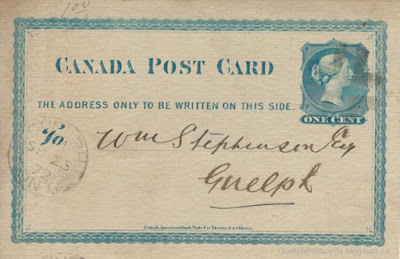 A brief inspection reveals that this item was indeed a novel form of mail, since it has strict instructions printed on it: "The address only to be written on this side." No chit-chat here! In place of a stamp, it has a portrait of Queen Victoria printed in the upper-right corner. This portrait assured the post office that the fee for mailing the card—one cent—had indeed been paid as part of the purchase price of the card. Since the right to print this "stamp" lay solely with the government, they were the only printers of these cards. Some very small type at the bottom of the card reveals that the printer contracted for the job was the "British American Bank Note Co., Montreal & Ottawa."
 The message says:
 (Norfolk Methodist Church, Guelph, ca. 1910., printed by the International Stationary Co.)
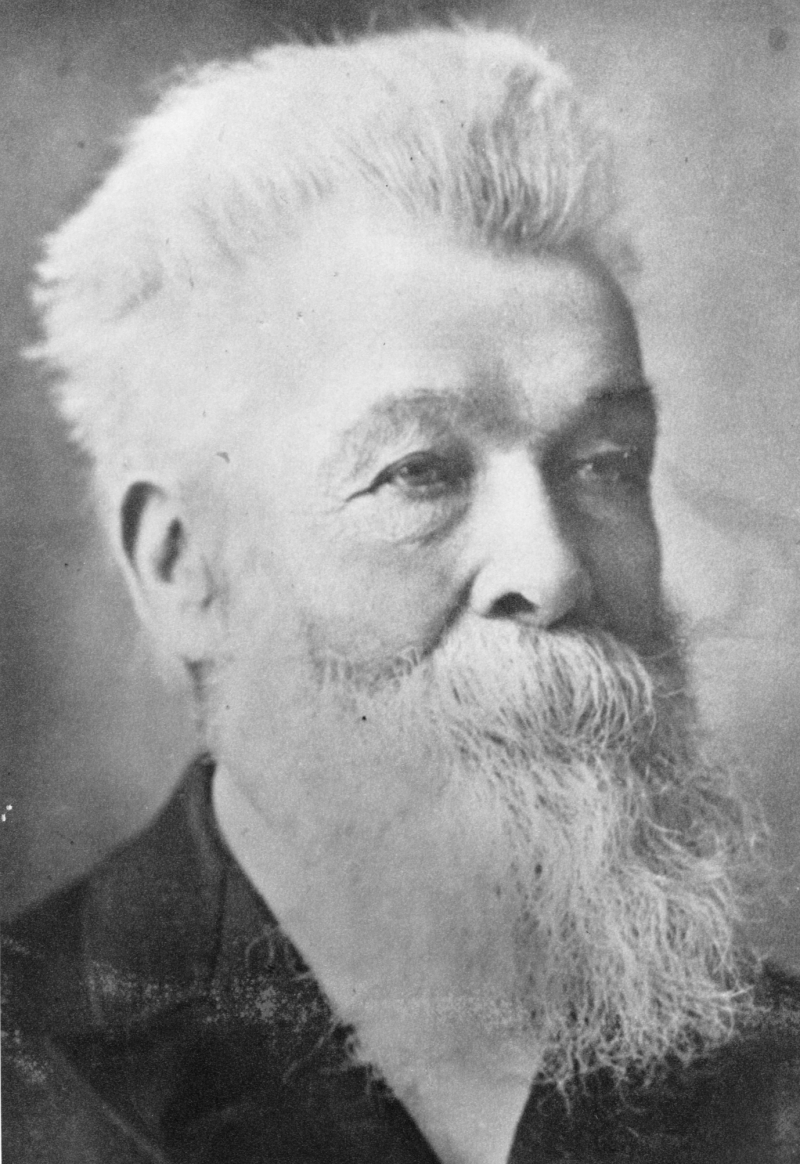 ("William Stevenson," perhaps at the time he served as Mayor; Courtesy of Guelph Public Library Archives, F38-0-4-0-0-4.)
 ("Central School, Guelph," printed by A.L:. Merrill, Toronto, ca. 1910.)
 In 1872, when the postcard above was sent, Mr. Stevenson made a number of entries in Guelph's Central Exhibition, which was his usual practice. The Mercury (4 Oct) records that he won prizes in a number of categories, including Gravenstein apples, pears (variety and Bartlett), grapes (Adirondac, "ereveling," Hartford), and melons (scarlet flesh), not to mention his first prize showing in floral design.
 (The location of Wm. Stevenson's nursery and Maple Bank in Wellington County Atlas, 1877.)
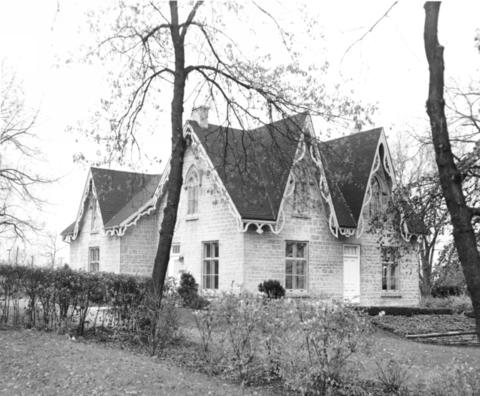 ("Maple Bank," ca. 1960; Courtesy of Guelph Public Library Archives C6-0-0-0-0-466.)
 ("Stevenson family," ca. 1860; Courtesy of Guelph Public Library Archives, F38-0-14-0-0-473.)
It would be remiss of me not to mention that some of the Stevenson children became noted figures in town. Ephraim Stevenson was a member of the Guelph Maple Leafs baseball club that held the semi-professional world championship in the early 1870s. (Detail from "Maple Leaf Baseball Team, 1871." Courtesy of Guelph Civic Museums, 1979X.00.762.)
 She is identified by her married name of Maud Stevenson Pentelow. (Courtesy of Guelph Civic Museums, 2014.84.1066.)
 (Courtesy of Guelph Civic Museums, Grundy 12.)
Sources consulted for this post include:
What might be called the "pre-history" of the postcard was recently outlined by Andrew Cunningham in Cardtalk (2021, v. 42, n. 2) the newsletter of the Toronto Postcard Club (of which I am a member). He explains that the idea of postcards as a specific and regulated piece of mail was introduced in Austria in 1869. Postcards could be sent through the mail just like letters but at a lesser rate (often half-price), the downside being that they could convey only short messages and afforded less privacy than regular mail.
The idea proved immediately popular and was soon copied elsewhere. In 1871, the Canadian government adopted rules allowing postcards in domestic mail. As abroad, "post cards" or "postals" were soon adopted by Canadians. Unlike later practice, postcards were then used chiefly for business correspondence, to request prices of goods or acknowledge receipt of payments, for example.
Here is an example of this type of card, sent to "Wm. Stephenson Esq." of Guelph on 25 Sep. 1872:

The back of the card could hardly be plainer: It was a complete blank—write whatever you like. This may sound potentially exciting but most messages are disappointinly uninspired. Here is the back of the card sent to the Mr. Stephenson:

Deeds to you & Fleming duly executed. When will you & he be in to complete the purchase. W.M. Merrit // Sept. 25/72Short and to the point—businesslike. Indeed, the point of the card is apparently to further a real estate transaction. Let's see who was in on the deal.
Mr. Wm. M. Merritt was a Guelph lawyer. He studied law in Toronto and was called to the bar in 1868, at which point he took up practice in Guelph in the firm Dunbar & Merritt (Globe, 1 Apr 1898). He specialized in commercial law, so handling the deed in a real estate transaction was right up his alley. So, it appears that this postcard was sent from a Guelph address to another one—a short trip!
The year after he sent this postcard, Mr. Merritt moved back to Toronto, where he remained for the rest of his life. Even so, Guelph seems to have made an impression. He returned briefly in 1876 to marry local girl Miss Elizabeth Robertson, in what the Mercury (23 Feb) described as a notably fashionable wedding.
The "Fleming" mentioned in the postcard was likely Mr. George Fleming, a recently retired farmer. Mr. Fleming was an early settler of Guelph, having emigrated from Paisley, Scotland around 1836, when the former was still mostly a set of modest, log buildings (Mercury, 6 Dec 1876). For 32 years, he farmed a 100-acre lot a short distance east of town and then relocated to a residence on Berlin st. (now Foster Ave.) upon retirement.
It seems that shortly after his arrival, Mr. Fleming was the victim of disrobement (Mercury, 12 Aug 1868):
Guelph Police Court.Perhaps this incident could be taken as a compliment to Mr. Fleming's good taste in shirts.
…
James Fitzgerald was charged with the theft of a shirt from Geo. Fleming. He took it off the clothes line and put it on, and when the Chief Constable caught him he became pugnacious. At first we was for having the case tried at the County Court, but after the witnesses were examined he thought better of it, pleaded guilty, and consented to its being disposed of summarily. He was sent to gaol for a month at hard labour.
The recipient of the postcard was Mr. Wm. Stevenson, an important figure in Guelph's early days. Mr. Stevenson was born in 1817 near Thrumpton Hall, Nottinghamshire and immigrated to Guelph at the age of 20, at about the same time as Mr. Fleming. In religion, he was an active Methodist. He and James Hough were the prime movers behind the organization of the Norfolk Street Methodist Church in 1836, and he served as a preacher there from 1841.

Wm. Stevenson took quite an active part in the governance of the city. He was a Town Councilor in 1851 when Guelph became an incorporated town, separate from the surrounding township. He also served as town alderman (Councilor) in 1854, 1872, 1879, and 1880–1884. In 1885 and 1886, he was Mayor of the Royal City. One of his accomplishments in that time was organizing the Guelph Junction Railway, which connected the city with the Canadian Pacific Railway, thus providing some competition with the Grand Trunk Railway. While this connection helped the commercial interests of the city, its adoption of the Priory as a station set that building on the road to ruin, an outcome that Mr. Stevenson certainly did not anticipate nor would have approved.
Apparently a fan of reading and education, Mr. Stevenson also served on the Board of Education and took an active part in the founding of the Central School which competed with the Church of Our Lady for attention on Guelph's downtown skyline from 1876 until its replacement with a more modest structure in 1968.

Did I mention that Mr. Stevenson had a day job? He was a "nurseryman," that is, he grew and provided plants and trees to order. An ad from the Mercury (13 May 1874) gives an idea of what was on offer:

All of this work was carried out at his ample residence of "Maple Bank," at the corner of Grange and what is now Stevenson Street (yes, named after Wm. Stevenson).

The house itself was built sometime in the 1850s and is quite a nifty example of the Gothic Revival style in Ontario.
Happily, Maple Bank survives today and can be glimpsed from Grange street, as in this Google Street view scene:
Here is a picture of the Stevenson family, posed at Maple Bank, ca. 1860:
In the back row stand Wm. Stevenson next to his second wife, Isabella, with Ephraim in behind. The girls are probably Miriam, Laura, Belvedera, Caroline, and Clara (ages, 10, 8, 6, 5, and 1, respectively, in the 1861 census). Given that Clara appears to be about 4–5 years old in the photo, it was likely taken around 1865.
Among Guelph history buffs, Mr. Stevenson is also remembered for the brief reminiscences he delivered in a speech in 1877. It follows the usual form of dates, names, and brief recollections, which the reader would like to know more about. For example, here is his brief recollection for 1854:
In October of 1854, about a dozen of the best stores on Wyndham and Macdonell Streets were burned down, causing a loss of many thousand dollars. About this time the town limits were enlarged, much to the disgust of those parties included in the new limits.Why were the new Guelphites so disgusted, and what form did their distaste take? It would certainly have been nice to know more of Mr. Stevenson's thoughts on the matter, particularly since he was a town Councilor at the time.
In any event, our humble postcard serves to remind us of one of the influential figures of Victorian Guelph.
Wm. Stevenson died on 6 June 1899 at the age of 81 and is buried at the Woodlawn Cemetery.
It would be remiss of me not to mention that some of the Stevenson children became noted figures in town. Ephraim Stevenson was a member of the Guelph Maple Leafs baseball club that held the semi-professional world championship in the early 1870s.
In a reminiscence about his early years in Guelph, Frank Coffee describes his memory of the team in these words (Mercury, 26 Oct 1918):
The original Maple Leafs had won a Canadian championship; Jim Nichols, Bill Sunley, Eph. Stevenson, Johnnie Colson, Tommy and Billie Smith, Jack Goldie, Kenneth Maclean, Harry Steele, were names to conjure with, as in successive seasons they held, against all comers, the championship emblem—the first silver ball.I have yet to find a labelled photo of Ephraim in his Maple Leafs uniform but I think that this photo from a collage assembled in 1871 is a good match for the young man posed on the porch of Maple Bank above:

Despite his prowess at baseball, Ephraim's calling was to be a Methodist clergyman.
William and Isabella's youngest daughter, Maud, achieved fame as a singer. A paragraph from a short biography provides some details of interest:
The Toronto Globe of November 4, 1899, carries an account of Miss Stevenson and mentions that she is known from coast to coast across Canada for her concert work. Also in London, England, she received flattering comments on the tone and quality of her voice as well as the keen dramatic instinct she possessed. She was, it said, able to sing with equal ease, the most difficult classical selections and Scottish ballads. Her soprano voice had a magnificent range and sweetness. She was called "Guelph's sweet-voiced singer."There is a portrait of her from ca. 1880 in a Notman photograph in a dark outfit and looking rather severe:
Maud's older sister Clara was also an excellent singer, though she did not enjoy an international reputation. Nonetheless, she is commemorated in the name of Clara Street in the St. George's Park neighbourhood. The reason is not clear to me, although it may not be a coincidence that Clara was the second wife of local mover-and-shaker J.W. Lyon. Anyone who knows the story is invited to fill it in in the comments below.
A portrait of the children of William and Isabella Stevenson, taken ca. 1925, is shown below:
From left to right, the figures are Belvedera, Clara, Carolina, Minnie (Miriam?), Maude, Rev. Ephriam, and Laura.
Sources consulted for this post include:
- Sudbury, H. "Stevenson, William." Publication of the Guelph Historical Society 1965. 5,9: 1–2.
Subscribe to:
Posts (Atom)