Wednesday, 30 October 2019

T.J. Hannigan: Power and politics—and postcards

Thomas Joseph Hannigan was a runner: He ran in road races, he ran businesses, he ran lobby and special interest groups, and he ran for office. He was an important figure in Guelph in the first four decades of the twentieth century. Plus, he sold a few postcards along the way.

Thomas Joseph (very often abbreviated to "T.J.") Hannigan was born on 6 Nov 1869 in Campbellford, Ontario, to John and Ellen. The family moved to Guelph in 1888 (Mercury, 27 June 1940). The 1889 city directory lists John as a tinsmith and young Thomas as a "finisher". The 1891 directory specifies Thomas's place of work as the Bell Organ factory, where he likely finished the organ cabinets.

Hannigan was a joiner in more sense than his work in carpentry. He quickly became involved in various community organizations. In 1891, he is noted as a participant in a minstrel show put on by the Guelph Catholic Union (Mercury, 30 Jan. 1891). He performed in a number called "Africans Bluebeard" described as a musical burlesque. (It's quite possible the performance was in blackface, which would be a liability for a future politician today but was unremarkable for people like Hannigan in that era.)

In 1892 and 1895, Hannigan is listed as an officer of the Canadian Order of Foresters, Court Wellington, No. 180.

In spite of his growing involvement in the social life of the Royal City, sometime in the mid 1890s, Hannigan moved to Plattsville, where he became a hotelkeeper. No doubt this move was a step up the ladder of success, working for himself rather than an employer.

In spite of the move, the connection with Guelph was not severed. In 1895, Hannigan returned to the Royal City to wed local girl Mary Tait in the Church of Our Lady (Mercury, 3 July 1895). The next year, Hannigan's father John died in Plattsville and was buried in Guelph. By 1901, Thomas and his new family had returned to the Royal City.

It seems that Hannigan was a fan of the sport of running. Once back in Guelph, he helped to found the Guelph Cross Country Run and Road Race Association (Mercury, 27 June 1940). With a time-out during the Great War, this association organized running competitions in Guelph, focussed on a set of road races on Thanksgiving Day. Hannigan's interest seems never to have wavered:

He has served as president, General manager and treasurer of this association on numerous occasions. Last year [1939] he was president again. Mr. Hannigan was also president of the Guelph Track Club.
From 1902, city directories list T.J. as the manager of a billiard hall, situated at 1 Wyndham Street, apparently on the second floor of what was the southern half of the Macdonald Block. From its windows, gentlemen at leisure would have had a splendid view of Jubilee Park, old City Hall, and the marketplace.


It appears that T.J. remained in this business until about 1910. It was during this time that he dabbled in the contemporary postcard craze. I am aware of two postcards marked "Published by T.J. Hannigan" on the back, one of St. George's Square and the other of the Church of Our Lady, where he was married. Note the distinctive handwriting featured in the captions below.


Neither card provides a printers name and neither image is unique to T.J. Hannigan. The image of the Post Office in St. George's Square can be dated to about 1904, as the third storey was added to the building in 1903, and the clock added to the empty portal in the tower in 1905. Neither postcard has been postally marked. One card, not in my possession, bears a postmark 16 Jan. 1906.

Further postcards featuring similar captions also exist. All of these have a generic "Private Post Card" logo on the back. Three cards, featuring views of the Court House, Speed River, and Macdonald Institute, have no publisher's or printer's marks. Another six cards are marked "W.G. MacFarlane," a Toronto publisher of the era. These cards feature views of St. George's Church, the Carnegie library, the General Hospital, and the Ontario Agricultural College (OAC). Cards in this set have postmarks from 3 November 1905 through 20 September 1906.

Here is a card of a man canoeing on the Speed River, probably north of the dam in Riverside Park. It has no publisher's or printer's mark.


Here is a card of the barns at the OAC. They were situated where Rozanski Hall lies today, as seen looking down Trent Lane from the north. Cards like this one are marked "W.G. MacFarlane" on the back.


Indexes on the back of these cards are marked A.103, A.105–108, and A.110, suggesting that A.104 and A.109, at least, are still to be found.

It may be that Hannigan decided to sell some postcards in his billiards hall as a side hustle, not an unusual arrangement at the time. He obtained them from W.G. MacFarlane and made them available from late 1905 and into 1906. Perhaps he saw the MacFarlane cards for sale in other businesses and ordered a few specially made for him. Alternatively, he may have sold cards from MacFarlane and perhaps others, not bothering to personalize them except for one small run.

It is hard to know for sure. It seems likely, though, that Hannigan took only a brief interest in the trade. He had other matters on his mind.

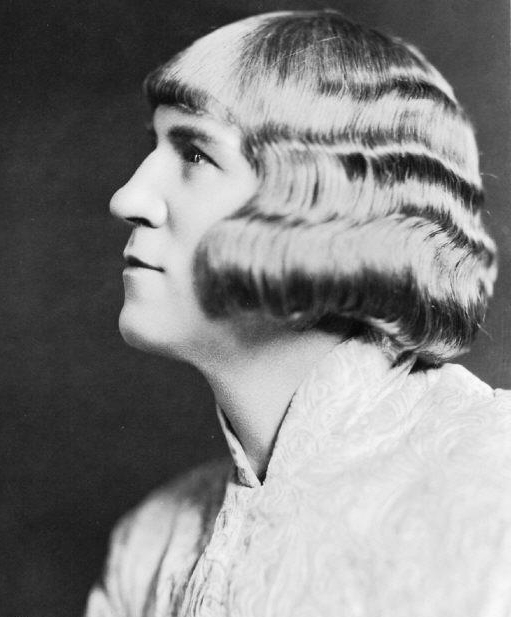
Hannigan was also involved in the organization of the Old Home Week festivities in 1908. In particular, he produced the official, souvenir program for the event, which featured views from his postcards and a lovely photo of himself.


(T.J. Hannigan, from the 1908 Old Home Week Souvenir booklet. Courtesy of Guelph Civic Museums, 1973.23.26)

The caption notes that the booklet was a sample of Hannigan's advertising. Presumably, this reference is to a business in which he was involved, although I am not yet sure what that was. It may be that his interest in postcards and in advertising at that time were somehow related. It was just as well that he was branching out.

On 17 Dec. 1909, a fire gutted the Norrish block on the Market Square (now Carden St. west), including Hannigan's pool room on the third floor (where it had been recently relocated). It was time to put the billiard business behind him. Hannigan began a new business venture, running "McDougall & Hannigan," a real estate and insurance company. In 1913, the partnership was dissolved and Hannigan operated the business on his own account. He remained in this line of work for the remainder of his life.


(Advertisement for MacDougall & Hannigan, "The men who sell real estate" from the Christmas edition of the Mercury, 1910. The address "just around the corner" seems cryptic; the city directory gives the address 89 Quebec Street East—now part of the Quebec Street Mall. Also, is it just me or does it appear that the photos are mixed up?)

Hannigan's interests in real estate in the Royal City seem to have been widespread. Irwin (1998) notes that he was involved in the disposition of properties such as Wheeler Avenue in the Ward, and Chester and Stanley streets near Exhibition Park. Plans in the University of Guelph archives associate him with developments near St. James's Church and Crimea Street.


(Ad for Hannigan's real estate business, "He knows." From the Industrial edition, 1915.)

The property that Hannigan was most involved with was Wellington Place (or Boulevard, later renamed Riverview Drive and Waverley Drive), on the east side of Riverside Park. The city directory gives his address as Wellington Place starting in 1922. There, he named his house "Athlone," presumably after the town in central Ireland where, it may be, that the Hannigan family originated.

His tenure there was not untroubled. On 7 May 1928, Hannigan was awakened at an early hour to find that his house was on fire and his bedroom filled with smoke (Mercury):

When the pungent, penetrating fumes of smoldering wood aroused him, Mr. Hannigan, clad only in his pyjames, hastened to the upper portion of the back verandah, and climbed down a post to the ground. Securing a ladder, he placed it against an upstairs window, and re-entering the smoke-filled room, assisted Mrs. Hannigan, who was dazed from the fumes, to the outside of the house.
Although there was considerable damage, Hannigan probably had the house insured. Evidently, it was repaired and he remained there for the rest of his life. Hannigan's special fondness for flowers is apparent in the remark in the article that "many valuable bulbs stored in the cellar were ruined."

Hannigan became politically active. He was elected an alderman for St. John's ward in 1913 and 1914, and in 1919 and 1920. He joined the local Conservative Party and took on a leading role. In 1937, he opposed the nomination of local boy (and future Ontario Premier) George Drew for the South Wellington seat. Rumors swirled that Hannigan would run as an Independent Conservative or that he had already prepared cards listing him as a Farmer-Labor candidate (Globe, 29 Sep. 1937). Hannigan stated that he could neither confirm nor deny the rumors, although he did not run in the end.


(George A. Drew; courtesy Wikimedia Commons)

Hannigan also threw his hat into the ring as Conservative nominee for the 1939 federal election, although he was superseded by Lieut.-Col. C.D. Crowe (Globe, 16 Aug. 1939). He put his name forward again as a National Government candidate in 1940 but again was unsuccessful (Globe, 23 Feb. 1940). At the age of 70 years, he clearly had not lost his enthusiasm for the political life!

During his life, Hannigan was best-known for his role in the development of Hydro power. In the late 19th Century, cities in southern Ontario, including Guelph, had adopted electricity for illumination, powering factories, and private use. Electricity was generated locally, near where it was consumed. In the early 20th Century, power stations were built at Niagara that could generate enough power to run many cities. Distribution of Niagara power constituted the beginning of the electrical grid that we know today.

One important matter concerned ownership of the grid. Would Niagara power be owned and distributed by private companies or a public utility? The campaign for public ownership was led by London M.P.P. Adam Beck, later knighted for his efforts. Organizations including the Hydro Electric Railway Association of Ontario and the Ontario Municipal Electric Association were quickly formed to push the program forward.


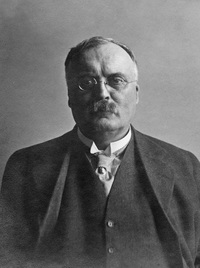
(Sir Adam Beck, ca. 1902 as Mayor of London; courtesy of London Public Library)

In Guelph, the public option was broadly preferred. As Stephen Thorning pointed out (2000), the Royal City was pleased with its own track record with its city-owned power utility and the Guelph Junction Railway. Prominent Guelphites organized to support the public option, led by millionaire publisher and civic booster J.W. Lyon, who became president of both Railway and Electric associations.


(J.W. Lyon; Men of Canada (1891, p. 230).)

Hannigan joined both efforts in top positions, such as secretary, treasurer, or both. He took over leadership from Lyon after the latter retired from the fray in the mid-1920s. He continued to promote public ownership of utility for the rest of his life, defending it against encroachments on its turf. He was successful in maintaining public ownership of the grid, although efforts to electrify the inter-city railway system did not bear fruit.

Hannigan's tenure in the Ontario Municipal Electric Association was not without controversy. Liberal leader and Premier Mitchell Hepburn accused the Association of being a "slush fund" used by Hannigan to oppose the government and conduct shady insurance deals (Globe, 13 Aug. 1934). Certainly, Hannigan was a staunch Conservative. However, such allegations were never substantiated, so far as I am aware.


(Mitchell Hepburn; courtesy of Wikimedia Commons.)

No account of T.J. Hannigan's life would be complete without some mention of his passion for flowers. He was president of the Guelph Horticultural Society for many years, and also the Ontario Horticultural Association (Mercury, 27 June 1940). He was a particular authority on gladioli and entered his blooms in many competitions.

For example, Hannigan won many awards in the second annual exhibition of the Ontario Gladioli Society, held at the Ontario Agricultural College in Guelph and attended by gladioli gurus from across the continent (London Free Press, 23 Aug. 1923). Hannigan triumphed in the categories of Best six spikes Pink Perfection, Best three spikes smokey, Best six spikes yellow, Best six spikes pink; and second place in Best 12 spikes Le Marechal Foch (Holland variety), Best three spikes variegated, Best six spikes blue, Best three varieties three spikes each, and Best 12 spikes golden.

Hannigan also became Secretary-Treasurer of the Simcoe Tobacco Plantation Ltd. in 1930 and director of the Ontario Flue-Cured Tobacco Marketing Board. It seems that he was Catholic not only in religion but in botany as well.

T.J. Hannigan died in 1940 and was buried in Marymount Cemetery (Mercury, 27 June 1940). The Guelph Cross Country Run and Road Race Association decided to name its one-mile Thanksgiving Day race the "T.J. Hannigan special race" in his honour (Mercury, 24 Sep. 1940). Certainly, it was a fitting tribute for a man who enjoyed running so much.


(Guelph Cross Country & Road Association Annual Meet, 1909. Hannigan is seated in the front row, extreme left. Courtesy of Guelph Civic Museums 1981.212.1.)

Friday, 4 October 2019

McQuillan's bridge

Without fanfare, the County of Wellington advertised for tenders for the construction of six concrete bridges (Engineering and Contract Record 1916, v. 30, n. 21, p. 46):
Sealed tenders will be received by Jas. Beattie, Esq., County Clerk, Fergus, up to 2 p.m. on Thursday, June 1st, for the construction of the following concrete bridges for the County of Wellington:

Four concrete arched trusses of 70 ft., 65 ft., 60 ft. and 30 ft., spans, and two 14-ft. slab bridges.

For plans, specifications and estimate of quantities, apply to
Bowman & Connor
31 Queen St. W., Toronto.
So far as I can tell, the 70 ft. concrete arched truss bridge was to become the new "McQuillan's bridge," that is, the crossing over the Eramosa River on the boundary line between Guelph Township and Puslinch. This bridge, like its wooden predecessors, was known as McQuillan's bridge after the McQuillan family whose farm lay immediately to its north.

The McQuillan bridge is shown in the off-centre, real-photo postcard below:


The postcard was not addressed or mailed but has "Guelph le 1er Mais 1919, Ontario Canada" written on the back, suggesting it was taken on the 1 May 1919.

Today, McQuillan's bridge can be viewed from its replacement, the Stone Road bridge, via Google Street View:


A comparison of images shows that McQuillan's bridge retains its original form, although the knobs that once capped its midsection have since gone missing. The little shield in the middle of the crosspiece over the centre of the bridge says "1916," to celebrate the year of its construction.

This type of bridge is commonly known as a bowstring bridge, to describe how the parabolic shape of the arches on the deck resemble the curve of a bow with its ends held in tension by a bowstring in the form of the bridge deck. The metaphor is apt: The bridge works by suspending the weight of the deck from the arches by virtue of steel bars in the vertical columns and handles the horizontal thrust of the arches by virtue of steel bars embedded lengthwise in the deck.

Engineers of the day called the design a concrete truss bridge with a suspended floor. This type of bridge originated in France in the early years of the 20th Century and quickly spread elsewhere, including Canada. Frank Barber (1914) wrote a short article describing the type of bridge and its early deployment in Ontario, in which he was closely involved. For example, Barber had designed the Middle Road Bridge between Toronto and Mississauga in 1909.

As Barber explains, an important advantage of the bowstring bridge is that since the superstructure of the bridge resides entirely above the deck, it does not need to be raised high on large abutments. A look at McQuillan's bridge from a low angle shows that its designers were happy to have it sit low over the Eramosa River, on the plausible assumption that nothing large needed to pass under it.


McQuillan's bridge was designed by the engineering firm Bowman and Connor of Toronto. As engineers for Wellington County (and Waterloo), they designed and oversaw the construction of many such bridges in the region.

The winning tender for this construction project went to Charles Mattaini of Fergus. Mattaini was born and raised in Vergiate, Italy, near Milan, where he worked as a mason. He immigrated to Canada in 1898 and continued his work in the construction trade (Mattaini 1979). In 1903, he moved to Fergus with his new bride, Marie Landoni, and set out his shingle as builder with expertise in foundations, cisterns, water troughs, culverts, bridges, sidewalks, etc.

Mattaini's ledger for 1916 mentions a number of projects: bridge on Irvine, bridge for Erin Township, culvert at Prison Farm, County Council bridge, and McQuillan's bridge. It seems likely that he and his crew used material from the quarry at the Prison Farm nearby to complete the culvert and McQuillan's bridge.

The McQuillan family after whom the bridge was known were also masons (Daily Mercury, 23 May 1881). James McQuillan immigrated to Canada from County Monaghan, Ireland, and arrived in Guelph in the summer of 1827, only a few months after the village was founded in April. His skills as a mason and a builder proved immediately valuable. He built the first stone structure in the village, which was, perhaps, the stone school house at the corner of Neeve and Waterloo (now Fountain) streets (since demolished).

McQuillan and his family later occupied a farm on land now part of the University of Guelph along the north side of Stone Road east of Gordon Street. There he farmed and kept a tavern for some time. He then moved a little further east to a farm north of Stone Road and east of Victoria Road, which included a stretch of the Eramosa River, where he spent the rest of his life.

The map below shows the final McQuillan farm in the 1906 Wellington County Atlas. At that time, the farm was in the possession of Arthur and Bernard, two of James McQuillan's sons. On the map, the circle in the lower-right corner shows the location of McQuillan's bridge.


The box on the map shows the laneway to McQuillan's house, which he also built (since demolished), from Victoria Road. A photograph of this house was taken by Gordon Couling in March 1969 and resides in the Wellington County Archives.


("Stone house, Concession 1 Lot 10 in Division G, Guelph Township, 1969." Wellington County Archives A1985.110.)

James McQuillan died suddenly of "old age" on 21 May 1881, in his 85th year.

In 2000, Stone Road was widened to two lanes and rerouted north of the McQuillan's bridge. As noted in "The Grand River Watershed Heritage Bridge Inventory" (2013), the old bridge was designated as a heritage structure in 2004:

The Stone Road [McQuillan] Bridge is included on the Ontario Heritage Bridge List, spans a designated Canadian Heritage River route and is considered to be an early and rare surviving example of concrete bowstring arch construction in a local, provincial and national context.
It now functions as pedestrian bridge for hikers and as a memorial to the technology and taste of builders of the early 20th century.


The McQuillan bridge is not the only memento of the prolific McQuillan family. For example, the McQuillan Block on 101–107 Wyndham Street was built by Arthur and Francis (Frank) McQuillan, two of James's sons.


The Block sits behind the tree in this Google Street View scene. Built in 1874, the Block originally extended further along the street, through the Budd's clothing store (since vacated) in the picture. In 1965, a fire destroyed the two northern units. The old sidewall of the original block can still be seen over the roof of the replacement building on the extreme left of the image.

Friday, 23 August 2019

Speedwell: The Guelph Military Convalescent Hospital

In the chilly afternoon of 8 November 1920, a group of people crossed over the Eramosa River on the sturdy, concrete bridge to the Canadian Pacific platform at the Speedwell station. They were the last patients and staff of the Speedwell Military Convalescent Hospital, commonly known as the Speedwell Hospital. They consisted of 45 walking patients, 9 "stretcher cases," 2 doctors, 7 nursing sisters, 3 vocational aides, and 9 orderlies. They boarded the 3:40pm train for Toronto, bound for Christie Street Hospital. The Speedwell Hospital was now closed.


(View of the Prison Farm from near the Speedwell train stop. Printed by International Stationary Co., Picton. Although the card is from ca. 1912, the note on the back says, "This is present Speedwell Hospital.")

The story of Speedwell Hospital begins in 1915. It had become clear that the conflict in Europe was going to be a long and grinding affair. Many personnel sent off to war were coming home badly wounded and in need of substantial care, and many more would do so in future. In June of that year, the Canadian government set up the Military Hospitals Commission (MHC) to acquire and operate a system of hospitals and other facilities to see to the needs of returning veterans. Given the pressing nature of the situation, the MHC was on the look-out for existing facilities that it could adapt for its purposes. The Ontario Reformatory at Guelph, still often known as the Prison Farm, was a good candidate. It could certainly serve the medical needs of wounded veterans but, more to the point, its farm and machine operations could provide employment and vocational training for veterans as they re-integrated into civilian life.

The choice of the Prison Farm was telling in some ways. The Prison Farm had been designed to turn young men from lives of petty crime or dissolution to lives as productive and upright citizens, learned through agricultural work or tradecraft. Although the Speedwell Hospital was to function as a medical facility, it too had a broader social function. Like the Prison Farm, it was intended to turn young men from soldiers into civilians through experience with agricultural work or useful trades.

Soldiering was generally viewed as heroic and not criminal, yet the fundamentally undemocratic operation of the military and the dependency of its rank and file on the organization were regarded as problematic for civilian life. Thus, Speedwell would be a place where returned soldiers would be honoured and healed but also helped to begin lives as the heads and breadwinners of the nation's future families.

Unfortunately, Speedwell did not succeed in this mission.

On 19 October 1917, the first 50 returned soldiers were brought to Speedwell from the London Military Hospital (Evening Mercury). The Prison Farm had been thoroughly renovated in preparation for their arrival. Of course, bars and screens had been removed from windows and iron doors replaced with curtains. Painters, carpenters, and other tradesmen from Guelph had been busy for months making the place more welcoming and less confining.


(Military Hospital, with a new dormitory wing visible on the right. Printed by the Heliotype Co. of Ottawa, ca. 1920.)

In addition, two new wings had been built as dormitories. Each was two storeys high and could accommodate 74 beds on each floor, for a total of 296. In addition, a large theatre had been constructed behind the Main Building, with a capacity of about 600. Here, soldiers could put on entertainments for each other, for visitors, or be entertained by special guests. A recreation room featuring billiard and pool tables as well as pianos was provided. A library was also fitted up, and a call for book donations put out. A canteen was constructed in the basement where patients could eat cafeteria style, if they could.


(Soldiers playing billiards at Speedwell. Courtesy of Guelph Civic Museums 1978.6.4.)


(Soldiers at a Speedwell cafeteria. Courtesy of Guelph Civic Museums 1978.6.1.)

Vocational training was also organized. Patients could get training in the trades, such as carpentry and auto mechanics. Remedial schooling was also available.


(Soldiers making furniture in a carpentry shop at Speedwell. Courtesy of Guelph Civic Museums 1978.6.5.)

As part of the deal between the Department of Soldiers' Civil Re-establishment (DSCR—successor to the MHC), command of the hospital remained with the military, headed by Lieutenant Colonel T.G. Delamere, a veteran of the first Canadian contingent to France who was wounded in action and returned to Canada. Even so, many of the staff of the facility would continue to be civilians, many remaining from the Prison Farm days.


(Real photo postcard of Speedwell, taken from the north with a Farm side road in the foreground.)

In some respects, Speedwell Hospital served its patients reasonably well. Opportunities for playing billiards, reading books, and writing letters and postcards were likely agreeable. Many special entertainments were mounted also. For example, sporting events were brought in. On 14 April 1919, for example, a boxing program was put on featuring "Irish" Kennedy versus "Battling" Ray of Syracuse (Globe). Although scheduled for 10 rounds, Kennedy knocked out Ray with two telling blows to the jaw in round 5. A wrestling match between Finnemore of Milton and Hays of Galt went nearly 25 mintues, when Hays made the second fall of the bout. The Eustis Bros. of Toronto delighted the assembled with their excellent acrobatic display. Three boxing matches between returned soldiers were well fought and ended in draws.

In 1919, amateur baseball returned to Guelph, and the Speedwell Hospital entered a team. The experience seems to have been a success as Speedwell went on to enter a team in 1920 as well.

Edward Johnson, local boy who was already an international singing sensation, put on a show to a packed audience at the Speedwell theatre on 10 September 1920 (London Free Press, 11 Sep.).


(Edward Johnson as Pelléas in Claude Debussy's Pelléas et Mélisande at the Metropolitan Opera in New York in 1925. Courtesy of Wikimedia Commons.)

Soldiers at the the Hospital also organized their own entertainments, which were sometimes made available for the community. For example, the Speedwell Hospital Minstrels put on a minstrel show in the old Guelph City Hall (Evening Mercury, 19 Feb. 1920). Minstrel shows were variety shows in which white men wore blackface and capered, sang, and played instruments in the manner they imagined southern African Americans did. The form had been largely superseded by Vaudville style shows but persisted as an informal kind of amusement. The Speedwell Minstrels' performance was liked well enough that they were invited to repeat it in Elora.

Ties between the returned soldiers and the community seem to have been positive. Reports suggest that many soldiers remained in Guelph after their time at Speedwell, though I have not found accounts of exactly who they were or how numerous. Connections with town were facilitated by the Toronto Suburban Railway stop at Speedwell station, across the Eramosa River from the institution. The Guelph Radial Railway (streetcar) opened a regular service to Speedwell (Evening Mercury, 15 Jan. 1920). Business on this route was so good that two extra daily trips were put on, which were filled to capacity.


(Storage building at Speedwell; Construction v. 13., n. 3, p. 97, March 1920.)

Various aid organizations, many run by women, took a great interest in the well-being of the soldiers, for example (Globe, 19 Dec. 1919):

The Speedwell Hospital Visiting Committee of the Red Cross Society at Guelph yesterday prepared the personal property bags and packages which are to be distributed to all the patients of the hospital. The committee received many generous donations for these packages, which will contain raisins, chocolates, smokes, socks, handkerchiefs, apples, and other articles. In each there is also a Christmas card and a Red Cross card. The distribution of gifts will be made on Thursday afternoon.
Soldier's Comfort Committees in many communities made goods and campaigned for funds to provide soldiers with domestic comforts. For example, the Women's Institute of Ospringe made and donated an "autograph quilt" to the Speedwell Hospital in 1919.

At the provincial level, Mrs. Arthur VanKoughnet of the DSCR coordinated a funding drive with impressive results (Globe, 7 Oct. 1919):

Oakville Woman’s Patriotic League, $200.00; Seaforth Canadian Red Cross Society, $125.00; St. Cyprian’s Carry on Club, $130.50; Riverdale Woman’s Patriotic League, $225.00; Woman’s Volunteer Corps. $125.00; Grey County Woman’s Institute, Ayton, $202.00; Ioco Good Cheer Club, $66.00; Gorrie Woman’s Institute, $54.50; Annan Woman’s Institute, $30.00, and others from individuals. Donations of comforts of various kinds were received from Sherbourne Street Methodist Church, Jarvis Street Patriotic Society, Navy League of the United States, York Rangers’ Chapter I.O.D.E., Sir Thos. Cheton Chapter, I.O.D.E., Hastings; W.I. Roseneath, Cobourg Ladies, 169th Regt., St. Alban’s Red Cross Society, North Toronto Red Cross Society and Soldiers’ Comforts, D.S.C.R., 71 King street west.
Some of the soldiers applied themselves to the domestic arts, perhaps those who were unable to work in the abbatoir or carpentry workshop. Some of the fruits of their labour, from Speedwell and other facilities, were put on display in the Women's Building of the Toronto Exhibition (Globe, 26 Aug. 1919):
There are beautiful scarves and hat bands woven on hand looms, beaded necklets and watch fobs of fine color and design; examples of metal work, hammered brass and copper; cushion covers and centerpieces in embroidery and cross stitch; excellent carpentry and cabinet work; beautifully carved and inlaid trays; hand-painted China and other things almost beyond his number.
Above all, the author heaped praise on the fine baskets that the men had made.

The author also took pains to maintain the dignity of the soldiers. Although this work was of a traditionally feminine character, it "may frequently set an example of the beauty of usefulness and simplicity to the women who exhibit their achievements in the adjoining rooms." In other words, the soldiers' scarves, embroidery, and baskets were safely masculine, and admirably so.

Of course, some items were decidedly military, such as a belt made of war trophies, a kind of art practiced in the trenches in France:

A unique contribution to the collection is a belt made from captured German regimental badges, and clasped with the regulation German brass buckle bearing a crown and the words “Gott Mit Uns.”
In spite of these efforts and the benefits they conferred, returned soldiers experienced significant troubles at Speedwell.

Some troubles were consequences of the war. For example, George William Moyser of the 71st Battery of Toronto, died as a result of ill-health caused by a gas attack suffered in France (Globe, 28 May 1919). Others were due to misadventure. Fred Tucker died as a result of falling off the top of the quarry pit at the back of the Hospital (Daily Star, 11 Aug. 1919).

Many soldiers were killed as a result of the Spanish Flu epidemic. For example, Lavelle Germain of St. Marys was taking a vocational course at Speedwell but staying in Guelph. He returned to his room at the King Edward Hotel complaining that he felt unwell. He later called for a doctor, who arrived to find Germain all but dead (Evening Mercury, 3 Feb. 1920). A whole ward of Speedwell was converted into a ward for flu victims, and several ill students from the O.A.C. were moved in (London Advertiser, 10 Feb. 1920).

Of course, the Spanish flu affected everyone. Nursing Sister Miss Geraldine McGinnis of London died of pneumonia resulting from the flu (London Advertiser, 12 Feb. 1920). She must have been very dedicated to her vocation as she had served two tours in France during the war and was in her second stint as a nurse at Speedwell.

Physically, Speedwell itself was not well suited to work as a hospital. Among the many problems was the damp. The stone walls of the institution seemed to encourage condensation, making the rooms continually uncomfortable. Dampness was a particular problem for the "lungers," that is, the many tuberculosis patients housed at Speedwell. Patients complained bitterly to a Mercury reporter who went to investigate (Evening Mercury, 8 July 1920):

Vincent is a British naval veteran, in with bronchitis. “The floors here are like the decks of a battle ship,” he said. “I had some experiences in the navy, was mined twice, but the experience I have had here are worse than the former ones.”
...
“It has to be a pretty wet place before I’ll complain of it,” said “Pick” McRae, “but you can tell ‘em all it’s too wet here for me.” McRae is a lung patient in cell number 9. Water was dripping from the walls of his cell.
As the word "cell" suggests, Speedwell retained the look and feel of a prison, in spite of the renovations and amenities. Naturally, the patients found this quality disheartening.

Speedwell had significant institutional problems as well. The DSCR's contract with the Ontario government meant that civilians staffed many of the Hospital's operations, such as the farm. Veterans felt that they should have preference for work at Speedwell and resented limitations on their opportunities there.

Budget limitations also led to conflicts among the staff. Nurses at Speedwell, who belonged to the military organization, complained that their medical duties did not allow them time to deliver and supervise patients' meals, as expected by the institution's dietitians, who belonged to the civilian authority. The dietitians complained that there was not enough money available to hire civilian staff to carry out that duty.


("Portion of the spotlessly clean kitchen at Speedwell, wherein cooking is a ?? and diet a study. No dish is used whereon one germ exists and frequent tests keep up this desirable condition." The London Advertiser, 20 Dec. 1919.)

In 1920, the situation came to a head. One hundred and fifty patients signed a petition demanding a sharp improvement in hospital conditions. They and the Great War Veterans Association (GWVA) called for the resignation of the Hospital administrators and for jobs at Speedwell to be given to veterans before civilians. Many of the nurses walked off the job in protest at conditions in the Hospital. A provincial inquiry found that want of money had led to filthy conditions falling well below the standards of a military hospital.

In the face of these problems, the DSCR decided that the situation at Speedwell was irretrievable and that the facility would be closed down. Military staff were re-assigned, civilians were laid off, and patients were moved to other facilities. The local Soldiers' Comfort Committee paid a final visit, bringing fruit and other gifts and holding a farewell dance (Evening Mercury, 4 Nov. 1920).

The Ontario government contemplated other uses for Speedwell, such as an insane asylum or merger with the OAC. In the end, they decided to return it to its former use as a prison. Local contractors were hired to put bars in the cell windows and make other preparations (Evening Mercury, 22 Nov. 1920). The theatre, which had served as a focal point for the amusement of returned soldiers, burned down in a mysterious fire during renovations (Globe, 28 Nov. 1921). The Speedwell Military Convalescent Hospital experiment was truly at an end.


Information about Speedwell and its institutional problems comes mainly from:

Durham, B. (2017). “The place is a prison, and you can’t change it”: Rehabilitation, Retraining, and Soldiers’ Re-Establishment at Speedwell Military Hospital, Guelph. 1911-1921. Ontario History, 109 (2), 184–212. https://doi.org/10.7202/1041284ar

Wednesday, 31 July 2019

The Toronto Suburban Railway: Guelph's streetcar to Toronto

On 12 April 1917, a lone streetcar from Toronto pulled into Guelph. On hand to greet it were a passel of railway dignitaries along with a clutch of curious locals. Officials with the Ontario Railway and Municipal Board and with the Toronto Suburban Railway (TSR) itself climbed on board for a "trip of inspection" back to the Big Smoke (Toronto Globe, 13 April 1917).

Before their departure, Mr. R.T. Hagen, Chief Engineer of the TSR confirmed that regular service between Guelph and Toronto was slated to start on Saturday the 14th although there would be but one car per day each way. On 1 May, after a period to identify and correct any difficulties, more frequent service would begin.

The new service was immediately well patronized. Although regular railway service between the Royal City and the Queen City had been established for decades, the idea of riding the trolley between the two (or points along the way) seemed to fulfill a need.

The cars themselves sound as though they were quite inviting. Car 101, a passenger car built at the Preston Car and Coach Company, was well appointed, finished in attractive cherrywood. The upper sashes of the side windows were glazed with leaded glass. Cars were entered from a center stairway that reached to street level for added convenience.

(TSR car #105 in front of old City Hall, Carden St., January 1918. Courtesy of Guelph Public Library F38-0-15-0-0-268.)

At the back of the car was the Main Room, featuring green, plush, upholstered, high-backed seats with headrests and footrests. A polished bronze handle on the aisle sides allowed passengers to seat themselves with dignity. A pushbutton was provided in each setting so that riders could inform the motorman of their desire to get off at the next stop. Overhead were luggage racks for storage and a three-ply, poplar veneer ceiling. A private toilet was located at the front.

At the front of the car was the Smoking Room, outfitted with low-backed seats upholstered with green pantasote—imitation leather—for a look reminiscent of a gentlemen's club. In service, the Smoking Room would have been filled with clouds of hot ash and tones of gentlemanly conversation. At the front of this room was the motorman's compartment, with the pedals, gears, levers, bells and gongs needed to control the train and communicate with its passengers.

Travelers on the TSR often used it to commute to larger centers for shopping or socializing. It became common practice for the Railway to add a trailer car to the Saturday train for shopping purposes. Ladies from smaller places along the line would visit Guelph to do their shopping and could deposit their purchases on the car over the course of the day. In the evening, the car would leave the Royal City to haul its load of goods and women on their trip home.

Traveling to parks was also a popular use. Guelphites were known to ride the TSR to attend dances at Edgewood Park in Eden Mills. In 1925, the TSR purchased Eldorado Park, a private park along the route in Chingoucousy Township, now within the town of Brampton. The idea was to boost ridership on the line by providing an attraction for passengers to visit, much as the Guelph Radial Railway (streetcar) built Riverside Park in 1905. A Ferris Wheel and Merry-Go-Round were added to make the proposition more attractive.


("Electric railways, Canada (1923)"—apparently a special excursion train from Toronto to Eldorado Park. Courtesy of British Pathé)

The Toronto Suburban Railway began life in 1890 as the Weston, High Park & Toronto Street Railway Company, with service centered on the town of West Toronto Junction (now known simply as "The Junction"). Two prominent railway wheeler-dealers, Sir William Mackenzie and Sir Donald Mann, known as "King" and "Duke" respectively, acquired the TSR in 1911 and began an ambitious expansion program. A line to from Lambton to Guelph was surveyed in 1911–1912, although grading and track-laying was delayed due to the Great War. Plans to carry the line through to Berlin (now Kitchener) were never realized.

(Sir William Mackenzie, April 1917. Courtesy of Library and Archives Canada.)

(Sir Donald Mann, 1907. Courtesy Wikimedia Commons.)

When the TSR Guelph line began operations in 1917, it had only four cars, 101, 104, 105, and 106, the first two being passenger coaches while the latter two also included baggage compartments. Cars 102 and 103 had burned in a fire at the Preston Car Coach Company before they could enter service. By 1918, it was clear that the TSR required more capacity, which was met by the purchase of four used, wooden, open-platform cars from the New York Elevated Company. These old wooden cars made for quite a contrast with the modern, steel cars already on the line.

(TSR car at Stop 101, in front of the Grand Trunk Station (now VIA—not seen) on Carden St., 1919. A trailer acquired from the New York Elevated Co. is attached behind. Courtesy of Guelph Public Library, F38-0-15-0-0-267.)

Two further passenger cars, 107 and 108, were added in the mid 1920s, along with a locomotive and a car-snowplow.

(TSR car #107, manufactured by the Niagara, St. Catherines & Toronto Railway (NS&T) in 1924. It was returned to the NS&T in 1935 and was rebuilt and used by that railway from 1943 through 1959. It is seen here on the Martindale trestle on the Port Dalhousie West line, 8 September 1957. Postcard by JBC Visuals; photo by Robert J. Sandusky; from the author's collection.)

The TSR had a number of interesting features. First of all, it was electric rather than steam powered. Electricity generated at Niagara Falls had recently been brought to much of southwestern Ontario, so it was available for expansive projects such as regional transportation. Power was provided to the TSR line by an overhead system suspended on brackets attached to 35 foot (10.7m) high wooden poles carrying a 25,000 volt AC, three-phase, 25 cycle current.

Power substations were built at intervals along the line to convert this power to DC for the trains. One was constructed in Guelph on Bay Street (now James Street East) although, in the event, it was used as a freight shed instead.


(Intended TSR power substation, 22 James St. E. Courtesy Google Street View. In Guelph, the TSR used the local streetcar tracks from Carden Street, down Gordon Street and then went its own way along James Street East.)

One of the implications of this system was that TSR trains gave a spectacular show in certain weather conditions. Consider a reminiscence by Jack Watkins, who recalls a memorable trip to take in a hockey game:

"I remember going to Georgetown on the thing, one night in the '20s. It was during a sleet storm—you should have seen the fireworks display from the trolley pole! We were going to see Guelph and Georgetown play hockey. We had to crawl from the suburban station to the arena. I can't remember who won the game!"
Of course, high-power electrical systems can also be quite dangerous. Norman Paul, TSR electrician at the Georgetown power substation, was electrocuted to death on 28 April 1917 (Acton Free Press, 3 May 1917). He was found unconscious with a skull fracture and both arms badly burned. It seems that he came into contact with a live wire and was hurled violently to the floor. He was rushed to Guelph General Hospital but never recovered.

Another feature of the TSR was that its route was notoriously curvy. Its riders estimated that 1/3 of the route consisted of corners instead of straight lines. The result was that the train lurched perilously from side to side during operation. Indeed, the wide, semi-circular seat at the back of the Main Room was known as the "thrill seat" because of the sideways distance it would travel as the train went along. Passengers remembered the line "fondly" as the "Corkscrew Railway" or the "Seasick Railway" as a result.

The reason for this meandering layout was to economize on land acquisition expenses. Where keeping the track straight meant purchasing expensive property, Mackenzie and Mann opted for cheaper, swervier rights of way. Besides the immediate savings, this strategy may have seemed shrewd since even a somewhat jolty trip on a nicely-appointed train was more comfortable than a trip by horse-and-buggy on the province's rutted and potholed roadways, which was the main alternative for many of the TSR's passengers.

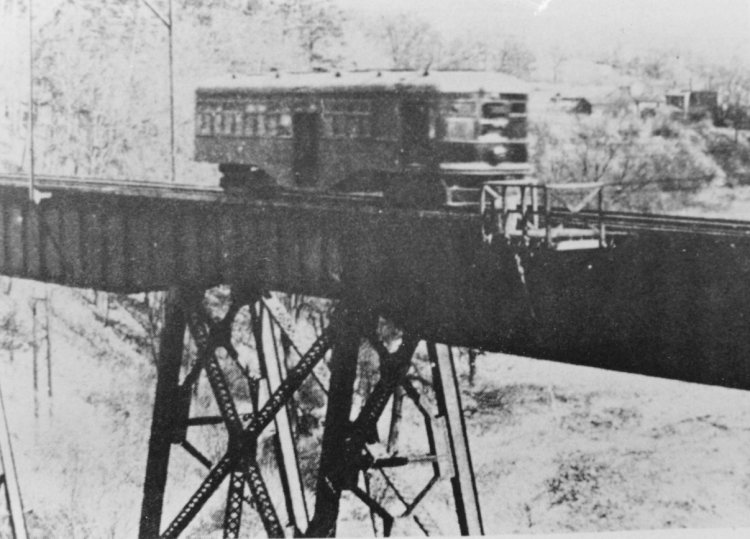
Finally, the TSR had some impressive bridges. The most spectacular was the bridge over the Humber River just west of Lambton Park. It stood at 711 foot long and 86 feet high (217 x 26m). Passage over this vertiginous bridge may have added a giddy touch of vertigo to go with the nausea induced by the rest of the route.

(TSR car crosses the Humber River high bridge, 1920. Courtesy of Guelph Public Library, F38-0-15-0-0-266.)

In spite of its initial popularity and considerable virtues, the TSR was not a paying proposition for long. After the Great War, automobiles found ever greater favor with the public, for both recreation and commuting. Busses began to transport groups of people between cities. Governments encouraged this trend through a broad program of road improvements and expansion. No similar effort was made to encourage rail travel, which suffered accordingly.

The TSR began to operate at a deficit in 1921. Perhaps to address this issue, the company began a freight service in 1923. One customer was the Prison Farm, which shipped milk and produce to Toronto over the line. Thus, the TSR truly became a milk run!

Even so, any hopes of profitability faded from view. The TSR ceased operations in 1931. A delegation of Acton residents went to the Canadian National Railway (CNR) office in Toronto at the time to protest the plan. (In 1918, the TSR was acquired by what later became the CNR.) The meeting ended quickly after the complainants admitted that they had made the trip to Toronto by car.

Although the TSR's assets were sold off and its tracks dismantled in the mid-1930s, some reminders of its existence remain in and around the Royal City. At the end of James Street East, past the intended power house, a trail atop the old railway bed leads under the Cutten Club along the south bank of the Eramosa River past Victoria Road and to the old Speedwell stop, near where a concrete bridge led over the river to the Prison Farm. Another section of the old railway bed can be enjoyed at the Smith Property Loop nearby in Puslinch, which is available for walking and biking.

Anyone interested in the TSR specially and local railway history generally must also visit the nearby Halton County Radial Railway on Guelph Line. The HCRY has restored trains and facilities from regional railway history and lies on a section of the TSR right-of-way through Halton County. It is open May through October.


Thanks to the Guelph Public Library and Guelph Civic Museums for assistance with research for this post.

I consulted the following sources for this effort:
Let me know about any other substantial sources in the comments, please.

Friday, 28 June 2019

The Prison Farm and the Eramosa river

In June, 2019, the Guelph Innovation District was put on sale by the Province of Ontario. This bloc consists of about 330 acres and includes the old Turfgrass Institute and also conservation lands on the west bank of the Eramosa River. Who the new owners will be and what they will build on the land is up in the air.

Change was in the air in the early 20th Century as well. As noted in an earlier posting, the Eramosa River had become a focus for recreational boating for Guelphites in the 19th Century. As a result, the geography of the river was familiar in much detail to many locals. As the 20th Century began, the Eramosa remained popular for this purpose. The summer of 1911 was no exception (Evening Mercury, 24 July 1911):

Many canoeists out.

Canoeing is one of the most popular sports followed in Guelph and the river was fairly dotted with the graceful craft yesterday. The Speed River provides one of the best canoeing courses in this part of the country, and many took advantage of the fine day for a paddle.
However, the arrival of the Ontario Prison Farm the previous year had changed the character of the Eramosa significantly. No longer mainly recreational, the Eramosa River also flowed through the boundaries of an important institution.

I have previously outlined the development of the Prison Farm, so a quick recap will do here. In 1907, local M.P.P. Joseph Downey led a government committee that made recommendations for reform of short-term prisons in the province. Up to that point, prisoners sentenced to terms between a few months and two years were often incarcerated in the Central Prison, Toronto (administered by James Massie of Guelph for many years). The Central Prison sought to recoup the costs of incarceration by putting prisoners to work in several manufacturing trades, combined with a liberal application of corporal punishment. The arrangement was never truly successful, so the government was looking for alternatives.

(Wellington South M.P.P. Joseph P. Downey, Wellington County Historical Atlas, 1906.)

The Downey report suggested construction of a new prison facility in an agricultural setting, so that prisoners could enjoy the character-building features of farm work. Plus, the farm produce could offset the cost of incarceration. Also, the facility would employ a "minimum-security" approach, forgoing bars on windows, guards with dogs and guns, etc. In this way, the "boys" could learn employable skills and gain a sense of responsibility for their own conduct.

(Provincial Secretary William J. Hanna; courtesy of Dictionary of Canadian Biography.)

Set-up of the new "Prison Farm" was led by Provincial Secretary W.J. Hanna. Since the new prison was to be an agricultural operation, the Secretary sought the advice of one of the foremost authorities at the Ontario Agricultural College (OAC) in Guelph, Professor Charles Zavitz (after whom Zavitz Hall is named). After a thorough search, Prof. Zavitz suggested the perfect locale—Guelph—as Mr. Hanna later explained in a speech on the subject to the Canadian Club of Guelph (Evening Mercury, 28 Oct. 1911):

“We asked for a land suitable for this purpose—easy of access to railways, and to some town—land suitable for agricultural purposes, with sand, gravel, stone and other materials also on the farm. There were many answers from Montreal to Winnipeg. We started out with the idea of putting the responsibility on some one else, and taking the credit to ourselves, so we went to the O.A.C., and got help there. After some investigations, Prof. Zavitz returned disappointed, for there was none suitable. Then he admitted, with great modesty, that the very thing was within sight of the O.A.C., and the city of Guelph. His modesty then was remarkable."
The land along the Eramosa certainly fulfilled these criteria, with two railways, a river, productive farmland, and surface deposit of quarry-ready stone all on site, not to mention proximity to the expertise available from the OAC itself.

(Professor Charles Zavitz; courtesy of Wikimedia Commons.)

The Province began to acquire the land immediately, finishing with the purchase of Arthur McQuillian's farm in January 1910, making a total of more than 800 acres (Globe, 18 Jan. 1910). In April, Secretary Hanna, M.P.P. Downey, and other leaders in the project visited the site to settle their plans (Globe, 2 Apr. 1910). The first contingent of 14 prisoners were transferred from the Central Prison on 11 April (Globe, 12 Apr. 1910). These "boys" were referred to as "trusties," meaning that they were trusted to behave themselves, instead of being handcuffed, shackled, or made to wear prison uniforms. They were housed in a wooden lean-to, up against a small brick cottage left standing on the grounds, and employed in sowing wheat, oats, and barley under direction of "practical men and by students from the Agricultural College" (Toronto Star, 16 Apr. 1910).

Two large, temporary barracks were constructed for lodging while permanent buildings were being designed. These were completed in June, allowing for the transfer of up to 300 prisoners.

(Temporary barracks; Courtesy Guelph Civic Museums 2004.32.101.)

Workshops were also built to facilitate construction and farm work. Perhaps the most urgent of these efforts was construction of a lime kiln in order to make the quarry operational. A kiln and stone crusher were duly built by the river in the vicinity of The Rocks, thereafter known as The Quarry. A short railway was built to facilitate transportation of the aggregate and lime to the prison's workshops.

(Stone crusher and lime kiln; Courtesy Guelph Civic Museums 2004.32.101.)

These products were needed for construction of the remainder of the prison buildings and connections to the railway. In particular, since the quarry lay on the opposite side of the Eramosa river from the CPR line, some bridges were necessary. Two were constructed. One was a picturesque concrete bridge of three spans, made using material from the quarry and labor by the prisoners.

(Three-span, concrete bridge; Courtesy of Guelph Civic Museums 2004.32.101.)

The second bridge was more utilitarian: a small, wooden trestle bridge to carry a spur line from the CPR to the farm railway near the lime kiln.

(Trestle bridge today, author's photo, 2019.)

Since the bridges were built using prison labor, there are no contract tender records that state when they were built. However, the concrete bridge is mentioned in connection with a visit to the Prison Farm of the Parole Board (Globe, 17 Dec. 1910):

After the commissioners arrived at the Reformatory, they spent some time in going over the Reformatory property, visiting the various points of interest and inspecting the live stock, particularly the magnificent herd of Holsteins. They had luncheon at the Reformatory, and afterwards visited the stone quarries, the lime kilns, and the new bridge over the River Speed, recently constructed of reinforced concrete by the prisoners and over 160 feet in length.
So, the concrete bridge was apparently in service by December, 1910.

("Prison Farm"; Postcard by International Stationary Co., ca. 1915; author's collection.)

The postcard above shows a view of the concrete bridge and Prison Farm from the west side. Background left stands the administration building and dormitories, while the workshops stand on the right.

Officials seem to have been less proud of the trestle bridge, since there is no report of it being inspected by any bigwigs. However, the Railway Commissioners of Canada had to provide express permission for any modifications of the CPR line. An authorization for the Prison Farm spur line duly appears in the The Canadian Engineer (22 Dec. 1910; v. 19, n. 25, p. 787):

[Order no.] 12409—Nov 29—Authorizing the C.P.R. Co. to construct a spur for the Provincial Reformatory, Township of Guelph, County of Wellington, Ont.
Given the haste that authorities were in to export products of the Prison Farm, it seems safe to conclude that the trestle bridge and spur line were completed shortly after this authorization was given, in other words, late 1910 or early 1911.

Construction on the Prison Farm grounds was sufficiently advanced for Ontario Premier Sir James Whitney to ceremonially lay the cornerstone of the Administration Building on 25 September 1911. Over 200 dignitaries from near and far arrived for the show. They were treated to a display of the farm produce and, of course, the feats of building accomplished by the prisoners, including the new, concrete span (Evening Mercury):

A little dump railway ran through the grounds, in which the heavy material was transferred to points where it was needed, and the handsome concrete bridge across the river Speed, where it crosses the grounds, showed what could be done in an artistic way by men who have fallen under evil influences.

(Wielding the silver trowel, Premier Whitney officially lays the cornerstone; Globe, 7 Oct. 1911.)

In their inspection of the prisoners' sleeping quarters, notice was drawn their use of postcards, among other paraphernalia, to domesticate their rooms:

The dormitory especially proved a scene of interest, as a number of the prisoners, by means of picture post-cards, calendars and newspaper pictures had made a home-like effect of their surroundings.
After the cornerstone laying and inspection, the dignitaries were treated to luncheon, served by the prisoners and featuring the produce of the farm itself. Some amusement was evident at the sight of government officials and policemen rubbing elbows with convicts. Premier Whitney took the opportunity to remark on the rectitude of this aspect of the government's efforts, given that the purpose of the Prison Farm was not primarily retribution but rehabilitiation of "unfortunate" men who had, perhaps under the influence of drink, committed minor offenses:
“This project has no part with the antics of certain hysterical people, usually women, who make heroes of wrongdoers and place offerings before murderers,” quoth Sir James. “It is designed to prove that the public is prepared to extend a helping hand to its unfortunate friends who seek to regain lost ground. It is the ordinary consideration of the most elementary fair play to give the unfortunate an opportunity to redeem themselves in future.”
The Prison Farm embodied this new program, to reform the misguided and return them to society as productive citizens.

(Sir James Whitney; courtesy Wikimedia Commons.)

Unsurprisingly, the behavior of prisoners was the subject of much local interest. For the most part, people were positively impressed. Indeed, the prisoners behaved themselves notably better than did the students of the OAC on the occasion of Halloween in 1910 (Toronto Star, 3 Nov. 1910):

If the inmates of Guelph’s prison farm had broken loose on Hallowe’en and done as much damage as is charged against the students of Guelph’s Agricultural College, there would have been protests from all over the Province, and strong pressure would have been brought to bear on Mr. Hanna to relinquish his plans for the amelioration of convict life.
The students were credited with a number of misdeeds: delaying streetcar service by greasing tracks, pulling down a highboard fence, trying to paint a fountain, blocking a streetcar track with vans, blocking Macdonald Hall entrance with vehicles, and demolishing a college post-office by locking a steer in it.

These activities resulted in eight arrests, two lawsuits, and an investigation by OAC President Creelman. One wonders how President Creelman would have compared his job to that of the Prison Warden.

Of course, the main concern was about escapes. Some escapes were regarded with amusement (Globe, 14 Nov. 1910):

A city minister claims that the prison farm inmates will not attend Sunday services unless there is a band or special soloists present. When the Protestant minister goes out he finds that most of the men are professing Roman Catholics, and when the Roman Catholic priest goes out to speak to them he finds that a surprisingly large number of them are Protestants.
Escaping Sunday sermons was perhaps understandable to some locals.

Of course, not all prisoners could resist the urge to run off. The first was George Cowan, a 16-year-old English lad jailed for sneaking rides on railway cars. He snuck away from his dormitory one evening but left an easy-to-follow trail in the wet grass and was picked up quickly in Eden Mills (Globe, 1 Oct. 1910).

Another was Charles Anderson, a Hamiltonian serving an eight-month sentence for theft (Durham Chronicle, 29 May 1913). He stole away to a hideout in a swamp near the Prison Farm but was found buried in muck with only his eyes and mouth protruding. He was disinterred and taken to the County Jail.

Other escapes were harder to fathom (Evening Mercury, 21 Jul. 1911):

Boat stolen from prison.

A boat was stolen from the Prison Farm and on searching it was found on Mr. Macalister’s property near the waterworks. It had a chain on, held by staples driven into a tree.
This escapist boat slipped away once more only four days later:
Boat again stolen.

The boat, which was stolen from the Prison Farm some time ago again mysteriously disappeared and was found pulled up on the river bank some distance below the farm. The next time the boat is tampered with the guilty party, if found, will be prosecuted.
Would the guilty party, if prosecuted, be sent to the Prison Farm? Or, was the boat not stolen but instead possessed? Why did the Prison Farm have a boat, anyway? To my knowledge, these questions were never answered. No river gives up all its secrets and the Eramosa is no exception.

In any event, Guelphites' views of that region of the Eramosa River had begun to take on a different character. It was no longer their playground but a somewhat alien place, belonging to the government and inhabited by people they did not necessarily want to mingle with. Paradise had become a prison yard. The Rocks had become the Quarry. The new bridges over the river were also visible symbols of the reach of the new institution.

(Satellite image of Eramosa river by the Prison Farm; Courtesy of Google Maps.)

Now that the land around the Eramosa is set to change hands once more, Guelphites' perspectives on the river are likely to change again.


I have not yet found any old photos of the trestle bridge. However, it remains in place although in somewhat dilapidated condition. The railway bed, minus the tracks, leading from the CPR line to the bridge still remains in place. A path leads through the brush to the deck, which is covered in grass.

(Author's photo; 2019.)

The concrete bridge was removed some years ago. However, the road bed leading from the CPR tracks to it remains in place. A path leads along its top to the river, though it is now more appreciated by geese than by people.

(Author's photo; 2019.)

Here is a picture of the Quarry being worked in its early days. Note the railway ties on the ground.

(Courtesy of Guelph Civic Museums 2004.14.18.)

Remnants of the Prison Farm railway at the Quarry can still be found in the form of ties embedded in the ground.


A 1911 booklet with a description of the Prison Farm and photos of its facilities—used above—can be found on the Guelph Civic Museums website (2004.32.101).