Postcards of Guelph, Ontario, Canada, from my collection, spanning the early 20th century to the present. Click on postcard images to see them enlarged, and on Street View images (where given; copyright to Google) to compare with the present-day city. Also, check out my Flash from the Past columns with the Waterloo Record.
A couple of years ago, I posted a two-part series on Old Home Week, 1913. (See Part I: The preparations and Part II: The event.) Also known as an Old Boys Reunion, the event provided Guelphites, former Guelphites, and well wishers a chance to get together again, enjoy some jollifications, and generally have a good time.
One difficulty that arose in putting together that posting was the lack of photographs of the event. The only postcard feature clearly related to the event is the cancellation logo, reading "Guelph’s Old Home Week 1913, July 28–Aug 2", which the postal service used to advertise it in the weeks leading up to the reunion. No postcards were explicitly labeled as giving pictures of it. That stands in contrast to the Old Home Week of 1908 in Guelph, which is recorded, for example, in the following real-photo postcard.
Happily, this conclusion seems to be untrue. There are postcards with photos of Old Home Week 1913 in the Royal City. They are not labelled as such but attention to the details of the pictures gives them away. In the remainder of this posting, I will display these postcards and explain why I think they record the 1913 celebration. All the postcards in question are from a series published in sepia tones beginning around 1912 by the International Stationary Company in Picton, Ontario.
The first postcard is one of St. George's Square. The Square was central to any civic celebration in those days. Also, due to frequent upgrades and renovations, photographs of it can be dated with some accuracy.
This picture shows the Old Post Office/Customs House from the south with the Blacksmith Fountain on the left. Clearly evident is a lively set of patriotic bunting strung over the Square and lining its sides. Unions Jacks abound and Japanese flags can also be seen flying near the middle of the picture. A south-facing banner over the Fountain reads, in part, "... welcome home." In addition, a number of ladies can be seen in front of the Post Office boarding the streetcar and walking on the sidewalk to the right all in formal, white dresses and hats. Clearly, a big, important event is taking place.
Some details allow the photo to be placed within a useful range of dates. Just to the right of center can be seen a lamppost with two globes beneath a cross-arm. These orbs are part of the incandescent street lighting system that was installed downtown in 1912. See the detail below.
In addition, just up Wyndham St. to the left of the clock tower of the Old Post Office/Customs House is a large sign with the word "Trader's Bank" written on it in large letters. This bank appeared, along with this sign, in 1885. In 1913, the bank vacated these premises, which were then taken over by the Union Bank in 1914, at which time the sign was removed. So, our postcard photo dates from between 1912 and 1914. See the detail below.
I surmise, then, that it depicts the Old Home Week of 1913.
With this attribution, there are grounds for including other postcards in the same series to this event. In fact, it appears that the photographer made a sequence of cards stretching the length of Wyndham St. and beyond. Let us begin at the south end of Lower Wyndham. I include the card below due to the presence of the incandescent lamps and the crowds of women in white dresses (along with a number of men) who seem to have just disembarked from the train station on the right. Also visible is a load of patriotic bunting over Lower Wyndham St. The card also provides a good view of the entrance to the Wyndham St. railway underpass beneath.
Note the odd caption that describes Wyndham St. as "Main St."
The next postcard provides almost a reverse angle. This shot is taken from the west side of Wyndham St., looking south-east towards the Grand Trunk Railway (now VIA) station, which, like the underpass, had been built in 1911. There are no particular signs of Old Home Week except perhaps for some white dresses and its fit with the rest of the series.
I enjoy how people felt free to just stand around in the street in those days!
The next photo is taken from the roadway about where Wyndham St. crosses Macdonell. Patriotic bunting is everywhere visible, overhead, on the walls of the city hall on the right, and the fire station behind. The incandescent lighting system helps to date the photograph, as does the date given in the message on the reverse side, 30 Sep. 1917.
Oddly, the caption reads, "The Armouries." It is true that Armory building is in the center of the picture but only well in the background. The wagon in the foreground is hard to identify. Perhaps it is a ladder truck belonging to the fire department. A marching band follows behind.
The next postcard takes us past St. George's Square to the other end of Wyndham St. where it meets Woolwich St. This very fine view shows some festive streamers in an inverted-V hanging from the "New" Wellington Hotel. (This description is curious since the Wellington Hotel had occupied this site since 1871. It may refer to the extensive renovations made in 1904, which led the Mercury to describe it as the "new Wellington" then; 2 Sep. 1904.) The new street lights are prominent, as is a big sign in the shape of a mortar advertising the Bogardus Pharmacy sited in the Guelph Opera House building. I wonder what is pictured on the sandwich board out on the sidewalk. Hopefully nothing too narcotic! The card was addressed on 30 Jan 1918.
The next card is a reverse angle, that is, taken from in front of the Wellington Hotel with the Opera House, Woolwich St. and a couple of streetcars in view. The Opera House shops are, from left to right, Morans & Hertzberg's furniture store, Wallace Bros. Boots & Shoes, Dobson & Hewes—Ladies Tailors & Furriers, and, of course, the Bogardus drug store. The card is postmarked 18 July 1914.
If you look carefully, you can see a two-wheeled garbage cart in front the Wallace Bros. store. Those horses don't clean up after themselves, do they?
The next card is taken from nearly the same location but pointing northward along Eramosa Rd. I have posted about this card earlier, and it remains one of my favorites. I attribute it to Old Home Week, 1913, on the basis of the street lighting, the women's formal wear, and the patriotic bunting on the buildings and over Eramosa Rd., not to mention its fit with the other cards in this sequence. Issues with the caption continue also, this time in the form of the misspelling of "Eramosa". The card was posted on 1 June 1916.
I hope the two little girls in their Sunday best had a good time!
The next card in this sequence comes from a little way down Woolwich St. from the previous one. It features the County Court House, Guelph's oldest public building, completed in 1843 in the "Scottish castellated" style. As before, the attribution of the card to Old Home Week, 1913, arises from the street lighting, dress, and fit with the other cards. It is postmarked 23 Sep. 1914.
Aesthetically, the card is a good one as it features the incongruous turrets of the Court House, framed by a tree and a lamppost.
The final card (so far) comes from further afield, that is, Exhibition Park. It appears to depict a part of the Park near the end of Mont Street where the land slopes up towards the south. Today, this area is still where the open fields in the middle of the Park give way to trees at the southern end. The picture looks for all the world like just a formal picnic. Yet, many events associated with Old Home Week, 1913, took place in the Park, so the card's assignment to the same sequence is, at least, plausible.
This card is postmarked 23 Sep. 1914.
If these cards are photographs of Old Home Week, 1913, then it seems odd that the captions do not mention it. Perhaps, since the cards were printed a year or so after the fact, it was thought by the producer that the association would have no value to potential customers. Instead, they would have to sell simply on their visual qualities.
That is all for now. Hopefully, further cards in this sequence showing Old Home Week, 1913, can be found. We are fortunate to have these cards since no other photographic record of the event is evident from other sources. If you know of any more, please let me know and/or give pointers in the comments!
A number of civic events held in Guelph in the 1910s were celebrated in a similar manner. Thus, photographs of these celebrations are easily confused and sometimes mislabelled. Here, I will give a brief key to distinguishing photographs of some of these events, in particular, photos mistakenly attributed to Old Home Week, 1908.
The real-photo postcard below is securely attributed to Old Home Week, 1908. The postmark on the back reads 13 Aug. 1908 and the message states:
Dear Bro: I hope you all got home O.K. See other side for Old Home week. We had a Rousing time. Son is getting along fine. Hoping you are all well. I am Your Bro, Herb
For identification, note the inverted-V banners hanging from the Old Post Office/Customs House and the absence of incandescent lighting on the utility poles. (Street lighting at that time was produced by arc lights suspended over the street by wires.) On the extreme left, note a banner over the Dominion Bank that ends with "Dominion". The south-facing banner over the Blacksmith Fountain reads, "A [Royal] welcome [to the Royal] City". (The banner is clearly visible in photo F38-0-9-0-0-15 at the Public Library archive.) See the detail below.
The "Trader's Bank" sign is clearly visible to the left of the Post Office clock tower. These details help to secure the attributions of other photos to Old Home Week, 1908.
Here, the "Trader's Bank" sign is gone but the Blacksmith Fountain is still present, thus dating the photograph from 1914 to 1922. There are no inverted-V banners on the Old Post Office. Instead, Union Jacks hang underneath its windows. The south-facing banner over the Blacksmith Fountain reads, "We welcome our visitors". (This banner is more legible in this second photo of the same scene.) Note also the fence around the Blacksmith Fountain, not present in 1908, and the benches north and south of it, not present in 1913. (Further photos of this event, also misattributed to the Old Home Week, 1908, can found in the Public Library archives as items F38-0-9-0-0-21, F38-0-9-0-0-20, F38-0-9-0-0-19, and F38-0-9-0-0-22.)
The celebration seems not directed at soldiers returning from WWI, as these would hardly be described as "visitors". It may record the arrival of visiting dignitaries of that time. The Prince of Wales visited Guelph in 1919 and went on a parade through St. George's Square. However, the weather was wretched that day and the Prince was soaked during his trip through the downtown. As the Square looks quite dry in the photos above, they must record some other visit.
A likely alternative would be the visit of the Duke and Duchess of Devonshire from 13 to 15 June 1918. The Duke, then Governor-General of Canada, was on a morale-boosting trip through the country in the company of his wife and daughters Lady Blanche and Lady Dorothy, along with other VIPs. Upon their arrival, the party paraded up Wyndham Street in automobiles borrowed especially for the purpose and, thus, would have enjoyed a display of British patriotism present in St. George's Square. The Mercury (12 June 1918) printed a plea from the Reception Committee "that all places of business and residences be suitably decorated for the occasion." During their visit, the dignitaries met veterans, had lavish dinners, and visited the hospitals as well as the O.A.C. A highlight was the vice-regal inspection of all of Guelph's 3000 or so school children in Exhibition Park on 14 June.
The decorations visible in the photo above would certainly suit this occasion. Plus, there is no mention in the papers of bad weather. So, attribution of these pictures to the vice-regal visitors of 1918 is plausible if not completely secure.
In summary, here is a table of features of St. George's Square to distinguish these three events:
Feature
Old Home Week, 1908
Old Home Week, 1913
Vice-Regal visit, 1918 (?)
Lighting
arc lighting on wires
incandescent lighting on poles
incandescent lighting on poles
Blacksmith Fountain
no fence
fence
fence and benches
South banner
"Royal welcome to the Royal City"
"...welcome home"
"We welcome our visitors"
Post office decoration
inverted-V banners under third-storey windows
semi-circular banners under windows, two streamers from top of pinnacle to each side of building
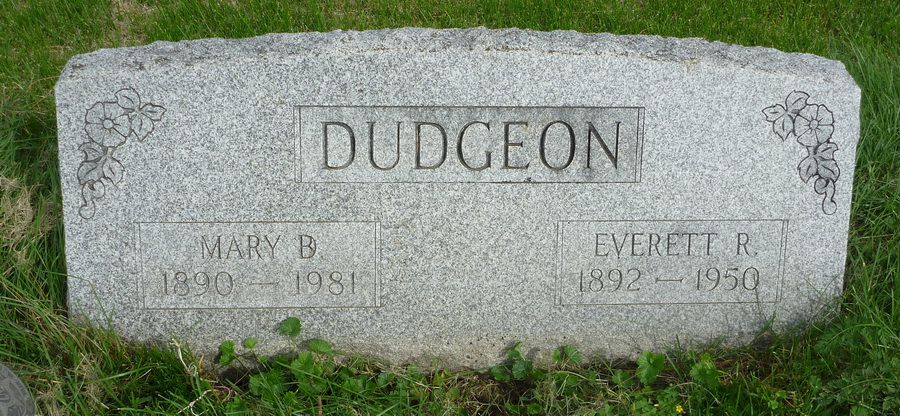
This handsome young man is Everett Raymond Dudgeon, a member of the O.A.C. Aggies rugby football team of 1912. That year was a good one for the Aggies: they won the Intercollegiate Junior Championship of Canada! In the photo, Everett cuts a fine figure in the standard gear for Canadian football of the era: a leather helmet, woolen sweater, one-piece canvas suit with sewn-on shoulder pads, knee-high stockings, and cleated leather boots.
As is evident from the setting, this photograph was taken in a professional photography studio. It is an example of what is called a "real photo postcard" (RPPC), that is, a photograph that has been printed as a postcard. An RPPC was often printed in a small batch for someone as a souvenir with copies to share with friends and relatives. Dudgeon sent this copy to his cousin Miss Lucile Haynes in Estherville, Iowa on 12 March 1912. The message reads:
I guess there is some class eh—whot? Does it look real. Or imitation? E. R. D.
The odd language may be explained by the fact that Dudgeon was an American from Goose Lake, Illinois. He was born to Israel and Leonora Dudgeon on 10 August 1892 and had evidently been sent to the O.A.C. to learn to the modern way to be a farmer. Probably, he felt a little out of place in a Canadian college where, his relatives assumed, he would be required to speak the King's Hinglish. He also seems a little uneasy as an authentic member of the O.A.C. rugby football team. Little did he know in March that he was destined for Canadian football glory by the end of the year.
By the time that Dudgeon joined the O.A.C. team, rugby football had become an established sport throughout urban Canada. According to Frank Cosentino (1969), Canadian football began in Montreal in 1865 when a team of British soldiers played a game of rugby against a team of civilians from McGill University. In Britain, rugby had been invented in 1823 at the "public" (private) school in Rugby, England when William Webb Ellis decided to pick up and run with the ball during a soccer game. The sport caught on in British schools and with British officers, who then brought it to the colonies. At the game in Montreal in 1865, it caught on with students at McGill and then quickly spread to other schools and universities in Quebec and Ontario. In 1875, a team from McGill played an exhibition match in their version of the sport against a team of rugby players from Harvard. From there, Canadian rugby football quickly caught on and was adapted at American schools as well.
It did not take long for players at various Canadian colleges and amateur athletic clubs to decide to organize leagues for competitive play. The Quebec Rugby Football Union (Q.R.F.U.) was formed in 1882, followed later the same year by the Canadian Rugby Union (C.R.U.) and, in early 1883, by the Ontario Rugby Football Union (O.R.F.U.). In the ensuing years, league arrangements changed, rules were proposed, revised, and rejected (often putting the different leagues out of sync), but the sport gained steadily in popularity. In 1897, the Canadian Intercollegiate Rugby Football Union (C.I.R.F.U.) was formed to coordinate and regulate the college game, which was widely regarded as the highest quality of football then in play. The new league included both senior and intermediate divisions, which began play in 1898. The trophy for winners of the senior competition was the Yates Cup, which is still awarded to O.U.A. champions to this day. A junior division was added in 1906, and it was in this division that the Guelph team competed.
The Canadian game of rugby football at the time was neither English rugby nor modern Canadian football. The scrum of rugby had changed to a row of eleven players along each side of a line of scrimmage. In the middle of each line-up was the center and two supporters, one on either side who threw their inside arms over the back of the center to form a solid unit. Flanking them were two supporters known as "inside wings", then two "middle wings" and two "outside wings", and sometimes a "flying wing" further out. In the back field was a quarter-back, two half-backs, and sometimes a full-back. With two, 14-men teams in play, the field could get quite busy.
The ball was put in play when the offensive center kicked the ball back to the quarter-back with his heel. The quarter-back typically relayed the ball to one of the half-backs who might either attempt to plunge ahead through the opposing line-up, skirt the line-up to either side, or kick the ball up-field.
Since blocking (or "interference") was not allowed (except at the line of scrimmage), plunging into the opposing line would often result in a "buck", that is, a mass of players trying to push the ball-carrier forward from behind, in the case of the offensive team, or wrapping an arm around him and pushing him backward, in the case of the defensive team. Tackling above the shoulders or below the knees was not allowed, so such shoving matches were often the result of running plays up the middle. On occasion, a defensive player could throw himself on the ground in front of a runner hoping to trip him up but this tactic risked putting the defender at the bottom of a large and very heavy pile-up. While the buck formed an intriguing contest of strength and will, it was confusing for spectators who would lose sight of the ball in it.
Although the forward pass was not legal, a runner could lateral the ball to another back-fielder, hoping to outflank the opposition. Alternatively, the back-fielder could kick the ball forward, aiming for the arms of a teammate, or simply trying to move the ball downfield as far as possible and hoping to recover it promptly.
If the ball were ruled dead, then it was placed at the new line of scrimmage and the next down commenced. There were no huddles; players simply returned to their positions and listened for signals shouted to them by the quarter-back. The offensive team had three downs either to move the ball ten yards up-field or to retire 20 yards down-field. The latter was allowed only once per possession.
Scoring systems were in some flux at the time and differed from league to league. In the I.C.R.F.U., there were three main ways of scoring points. First, a touch-down (or "try") occurred when the offensive team moved the ball into the defenders' end zone, and was worth five points. A further point could be added (a "conversion") if the offensive team could kick the ball through the defenders' goal on the next play. A rouge occurred when the offensive team kicked the ball into the defenders' end zone and the defenders could not bring it out, and was worth one point. A safety occurred when the ball was called dead in the possession of the offensive team in their own end zone.
Kicking by back-fielders and scoring by rouging were much more prominent parts of the game then than they are today. However, this type of play does still occur from time to time in the modern Canadian Football League (C.F.L.) and, when it does, reminds us of what an I.C.R.F.U. game might have looked like. Consider this "wild finish" from a C.F.L. game between Montreal and Toronto on 29 October 2010. Here, the Montreal Alouettes miss a field goal, causing the Toronto Argonauts to kick the ball out of their end zone in order to avoid a rouge. The Alouettes kick it back into the end zone and recover for a touchdown.
You can see how spectators would have enjoyed such play. And, enjoy it they did! Thousands of spectators attended the senior league games, which proved to be money-makers for the host clubs. O.A.C. students were no different and followed the sport and their team avidly. Consider these remarks from the O.A.C. Review of October 1908 (v. 21, no. 1, p. 38):
Of all college games, without a doubt, the one most popular is rugby. It is not only one of the most interesting sports to watch, but among the most fascinating to play. And is it any wonder that this is so, when one recalls dashing across the field, ball under arm, with a dozen men from different corners of the field in hot pursuit, and then to dodge two or three of them, gently push three or four others to the right or left, and finally cross the line for a touch-down amid the deafening applause of the assembled crowds? Well you’ll agree with me that there’s some incentive in doing things like this, for that shows the kind of stuff men are made of.
Indeed, football was favored at colleges, in part, for its masculinity. Many were concerned (and some remain so today) that civilization in general, and book-learning in particular, had a feminizing effect on young men. In the classrooms at Canada's institutes of higher learning, young men would learn knowledge and skills and make social connections that would prepare them for a life of social and economic advancement. However, this life was also a life of leisure that could made them soft. In the late Victorian era, organized sport was seized on as a solution to this problem (Mott 1983, p. 62). Competition on a mock field of battle would help to turn boys into manly men, where manliness was defined as "not only physical vitality and courage, but also decisiveness, clear-headedness, loyalty, determination, discipline, a sense of charity, and especially the moral strength that ensured that courage would be used in the service of God and the Right." (Mott 1983, p. 58).
Rugby football was ideal for this purpose. It was a rough game through which boys could learn important life lessons at the school of hard knocks (Globe, 22 September 1909):
Rugby is too rough a game. How often the followers of the gridiron sport hear comments like this about the game—"It's too rough", and "the boys get hurt", and "it isn't good for them".
Of course if fond mammas want their youthful pride and hope to grow up like a banana plant in a greenhouse, there is little sense in arguing the point. The game is too rough for molley coddles. On the contrary, if the boy is to be taught to fight his way in the great battle of life, there is no game that will teach him how in a better way. He'll get plenty of knocks and raise many a crop of healthy bruises but he gains stamina and the knocks he gets, if he is an ordinary cuss in later life, will be equally hard.
Get a canvas suit for the boy, well padded, and let him get out and fight the battles on the Rugby field first.
Any good rugby football player at the O.A.C. should expect to take a beating, as suggested by this cartoon published in the O.A.C. Review (1912, v. 25, n. 1, p. 33) under its football column:
The tough-guy ideal of the young male football player also fit in with the martial spirit of British imperialism that was popular in Canada at the time (The Canadian Courier, 8 Dec. 1906, v. 1, no. 2, p. 8):
Rugby football with its rush and plunge, its squirming log-heaps of struggling humanity, and its constant clash of weight and strength against weight and strength is probably the nearest approach to actual warfare the world of sport can produce. That is why it appeals so strongly to the fighting Anglo-Saxon nature.
By providing and supporting a football team, the O.A.C. was helping to prevent the feminization of its students and, at the same time, upholding the fighting spirit of Anglo-Saxon Canada.
In 1912, the College was hungry for manly triumph on the football field. In the O.A.C. Review in July 1912 (v. 24, n. 10, pp. 596-597), team captain C. A. Webster wrote of the promise of the season. The team was to see the return of many veterans from the previous campaign. There was talk of engaging a coach just for the football team. In addition, all the games were to be played in Exhibition Park in the city. Webster considered the field conditions there more favourable to the light, fast game of the Aggies. Also, Guelphites would likely turn out in numbers to support the local team. After all, like many smaller Ontario cities, Guelph had no football team of its own so, once the baseball season was over, football would be on the top of every sports fan's list. Every player was urged to focus every aspect of his diet, exercise, and daily routine to produce success in football!
The season started with a couple of exhibition games. First, the Aggies played the team from Upper Canada College (U.C.C.) on 28 September in Exhibition Park (O.A.C. Review, v. 25, n. 2, pp. 77-78). U.C.C. was a private high school in Toronto catering to the city's elite and typically had a good team. Indeed, the U.C.C. dominated most of the game, leading O.A.C. 16-0 at the end of the third quarter. In the final quarter, the Aggies turned the tables and scored six points, which still left the final tally at 16-6. Its performance in the final quarter was promising for the Aggies, as was attendance at the game ("... a good crowd was present, the girls from the [Macdonald] Hall being particularly in evidence."). Nevertheless, the team clearly had to get its act together.
On 5 October, the Aggies played another exhibition game (also in Exhibition Park) against the "Dutchmen" from St. Jerome's College (now St. Jerome's University) in Berlin (now Kitchener). The description in the O.A.C. Review (v. 25, n. 2, p. 79) notes that the Red and Blue (the Aggies' colours, that they would have worn on their knee socks) looked very solid whereas their opponents appeared worn out by the end of the first quarter. The account of the game in the Berlin News Record (7 Oct. 1912) is more fulsome and gives us a glimpse of the Aggies' style of play:
The O.A.C. squad presented a formidable line their men averaging over 165 lbs. Their back division works smoothly on the defensive and the hand of Harry Griffith, the ex-University of Toronto coach, is plainly evident in their tactics. They depended largely upon end runs which they started quickly and usually got away for gains. Their kicking department is strong, Simpson being a particularly good punter and in catching their work was almost faultless, the halves getting under punts and returning them with a coolness and accuracy that is not always found on some other teams in supposedly faster company.
The mention of Harry Griffith is interesting. Griffith coached teams at the University of Toronto that won the first Grey Cup in 1909 and the second in 1910. Afterwards, he coached at Ridley College in St. Catherines but never at Guelph. Was he the coach that Webster had wanted to hire? In any event, although Griffith may not have coached the Aggies, they clearly emulated the style of football that he instilled in his winning teams at Toronto.
It certainly began to pay dividends. On 5 October, the Aggies beat St. Jerome's by a score of 39-0. In fairness, the O.A.C. team was evidently much larger than the other one and several of the St. Jerome's players were professors and so perhaps not as robust as their opponents. Three of them were injured in the game, one badly enough to be forced from the field. Nevertheless, the Berlin News Record praised the Aggies:
The O.A.C. team have adopted the Varsity methods as taught by Harry Griffith and the snap with which they get away should carry them far this season. Their line is heavy, affording the backs plenty of protection. All told the O.A.C. have a clean bunch of players and St. Jerome’s returned well pleased with the treatment they received.
Dudgeon played on the inside wing, part of the line that gave the backs time to shine. Since he did not carry the ball, Dudgeon did not get specific mention in any press reports.
With their exhibition games behind them, the Red and Blue began the competitive season with a game against McMaster University (then still located in Toronto) on 12 October. The Aggies won the game by a score of 18-12 (Globe, 14 Oct. 1912). On 19 October, they beat the Varsity thirds, that is, the University of Toronto's junior team, by 21-11 (Globe, 21 Oct. 1912):
That the A. O. College (sic) this year has the finest team for the past fifteen years was proved this afternoon when the A. O. firsts defeated the University of Toronto thirds by 21 to 11. The heavy wind throughout the game was taken advantage of by the Aggies in their quarters. On the defensive they were like a stone wall, holding Varsity at one time when the latter was only one foot off the line. Herder, Madden, and Webber (sic) starred for the Aggies, Herder’s end runs for heavy gains being the spectacular feature, while his punting was the best seen here for years.
Toronto Varsity teams were often the class of the league, so defeating them would bode especially well. As part of the "stone wall", Dudgeon must have been pleased with the outcome.
The Guelph Mercury for the fall of 1912 is missing, so records of the team's efforts are somewhat spotty. The Toronto Star (11 Nov. 1912) mentions a victory of Guelph over Kingston (that is, Queen's University?) on 9 November by a score of 23-7. This victory appears to have made the Aggies the Intercollegiate champions of Ontario. Their next move was to play against the Quebec Intercollegiate junior champions, St. Lambert's College of Montreal. The game was played in Guelph on 23 November and the Aggies manhandled their opponents by a score of 50-2 (Globe, 25 Nov. 1912):
The first quarter was the only one really hard fought, the O.A.C. in the other three doing practically what they willed.
The Aggies tackled sure, and their back division outbooted and outran their opponents, while the line tore holes in the Saints’ defence. Simpson starred for O.A.C., at one time going half the length of the field for a touchdown ...
The rest of the column is garbled.
This victory made the O.A.C. team the junior intercollegiate champions of the Dominion. (At that time, only Quebec and Ontario played at the national level. Only later in the 1920s did teams from western Canada begin to challenge for national titles.) At this point, the Aggies had their team picture taken on the steps of the main entrance to Massey Hall.
Dudgeon is standing in the back row, third from the left. They appear cold but proud. Herder is holding a puppy in his coat, perhaps the team mascot. A signature scratched into the lower-right corner appears to identify the photo as taken by "Kennedy", probably Robert Kennedy, who had a photography studio downtown at the time.
One game remained, for the Canadian Rugby Union (C.R.U.) championship, against the top team of the Ontario Rugby Football Union (O.R.F.U.) junior division, that being the Hamilton Alerts. A game against the Alerts would be no picnic. The Alerts were O.R.F.U. champions for the second year in a row. Hamilton was arguably the football capital of the country at the time and its teams were playing for the C.R.U. championships at all three levels. Also, Hamilton football fans did not take defeat well. This fact is exemplified by an incident that occurred after the senior Alerts were defeated by the Ottawa Rough Riders in Hamilton on what Hamilton supporters believed to be a blown call by referee Billy McMaster (Globe, 8 Oct. 1912):
"As soon as the match was over, businessmen of that city hit me on the back and the head with sticks and shouted, 'That is the fellow who sold us to Ottawa for five hundred dollars!' Though in some cases they made it a thousand. Ladies pointed their parasols at me, and screamed, 'That is the cheat!' and the mob whirled the two policemen who were escorting me off the field aside and started to tear off my clothes, when Burkholder [a former Alerts' player] interposed his great bulk and dragged me along to the back of the stand. Here like a thief or a murderer, I was compelled to creep along ... They stoned the Ottawa players [with paving stones torn up from the street] and followed us for many hundreds of yards. I got half a brick, which I have at home, on the head, which caused a lump as big as a hen's egg, and poor Kilt of the Rough Riders received from another brick a gash in the face that must have measured between three and four inches. And this mob was composed not of boys only, but of grown up men."
Perhaps it was a good thing, then, that the junior championship game would take place in Guelph, and most Hamilton fans would likely remain in the Mountain City to take in the senior and intermediate finals to be played there on the same day.
(I can't resist this follow-up to the story above (Currie 1968, p. 50):
Fifty-five years later, after another Hamilton-Ottawa battle in Hamilton, an irate Rough Riders' supporter protested about the way Hamilton fans had insulted the Ottawa team by pelting them with paper cups. Jake Gaudier, the Hamilton president and general manager, replied that while he couldn't condone such behaviour, perhaps Ottawa should be thankful that things had improved somewhat since 1912.
)
The game was duly played on 30 November at Exhibition Park. It is described in detail in the Hamilton Spectator (2 Dec.), which I will place in its entirety in an appendix, should you want to read the whole account. A CPR train carrying the Alerts left Hamilton for Guelph at 8:40am minus one player who, for reasons untold, had to be tracked down and ferried up by car. A number of Hamilton fans made the trip to support the Garnet and Grey. Five hundred or so Guelphites turned out to support the Red and Blue. The game began in mid-afternoon and was an exciting contest. Though the Aggies were bigger than the visitors, the terrain did not favour the home team's style of play due to recent snowfalls:
... the field was in one wretched condition, being ankle deep in slimy, soupy mud. The juniors, depending as they do on their speed, were naturally up against it right off the reel, it being impossible for them to get going in the mud.
In the first quarter, the Aggies "kept up a continual volley of punts", with the wind at their backs, forcing a rouge in the early minutes. However, the Alerts backfield managed to hold steady and the score at the end of the quarter was O.A.C. 1-Alerts 0.
In the second quarter, the Alerts got the upper hand, recovering a fumble in the Guelph end for a touchdown, which they did not convert. However, the Alerts later forced a rouge, leaving the score at half-time O.A.C. 1-Alerts 6.
In the third quarter, the Aggies took back the initiative, resuming their kicking attack and neutralizing the Alerts' offence. They forced 3 rouges and a safety, tying the score at the end of the quarter at O.A.C. 6-Alerts 6.
In the fourth quarter, the O.A.C. resumed the offensive and forced another rouge to go up 7-6. The home crowd roared! Perhaps they shouted out the O.A.C. football cheer, as listed in the Song Book of the O.A.C. (1915, p. 78):
On, O.A.C., On, O.A.C.
Plunge—right—through—that—line.
Run the ball clear 'round Toronto (McMaster, etc.)
A touchdown sure this time!
On, O.A.C. On, O.A.C.
Fight on for her fame
Fight, fellows, fight,
And we will win this game!
[Alerts quarter-back] McKelvey kicked far up the field to Madden, who returned, and Laing, catching the punt, ran 15 yards, and kicked when being tackled. Simpson fumbled the punt, and Alerts secured on the college 40-yard line. On two bucks they were thrown back for a loss, and then McKelvey kicked over the line to Madden, who returned the kick along the ground. Fully a half-dozen college players were standing around Brydges waiting for him to pick up the ball and at last when he did, he got away from the bunch and ran unmolested up the field for a touch-down, which he converted a moment later.
This setback took the wind from the Aggies' sails and they could muster no further points. The final score was O.A.C. 7-Alerts 14.
The Hamilton Spectator gloated, "the junior Alerts emerged from their clash with the husky team of the Ontario Agricultural College at Guelph on Saturday afternoon with the scalps of the Plow Boys dangling from their belts..." It traced the loss to the Aggies' decision to put the wind at their backs in the first quarter after winning the toss. It showed a "lack of grey matter" to elect to play facing into the wind in the final frame. The O.A.C. Review (Jan. 1913, v. 25, n. 4, p. 219) was somewhat more gracious:
The football season is over, and while we did not win the Canadian championship, we did the next best thing—we lost the final game. ... On the day's play the better team won. But with a dry field the O.A.C. boys would have very nearly copped the honors. Under the prevailing conditions speed was an unknown quantity, and here is where our boys have shone all season.
Even so, Dudgeon and his teammates had won the Canadian intercollegiate title and had played manfully in every contest.
It was Everett Dudgeon's final season of Canadian rugby football. He had been a spare in 1910, played on the front line in 1911 and 1912, and does not appear in the 1913 team. He graduated from the O.A.C. (I assume) and returned to practice his profession in Illinois, where he settled down on a farm near Serena. On his return, he hitched up with Mary and the couple quickly had two boys, Kenneth and Dudley. I imagine that he had some interesting stories to tell his sons about the time their father was a Canadian rugby football champion. Everett died on 3 March 1950 and is buried in the West Serena Cemetery.
Here is the account of the O.A.C.-Alerts game (Hamilton Spectator, 2 Dec. 1912):
Junior Alerts trotted off with a victory at Guelph
Agricultural team had the weight, but the local kids were not to be denied on such a day—Score 13-7 (sic)
Junior Alerts 14, Ontario Agricultural College 7.
The junior Alerts are junior champions of Canada. After battling their way into the finals two years in succession, only to be nosed out for the Dominion honors in the deciding game each year, the junior Alerts emerged from their clash with the husky team of the Ontario Agricultural College at Guelph on Saturday afternoon with the scalps of the Plow Boys dangling from their belts and the long coveted junior Canadian championship locked up for the season. With three championships hanging in the balance on the day’s play, the youthful wearers of the Garnet and Grey were determined to do their share towards making football history for the city in the shadow of the mountain, and they did it nobly.
Undismayed by the reports that emanated from Guelph during the past week regarding the strength of the Aggies and the sickening defeat that was waiting for the Alerts, the local juniors invaded the thriving little city early on Saturday morning with confidence written all over them. Of the three local teams fighting for championships, the juniors were the only one of the trio who were not playing at home, and on dope the youngsters looked to be the doubtful quantity. For a week it had snowed and thawed in turns at Guelph and when Referee Anglin’s whistle called the teams together for the kick-off, the field was in one wretched condition, being ankle deep in slimy, soupy mud. The juniors, depending as they do on their speed, were naturally up against it right off the reel, it being impossible for them to get going in the mud. The Guelph team outweighed the Garnet and Grey squad easily 15 pounds per man and a roar went up from the 500 Guelph rooters in attendance when the two teams trotted on to the field.
“Oh, this is going to be a walk-over! How did a team like that ever get into the finals?” bellowed one Red and Blue bedecked Guelphite, and he was only voicing the sentiments of everyone on the grounds, outside of the half dozen local supporters, who passed up the big game at Hamilton to follow the juniors to victory. Very little betting was done on the class, the bets that were made being for the most part 2 to 1 that O.A.C. would pull down a victory.
A strong breeze was blowing up the field, and when O.A.C. won the toss they surprised the Alerts supporters by deciding to kick with the wind in the first quarter, instead of having it behind them in the last quarter. Probably the Guelph squad greatly underrated the Alerts, and figured on running up such a mammoth score in the first chapter that the kids from Hamilton would never be able to catch up, but that overwhelming score failed to materialize, and it was Guelph’s lack of grey matter in deciding to use the wind in the first quarter that allowed the locals to double the score. After battling nip and tuck all the way, the teams entered the last quarter with the score a tie—6 to 6, and the Alerts had the benefit of the wind behind them. With the whistle, the Aggies started in to force the play, and inside of a minute they scored a rouge and broke the tie. Simpson, the right half-back, punted low over his scrimmage, and the ball bounded away from McKelvey and rolled behind the Alerts line, Mac being forced to rouge. That one point scored by Guelph in the final quarter was only a flash in the pan, however, and with a sickening thud the championship aspirations of the college team fell flat a moment later, when Brydges smothered a loose ball near the center of the field, and with nobody near him, galloped 40 yards over the line for a touch-down, which he converted easily, making the score 12 to 7. After that touch-down was scored, Guelph completely lost all heart, and for the remainder of the quarter the Alerts made a farce of the game by standing idly and letting the half-backs run 15 or 20 yards with the ball before they pulled them down in the mud. And before the welcome final whistle sounded, McKelvey, the grand little back of the Alerts, annexed two more scored by kicking to the dead-line.
Despite the fact that the Guelph line was many pounds heavier than that of their opponents, the Alerts shaded them all the afternoon. It was on the back division, however, that the game was won and lost, the local trio, McKelvey, Laing and Finlayson, working like well-oiled machinery, with McKelvey being the shining star. In Madden, the college team had a kicking half-back who could punt farther than any of the local halves, but that let him out. He was slow at getting rid of the ball, and not once during the entire game did he vary his style of play, kicking straight up the field every time. The result was that the Alerts backs were always waiting for the ball, and while the soggy going prevented them from getting away for any runs, they had ample time to return the punts just as fast as they came. On the wing line Guelph worked perfect interference, but Referee Anglin soon spotted it, and time and time again he handed the ball over to the Alerts for this interference just when it seemed that the college team could not be stopped from scoring.
In the game against Toronto Centrals on Wednesday, Chick Sheridan was the big noise of the Alerts line, but the three Guelph delegates who journeyed to Oakville to see that semi-final game gave the Aggies to understand that they had to stop Sheridan if they wanted to win the game, and Chick was a marked man all the afternoon. Notwithstanding the fact that he had three men marking him all the time, Sheridan played a grand game, and while he did nothing spectacular, he was a sure tackler and was up under the ball every time. Tyce, at the other outside position, and Clements, at flying wing, were also forty ways, and it was mainly through the superb tackling of this trio that the Alerts brought the honors back to Hamilton. Snider, Voelker, Ireland and Caffrey were used in nearly all the bucks, and while neither team gained their yards more than twice all the afternoon by this style of attack, the Alerts quarter shaded the men they called on to mark. “Doe” Jones was also used as a ball carrier, and what work he was given to do he did nobly. In Brydges the juniors have a quarter-back who is really ripe for senior company, and should anything happen to “Red” Harper, the seniors would make no mistake next year in sticking Brydges in to direct the play. Gifted with a good noddle and the ability to get rid of the ball like the proverbial streak of lightning, Brydges is just about the niftiest quarter playing junior football in Canada. The Alerts scrimmage looked like school children in comparison with the trio in the center of the O.A.C. line, but what that scrimmage lacked in weight they more than made up in speed and aggressiveness. Ireland and Osborne were air-tight, and when Alerts were in possession Brydges was given perfect protection in getting the ball away. As is usual with college teams, the O.A.C. squad relied a great deal on the open, passing game, but not once during the game did their long passes and criss-crosses behind the line net them anything. It was nothing unusual to see the backs pass the ball almost the width of the field, but there was always an Alerts player waiting for the man to receive the pass. While Madden was given most of the work on the college back division, the real star of the college back division was Simpson. This player is a big, husky boy, who has a plunging style all his own, and once he gets away it is like running into a steam-roller to try and bring him down; but Simpson was a marked man all of the afternoon, two and three Alerts wing men being on top of him every time he caught the ball. Huckett, at full back, and Herder, the other men on the college rear division, were both fair halves, but neither compared with the McKelvey-Finlayson-Laing combination. When the C.P.R. train carrying the team left Hamilton at 8:40 in the morning “Bear” Fickley was not in sight, and it was thought that the team would have to do without his services. When the squad arrived at Guelph Manager McComb got Dr. Carr on the long-distance phone and told him to round up the absent Fickley and get him to Guelph in time for the game at all costs. After keeping the wires burning for nearly an hour Dr. Carr finally located the “Bear,” and bundling him into a high-powered automobile he gave the chauffeur instructions to burn up the roads between the two cities. It was after 2 o’clock before the car left Hamilton, and Fickley did not reach the grounds until the game had been on about five minutes. Not taking time to get into a football suit, Fickley jumped right into the game with a new pair of blue trousers adorning his form, and he was one of the most conspicuous players on the field. After the game it was impossible to tell what the original color of those blue strides were.
Right off the reel in the first quarter the O.A.C. team corralled a point on a rouge. Guelph won the toss and Brown kicked off to McKelvey, who fumbled near his own line, but Laing saved. On the first down McKelvey kicked to Madden, who immediately returned over McKelvey’s head and the ball rolled behind the line, McKelvey being forced to rouge by Webster. The College team forced the play continually in this quarter and while they could not gain an inch on bucks through the line, Madden and Simpson kept up a continual volley of punts and it was only through the brilliant work of the rear division that Alerts held the score down to one point. When the quarter time whistle sounded, Alerts were in possession at midfield. O.A.C. 1, Alerts. 0.
Second Quarter.
With the wind behind them in the second quarter, McKelvey punted at every opportunity, but the College backs caught faultlessly and it was not until Alerts secured possession on an offside play near the center of the field that they were in a position to score. McKelvey kicked on the first down to Madden, who fumbled when tackled by Sheridan, and Finlayson fell on the ball about ten yards out from the Guelph line. On the next down, McKelvey tried an outside kick over the line, but Finlayson who was outside, charged him and the College back foozled the ball. There was a wild scramble for the loose oval but Clements dived through the air, and smothered the ball for a touchdown, which was not converted. With the try, the Alerts took a new lease on life and just before the quarter ended, McKelvey kicked to Huckett, who was forced to rouge. Half time score, Alerts 6, O.A.C. 1.
Third Quarter.
The College players came back strong after intermission and by kicking at every opportunity, soon worked the ball into the Alerts territory. College secured at the Alerts 35-yard line and Madden kicked over the line to McKelvey, who was forced to rouge. Alerts 6, O.A.C. 2. On the next down, McKelvey tried an outside kick, which failed and the Farm students secured, Simpson kicking to the deadline for another point. Alerts 6, O.A.C., 3. The College players were working like fiends and play had not been resumed more than 1 minute when Madden kicked near the line to McKelvey, who was thrown back for a safety touch. Alerts 6, O.A.C., 5. Alerts secured on their own 40 yard line and Voelker bucked for yards. Voelker was hurt and on the next down Caffrey went down for the count and had to be carried from the field. Fickley taking his place, Alerts forced the play down the field but lost the ball on an offside and Simpson kicked back over the line to Laing, who was forced to rouge and the scored was tied, Alerts 6, O.A.C., 6. The quarter ended without a further score.
Fourth Quarter.
Guelph began the final spasm by bucking for yards, and Simpson kicked a low punt over his scrimmage, which bounded past McKelvey over the line, and Mac was forced to rouge. O.A.C. 7, Alerts 6. The 500 college rooters who had been yelling like made in the third quarter, when their team tied up the score, broke out in renewed cheers and appeared to think that the game was as good as salted, but Alerts were far from being through. McKelvey kicked far up the field to Madden, who returned, and Laing, catching the punt, ran 15 yards, and kicked when being tackled. Simpson fumbled the punt, and Alerts secured on the college 40-yard line. On two bucks they were thrown back for a loss, and then McKelvey kicked over the line to Madden, who returned the kick along the ground. Fully a half-dozen college players were standing around Brydges waiting for him to pick up the ball and at last when he did, he got away from the bunch and ran unmolested up the field for a touch-down, which he converted a moment later. Alerts 16 (sic), O.A.C. 7. After that try the game developed into a farce, with the Alerts having it all their own way, McKelvey kicking over the line for two more rouges before the final whistle sounded. Alerts 14, O.A.C. 7.
After supper at the hotel, the sturdy band of Hamiltonians started out to celebrate, and while they furnished more noise than the residents of Guelph ever heard before, they were withal an orderly crowd, indulging in no rough-house tactics.
Those who indulged.
Postcards are generally noted for their sunny views and sunny messages. Messages on postcards are often confined to mundane expressions about good health, such as "we are all fine" and "hope this post card finds you well." However, that is not always the case. Sometimes, postcards convey messages about ill health, from simply feeling poorly to reports of fatalities. It is interesting to look through the messages found on postcards for these unusual but sometimes telling glimpses into how people experienced illness in the Edwardian era. In this posting, I will share a few messages relating to illness from my collection. For the sake of focus and space, I will restrict the messages to physical illness—thus excluding psychological problems like home sickness—and set aside injuries such as work related accidents (where the distinction is clear).
First of all, illness is often mentioned simply in order to explain or excuse people's manner of writing. A simple example would be the following from a postcard postmarked in 1908:
Was ill on Sunday and have been too busy to write since. Am all right now. G.
Sending a postcard saying that you cannot write may sound like an oxymoron. However, in the Edwardian era, it was usually the case that only a full letter counted as "writing". A mere postcard with a line or two did not qualify. Here, the postcard mentions an illness to excuse the fact that "G" has not written when that might have been expected. Nothing serious.
Besides excusing one's own want of letter writing, postcards describing illness could be used to prompt letters from others. I have the sense that such prompting is partly behind the following message addressed to Master L. Frayer of Galt on 11 April 1907:
Apr. 11/09 // My Dear Lauren // Are you ever going to write to me again[?] have been looking for a letter the last few days. If P. comes up on S. tell him to bring me Mrs. (??) have not been so well the last few days but hope to be well soon. Love ??
Postcards were frequently used to scold tardy letter writers, and the mention of illness might be a kind of passive-aggressive measure to help ensure an appropriate response. After all, every sick person wanted letters of sympathy and well-wishes.
Winter was a particularly bad time for the flu. Postcards mailed in January, February, or March that mention illness often relate to the flu. In my collection, the French term "la grippe" is often used to designate the flu, as in this message from a postcard mailed on 26 January 1906:
... These are real spring days surely, but so much La Grippe am afraid to say I’ve escaped so far, but hope it continues. I believe in preventatives and so far it’s alright. I suppose you’re not looking for anything more or have you been in style[?] I believe you were too. Hope your throat is O.K. by now. ... Jean.
In the era before vaccinations, the annual flu was a risk that was hard to avoid, apart from the use of "preventatives", to which we will return.
Some postcards mention chronic conditions, such as asthma. Here is one example, sent to Mrs. Henry Sanders of Detroit on 25 September 1907, which mentions asthma in conjunction with a number of other ailments:
Guelph, Sept. 25, 1911 // Dear Cousin. // A few lines to let you know we are still living. But Richard is layed [sic] up with the asthma. Hope yours are all well. Did you hear Uncle George burried [sic] his youngest son Eddie and his wife is laying very low[;] waiting for her to go off at anytime. She may be dead by now. I have not wrote to your mother yet but will try & soon write to her. Mother is very poorly. How is Bertha do you hear & her baby. good by with love & best wishes from your loving cousin Bertha. I got your card & book all O.K. Write soon.
Some families seemed to get more than their fair share of troubles!
As a chronic condition, asthma could be quite limiting, as noted in this post card sent to Miss E. M. Wade of Smithville, Ontario:
Dear Eleanor :- Maude & Rob went to Toronto fair to-day so I am taking care of the children. we have just been down town for ice cream. we were going to Riverside Park, but it started to sprinkle so we had to come in. Robert is just so wheezy as can be. It is awful to be so susceptible to cold. ...
The term asthma is not used, but it seems to apply to poor, young Robert.
Serious illnesses seem to have been regarded with more resignation than might be the case today. For example, a half-dozen cases of mumps today is a major concern (and properly so). Old postcards reporting incidents of such diseases of childhood seem to treat it rather matter-of-factly. For example, this line was addressed to "Master Herbert Nelson" of Sarnia in 1909:
How is that “measley” boy coming up? Your Old Aunt.
Herbert was about 10 years old at the time and measles would have been a common ailment for a boy that age. Certainly, his aunt seems unfazed at the news.
Infectious diseases became more ominous during the First World War. Large camps full of soldiers in crowded quarters made for an elevated risk of outbreaks. For example, smallpox and diphtheria were on the rise in Ontario (Globe; 8 Jan. 1915) with a serious smallpox outbreak occurring in the Six Nations Reserve in Brantford. As a result, recruits in central and western Ontario were ordered vaccinated against those illnesses (Globe; 20 Jan. 1915). Perhaps this outbreak explains the following postcard message from Agnes Stewart to Miss Annie McCaig of Sarnia (2 Feb. 1915):
My dear Annie, Did you know that I had come here [Guelph General] as resident nurse? Your Aunt & I are good friends and she wishes to thank you for your letter & all the news you gave her. She did not know about the smallpox. She is well & hopes you will write again to her. Kind regards. Agnes Stewart // Glad you all getting well. Take care of yourself.
It sounds like Annie may have had a case, although a minor one.
Undoubtedly, the gravest epidemic of the period was the Spanish flu. Its origin is contested but the concentration of soldiers in Europe and North America helped it to spread rapidly around the globe. It is estimated to have infected 500 million people and killed at least 50 million, making it one of the deadliest disasters in human history. Some 50,000 Canadians are thought to have died of it. The flu continued to circulate well into the 1920s and was known for striking down people who were otherwise quite healthy, often devastating families. One report of the flu in Wellington County is given in a lengthy postcard (in tiny writing) from "Edith" in Erin to her cousin Susan, Mrs. H. H. Harding, of Guelph on 29 March 1920:
Dear Cousin.. Your card received O.K. Glad to hear from you. But sorry to hear you all have been sick with the flu. But oh how thankful you should be that yous [sic] have come through it safely when so many have died lately. There’s a young boy up the lane died this week, and young married women up at Orangeville I used to go to school with died and left 4 little children - the oldest 6 and baby 8 months[.] she was only 23-years old herself. ...
There must have been many more such sad stories related in the postcards of that time.
Some illnesses were more mysterious and seemingly arbitrary. Postcard descriptions convey a sense of helplessness, as in this example addressed to Miss Bessie Reid of Mobeetie Texas on 1 September 1910:
Guelph Sep 1st // Dear Children // John is sitting up today is feeling pretty well but cannot rise his legs yet at all nor his hands hope he will get better of that love from Mama
Here is a similar example, addressed to Mrs. D. C. Parsons of Davenport, Iowa on 19 November 1910:
Saturday, Mother still keeps growing weaker. face enlarging & discharging very rapidly. Little Sadie is not expected to live with Brain Fever. - has had the fever about 3 days. - E. Jaap
The term "brain fever" is a Victorian one that could refer to any number of illnesses, thought to have been brought on by some severe, emotional distress. Brain fever tended to be a life-threatening ailment.
In the face of these various threats to health, Guelphites of the day responded in various ways, including the use of "preventatives", as mentioned earlier. Some of these prophylactics seem to have been folk remedies, as suggested in this message from a card sent to Mrs. J. N. Babson of Cleveland on 14 November 1906:
... The cold is about all gone - took a proper dose of “onion” yesterday fore-noon - concluded my experimental dose had been insufficient. Met E. Crowe - she says K. is better. L.
L. does not say what a "dose of onion" would be but it sounds like a household cure. Onions are still held to have curative powers.
In her book, How to be a Victorian (pp. 270ff), Ruth Goodman notes that people of the era were the objects of a barrage of drug advertising. Such ads promised good health if only the reader would keep a stock of patent medicines on hand, perhaps taking them regularly or, at least, at the first sign of discomfort. Each advertised physic was said to be able to mitigate or cure a wide variety of ailments. For example, consider the text from an ad for Dr. Wood's Norway Pine Syrup that mixes fear, hyperbole, and neuroticism in its appeal to potential customers (Globe, 31 March 1906):
More terrible than war!
More terrible than war, famine, or pestilence is that awful destroyer, that hydra-headed monster, Consumption, that annually sweeps away more of earth's inhabitants than any other single disease known to man.
"It is only a cold, a trifling cough," say the careless, as the irritation upon the delicate mucous membrane causes them to hack away with an irritable tickling of the throat. When the irritation settles on the mucous surface of the throat, a cough is the result. To prevent Bronchitis of Consumption of the Lungs, do not neglect a cough however slight as the irritation spreading throughout the delicate lining of the sensitive air passages soon leads to fatal results. If on the first appearance of a cough or cold you would take a few doses of Dr. Wood's Norway Pine Syrup you would save yourself a great deal of unnecessary suffering. Dr. Wood's Norway Pine Syrup contains all the life-giving properties of the pine trees of Norway, and for Asthma, Croup, Whooping Cough and all Throat and Lung affections it is a specific. Be sure when you ask for Dr. Wood's Norway Pine Syrup to get it. Don't be humbugged into taking something else. Price 25 cents.
Miss Lena Johnston, Toledo, Ont., writes: "I have used Dr. Wood's Norway Pine Syrup for throat troubles after taking numerous other remedies, and I must say that nothing can take the place of it. I would not be without a bottle of it in the house."
The ad makes broad claims for the power of this specific, without saying much about the nature of the "life-giving properties of the pine trees of Norway." The contents of such specifics, tonics, and the like were not regulated and could contain a variety of powerful drugs (Goodman 2013, p. 282):
Morphine, opium, cocaine, laudanum, heroin, chloroform, ether, aspirin and cannabis were all purchasable, without any form of medical supervision, and for a very few pence.
As a result, Goodman observes, addiction to these medicines was all too common. Although people sometimes fell ill and even died from these addictions, addiction was not recorded as a cause of death at the time. Thus, anyone, even children, reported to have "wasted away", "died in his sleep" or perished from a "brain fever" may have suffered from a drug overdose.
Scepticism about these tonics had prompted some official investigation. Specifically, governments of the era were concerned with "adulteration", that is, the inclusion of fraudulent ingredients in drugs (or foods). For example, a preliminary investigation by the US Inland Revenue Department found that many over-the-counter drugs contained very little active ingredient and a great deal of alcohol, up to 40% (Globe, 28 Feb. 1906):
These preparations contain so small an amount, if any, of effective drugs or medicines, and so large an amount of alcohol as to make their use as intoxicants not uncommon.
Being so potent, the medicines would have an obvious and immediate impact and at least give the taker the impression that they were taking some effective action to treat themselves. With so much alcohol in common medicines, the Inland Revenue investigators suggested that druggists should require a liquor license to sell them.
Illnesses that did not simply go away or yield to the confections of druggists might result in a visit to the doctor. Once prohibitively expensive for most, visits to a doctor had become more affordable for the Edwardian middle class in Guelph. In that light, there were times when a doctor's attention was definitely what was required, as in the case mentioned in this postcard by "Fred", which was never addressed or sent:
The Dr. lanced my face four or five days ago. it was as big as a tea cup. I think it must be from the poison ivy. I was some sick. all kinds of pain and sick feeling and weak. I could hardly walk. I hope I will be able to come in the Freight. It will be some experience. Coming with the cattle. we might only bring the sixteen cattle we have already bought. I haven’t shaved for a week. I will have some whiskers when I come home. Eddie has had a bad cold. We got lots of warm clothes for him before he starts. Fred
I imagine that Fred's face must have hurt for a while after that experience!
Of course, some ailments demanded a trip to one of Guelph's hospitals. Hospitals and nursing facilities were a point of pride in the Royal City, and were depicted frequently in postcards of the Edwardian era. Many postcard messages also speak of stays in hospital. With some good fortune, the hospital was a place where sick people could recuperate from their illnesses, as mentioned in this postcard to Mrs. H. C. Schumm of Baden, Ontario on 18 June 1912:
G. General Hospital // Dear Alice // I have been perched up on pillows to-day but am down flat again. Come to see me soon as you can. this is my first writing. I am tired so good bye. With love, Luella
Another postcard dated 23 June notes that Luella had left the hospital for Hespeler, so I assume that she had recovered by that time.
Luella gives the General Hospital as her address. Also, the card depicts the hospital itself, as shown below.
The card was published around 1910 by the Illustrated Post Card Co., Montreal. It was evidently taken in the spring before the foliage could completely obscure the building. It may be that the hospital kept a stock of such cards on hand for the use of patients and assisted in getting them into the mail.
The old General Hospital was located roughly where the Medical Health Centre on 75 Delhi St. currently sits (just down the road from the current hospital), which you can see in the Google Street View image below.
The hospital is where operations for various ailments might be performed, as mentioned in this postcard from Lena Martin to Miss Martha Polzen of Berlin (now Kitchener) on 13 June 1910:
Guelph. June 12th/10 // Thought I would let you know that Katie is at the General Hospital at Guelph from an operation for appendiscitis [sic] a week ago. is doing nicely but may have to undergone [sic] another operation soon for internial [sic] trouble. With love, Lena Martin per Katie Bachert
Wasn't it nice of Katie to write this postcard on Lena's behalf? The operation was probably performed in the east wing (right in the postcard), named the Victoria Jubilee Wing after the Queen's Jubilee when its construction began in 1887 (Golden Jubilee: School for Nurses, 1938). That wing contained the first proper operating theatre in the hospital. Happily for Katie, the appendectomy operation had been well advanced by 1910. Before about 1885, most sufferers of appendicitis were expected to die of infection.
Of course, not all operations were expected to succeed, as reported matter-of-factly in this postcard by Susie sent to Mrs. Noah Sunley of Chilliwack on 16 August 1912:
Thur evening Aug 16th // Dear Mother:— I hope you are enjoying yourself. We are all well at present. We throw in with the haying and started harvest. G. Swan went through a very serious operation Tues. Very little hopes for him. We will write a letter in a few days. Dont’ forget to write again as we do enjoy your letters. hoping all is well. Bye Bye. Your daughter, Susie.
With a few exceptions, surgery remained the treatment of last resort for those who were unwell in Guelph.
The messages conveyed in postcards tend to be brief and quotidian. Mentions of health are often confined to "we are well" and "hope you are fine." For such reasons, postcard messages are often overlooked in favour of their pictures. Yet, postcard messages can serve to illustrate the life experiences of their writers, and postcards on the experience of illness seem to bear this out. In messages like the ones above, we get a glimpse through a proverbial keyhole of what it meant when you were not well in the Royal City of about 100 years ago.
On 24 May 1905 (Victoria Day), thousands of Guelphites headed up Woolwich St. to their new playground, a park by the side of the river Speed. Many took the handy streetcar, which stopped by the entrance to the park. Only a year before, the place had been a private farm belonging to Alfred Lace. However, the city had managed to purchase the property with a view to turning it into a park. The citizens of Guelph were on their way to experience it and render their verdict.
According to the Mercury the next day, Guelphites were impressed by what they found. The park was not complete. Trees and undergrowth had been cleared but many of the planned amenities were not yet in place. However, the beauty and potential of the site were widely appreciated:
The promise is that when in shape it will prove a very popular resort for citizens, will aid in increasing the number of excursionists who visit Guelph, and will prove profitable to the city, aside from the additional earnings it will make for the street railway. Invariably yesterday’s visitors expressed themselves as pleased with the park and its promise as a pleasure resort.
The people were happy and receipts for the street railway were up. Indeed, the Mercury reported, the street railway carried 1109 more passengers than on Victoria Day the previous year.
What led the Royal City to buy the grounds and construct the park? Why had it bought land in that location, then north of the city limits, and not elsewhere? The answer is complex but centers on the prominent Guelph businessman J. W. Lyon.
According to the The Canadian Album (1891, p. 230), James Walter Lyon was born in Uniondale, Susquehanna Co., Pa., in 1848. He found his calling in business early on:
At age nineteen he left home to canvass for books in Michigan, and at twenty-two he had made and saved ten thousand dollars. He was then taken into partnership by his employer, O. A. Browning, of Toledo, Ohio, and in 1872 they opened a branch of the business in Canada, which proved a great success.
The Canadian office was sited in Guelph. According to the Historical Atlas of the County of Wellington (1906), Lyon liked what he saw in Canada and in the Royal City. In 1874, he sold off his interest in the US company and bought out his partner's interest in the Canadian branch, renaming it the "World Publishing Company". The new name was well chosen: The World Publishing Company became a global success with branches in Australia, South Africa, East and West Indies, and South America. Although book printing was carried out in Toronto, the head office, and J. W. Lyon, as he was always known, stayed in Guelph.
(J. W. Lyon, Historical Atlas of the County of Wellington, 1906)
Besides his publishing empire, Lyon became a highly successful real estate developer. He bought and sold land throughout the US and Canada. Partridge (1992) notes that Lyon bought about 400 acres in the area of York and Victoria roads in Guelph and donated the sites to manufacturers for development. He bought and upgraded John Hogg's old pile at 67 Queen Street, which he named "Wyoming" after the Wyoming Valley in Pennsylvania where he grew up. All his enterprises were blessed with success and he became Guelph's first millionaire. The stretch of Queen Street where he lived was sometimes known as "Millionaires' Row".
Lyon was also Commissioner of the Guelph Radial Railway Company (the streetcar) and keen on its development. Built originally by the brewer George Sleeman, the streetcar system was running well but had not yet become a money-maker. Lyon realized that part of the problem was the limitation of its clientele. The streetcars helped Guelphites commute to work and got students up College hill to the O.A.C. and back. To make money, the streetcar needed to attract new ridership and also to increase business on its northern route, which ended at the Woodlawn Cemetery, hardly a big draw although, of course, people were dying to go there. Besides, it needed more ridership during down times like evenings and weekends.
Lyon saw an opportunity and announced it in a letter to the editor of the Mercury (14 Oct. 1904):
New Park
Scheme for obtaining one proposed by Mr. Lyon
To the editor of the Mercury:
Dear Sir, —Myself and my Directors are extremely anxious to make the Guelph Radial Railway a success, financially as well as the means to recreation for the people of Guelph. ... The trouble with our line, however, is that it starts nowhere and goes nowhere, or, as it is said with a smile, “from the brewery to the cemetery.” The College end is satisfactory, and we desire to make the opposite end, up the Elora Road, equally satisfactory and profitable. With that in view, we have obtained an option on the Alfred Lace property—two properties, five acres and nine and a half acres. By acquiring this we would have a splendid outside park, excellently adapted for Sunday school and other picnics, well timbered, fronting about a quarter of a mile on the river Speed, and the dam for Pipe’s Mill furnishing boating and bathing, an ideal ground for all sports, games, amusements and band stand, an added attraction being an excellent spring of water.
...
A park would address both issues at once: It would create an attraction on an underperforming route and lure picnickers, especially Sunday school children, as passengers into the system. The new park could help put the streetcar in the black.
The problem, as Lyon realized, was that the development would cost a fair amount of money. The option obtained by the directors put the price of the land at $3,200. That would be a large sum for the city and would be seen as extravagant by some ratepayers. He raised a number of arguments to make his case.
The first point, of course, was that it would make the streetcar profitable. In 1903, the city had bought the streetcar system from investors for $30,000 and assumed liability for its debt of $48,000 (Mills 2010, p. 185). So, the sooner it made money, the better it would be for the taxpayers.
Lyon noted that the city was losing its park land downtown. Guelph had recently sold part of the Market grounds to the Canadian government for the construction of the Armory. Also, the Grand Trunk Railway was in the process of expropriating Jubilee Park, a public park where the VIA station now stands. There was a need for new park land and it seemed only fair, argued Lyon, that the money from these sales should go to the establishment of a new park.
In a second letter to the editor of the Mercury (30 Dec. 1904), Lyon made further points in answer to his critics.
For example, he argued that the new park would put Guelph ahead of its regional rivals, especially Berlin (now Kitchener):
In my opinion the natural features are superior to those of the celebrated park in Berlin. The Berlin people talk of the money they make out of the Guelph people. Let us make some money out of Berlin and other towns, and get a double fare out of the June excursionists; when they have seen the College, then take them to the park.
Lyon also noted that the park would be serviced by the existing streetcar system. This would save the city the thousands of dollars it would cost to build a new route to some other destination and provide more cars and employees to run it.
He also rejected the argument that the city should wait until it could buy build a park at Puslinch Lake. The city of Guelph was very interested in developing a recreational park at the Lake, and businessmen like Lyon and George Sleeman had bought property there. However, Lyon noted that it would take a great deal more money, and many more years, for such a project to materialize. (It never did.) The new park on the Lace property could be opened in a few months.
Besides, Lyon reiterated the beauty and allure of the site.
In the end, Lyon took matters into his own hands. With the option to buy the Lace property nearing its end, and the City council waiting to hold a referendum on the matter, Lyon simply bought it (21 Nov. 1904). If the city supported its purchase, they could have it at cost. Otherwise, he could sell it to other interested parties, of whom there were several by then. The bylaw to purchase the property was passed and the city bought it from Lyon. Lyon was made the Chairman of the parks board and put in charge of the park's development.
On Victoria Day, 1905, the park opened and was another success for Lyon. The postcard below, published shortly after the opening of the Park for A. B. Petrie, shows its main entrance off the Elora Road (now the northern section of Woolwich St.).
Note the small signs on either side of the main "Riverside Park" marquee. They say, "No driving allowed." It was decided that people could not drive their own vehicles (horse- or motor-powered) into the park (Mercury, 13 June 1905). Perhaps Lyon wanted to spare patrons the need to dodge horses or their droppings. Or, perhaps this was his way of encouraging them to take the streetcar.
Lyon proceeded with the planned improvements. The first improvement was a box of monkeys. That was evidently Mayor Sleeman's idea (Mercury, 13 June 1905):
Swings and other facilities will be pushed forward and, as a special treat for the children, Chairman Lyon was empowered to purchase a cage of monkeys. No restrictions as to color, breed, or behavior were laid upon the chairman. The Mayor spoke of his experience when he had a monkey: it was a trade winner from the word go.
Six monkeys—four ringtails and two rhesus monkeys—arrived from New York on 22 June. They were to be fed bread, fruits and nuts but no meat. They were kept in their shipping box until their cage was completed. The monkeys were the beginning of the zoo that featured in the park for many years.
In an early instance of crowdsourcing, the board decided to hold a contest to find an official name for the new park. The Mercury had been calling it the "New Park", the "Street Railway Park" and "Riverside Park" but nothing had been made official. The Mercury announced the contest on 23 June, soliciting entries especially from school children and offering a book of streetcar tickets as a prize. The contest drew an enthusiastic response and the Mercury printed many of the suggestions received by Mr. Hackney, the manager of the streetcar system (16, 17, 19, & 22 June). The suggestions revealed many ideas about how to name the place:
Honor (or flattery): Lyon Park, Lyon's Park, Lyondale, Lyonhead, Lyonville, Lyon Valley, Lyon Hurst, Lyon Lane, Lyoneese, Lyon's Cliff, Car Lyon, and Hackneydale.
Scenery: Speedview Park, Speedvale Park, Speedside, Speed River, Ferndale, River View, Lakeview, Cedar, Elmdale, Forest Nook, Woodlawn, Woodview, Woodland, Springdale, Cedarvale, Pipe's Dam, Edgewater, Bush, and, of course, Riverside.
Loyalty: King Edward Park, Royal City Park, The King's Park, Alexandra, Hanover, Park Royal, Commonwealth, Gotha, Princess, Balmoral, Sandringham, Kensington, and Maple Leaf.
Romance: Inverlea Park, Saltaire Park, Wausakasene ("by the side of the river"), Kill Kare, Gretna Green, Lover's Rest, and Restormal.
Whimsical: Eureka Park, Ideal Park, Madeline Square Garden, Sans Souci, Mikado, Spurliner's, Line Rhine, Uneeda Rest, Minnetonka, and Togo.
The selection was announced in the Mercury (11 July) with a brief note: "'Riverside Park' is the name selected for the street railway park." With so many other Ontario cities like Berlin establishing a "Riverside Park", it seems that Guelph would not be left out.
(The date 11 July is sometimes given as the official opening of the Park. The Mercury contains only a brief mention of the naming and nothing else. Perhaps we could say that this date was its christening.)
The Park proved quite popular. On 6 July, "practically" the first concert was given by the Guelph Musical Society in the new bandstand (Mercury, 7 July 1905). Over 2,000 people were on hand, and the streetcars were packed. Mr. Hackney estimated that one-third more people wanted to use the streetcars but could not due to limited capacity. Lyon and the other directors must have been smiling.
Riverside Park was meant not only for the comfort of Guelphites but also to impress out-of-towners. This it seemed to do. The Mercury (25 Aug. 1905) printed an except from a letter by Rev. J. B. Mullan of Fergus to the Fergus News-Record giving his assessment in a suitably ministerial tenor. The account tells us about the Park's facilities, both present and lacking, as people of the time saw them:
The Riverside Park will yet be an ideal one. The Radial Company, who own it, are determined to make it the most attractive of all the parks in neighboring towns and villages, such as Stanley at Erin, or Idlewyld in Hespeler, or the still more famous one in Berlin. There are fifteen acres in it, and the Company are about to add as many more to it, most of which is composed of rock and hill, and dell and stream and river, and wood and spring—features of natural scenery which will yet make it, with the help of taste and money, an ideal park. Already there is a large refreshment of ice-cream building, a splendid band stand, a never failing spring, a museum, a number of swings, and many fine rustic seats. Bathers, too, of both sexes, who have their suits, find good bathing there. The caretaker also gives lessons in swimming. There is a large stretch of water, too, above the dam, for boating, but the Company have not yet supplied the boats. There are one or two features of the Park which I do not care about. The merry-go-round and the shooting gallery should not be there, as the children and young people are tempted to spend too much of their money. One of the attractions of Idlwyld, Hespeler, is that they have all the dishes you need for a large picnic, and you can have the use of them for a few cents; but at Riverside there are no dishes, and no place round where you can borrow any. We had all the trouble of bringing them from the city. These defects will be supplied through time. Rome was not built in a day, neither can you make a Park in a year. It is a slow growth like the oak. We met, however, with such kindness and consideration at the hands of all the officials of the G.T.R., the trolley, and the Park, that we feel that if spared, we would like to go back with all the Sabbath schools—a big union picnic next year. In conclusion, permit me in kindness to any who are about to visit the Park, to utter this warning—Beware of the wasps.
Note that the Reverend also declines to name the park in Berlin! Did non-Berliners have to spit on the ground if they said it?
Below is a postcard published ca. 1910 by the Valentine & Sons Publishing company. It shows several youngsters enjoying a swim in the Speed at the park. (Or, are they fleeing the wasps?) The photo may have been taken from on top of the dam of the Speedvale Mill.
It looks very refreshing, an impression helped by the watery palate chosen by the colourizer.
Besides the facilities of 1905, we gain an insight into the activities of well-heeled picnickers in Riverside Park from a detailed article in the Mercury (28 Aug. 1905) describing the First Annual Picnic of the Commercial Travellers' Association, that is, men who travelled frequently in pursuit of their business. The group was well connected, as Mayor Sleeman, M.P.P. J. P. Downey, and M.P. Hugh Guthrie were all in attendance.
The picnic was highly organized by the Association's picnic committees, and nearly every member and his family attended, making nearly three hundred in all. The affair began with a series of games and athletic contests:
The proceedings commenced shortly after three o’clock, when the married men essayed to down the single men at baseball, but the job was too much for them and they gave it up after three innings. The score resulted 6-4 in favor of the single men.
In defense of married men, I should point out that single men tend to be younger.
Next came the foot races, with separate events for boys under 10, girls under 10, boys under 16, girls under 16, young women, single men, married men, and fat men. The victory of "Jock" Smith in the fat men's race is described in some detail.
After a men's and a ladies' egg race, the events became more gender specific. The men ran a backward race and a sack race. The ladies ran a "soap race" and a "tack and hammer race". A soap race at a Toronto Retail Grocers' picnic in 1896 is described as follows:
There were 22 entries for the soap race, ranging in age from girls of 17 to women of 50. The conditions of the race were that each woman was to run 100 yards, picking up a bar of soap every 10 yards, and carrying all her soap in an apron to the finish. The stumbling and falling of the women in their attempts to pick up the soap as they ran, was indeed funny "for the spectators."
In the tack and hammer race, the women had to hammer sixteen nails into a box.
... the thread & needle is good fun. The gentlemen race from one end of the ship with a needle in one hand to a lady with thread & she must thread the needle for him with one hand before he can start back again - they get so excited they cannot hold the needle still & the lady keeps missing the eye & all scream & laugh together.
To make it more interesting, the Association appears to have reversed the gender roles with the ladies running and the men trying to thread the needles.
At six o'clock, everyone sat down in the Pavilion for a "sumptuous tea" provided by the Kandy Kitchen, followed by several speeches. The speakers praised the Association, its members, their families, and the British Empire for furnishing them with so many possibilities for travel and business. Some remarks made by Hugh Guthrie, the M.P., would sound a little peculiar today:
They were the great channel of distribution of home and foreign made goods, and Mr. Guthrie paid high tribute to the colonizing power of Great Britain, whose trade followed the flag. Especially in newer Canada did the commercial men make trade bound forward; they were all proud of the commercial standing of Canada. To a marked degree, the commercial travellers were “the men behind the gun.” The present age would hardly permit of the simple, quiet life; it was more nearly a case of the survival of the fittest, and Canada and Canada’s travellers, employers, and capitalists were no laggards.
He wished them all "health, happiness, and contentment—and higher emoluments", which they met with applause. After more teasing and eulogizing, the evening wrapped up with an auction of wheelbarrows and boxes from the wheelbarrow race ("in which the contestants had to wheel home a box which persisted in slipping off"). Each box contained "some useful article", including an "all day sucker", from the Kandy Kitchen, I assume. Exhausted and amused, the picnickers then headed for the streetcars.
The next day, 29 August, a fireworks display was held (Mercury, 30 Aug. 1905). Somewhere between 2,500 and 3,000 people attended. It lasted from 8 o'clock to past nine and brought the summer park season to a close with a bang.
As J. W. Lyon had predicted, the park helped the streetcar finally to turn a profit. The net take for the 1905 financial year was $1,915.71, much better than the net loss of $2,378.80 the previous year (Mercury, 7 Nov. 1905). Receipts were up 30% over the previous year, which Mr. Hackney put down to the opening of the park. Lyon's gamble, if that's what it was, had paid off.
Riverside Park continues to be a fixture in the social life of Guelph. Its continued popularity is a legacy of several aspects of the Edwardian city. First, it is a monument of sorts to the long-vanished streetcar system. Streetcar technology had made it possible to move large enough numbers of people to and from this location outside of town cheaply and efficiently. Second, it testifies to the prosperity and growth of the city. Guelph now had enough citizens with sufficient income and leisure time to support a park built especially for their amusement. Third, Riverside Park is the legacy of J. W. Lyon, whose business acumen and civic boosterism made it possible.
I have yet to find a map of the interior of Riverside Park in its early days. However, its initial boundaries are included in the Historical Atlas of the County of Wellington (1906). See the detail below.
The entrance was evidently in about the same location as today, at the south end of the lot on Woolwich. The solid black square above the word "Riverside" is the location of the Lace house, which remains in that place today as a park office.
Compare the detail above with the satellite image below, from Google Earth, with the original park boundaries marked by white lines.