Monday, 27 April 2015

St. George's Anglican Church clock

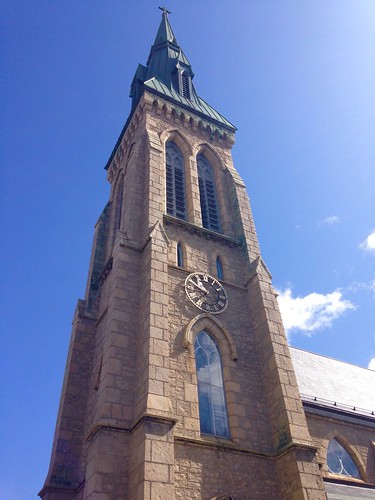
Guelph has had many prominent civic clocks, including the Bell Organ and Piano clock, the Scotiabank clock, the old Post Office clock, the City Hall clock, and the Floral clock. However, Guelph's longest-lasting civic clock is perhaps its most humble one: the clock of St. George's Anglican Church.

Since this clock has a subtle visual presence, it makes sense to start by pointing it out. Here it is in a Google Street View image:


The dial is visible just above the lancet window on the second storey of the tower. It may not be evident from this image, but the dial measures 6 feet or 1.82 m across. This view already suggests one reason why the clock does not pop out: It has a dial but no face. The gold arms and markings of the dial and hands also do not contrast sharply with the limestone wall of the Church. It seems that the clock was designed to blend in with the building rather than to stand out against it.

Postcard photographers certainly did not go out of their way to feature the clock. It is barely visible at a sharp angle in this postcard published by Progress Printing, Preston, Ontario around 1970:


(You can get a better view in pictures of the church from 1966 and from 1982.)

In spite of its subtlety, the church clock is the most time-honoured timepiece in Guelph. It was a gift to the church by the famous Arthur William Cutten. Cutten was the second of nine children born to Walter Cutten and Annie MacFadden (13 Apr 1870), a family of devout Anglicans. Arthur grew up in Guelph, attended church, and went to high school at Guelph Collegiate. However, rural Guelph could not satisfy this young man's ambition, so he lit out to Chicago in 1888, where he was employed as a bookkeeper. To make a long story short, Cutten used his modest income to speculate successfully on commodities and became a very wealthy man. However, in spite of his yen for the big city, he never forgot his little home town.

In the 1920s, Cutten lavished money on the old burg in general and St. George's Church in particular:

In Guelph he donated $20,000 to pay off the Guelph YMCA mortgage; he donated funds to St. George’s Church for stained glass windows, marble floors, a bell, an organ, and a carillon (the chimes alone were estimated to have cost over $25,000); to Woodlawn Memorial Park he donated funds for more land, iron fencing, entrance gates and other property improvements ($13,000) and was instrumental in creating the Cemetery Commission and establishing the Perpetual Care (Maintenance) Fund. As well, he provided financial support for all his siblings.
His best-known project was the Cutten Fields golf course, still a central feature of the Royal City.

The clock was given to the Church in connection with the carillon, which included a set of 23 bells (now 36) mounted in the Church belfry and played from a touch-sensitive keyboard. St. George's carillon was only the fourth in Canada and was thus quite a bragging point for its parishioners. Both clock and carillon were made in Croydon, England by Gillett and Johnston (Mercury, 18 March 1926), makers of the carillon in the Peace Tower and a firm that continues in operation to the present day. The paper also remarks that the largest bell in the set weighed in at 1,745 lbs. (about 790 kg), so the device was clearly designed to produce a big sound.

The clock uses some of the bells of the carillon and rings every quarter hour from 7:15 am to 11:00 pm. In fact, the clock plays the "Westminster quarters", patiently described in the Mercury for the uninitiated:

At a quarter past the hour four notes will ring out; at the half hour, eight notes, the first four and four others to blend in pleasing melody; at the three-quarters, twelve notes; and at the hour sixteen, followed by the strokes, indicative of the hour.
In case that is not clear, here is a small clock sounding the Westminster quarters:


St. George's clock rings out the hours 24/7. It was initially powered by a system of weights that had to be raised up the tower twice a week by pulling on furnace chains—no small task! In the 1950s, this system was replaced with an electric one. Don Hamilton, the carillonneur of St. George's since 1987, notes that the original clock mechanism continues to serve well: It keeps time to within a few seconds a day and can be adjusted by changing a system of weights attached to its 4 1/2 foot pendulum.

I was fortunate enough to be given a tour of the clock and carillon by Mr. Hamilton. A steep and narrow stairway of 59 steps leads from the base of the tower up to the clock level. There, the clock sits mounted in front of the big lancet window facing onto the street. The clock can be seen striking the half hour in the video below:


Note the pendulum swinging in front of the window, the flywheel spinning in the background during the chimes, and mechanism on the right that pulls the chords connected to the bell clappers.

Up another narrow flight of stairs is the room with the carillon keyboard. This keyboard features a set of "batons", sticks that are arranged somewhat like piano keys and played by using fists to depress them. Acoustics can be controlled by varying the force used on the batons and by using a set of foot pedals beneath. The carillon of 36 bells at St. George's provides three octaves, enriched by the harmonies set up among the bells themselves.

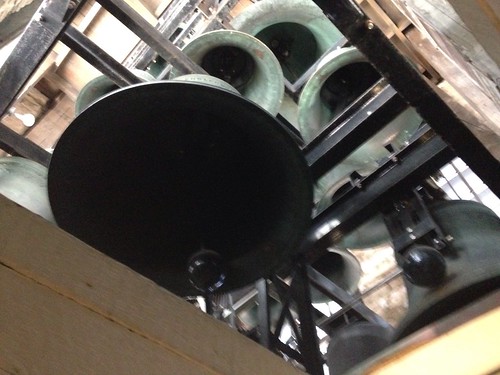
Those bells can be glimpsed through a hatchway into the belfry on top of the keyboard room:


Note the clapper inside the bell on the lower left. Clappers inside the bells are attached to the carillon. Now, note the clapper on the outside of the bell on the lower right. Those bells with clappers mounted outside are also a part of the clock chiming mechanism.

The History of St. George's Church (Moore 1982, p. 77) notes that the carillon (and thus the clock) was ready for action on Saturday, 17 April 1926. The clock, carillon and organ were dedicated by Bishop Owen on 19 May (History of St. George's Parish 1832–1932, p. 81). The clock has kept time faithfully ever since.

One question remains: Why did Arthur Cutten donate the clock and carillon to St. George's Church? Mr. Hamilton notes that the church previously had a set of chimes in the belfry, which were not nearly as loud or sophisticated in comparison to a carillon. So, the clock and carillon would improve the church's acoustical profile and increase the pride of the parishioners in their edifice. In addition, not far away, the Catholic Church of Our Lady was having two magnificent towers added to its facade in 1926, considerably increasing its civic profile. St. George's Church was not in a position to compete architecturally but the clock and carillon may have provided a different way to keep up with the Joneses. Or, it may have been a coincidence.

Whatever the reason, the clock of St. George's Church remains the Royal City's most enduring civic timepiece.

Saturday, 28 March 2015

Postcard from the trenches: Charles Mogk

When Canadians went overseas to fight in the Great War, communication with friends and family at home became significant for morale in both places. With the great popularity of picture postcards in the preceding decade, it was natural that postcards would be an important part of that process. As noted in my earlier post about Thomas McCloskey, social groups such as the Y.M.C.A. often provided postcards for the use of soldiers to send quick notes home. However, the armed forces themselves realized the significance of postcards for this purpose and sought to provide them to the troops. However, they decided to design a special postcard of their own.

Indeed, hardly had the British Expeditionary Force crossed the Channel when letters and postcards from the Tommies began to flood back to the UK. Since stamps were often hard to come by on the battlefield, the postage was frequently collected by the Post Office from the recipients. This process proved to be too costly and time-consuming, so the House of Commons quickly passed an act making all letters (and postcards) from active service personnel free.

This measure solved the stamp problem but left the military with the problem of how to monitor the information that was being sent from the front through the mail. There was the potential that service personnel might leak news that was of operational importance. Also, and perhaps more significantly, they were concerned that a flood of unvarnished information about the conflict might undermine morale on the home front. To deal with this issue, the military produced its own postcard, officially "Army Form A.2042" or "The British Field Service Post Card" (F.S.P.C.).

When it arrived in France, the Canadian Expeditionary Force was also issued the F.S.P.C. so that Johnny Canuck could write home too. An example of this card, send to Guelph in 1917, can be seen below.

Front side:


Back side:


The card has some remarkable features. Text in the left margin on the front states that, "The address only to be written on this side. If anything else is added the post card will be destroyed." The back side contains a similarly dire warning: "NOTHING is to be written on this side except the date and signature of the sender. Sentences not required may be erased. If anything else is added the post card will be destroyed." The army had dealt with the problem of censoring these postcards by making it possible to communicate only an extremely limited type of message with them.

A look at the back of the card shows how the system worked. The sender had a menu of pre-formed sentences among which to choose for communication. The choice was signified by crossing off the sentences that did not apply in the sender's case. In this case, the sender has left "I am quite well", "Letter follows at first opportunity", and "I have received no letter from you {lately/for a long time}", and signed his name, C Mogk, and the date, Dec. 9 [1917]. On the front, only the address has been pencilled in: "Mrs. Hy Mogk // 344 Woolwich St. // Guelph, Ont // Canada". Having complied with the directions, the letter was cancelled by the Army Post Office and sent to Guelph.

Commentators have emphasized the draconian way in which these cards attempted to control the narrative about the war. For example, Paul Fussell says (1975, p. 185):

The implicit optimism of the post card is worth noting—the way it offers no provision for transmitting news like "I have lost my left leg" or "I have been admitted into hospital wounded and do not expect to recover."
Only good news was allowed and only movement away from the front could be explicitly communicated. Soldiers sometimes rebelled against this censorship in clever ways. The poet Wilfred Owen had an understanding with his mother that when he crossed out "I am being sent down to the base" with a double line, it meant that he was really being returned to the front lines.

In spite of the Procrustean nature of the card, it was massively popular. Untold millions were printed, filled out, and mailed. By the autumn of 1917, the British Expeditionary Force was sending over 285,000 pieces of mail per day, many of them in the form of these cards. Part of their appeal was that they got home quickly since they did not have to be opened and laboriously checked by military censors. As such, they were called "Whizz bangers" or "Quick firers" by the troops, after German shells that travelled faster than sound (Fussell 1975, p. 183). Booth (1996, p. 14) notes that the cards were often sent off after a major battle, to let people at home know the sender was still alive, if not "quite well."

Perhaps this is the reason for the card home from Charles Mogk. Born on 16 Jan. 1888, Charles was one of five offspring of Henry and Catherine Mogk of Bornholm, Ontario. His Attestation Paper shows that he was inducted in the army at Radisson, Saskatchewan, 17 Feb. 1916, near Richard where he was apparently working as a farm laborer.

No part of his service record is available online. However, the postcard may suggest that he had seen action in the Second battle of Passchendaele, which occurred in late October and early November. In that battle, the Canadian Corps succeeded in taking high ground near Passchendaele in the face of some determined opposition. Perhaps Charles was sending the postcard to assure his family that he had survived.

The postcard is addressed not to his family in Bornholm but to Henry Frederick Mogk in Guelph. Henry was Charles's older brother and is listed in the 1917 Vernon's City Guide to Guelph as a carpenter living at 344 Woolwich St. Also at that address were his wife, Devina, and their son Clarence, who is listed as a clerk in the Candyland confectionary on Wyndham St. What an ideal job for a 13 year-old boy! Henry and Devina seem to have had a penchant for double middle names, for all their children have them. The 1921 census lists Ida Florebett Eugenia Mogk, Clarence Clina Faraligh Mogk, Jais Mary Marie Mogk, and Henry William Stanley Mogk. The house is one of Guelph's characteristic stone cottages and can be seen in this Google Street View image:


The Mogk family were in Guelph for only a few years. They appear for the first time in the 1914 directory and disappear after the 1917 edition. The 1949 Voters' list puts them in Hamilton. (There was another Mogk family in Guelph, headed by August Mogk, that lived for a long time in the Royal City. Although the two families were probably related through ancestors in Germany, August's ancestors were associated with the Waterloo region and not Bornholm.)

Interestingly, Charles observes the custom of addressing his postcard not to his brother but to his sister-in-law, Devina. Many postcards in that era were addressed to young girls, who might collect them for the pictures. However, it was also not unusual for postcards to be addressed to the wife of the sender's immediate relation. Perhaps, as family correspondence was regarded as a domestic matter, it was considered appropriate to send it to the woman who had charge of the home.

Happily for the Mogk family, Charles survived the war. The 1921 census lists him back in Bornholm living with his parents. Also listed is Jean Mogk (née Stevens) who was Charles's new wife. The census states that Jean, who was born in Scotland, immigrated to Canada in 1920. It is not clear when the couple married, but the timing suggests that Jean was a war bride. I wonder if they had met by the time Charles sent his postcard in 1917.

A picture of the new couple has come down to us, courtesy of Brenda Rohrer Smith:


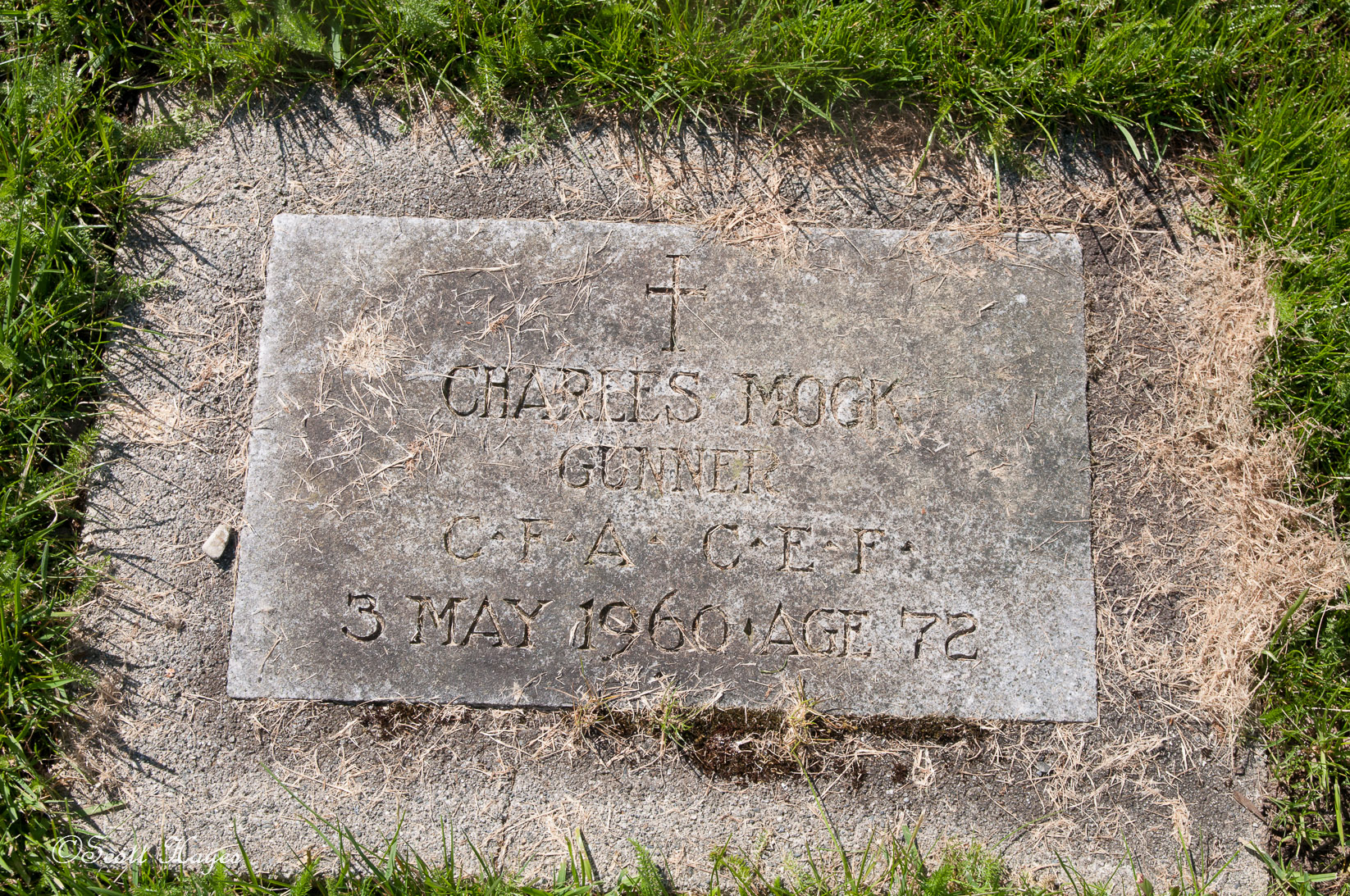
Unfortunately, the marriage was cut short when Jean died in Perth, Ontario, in December 1925. Charles later married Ethel Hannah Case, who had previously been married to George Ross of Keppel in Grey County. Records are silent on the matter, but Ethel may have been widowed around the same time that Charles became a widower. Perhaps looking for a change of scene, and recalling his work as a youth in western Canada, Charles and Ethel moved away from Ontario and are to be found on the 1958 Voters' list in Penticton, B.C. Charles died on 3 May 1960 and Ethel on 15 May 1973 and both are buried in the Maple Ridge Cemetery. Charles's grave marker can be seen below:


The marker notes only his name, age, and military service: "Gunner // C.F.A. C.E.F.". I believe this stands for "Canadian Field Artillery, Canadian Expeditionary Force", suggesting that Charles served as an artilleryman during the conflict. The marker is brief, formulaic, and to the point, much like the F.S.P.C. that he sent to Guelph from the front lines all those years before.


Postscript

The British Field Service Post Card apparently had a lasting impact on modern life. Fussell says that it set the precedent for one of the most unwelcome, modern types of written communication, the bureaucratic form (1975, p. 185):

The Field Service Post Card has the honor of being the first widespread exemplar of that kind of document which uniquely characterizes the modern world: the "Form." It is the progenitor of all modern forms on which you fill in things or cross out things or check off things, from police traffic summonses to "questionnaires" and income-tax blanks.
The mechanism of the British F.S.P.C. was widely parodied after the war. Fussell remarks on the following note written from after the war by Wilfrid Owen to fellow poet and veteran, Siegfried Sassoon (p. 185):
My dear Siegfried,
Here are a few poems to tempt you to a letter. I begin to think your correspondence must be intercepted somewhere, So I will state merely
I have had no letter from you {lately/for a long time}.
Besides being the origin of the form, the F.S.P.C. seems to have fixed in people's minds the notion that government agents might be watching their mail.

As such, the F.S.P.C. had become a familiar, running joke in the English-speaking world. Commercial postcard makers also produced parodies of them for many years after the war. I wonder if the soldiers felt nostalgic for them or merely enjoyed abusing the knock-offs as a kind of revenge.

Also, the F.S.P.C. was issued in Urdu for use by the India Expeditionary Force. I wonder what they thought of it.

Friday, 27 February 2015

Tytler Public School

Tytler Public School is back! The old public school in the Ward was closed in June of 2013 after a remarkable 135 years of service. The students even gave it a big hug as a send-off! However, it was recently announced that Tytler school would be brought back into service for young French Immersion students. And the story was even illustrated with a lovely postcard, a copy of the one below.


The card was published by The Valentine & Sons Publishing Co., Ltd. Montreal and Toronto sometime around 1910. The picture shows a stately Edwardian building with perhaps a bit of local character in the gable over the central stairway. The postcard label shows that its original name was "St. Patrick's Ward School". This recalls the days when Guelph had an elementary school for each of its wards, each named after saints, plus one in the middle, the "Central School".

Compare the postcard image with that from Google Street View.


It looks quite well preserved, although some windows have been blocked up and the school yard paved.

The school was designed by William Austin Mahoney (1871-1952), a prolific local boy who learned architecture through the International Correspondence School of Scranton, Penn. while working as a carpenter in Chicago. He put up his shingle back home in Guelph in 1905 and was soon busy. He designed a number of local buildings of note, including several schools beside St. Patrick's. The "Building Operations" column of the Mercury (12 Sep. 1908) itemizes the work done to erect the building:

St. Patrick's Ward School — Four room, up-to-date school. Red brick, on Ontario street; Sam Rundle, stone and brick; George Scroggie, carpenter; Dempsey Bros., painting; J. J. Mahoney, plastering; H. Occomore & Co., heating; G. W. Brown & Co., slaters; Mahoney Bros., plumbing; W. A. Mahoney, architect. Cost, about $13,000.
Note all Mahoneys! Going by the City Directory of Guelph (1917), the Mahoney Bros. were Harry and Richard, William's brothers. J. J. Mahoney was his brother James. J. Mahoney, a building contractor. Perhaps brother Jeff D. Mahoney, also a building contractor, was on vacation. In any event, St. Patrick's Ward School was something of a family affair.

This history still leaves us with at least a couple of mysteries. First, how did "St. Patrick's Ward School" become "Tytler School"? Second, if the school was 135 years old in 2013, how do we account for its construction only 105 years earlier?

The first mystery is easily solved. St. Patrick's Ward School was re-named in honour of William Tytler on 14 Feb. 1922. The School Board conferred the honour on Mr. Tytler (1842-1932), who had been the local Public School Inspector and Secretary of the Board for almost 30 years. A native of Nicol Township, Tytler graduated from the University of Toronto in 1862 and enjoyed a very successful career in education. In 1875, he was hired from St. Mary's High School to become headmaster of the new Guelph Collegiate Institute. He become Public School Inspector in 1893, a position he retained until 1924. He resigned for good from the Board only in 1930, for a remarkable career spanning about 66 years. So, it is no wonder that he had a local school named after him, although it is not clear why St. Patrick's School was selected.

The pre-history of St. Patrick's School is also an interesting story. In fact, the Mercury (4 May 1908) gives a complete run-down of it. In the author's view, the first school in St. Patrick's Ward was actually the very first school in Guelph. John Galt had ordered the construction of a school in 1828. Originally called the "Galt Academy" (and later "The Old Stone School"), it stood near what is now the corner of Fountain and Neeve Streets, roughly where the Chamber of Commerce sits today (Allen 1939, p. 23). Thus, it seems to have been part of Galt's plan to aggrandize Priory Square. After the railway tracks were laid next to it in the early 1850s, the location became just too noisy and the building was abandoned. Because it sat in the east end of the town, as it then was, the article's author regards it as the first East Ward school.

For many years, school in the east end of town was carried on in rented accommodations. However, demand increased to the point where the School Board decided on a permanent structure. Property was purchased and a building put up on Ontario Street in 1878. This school was designed by another industrious Guelph architect, John Hall Jr. It is described in this way in the Mercury's "Building Operations" column (27 Nov. 1878):

The building is T shaped and built of stone, and has at the rear a very fine roomy play ground. The architecture follows more closely the Italian than any other style, and is in every respect an ornament to the neighborhood. On the north corner there is a handsome belfry, which rises to a height of 36 feet. The stone is laid in imitation of random coursed work. The openings are pla[i]n corners of cut stone and the entrances are surmounted by ornamental hoods. The building is divided into two school rooms, each 22 by 28 feet. There are two entrances into the school—one for boys and the other for girls. The lobbies and cloak rooms lead from the entrances into the school rooms already referred to. Here all the modern and improved school furniture and appliances are to be found. The building is heated by stoves. The total cost was about $1,900.
Unfortunately, I have not been able to find any pictures of it. But, it is fun trying to imagine it.

In any event, the construction of two rooms was providential, since it was ten years before there were enough students to occupy more than one room. Of course, as time went on, the two-room school become overcrowded and it was eventually razed to make way for the new, four-room building designed by William Mahoney. (Coincidently, William Mahoney's father, Richard, appears to have done the carpentry work for the earlier school. School construction was truly in the family DNA.)

So much for the history of the building. Luckily, we also have some reminiscences of student life in the place. Mr. James L. Hunt provides a number of interesting anecdotes about his time as a pupil there in the early 1940s. Education at Tytler in that era focussed on the Three Rs, cultivated through lots of memorization, which suited young Mr. Hunt just fine. We get some interesting glimpses of the staff. For example, his grade 3 teacher, Miss Dooley, was thought very pretty by all the boys and remained a teacher for her whole career, meaning that she never married. In those days, getting married ended a woman's career, at least in school.

However, the school custodian was not so amenable:

The school had one real tyrant in the form of the school janitor Mr. Smith who took a perverse delight in tyrannizing the boys. At every recess the first thing that happened was that everyone was herded into the washrooms whether you had to pee or not. It was presumably believed that this would minimize the incidents of hands being raised and "Please Miss may I leave the room?" The boys washroom had about 6 urinals and Mr. Scott [sic] was always there waiting to maintain order and decorum. Perversely he always organized the boys into two lines: one at station 1 and the other at station 2. As 3, 4, 5, and 6 became available he manned them always from the number 2 line which therefore moved quickly. However, if you were unfortunate enough to be ordered into the number one line you simply waited your turn and missed half the recess. There was no appeal, no fairness you did as you were ordered and offered no lip. We hated him with a fiery passion!
Hopefully, Tytler School has since abandoned this practice!

So, Tytler School has had an interesting history, both institutional and personal, and one that, by some accounts, goes right back to the foundation of the town itself. Plus, it seems, there is more yet to come.

Sunday, 18 January 2015

Who had a hand in the planning of Guelph?

If you did not grow up in Guelph, then, like me, you may remember in your early days trying to figure out the arrangement of streets downtown. There are several points where streets converge in an unusual way. Norfolk Street begins at a dog-leg intersection with Gordon St., Wilson Street, Waterloo Avenue and (formerly) Essex Street. It then meets Quebec Street, Yarmouth Street, and Paisley Street at its middle point. Finally, it is cut off at Norwich Street where it meets, and is continued by, Woolwich Street. Further east, when moving up Wellington Street, you pass under a railway bridge and find yourself veering left and on Woolwich Street.

Trying to form a mental map of the area takes a while. Sometimes, it helps to make a drawing. That is what one newcomer to Guelph did on the back of a postcard sometime around 1910, as you can see below.


The front of the card has a picture of the MacDonald Institute at the O.A.C. However, it is the back of the card that matters here. The message reads:

Peg/ This is the McDonald Institute in Guelph. No relation to the College in Montreal. This is a funny little town but fairly busy. I slept in the park for a few hours last night. The constabul [sic] thought I was a bum and was going to throw me out. This is the way the streets run.
(Actually, the Macdonald Institute was funded by the same Sir William Macdonald who funded the MacDonald College in Montreal but that is another story.) Besides the vigilance of the constabulary, our unnamed author was clearly impressed by the street layout while walking around the downtown. The result looks a little like a spider web. If you are familiar with the city, see if you can identify the streets.

Frankly, I cannot quite make it out. Not having the scale, orientation, or any street labels does not help. Certainly, I would not use it to give directions. In any event, the general impression is enough: Downtown Guelph is both circular and triangular at the same time.

One of the reasons for this unusual layout is that the streets were designed to radiate outwards from a focal point, that being the site where John Galt and his party chopped down the maple tree to launch the town. That site is near the current intersection of Wellington, Macdonell and Woolwich Streets. At the time the postcard was written, Wellington had not been extended to that point. Instead, Woolwich Street began at Priory Square, where it met Quebec Street, Macdonell Street, the Market Square, and Waterloo Street (now Fountain Street). Check out this detail from the 1892 map posted in the Main Branch of the Guelph Public Library. Priory Square is in the lower right corner, bisected by the railway line.


With a little imagination, the map looks almost as if someone had traced the fingers of their left hand to make up the street layout, with Woolwich as the thumb. In fact, this idea was a long-standing myth about the founding of the Royal City. Guelph was officially founded on April 23, 1827 (St. George's Day) when John Galt, in the presence of a party from the Canada Company, chopped down a maple tree near the banks of the Speed near the present day intersection of Wellington and Woolwich Streets. The Annals of the Town of Guelph relates the rest (Burrows 1877, p. 12):

It has been stated that after the tree was felled Mr. Pryor laid his hand upon the stump, and stretching his fingers as far apart as possible, indicated the direction in which the streets of the new town were to be laid out.
Charles Prior was a builder that Galt had hired to oversee construction of the first buildings of the town. If the story about Mr. Prior's hand seems implausible to you, then the author agrees:
... it is scarcely reasonable to suppose, either that a man of Mr. Pryor's well-known intelligence and scientific attainments would adopt so rude a method of laying out what was intended to be a large and important city, or that Mr. Galt would have countenanced such a proceeding.
Gilbert Stelter points out that the real story of Galt's town plan for Guelph is more complicated. Among other things, Galt wanted the streets to converge on the site of the tree stump in order to emphasize the importance of the Canada Company buildings, such as the Priory, that were to be located around it. Immigrants to the town, arriving across the Speed from York to the east, would perceive the centrality of the place through the very lay of the land.

In fact, as Stelter notes, Galt's original plan was more fan-like than hand-like. However, after his departure, the Canada Company changed the plan, selling some of the space designated as public by Galt and thus making Woolwich Street look more like a thumb. Later, the site was bisected when the city sold some of it to the Grand Trunk Railway for a bridge abutment.

Today, if you would like to see the site of the town's founding, you can look at the side of that abutment:


The plaque on the side of the abutment reads:

This tablet marks the spot where John Galt, general agent of the Canada Company, cut the first tree in founding the city of Guelph, April 23rd, 1827.
As the Square was reduced and bisected, the rationale for it became obscure. Thus, its configuration, and the radial plan of the streets seemed increasingly arbitrary, perhaps lending credibility to the myth of Charles Prior's hand on the stump. Stelter notes that the story was repeated for years at the Guelph Civic Museum, which perhaps helped it to live on. In any event, the curiously configured streets of downtown Guelph live on also, somewhat to the puzzlement of new arrivals to our funny little town.

Sunday, 14 December 2014

Happy holidays from the Goodwin family!

In addition to providing pictures of distant places, people have used postcards to connect with friends and family over the holidays. Postcard makers have produced many postcards with holiday-related images in order to satisfy this desire. In this posting, we will look at a number of postcards that have been sent to people in Guelph in order to convey best wishes on festive occasions. More specifically, we have the good fortune to have cards that were sent to one particular family in Guelph, namely the Goodwin family.

The first card is for New Year's and contains a small, wintery scene along with a verse of well wishing. It is unusual for a postcard as it is in portrait rather than landscape orientation.


In addition to the printed verse, the message on the back says, "Wishing you all a Happy New Year. Nora" It is addressed to Miss Alice E. Goodwin at 518 Woolwich St. in Guelph (roughly where the water tower stands on Woolwich near Speedvale today) and appears to have been sent from Elmira on 29 Dec. 1911.

The Goodwins were an established Guelph family. According to the 1901 census, William Goodwin Sr. was born in 1866 but later moved from Toronto to Guelph in 1888 to work in the Bell Organ and Piano factory, where he spent the rest of his career until its ultimate closure in 1932. He and his wife had a large family, consisting of Harry (b. 1891), William Jr. (b. 1893), Florence (b. 1895), Ralph (b. 1896), Gertrude (b. 1899), and then Alice (b. 1901). (William's job must have paid reasonably well, as Annie Scroggie, apparently a neighbour, is listed as a domestic in the Goodwin household.) Probably, Alice, like many girls of her era, collected postcards and so had many addressed to her by friends and relations.

William Sr. is described in his obituary (Mercury; 30 Mar. 1933) as "one of this city’s best known and most esteemed residents" and as someone who "took a keen interest in sports and for some time was a member of the executive committee of the Guelph Cross Country and Road Race Association". In other words, he was an avid cyclist and promoter of cycling in the city. He and Annie (née Hiebein) were married in 1891 and evidently wasted no time in starting a family.

The three sons were about the right age for military service when the Great War broke out. Harry was evidently keen to join up and was reported to be one of the first Guelph boys to ship out. He received the Military Medal during his service but was apparently badly wounded and returned to Canada to recuperate in the Davisville Hospital in Toronto. It seems that he never recovered and died in 1921 (Mercury; 22 Jan. 1921). His body was returned to Guelph, where he was buried in the soldiers' section of Woodlawn Cemetery with military honours. Unfortunately, I can find no records of his induction or service, nor is he remembered on the Guelph Cenotaph or any books of remembrance, which seems a shame.

There is no record of military service for the middle son, William Jr. Perhaps this is due to his marriage on 26 Sept. 1917 to Reta Shepherd. William remained in Guelph until his death on 23 May 1948 (Mercury; 25 May 1948). His obituary mentions two children, Albert and Mrs. Ernest McFarland, both of Toronto. Reta is not mentioned, so they may have divorced.

The youngest son, Ralph, had a different military experience from Harry. His attestation papers show that he was conscripted into service on 25 Oct. 1917 in Guelph, the day before his brother's marriage! His military career is uncertain but the next record shows that he married Gladys Viola Joyce in Guelph on 13 Oct. 1920. The 1921 census shows him living in the Joyce household with his new wife. At some point in the next decade, the pair moved to Lansing, Michigan.

For whatever reason, the family seemed to have an affinity for Michigan. Just before the war, Florence married a young man from Brighton, England named William Sprentall. In 1919, the pair emigrated to Ann Arbor, Michigan, perhaps establishing the family's connection to that State. In any event, the remaining holiday postcards in this set were mailed to Guelph from Ann Arbor in 1921.

The next card conveys wishes for a happy American Thanksgiving. It was published by Whitney of Worcester, Mass., and sent on 3 Nov. 1921.


The message on the back says, "Hope you folks are all well and in good spirits. rec’d your card. Mabel." It is not clear who Mabel is; perhaps an in-law in Ann Arbor who wanted to send Alice another card for her collection.

The next card is a birthday card sent on 1 Dec. 1921 to Mrs. Goodwin (Annie) on the occasion of her birthday on 3 Dec.


The message on the back reads, "All are well. Doris May can sit alone & realy [sic] takes steps. May." May will be Florence, whose middle name is May. I guess that Doris May must be Mr. & Mrs. Sprentall's new baby girl! The address is given not as Woolwich but just as "Elora Road", which was then the name of the street north of the city limits. Clearly, the post office knew where to deliver the card, even with such a vague address.

Of course, with Christmas approaching, we would expect Christmas postcards to be on the way. The following seasonal card was sent from Ann Arbor to Miss Alice Goodwin on 21 Dec. 1921.


The message on the reverse side says, "A merry Christmas and Happy New Year to you and to the family. The Woods". New friends of the Sprentalls, perhaps.

The next Christmas card continues the now familiar theme of pictures of snug but snowy houses combined with light verse.


It was sent to Alice on 24 Dec. 1921 and conveys the following message, "Hope you have a Merry Xmas and a happy New Year. This is the wish of Mr. and Mrs. Christ[.] Paul." "Xmas" was a frequently used abbreviation of "Christmas" often used and highly suited to the restricted writing space available on post cards.

For the final postcard, we return to the New Year's theme with another postcard made by Whitney, Mass., and sent to Alice on 1 Jan. 1922.


On this occasion, the message states, "Dear Alice: All well. Santa was real good to all of us. Lavina was here yesterday with her 5 children. Wish you all a Happy New Year. Tina".

That is all the holiday cards sent to Alice that I have yet found.

As for the two remaining Goodwin sisters, Gertrude married Frederick Thatcher but stayed in the Royal City. The 1953 Voters list shows her still living at 518 Woolwich St. The 1962 Voters list gives her as a widow, still living at 518 Woolwich with their son, Fraser. She died on 9 Nov. 1983 (Mercury; 10 Nov. 1983).

It seems that Alice never married, although she did move to Brantford at some time, as noted in her father's obituary.

It is curious that this set of cards has stayed together. I can only infer that Alice was pleased with the cards and kept them not for their intrinsic virtues but as a memento of her youth and her relations in Michigan. For us, they provide a little glimpse into past usages of postcards in keeping people in touch at special times of the year in days gone by.

Happy holidays!

Monday, 17 November 2014

Thomas McCloskey: Journey home from war

This year marks the 100th anniversary of the start of World War One. Naturally, when we look back to that time, we tend to focus on the soldiers and others who served overseas in that conflict, with particular attention to those who were killed. The foremost of these has to be John McCrea. There is also Ed Butts' excellent series of Guelph's Cenotaph Stories published in the Guelph Mercury. Without subtracting from the significance of those stories, it is also relevant and interesting to inquire about Guelphites who did return from foreign service. One of those Guelphites was Thomas McCloskey.

Thomas McCloskey merits our attention in this blog because of a postcard that he sent home from England in August of 1918. Here are the front and back of the card:


The message on the card shows Thomas taking a few moments to connect with his family back in Guelph:

London Aug 12/18 // Dear Sister, On leave for a few days. Received your letter before I left camp. Will write on return. Having a dandy time. Grand Canadian Camphionship [sic] sports to be run off this afternoon, I am not going. Going to Kew Gardens instead. Supposed to be the finest in the world. Please write soon. T. McC. [PS.] Got an extension of 24 hours on my pass. Met a lot of Guelph boys here this time.
The message is pleasant and upbeat, meant to reassure the family that all is well. It reinforces Thomas's connection to home, both because of its destination and because of its mention of meeting "a lot of Guelph boys" in London.

We learn a number of things about Thomas straight away. He is a Canadian soldier from Guelph and is visiting London on leave. On the back of the card, Thomas gives his details as "Pte Thos J. McCloskey, Seaford, 6 C. R. Battalion". This means that Thomas was in the 6th Canadian Reserve Battalion which was situated south of London near Brighton. When Canadian recruits were sent to Europe, they were attached to Reserve Battalions where they prepared for combat (Meek 1971, p. 146):

In the Reserve Battalions, advanced training was carried out by instructors who were experienced soldiers from the front lines. When the call came from France that a Battalion or a Brigade needed reinforcements, then a draft [of trainees] was called together from a Reserve Battalion, and sent to the front.
In other words, the 6th C.R. was just a way station on Thomas's journey to the front lines.

The card itself also tells us something about the situation that Thomas was in during his training in England. Unlike most postcards of the era, the card has no picture on the front. Instead, it resembles a form letter with the front reserved for a message and the back for addresses. In addition, the front carries the patriotic logo, "For God, For King & For Country" and "H.M. Forces on Active Service," along with two cannons. The printer is identified as the Y.M.C.A.

The Y.M.C.A.—also known as the Red Triangle from its logo—took a special interest in the morale of Canadian soldiers and their families. It sponsored entertainment for the troops abroad, including concerts, stage performances and "picture films". In addition, it put on Bible classes and guided tours for soldiers on leave, providing them with a morally acceptable acquaintance with Paris and London (Toronto Globe, 7 May 1918):

"Any clear-thinking person who knows Paris and London to-day, knows that they are zones of great moral danger," Capt. MacNeill went on [to a Toronto audience]. "There is no need blinking that. The facts are too apparent to any man who observes them. It is one of the great businesses of the Y.M.C.A. to surround our men on these leave occasions, with every protection that we can find. We try to close every door of evil influence against them and open every door of good influence for them.
Since he was headed for Kew Gardens, we can assume that Pte McCloskey was not in need of that service. However, he did take advantage of the postcards that the Y.M.C.A. apparently provided so that servicemen could write quick missives home to stay in touch. It even appears that the Y took care of the postage since the back of the card has "Canadian Soldiers Mail" in place of a stamp.

According to the 1911 census, Thomas Joseph McCloskey was born in September of 1896. He was the third of five sons of Frank and Agnes McCloskey resident at 251 Exhibition St. (This may be near the site of the city water tower today.) The house must have been busy as a brother-in-law Alexander and a lodger Winnie are also listed in that household, making a total of nine people.

Thomas's attestation paper states that he was inducted into the Canadian military on 15 Oct. 1917. He was 5', 9.25" tall, weighed 170 lbs., of fair complexion, light grey eyes and brown hair. He had been vaccinated in his left arm in 1907 and was freckled, perhaps a trace of his father's Irish heritage. The examining doctor put him in category "A", that is, fit for front-line duty.

The timing of Thomas's induction may be significant. The Canadian government had recently passed the Military Service Act, permitting the conscription of soldiers. Army recruiters were making the rounds of Canadian cities signing up young men. Here is a photo of a poster printed in the Guelph Mercury in Oct. 1917, issued by the Military Service Council, enjoining young men to visit the Medical Board for examination.


The Mercury would often publish items listing the number of young men examined by the Medical Board in the Armory the previous day. No notice was published on Oct. 16, but the notice from Oct. 17 runs as follows:

Thirty-two Passed Yesterday
Sixty-two applicants for examination appeared before the Medical Commission at the Armories yesterday. Over 50 per cent, or 32 were physically fit for overseas service and placed in Class A. Of the remainder 3 went into Class B, 5 in Class C, 1 in Class D, and 23 were declared unfit for any service and placed in Class E. To-day there are not nearly so many waiting as has been the case during the last week, and at ten o'clock there were only half a dozen in the waiting room.
Thomas was classified fit and sent to England for training, where he ended up sending home a postcard during his leave the following August.

Since Thomas was still in training in mid-August, near the end of hostilities, it may be that he was not sent into combat. (The Library and Archives Canada have not yet digitized his full service record.) In fact, the next official record of Pte McCloskey concerns his return to Canada. The Guelph Mercury often listed the return of soldiers from Europe. On 15 Sept. 1919, the Mercury noted the landing of "T. J. McCluskey" [sic] on the Cedric in Halifax. Three points of interest are concealed by this terse notice: Thomas's return was nearly a year after the Armistice, Thomas did not return to Guelph, and he did not return alone.

It is well known that 11 Nov. 1918 marked the end of hostilities on the Western front in Europe. What is less often recalled is that the war did not end officially until the Treaty of Versailles was signed on 28 June 1919. Between the Armistice and the Treaty, the Allied commanders faced a difficult decision. Their troops were understandably anxious to return home. However, the end of Germany's war effort brought about a collapse in its government. Kaiser Wilhelm abdicated and various parties attempted to seize power. German army units remained active and involved in the political conflict. As a result, there was no government that could negotiate an official end to the war, and there was a chance that some of the German army might resume hostilities with the occupying forces (Toronto Globe, 16 Jan. 1919):

"On authority of an unimpeachable character," says the Central News, "It can be stated that a situation exists in Europe under which war may break out again at any moment. The Allied War Council has arrived at a decision which means that the British people have mistaken the appearance of peace for reality. This decision means that the new British Ministry must revise the whole scheme of army demobilization."
Moreover, demobilization might embolden some German politicians to resume the conflict.

In addition to this, Canadian politicians were concerned about the surge in unemployment that would be caused by the sudden repatriation of more than a quarter million Canadians from Europe.

Many Canadian soldiers were impatient with the situation. Some marched in protests. There were several riots (Morton 1980). One such riot took place among Canadian troops at Seaford, apparently touched off by attempts of military police to enforce strict discipline on the uninterested soldiery. Authorities put the blame on conscripts (Toronto Globe, 19 May 1919):

A description of the rioting that was threatened in Seaford Camp in England by a section of the Canadian troops quartered there was given by Lt.-Col. Meurling of Nelson, B.C., who returned to Canada Saturday morning on the Scotian with 2nd Canadian Motor Machine Gun Brigade, the troops called upon to check the disorderly element, and who did so with hockey sticks and cricket bats.
Col. Meurling said that the trouble-makers were principally drafts of conscripts who had seen no fighting at the front. They wanted to be sent home before the fighting, and appointed Soldiers' Council to submit their demands to the officers. There were a number of these Councils in the camps in England. At the Seaford Camp threats were made on May 3, 4, 5, and 6, and the machine-gunners were told to suppress any rioting that might take place. The disorderly faction on May 6 threatened to attack the north side of the Seaford Camp, in which the gunners were located. No actual attack was made in force.
...
Col. Meurling said that the men complained because they got no satisfactory explanation for the delay in repatriation. He explained that the trouble-makers were among the drafts. The spirit of the corps in the units was high, and the behavior of the men in them good.
The Colonel's account somewhat downplays the extent of unrest. In any case, there is no evidence that Pte McCloskey participated in the Seaford riots. Indeed, he may have had good reason not to.

When Thomas returned to Canada later in 1919, it seems that he went to live in Montreal instead of returning to Guelph. The 1921 census shows him living at 859 Dorchester St W in Montreal along with Gladys McCloskey. Records show that Gladys was born in England and landed in Canada on the Cedric along with Thomas. In other words, it seems that Thomas had met Gladys and married her in England before his return. Did he meet her while on leave in London?

Despite their time in Montreal, it seems that although you can take the boy out of Guelph, you cannot take Guelph out of the boy. The 1928 Vernon's City Directory for Guelph lists Tom J McCloskey and wife Gladys W ("W" for Winifred) as residents in Guelph, living at 12 Alexandria St. That address must have been especially convenient since Thomas is also listed as the proprietor of McCloskey's Service Station:

McCloskey's Service Station
The bright spot—Famous for Service, Tire Repairs, Road Service, Gas, Oil & Accessories—Woolwich St. (Elora Rd), at City Limits, Phone 2725
That would be the corner of Woolwich and Speedvale today, right behind the McCloskeys' house on Alexandria. It seems that the couple must have done well in Montreal.

Unfortunately for the McCloskeys, the service station did not succeed. The 1934 City Directory seems upbeat, showing a name change to the "McCloskey's Serv-Us Station" and noting an expansion in their offerings to include cigars, confectionary, and soft drinks. The location is even called "McCloskey's Corner" and a second location at the corner of Gordon and Wellington St.s is listed. However, the 1935 Directory lists one John H. Brown as the proprietor of the station on McCloskey's Corner, with Thomas as an employee. The tough times of the Great Depression seem to have forced Thomas to sell his business.

The McCloskeys moved on. The 1936 City Directory does not list Thomas or Gladys. Indeed, only his brother Harry, whose wife Thomas wrote to in 1917, remains there at that point. It appears that Thomas and Gladys moved to British Columbia or, more particularly, New Westminster. Without access to the papers there, it is hard to say why or find out more about them. Perhaps they chose that city because New Westminster, like Guelph, calls itself The Royal City. At any rate, it appears that Thomas and Gladys enjoyed a long life together. Gladys died on 13 Feb. 1987 and Thomas shortly thereafter on 30 March 1987. Their grave marker can be viewed at CanadianHeadstones.com:


If I am ever in the neighborhood, perhaps I will look up more information (or some kind soul could post it in the comments). In any event, the tale of Thomas McCloskey illustrates the vagaries of life for Guelphites of that era and the fact that returning from war can be, in its own way, just as turbulent a journey as setting off for one.

Post Script:
I have come across a couple of short columns in the Mercury regarding Thomas McCloskey.

The first is from 31 May 1943:

T. McCloskey state deputy
Word has been received here that Thomas McCloskey, formerly of Guelph, has been elected State Deputy of the Knights of Columbus for the province of British Columbia. Mr. McCloskey left Guelph for B.C. some few years ago. While [here] he was active in the Knights of Columbus and held several offices successively in Local Council 1507.

The second column is from 25 Oct. 1950, noting the death of Patrick J. McCloskey of Port Moody in a car accident:

Born in Guelph he was the son of Mr. and Mrs. T. J. McCloskey who used to operate service stations here. The family left for the west in 1935.
It is interesting that the McCloskeys were still remembered in Guelph years after their departure.

Friday, 31 October 2014

The passenger pigeon

The 1927 Centennial edition of the Guelph Mercury provides a chronological listing of notable news items from the previous 50 years. Among those items is the following brief note:
1882: October 17. –Several flocks of wild pigeons flew over Guelph.
It is puzzling to think that editors of the Centennial edition would bother to mention some pigeons. However, it makes more sense when you realize that "wild pigeon" is what people usually called the passenger pigeon in those days.

The passenger pigeon was one of the most remarkable birds of North America. Individually, the male birds were regarded as attractively dressed, with red eyes, blue-gray heads and backs and brick-red breasts. The females were more brown on their upper parts and pale or buff colored below. Many artists made pictures or paintings of the bird, including the famous naturalist John James Audubon, whose picture of a young male being fed by its mother is reproduced in the postcard below.


The card was printed by Barton-Cotton Inc., Baltimore, taken from a painting made by Audubon in 1824.

Of course, the most notable aspect of the pigeon was its habit of congregating in enormous flocks. Often found in the tens or even hundreds of millions, the biggest flocks probably numbered billions of individuals. Descriptions of the flocks nearly always state that they darkened the skies for hours or even days. Perhaps the largest ever recorded was seen by Major W. Ross King at Fort Mississauga on Niagara-on-the-Lake, Ontario around 1860 (Greenberg 2014, p. 5). King reported that the flock stretched a mile or more in breadth and went from horizon to horizon. For 14 hours, more and more pigeons flew overhead in a dense column. The sight was repeated each day for days afterwards. Modern estimates of the size of the flock put it at about 3.7 billion birds, a number that staggers the imagination!

The reasons for the enormity of the flocks are unknown. Some birds collect into large flocks in order to collaborate on finding food and water and avoid predators. Swarms of Australian budgies seem to operate this way, flocking to share water sources, keep a look out for hawks, and challenge any threats that do emerge. Steven Pearce has posted some spectacular footage of swarming budgies on his blog.


A segment from a recent BBC documentary also features a big flock of budgies and notes that their congregations may function as a kind of super-organism, allowing the birds to access and process information as a collective that they could not do individually.


This footage provides perhaps a taste of what a massive flock of wild pigeons was like.

The pigeons flew across eastern North America from the Gulf of Mexico to Hudson Bay and Maine to Montana. However, their home territory seems to have been centered on the southern Great Lakes region, including southwestern Ontario. They flew swiftly, at perhaps 90 k/h, and could cover large distances daily. One note from the Detroit Free Press observed that passenger pigeons shot in that vicinity were found to have rice in their crops, a grain that grew about 700 miles distant (Toronto Globe, 23 March 1850), presumably to the south. In other words, the birds had flown that far since their recent meal of rice.

Passenger pigeons seem to have subsisted on seeds and fruits. Local lore has it that they enjoyed acorns and beech nuts particularly, so that flocks would appear when those foods were abundant. However, they would take a variety of foods. One old timer describes the pigeon's diet as follows (Globe, 3 June 1905):

It lives entirely on vegetable matter, such as fruits, grain, nuts, seeds, bulbs and plants. I have taken from the crop of one more than a good handful of beechnuts, which would be packed so tightly that it must have seriously incommoded its flight. When nuts and grain are scarce they will eat nearly anything in the vegetable line, such as buds, tender shoots, grasses and some kinds of fungi. Although I have taken all I have named and more from their crops, I do not recollect seeing any animal remains, such as worms or insects, of which most birds are so fond.
They were also reported to feed in farmers' fields and were regarded sometimes as pests for that reason. Dr. Henry Howitt of Guelph reported that his father viewed them in this way (Steele 1967, p. 173):
[Howitt] also said that in the 1850s the pigeons were in large numbers in this area and he recalled the difficulty his father had with the spring planting of grain at that time on their farm near where the lime kilns are now situated.
That would be somewhere near Wellington St. and east of the Hanlon Expressway.

Besides feeding and migration, the passenger pigeon also nested in vast hordes. Rookeries of the biggest flocks were reported to cover hundreds of acres. One retrospective report describes a rookery near Blenheim, Ontario as covering a space six or eight miles in length and nearly the same width (Globe, 15 Dec. 1894). Another report says that the biggest rookery occurred in Michigan and measured about 28 miles by three or four miles (Globe, 18 May 1907). The noise made by the crowds in these roosts must have been phenomenal, as is confirmed by one retrospective description about a rookery near Exeter, Ontario (Globe, 4 Feb 1899): "They could be plainly heard cooing three miles away."

Besides the area covered, the flocks were noted for their tendency to break down the trees where they nested. Indeed, they could decimate forests and fields with the weight of their bodies and their droppings. This report of a rookery along the Speed River at Guelph in 1835 is typical (Curry 2006, p. 251):

An immense rookery extended on both sides of the River Speed from Guelph to Rockwood; within its bounds trees were broken down by the weight of the pigeons and at the proper time, wagon loads of the young birds could be easily obtained.
Being in the midst of such a vast rookery must have been an other-wordly experience.

Of course, as noted above, the locals did not merely marvel at the abundance of the passenger pigeons. The birds were also taken as food. In his book "The Grand River Iroquois: Their music and customs", J. C. Hamilton records the tune of a Pigeon Dance performed by the Six Nations people who located here after the American Revolution. (Unfortunately, I have not been able to locate a copy of the book.) Probably, the import of this song was like the Seneca story about the bird, in which the passenger pigeon is called "Big Bread" and is offered to humanity as a tribute. One old-timer recalled how First Nations people continued to harvest the birds from a rookery in the early 1850s near Blenheim (Globe, 15 Dec. 1894):

No bird is more graceful in form and motion than the matured pigeon, and none is more awkward and unsightly than the "squabs", as the young are called. These were easily dislodged by the arrows of the Indians, who came in droves from the reserve on the Grand River. The squaws were laden with great baskets of the unctious fare, and many a wigwam and home had rich and dainty food that spring and summer.

Early settlers found that the birds provided food for them when they were threatened with starvation (Globe, 3 April 1869):

And the extra-ordinary statement is found in the M.S. of the late Mr. Merritt, that one old couple, too old to help themselves, and left alone, were preserved providentially from starvation by pigeons, which would occasionally come and allow themselves to be caught. The fact is stated by others, that pigeons were at times, during the first years of settling, very plentiful, and were always exceedingly tame. Another person remarks, that although there were generally plenty of pigeons, wild fowl, fish and partridge, yet, they seemed to keep away when most wanted.
It seems that, sometimes, the pigeons were greeted like manna from heaven.

As settlement proceeded, settlers refined their harvesting methods. At rookeries, fallen squabs might simply be collected from the ground. Others were dislodged from their nests with poles (Globe, 5 June 1900):

The rising generation is apt to discredit stories of pigeon-hunting with a pole and bag, but many remember the easy sport of knocking the birds from the trees. In the neighborhood of their roosts a bag of pigeons was as easily gathered as a bag of apples in an orchard.
Birds on the wing could be caught in nets. One technique was simply to erect nets in the flight path of roosting birds, as seems to be the case with the net from St. Anne's, Lower Canada, 1829 (Library and Archives Canada C-012539).


Another method was to entice pigeons into an open field and then propel a net over them. The pigeons might be baited with food or salt, or a stool pigeon could be employed. This was typically a pigeon linked to a special rod that could be moved up and down to cause the pigeon to hover and land, apparently suggesting to other birds that it was safe to land there (Globe, 15 Dec. 1894).

Of course, the most common method for obtaining pigeons was to shoot them. Whenever a flock of pigeons was sighted in a given area, the local newspapers would print a notice and urge local hunters to take advantage. For example, here is a notice from the Guelph Mercury (13 April 1876):

Pigeons. –Wild pigeons have not been so numerous in this neighborhood for a very long time as they are this year. People from the country tell us that in some sections they actually swarm. Sportsmen had better make hay while the sun shines.
News would travel widely by the telegraph lines laid alongside the railway tracks, and trains full of sportsmen and even professional pigeon hunters would arrive in return.

Flocks of pigeons often flew low to the ground, where armed men could simply blast away at them. Another tactic was to wait until the birds had roosted in dense quarters for the night (Globe, 15 Dec. 1894):

But it was in the autumn when the rarest sport was afforded. Then the pigeons gathered in some low, dense, second-growth timber to rest at night. These trees grew closely together, and were seldom over twenty feet in height. The hunter waited till darkness gathered like a pall, and then, provided with a pitch-pine torch, the slaughter began. No artist could ever paint such a scene. The tops of the trees were covered by what, looking in the flashing light [of gunshots] seemed like snow balls. These were the startled victims, with breast-feathers erect. At each discharge the ground was strewn with fluttering game, and those not touched were attracted to the fatal light, awaiting their doom.

Although a wild animal, the passenger pigeon's way of life lent itself to inclusion into the industrial style of food production that was taking shape in the 19th century. The eastern half of North America was being turned into a vast food-making machine through farming and railway technologies. Pigeons could be killed in the thousands and packed into apple barrels for shipping to eastern urban centers, as noted in this news item (Globe, 15 Jan. 1883):

A hunter recently killed, during four weeks, 30,000 wild pigeon in a pine forest near Fayetteville, Ark. He found a market for them all in Chicago, Ill.
In 1855, is was estimated that 25,000 dozen wild pigeons were sold in markets in New York City (Globe, 3 Dec. 1855). Vendors quoted prices in the newspapers, e.g., $1 / dozen in Toronto (Globe, 5 Sept. 1857) and $2.50 / dozen in Montreal (Globe, 3 March 1880). The passenger pigeon had become a commodity.

In addition to their use as food, pigeons were captured for sport. Gun clubs would purchase multitudes of pigeons for trap shooting contests. Each shooter would have a given number of birds to shoot at, one-at-a-time, and the winner was the one who shot the most. Onlookers could gamble on the results. Large competitions could consume thousands of birds, e.g., (Globe, 31 May 1873):

The State Shoot. –The Buffalo Commercial Advertiser understands that the Dean Richmond Shooting Club, of Batavia, have now on hand about two thousand wild pigeons, for the coming Sportsmen’s State Convention at that place. Mr, Knapp, who went West for the purpose of securing birds, left Wisconsin on Monday last with twelve thousand more, so that it is not likely there will be any scarcity of feathered marks for the boys to ‘bang away’ at. …
Guelph newspapers carried detailed records of pigeon shooting matches held in the city or attended by residents. George Sleeman, the brewer and Mayor, was especially fond of the sport and often hosted matches on his estate at the west end of town. Matches could be between teams, e.g., Guelph vs. Berlin (now Kitchener), or individuals, e.g., (Mercury, 6 Dec. 1880):
Pigeon Shooting. –On Saturday afternoon a friendly pigeon pop took place on the last near Sleeman's brewery, between Mayor Sleeman and John Leanly. The following is the result: Leanly 3; Sleeman 8.
A team match between Guelph and Aberfoyle required 200 birds (Mercury, 8 Nov. 1881).

The sport of pigeon shooting could be controversial. For one thing, safety was often not a priority for the managers of the shoot, and the handling of the birds attracted criticism. Consider the following report from the Guelph Mercury (26 Dec. 1883):

Dangers of Pigeon Shooting. –... There were two pigeon shooting matches in progress during the day, the one near the water works and the other in the vicinity of Mr. George Sleeman's brewery. There was a considerable number at both, and several reports have come to hand about the careless manner in which the shooting was conducted, shots being fired in all directions. While Dr. and Mrs. Hewitt of Toronto, were driving along the Waterloo Avenue from the city a shot went through Mrs. Hewitt's bonnet. It is also reported that Mr. Mair, Manager of the Federal Bank, and another gentleman were struck by stray shot. These things should teach City Council that a by-law is necessary which will prevent shooting off fire arms within the city limits altogether.
Perhaps holding the event at a brewery was not a good idea.

However, the article continues on to challenge the sport itself:

Pigeon shooting is inhuman sport at any rate; in England it has been stopped by a law made last session, and although there is no such act in Canada, a cruel amusement would be stopped and the dangers of a careless use of firearms lessened as far as this city is concerned by such a by-law as we speak of.
Indeed, Westminster had just passed a law prohibiting the sport on the grounds of the customary treatment of the domestic pigeons used in Britain (Globe, 27 March 1883):
It ... is a common practice to mutilate pigeons before placing them in the trap by pulling out their tail feathers and rubbing pepper into the wound, in order to make them fly. A still more fiendish act of barbarity is the gouging or pricking out of one or other of the bird’s eyes so as to ensure its flight to the left or right side as may be desired. These and kindred atrocities are continually practiced by those who have the handling of the birds, with the object of making them swift or slow in flight according to the arrangements made by those who have money bet on the matches.
It is known that stool pigeons in Canada could be blinded (Globe, 15 Dec. 1894), so it appears that passenger pigeons in Canadian pigeon pops sometimes received similar treatment to those in Britain. I am not aware that the shoots were ever banned. Instead, passenger pigeons simply became more and more scarce.

Indeed, passenger pigeon flocks began to dwindle in Ontario so that the appearance of one at Guelph in 1876 was the first "in a very long time". The appearance reported in the Mercury in 1882, quoted above, was certainly noteworthy but the last sighting I have found in that paper is in 1897 (8 April):

Wild Pigeons. Thirty or forty years ago wild pigeons used to make this locality their breeding ground. For the last quarter of a century they have almost disappeared, with the exception of a stray one now and again. On Tuesday morning about ten o’clock Mr. Thos. Weir and others saw a large flock flying northwards.
The last wild specimen on record was shot in 1900 in Ohio. Odd sightings were reported for two or three decades later but these were probably mourning doves that were mistaken for passenger pigeons. Explanations for their disappearance varied. One theory had it that the pigeons had flown to South America where, like fugitives, they could avoid the hunting they faced in the north (Globe, 30 June 1900). Given some time to recover, it was hoped that the birds would return northwards once again. Others held that flocks simply could not find sufficient food, since the forests on which they depended had been converted to agriculture by settlers (Globe, 18 May 1907):
Though the forests of the early days supplied them with food in abundance, a modest calculation of their needs shows that the survival of the great flocks would have made the cultivation of the land impossible. It was as necessary to clear away the wild pigeon from the forest lands of Ontario as it was to clear away the buffalo from the prairies of the west.
Another thought was that the birds had succumbed to some natural disaster such as flying out to sea in a fog or being slain in a storm. Such misadventures had happened to individual flocks before (Globe, 25 Feb. 1899):
I was reminded of an incident told me by a friend of mine who worked at Jarvis Island mine on Lake Superior, while Captain Plummer was in charge of the mine. He was crossing from Jarvis Island to Port Arthur in a sailboat early in May. There had been a squall, with heavy hailstorm, and shortly after he left the boat ran through acres of wild pigeons floating on the water. They had evidently been beaten down by the storm and drowned while crossing the lake. He said there were hundreds of thousands of them. No doubt many others have been destroyed in the same way. ... Can it be possible that storms on the great lakes have destroyed them all, or do they exist in other countries.
Few people seemed to blame the increasingly efficient slaughter and consumption of the birds. It seemed inconceivable that a bird once present in the billions could be wiped out in a matter of years.

The birds were missed after their extinction. Many writers who wrote in to newspapers to report late sightings reminisced about the pigeons as if they were childhood friends encountered once more, e.g., (Globe, 9 June 1900):

To the Editor of the Globe: Your correspondent who speaks of the disappearance of the wild pigeon is nearly true. I have hardly seen any for about thirty years, but about three weeks ago while driving from Kingsville to Harrow I saw a pair. They flew from near a culvert over a small stream, into the bush, where they lit in a small tree, and I knew them.
I felt just as though I had met a friend of my boyhood days. I have killed great numbers when they were plentiful. Toronto, June 4. Joseph Barrett.

Although gone, the birds retain a shadowy presence in Ontario. Many place names in the province reflect their former haunts. Mitchell (1935, p. 62) notes several locations bearing the First Nations' names for the bird, which was "O-me-me-wog" in Pottawattomie and "Omimi" in Chippewa and Cree. These locations include Mimico in Toronto at the mouth of the Humber River, Omeme on the Pigeon River west of Peterborough, and Omeme(a) Island, next to The Massasauga Provincial Park near Parry Sound. In addition there is Omeme Lake in Quetico Provincial Park west of Thunder Bay.

English place names containing the term "pigeon" also refer to the passenger pigeon. The Natural Resources Canada website lists 29 such places in Ontario. Some of these include Pigeon Falls, along the Pigeon River west of Thunder Bay, which forms the border between the U.S.A. and Canada, several Pigeon Lakes, such as the Pigeon Lake west of Peterborough, fed by Pigeon Creek and the local Pigeon River past Omeme, Pigeon Hill northwest of Renfrew,
Pigeon Point in Georgian Bay just west of Collingwood, and Pigeon Bay on the north shore of Lake Erie from Kingsville to the end of Point Pelee. This last area is famous as a resting place for migratory birds, and the passenger pigeon seems to have frequented it also in times past. (If you know of others pigeon-related places in Ontario, leave them in the comments please!)

Although the passenger pigeon is long extinct, it is possible to see some. The Royal Ontario Museum (ROM) has recently brought its collection of stuffed birds out of retirement. The ROM houses one of the biggest collections of pigeon remains, about a half-dozen of which originated in the Guelph area (Steele 1967). Some of the stuffed birds are now on display in the Gallery of Birds section devoted to Life in Crisis. The birds are depicted in a mural scene set in Forks of the Credit. The display continues until 12 April 2015. Here is a photo I took of part of the display.
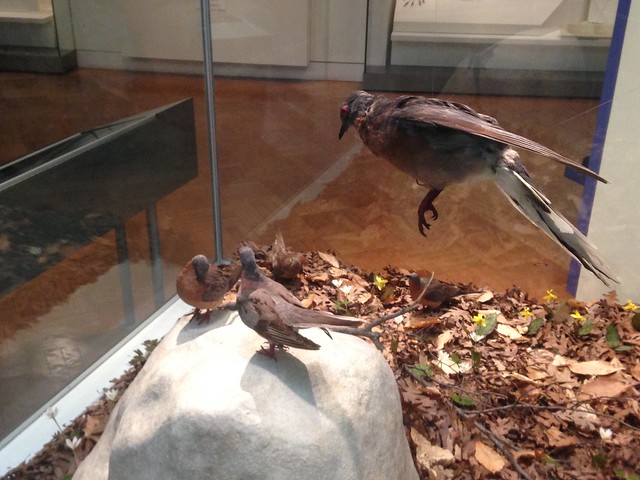
Passenger pigeons!

There are at least two reasons for bringing out the pigeons. First, 2014 marks the centennial of the death of the last passenger pigeon, Martha, kept in the Cincinnati Zoo. Second, the Long Now Foundation is launching a program to recreate (or "de-extinct") the passenger pigeon using biotechnology. (You can watch Stewart Brand explain the idea in a TED talk.) The idea is explored and critiqued in this very good PBS video:


On the one hand, witnessing the passage of a massive flock of passenger pigeons would surely be awe-inspiring. On the other hand, people might not welcome what could be taken now for an invasive species. Ontarians might recall when, in the 1960s, Canada geese were introduced into the province where they had become relatively rare. Would billions of ravenous wild pigeons truly be warmly received?

It is remarkable that, 100 years after its extinction, the "wild" or passenger pigeon can still inspire awe and ambition. It is no wonder that the editors of Guelph's Centennial newspaper thought it deserved a place in their history of the early days of the Royal City.


Guelph and its vicinity were frequented by the passenger pigeon. Here is a list of sightings of and interactions with flocks of wild pigeons gleaned from various sources:
  • 1834: "Nichol, Elora ... Two or three lots, trees filled with nests." (Mitchell 1935, p. 39)
  • 1835: "An immense rookery extended on both sides of the River Speed from Guelph to Rockwood; within its bounds trees were broken down by the weight of the pigeons and at the proper time, wagon loads of the young birds could be easily obtained." (Curry 2006, p. 251)
  • 1849 & 1851: “A singular feature of the present ?? large flights of wild pigeons now ?? country. We have observed ?? immense extent, pass over Galt. In Blenheim and Puslinch, they ?? we are informed, than during ?? hatched there in 1849. From ?? flock follows flock in endless succession ?? the morning towards the north, ?? turning to roost in the south. ?? to prove that the season is less ?? than with us, inasmuch as the ?? living here, which they cannot ?? owing to the depth of the snow. ?? part of the prodigious fall of snow ?? lands, came from eastward, ?? therefore comparatively free. ?? these pigeons are killed—at this ?? they are mere bunches of skin ?? worth the powder that brings them ??—Galt Reporter” (Globe, 11 Jan. 1851)
  • 1850s: "Mr. Fred Fennell of Guelph has told me many times that his father as a boy lived in what is now Riverside Park, in 1870s, and he often related how the pigeons lighted in the hardwood trees of that area in great numbers and that his father before him recalled huge flocks feeding on beech nuts in that forest which stretched along the river." (Steele 1967, p. 173)
  • 1854: “Wild pigeons in abundance have appeared in this part of the Province during the past two weeks, and command the attention of the amateur sportsmen.” (Guelph Advertiser, 19 June 1854)
  • 1855: "The last known nesting site in this area was Hatch's Swamp, 1855, where the Collegiate Institute now stands and stretching a mile or more northward..." (Steele 1967, p. 172)
  • 1860s: "North of Guelph is a small settlement known as Marden, and here lived the Blyths, early pioneers of that area, and their land had a stream flowing through it and hardwoods and bush on either side and they told how they shot the pigeons in great numbers in the hardwood and bush, and their story was that if the swamp there could be drained, you would be able to collect a ton of shot that was expended at the pigeons. This of course is just a story but it helps to prove that the pigeons were in great numbers there at the time, in the 1860s. Mrs. Charles Blvth said that her father, Mr. Charles Atkinson, used to bring pigeons home by the sackful from that bush." (Steele 1967, p. 173)
  • 1869: “Wild pigeons have lately been on the wing northward in great numbers. This is considered a harbinger of early spring, but not one that can be trusted.” (Mercury, 5 April 1869)
  • 1876: “Pigeons. –Wild pigeons have not been so numerous in this neighborhood for a very long time as they are this year. People from the country tell us that in some sections they actually swarm. Sportsmen had better make hay while the sun shines.” (Mercury, 13 April 1876)
  • 1870s: "The late Jack Smith of Guelph who was the eldest of a family of noted hunters and trappers, stated that as a boy he and his brother Joe, next to him in age, and his father shot pigeons in Heming's Bush in the late 1870s, which is in close proximity to what is now the main part of the city of Guelph." (Steele 1967, p. 174)
  • 1882: “Several flocks of wild pigeons flew over Guelph.” (Mercury, 17 Oct. 1882)
  • 1887: “Wild Pigeons. Thirty or forty years ago wild pigeons used to make this locality their breeding ground. For the last quarter of a century they have almost disappeared, with the exception of a stray one now and again. On Tuesday morning about ten o’clock Mr. Thos. Weir and others saw a large flock flying northwards.” (Mercury, 7 April 1887)
  • 1897: “Guelph. … On Tuesday morning a flock of wild pigeons was seen flying northward. Such a sight has not been witnessed in this vicinity for the last quarter of a century.” (Mercury, 8 April 1897)
If you come across any further flock sightings in this area, please leave them in the comments!
Here are some sources that I have used for this posting that you may wish to consult.

Greenberg, Joel (2014). A feathered river across the sky: The passenger pigeon's flight to extinction, New York: Bloomsbury. See also the related Project Passenger Pigeon online!

Mitchell, Margaret H. (1935). The passenger pigeon in Ontario. University of Toronto Press.

Steele, William S., (1967). The passenger pigeon in Wellington County, Ontario. Canadian Field Naturalist 81: 172-174.


Thanks to Chris Early, Leslie Rye, and Alan Watson of the University of Guelph for helping me to track down our local passenger pigeons and William Steele's paper.

Thanks to Mark Peck of the ROM for his help in this effort also. As a postscript, Mark notes that you can see one of the Guelph birds nearby at the AGO:

None of the birds listed are on display at the ROM but, we had one of the birds (ROM #94346), remounted this year by one of our taxidermists', Ken Morrison of Feathers Alive in Huntsville, and it is now on display at the Art Gallery of Ontario for one of their temporary exhibits.
This bird was one of those males collected by William Steele in Guelph (Steele 1967, p. 174). So, if you are in neighbourhood, you can go and see this historic Guelphite for yourself.