Friday, 31 October 2014

The passenger pigeon

The 1927 Centennial edition of the Guelph Mercury provides a chronological listing of notable news items from the previous 50 years. Among those items is the following brief note:
1882: October 17. –Several flocks of wild pigeons flew over Guelph.
It is puzzling to think that editors of the Centennial edition would bother to mention some pigeons. However, it makes more sense when you realize that "wild pigeon" is what people usually called the passenger pigeon in those days.

The passenger pigeon was one of the most remarkable birds of North America. Individually, the male birds were regarded as attractively dressed, with red eyes, blue-gray heads and backs and brick-red breasts. The females were more brown on their upper parts and pale or buff colored below. Many artists made pictures or paintings of the bird, including the famous naturalist John James Audubon, whose picture of a young male being fed by its mother is reproduced in the postcard below.


The card was printed by Barton-Cotton Inc., Baltimore, taken from a painting made by Audubon in 1824.

Of course, the most notable aspect of the pigeon was its habit of congregating in enormous flocks. Often found in the tens or even hundreds of millions, the biggest flocks probably numbered billions of individuals. Descriptions of the flocks nearly always state that they darkened the skies for hours or even days. Perhaps the largest ever recorded was seen by Major W. Ross King at Fort Mississauga on Niagara-on-the-Lake, Ontario around 1860 (Greenberg 2014, p. 5). King reported that the flock stretched a mile or more in breadth and went from horizon to horizon. For 14 hours, more and more pigeons flew overhead in a dense column. The sight was repeated each day for days afterwards. Modern estimates of the size of the flock put it at about 3.7 billion birds, a number that staggers the imagination!

The reasons for the enormity of the flocks are unknown. Some birds collect into large flocks in order to collaborate on finding food and water and avoid predators. Swarms of Australian budgies seem to operate this way, flocking to share water sources, keep a look out for hawks, and challenge any threats that do emerge. Steven Pearce has posted some spectacular footage of swarming budgies on his blog.


A segment from a recent BBC documentary also features a big flock of budgies and notes that their congregations may function as a kind of super-organism, allowing the birds to access and process information as a collective that they could not do individually.


This footage provides perhaps a taste of what a massive flock of wild pigeons was like.

The pigeons flew across eastern North America from the Gulf of Mexico to Hudson Bay and Maine to Montana. However, their home territory seems to have been centered on the southern Great Lakes region, including southwestern Ontario. They flew swiftly, at perhaps 90 k/h, and could cover large distances daily. One note from the Detroit Free Press observed that passenger pigeons shot in that vicinity were found to have rice in their crops, a grain that grew about 700 miles distant (Toronto Globe, 23 March 1850), presumably to the south. In other words, the birds had flown that far since their recent meal of rice.

Passenger pigeons seem to have subsisted on seeds and fruits. Local lore has it that they enjoyed acorns and beech nuts particularly, so that flocks would appear when those foods were abundant. However, they would take a variety of foods. One old timer describes the pigeon's diet as follows (Globe, 3 June 1905):

It lives entirely on vegetable matter, such as fruits, grain, nuts, seeds, bulbs and plants. I have taken from the crop of one more than a good handful of beechnuts, which would be packed so tightly that it must have seriously incommoded its flight. When nuts and grain are scarce they will eat nearly anything in the vegetable line, such as buds, tender shoots, grasses and some kinds of fungi. Although I have taken all I have named and more from their crops, I do not recollect seeing any animal remains, such as worms or insects, of which most birds are so fond.
They were also reported to feed in farmers' fields and were regarded sometimes as pests for that reason. Dr. Henry Howitt of Guelph reported that his father viewed them in this way (Steele 1967, p. 173):
[Howitt] also said that in the 1850s the pigeons were in large numbers in this area and he recalled the difficulty his father had with the spring planting of grain at that time on their farm near where the lime kilns are now situated.
That would be somewhere near Wellington St. and east of the Hanlon Expressway.

Besides feeding and migration, the passenger pigeon also nested in vast hordes. Rookeries of the biggest flocks were reported to cover hundreds of acres. One retrospective report describes a rookery near Blenheim, Ontario as covering a space six or eight miles in length and nearly the same width (Globe, 15 Dec. 1894). Another report says that the biggest rookery occurred in Michigan and measured about 28 miles by three or four miles (Globe, 18 May 1907). The noise made by the crowds in these roosts must have been phenomenal, as is confirmed by one retrospective description about a rookery near Exeter, Ontario (Globe, 4 Feb 1899): "They could be plainly heard cooing three miles away."

Besides the area covered, the flocks were noted for their tendency to break down the trees where they nested. Indeed, they could decimate forests and fields with the weight of their bodies and their droppings. This report of a rookery along the Speed River at Guelph in 1835 is typical (Curry 2006, p. 251):

An immense rookery extended on both sides of the River Speed from Guelph to Rockwood; within its bounds trees were broken down by the weight of the pigeons and at the proper time, wagon loads of the young birds could be easily obtained.
Being in the midst of such a vast rookery must have been an other-wordly experience.

Of course, as noted above, the locals did not merely marvel at the abundance of the passenger pigeons. The birds were also taken as food. In his book "The Grand River Iroquois: Their music and customs", J. C. Hamilton records the tune of a Pigeon Dance performed by the Six Nations people who located here after the American Revolution. (Unfortunately, I have not been able to locate a copy of the book.) Probably, the import of this song was like the Seneca story about the bird, in which the passenger pigeon is called "Big Bread" and is offered to humanity as a tribute. One old-timer recalled how First Nations people continued to harvest the birds from a rookery in the early 1850s near Blenheim (Globe, 15 Dec. 1894):

No bird is more graceful in form and motion than the matured pigeon, and none is more awkward and unsightly than the "squabs", as the young are called. These were easily dislodged by the arrows of the Indians, who came in droves from the reserve on the Grand River. The squaws were laden with great baskets of the unctious fare, and many a wigwam and home had rich and dainty food that spring and summer.

Early settlers found that the birds provided food for them when they were threatened with starvation (Globe, 3 April 1869):

And the extra-ordinary statement is found in the M.S. of the late Mr. Merritt, that one old couple, too old to help themselves, and left alone, were preserved providentially from starvation by pigeons, which would occasionally come and allow themselves to be caught. The fact is stated by others, that pigeons were at times, during the first years of settling, very plentiful, and were always exceedingly tame. Another person remarks, that although there were generally plenty of pigeons, wild fowl, fish and partridge, yet, they seemed to keep away when most wanted.
It seems that, sometimes, the pigeons were greeted like manna from heaven.

As settlement proceeded, settlers refined their harvesting methods. At rookeries, fallen squabs might simply be collected from the ground. Others were dislodged from their nests with poles (Globe, 5 June 1900):

The rising generation is apt to discredit stories of pigeon-hunting with a pole and bag, but many remember the easy sport of knocking the birds from the trees. In the neighborhood of their roosts a bag of pigeons was as easily gathered as a bag of apples in an orchard.
Birds on the wing could be caught in nets. One technique was simply to erect nets in the flight path of roosting birds, as seems to be the case with the net from St. Anne's, Lower Canada, 1829 (Library and Archives Canada C-012539).


Another method was to entice pigeons into an open field and then propel a net over them. The pigeons might be baited with food or salt, or a stool pigeon could be employed. This was typically a pigeon linked to a special rod that could be moved up and down to cause the pigeon to hover and land, apparently suggesting to other birds that it was safe to land there (Globe, 15 Dec. 1894).

Of course, the most common method for obtaining pigeons was to shoot them. Whenever a flock of pigeons was sighted in a given area, the local newspapers would print a notice and urge local hunters to take advantage. For example, here is a notice from the Guelph Mercury (13 April 1876):

Pigeons. –Wild pigeons have not been so numerous in this neighborhood for a very long time as they are this year. People from the country tell us that in some sections they actually swarm. Sportsmen had better make hay while the sun shines.
News would travel widely by the telegraph lines laid alongside the railway tracks, and trains full of sportsmen and even professional pigeon hunters would arrive in return.

Flocks of pigeons often flew low to the ground, where armed men could simply blast away at them. Another tactic was to wait until the birds had roosted in dense quarters for the night (Globe, 15 Dec. 1894):

But it was in the autumn when the rarest sport was afforded. Then the pigeons gathered in some low, dense, second-growth timber to rest at night. These trees grew closely together, and were seldom over twenty feet in height. The hunter waited till darkness gathered like a pall, and then, provided with a pitch-pine torch, the slaughter began. No artist could ever paint such a scene. The tops of the trees were covered by what, looking in the flashing light [of gunshots] seemed like snow balls. These were the startled victims, with breast-feathers erect. At each discharge the ground was strewn with fluttering game, and those not touched were attracted to the fatal light, awaiting their doom.

Although a wild animal, the passenger pigeon's way of life lent itself to inclusion into the industrial style of food production that was taking shape in the 19th century. The eastern half of North America was being turned into a vast food-making machine through farming and railway technologies. Pigeons could be killed in the thousands and packed into apple barrels for shipping to eastern urban centers, as noted in this news item (Globe, 15 Jan. 1883):

A hunter recently killed, during four weeks, 30,000 wild pigeon in a pine forest near Fayetteville, Ark. He found a market for them all in Chicago, Ill.
In 1855, is was estimated that 25,000 dozen wild pigeons were sold in markets in New York City (Globe, 3 Dec. 1855). Vendors quoted prices in the newspapers, e.g., $1 / dozen in Toronto (Globe, 5 Sept. 1857) and $2.50 / dozen in Montreal (Globe, 3 March 1880). The passenger pigeon had become a commodity.

In addition to their use as food, pigeons were captured for sport. Gun clubs would purchase multitudes of pigeons for trap shooting contests. Each shooter would have a given number of birds to shoot at, one-at-a-time, and the winner was the one who shot the most. Onlookers could gamble on the results. Large competitions could consume thousands of birds, e.g., (Globe, 31 May 1873):

The State Shoot. –The Buffalo Commercial Advertiser understands that the Dean Richmond Shooting Club, of Batavia, have now on hand about two thousand wild pigeons, for the coming Sportsmen’s State Convention at that place. Mr, Knapp, who went West for the purpose of securing birds, left Wisconsin on Monday last with twelve thousand more, so that it is not likely there will be any scarcity of feathered marks for the boys to ‘bang away’ at. …
Guelph newspapers carried detailed records of pigeon shooting matches held in the city or attended by residents. George Sleeman, the brewer and Mayor, was especially fond of the sport and often hosted matches on his estate at the west end of town. Matches could be between teams, e.g., Guelph vs. Berlin (now Kitchener), or individuals, e.g., (Mercury, 6 Dec. 1880):
Pigeon Shooting. –On Saturday afternoon a friendly pigeon pop took place on the last near Sleeman's brewery, between Mayor Sleeman and John Leanly. The following is the result: Leanly 3; Sleeman 8.
A team match between Guelph and Aberfoyle required 200 birds (Mercury, 8 Nov. 1881).

The sport of pigeon shooting could be controversial. For one thing, safety was often not a priority for the managers of the shoot, and the handling of the birds attracted criticism. Consider the following report from the Guelph Mercury (26 Dec. 1883):

Dangers of Pigeon Shooting. –... There were two pigeon shooting matches in progress during the day, the one near the water works and the other in the vicinity of Mr. George Sleeman's brewery. There was a considerable number at both, and several reports have come to hand about the careless manner in which the shooting was conducted, shots being fired in all directions. While Dr. and Mrs. Hewitt of Toronto, were driving along the Waterloo Avenue from the city a shot went through Mrs. Hewitt's bonnet. It is also reported that Mr. Mair, Manager of the Federal Bank, and another gentleman were struck by stray shot. These things should teach City Council that a by-law is necessary which will prevent shooting off fire arms within the city limits altogether.
Perhaps holding the event at a brewery was not a good idea.

However, the article continues on to challenge the sport itself:

Pigeon shooting is inhuman sport at any rate; in England it has been stopped by a law made last session, and although there is no such act in Canada, a cruel amusement would be stopped and the dangers of a careless use of firearms lessened as far as this city is concerned by such a by-law as we speak of.
Indeed, Westminster had just passed a law prohibiting the sport on the grounds of the customary treatment of the domestic pigeons used in Britain (Globe, 27 March 1883):
It ... is a common practice to mutilate pigeons before placing them in the trap by pulling out their tail feathers and rubbing pepper into the wound, in order to make them fly. A still more fiendish act of barbarity is the gouging or pricking out of one or other of the bird’s eyes so as to ensure its flight to the left or right side as may be desired. These and kindred atrocities are continually practiced by those who have the handling of the birds, with the object of making them swift or slow in flight according to the arrangements made by those who have money bet on the matches.
It is known that stool pigeons in Canada could be blinded (Globe, 15 Dec. 1894), so it appears that passenger pigeons in Canadian pigeon pops sometimes received similar treatment to those in Britain. I am not aware that the shoots were ever banned. Instead, passenger pigeons simply became more and more scarce.

Indeed, passenger pigeon flocks began to dwindle in Ontario so that the appearance of one at Guelph in 1876 was the first "in a very long time". The appearance reported in the Mercury in 1882, quoted above, was certainly noteworthy but the last sighting I have found in that paper is in 1897 (8 April):

Wild Pigeons. Thirty or forty years ago wild pigeons used to make this locality their breeding ground. For the last quarter of a century they have almost disappeared, with the exception of a stray one now and again. On Tuesday morning about ten o’clock Mr. Thos. Weir and others saw a large flock flying northwards.
The last wild specimen on record was shot in 1900 in Ohio. Odd sightings were reported for two or three decades later but these were probably mourning doves that were mistaken for passenger pigeons. Explanations for their disappearance varied. One theory had it that the pigeons had flown to South America where, like fugitives, they could avoid the hunting they faced in the north (Globe, 30 June 1900). Given some time to recover, it was hoped that the birds would return northwards once again. Others held that flocks simply could not find sufficient food, since the forests on which they depended had been converted to agriculture by settlers (Globe, 18 May 1907):
Though the forests of the early days supplied them with food in abundance, a modest calculation of their needs shows that the survival of the great flocks would have made the cultivation of the land impossible. It was as necessary to clear away the wild pigeon from the forest lands of Ontario as it was to clear away the buffalo from the prairies of the west.
Another thought was that the birds had succumbed to some natural disaster such as flying out to sea in a fog or being slain in a storm. Such misadventures had happened to individual flocks before (Globe, 25 Feb. 1899):
I was reminded of an incident told me by a friend of mine who worked at Jarvis Island mine on Lake Superior, while Captain Plummer was in charge of the mine. He was crossing from Jarvis Island to Port Arthur in a sailboat early in May. There had been a squall, with heavy hailstorm, and shortly after he left the boat ran through acres of wild pigeons floating on the water. They had evidently been beaten down by the storm and drowned while crossing the lake. He said there were hundreds of thousands of them. No doubt many others have been destroyed in the same way. ... Can it be possible that storms on the great lakes have destroyed them all, or do they exist in other countries.
Few people seemed to blame the increasingly efficient slaughter and consumption of the birds. It seemed inconceivable that a bird once present in the billions could be wiped out in a matter of years.

The birds were missed after their extinction. Many writers who wrote in to newspapers to report late sightings reminisced about the pigeons as if they were childhood friends encountered once more, e.g., (Globe, 9 June 1900):

To the Editor of the Globe: Your correspondent who speaks of the disappearance of the wild pigeon is nearly true. I have hardly seen any for about thirty years, but about three weeks ago while driving from Kingsville to Harrow I saw a pair. They flew from near a culvert over a small stream, into the bush, where they lit in a small tree, and I knew them.
I felt just as though I had met a friend of my boyhood days. I have killed great numbers when they were plentiful. Toronto, June 4. Joseph Barrett.

Although gone, the birds retain a shadowy presence in Ontario. Many place names in the province reflect their former haunts. Mitchell (1935, p. 62) notes several locations bearing the First Nations' names for the bird, which was "O-me-me-wog" in Pottawattomie and "Omimi" in Chippewa and Cree. These locations include Mimico in Toronto at the mouth of the Humber River, Omeme on the Pigeon River west of Peterborough, and Omeme(a) Island, next to The Massasauga Provincial Park near Parry Sound. In addition there is Omeme Lake in Quetico Provincial Park west of Thunder Bay.

English place names containing the term "pigeon" also refer to the passenger pigeon. The Natural Resources Canada website lists 29 such places in Ontario. Some of these include Pigeon Falls, along the Pigeon River west of Thunder Bay, which forms the border between the U.S.A. and Canada, several Pigeon Lakes, such as the Pigeon Lake west of Peterborough, fed by Pigeon Creek and the local Pigeon River past Omeme, Pigeon Hill northwest of Renfrew,
Pigeon Point in Georgian Bay just west of Collingwood, and Pigeon Bay on the north shore of Lake Erie from Kingsville to the end of Point Pelee. This last area is famous as a resting place for migratory birds, and the passenger pigeon seems to have frequented it also in times past. (If you know of others pigeon-related places in Ontario, leave them in the comments please!)

Although the passenger pigeon is long extinct, it is possible to see some. The Royal Ontario Museum (ROM) has recently brought its collection of stuffed birds out of retirement. The ROM houses one of the biggest collections of pigeon remains, about a half-dozen of which originated in the Guelph area (Steele 1967). Some of the stuffed birds are now on display in the Gallery of Birds section devoted to Life in Crisis. The birds are depicted in a mural scene set in Forks of the Credit. The display continues until 12 April 2015. Here is a photo I took of part of the display.
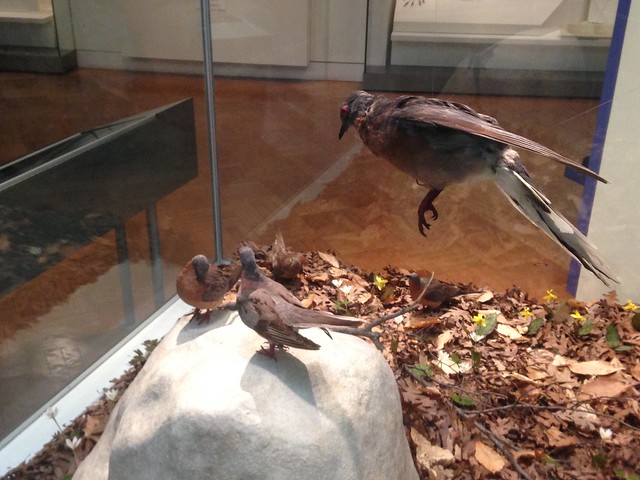
Passenger pigeons!

There are at least two reasons for bringing out the pigeons. First, 2014 marks the centennial of the death of the last passenger pigeon, Martha, kept in the Cincinnati Zoo. Second, the Long Now Foundation is launching a program to recreate (or "de-extinct") the passenger pigeon using biotechnology. (You can watch Stewart Brand explain the idea in a TED talk.) The idea is explored and critiqued in this very good PBS video:


On the one hand, witnessing the passage of a massive flock of passenger pigeons would surely be awe-inspiring. On the other hand, people might not welcome what could be taken now for an invasive species. Ontarians might recall when, in the 1960s, Canada geese were introduced into the province where they had become relatively rare. Would billions of ravenous wild pigeons truly be warmly received?

It is remarkable that, 100 years after its extinction, the "wild" or passenger pigeon can still inspire awe and ambition. It is no wonder that the editors of Guelph's Centennial newspaper thought it deserved a place in their history of the early days of the Royal City.


Guelph and its vicinity were frequented by the passenger pigeon. Here is a list of sightings of and interactions with flocks of wild pigeons gleaned from various sources:
  • 1834: "Nichol, Elora ... Two or three lots, trees filled with nests." (Mitchell 1935, p. 39)
  • 1835: "An immense rookery extended on both sides of the River Speed from Guelph to Rockwood; within its bounds trees were broken down by the weight of the pigeons and at the proper time, wagon loads of the young birds could be easily obtained." (Curry 2006, p. 251)
  • 1849 & 1851: “A singular feature of the present ?? large flights of wild pigeons now ?? country. We have observed ?? immense extent, pass over Galt. In Blenheim and Puslinch, they ?? we are informed, than during ?? hatched there in 1849. From ?? flock follows flock in endless succession ?? the morning towards the north, ?? turning to roost in the south. ?? to prove that the season is less ?? than with us, inasmuch as the ?? living here, which they cannot ?? owing to the depth of the snow. ?? part of the prodigious fall of snow ?? lands, came from eastward, ?? therefore comparatively free. ?? these pigeons are killed—at this ?? they are mere bunches of skin ?? worth the powder that brings them ??—Galt Reporter” (Globe, 11 Jan. 1851)
  • 1850s: "Mr. Fred Fennell of Guelph has told me many times that his father as a boy lived in what is now Riverside Park, in 1870s, and he often related how the pigeons lighted in the hardwood trees of that area in great numbers and that his father before him recalled huge flocks feeding on beech nuts in that forest which stretched along the river." (Steele 1967, p. 173)
  • 1854: “Wild pigeons in abundance have appeared in this part of the Province during the past two weeks, and command the attention of the amateur sportsmen.” (Guelph Advertiser, 19 June 1854)
  • 1855: "The last known nesting site in this area was Hatch's Swamp, 1855, where the Collegiate Institute now stands and stretching a mile or more northward..." (Steele 1967, p. 172)
  • 1860s: "North of Guelph is a small settlement known as Marden, and here lived the Blyths, early pioneers of that area, and their land had a stream flowing through it and hardwoods and bush on either side and they told how they shot the pigeons in great numbers in the hardwood and bush, and their story was that if the swamp there could be drained, you would be able to collect a ton of shot that was expended at the pigeons. This of course is just a story but it helps to prove that the pigeons were in great numbers there at the time, in the 1860s. Mrs. Charles Blvth said that her father, Mr. Charles Atkinson, used to bring pigeons home by the sackful from that bush." (Steele 1967, p. 173)
  • 1869: “Wild pigeons have lately been on the wing northward in great numbers. This is considered a harbinger of early spring, but not one that can be trusted.” (Mercury, 5 April 1869)
  • 1876: “Pigeons. –Wild pigeons have not been so numerous in this neighborhood for a very long time as they are this year. People from the country tell us that in some sections they actually swarm. Sportsmen had better make hay while the sun shines.” (Mercury, 13 April 1876)
  • 1870s: "The late Jack Smith of Guelph who was the eldest of a family of noted hunters and trappers, stated that as a boy he and his brother Joe, next to him in age, and his father shot pigeons in Heming's Bush in the late 1870s, which is in close proximity to what is now the main part of the city of Guelph." (Steele 1967, p. 174)
  • 1882: “Several flocks of wild pigeons flew over Guelph.” (Mercury, 17 Oct. 1882)
  • 1887: “Wild Pigeons. Thirty or forty years ago wild pigeons used to make this locality their breeding ground. For the last quarter of a century they have almost disappeared, with the exception of a stray one now and again. On Tuesday morning about ten o’clock Mr. Thos. Weir and others saw a large flock flying northwards.” (Mercury, 7 April 1887)
  • 1897: “Guelph. … On Tuesday morning a flock of wild pigeons was seen flying northward. Such a sight has not been witnessed in this vicinity for the last quarter of a century.” (Mercury, 8 April 1897)
If you come across any further flock sightings in this area, please leave them in the comments!
Here are some sources that I have used for this posting that you may wish to consult.

Greenberg, Joel (2014). A feathered river across the sky: The passenger pigeon's flight to extinction, New York: Bloomsbury. See also the related Project Passenger Pigeon online!

Mitchell, Margaret H. (1935). The passenger pigeon in Ontario. University of Toronto Press.

Steele, William S., (1967). The passenger pigeon in Wellington County, Ontario. Canadian Field Naturalist 81: 172-174.


Thanks to Chris Early, Leslie Rye, and Alan Watson of the University of Guelph for helping me to track down our local passenger pigeons and William Steele's paper.

Thanks to Mark Peck of the ROM for his help in this effort also. As a postscript, Mark notes that you can see one of the Guelph birds nearby at the AGO:

None of the birds listed are on display at the ROM but, we had one of the birds (ROM #94346), remounted this year by one of our taxidermists', Ken Morrison of Feathers Alive in Huntsville, and it is now on display at the Art Gallery of Ontario for one of their temporary exhibits.
This bird was one of those males collected by William Steele in Guelph (Steele 1967, p. 174). So, if you are in neighbourhood, you can go and see this historic Guelphite for yourself.

Sunday, 28 September 2014

Bell Organ and Piano Co. clock

In previous posts, I have been revisiting some of the civic clocks that once looked out over the Royal City. Some were public clocks, such as those on the City Hall and on the old Post Office. Others were private property but nevertheless served as public timepieces, such as the Scotiabank clock. Another privately held clock prominently displayed in a public place was the Bell Organ and Piano Co. clock (the "Bell clock").

The company ("Bell Organ Company" to begin with) was founded by William and Robert Bell in 1864 and was taken over the next year by William. The business proved to be a great success and was moved from Wyndham St. to a larger facility in Market Square on Carden St. in 1871. By 1880, the company was billing itself as, "The largest and oldest organ factory in the British Empire"(Couling 1996, p. 13). The company decided to expand its factory into additional space on Market Square at the east end of Carden St. Besides more factory floor room, the company topped off their new structure with a clock tower. The new building and clock tower can be well seen in the postcard below.


The card was published by A. B. Petrie & Son sometime around 1905. It shows the south face of the building, looking out over the rail yards.

Today, the lot is largely empty, as you can see from this Google Street View perspective (taken from a lower angle), making the old factory a kind of ghost building:


View Larger Map

The clock was manufactured by the Seth Thomas Clock Co. of Thomaston Connecticut. It is described in glowing terms in the Mercury (29 Mar. 1882):

The clock stands 5 feet 8 inches high, and will have four illuminated dials of ground plate glass each measuring 4 feet 6 inches in diameter, the cost of which are $80 each. The pendulum weighs 130 pounds, and the hands are gilt, 2 feet 3 inches long. This is the first illuminated clock to our knowledge in the country.
The Seth Thomas catalog of 1911 lists a similar clock (No. 16) as an eight-day mechanism, suggesting that the Bell clock was wound once a week as well.

Here is a picture of No. 16 from the catalog. Somehow, it is not as I imagined.


It is clear that the townsfolk were impressed with the new timepiece. Indeed, installation of the clock on 20 April 1882 is noted in the Centennial edition of the Mercury (1927) as a noteworthy event in Guelph history. Perhaps Bell put the clock there precisely to impress or to boast. Today, high rise structures are sometimes built partly to stroke the ego of the builder. (Pick any Trump Tower for an illustration.) Also, the clock would have to be especially good since it was on the same street as the City Hall clock tower. A photo of both buildings in the Public Library archives shows how well the two clocks were lined up. Perhaps to minimize the competition, the Bell clock is placed as far away from City Hall as possible.

However, a more specific purpose may also be present. Besides its distance from City Hall, the Bell clock also dominated the Grand Trunk Railway station which was at the east end of Carden St. in that era. The entry on William Bell in the Cyclopedia of Canadian Biography (1888, p. 140) makes the point quite plain:

Four large dials on the tower, which surmounts the central corner, announce the time of day to the neighborhood and to passengers on the Grand Trunk Railway, the station of which company is quite contiguous to the factory.
Anyone arriving in or departing from the Royal City by the G.T.R. would likely have taken note of the Bell clock.

In addition, this photo from the Civic Museum archive shows that the clock tower stood at the end of Neeve St. where it crossed the railway tracks at the time. It was a common practice among architects to situate prominent features at the end of cross streets in order to add to their effect. Consider the siting of the steeple of St. George's Anglican Church at the end of Douglas St. as seen from St. George's Square, for example. Anyone entering downtown from Neeve St. would have faced the tower surmounted by its boldly illuminated dials.

The clock endured a number of trials over its life. On 22 Dec. 1883, a fire occurred in the Bell factory that stopped the clock at exactly midnight (Mercury). Happily, it did not seem to have been badly damaged. In November 1909, the clock stopped due to cold weather brought on by a storm (Mercury, 23 Nov. 1909). It was not unusual for outdoor clocks to have difficulty in the cold. In 1911, the G.T.R. station was moved next to the City Hall and the Neeve St. crossing was cut off. Thus, the clock was deprived of part of its raison d'être.

It is hard to tell when the Bell clock was finally removed. The company reached its zenith of production by about 1888, at which point it was sold to a British syndicate and renamed the "Bell Piano and Organ Co., Ltd." (Johnson 1977, pp. 295-296). Production suffered due to economic recession and World War I and did not recover during the 1920s. The Company was sold to a syndicate of Brantford businessmen led by John Dowling in 1928 (Mercury, 11 Apr. 1928). The premises were extensively remodeled by Oct. 1929 (Globe & Mail, 4 Oct. 1929) but it is not clear whether or not this included the clock tower. The firm seems to have gone bankrupt by 1931 and its assets were sold to Lesage Piano of Sainte-Terese, Quebec in 1934. It may be that the clock was removed at this time, although records of the period are spotty. At any rate, it seems to have disappeared to parts unknown by the end of World War Two.

Like all civic clocks, the Bell clock was more than just a timepiece. It was an assertion of importance by the Bell Organ and Piano Company. It was an aesthetic statement by the designers of the building. Perhaps it was also a symbol of progress, its glowing dials signaling to Guelphites from on high that their time had come.

Tuesday, 2 September 2014

Postcard exhibit

The Pepco Edison Place Gallery in Washington D.C. is currently staging an exhibition entitled “Postcards from the Trenches: German and American Soldiers Visualize the Great War”. It features hand-painted postcards sent from the western front by a German soldier named Otto Schubert. The paintings are quite compelling.

Here is an example entitled "Horses under shrapnel fire".


The postcards can be viewed here.

(From the Design Observer.)

Sunday, 31 August 2014

The origin of the Blacksmith Fountain

As noted in an earlier post, St. George's Square is the centre of some controversy. The Square is due for some infrastructure upgrades and, it is proposed, some reconfiguration. More specifically, one proposal calls for the establishment of a large island in its middle. The island would be the site of various attractions and events, as yet not specified.

In that earlier post, I summarized the history of the previous island in the square. That history began with the construction of the Blacksmith Fountain and its surrounding garden in 1885. Of course, that history leaves open an important question: How did the Blacksmith Fountain get there? That takes some explaining.

Here is another postcard in which the Fountain has center stage.


If you look closely at the edge of the grass right under the Fountain, you can see an old reel lawn mower. There also appears to be a young man relaxing behind a post at the left edge of the grass. Perhaps he is supposed to be pushing the mower.

This image is actually the same as the one in the earlier posting but not colourized. It was published by Warwick Bro’s & Rutter in Toronto and was posted 5 Dec. 1908. Curiously, the message reads:

How do you like these stone buildings? The P. O. [Post Office] is in the foreground. Am here at the Winter Fair. Your letter came safely and will answer soon. P. F. C.
In fact, the Fountain is in the foreground. The P.O. is in the background. Nevermind.

As with the current situation, the story of the Blacksmith Fountain begins with some infrastructure upgrades. In 1878, the Royal City began planning a water works, that is, a system of town-wide water distribution through pipes from a central reservoir, located upstream of the town on the Eramosa ("Guelph water supply", Gilbank 1969). By the end of 1880, some ten miles of pipe had been laid.

The aim of the effort was focussed on the provision of hydrants for fire control. Some 94 were positioned by the end of 1880. However, the townsfolk had further ambitions for the system. As Alderman Read put it in 1883, after the citizens had sunk thousands of dollars into the construction of the water works, they still could not get a drink (Guelph Mercury, 21 Aug. 1883). Already in 1880, people were thinking in terms of a fountain for St. George's Square (5 May 1880):

The suggestion had been made that a cheap drinking fountain for horses should be placed in the centre of St. George's Square. The city may contemplate placing a large fountain there at some future day...
No cheap fountain was put in place, that I am aware of. However, the idea for a grand installation seems to have stuck in people's minds.

So, the infrastructure was underground and the idea was in the air. However, the cash was lacking. That problem was addressed by the generosity of the city's leading men of industry. In the summer of 1883, the town council received a "liberal offer" from Mr. David McCrae (see photo here). McCrae, father of the famous John McCrae, was a farm owner and animal breeder, co-owner of the profitable Armstrong, McCrae & Co., a woolen clothing factory, and also captain of the Ontario Battery of the 1st Provisional Brigade of Field Artillery, formed in 1880 (Johnson 1977, p. 211). Mr. McCrae offered to pay the town one or even two years of his taxation exemption (think "tax refund") as a contribution towards some civic improvement (21 Aug. 1883). The council leaped at the chance and talk turned immediately to fountains. Alderman Read suggested four or five "not expensive" fountains might be placed around the town. Alderman Stevenson, however, was keen on something more dramatic:

Ald. Stevenson was in favor of having something grand–say an imposing fountain on St. George's Square, and the work to be commenced at once.
Alderman Laing suggested a park. However, Ald. Stevenson's idea carried the day and the council struck a Special Committee to pursue the matter.

By October, it became clear that the council did not have money enough for the imposing fountain it desired. It is not clear why. Either McCrae's donation was not sufficient, or perhaps they split it up amongst several projects. In any event, they began to look for additional sources of funding (2 Oct. 1883).

The Committee collected money by subscriptions throughout the fall and winter. In this way, they collected the substantial sum of $500 (8 Apr. 1884). However, the breakthrough came in May with the arrival of another generous donation from a well-to-do business man, Mr. J. B. Armstrong. Mr. Armstrong sent the following open letter to Mayor Caleb Chase, reprinted in the Mercury (6 May 1884):

To His Worship the Mayor and Corporation of the City of Guelph:
In reply to a wish by the Council toward erecting and fitting up a fountain on St. George's Square, I beg to say I should be pleased to present the city with a fountain according to the accompanying design, the other subscribers to furnish the base surrounding and fit it up. It will be about 12 or 14 feet high, the central figure representing Industry.
Mr. Hall has kindly furnished the accompanying sketch, and will furnish you any particulars you want.
Yours very truly,
J. B. Armstrong.
Too bad that the paper did not publish the sketch!

J. B. Armstrong (who seems always to be referred to as "J. B." instead of "John" or "James") is listed as a 33-year-old carriage maker in the 1871 census. The Industrial Number of the Mercury in 1908 states that the business was founded in 1834 and incorporated under the name J. B. Armstrong in 1876. Its addresses were 41, 43 & 45 Macdonnell St. Clearly, Mr. Armstrong was doing well.

Why he decided to contribute to the fountain in St. George's Square is not clear. Perhaps he was related to the Armstrong who was David McCrae's business partner and was persuaded to climb aboard the project. Perhaps, like Mr. McCrae, he was a civic booster with a desire to improve the city and make a splash. Perhaps he thought that a monument to industry was overdue. None of the material I have found makes the matter any clearer.

The City gratefully accepted the offer. The form and location of the fountain were now set. However, even with this generous donation, funds were a little short (20 May 1884). That is when the Guelph Amateur Dramatic Club entered the stage.

The Amateur Dramatic Club (ADC) was a group of drama enthusiasts who put on occasional performances in the city. Sometimes, they would donate their box office proceeds to worthy causes. The ADC had just put on a performance of a drama called "Meg's Diversion" and the farce "Done on both sides." The show was a sell-out and the ADC had decided to put on another performance with the proceeds going to the Fountain fund. The proposal, made in a letter to council by ADC President, Mr. E. F. B. Johnston, was immediately accepted (2 Jun. 1884). And so, Guelphites were treated to a repeat performance.

The plot of Meg's diversion is complex (30 May 1884). Meg is persuaded by her father Jeremy Crow to affect feelings for Jasper Pidgeon so that Jeremy can borrow money from Jasper to pay off his looming debts. The ruse works but is then exposed by Japser's older brother Roland. Roland then pursues Meg and wins her affections. However, Meg then discovers that Roland really loves her sister Cornelia and was merely toying with her for revenge. Cornelia, though, is promised to Ashley Merton, Esq. However, Ashley actually prefers Mrs. Netwell (who, I assume, is a widow) and so is relieved to give up his engagement to Cornelia who, then, is free to marry Roland. Jasper, meanwhile, renews his attentions to Meg, who finds that she loves him after all. Finally, Jasper discovers that he has made a fortune (it is not clear how), meaning that he and Meg can live happily ever after in spite of their devious relatives.

The performance was praised in the Mercury:

Miss [Lizzie] Mercer ["Meg"], always a favorite on such occasions, excelled herself... She was accurate throughout, and succeeded in bringing out the double character of a flirt and sincere lover very successfully. ... Mr. [E. F. B.] Johnston ["Jasper"] brought out effectually the value of the true heart and honest, manly character and bearing which belonged to the rough exterior of the carpenter.

The farce Done on both sides is less complex. Mr. Brownjohn visits the Whiffle family to woo Lydia Whiffle and invites himself to dinner. The Whiffles are perplexed because they are hard up and have nothing to eat. The situation is saved by the timely arrival of Mr. Pygmalion Phibbs who is a veterinary surgeon carrying a haunch of venison as a gift for the President of the Veterinary College. The Whiffles tell Phibbs that Brownjohn is the President, whereupon Brownjohn orders Phibbs to prepare the venison for the family dinner, much to Phibbs' dismay. Finally, the truth is revealed and everyone, ludicrously, is reconciled.

The audience seems to have enjoyed it. Perhaps the characters were parodies of local bigwigs.

The event raised around $40 or $50 towards the fountain, which was considered an appreciable sum (6 Jun. 1884). Perhaps it put the project over the top. Mr. J. B. Armstrong soon gave the contract for construction of the granite foundation to Mr. J. H. Hamilton (14 Jun. 1884), owner of a "Monumental Works" on Woolwich St. founded in 1871. The measurements for the statue's base were four feet square by eighteen inches high.

The Blacksmith Fountain was officially inaugurated on Queen Victoria's birthday in 1885. It is described in its historic designation as follows:

The statue of a blacksmith is cast in a metal alloy. Supporting the statue is an octagonal basin, held by a Rococo-style cast iron pedestal. The water spouts from the mouths of eight rams heads that decorate the basin's rim. The base is constructed of red-granite and bears the historic inscription, “Presented by J.B. Armstrong 1884”.
But the tale of the origin of the Blacksmith Fountain is not a tale of iron and granite. It is a tale of plumbing, industry, and amateur dramatics.

PS. The Blacksmith Fountain was removed from St. George's Square in 1922 so that the roadway could run through the middle of the Square. If the middle becomes an island again, should the old gentleman return as well? What would the Fountain Family say?

Saturday, 26 July 2014

The Homewood Retreat grounds

Currently known as the "Homewood Health Centre", Guelph's place of refuge for the afflicted and addicted began as the Homewood Retreat on 18 May 1883. The Retreat was the first wholly, privately owned sanitarium in Canada. The prime movers of its establishment were A. J. W. Langmuir and E. A. Meredith, both of whom were former inspectors of asylums in the Province of Ontario.

They were motivated by both humanitarian and commercial interests. Langmuir thought that a private institution might be able to enact reforms in the care of patients that were not practicable in government institutions (Sanitarium 1983). At the same time, Canadian patients who sought a higher level of comfort and service were traveling to the United States for care. A local institution would keep that revenue in the country and make a profit for the shareholders (Hurd et al., 1917).

Finding a suitable location was crucial to the success of the venture (Sanitarium 1983, p. 1):

[Langmuir] conceived the idea of a private psychiatric hospital, preferably outside of the pressurized life of the big city of Toronto, yet near enough to be accessible by railway or road for horse-drawn vehicles.
Toronto, apparently, was not a good place for people to find rest and recovery. Besides which, land would be more affordable out in the countryside.

However they did it, Langmuir and his associates located an ideal site about one mile north of the centre of Guelph. The 19-acre property epitomized the ideals of the Picturesque. It contained the crest of one of the city's many drumlins, one that commanded an excellent view of the Speed River. In addition, a large and romantic residence sat along the hilltop. This house was "Craiganour", the former home of Donald Guthrie, once the local Member of Parliament, who named it after his birthplace in Scotland.

Craiganour was made of local stone and built in the Italianate idiom then very popular in the country. Notable features include the paired windows with rounded heads, the belvedere in the projecting tower and the broad awning over the porch that stretched around two sides of the structure. The effect was meant to be impressive but, at the same time, inviting. It is a great shame that it was destroyed by an electrical fire in January 1911.

The old building can be seen in the following postcard printed by Rumsey & Co., ca. 1910.


Although the building dominates the photograph, it is the grounds that are the centre of attention. The broad lawn is impressively flat, an observation reinforced by the substantial roller in the middle. Several figures are seen at the edges of the lawn, perhaps preparing to play tennis or croquet. To the left, a stairway can be seen connecting the lawn with the main building.

The site and grounds proved helpful in the rehabilitation of patients. Clearly, outdoor recreation was an important part of the therapy. A report on the facility in the Toronto Globe mentions lawn tennis and quoiting ("The Homewood Retreat at Guelph described," 27 April 1901). The Industrial Number of the Mercury also mentions "cricket creases" (1908). In addition, there are photographs of patients playing bowls on the broad lawns (Sanitarium 1983, p. 18). In fact, a game of bowls on the lawn appears in another postcard, this one published by the International Stationary Co. of Picton also around 1910.


One thing that I enjoy about many of the postcards from this publisher is that people are integral to the photographs. (Look through previous postings to see other examples.) Here, interest in the scene consists of the postures and arrangements of the people in it. Several men sit at their ease in stick furniture while others stand about apparently discussing the play. One lies recumbent on the ground to one side, echoing the posture of the chair in the middle foreground. It is a quiet and even indolent moment.

Besides gaming and sporting possibilities, the grounds offered opportunities for the simple enjoyment of water and greenery. Visitors never failed to notice the beauty of the site and its therapeutic potential. A Globe article on the opening of the institution describes them thus ("The Homewood Retreat", 31 May 1884):

On each [patient's] flat is an alcove with large bay windows facing south, so as to receive the sun for the greater part of the day. From these windows the prospect is a delightful one. The greater part of the twenty-acre park surrounding the building spreads out in front, stretching down to the River Speed, which forms the southern boundary. Glinting patches of the river's surface are seen, changing always as the gently moving leaves close or broaden the view. Dazzled with the brightness, the eye seeks relief and finds it in the sunny or shaded green of the grove, lawn, and meadow.
...
A ramble in the grounds was almost a day's outing. The trees are all strong and beautiful and the grass close and of healthy growth. At the rear of the house are the vegetable garden and orchard, also the stable and stable-yard.
There is one postcard that may capture a view of the Speed near this place. It is labelled simply "River Speed" and was published by Valentine & Son’s sometime around 1905.


The course of the Speed and the shape of the hill opposite are appropriate for a photo taken from the Riverslea estate, built originally by James Goldie and now on the Homewood grounds a little south of the original Homewood. The vista from the belvedere at the Homewood Manor might have been similar.

Another interesting description was given in a letter sent by "Veronica" to a column called "Circle of Young Canada" in the Globe (1 April 1916). In the letter, Veronica describes the scenery where she lives in Guelph:

I'm sure you'd all admire the view from our front windows. I'm not a very good painter of pen-pictures, or any other kind for that matter, but will try to describe it to you. Our house is at the head of a little street that runs down to the River Speed, so we have a clear view of that stream. The other side of the river is closely wooded and the trees were a picture when they were turning all colors. The Homewood Sanitarium is on top of the hill, and every day as the leaves fall we discover new buildings that couldn't be seen before. One of the buildings is called "The Manor" and looks just like an old English home situated in a large park. The scenery all around is beautiful also as there are hills in every direction, either wooded or laid out as farms.
Perhaps Veronica lived near the intersection of Strange (now Dufferin) St. and Clarke St., which affords a decent view of Homewood from across the river.

Besides surveying the Homewood grounds from her window, it may be that Veronica could have explored them readily on foot. A foot bridge had been built across the Speed for the use of patients to get to Homewood from the C.P.R. line on the other side of the river (Sanitarium 1983, p. 8). It was used as such by a special delegation from the Canadian Medical Association in 1910, who were entertained with a buffet luncheon on the lawns.

(This bridge was swept away in the flood of 1912, and it is unclear whether or not it was rebuilt. There is also mention of a foot bridge near Riverslea that existed "within memory of some older Homewood employees" but was removed due to decrepitude; Sanitarium 1983, p. 8).

The Homewood grounds continue to be an important part of the facility and of the greater community. It is, for example, the site of a "horticultural therapy program". Patients learn how to plant and maintain a vegetable garden, which is therapeutic in itself and brings them outside where they can enjoy their surroundings ("Homewood garden part of food production project", Mercury, 16 July 2014):

Currently the garden grows on a roughly 190-square-metre piece of land, surrounded by the centre's beautiful lawns, woods, trails, and historic buildings.

[Program director Tami] Proctor said patients started all of the garden plants from seed and transplanted the seedlings just over a month ago. "It's a true seed-to-table garden," she said.

"This teaches people how to plant a garden," she said. "Some have never planted before, and it gives those with gardening experience the opportunity to really shine and share what they know."

A garden, she said, acts as a "grounding tool," helping patients reconnect with nature, with their senses, and with a sense of inner peace. Digging in the dirt, hearing the surrounding sounds, engaging the sense of smell and taste, is all therapeutic.
The idea is reminiscent of the original idea for the Guelph Correctional Centre, in which prisoners were to be given agricultural tasks to perform in order to detach them from their fondness for alcohol.

Unfortunately, the future of the Homewood grounds may be in question. The current owner, Schlegel Health Care Inc., has applied to the city to sever a number of the lots on the property ("Committee of Adjustment", 12 June 2014). Although no permissions have been granted, it may be that some of the Homewood estate is headed for the auction block. Whether or not that would be a good thing remains unclear, but it would change fundamentally the character of that well-trodden terrain.


26 April 2016:
Schlegel's plans for Homewood portend big changes for the site, or sites. See the Friends of Homewood Grounds website for more information.

Also, see rych mill's Flash from the Past column for more history of the site and institution.

Monday, 30 June 2014

Happy Canada Day, 2014

Canada Day (formerly Dominion Day) seems like a good time to bring out the patriotic postcards. These fall into at least two types. First, some postcards depict patriotic occasions, such as Victoria Day or Dominion Day. For example, we have already encountered this card of St. George's Square taken on Dominion Day 1954.


A second type of patriotic postcard imposes patriotic decorations on a normal scene. An example of this type can be seen in the card below. It was printed by Warwick Bros & Rutter and was postmarked on 18 Oct. 1904. Typical of early cards, it has an undivided back; that is, the back is reserved entirely for the address of the recipient, leaving only a small space on the front for a message.


The message is a very brief, "Our joint, notice the crowd. Jim." The card is addressed to Miss F. Leslie of St. Marys, Ont.

The photo on the card provides quite a nice view across St. George's Square as it appeared around the turn of the 20th Century. In the foreground is a view of the Blacksmith Fountain with the streetcar paraphernalia surrounding it.

In the background is the old Bank of Montreal building built in 1858 to the designs of architect William Thomas. To its right in the picture is the bank manager's residence, designed in the Chateau style by George Miller in 1892 (Anderson et al., 2000). On the left of the bank lies Quebec St. West with Chalmers and Knox Churches prominently in view.

The Street View photo best corresponding to this view would be the one below:


View Larger Map

The new Bank of Montreal building is visible in the place of the earlier structures, razed in 1961.

The special "Industrial number" of the Guelph Mercury of 1908 has the following to say about the bank:

The Guelph branch was established more than sixty years ago and occupies a handsome stone building which was erected by the bank about half a century ago. This was the first bank established in Guelph, and is one of the strongest and most popular in the city, a condition largely due to the able and conservative business methods under which, for the past ten years, it has been conducted by its manager, Mr. H. Lockwood. He has been identified with this bank for the past 30 years, and is one of its most honored and trusted officials. He is one of Guelph's most representative and substantial business men.
The item includes a photograph of Mr. Lockwood.

A Henry Lockwood, age 48, is listed living in Guelph in the 1901 census, along with wife Anne, children Kathleen and Norman, parents William and Eleanor, and Teresa Weiler, a domestic servant. It seems as though the manager's house on St. George's Square was both comfortable and well used.

The image of these fine bank buildings in the postcard, run by substantial, middle-class men, surely captures the image that the Royal City wished to project to the world.

The photograph is framed by patriotic symbols. On the right are the British and Canadian flags along with that odd set, a beaver with a lion and unicorn. On the left is a shield sporting the symbols of all the provinces, along with another Union Jack, topped by an imperial crown and supported with crossed sprigs of maple leaves.

In spite of the heavy use of symbolism, I do not think that the card was intended to celebrate a particular occasion. Printing photographs on paper was a costly process in that era, one that could be reduced in price by printing a smaller photo and in halftone rather than in colour. Coloured drawings could be added to take up the leftover space at relatively little additional expense. So, it is price more than patriotism that may explain the design of this card. Even so, it is an appropriate card for the country's birthday.

That leaves us with the issue of the identities of card's sender and recipient. There is a J. E. Leslie listed as a teller at the Bank of Montreal in the Vernon's City Guide of 1905–07. That is probably "Jim", who is listed as listed as a 15-year old in St. Mary's in the 1901 census as the only son of the six children of John and Mary Leslie. Miss Florence Leslie, 19 years old, is listed as his one of his sisters and is likely the addressee. So, when Jim mentioned "our joint," he did indeed mean the Bank. When he commented ironically on the "the crowd" at the bank (only one figure is visible), was he in jest, or was he another young man a little bored with his clerical job?

Since we are dealing with Canada Day and 1904, it seems appropriate to close with the Dominion Day activities planned in Guelph that year. A short article in the Mercury (30 June) gives the details. The Maple Leaf baseball team was to play a double-header against Galt in Exhibition Park, followed by a concert by the Guelph Musical Society band. As a special treat, there was to be a "throwing contest" between Guelph's Bert King and a "great throwing outfielder" from Galt.

In addition, the 11th and 16th Field Batteries were to stage a mock battle during a break in the morning game, followed by a tug of war between the two units in the afternoon. The winner would receive a silver cup from Adjutant Petrie. (Any relation to A. B. Petrie?) Also, the day would include a raffle in with the following prizes: 1st, a ticket to St. Louis; 2nd, a set of dishes; 3rd, a rocking chair; 4th, a silver cake-basket; and 5th, a lemonade set.

And so it was in the City of Guelph at Canada Day 110 years ago.

Tuesday, 10 June 2014

Wells' bridge

In the early morning hours of 13 May 2014, lightning struck the old manor at 25 Manor Park Crescent in Guelph. The old stone home caught fire, requiring the efforts of five city fire stations to extinguish. Witnesses described the conflagration as "fierce."

As noted in the Mercury article, the old Manor was built ca. 1857 for Arthur Wells (1824–1900), in the midst of his property just south of the Speed River, west of Edinburgh Rd. In those days, the location was known to locals as "Wells' Grove" and was considered to be at the very western edge of town at the time. Perhaps having property at the edge of town allowed Arthur and his wife Georgina Dora (née Rideout) to have a house and property of the grandeur they preferred.


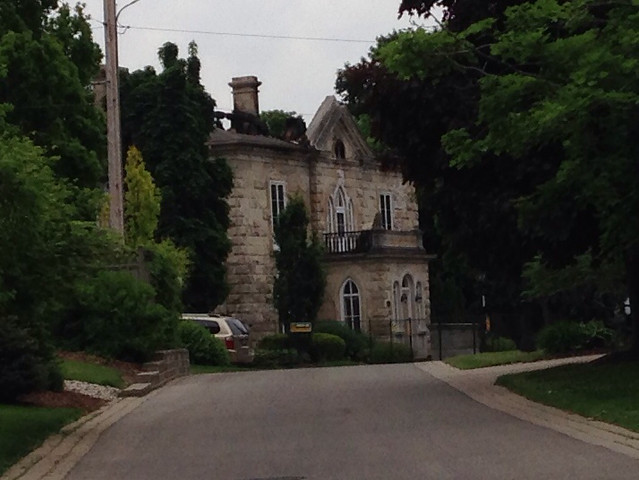
As you can see below, the house is indeed striking. Gordon Couling (1976, v. 16) notes that it was probably designed by Wells and built by noted local mason Matthew Bell. Couling describes it as, "One of the finest stone homes in the city - of major architectural significance," and made from "limestone quarried on the property." Fire damage to the roof over the front gable is clearly evident.


In addition, pictures of the house are available at the Public Library Archive (here also), and the Wellington County Museum and Archives. The Library also has a portrait of Arthur, Georgina, and the family taken at the Grove ca. 1870. (The photo seems to show all eleven of their children and the youngest, Ralph, was born in 1866.) Plus, the Guelph Civic Museum has a photo of the stone barns that also sat on the property. The Wells family lived in style.

The story of Arthur Wells is related in some detail by a descendant, Jane Wells with Kathryn Bassett. Arthur was born and raised in Toronto and went to Upper Canada College. At the age of fifteen, he journeyed to Avignon in the South of France to study civil engineering at the University there. After graduation, he worked on building railway bridges in France and then returned to Canada to work on bridge building for the Grand Trunk Railway.

That work brought Arthur to Guelph where he supervised building of railway bridges at Rockwood and Guelph, at Allan's Dam. He must have liked the place as he settled in the town with Georgina and worked in various capacities, such as Deputy Postmaster, for a number of years. To all appearances, the family were upstanding citizens.

Then, in 1880, (proverbial) lightning struck the household. Arthur ran off with his housekeeper, Martha Glover. Stephen Thorning says that Wells experienced "a serious case of mid-life crisis" (Wellington Advertiser, 23 March 2007) and, indeed, Glover may have been pregnant when the pair left Guelph for Pueblo, Colorado. There, Arthur married Martha and the couple had a family of eight children in the United States.

Wells' Grove and Manor does not feature in any postcards of Guelph that I am aware of. However, the bridge over the Speed nearby at Edinburgh Road had become known as "Wells' bridge" and is labelled as such in the card below. This card was published by Warwick Bro’s & Rutter of Toronto, probably ca. 1905. (On some printings, the bridge is mislabeled as Gow's bridge, which stands further upstream.)


In those days, the Speed River flowed in not one but three channels at Edinburgh Road. Or, to put it another way, there were two large islands in the Speed at that time, requiring three bridges to span the gaps. (See this later aerial photo where the bridges are at the bottom centre.) The bridge in the postcard seems to be the three-span middle bridge, as seen roughly from the west. Look at this photo from 1928 for a similar view. Note that the Spring Bank Brewery, built by Sleeman's in 1900, is not visible in the postcard image, suggesting that it was taken before the turn of the century.

It is not clear how or when exactly Wells' name became associated with the bridge. Although Wells was a bridge builder, there is no mention of his having constructed this span. Also, since Edinburgh road itself was designated by the Canada Company in 1828 (Ross 1998), it seems likely that the structure preceded Wells' arrival in town.

The earliest use of the term "Wells' bridge" that I am aware of is in the 19 April 1869 Mercury, in which it is noted that "Wells' bridge" remained "uninjured" by a spring flood that year. Perhaps the bridge became associated with Wells because he took a special interest in it. For example, on 20 August 1867, he sent a report to the Town Council stating that the span was in a "dangerous condition" and should be open only to foot traffic until it could be repaired. It may be that this report cemented the association between Wells and the bridge in the minds of the townsfolk.

In any event, one certain connection between Arthur Wells and Wells' bridge is matrimonial misadventure, for the bridge was the site of a kidnapping and forced marriage. On 25 July 1877, Miss Annie Mary Carr, a niece of Sheriff Peter Gow, received a letter, apparently from her father stating that he would be in town the next day and asking her to meet him at Wells' bridge (Mercury, 30 July 1877 ff). She complied.

Instead of her father, however, she was met by a carriage with three men who said that they had been sent to pick her up. Unsuspecting, she climbed in and was taken to the corner of Wellington and Gordon streets where the carriage was met by Frederick Sturdy, a local painter and the man with whom she had recently broken off an engagement! He and his daughter Louise pushed her into the back of the carriage and ordered her to be quiet. The carriage proceeded out of town by Victoria road and south to Hamilton, where Miss Carr was confined in a house in a secluded location. Plied with alcohol and threats, Miss Carr agreed to marry Sturdy, the ceremony being quickly performed at the residence of the Rev. D. H. Fletcher, who seems to have suspected nothing.

It seems, though, that Miss Carr was missed and Sturdy suspected. Two constables from Guelph were sent to Hamilton on Saturday to investigate. They located Sturdy's carriage at the American Hotel there. Although Sturdy's whereabouts were not known, he had left instructions to prepare his horses for Sunday afternoon at five o'clock, so the constables decided to wait him out. Sheriff Gow arrived at 4pm and the three of them arrested Sturdy when he turned up. Upon finding out the location of Sturdy's hideout—104 Locomotive St.—Gow drove out and rescued his niece. She was returned to Guelph, and Sturdy and his daughter (and Sturdy's other assistants) were brought there to prison to await trial.

The sensational story was evidently picked up by newspapers around the continent, even as far as the Feliciana Sentinel of St. Francisville, Louisiana (25 August 1877). The Mercury described the abduction and forced marriage as "one of the blackest crimes ever committed in Guelph" and a deed that,

... would make the blood of all respectable citizens boil over with righteous indignation, and at the same time ask the question, "Can such an outrage have been committed in a civilized community?"
Despite the infamy of the abduction, it is not recalled in later histories of the town, much like Wells' flight to Colorado with his housekeeper. Perhaps both were tales too painful to repeat.

In any event, Wells' bridge remained in continuous use for 100 years or more. By the 1950s, however, the City of Guelph and the Grand River Conservation Authority had decided on some major alternations to the Speed River downtown. The City wanted to widen the bridge at Edinburgh Road to increase the flow of cars. This improvement to Edinburgh would also help with plans for a major new road along the riverfront ("Memorial Parkway", now Wellington Road). The Conservation Authority sought likewise to increase the flow of water in the Speed and thus reduce the perennial risk of flood along its banks.

In 1957, contractors dredged out the middle channel of the Speed, widening and straightening it like a highway. The overburden was used to fill in the north and south channels of the river, where Wellington Road and the Royal Recreation Trails now lie (Mercury, 23 Feb. 1956; 18 July 1957). Mostly likely, the rubble from Wells' bridge lies buried there too, along with whatever other tales it might have had to tell.